Archive
06/18/2020 – Ephemeris – Finding the constellation Hercules
This is Ephemeris for Thursday, June 18th. Today the Sun will be up for 15 hours and 34 minutes, setting at 9:31, and it will rise tomorrow at 5:56. The Moon, 3 days before new, will rise at 4:48 tomorrow morning.
Orion, the hard luck mythological Greek hunter gets a splashy constellation in the winter sky, but the greatest hero of all, Hercules, gets a dim group of stars on the border between the spring and summer stars. At 11 p.m. Hercules is very high in the east-southeast. It is located above and right of the bright star, Vega in the east. Hercules’ central feature is a box shaped of star wider at the top than the bottom, called the Keystone, which represents the old boy’s shorts. From each top corner extend lines of stars that are his legs, from the bottom stars, the rest of his torso and arms extend. So in one final indignity he’s upside down in our sky. Some see him crouched down, club upraised holding the Hydra about to throttle it. For those with a telescope it contains the beautiful globular star cluster M13.
The event times given are for the Traverse City/Interlochen area of Michigan. They may be different for your location.
Addendum
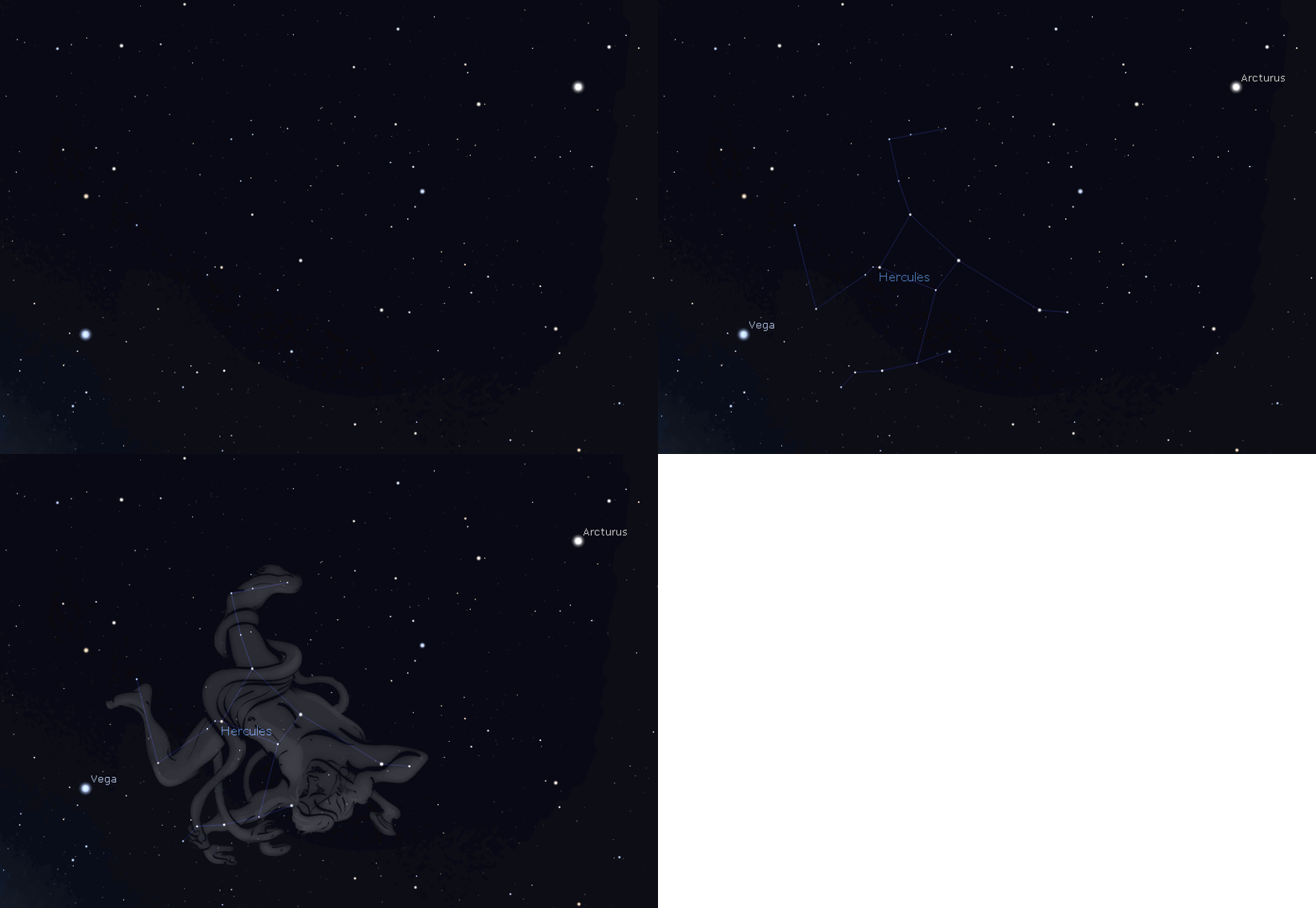
Hercules animation showing neighboring stars at 11 p.m. for mid June, Click on image to enlarge. Created using Stellarium.
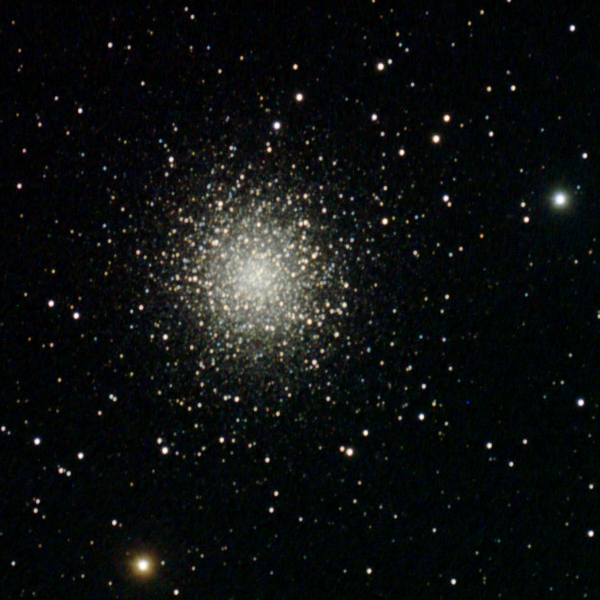
M13, the Great Globular Star Cluster in Hercules. Credit: Scott Anttila
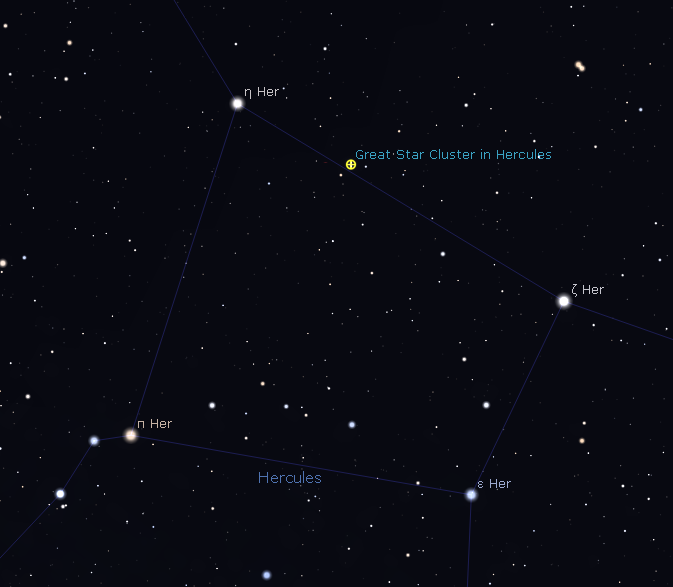
Stars and M13 (Great Star Cluster in Hercules) visible in binoculars in the Keystone of Hercules. Click in the image to enlarge. Created using Stellarium.
06/16/2020 – Ephemeris – One circlet of stars, two constellations: old world and new world
This is Ephemeris for Tuesday, June 16th. Today the Sun will be up for 15 hours and 34 minutes, setting at 9:30, and it will rise tomorrow at 5:56. The Moon, 3 days past last quarter, will rise at 3:52 tomorrow morning.
High in the south-southeast at 11 this evening can be seen a small nearly circular constellation of Corona Borealis, the Northern Crown. It is just below Boötes, the kite shaped constellation off the handle of the Big Dipper. According to Greek myth the crown was given by the gods to the princess Ariadne, daughter of King Minos of Crete. The crown is more like a tiara with the bright star Alphecca at the front. To the Anishinaabe people, who are natives of our region it is the Sweat Lodge. Part of what we call Hercules next to it is the Exhausted Bather, who is lying on the ground after the ceremony. The seven stones that are heated for the Sweat Lodge are the Pleiades, now too close to the Sun to be seen.
The event times given are for the Traverse City/Interlochen area of Michigan. They may be different for your location.
Addendum

Animated Corona Borealis/Sweat Lodge Finder Chart looking to the south-southeast at 11 p.m. June 16th. Click on the image to enlarge Created using Stellarium and GIMP.
06/12/2020 – Ephemeris – The Summer Triangle proclaims that summer is almost here
This is Bob Moler with Ephemeris for Friday, June 12th. Today the Sun will be up for 15 hours and 32 minutes, setting at 9:29, and it will rise tomorrow at 5:56. The Moon, 1 day before last quarter, will rise at 2:27 tomorrow morning.
Summer skies are coming. It’s only 8 days until summer officially arrives. It is a calendar day early this year because of the extra day added in February for the leap year. Looking to the eastern sky at 11 pm are three bright stars in a large triangle. The top star Vega is about half way up the sky to the zenith, and the brightest of the three. It’s in the small constellation of Lyra the harp. Lowest of the stars and just about due east is Altair in Aquila the eagle. Completing the triangle is Deneb in the northeast in the tail of Cygnus the swan or the head of the horizontal Northern Cross. These three stars make up the Summer Triangle. Be that as it may, the Summer Triangle will be in our evening sky moving slowly westward until December.
The event times given are for the Traverse City/Interlochen area of Michigan. They may be different for your location.
Addendum
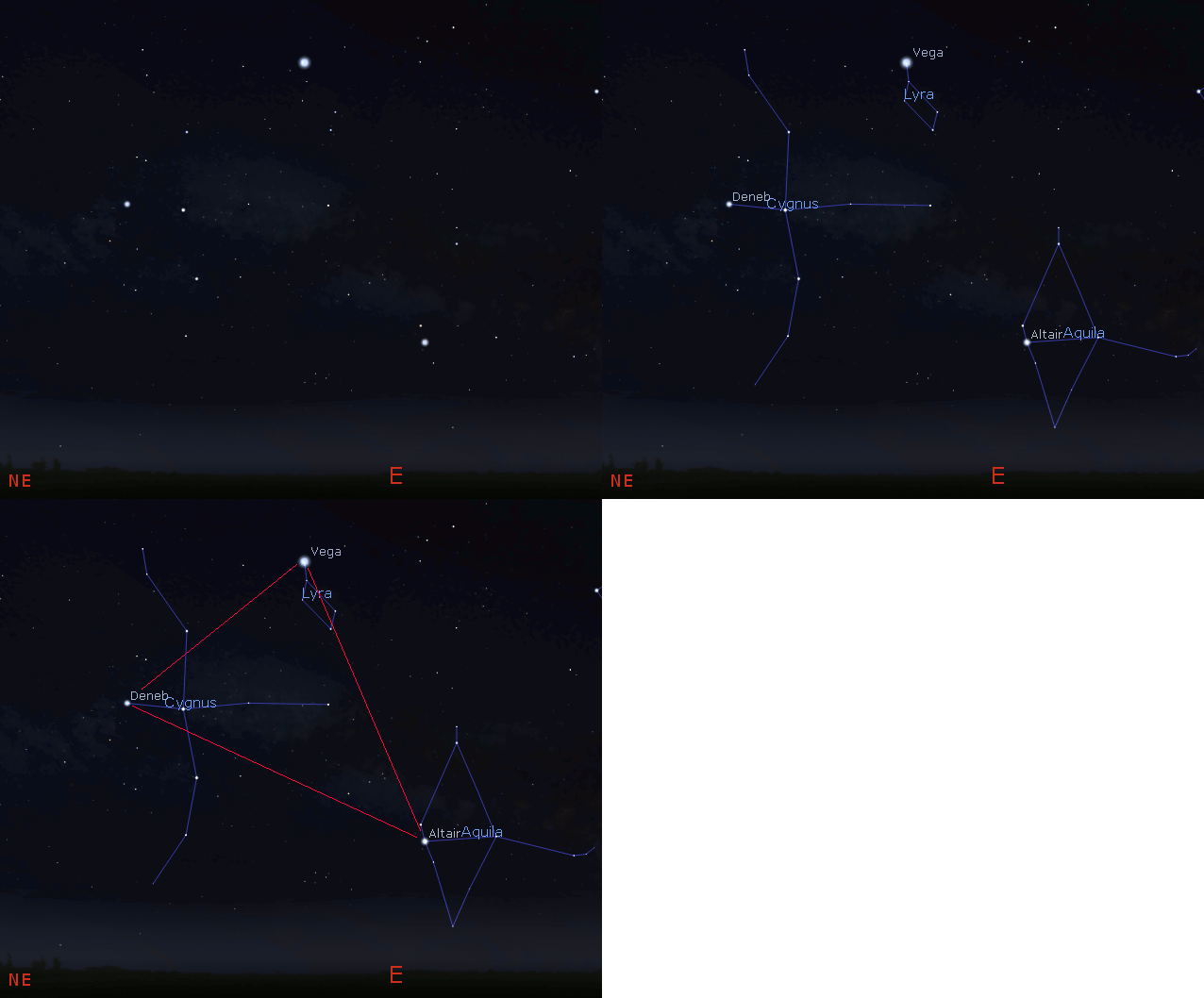
Finder animation for the Summer Triangle, seen in red for 11 pm, June 12th. Created using Stellarium and GIMP.
06/09/2020 – Ephemeris – The constellation of the crow and a star often mistaken for a UFO
This is Ephemeris for Tuesday, June 9th. Today the Sun will be up for 15 hours and 30 minutes, setting at 9:27, and it will rise tomorrow at 5:56. The Moon, half way from full to last quarter, will rise at 1:06 tomorrow morning.
I don’t want spring to get away from us without pointing out a small but distinctive constellation now low in the southwest at 11 pm called Corvus the crow that to me looks like an odd shaped box. Wider at the bottom than the top and left side taller than the right. It’s supposed to be a crow in flight diagonally to the upper right. I find it easy to find by that odd shaped box. Also at 11 pm, the summer constellation of Scorpius the scorpion is rising with its bright red star Antares twinkling madly. This red giant star stays low in the southern sky, so we always, here in Michigan, see it through lots of atmosphere whose turbulence accentuates its twinkling. I call it my UFO star. It’s a riot in binoculars or a telescope.
The event times given are for the Traverse City/Interlochen area of Michigan. They may be different for your location.
Addendum
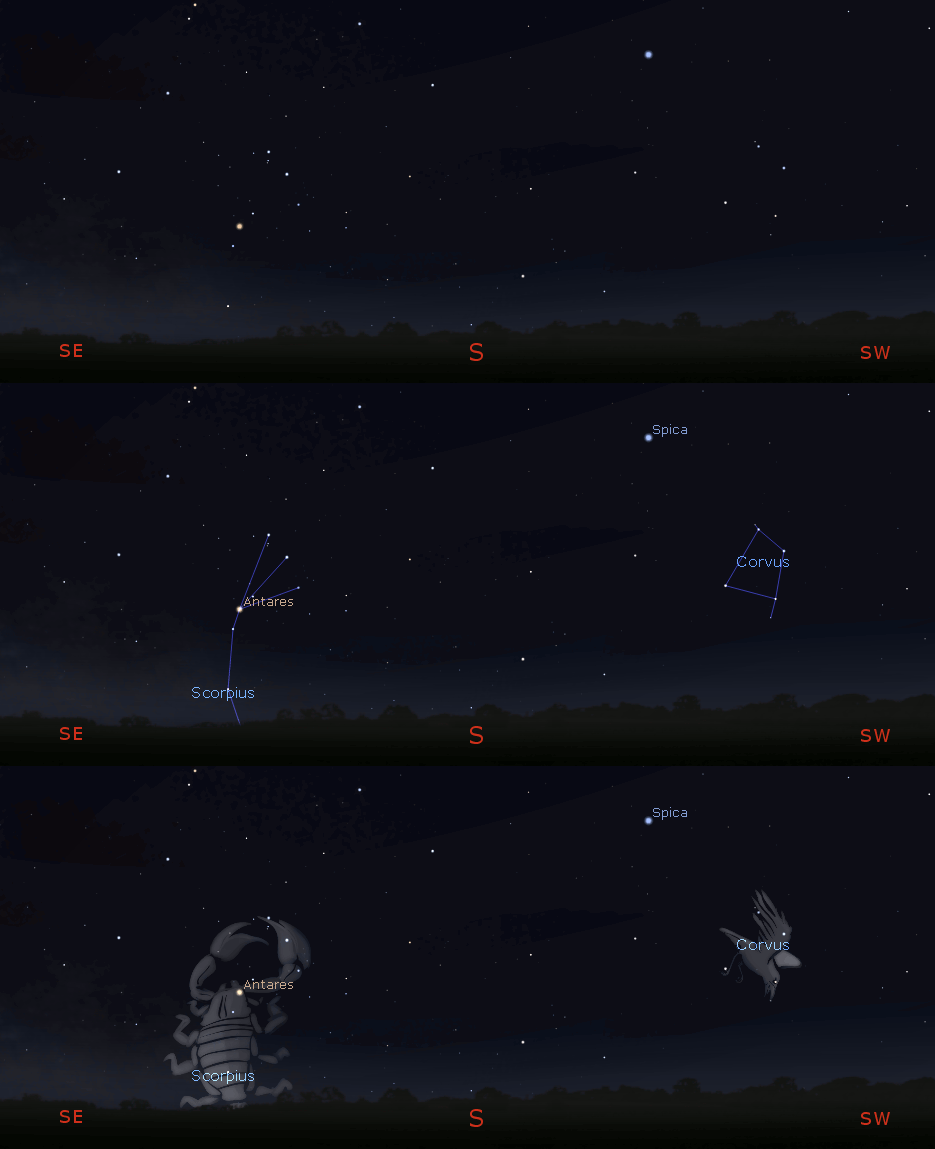
Corvus the crow and Antares the star in Scorpius at 11 pm tonight, June 9, 2020. Created using Stellarium and its embedded art. This is not how I see either constellation. Everyone gets to use their own imagination. Mine doesn’t agree with either image, but I’m not artistic enough to show how I imagine them. Though for Corvus I just see the distinctive box. Click on the image to enlarge it.
05/21/2020 – Ephemeris – A star cluster in a most unusual spot
This is Ephemeris for Thursday, May 21st. Today the Sun will be up for 15 hours and 3 minutes, setting at 9:11, and it will rise tomorrow at 6:07. The Moon, 1 day before new, will rise at 6:16 tomorrow morning.
High in the south at 10:30 p.m. or so is a tiny and faint constellation of Coma Berenices, or Berenice’s hair. In it are lots of faint stars arrayed to look like several strands of hair. The whole group will fit in the field of a pair of binoculars, which will also show many more stars. The hank of hair supposed belonged to Berenice II, Queen of Egypt, in the 3rd century BCE. Coma Berenices is the second closest star cluster to us at only 250 light years away, after the Hyades, the face of Taurus the bull a winter constellation. It’s in an odd spot for a galactic star cluster, which are supposed to lie in the plane of the Milky Way. It’s actually seen at the galactic pole, as far as possible away from the milky band. It’s a matter of perspective because it’s so close to us. It’s still really in the plane of the Milky Way.
The event times given are for the Traverse City/Interlochen area of Michigan. They may be different for your location.
Addendum
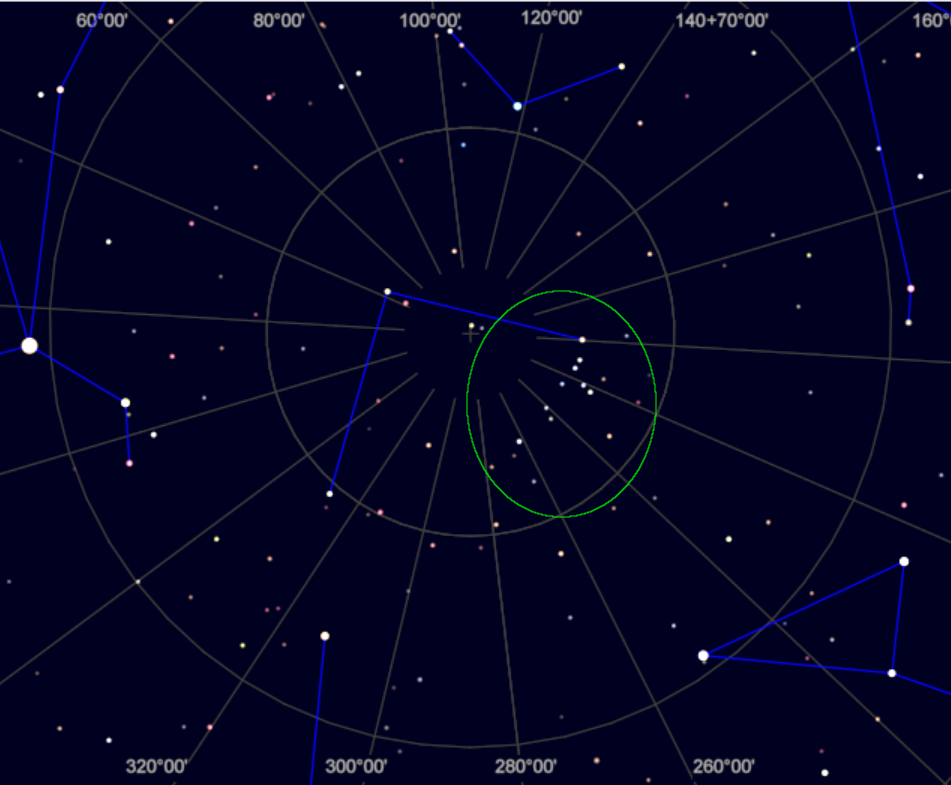
Coma Berenices and galactic coordinated showing how close to the galactic pole it is. The bright star Arcturus at the left edge. Leo’s hind end is at the lower right. Created using Cartes du Ciel (Sky Charts).
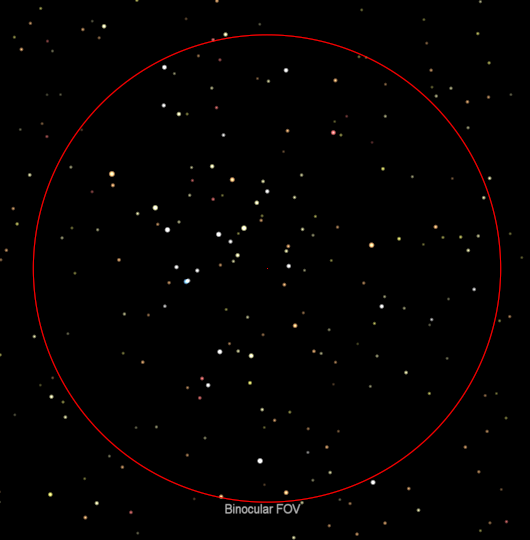
Approximate 7 power binocular field of view of the Coma Berenices Star Cluster. Created using Cartes du Ciel (Sky Charts).
Note: There is another cluster in the constellation. It’s called the Coma Cluster. It’s a cluster of over a thousand galaxies a bit over 300 million light years away.
05/15/2020 – Ephemeris – Virgo and its cluster of galaxies
This is Ephemeris for Friday, May 15th. Today the Sun will be up for 14 hours and 50 minutes, setting at 9:04, and it will rise tomorrow at 6:12. The Moon, 1 day past last quarter, will rise at 4:01 tomorrow morning.
One of the large constellations we see in the south at 11 p.m. can be found using the Big Dipper overhead, follow the arc of the handle to the bright star Arcturus, the straighten the arc to a spike to reach Spica, a bright blue-white star in the south. Spica is the brightest star in the constellation Virgo the virgin. She represents the goddess of the harvest, Virgo is holding a sheaf of wheat in depictions of her, and Spica is placed at the head of the sheaf. In the space between Spica and Leo the lion to her upper right is, a great cluster of thousands of galaxies just below naked eye visibility. The Virgo Cluster. Inside that cluster is galaxy M87 in whose center lies a black hole with the mass of 6.5 billion suns that was imaged last year. The center of the cluster is at about 54 million light years away.
The event times given are for the Traverse City/Interlochen area of Michigan. They may be different for your location.
Addendum
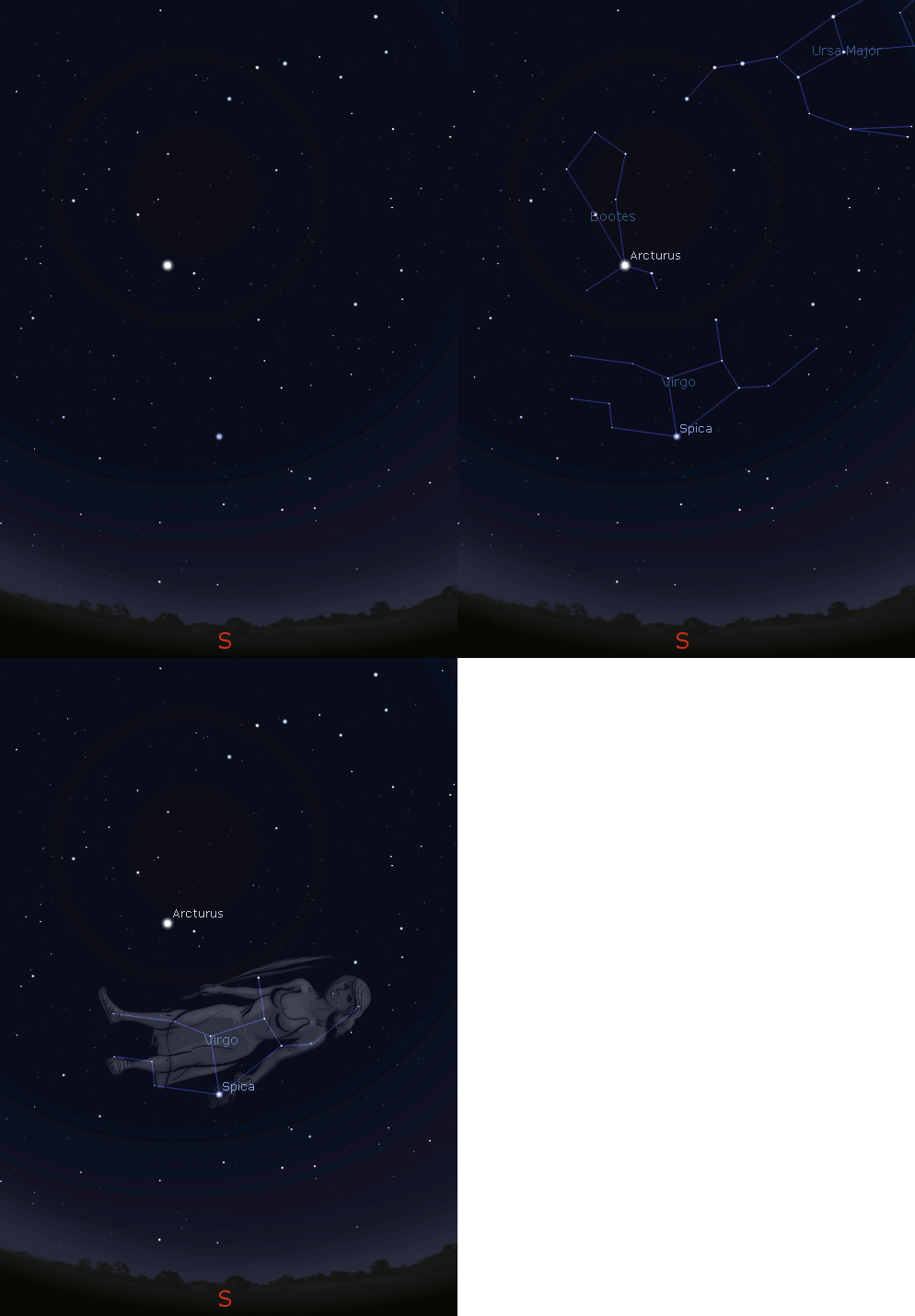
Spica finder animation . Click on the image to enlarge. Created using Stellarium and GIMP.
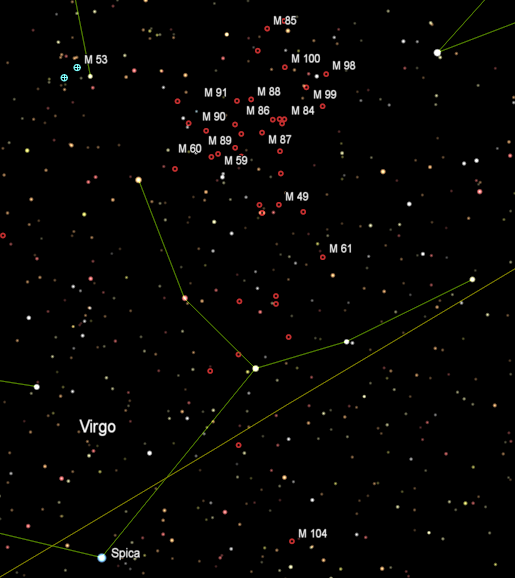
Some of the brighter members of the Virgo Cluster (of galaxies) as red ovals. The galaxies marked with an ‘M’ number are part of Charles Messier’s catalog. It took a telescope of 8 inch diameter for me to spot them. Someone with better vision, like Messier himself can spot them with a smaller telescope. M53 and the object next to it are globular star clusters in the outer reaches of our galaxy. Created using Cartes du Ciel (Sky Charts).
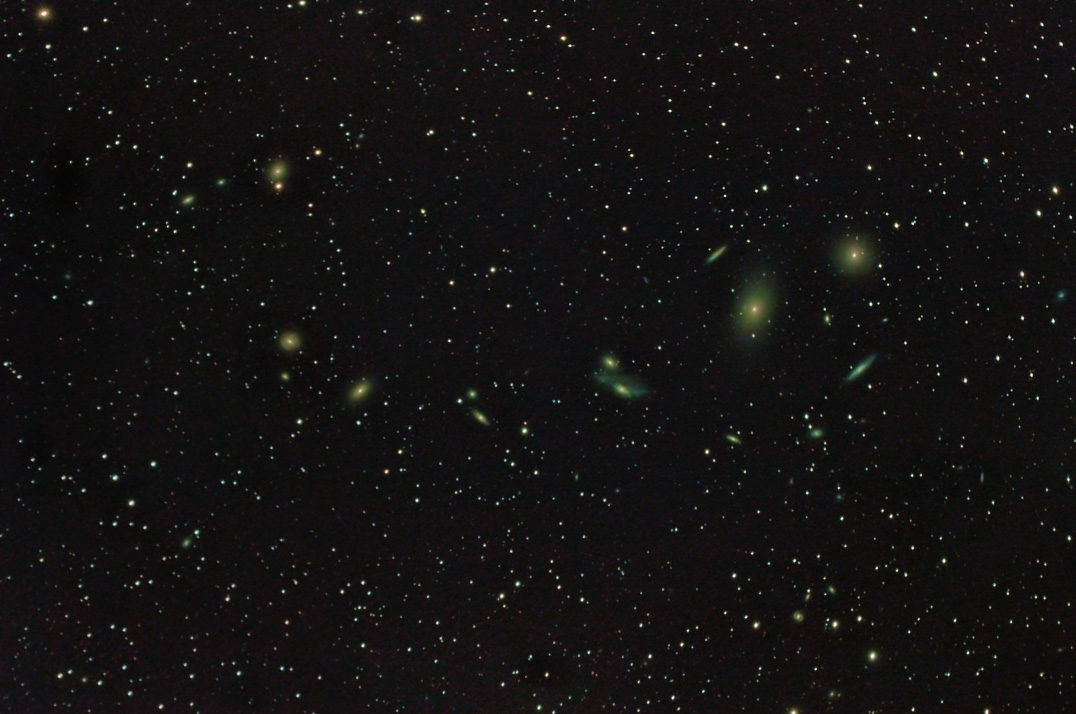
Markarian Chain of galaxies within the Virgo Cluster by Scott Anttila.

The first image of the black hole in M87. Credit Event Horizon Telescope.
05/14/2020 – Ephemeris – Finding the zodiacal constellation of Virgo
This is Ephemeris for Thursday, May 14th. Today the Sun will be up for 14 hours and 48 minutes, setting at 9:03, and it will rise tomorrow at 6:14. The Moon, at last quarter today, will rise at 3:36 tomorrow morning.
Tonight at 11 p.m. in the south is the constellation and member of the of the zodiac: Virgo the virgin. Virgo is a large constellation of a reclining woman holding a stalk of wheat. Spica, is the head of that spike of wheat; and as such it ruled over the harvest in two of Virgo’s guises as the goddesses Persephone and Ceres. Virgo is also identified as Astraea the goddess of justice. The constellation of Libra, the scales, which she is associated with, is found just east of her low in the southeast. Early Christians who sought to de-paganize the heavens saw Virgo as the Virgin Mary. Virgo is the host to a great cluster of galaxies seen far beyond its stars. Tomorrow morning Mars will appear just above the Moon for very early risers.
The event times given are for the Traverse City/Interlochen area of Michigan. They may be different for your location.
Addendum
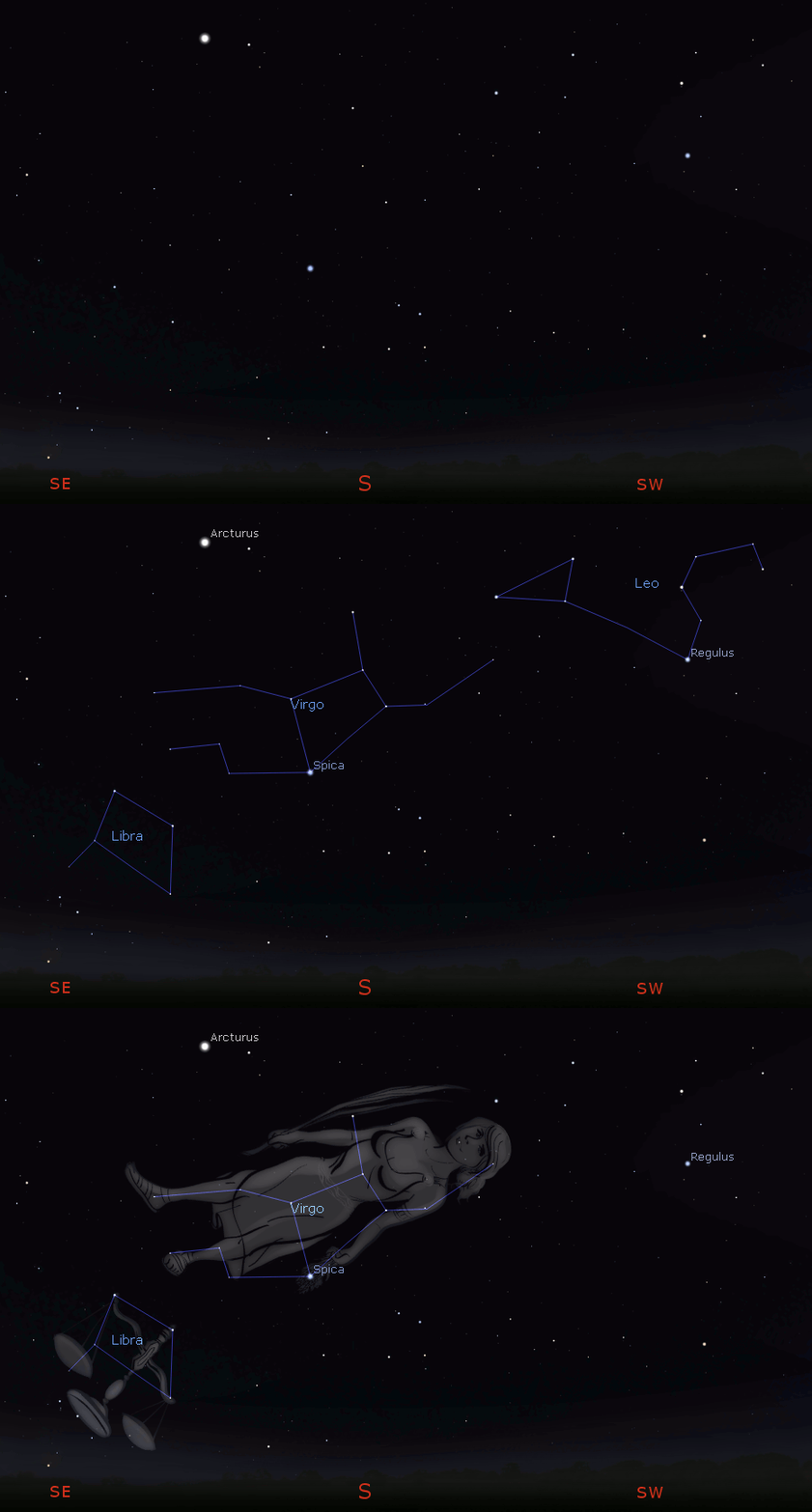
Virgo finder animation with Leo added as an aid for 11 p.m. tonight May 14th. Click on image to enlarge. Created using Stellarium and GIMP.
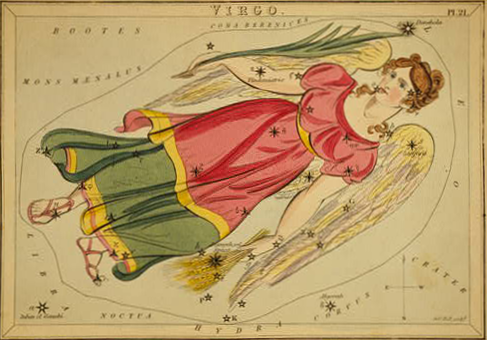
Virgo as depicted in Urania’s Mirror, a set of constellation cards published in London c.1825. From the Library of Congress. Hat tip Wikipedia.
05/12/2020 – Ephemeris – Hydra the water snake slithers along the southern horizon
This is Ephemeris for Tuesday, May 12th. Today the Sun will be up for 14 hours and 44 minutes, setting at 9:01, and it will rise tomorrow at 6:16. The Moon, 2 days before last quarter, will rise at 2:33 tomorrow morning.
Low in the south and southwestern sky at 10 p.m. and later can be found the constellation of Hydra the water snake. Unlike the monster of the same name this Hydra has but one head, which is its most distinctive part. At 11 p.m. the head of Hydra is located between the bright stars Procyon in the west southwest and Regulus in Leo the lion in the southwest. Hydra’s head is a small but distinctive group of 6 stars that make a drooping loop to the right. The rest of Hydra wends its way diagonally to near the southern horizon below the bright blue star Spica in Virgo. Some delineations of Hydra have the tail tickling the constellation Libra which has just risen in the southeast.
The event times given are for the Traverse City/Interlochen area of Michigan. They may be different for your location.
Addendum
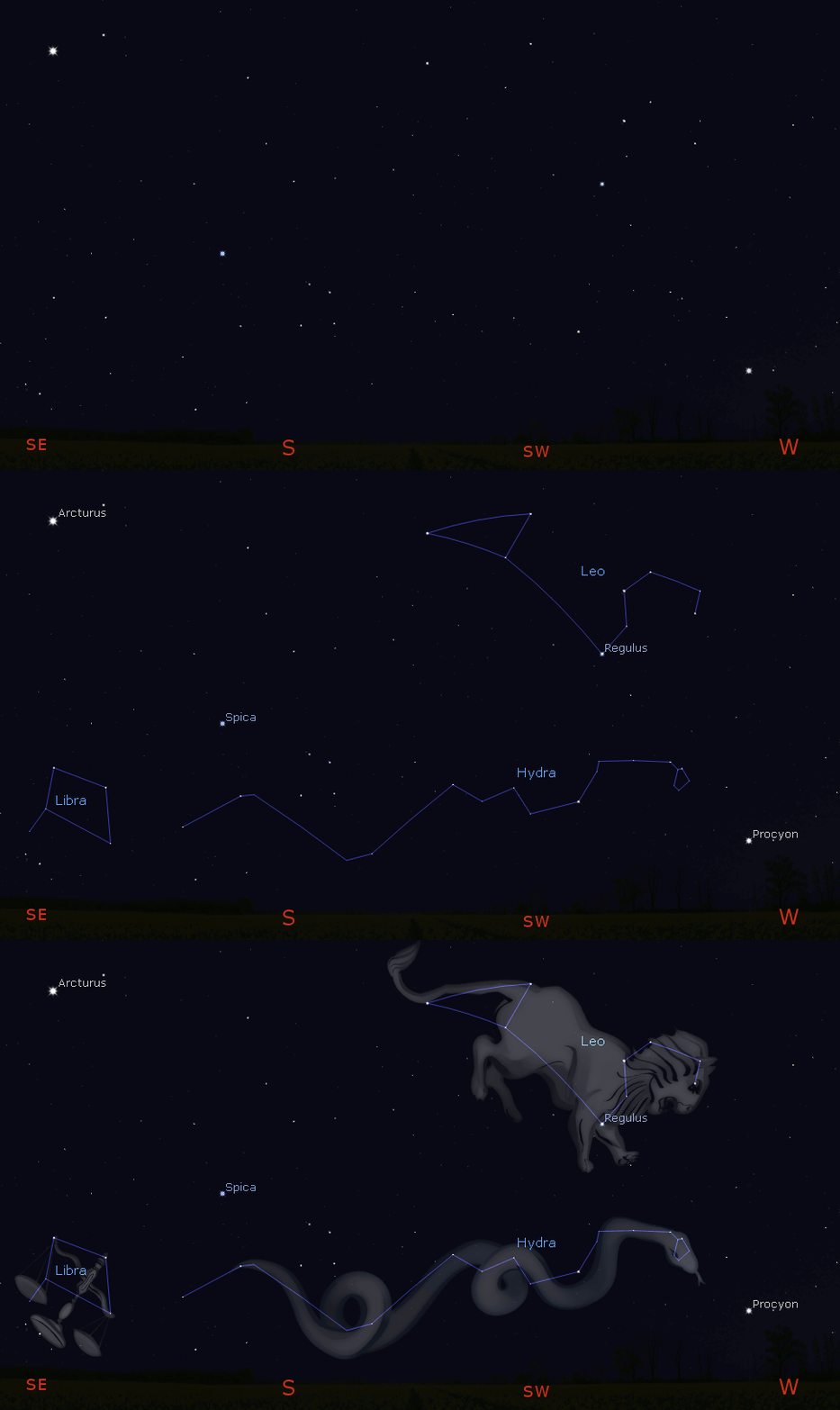
Hydra finder animation for tonight, May 12, 2020. Hydra is the longest constellation. Click on the image to enlarge. Created using Stellarium.
04/24/2020 – Ephemeris – The Big Dipper can be used to point to other stars and constellations
This is Bob Moler with Ephemeris for Arbor Day, Friday, April 24th. Today the Sun will be up for 13 hours and 57 minutes, setting at 8:39, and it will rise tomorrow at 6:41. The Moon, 2 days past new, will set at 10:21 this evening.
The Big Dipper can be used to point to other stars and constellations. Right now the Big Dipper is nearly overhead. The front bowl stars point to Polaris, the North Star which never seems to move in the sky. The handle can be used to find two stars. First follow the arc of the handle away from the bowl to find the fourth brightest night-time star Arcturus in the base of the kite shaped constellation of Boötes. Straighten the arc to a spike and continue to the south and you will come to the bright blue-white star Spica in Virgo the virgin. You can remember these stars with the phrase “Follow the arc of the handle to Arcturus and then spike to Spica” or if you prefer the alternate pronunciation of the latter star “Speak to Speeka”.
The event times given are for the Traverse City/Interlochen area of Michigan. They may be different for your location.
Addendum
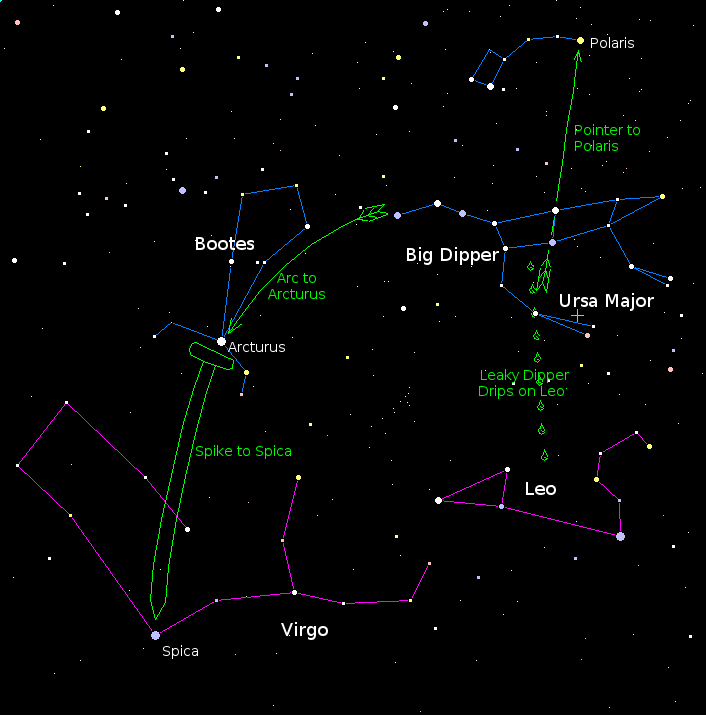
Finding stars and constellations using the Big Dipper. Click on the image to enlarge. Created using my LookingUp program for Windows.
04/20/2020 – Ephemeris – The Little King Star
This is Ephemeris for Monday, April 20th. Today the Sun will be up for 13 hours and 45 minutes, setting at 8:34, and it will rise tomorrow at 6:47. The Moon, 2 days before new, will rise at 6:37 tomorrow morning.
The brightest star in the constellation Leo, which is high in the south these evenings is Regulus, whose name means “Little King”. It is appropriate due to its position in the heart of the king of beasts Leo the lion. Regulus is dead last in brightness of the 21 first magnitude stars, the brightest night-time stars. Even so, it is much brighter than the Sun. It is 79 light years away. The Sun would require a telescope to be spotted at that distance. Regulus appears to be a quadruple star system. The bright star itself is really two stars with a bright star orbited by a much dimmer star every 40 days. There are two dimmer stars much further out that share Regulus’ motion through space. There are an infinite variety of star system arrangements in the galaxy and beyond.
The event times given are for the Traverse City/Interlochen area of Michigan. They may be different for your location.
Addendum
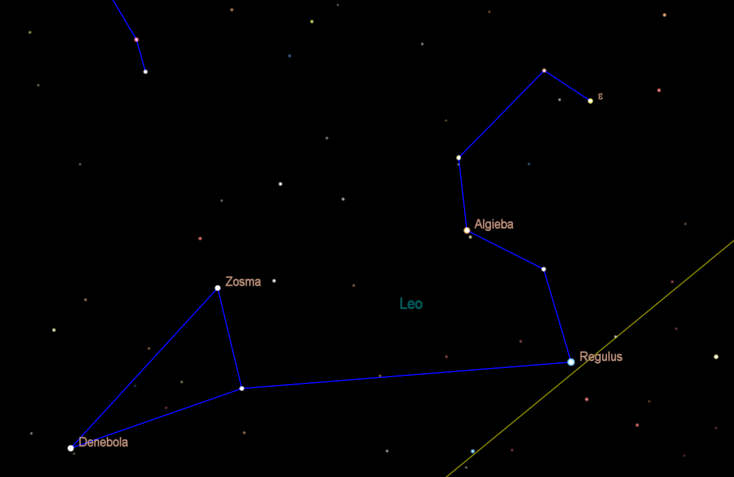
The naked eye stars of Leo, including Regulus at 9:30 p.m. April 20, 2020. Note that Algieba is a binary star that can be seen in small telescopes. The yellow line that passes Regulus is the ecliptic the apparent path of the Sun. The Moon and planets also hang out near that line. Created using Cartes du Ciel (Sky Charts).
 Bob Moler's Ephemeris Blog