Archive
03/10/2016 – Ephemeris – The many faces of the Big Dipper and Ursa Major
Ephemeris for Thursday, March 10th. The Sun will rise at 7:03. It’ll be up for 11 hours and 39 minutes, setting at 6:43. The Moon, 2 days past new, will set at 8:59 this evening.
The Big Dipper has many names to many peoples and countries around the world, from the plough, Charles’ Wain, and many others. Officially to the International Astronomical Union, it’s part of Ursa Major, the Great Bear, also recognized by Native Americans, Europeans, it’s even in the Bible. In the Book of Job the star Arcturus is a miss-translation. Arcturus means Guardian of the Bear. It should be Bear itself, and most modern translations catch that mistake. Anyway, the Anishinaabe people around the Great Lakes say the stars of the bear are that of another creature, that of Fisher Star one small weasel-like mammal that brought summer to the Earth, and now heralds the seasons of spring and autumn by his position in the sky.
Times are for the Traverse City/Interlochen area of Michigan. They may be different for your location.
Addendum
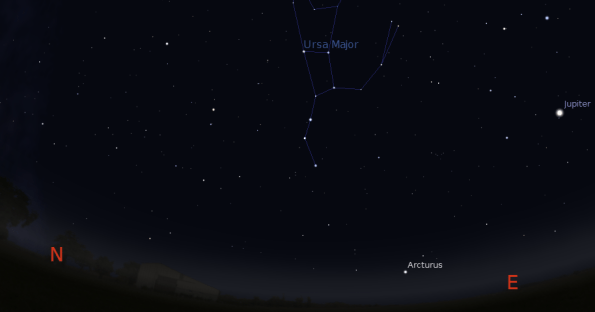
Ursa Major in the northeastern sky at 9 p.m., March 10, 2016. Created using Stellarium.
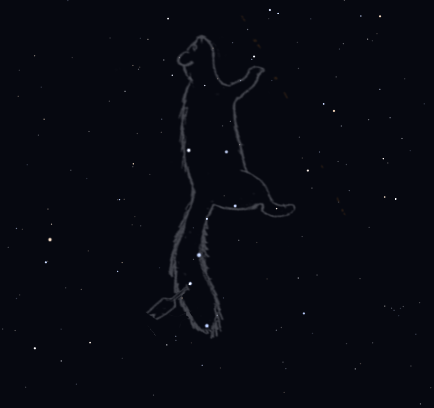
Fisher Star. Star field created by Stellarium.
02/28/2016 – Ephemeris Extra – The years of our lives
The continuing story of a small planet revolving around its star
Updated from the originally published in the January 1997 Stellar Sentinel, the monthly newsletter of the Grand Traverse Astronomical Society and republished in the February 2016 edition.
This year, 2016, is a leap year. In leap years we have the US presidential elections, the Summer Olympic Games, and February has 29 days. So what exactly is a leap year, and why am I writing about this earthly phenomenon in an astronomical society newsletter? Well it’s astronomical of course. And if you think a year is a year is a year, well think again.
The calendar we use today is based on the Sun. In ancient times the calendars of the Babylonians, Jews and many other ancient civilizations were based on the Moon, using the lunation, the period of about 29.5 days between new moons, as the basis for the calendar. Lunar calendars tended to have months alternating 29 and 30 days, and years of 12 or 13 months to keep the whole scheme roughly in sync with the seasonal year. There are vestiges of this system today in the various folklore of planting by the Moon.
The ancient Egyptians actually used two calendars. The first was one based close to the sun and had 365 days. It had 12 months of 30 days, each containing three 10 day decans. There were 5 days at the end of the year that were holidays, and belonged to no month. This civil calendar was used for state and accounting purposes. The agricultural calendar was based on the Moon. These two calendars were reconciled every 25 civil years which equaled 209 lunations, divided into 16 ordinary 12 month years, and 9 ‘great’ years of 13 months. Still, since the Egyptian civil year is nearly a quarter of a day a year short, the civil calendar shifted slowly in relation to the seasons. The Egyptian agricultural year started with the flooding of the Nile, which in those days was coincident with the heliacal rising of the brightest night time star Sirius, which they called Sothis. A heliacal rising is when a star or planet is first visible in the morning twilight. This heliacal rising occurs at a mean interval of 365.2507 days. Thus the Egyptian civil calendar would be in sync with the agricultural year every 1460 years, a period called the Sothic Cycle.
The ancient Greek calendars were lunar ones. Early on, each locality had their own calendar. Starting in the 6th century BC the calendar situation got better when a cycle synchronizing lunar calendars with the sun was discovered. It is the Metonic Cycle, probably discovered in Babylon. Here 19 years of 365.25 days equal almost exactly 235 lunations. That’s 12 ordinary 12 month years and 7 ‘great’ years of 13 months. We find remnants of the Metonic Cycle with the Golden Number for the year given in almanacs, a number ranging from 1 to 19. This year’s Golden Number is 3. The year 1 BC was 1. Under the old Julian calendar it was use to help determine the date of Easter.
The Julian Calendar is named for Julius Caesar who instituted it as a part of calendar reform he instituted in 46 BC. The old Roman calendar was a lunar one, but in the earlier years of Julius Caesar’s reign the adjustments, called intercalations, such as 13th months in some years to keep the calendar roughly attuned to the sun, were neglected. To straighten all this our, the year 46 BC was made 445 days long. Starting in 45 BC the new calendar was instituted using the year of length 365.25 days. Each 4 years an intercalary day was added. This was February 29th, giving a 366 day year. This we call a leap year. Year 45 BC was a leap year, but due to some misunderstanding about the calendar reform, the one leap year in every four, was not kept. In fact too many leap years were added, so in Caesar Augustus’ reign leap years from 8 BC to AD 8 were omitted to get back on track.
The western world ended up adopting the Julian calendar, and it was humming along just fine with leap years every 4 years. However the Catholic Church and Pope Gregory XIII became alarmed that Easter was in danger of no longer being a spring feast. The early church, adopted the Julian calendar rather than the Jewish lunar calendar. But the most important feasts, the Crucifixion and Easter were tied to the Jewish feast of Passover, a spring feast starting in the middle of the month at full moon time. Part of the problem was that the Vernal Equinox for ecclesiastical purposes was assumed to fall on March 21st, whether it actually did or not. The first Sunday after the first full moon was Easter.
The problem is that the seasonal or tropical year is 11 minutes and 14 seconds shorter than the Julian year of 365.25 days. In 400 years this amounts to about 3 days error. So the easy correction is to eliminate 3 leap years out of 400 years. The formula is simple. All years divisible by 4 are leap years except century years which are not also divisible by 400. Thus the year 1900 was not a leap year, but 2000 was, and 2100 will not be.
The other part of the reform was harder to swallow. It was the elimination of 10 days because the real Vernal Equinox was by the 16th century falling on March 11th. The Church was able to have this adopted in Catholic countries right away, so in the calendar of 1582 ten days were omitted between October 4th and 15th. Protestant countries generally followed suit later. England and the American Colonies converted to this new Gregorian Calendar in 1752 when by then 11 days were omitted between September 2nd and 14th. The last to convert to the Gregorian Calendar was Greece and Orthodox Christianity who also made further improvements for the future.
I had once investigated how Microsoft Excel spreadsheets store dates. It’s stored as a consecutive date starting with date 1 on January 1, 1900. I had to convert dates downloaded from an IBM AS400 computer into a format compatible with Excel. The dates came one day off. It turns out that Microsoft or whoever devised the Excel dating scheme forgot that the year 1900 was not a leap year in the Gregorian calendar. For my astronomical research I use dates both far in the past I use dating algorithms that use the Julian and Gregorian calendars where appropriate and takes into account the Gregorian discontinuity of 1582 into account. These algorithms convert calendar dates to another type of consecutive day scheme called Julian Day Numbers of Julian dates for short, and back again. In astronomy we see cycles of planetary orbits, variable star periods, etc. They don’t fit into our hodgepodge of different month and year lengths. We just want to know how many days between event A and event B. Julian dates work for us. The Julian dates start on January 1, 4713 of the Julian calendar, which predates any known historical date. Oh by the way: Julian dates start at noon Universal Time (UT) or Greenwich Mean Time (GMT), and fractional days are decimal.
I didn’t even touch when the year begins. In Great Britain when the 1752 reforms took place they also changed the start of the year from March 25th to January 1st.
Bibliography
- The Exact Sciences in Antiquity by O. Neugbauer. Dover Publications
- Explanatory Supplement to the Ephemeris H.M. Nautical Almanac Office
02/26/2016 – Ephemeris – The lion roars into the evening sky
Ephemeris for Friday, February 26th. The Sun will rise at 7:26. It’ll be up for 10 hours and 59 minutes, setting at 6:25. The Moon, half way from full to last quarter, will rise at 10:27 this evening.
Besides the advancing sunset times, there is another sign that spring is coming. That’s the appearance of the constellation Leo the lion rising in the east in the evening. The front of this beast is a backward question mark of stars with the bright star Regulus as the dot at the bottom. That’s his head, mane and chest. His haunches are a triangle of stars to the lower left, the last star is in the east above brilliant planet Jupiter. just clearing the horizon at 9 p.m. One way to find Leo is to remember that cat’s aren’t supposed to like water, though mine have always had a certain fascination with the toilet. Find the Big Dipper standing on its handle and imagine drilling a hole in the bottom of the bowl. The water, falling from the north, will fall on Leo’s back.
Times are for the Traverse City/Interlochen area of Michigan. They may be different for your location.
Addendum
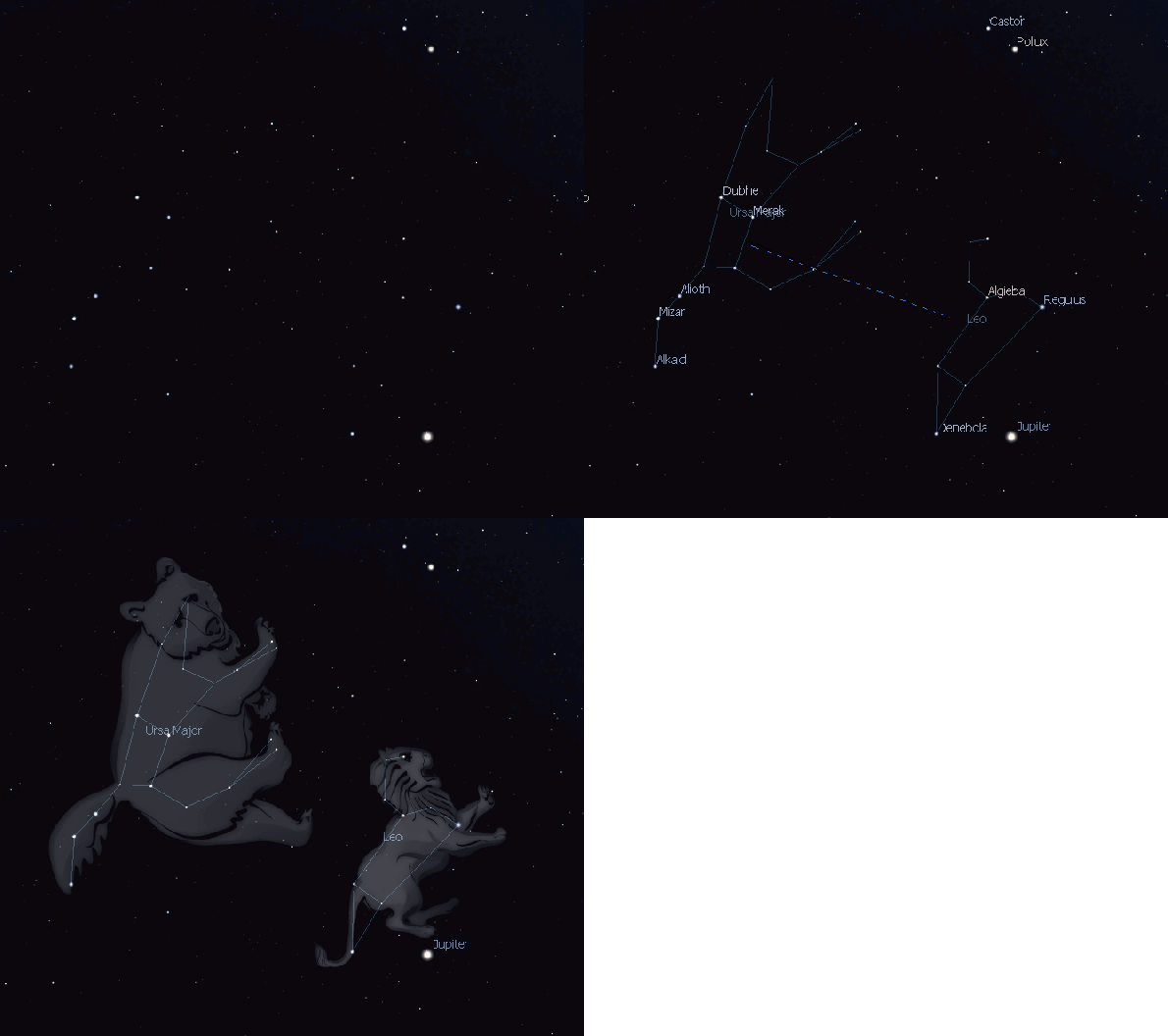
How to find Leo with Jupiter and the Big Dipper. At 10 p.m. on February 26, 2016. Created using Stellarium and GIMP.
02/25/2016 – Ephemeris – The Crab and the Beehive
Ephemeris for Thursday, February 25th. The Sun will rise at 7:27. It’ll be up for 10 hours and 56 minutes, setting at 6:24. The Moon, 3 days past full, will rise at 9:29 this evening.
At 9 this evening, the faint constellation, and member of the Zodiac, Cancer the crab will be located in the southeastern sky half way between the bright stars Castor and Pollux of the constellation Gemini, high in the south and the bright star Regulus in Leo the lion and Jupiter in the east. Cancer is very dim, looking like an upside-down Y. In the center of Cancer is a fuzzy spot to the unaided eye. In binoculars or a low power telescope this fuzzy spot becomes a cluster of stars. It is Messier 44 or the Beehive star cluster. At 577 light years away, it is one of the closest star clusters, but more distant than the Pleiades and Hyades the face of Taurus the bull. Of the three the Pleiades is the youngest at 100 million years. The Beehive is 7 times older.
Times are for the Traverse City/Interlochen area of Michigan. They may be different for your location.
Addendum
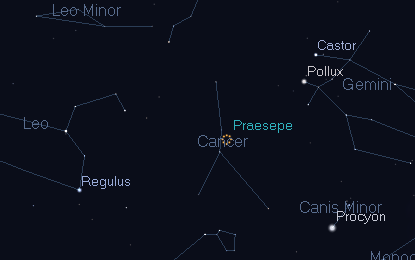
Cancer Finder Chart. Created using Stellarium.
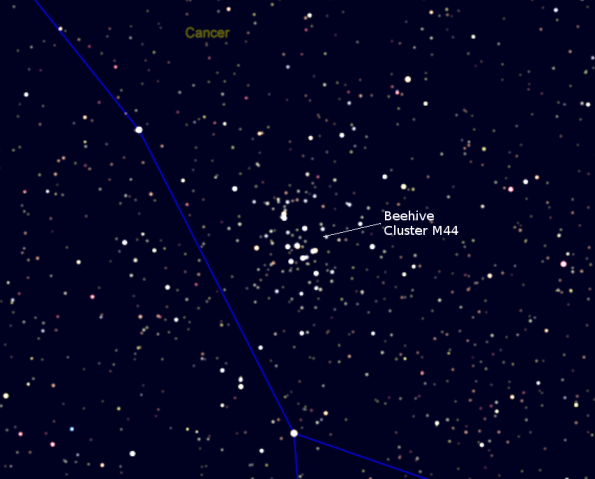
The Beehive star cluster, M44, a great binocular object. Its ancient name was the Praesepe or manger when glimpsed by the naked eye as a fuzzy spot. Created using Cartes du Ciel (Sky Charts)
02/24/2016 – Ephemeris – The planets are all hanging out in the morning for another 2 weeks
Ephemeris for Wednesday, February 24th. The Sun will rise at 7:29. It’ll be up for 10 hours and 53 minutes, setting at 6:23. The Moon, 2 days past full, will rise at 8:31 this evening.
Let’s check out the whereabouts of the bright naked eye planets. All the classical planets visible from antiquity are officially now in the morning sky. Though Mercury is too close to the Sun to be spotted. Jupiter will rise at 7:25 p.m., in the east. Jupiter is still a morning planet since it’s not up at sunset. It’s among the stars of Leo. Mars will rise next at 1:12 a.m. in the east-southeast. It’s seen against the stars of Libra now. Saturn will rise at 2:49 a.m. in the east-southeast. It’s above the stars of Scorpius, actually in Ophiuchus. Venus will rise at 6:27 a.m. again in the east-southeast. Comet Catalina is up all night and is a telescopic object and fading fast. At 10 p.m. is above the constellation of Cassiopeia and right of Perseus.
Times are for the Traverse City/Interlochen area of Michigan. They may be different for your location.
Addendum
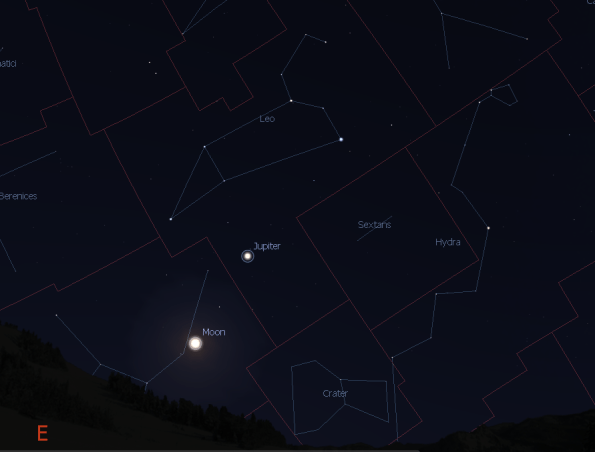
Jupiter, the Moon in the official constellation boundaries as set up by the International Astronomical Union at 10 p.m. February 24, 2016. Created using Stellarium.
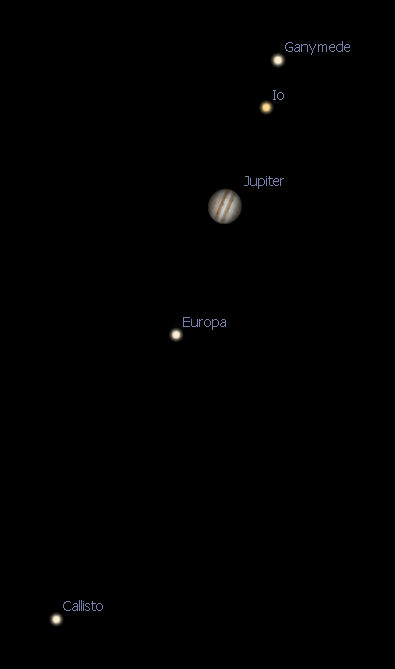
Jupiter and its moons as they would be seen in a telescope, at 10 p.m. February 24, 2016. Jupiter has an apparent diameter of 44.2″ Created using Stellarium.
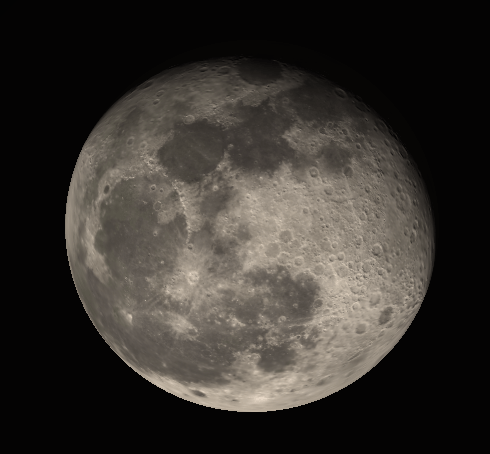
The Moon as it might be seen in binoculars at 10 p.m. February 24, 2016. Created using Stellarium.
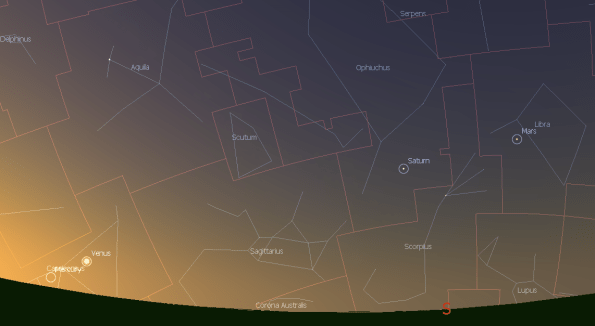
The morning planets with constellation boundaries at 7 a.m. February 25, 2016. Created using Stellarium.
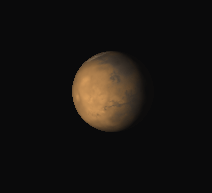
Mars in a telescope at high power. It’s apparent diameter is 8.4″. At 7 a.m. February 25, 2016. Created using Stellarium.
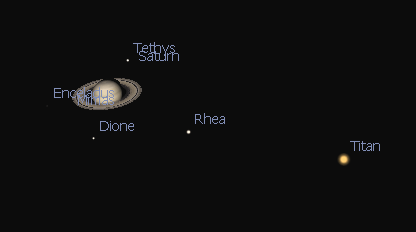
Saturn and its large satellite Titan and other moons as they should appear in a telescope in the morning of February 25, 2016. The planet is 16.4″ in diameter while the rings span 38.2″. Created using Stellarium.
The telescopic planet images are not to the same scale. Use the diameters in seconds of arc (“) as a way to compare the sizes.
Comet Catalina has become too faint to be seen in binoculars as it heads out of the solar system. To follow the comet further go to Seiichi Yashida’s Weekly Bright Comets page. Comet Catalina is n longer the brightest comet on the list, and is currently listed second. Click on it [C/2013 US10 ( Catalina )] for finder charts and other information.
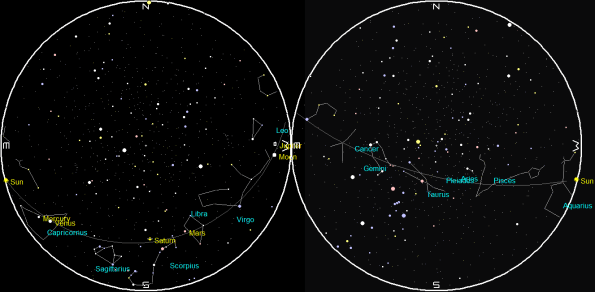
This is a chart showing the sunrise and sunset skies for February 24, 2016 showing the location of the planets and the Moon at that time. Created using my LookingUp program.
Some of these images above are shown smaller than actual size. Image expansion lately hasn’t worked. If you are using Firefox, right-click on the image, and then click on View Image.
02/16/2015 – Ephemeris – The little Dog Star
Ephemeris for Tuesday, February 16th. The Sun will rise at 7:42. It’ll be up for 10 hours and 29 minutes, setting at 6:12. The Moon, 1 day past first quarter, will set at 3:45 tomorrow morning.
Procyon is the bright star to the east or left of Betelgeuse in the sky tonight, which puts it in the east-southeast at 9 tonight. Procyon is the brightest of the two stars in Canis Minor, Orion’s little hunting dog. Procyon is sometimes called the Little Dog Star for that reason. The Dog Star Sirius is a ways below and right of it. The name Procyon means “Before the Dog”, because Procyon, though east of Sirius, rises before it due to its more northerly position. This only works if one is north of 30 degrees north latitude. South of that, Sirius rises first. Procyon is a white star 11 and a half light years away, 3 light years farther than Sirius, and like Sirius it has a faint white dwarf companion. It’s a bit less than half the Sun’s age.
Times are for the Traverse City/Interlochen area of Michigan. They may be different for your location.
Addendum
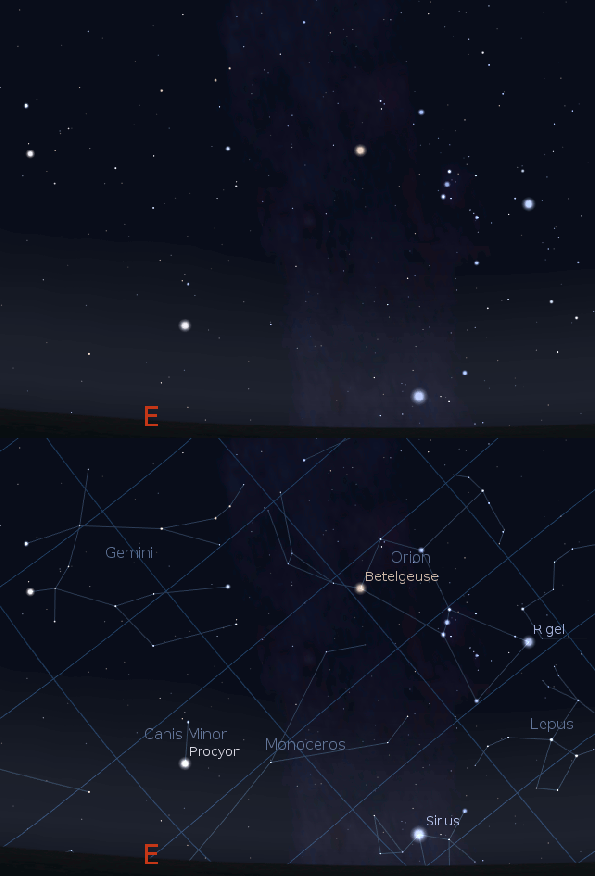
Procyon, Sirius and the stars of winter. Created using Stellarium
Note that at their rising Procyon is higher in the sky than Sirius.
There are some grid lines on the chart. The ones running from lower left to upper right are lines of declination, which are like latitude lines on the Earth. On this chart they are 10º apart. The line that intersects the horizon at the east compass point is the celestial equator. It will meet the western compass point at the horizon. As the Earth rotates the stars and planets will move westward in the direction of these declination lines. The lines that run from upper left to lower right are hour lines of right ascension. Here they are 15 degrees or one hour apart, The Earth rotates 360º in a sidereal* day. 360 divided by 24 hours gives 15º an hour. So the celestial sphere of stars and planets will slide 15º westward in a sidereal hour.
* A sidereal day, rotation with respect to the stars, is about 4 minutes shorter that the solar day, the day and time we keep based on the Sun. The Sun moves about one degree eastward each day, so the rotation has to catch up that one degree each day. The rotation of one degree takes 4 minutes. I’ll let you work that one out for yourself.
02/12/2016 – Ephemeris – A circle of bright stars in winter
Ephemeris for Friday, February 12th. The Sun will rise at 7:48. It’ll be up for 10 hours and 18 minutes, setting at 6:06. The Moon, 3 days before first quarter, will set at 11:19 this evening.
The winter skies are blessed with more first magnitude stars than any other season. With the moon out these stars will stand out even more, as dimmer stars are suppressed. Six of these stars lie in a large circle centered on the seventh, the Winter Circle.
This circle is up at 9 p.m. Starting high nearly overhead is Capella in Auriga the charioteer. Moving clockwise down to the south, we come to Aldebaran in the face of Taurus the Bull. Then down to Orion’s knee we find Rigel. Down and left is the brightest star of all Sirius in Canis Major Orion’s large hunting dog, lowest of these stars in the southeast. Moving up and left there is Procyon in Canis Minor, Above is Pollux in Gemini the twins. All are centered on Betelgeuse the bright red star in Orion’s shoulder.
Times are for the Traverse City/Interlochen area of Michigan. They may be different for your location.
Addendum
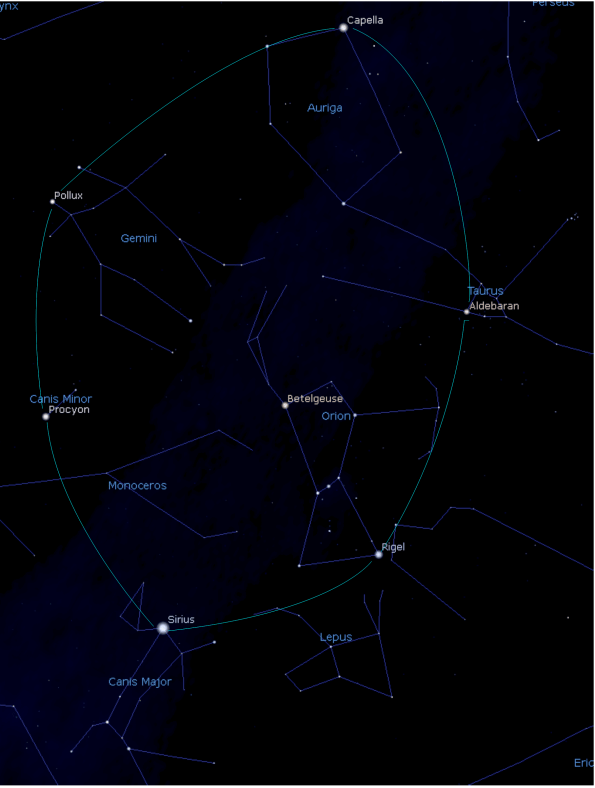
The bright stars of winter arrayed in a circle. Created using Stellarium.
Some also see a Winter Triangle consisting of the stars Betelgeuse, Sirius and Procyon.
02/08/2016 – Ephemeris – The celestial unicorn
Ephemeris for Monday, February 8th. The Sun will rise at 7:53. It’ll be up for 10 hours and 6 minutes, setting at 6:00. The Moon is new today, and won’t be visible.
Among all the constellations in the sky of animals real and mythical, there is also a unicorn. It’s called Monoceros, and inhabits the southeastern sky at 9 p.m. bounded by Orion on the right, Canis Major, the great dog below and Canis Minor, the little dog to the left. Unfortunately for observers without optical aid Monoceros, though large, is devoid of bright stars. Maybe that’s why no one sees unicorns anymore. It has many faint stars because the Milky Way runs through it. To the telescope it is a feast of faint nebulae or clouds of gas and dust, the birth place of stars, including the red rose of the Rosette Nebula whose central star cluster can be seen in a telescope but the nebulosity requires a camera to capture and store its light.
Times are for the Traverse City/Interlochen area of Michigan. They may be different for your location.
Addendum
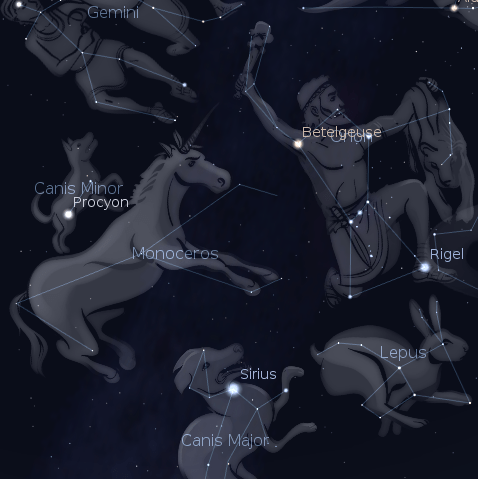
Monoceros the unicorn. Created using Stellarium.

Rosette Nebula in the infrared from the Spitzer Space Telescope. Credit: NASA/JPL/Caltech
02/04/2016 – Ephemeris – Orion is visible from everywhere
Ephemeris for Thursday, February 4th. The Sun will rise at 7:58. It’ll be up for 9 hours and 56 minutes, setting at 5:55. The Moon, half way from last quarter to new, will rise at 5:21 tomorrow morning.
The constellation of Orion the hunter is now due south at 9 p.m. It is an upright rectangle of bright stars, the shoulders and knees of this giant. In the center are three stars in a straight line, his belt, and from his belt hangs a sword. Orion is the most famous of all constellations world-wide, due to its bright stars, and straddles the celestial equator, so that it is visible at least in part from pole to pole. It contains the closest star forming region to us, the Great Orion Nebula seen easily in his sword with binoculars or small telescope. The Horse Head Nebula is found below the left belt star, but only in photographs. Another photographic feature is Barnard’s Loop, the partial shell of an ancient supernova to the left of Orion.
Times are for the Traverse City/Interlochen area of Michigan. They may be different for your location.
Addendum
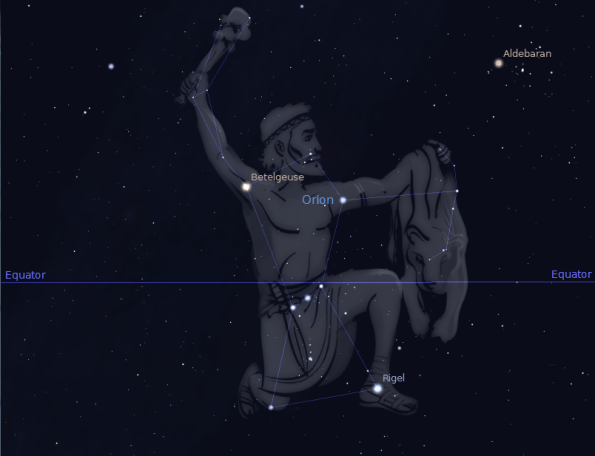
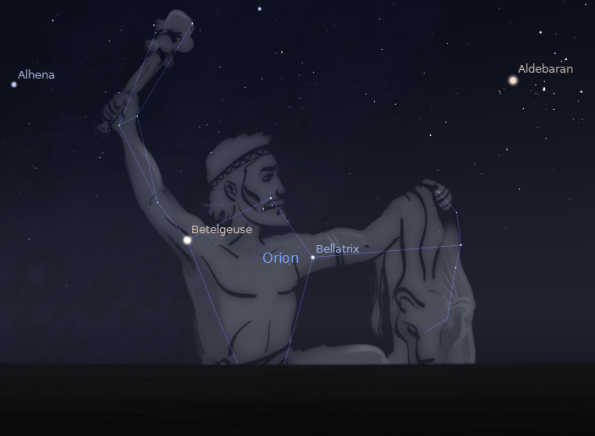
Orion from mid latitudes north of the equator. Orion would be upside down if viewed south of the equator. Created using Stellarium.
Orion from near the north pole. Created using Stellarium.
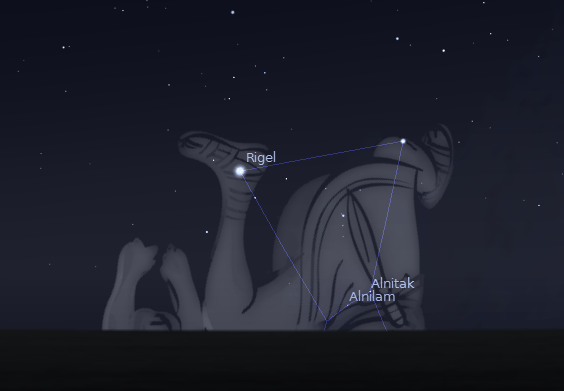
Orion from near the south pole. Created using Stellarium.
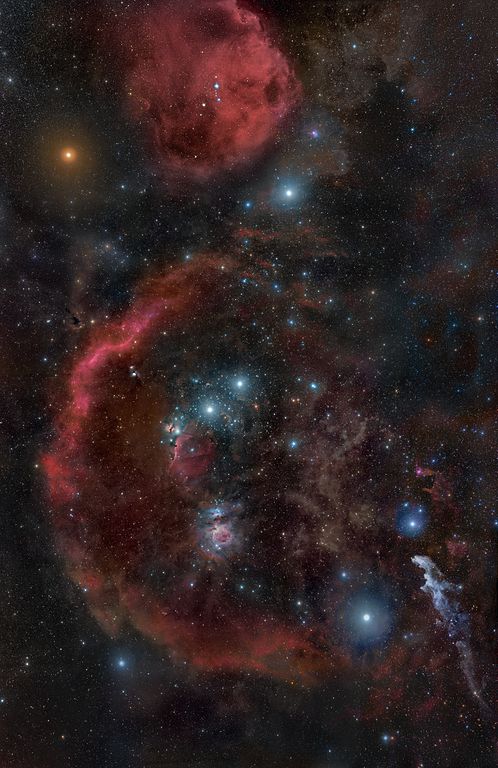
The nebulae in Orion including the Great Orion Nebula in the sword, the Horse Head Nebula below the leftmost star of Orion’s Belt named Alnitak. Barnard’s loop is the big arc on the left. Just above Alnitak is the Flame Nebula, I neglected to mention it in the program. It can be spotted in a telescope, especially if Alnitak is moved off the edge of the field of view. Credit Rogelio Bernal Andreo, via Wikipedia.
Note the nebula at the lower right. It’s the Witch’s Head Nebula, which I believe is shown brighter than it actually is. It’s being illuminated by the blue giant star Rigel to the left of it.
02/02/2016 – Ephemeris – Hard luck Orion
Ephemeris for Ground Hog Day, Tuesday, February 2nd. The Sun will rise at 8:01. It’ll be up for 9 hours and 50 minutes, setting at 5:52. The Moon, 2 days past last quarter, will rise at 3:31 tomorrow morning.
The large and bright constellation of Orion is now in the south at 9 p.m. It is seen as an upright rectangle of bright stars, with a belt of three stars in the center. Orion is a minor character in Greek mythology. Orion was the son of Neptune, and was a hunter. He had an ill-fated romance with Merope whose father King Oenopion had him blinded. After having his sight restored, Orion became a companion of Diana goddess of the hunt and they wanted to marry. In one story Apollo, Diana’s brother disapproved of Orion also and was able to trick Diana into accidentally killing Orion with her bow. The heart-broken Diana then placed Orion in the sky with his hunting dogs, were we see him to this day.
Times are for the Traverse City/Interlochen area of Michigan. They may be different for your location.
Addendum
Actually this isn’t the only story of Orion’s death. The other was that he was stung by a scorpion, also by the urging of Apollo. This is the explanation as to why Orion and Scorpius the scorpion are never in the sky at the same time. However south of the equator that is no longer true, but the Greeks and Romans never ventured that far south enough to see it.
Orion from mid latitudes north of the equator. Orion would be upside down if viewed south of the equator. Created using Stellarium.
 Bob Moler's Ephemeris Blog