Archive
07/15/2014 – Ephemeris – The constellation of Lyra the harp
Ephemeris for Tuesday, July 15th. Today the sun will be up for 15 hours and 13 minutes, setting at 9:24. The moon, half way from full to last quarter, will rise at 11:19 this evening. Tomorrow the sun will rise at 6:12.
Very high up in the eastern sky at 11 p.m. can be found a bright star just north of a small, narrow, but very distinctive parallelogram of stars. They are the stars of the constellation Lyra the harp. The bright star is Vega, one of the twenty one brightest first magnitude stars. Vega is actually the 5th brightest night-time star. The harp, according to Greek mythology, was invented by the Greek god Hermes. The form of the harp in the sky, is as he had invented it: by stretching strings across a tortoise shell. Hermes gave it to his half-brother Apollo, who in turn gave it to the great musician Orpheus. The sun has a motion with respect to most stars around it. Its direction is towards the vicinity of Lyra.
Times are for the Traverse City/Interlochen area of Michigan. They may be different for your location.
Addendum
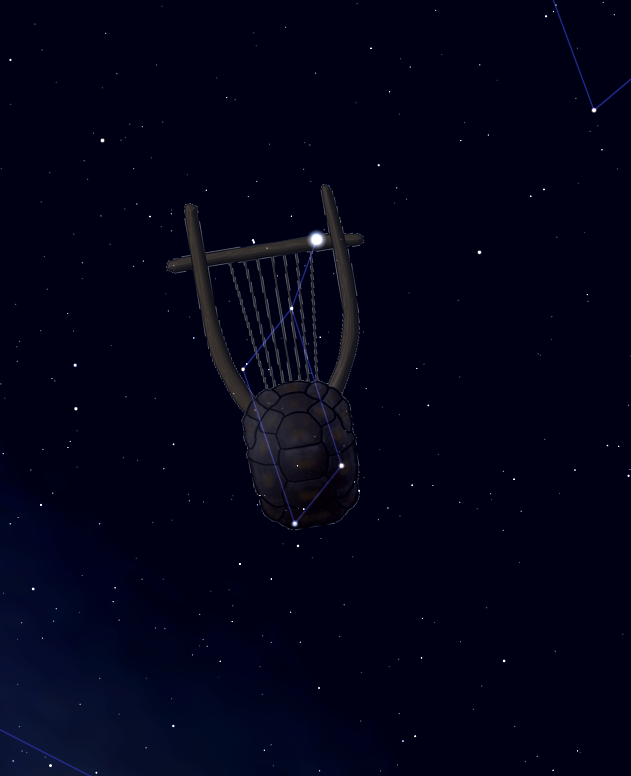
Lyra as a tortoise shell harp. Created using Stellarium and free clip art.
06/30/2014 – Ephemeris – The celestial snake handler
Ephemeris for Monday, June 30th. Today the sun will be up for 15 hours and 30 minutes, setting at 9:31. The moon, 3 days past new, will set at 11:14 this evening. Tomorrow the sun will rise at 6:01. | The red star Antares shines in the south at 11 p.m. In the constellation of Scorpius. In the area of sky above and a little to the left lies a large constellation of faint stars called Ophiuchus, the serpent bearer. The constellation shape is like a large bell, which reminds me of the head, shoulders and arms of a fellow that’s holding the snake-like a weight lifter pulling up a heavy bar bell. The serpent he’s holding is Serpens, the only two-part constellation in the heavens. The head rises to Ophiuchus’ right and the tail extends up to the left. In legend Ophiuchus was a great physician, educated by the god Apollo, and the centaur Chiron, also found in the stars as Sagittarius, now rising below and left of him.
Times are for the Traverse City/Interlochen area of Michigan. They may be different for your location.
Addendum
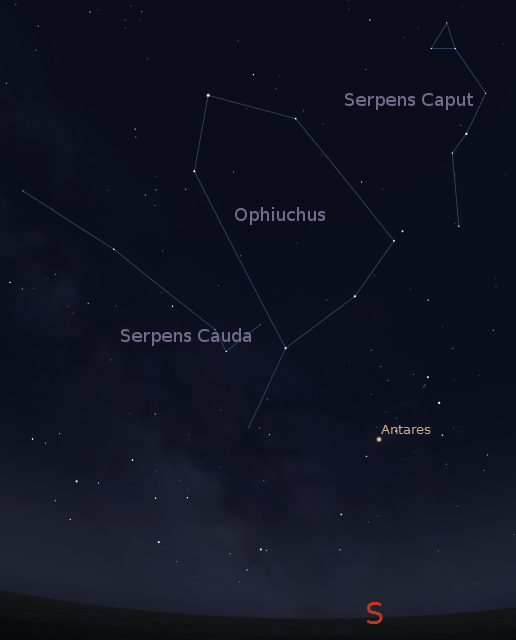
Ophiuchus and Serpens at 11 p.m.. Created using Stellarium.
06/27/2014 – Ephemeris – Scorpius invades Libra
Ephemeris for Friday, June 27th. Today the sun will be up for 15 hours and 32 minutes, setting at 9:31. The moon is new today, and won’t be visible. Tomorrow the sun will rise at 5:59.
One of the constellations of the Zodiac or circle of animals isn’t either animal or human. It is Libra the Scales or balance. It lies low in the southern sky at 11 p.m., just to the right of the rising Scorpius the scorpion. Libra, it seems, is an afterthought, a simple diamond shape of four stars. This year with Saturn inside. Its two brightest stars Zubeneschamali and Zubenelgenubi translate to the north and south claw respectively, of Scorpius to the left of it. The Arabs, at least, seemed to view this as part of Scorpius. The balance was perhaps to signify the equality of day and night, at the time the sun was in this part of the sky at the start of autumn, over 2000 years ago. Nowadays the sun is one constellation west, in Virgo at the start of autumn.
Times are for the Traverse City/Interlochen area of Michigan. They may be different for your location.
Addendum
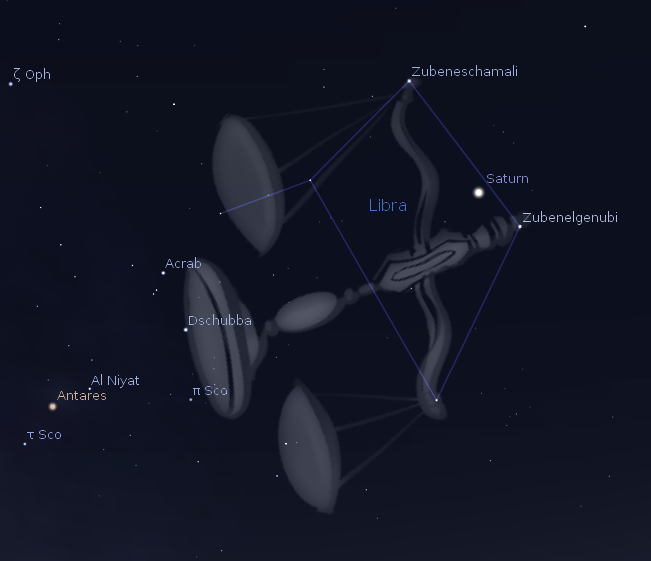
Libra with Saturn this year (2014). Created using Stellarium. Note: the named stars to the left belong to Scorpius.
06/26/2014 – Ephemeris – Draco the dragon is twisted around the pole of the sky
Ephemeris for Thursday, June 26th. Today the sun will be up for 15 hours and 32 minutes, setting at 9:31, the latest sunset. The moon, 1 day before new, will rise at 6:32 tomorrow morning. Tomorrow the sun will rise at 5:59.
High in the northern sky at 11 p.m. lies the twisted constellation, that of Draco the dragon. This dragon is more like the snakelike Chinese dragon than the dinosaur like dragon of European legend. I find it better to start at the tail of Draco, to trace him out in the stars. Draco’s tail starts between the bowl of the Big Dipper and the Little Dipper. The Dragon is seen in a line of stars that extends parallel to the handle of the Big Dipper before curving around the bowl of the Little Dipper then bends back toward the south. The head of Draco is an odd box of stars near the bright star Vega, high in the east. Though not made up of very bright stars, Draco has an easy shape to trace.
Times are for the Traverse City/Interlochen area of Michigan. They may be different for your location.
Addendum
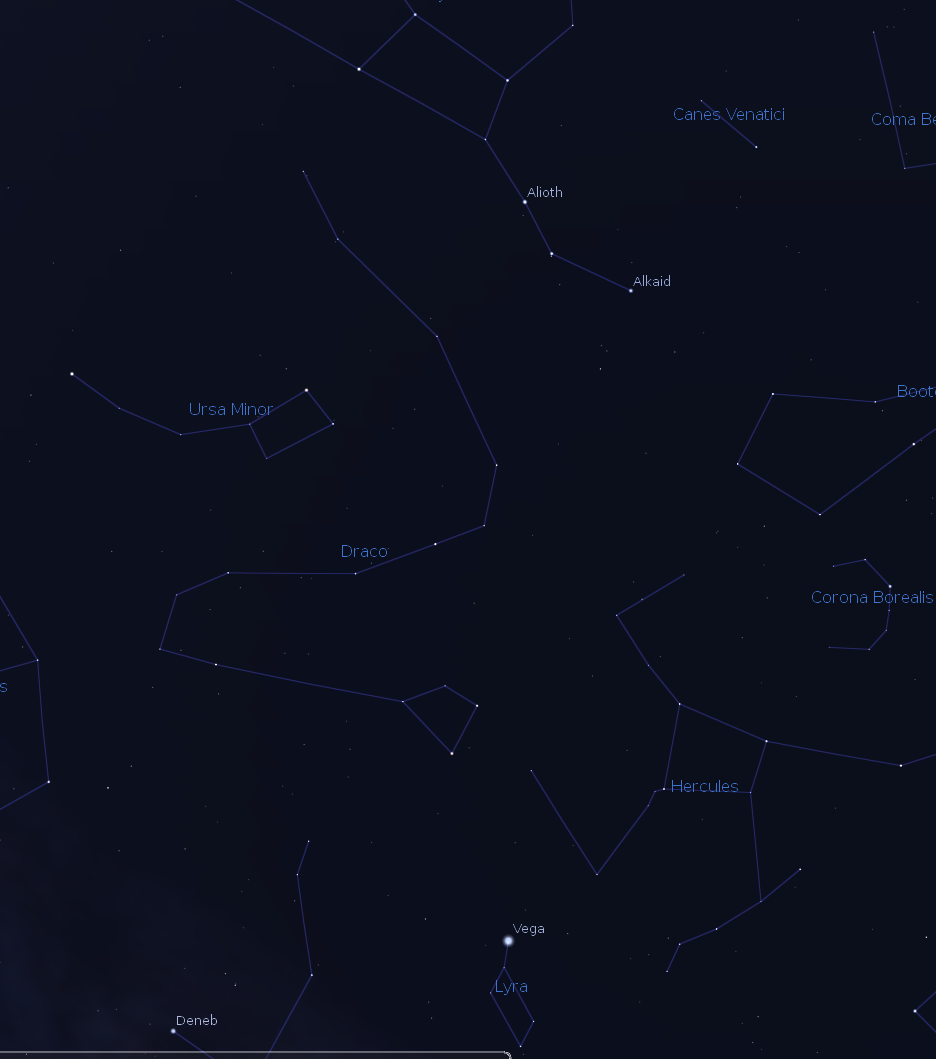
Draco via Stellarium in approximately the same orientation as the Jamieson atlas below. You’s have to face southeast and bend over backward to see this orientation in the sky.
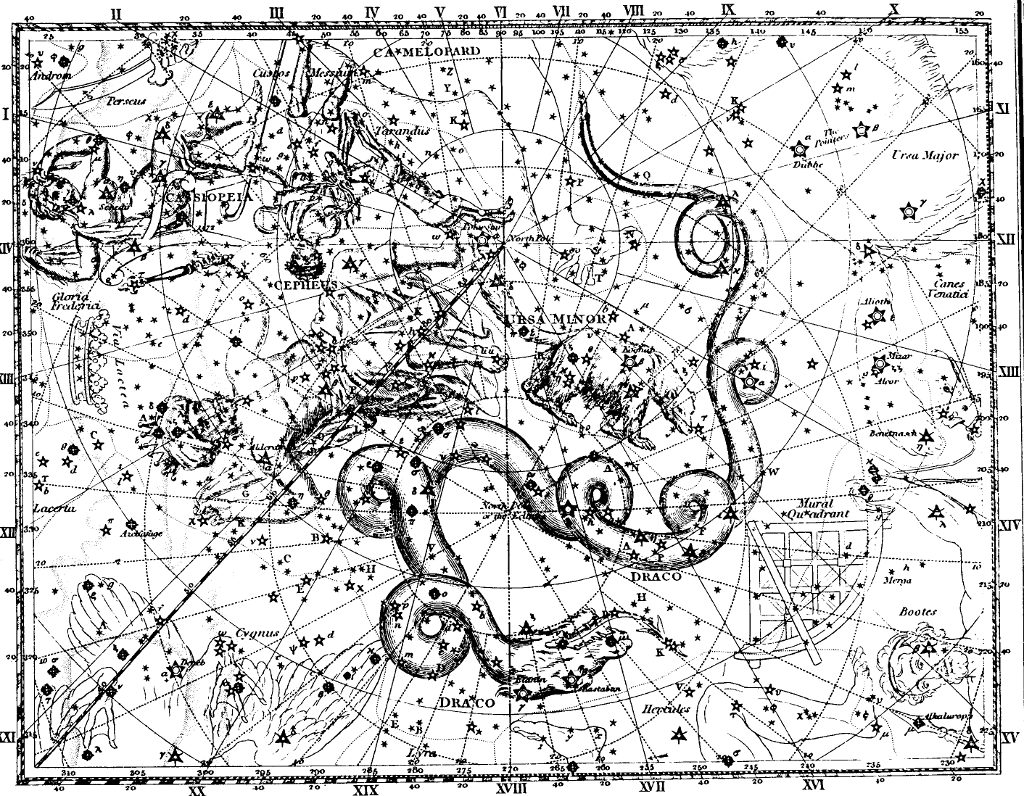
Draco the Dragon as drawn in Alexander Jamieson’s 1820 Celestial Atlas as printer in Men, Monsters and the Modern Universe by George Lovi and Wil Tirion, 1989, Willmann-Bell, Richmond, VA
06/19/2014 – Ephemeris – The constellation Hercules
Ephemeris for Thursday, June 19th. Today the sun will be up for 15 hours and 33 minutes, setting at 9:30. The moon, at last quarter today, will rise at 1:50 tomorrow morning. Tomorrow the sun will rise at 5:57.
Orion, the hard luck Greek hunter gets a splashy constellation in the winter sky, but the greatest hero of all, Hercules, gets a dim group of stars on the border between the spring and summer stars. At 11 p.m. Hercules is high in the southeast. It is located above and right of the bright star, Vega in the east. Hercules’ central feature is a keystone shaped box of stars, called the Keystone, which represents the old boy’s shorts. From each top corner extend lines of stars that are his legs, from the bottom stars, the rest of his torso and arms extend. So in one final indignity he’s upside down in our sky. Some see him crouched down, club upraised holding the Hydra about to throttle it. [For those with a telescope it contains the beautiful globular star cluster M13.]
Times are for the Traverse City/Interlochen area of Michigan. They may be different for your location.
Addendum
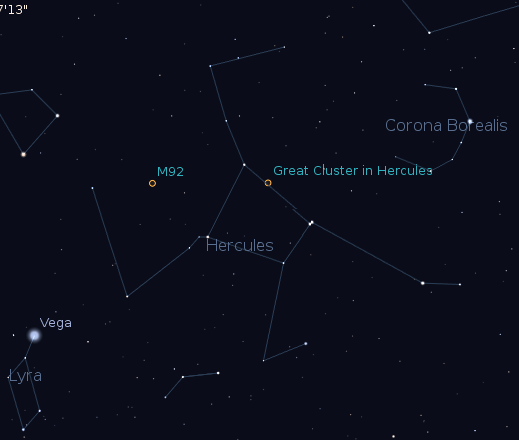
The constellation Hercules and his neighbors. Created with Stellarium.
On Tuesday I mentioned that for the Anishinabek people around the Great Lakes, Corona Borealis is a Sweat Lodge. Incidentally the Pleiades, only seen in the sky at the same time as Corona Borealis on autumn evenings on opposite ends of the sky, are the seven stones of the Sweat Lodge ceremony. The stars of Hercules represents one poor fellow, who couldn’t stand the heat of the sweat lodge and is splayed on the snow near by.
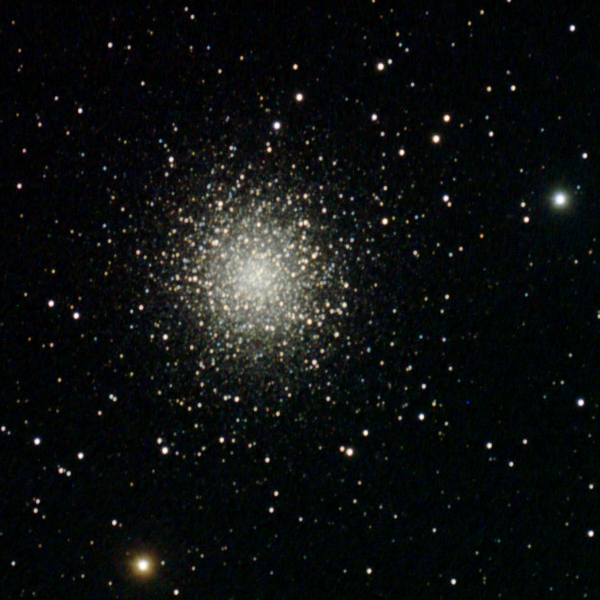
M13, the Great Globular Star Cluster in Hercules. Credit: Scott Anttila
06/17/2014 – Ephemeris – The constellation Corona Borealis, the Northern Crown
Ephemeris for Tuesday, June 17th. Today the sun will be up for 15 hours and 33 minutes, setting at 9:30. The moon, 2 days before last quarter, will rise at 12:46 tomorrow morning. Tomorrow the sun will rise at 5:56.
High in the south at 11 p.m. can be found a small but easily spotted constellation of Corona Borealis, the Northern Crown. It is located just east or left of the kite shaped constellation of Boötes, with its bright star Arcturus at the base. The Northern Crown is a semicircle of stars, like a tiara, with a brighter star Gemma at the bottom. Despite the obvious allusion of stars to diamonds and the sound of the star’s name, this is not a gem studded crown. Gemma means blossom, so Corona Borealis may represent a floral crown. According to Greek mythology it belonged to Princess Ariadne, daughter of King Minos of Crete. She was abandoned by Theseus, whom she helped out of the Labyrinth of the Minotaur.
Times are for the Traverse City/Interlochen area of Michigan. They may be different for your location.
Addendum

Corona Borealis with Boötes. Created with Stellarium.
For the Anishinabek peoples around the Great Lakes, Corona Borealis is a Sweat Lodge.
06/02/2014 – Ephemeris – The Big Dipper points to other stars and constellations
Ephemeris for Monday, June 2nd. Today the sun will be up for 15 hours and 21 minutes, setting at 9:21. The moon, 3 days before first quarter, will set at 12:41 tomorrow morning. Tomorrow the sun will rise at 5:59.
The Big Dipper points to other stars and constellations. Right now the Big Dipper is nearly overhead. The front bowl stars point to Polaris, the North Star which never seems to move in the sky. The handle can be used to find two stars. First follow the arc of the handle away from the bowl to find the fourth brightest night time star Arcturus in the base of the kite shaped constellation of Boötes. Straighten the arc to a spike and continue to the south and you will come to the bright blue-white star Spica in Virgo the virgin. Don’t confuse it with reddish Mars to the right of it now. You can remember these stars with the phrase “Follow the arc of the handle to Arcturus and then spike to Spica”
Times are for the Traverse City/Interlochen area of Michigan. They may be different for your location.
Addendum
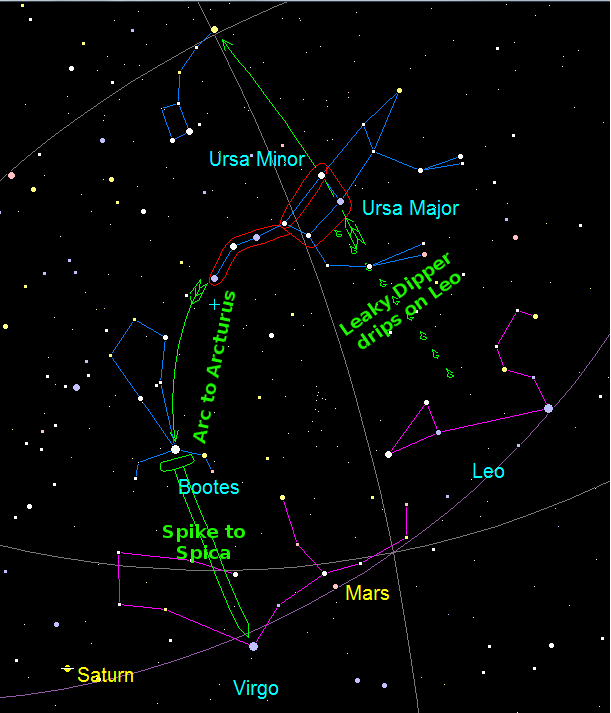
The Big Dipper can be used to point to other stars and constellations in the spring sky. Credit: My LookingUp program.
05/29/2014 – Ephemeris – Boötes the Herdsman
Ephemeris for Thursday, May 29th. Today the sun will be up for 15 hours and 15 minutes, setting at 9:18. The moon, 1 day past new, will set at 10:04 this evening. Tomorrow the sun will rise at 6:01.
High in the south southeastern sky at 10:30 tonight can be found the kite shaped constellation of Boötes the herdsman, chasing or herding the Great Bear Ursa Major of which the Big Dipper is the hind end, across the sky. The bright star at the base of the kite is the 4th brightest night-time star Arcturus. It can be found and name remembered by first locating the Big Dipper and by following the arc or curve of the handle to Arcturus. This star is an orange-colored giant star, 37 light years away. Its light was used open the 1933 Chicago Worlds Fair believing its light left the star in 1893 the year of the previous Chicago Worlds Fair. It turns out that Arcturus is 3 light years closer than what they thought.
Addendum
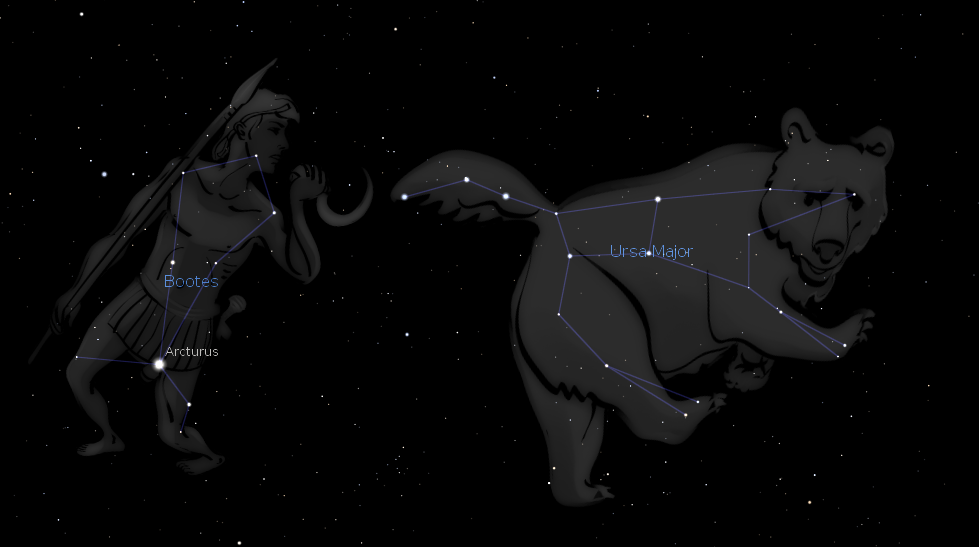
Bootes and Ursa Major high overhead on late spring evenings at 11 p.m. Created using Stellarium.
04/28/2014 – Ephemeris – The legend of the constellation of Corvus the crow
Ephemeris for Monday, April 28th. The sun rises at 6:37. It’ll be up for 14 hours and 6 minutes, setting at 8:43. The moon, 1 day before new, will rise at 6:53 tomorrow morning.
The small constellation of Corvus the crow is located low in the south at 10:30 this evening. It’s made of 5 dim stars, but the pattern is a distinctive distorted box with two stars at the upper left marking that corner. To the right is a fainter constellation of a thick stemmed goblet called Crater. Both appear above the long constellation of Hydra the water snake who is slithering just above the southern horizon. In Greek mythology Corvus, then white, was the god Apollo’s pet. He once bid Corvus to take a cup and fetch him some water. Corvus however dallied and waited for a green fig to ripen. Corvus grabbed a snake and returned with a story on how the snake had delayed him. The angry Apollo turned the crow and all crows to this day black.
Times are for the Traverse City/Interlochen area of Michigan. They may be different for your location.
Addendum
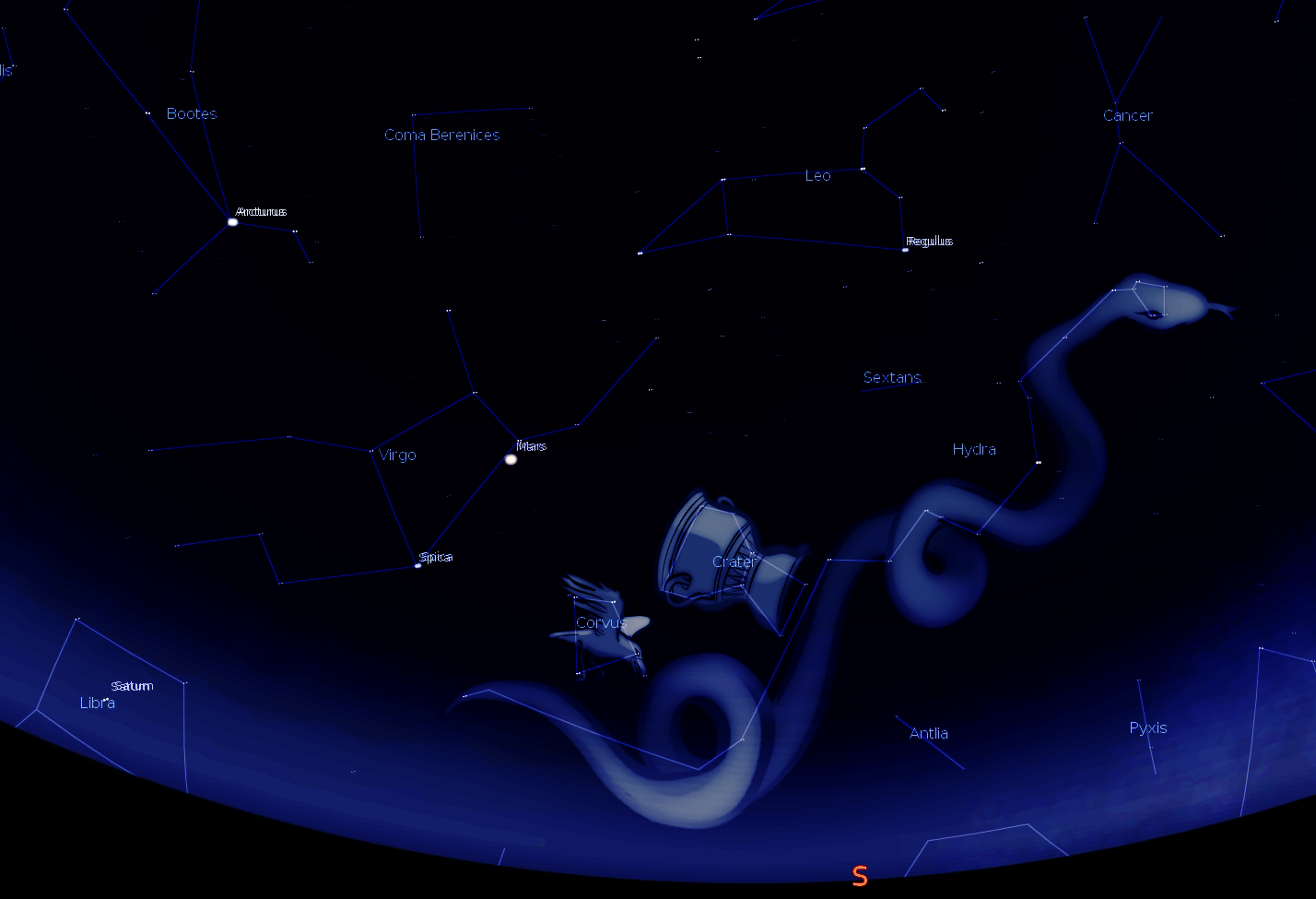
Corvus the crow, Crater the cup and Hydra the water snake along with the other spring constellations ay 10 p.m. April 28, 2014. Created using Stellarium.
04/22/2014 – Ephemeris – The Great Bear and the Fisher Star
Ephemeris for Earth Day, Tuesday, April 22nd. The sun rises at 6:46. It’ll be up for 13 hours and 49 minutes, setting at 8:36. The moon, at last quarter today, will rise at 3:31 tomorrow morning.
This evening the Big Dipper is practically overhead. The Europeans and some Native Americans say it as the hind end of a bear with dimmer stars making up the rest of the bear. The official constellation of which the Big dipper is a part is Ursa Major, the Great Bear. The native Americans were smart enough to depict the handle stars of the dipper as three hunters following the bear, rather than the bear’s unnaturally long tail. The Anishinabek Indians who settled around here saw instead of a bear a weasel like creature, who did have a long tail called Fisher or Fisher Star, who through a great adventure, with his other animal friends, brought summer and the rest of the seasons to the frozen earth.
Times are for the Traverse City/Interlochen area of Michigan. They may be different for your location.
Addendum
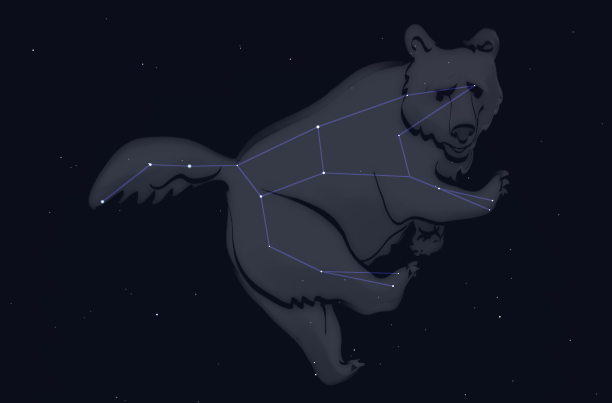
The Great Bear as the Europeans saw it. Created using Stellarium.
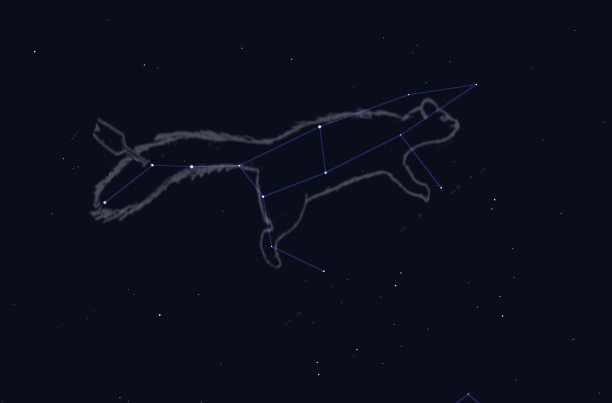
The Fisher Star. Created using Stellarium.
 Bob Moler's Ephemeris Blog