Archive
07/04/2019 – Ephemeris – Happy Independence Day, at our farthest from the Sun
Ephemeris for Independence Day, Thursday, July 4th. Today the Sun will be up for 15 hours and 28 minutes, setting at 9:31, and it will rise tomorrow at 6:03. The Moon, 2 days past new, will set at 11:20 this evening.
Today, Independence Day the Earth is at its greatest distance, aphelion, from the sun or about 94.5 million miles (152.2 million km) from the Sun. It doesn’t do much to weaken the strength of sunlight, as you will find out when you go to the beach. But, occurring in summer, it makes summer the longest season by a several days over winter. Our calendar tries to keep up with the seasonal or tropical year, while the Earth’s revolution from its farthest or aphelion point to the next is slightly longer. Back in 1776, at the founding of our nation, the Earth was farthest from the Sun on June 30th. As we go more centuries into the future our summer will even get a bit longer. But remember the poor Australians, and others in the southern hemisphere, whose winter will also get longer.
The times given are for the Traverse City/Interlochen area of Michigan. They may be different for your location.
Addendum
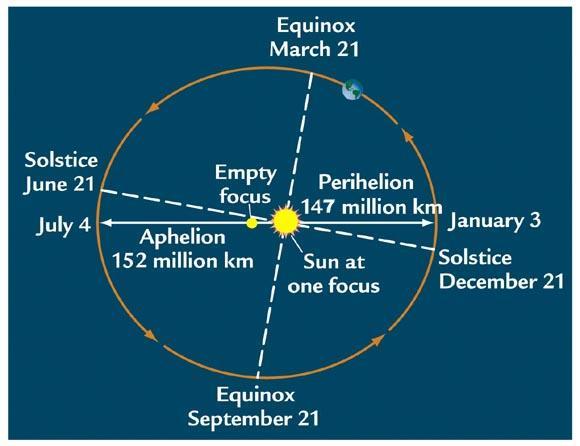
The Earth’s elliptical orbit, somewhat exaggerated, showing perihelion, aphelion and the seasons. Credit “Starts with a Bang” blog by Ethan Siegel.
04/22/2019 – Ephemeris – Earth Day
Ephemeris for Earth Day, Monday, April 22nd. Today the Sun will be up for 13 hours and 49 minutes, setting at 8:36, and it will rise tomorrow at 6:45. The Moon, 3 days past full, will rise at 12:24 tomorrow morning.
A good slogan for this Earth Day or any day is “Support your local planet.” As an amateur astronomer I look around the solar system at all the habitable planets. The Earth is it. Mars may be terraformed at great expense, that is made more earth-like. There may be life in the oceans of Jupiter’s moon Europa, or Saturn’s Enceladus, but they are not habitable for us. Terraforming (stopping and reversing climate change) the Earth would be the easiest and much more practical. One look at our nearest neighbor Venus will show us our fate, hopefully in billions of years from now, a hell hole of heat and a crushing atmosphere. Our job is push-off that day as far as we can, and keep the Earth a blue-green oasis in the solar system.
The times given are for the Traverse City/Interlochen area of Michigan. They may be different for your location.
Addendum
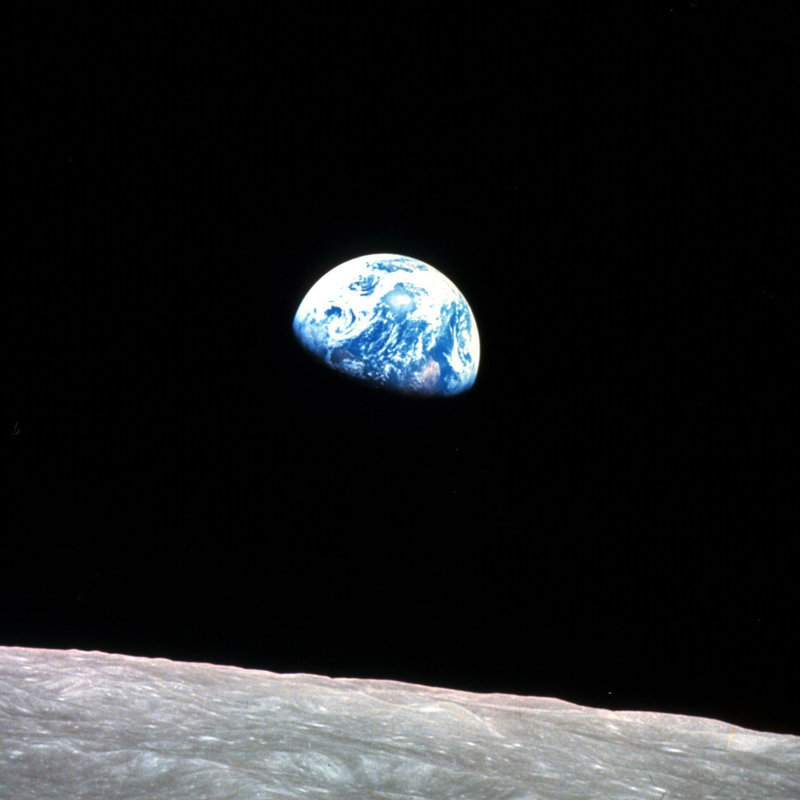
Earth rising above the Moon’s limb from Apollo 8. Credit: NASA/Apollo 8
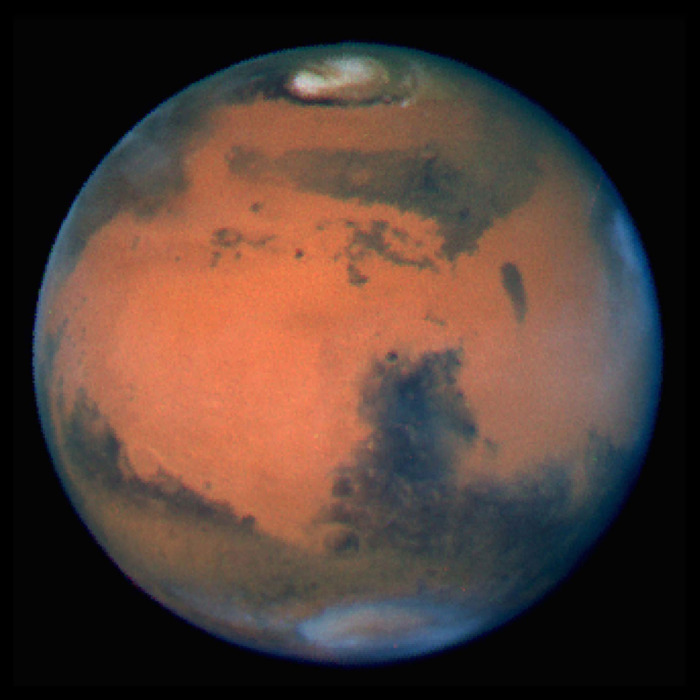
Mars had its day, but that ended about 3 billion years ago. Being half the size of the Earth, Mars cooled down, lost its magnetic field, so the solar wind stripped away most of its atmosphere and water. Credit NASA.
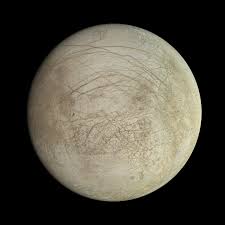
Europa, one of the four Galilean moons of Jupiter and easily seen in small telescopes, is slightly smaller than our Moon. Under that thick icy shell lurks an ocean with more water than all the Earth’s oceans. There’s probably volcanic vents like the black smokers in Earth’s oceans where a whole ecology of extremophiles could live like they do on Earth. Credit: NASA.
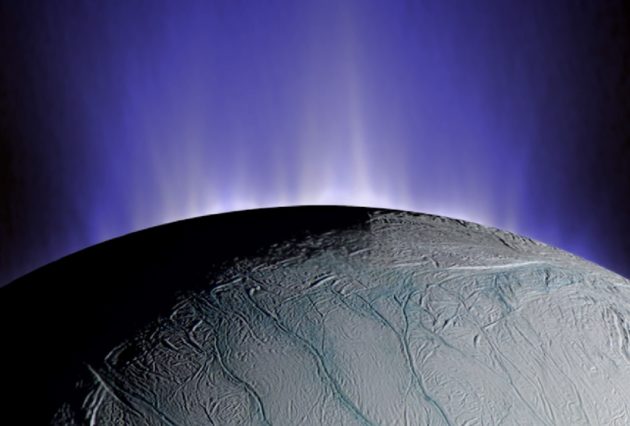
Enceladus, a small moon of Saturn spews continuous geysers of water from cracks in its south polar region indicating an ocean below its frozen icy exterior. Sampling the plumes with the right instruments may detect life on this small world without the need for drilling. Credit: NASA.
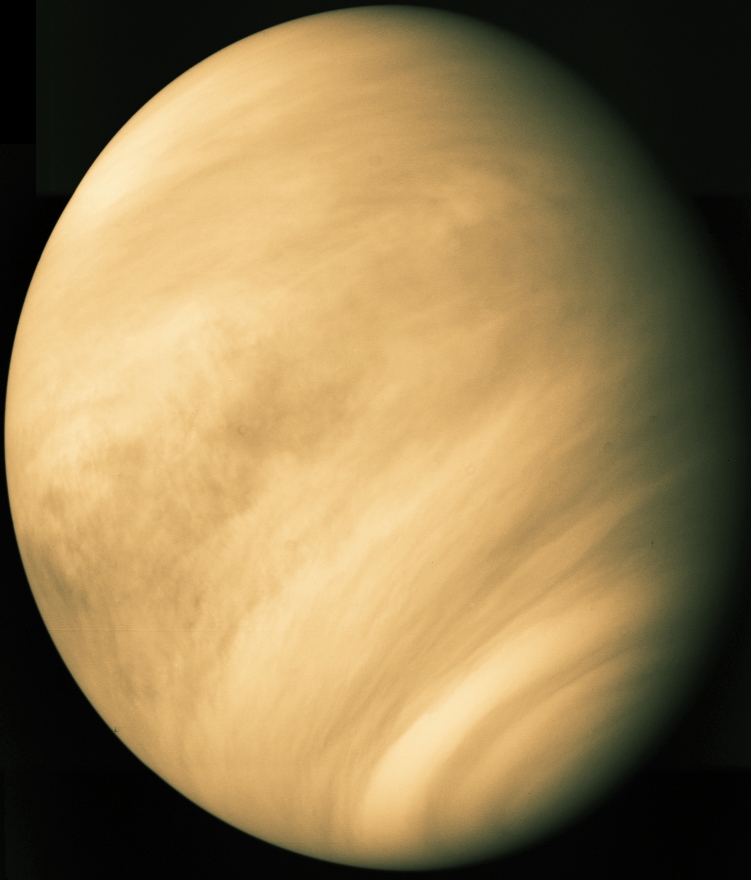
Is this our future? Venus had the misfortune of ending up too close to the Sun. It has a hellish landscape of nearly 900 degrees F, and 90 times the Earth’s atmospheric pressure. Its clouds consist of sulfuric acid. Talk about a runaway greenhouse effect and acid rain… Credit: NASA.
04/11/2019 – Ephemeris – How far away is the Moon?
Ephemeris for Thursday, April 11th. Today the Sun will be up for 13 hours and 16 minutes, setting at 8:22, and it will rise tomorrow at 7:04. The Moon, 1 day before first quarter, will set at 3:02 tomorrow morning.
This year, the 50th anniversary of the Apollo 11 first human landing on the Moon, I’ll be talking about some basic facts about the Moon, the Apollo program. The first thing is to realize just how far the Moon is from the Earth. Most diagrams of the Earth and Moon cheat and make them closer than they are. The Greek astronomer Hipparchus in the second century BC got pretty close. The Moon is about 30 times the Earth’s diameter away. If the Earth were represented by a basketball and the Moon by a tennis ball to get their proportional distance correct they would have to be 23 and a half feet (7.16 meters) away from each other, give or take. On average 238,000 miles (383,000 km). It took the Apollo astronauts 3 days cover that distance to get to the Moon.
The times given are for the Traverse City/Interlochen area of Michigan. They may be different for your location.
Addendum

The Earth and Moon to scale. Click on the image to enlarge. Source Wikipedia.
04/08/2019 – Ephemeris – How to find Polaris, the North Star
Ephemeris for Monday, April 8th. Today the Sun will be up for 13 hours and 7 minutes, setting at 8:18, and it will rise tomorrow at 7:09. The Moon, 3 days past new, will set at 11:54 this evening.
The most useful of the navigation stars for the average person is Polaris, the North Star or Pole Star. It is very close to the point in the sky that the Earth’s axis points to in the north. Currently it is about three-quarters of a degree from the pole, about one and a half moon diameters. In 2110 or thereabouts it will approach to slightly less than a moon diameter from the pole before slowly heading away. Polaris is always closer to true north than a magnetic compass in Michigan. To find it use the two stars in front of the Big Dipper’s bowl to point to it. This time of year the Big Dipper is above Polaris, so the pointer stars, that’s what they are called, point down to it. Polaris is at the end of the handle of the faint Little Dipper. The reason for Polaris’ motion is the slow 26,000 year wobbling of the Earth’s axis, called precession.
The times given are for the Traverse City/Interlochen area of Michigan. They may be different for your location.
Addendum
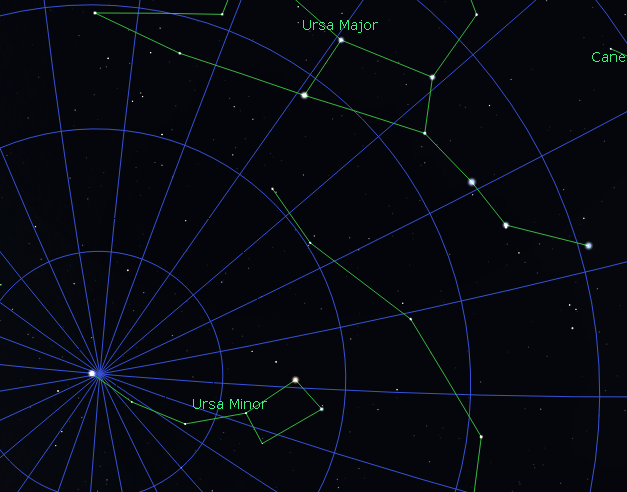
Ursa Major and Minor, the Big and Little Dippers. See how the two stars at the front of the bowl point to Polaris. It happens that the pointer stars are close to the 11th hour of right ascension (longitude in the sky). The right ascension lines converge at the north celestial pole, just as the longitude lines converge at the Earth’s north pole. Created using Stellarium.
The year I was born, 1941, Polaris was a whole degree from the celestial north pole.
If you’ve ever wondered why right ascension is in hours instead of degrees it’s because the Earth rotates within the celestial sphere, so it’s easier to keep track of the east-west position in the sky by using a clock that set to gain 3 minutes and 56 seconds a day. Such a clock keeps sidereal (star) time rather than solar (sun) time. One hour equals 15 angular degrees or 4 minutes a degree.
07/05/2018 – Ephemeris – Earth will be the farthest from the Sun in its orbit tomorrow
Ephemeris for Thursday, July 5th. Today the Sun will be up for 15 hours and 27 minutes, setting at 9:30, and it will rise tomorrow at 6:04. The Moon, 1 day before last quarter, will rise at 1:39 tomorrow morning.
At just before noon tomorrow the Earth will reach the aphelion point in its orbit of the Sun reaching 94.48 million miles from our star. The is a bit farther than the Earth was at its perihelion point in early January of 91.32 million miles. This doesn’t affect the total amount of heat the Earth gets from the Sun, as could be felt in the last week. The big temperature differences are due to the seasons, which are caused by the tilt of the Earth’s axis with respect to its orbit. However having aphelion in summer, when the Earth moves it slowest around the Sun makes summer the longest season. It’s 4 days longer than winter. I know it doesn’t feel like it in northern Michigan, especially with the April we had this year.
The times given are for the Traverse City/Interlochen area of Michigan. They may be different for your location.
Addendum
The Earth’s orbit, somewhat exaggerated, showing aphelion and the seasons. Credit “Starts with a Bang” blog by Ethan Siegel.
The exact date and distance of aphelion and perihelion change by a few days and a few thousand miles every year. The Earth’s orbit of the Sun is also affected by the other planets of the solar system, principally Venus and Jupiter.
07/06/2015- Ephemeris – Today we are at our greatest distance from the sun.
Ephemeris for Monday, July 6th. Today the Sun will be up for 15 hours and 26 minutes, setting at 9:30. The Moon, 2 days before last quarter, will rise at 12:23 tomorrow morning and tomorrow the Sun will rise at 6:04.
This is the day the we are the farthest we can get from the Sun for the year. The point in the Earth’s orbit that it occurs is called aphelion. Earth is closest to the Sun in January at perihelion. The actual distance difference between perihelion and aphelion is 3 million miles out of roughly 93 million miles. So now we’re roughly 94 and a half million miles from the Sun or 152 million kilometers., and will swoop down to 91 and a half million miles(91.4) or 147 kilometers from the Sun in early January. Because Earth’s northern and southern hemispheres have different ratios and placement of land versus ocean I’m not sure you could correlate seasonal differences of the hemispheres with the Earth’s distance from the Sun. Anyway the approximate time we reach aphelion will be 3 p.m. EDT (19 hr UT).
Times are for the Traverse City/Interlochen area of Michigan. They may be different for your location.
Addendum
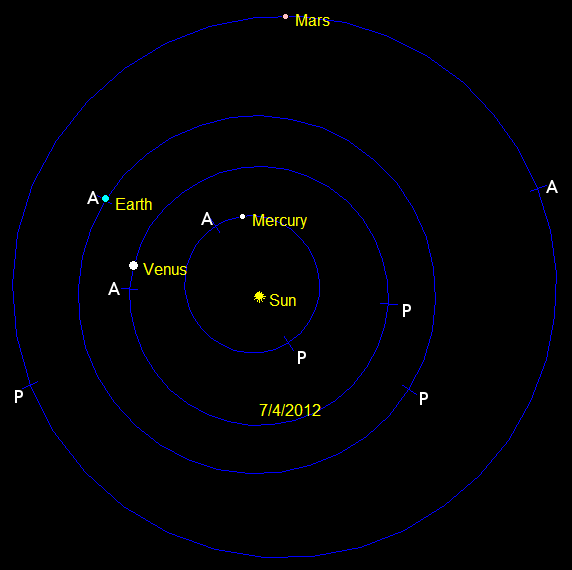
The orbits of the inner planets. (P)erihelion – (A)phelion
The above is a diagram from three years ago, so the planets other than the Earth will be in different positions today. The date of aphelion and perihelion move around over a greater range of dates than the equinoxes and solstices. I’m not sure why without researching it, but I suspect that the Moon has something to do with it.
06/26/2015 -Ephemeris – The latest sunset of the year
Ephemeris for Friday, June 26th. Today the Sun will be up for 15 hours and 33 minutes, setting at 9:32. The Moon, 2 days past first quarter, will set at 2:57 tomorrow morning and tomorrow the Sun will rise at 5:59.
This evening we will experience the latest sunset of the year. The sun has been setting within the same minute for a few days now. Now the Sun will begin to set earlier and earlier, at first imperceptibly, but soon with greater speed. By the middle of August the Sun will set 45 minutes earlier. Just in time to enjoy the summer Milky Way at a semi-decent hour. The shorter days, or actually daylight hours, and the diminishing altitude of the Sun at noon will cause a decrease in the heat we receive from the Sun. Still, right now we’re still warming up. However there is a tipping point around mid to late July, when we will not get enough heat to keep getting warmer and we’ll start to cool.
Times are for the Traverse City/Interlochen area of Michigan. They may be different for your location.
Addendum
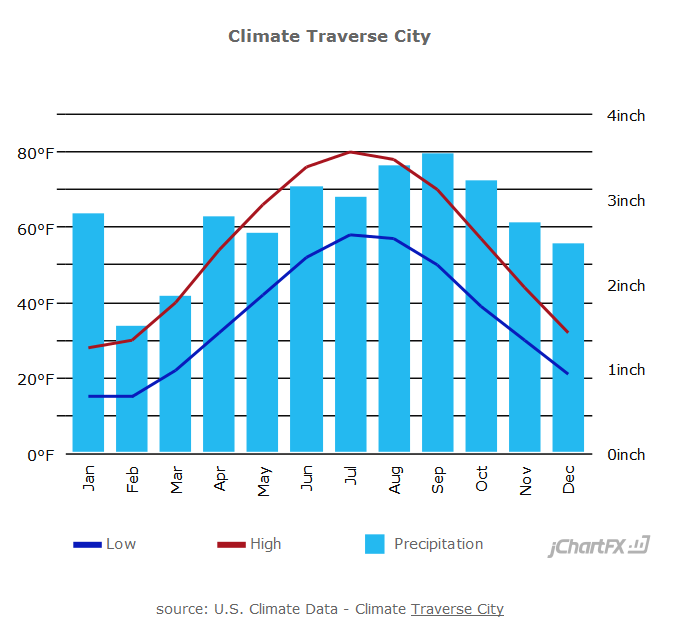
Traverse City Climate Chart. The hottest day is around July 15, and coldest day is around January 20. Credit: http://www.usclimatedata.com
www.usclimatedata.com has monthly and daily average data for many locations in the United States. They have code to embed this chart on your website. However it didn’t embed properly in the blog, so I took a screen shot.
01/02/2015 – Ephemeris – Telescope Clinic tonight in Traverse City
Ephemeris for Friday, January 2nd. The sun will rise at 8:20, the latest sunrise of the year. It’ll be up for 8 hours and 53 minutes, setting at 5:13. The moon, 2 days before full, will set at 6:38 tomorrow morning.
Did you or someone in your family get a telescope for Christmas, or have one in a closet or attic because you don’t know how to put it together or operate? Or maybe you are trying to figure out which one to buy. Well, tonight’s your night. The Grand Traverse Astronomical Society will host a telescope clinic at Northwestern Michigan College’s Rogers Observatory on Birmley Road, south of Traverse City starting at 8 p.m. Telescope experts from the society will help you set up your telescope and give you observing tips. So bring ’em if you’ve got ’em. If it’s clear, at 9 p.m., there will be a star party to try out your telescope, or try them out on the lights of Traverse City. Can’t make it? We can help you after any meeting.
Times are for the Traverse City/Interlochen area of Michigan. They may be different for your location.
Addenda
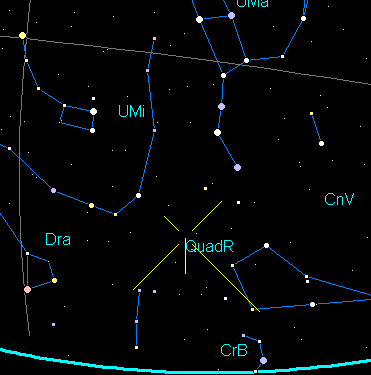
Remember the Quadrantid meteor shower tomorrow evening and into Sunday morning:
The moon will interfere with the meteor shower, so only the brightest will be visible. The radiant will rise from the northeast. The radiant will be nearly overhead at the start of twilight. On a dark night up to 120 meteors per hour may be seen according to the International Meteor Organization.
01/01/2015 – Ephemeris – Happy New Year – a look at January
Ephemeris for New Years Day, Thursday, January 1st. The sun will rise at 8:20. It’ll be up for 8 hours and 52 minutes, setting at 5:12. The moon, 3 days before full, will set at 5:43 tomorrow morning.
Happy New Year. Let’s preview the month of January. We’re a day from the latest sunrise at about the same time as today, 8:20 a.m. and will back down to 8:02 by the 31st. Sunset times are currently increasing by a minute a day from 5:12 p.m. today to 5:49 at month’s end. Listeners near the shore of Lake Michigan will have about the same sunrise time in Ludington, Interlochen/Traverse City, Petoskey and Mackinaw City, but the sunset times will vary markedly. The Quadrantid meteor shower whose radiant is near the end of the Big Dipper’s handle will reach peak on the 3rd, but it will have interference from the full moon,. On the 4th the Earth will be its closest to the sun of the entire year.
Times are for the Traverse City/Interlochen area of Michigan. They may be different for your location.
Addenda
Monthly Star Chart
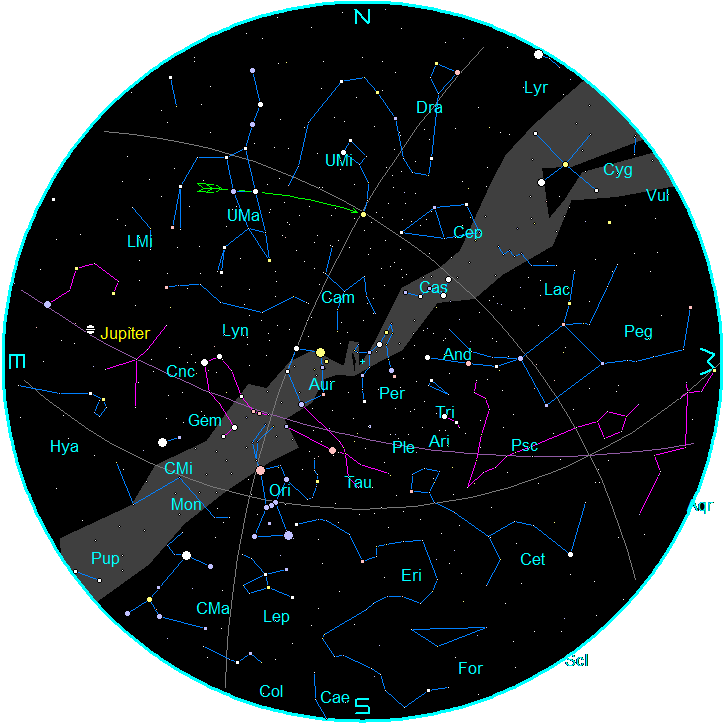
Star Chart for January 2015. Created using my LookingUp program.
The Moon is not plotted. The planets and stars are plotted for the 15th at 9 p.m. That is chart time.
Evening astronomical twilight ends at 6:58 p.m. on January 1st, and increasing to 7:30 p.m. on the 31st.
Morning astronomical twilight starts at 6:34 a.m. on January 1st, and decreasing to 6:22 a.m. on the 31st.
Add a half hour to the chart time every week before the 15th and subtract and hour for every week after the 15th.
For a list of constellation names to go with the abbreviations click here.
The green pointer from the Big Dipper is the pointer stars at the front of the bowl of the Big Dipper that point to Polaris the North Star.
The Quadrantid meteor shower
The moon will interfere with the meteor shower, so only the brightest will be visible. The radiant will rise from the northeast. The radiant will be nearly overhead at the start of twilight. On a dark night up to 120 meteors per hour may be seen according to the International Meteor Organization.
Quadrantid meteor shower radiant at 1:30 a.m.
The Earth at Perihelion
This is the closest the Earth gets to the Sun in its orbit this year. The Sun will be 91,402,000 miles or 147,096,000 kilometers away at around 1 a.m. January 4th, 2015 EST or 6 hr UT January 5th 2015. It makes winter the shortest season because the Earth is moving its fastest during perihelion. It’s only by a few days. And in northern Michigan where it seems that winter overlaps half of fall and spring besides, that few days difference is buried under snow.
Quasi-conjunction between Venus and Mercury on the evening of January 10th.
A quasi-conjunction. Conjunctions occur when two solar system bodies have the same right ascension. Mercury will get to within 0.6 degrees of Venus before retreating back sun-ward.
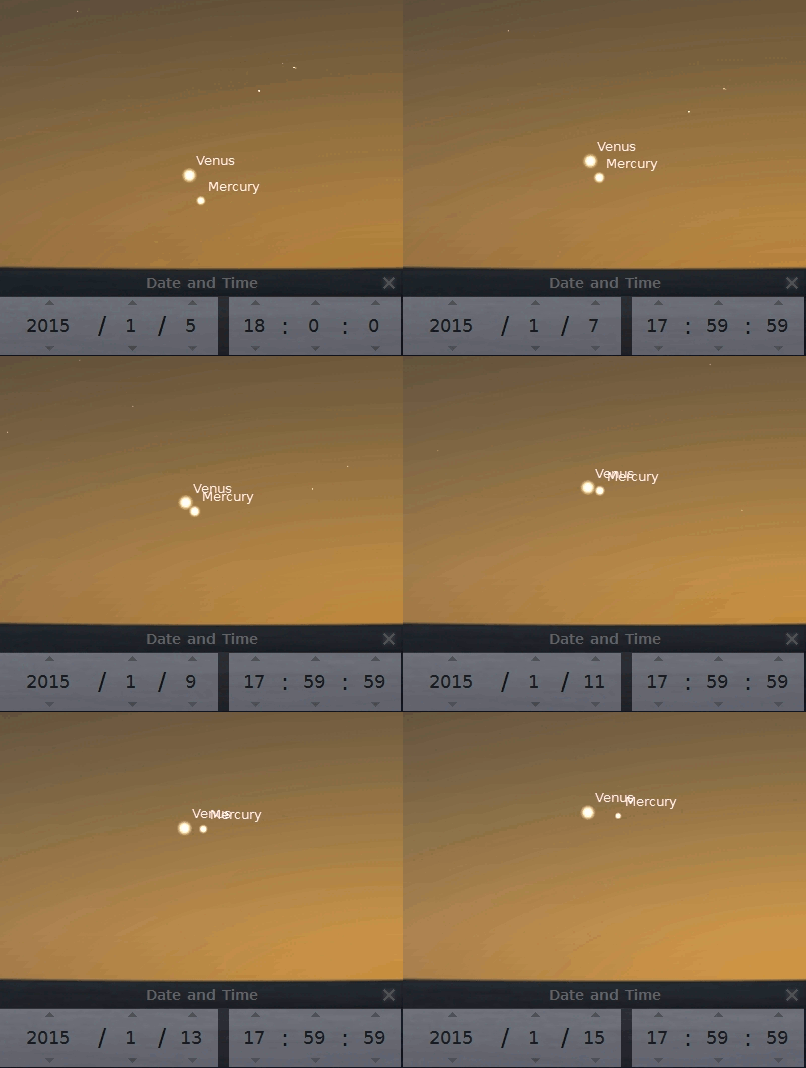
Animation of the Quasi-conjunction of Venus and Mercury. Time span 1/05/2015 to 1/15/2015 at 7 p.m. Created by Bob Moler using Stellarium and GIMP.
Comet C/2014 Q2 (Lovejoy)
Here is a finder chart for 9 p.m. for January. Every other position is marked with the month-day and predicted magnitude. Recently the comet has shown to be brighter than predicted by up to one magnitude. Note that magnitudes in astronomy are like golf scores – the lower the number, the brighter the object. So the comet should reach 4th magnitude.
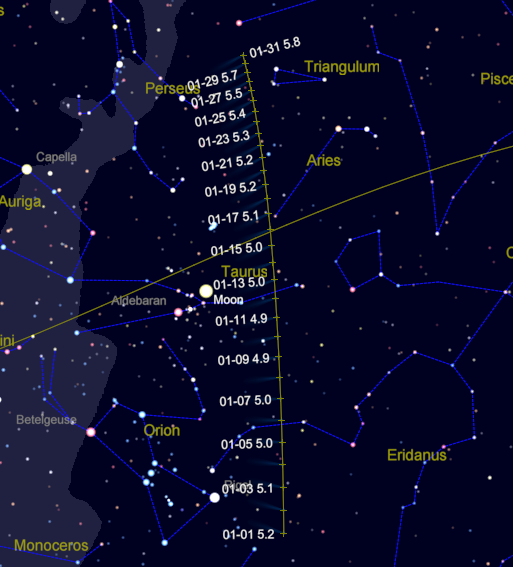
Nightly plot of Comet Lovejoy (C/2014 Q2) for the month of January, 2015 at 9 p.m.
Created using Cartes du Ceil (Sky Charts).
09/22/2014 – Epmemeris – Autumn begins tonight
Ephemeris for Monday, September 22nd. The sun will rise at 7:29. It’ll be up for 12 hours and 10 minutes, setting at 7:39. The moon, 2 days before new, will rise at 6:54 tomorrow morning.
Welcome to the last, almost full, day of summer. The Sun will reach the autumnal equinox point in the sky at 10:30 this evening. At that moment the Sun will cross the celestial equator, a projection of the Earth’s equator, heading southward. All locations on the earth except two will experience 12 hours of daylight and 12 hours of night. Well they would if the Earth didn’t have an atmosphere and sunset and sunrise were defined differently. The two locations that don’t experience equal night, which is what equinox means, are the north pole where the sun will be setting and the south pole where the sun will be rising. For us in the northern hemisphere daylight hours will be shorter and the Sun will peak lower in the south each day until the December solstice.
Times are for the Traverse City/Interlochen area of Michigan. They may be different for your location.
Addendum
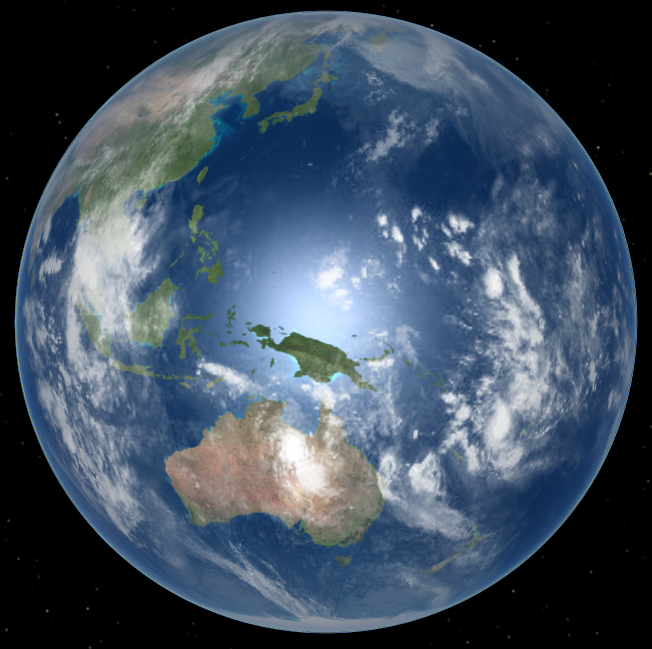
The Earth as seen from the direction of the Sun as it crosses over the Earth’s equator heading south. Created using Celestia.
 Bob Moler's Ephemeris Blog