Archive
Ephemeris extra: 09/22/2023 5 pm – The talk and Star party tonight and tomorrow have been canceled.
The problem is a communication problem on my end. Sorry.
Ephemeris Extra: 08/31/2023 – Comet C/2023 P1 (Nishimura) may be visible to the naked eye in September
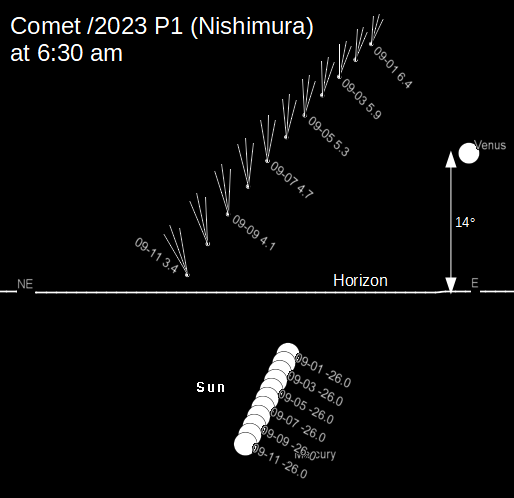
Comet Nishimura is shown at 6:30 AM in the east northeast for the mornings of September 1st through 11th. Venus stays pretty much at the same altitude of 14 degrees during this period. The Sun is shown here below the horizon. The comet and the Sun are labeled every other day with the month and day and estimated magnitude. Created using Cartes du Ciel (Sky Charts) by the author.
On August 12th this year Hideo Nishimura of Kakegawa, Japan discovered a comet that now bears his name. The comet has a chance of becoming a naked eye object this month, but for only a few days. It is a rapidly moving comet, and it is heading southward. We will only get a short period of time when it is possibly visible to the naked eye.
I’m sorry about all the weasel words about the brightness of the comet, but comets are notorious for being unpredictable with their brightness. They may brighten suddenly, they may dim suddenly, they may fall apart. We never know what happens to a comet until it happens.
Early brightness estimates were all over the place from 9th to 14th magnitude a range of 5 magnitudes or a brightness range of 100 from bright to dim. The comet was discovered only 12 days ago, as I write this, so there’s not very many brightness estimates to base future magnitudes on, even if the comet is well-behaved.
I’ve printed a chart, below, of the comet’s position in relation to the stars of Cancer and Leo for the period September 1 through 13th. The comet should be at least a binocular object during this period. I’ve also included a table of comet positions in altitude and azimuth for the start of astronomical and nautical twilight. The times of morning nautical twilight are listed on the Star Chart Page. Astronomical twilight starts about 36 minutes before nautical twilight this time of year.
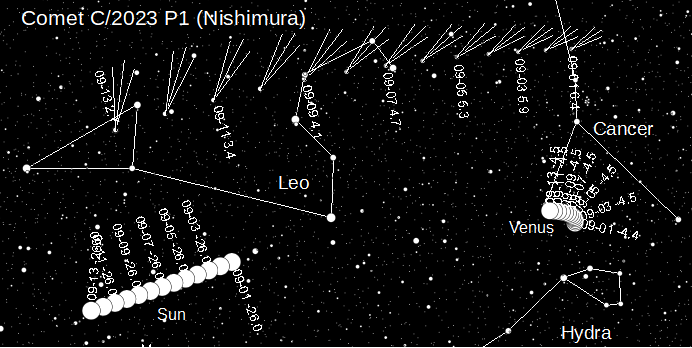
Comet Nishimura plotted against the stars of Cancer and Leo, along with the Sun and Venus. The comet, Venus and the Sun are labeled every other day with the month and day and estimated magnitude. Created using Cartes du Ciel (Sky Charts) by the author.
A pair of binoculars are the best way to view a comet that is just barely visible to the naked eye, or is competing with twilight. In both charts, the tail of the comet shows the direction that the tail would flow from and not its length.
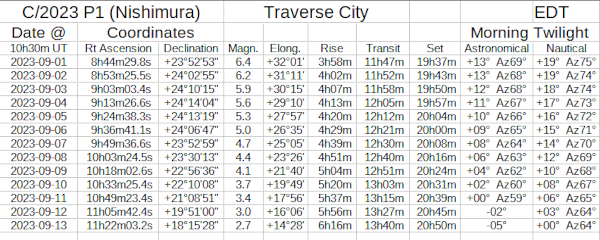
A table of positions of the comet at the beginning of astronomical and nautical twilight. Created using Cartes du Ciel.
At last report (August 26), it was half a magnitude dimmer than the predictions I have.
06/05/2023 – Ephemeris Extra – Venus prepares to leave the evening sky
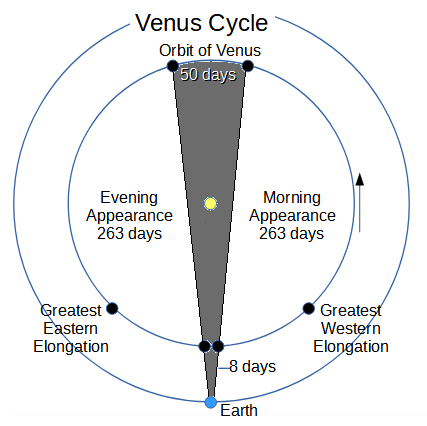
Based on the article of the same name printed in the Grand Traverse Astronomical Society’s June Stellar Sentinel newsletter.
Venus will not only leave the evening sky in dramatic fashion, but will enter the morning sky in an even more dramatic fashion in the latter half of August. Venus takes 225 days to orbit the Sun, but from an Earth also orbiting the Sun, the period from successive inferior or superior conjunctions of the Sun take 584 days or 19.2 months (1 year 7.2 months), or 9.6 months in the evening and morning skies respectively.
The interval from greatest eastern elongation, and inferior conjunction, when Venus passes between the Sun and the Earth is around 70 days. On June 4th, Venus will be at its greatest eastern elongation. The sight line from the Earth to Venus will be tangent to Venus’ orbit. Any Venusians, floating above their clouds, would see the Earth at quadrature, that is 90 degrees from the Sun.
Venus, at greatest eastern elongation, is heading straight toward us, so it will grow rapidly in apparent size. Venus begins the month with an apparent diameter of 22.9”. (” means seconds of arc. 1 second of arc = 1/3600 of a degree). At the end of the month Venus will have increased in apparent size to 33.5”, as can be seen with the illustration below. For comparison, Jupiter’s average apparent diameter is around 41”.
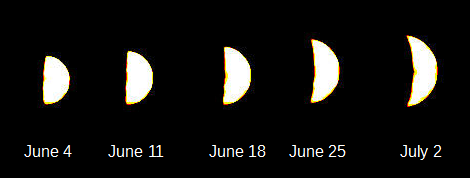
Sometime in July Venus will appear large enough to be able to detect it’s crescent phase in seven power binoculars. At inferior conjunction its apparent size will grow to 57.8”. Pity there won’t be a transit of Venus of the Sun to see it. By the way, if you missed the transits of 2004 and 2012, you won’t see another, unless you are a small child now, and will live to a very old age. There won’t be another transit of Venus until 2117.
The Mayan culture of Central America and the Yucatan Peninsula based one of their calendars on the Venus Cycle. It turns out that five Venus cycles equals a period just shy of eight years. That’s why we had 2 Venus transits eight years apart, June 8, 2004 and June 6, 2012. The next transits will be December 11, 2117 and December 8, 2125.
The Dresden Codex is one of only a handful of surviving Mayan books. It has a whole section on the Venus Cycle and how it fits into an 8 year Sequence. 13 eight year sequences equals 104 years, a Venus Round. Well, not quite, 103.91 years actually.
Venus has been ignored by NASA since the Magellan mission in the 1990s which mapped the surface through the clouds with radar. Recent reexamination of the results have suggested that there may have been relatively recent volcanism on the planet, even during the period that Magellan was imaging the surface of the planet.
NASA plans two missions to the planet toward the end of this decade. VERITAS stands for “Venus Emissivity, Radio Science, InSAR, Topography, and Spectroscopy” it’s a satellite map the surface in much greater detail than Magellan did. It will also map infrared emissions from Venus’ surface to map rock types.
DAVINCI+ stands for “Deep Atmosphere Venus Investigation of Noble gases, Chemistry, and Imaging” and will drop through the atmosphere taking measurements, and will take images of the surface like the Huygens probe did on Saturn’s largest moon Titan back in 2005.
In the past the Soviet Union sent landers and floated balloons in Venus’ atmosphere. The only active spacecraft that I know of orbiting Venus now is Japan’s Akatsuki, which is studying its atmosphere. However spacecraft using Venus as a gravity assist to get to Mercury or close to the Sun, have turned their instruments to Venus as they passed by.
Major Venusian events for the rest of 2023 (Eastern Time)
- June 4, 6:59 am – Venus at greatest eastern elongation 45.4°
- June 13, 7:05 am – Venus 0.5° north of the Beehive cluster
- June 21, 8:47 pm – Venus 4.1° south of the Moon
- July 1, 2:48 am – Venus in a quasi-conjunction with Mars, separation 3.6°
- July 7 – Greatest brilliancy, magnitude -4.7 (~36 days before inferior conjunction)
- July16, 3:49 am – Venus in a quasi-conjunction with Regulus
- July 27, 7:00 am – Mercury 5.1° north of Venus
- August 13, 7:10 am – Venus at inferior conjunction, 7.4° south of the Sun
- September 19 – Greatest brilliancy. Magnitude -4.8
- October 9, 2:10 am – Venus 2.3° south of Regulus
- October 23, 5:59 pm – Venus greatest western elongation 46.4°
- November 9, 4:28 am – Venus 1.1° south of the Moon
- November 29, 5:29 am – Venus 4.2°north of Spica
- December 9, 11:53 am – Venus 3.9° north of the Moon
Created from NASA’s SKYCAL Sky Events Calendar.
03/21/2023 – Ephemeris Extra – Spring has sprung without me
Being in the hospital and now in inpatient rehab one loses a sense of time. So the vernal equinox snuck by me unnoticed. My view of the outside world is another part of the hospital, a part of the HVAC system, and a piece of sky.
Yesterday, the Sun passed over the Earth’s equator, heading northward. The Sun is gradually setting at the South Pole and rising at the North Pole. Folks like me who live in the Northern Hemisphere are experiencing longer daylight than those south of the equator, who are beginning autumn. The daylight hours will increase daily until June 21st, the summer solstice. In the Interlochen/Traverse City area, that will be 15 hours and 34 minutes.
The cause of the Earth’s seasons is not our varying distance from the Sun in our eliptical orbit of the Sun of 93 million plus or minus a million and a half miles.By the way, the Earth is currently moving away from the Sun. It will be farthest from the Sun around July 4th or 5th.
Our perception of the advance of spring, besides the gradully warming temperatures and increasing daylight hours, will be the height of the Sun’s path in the sky, and the position of the Sun’s rise and set points on the horizon. All these annual changes are angles having to do with one’s latitude (an angle), Earth’s position in orbit (an angle), and the tilt of the Earth’s axis to it’s orbit (more angles).
Bob
03/19/2023 – Ephemeris Extra – Zodiacal light
This is the time of year when the faint glow can be seen in the west at the end of asttronomical twilight in the evening. It’s called zodiacal light. It is difficult to spot the first time. The final twilight glow tends to be horizontal, along the horizon, while źodiacal light has a thin pyramidal shape tilted to the left along the constellations of the zodiac. Right now, Venus appears in the heart of the glow.
Some of my older blog posts also cover zodiacal light with images of it I’ve taken, so search for zodiacal light in the spot provided.
On a personal note: I’m expected to be discharged from rehab by month’s end. I’m hoping that a couple of weeks after that, I can get back to a regular schedule. Here’s hoping.
Bob
11/12/2022 – Ephemeris Extra – Family Night at the Rogers Observatory is Canceled
We’re getting lake effect snow, which means clouds, too. So there is no hope for observing tonight.
Our next events will be
December 2: Grand Traverse Astronomical Society monthly meeting at 8 pm – the presentation Searching for the Star of Bethlehem by yours truly. There will be observing after the meeting if it is clear. This will be at Northwestern Michigan College’s Rogers Observatory.
December 3: Family Day at the Dennos Museum Center on the Northwestern Michigan College campus starting at 1 pm with hands-on activities and a presentation at 2 pm. This is in celebration of the NASA Kiosk at the Museum through December. The Museum admission fee is waived for Family Day.
10/02/2022 – Ephemeris Extra – NASA goes on the offensive
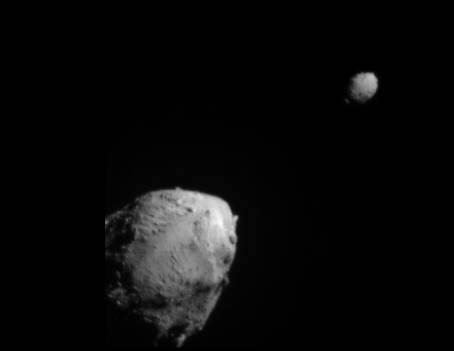
DART images of both Didymos, the big one, and Dimorphos, on approach. Credit NASA / JHAPL
This is a slightly revised version of my article in the Stellar Sentinel, the newsletter of the Grand Traverse Astronomical Society. Educators may receive a free PDF copy of this monthly publication via email, which covers astronomical topics and events visible from Northwest Lower Michigan. Send your request, stating your affiliation, to info@gtastro.org.
The score is: Asteroids-billions, NASA-1. It’s a bit unfair, since asteroids have been hitting the Earth for 4.567 billion years or so, and NASA has been around for 64 years before DART spacecraft collided with the asteroid Dimorphos. Hey, this was their first attempt at a small asteroid. As far as the 21st century destructive asteroid score is 1 to NASA’s 1, as far as I know.
That strike was in Chelyabinsk, Russia. That was February 15, 2013. We were all waiting on another asteroid making a close pass of the Earth, when the Chelyabinsk meteoroid exploded 14 miles above the city. Over a thousand people were injured by the blast wave. They saw the bright flash and rushed to the windows to see what it was. Then the blast wave hit, shattering the windows, causing glass cuts for over a thousand people. One building’s wall collapsed, and a fragment fell into a lake outside of town.
NASA’s record in attempting to hit a planetary object dates back to the early 1960s and the nine Pioneer missions to crash a probe on the Moon, sending back pictures all the way down. Back in the early 60s, just hitting a 2,100-mile (3380 kilometer) wide object a quarter of a million miles away was a dicey prospect. It’s one thing to miss the Moon on one side or the other, but to not have enough oomph to even make it all the way is downright embarrassing. NASA did much better by the end of the decade with the Apollo manned landings and bombarding the Moon with used space vehicles for seismic studies of its interior.
NASA actually collided a spacecraft into a comet. That was July 4, 2005, when the impactor part of the Deep Impact spacecraft hit Comet Tempel 1’s nucleus, attempting to study part of its subsurface. The non-impactor part was later renamed EPOXI and went on to fly by the dog-bone shaped Hartley 2 comet nucleus. Another reused comet explorer spacecraft Stardust after collecting cometary dust from Comet Wild 2 (pronounced Vilt 2), and possible interstellar dust penetrating the solar system, and after dropping the sample re-entry capsule back on Earth it ended in solar orbit. Later it was repurposed as the Stardust-NexT mission and flew by Tempel 1 six years later to study the crater the Deep Impact Impactor made in the comet.
To study the effect of a collision of a spacecraft from the Earth despite the fact that Dimorphos cannot be seen is a trick. However, the pair is an eclipsing binary from our point of view, so the brightness of the unresolved pair changes as they eclipse each other.
Before the collision, Dimorphos had an 11.9 hour orbit of Didymos. Dimorphos is a fifth the size of Didymos orbiting it at three times the primary’s radius. If the orbit is near circular, Dimorphos’ orbital velocity is only 0.39 mph (0.63 kph). It should be relatively easy to see a tiny change in Dimorphos’ orbital period.
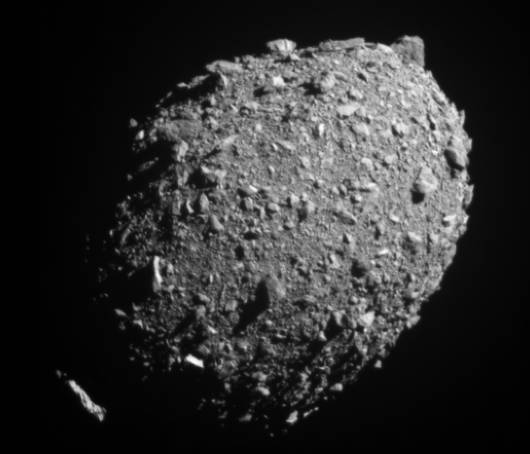
Last frame Dimorphos fit in from DART. Credit NASA / JHAPL.
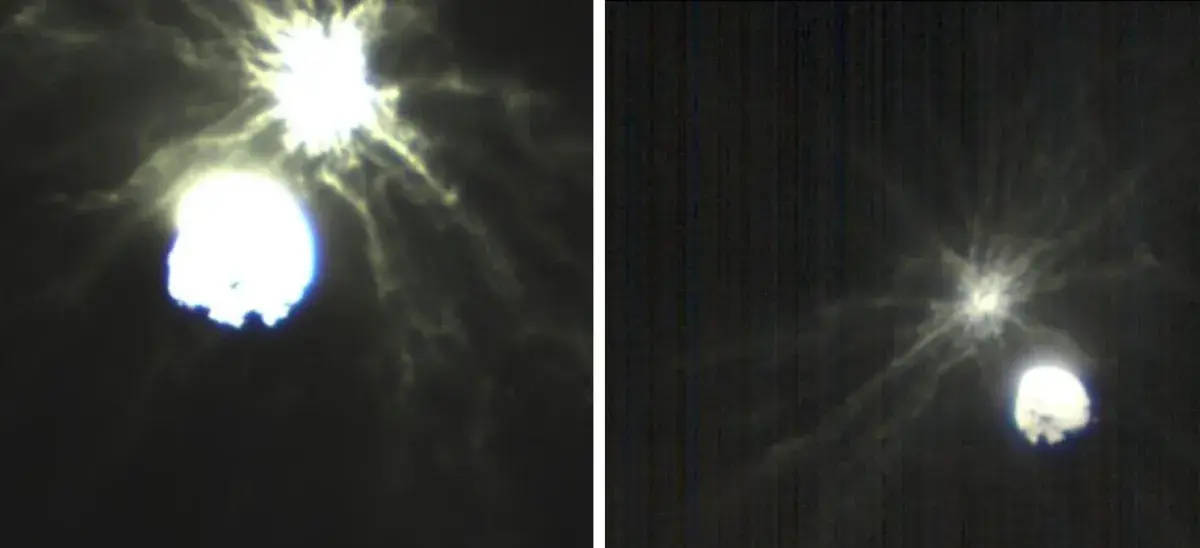
Two images from the LiciaCube satellite launched from the DART spacecraft 15 days before the impact, and trailing it to record the collision with its wide and narrow angle imagers. Dimorphos does appear to be a rubble pile asteroid from its appearance and the amount of ejecta caused by the impact. The ejecta adds to the effect of the spacecraft’s kinetic energy by pushing away from the asteroid by Newton’s third law of motion. Credit: Italian Space Agency.
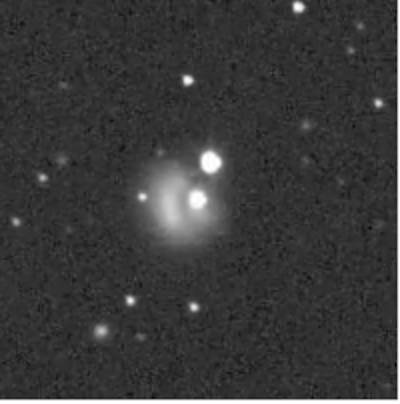
A frame from a time-lapse video taken from the ATLAS Project’s South African observatory of the unresolved Didymos – Dimorphos pair and the expanding ejecta cloud. The asteroid pair developed a dust tail like a comet for a while.
ATLAS is an acronym for a rather apocalyptic title “Asteroid Terrestrial-impact Last Alert System”. Developed by the University of Hawai’i and funded by NASA. It has two telescopes in Hawai’i, one in Chile, and one in South Africa. Credit: NASA/UH.
Days later, Dimorphos was exhibiting a thin dust tail, like a comet.
Now we wait on Earth’s observatories to observe of the period of Dimorphos’ orbit. It should decrease the orbital time.
Ephemeris Extra – Wandering through Sagittarius
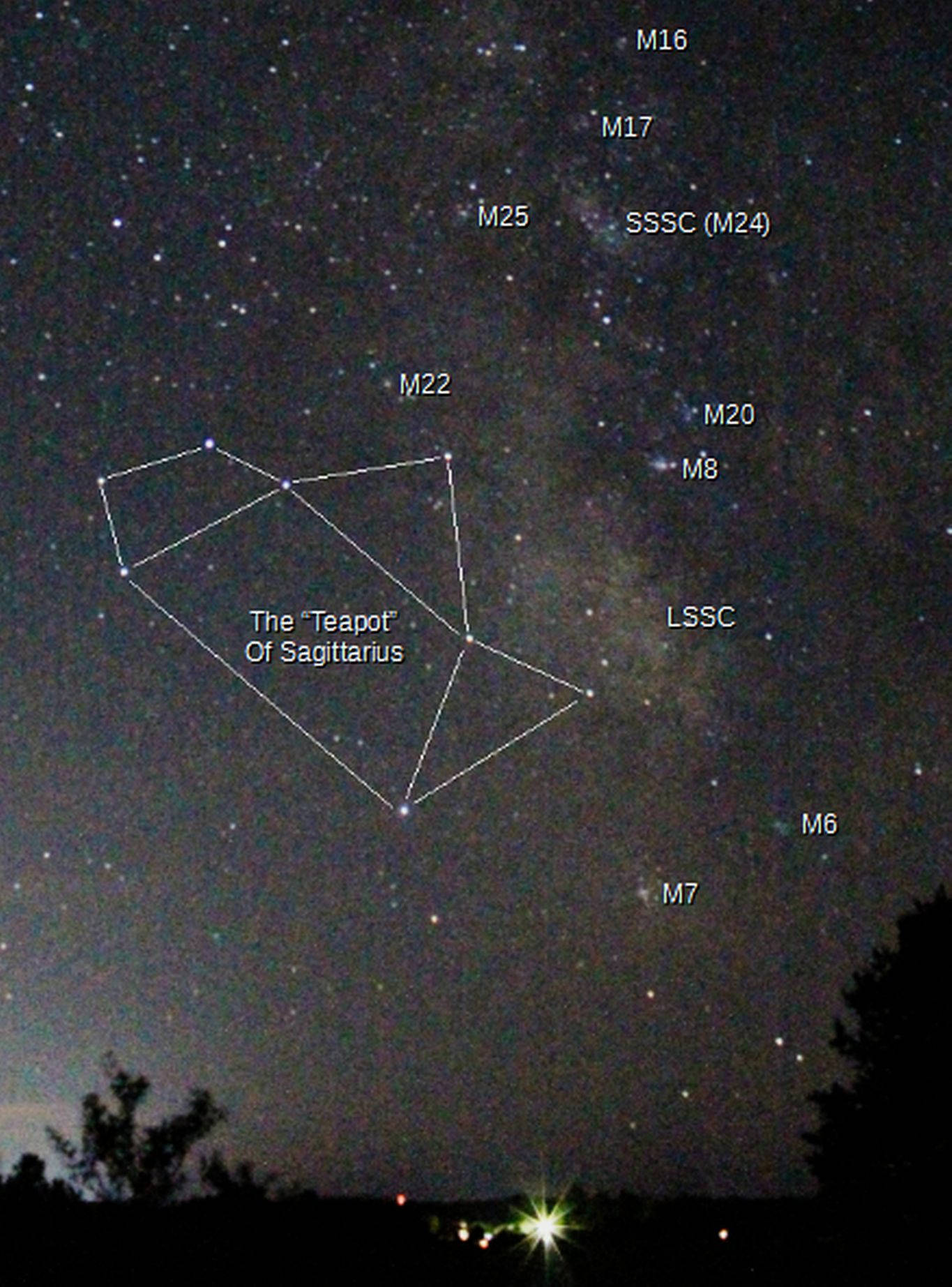
Sagittarius in a short time exposure with added annotations. The “M” designations are objects in Charles Messier’s catalog created in the latter half of the 18th century. LSSC is the Large Sagittarius Star Cloud, SSSC is the Small Sagittarius Star Cloud. Credit Bob Moler.
Sagittarius is seen low in the south in August. It’s between Scorpius to the west, and Capricornus, rising in the southeast. The name Sagittarius simply means archer. It doesn’t describe the fact that the archer isn’t just any old bloke with a bow and arrow, but is, indeed, a centaur, one of the two in the list of constellations. The other, Centaurus, is too far south to be seen from Michigan. And whose brightest star, Alpha Centauri, is in the closest star system to our solar system.
Centaurs, as a rule, were a rowdy bunch, the ancient Greek equivalent to a modern motorcycle gang. However, the centaur depicted by Sagittarius can be thought to be Chiron, though it can also be ascribed to Centaurus. Chiron was learned, a teacher and physician. I’ve noticed that in some artist’s depictions of Chiron, he is teaching Achilles how to use the bow and arrow. He also taught medicine to Asclepius, the great physician, who is seen in the heavens as the constellation Ophiuchus, above and right of Sagittarius.
What most of us see in the stars here is maybe a bow drawn to shoot at the heart of Scorpius, or a stout little teapot as in the children’s song. It even has the Milky Way seeming to rise from the spout like steam. The teapot rises in the southeast as if standing upright, and as the night wears on, it rises and move westward, slowly tilting to pour out its tea on the southwestern horizon.
The area of Sagittarius and the Milky Way is a fantastic part of the sky to explore with binoculars or a low power telescope on moonless nights. At the head of this post is a photograph of Sagittarius and the Milky Way taken from my home, with lines and labels. It’s somewhat spoiled by the sky glow from Chum’s Corner, a small commercial center 3.6 miles away, from the lower left. Most binoculars will show open or galactic star clusters as fuzzy spots like nebulae, which are fuzzy because they are clouds. The older globular star clusters require larger amateur telescopes to resolve.
I’ve only pointed out one in the image, that’s M22, whose designation, we have fun with at star parties at the Sleeping Bear Dunes National Lakeshore, since the road M22 runs through the park. Which came first? That’s easy, Charles Messier cataloged his 22nd object before Michigan was a state or even had roads. Well, maybe there were a few, around Detroit and Sault Ste. Marie, back when the major “roads” were the Great Lakes, and the rest Indian trails.
A telescope, even a small one, will resolve open clusters, showing individual stars. Telescopes will show the shapes of nebulae if they are bright enough.
One nebula with a distinctive shape is M17. The descriptive name I first knew it as was the Omega Nebula, and also the Horseshoe Nebula. To me, it never looked like either. It looked like a check mark, or a somewhat short necked swan. And it also goes by those names too. The planetarium program I use a lot, Stellarium, also calls it the Lobster nebula. I’m not much for seafood, but it doesn’t look like a lobster, or maybe I’m not hungry enough.
M16, is the Eagle Nebula. It has an associated star cluster. My eyes are drawn to the star cluster. The nebulosity is very faint, and I usually can’t see it. Part of the nebula was famously photographed by the Hubble Space Telescope and called the Pillars of Creation. In actuality, they are the Pillars of Destruction as they are being blown away by the stellar winds of the star cluster.
M8 is the Lagoon Nebula, it also has an associated star cluster. In telescopes, it is crossed by a narrow dust cloud suggestive of a lagoon. Nearby M20 is the Trifid nebula, which has a low surface brightness and can easily be missed. It is crossed by three narrow dust clouds dividing it into three, or on closer inspection, four wedges.
These just scratch the surface. So with or without optical aid wander through the celestial wonders and star clouds of Sagittarius. You have August and September to do it in the evening before they set for another year.
Based on an article I wrote for the August 2022 issue of the Stellar Sentinel, the Newsletter of the Grand Traverse Astronomical Society.
Ephemeris Extra – Sunrise solar eclipse
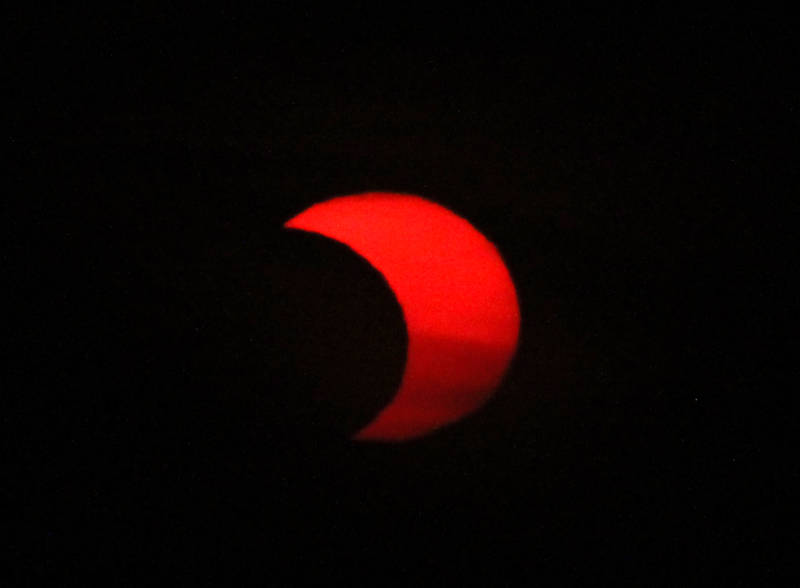
The partially eclipsed Sun this morning, taken through a solar filter, so it’s redder than it actually was. Taken shortly after 6 am from Traverse City, MI West Middle School. There were quite a bit of clouds on the horizon. Credit Bob Moler.
Here is an unfiltered view taken a few minutes earlier:
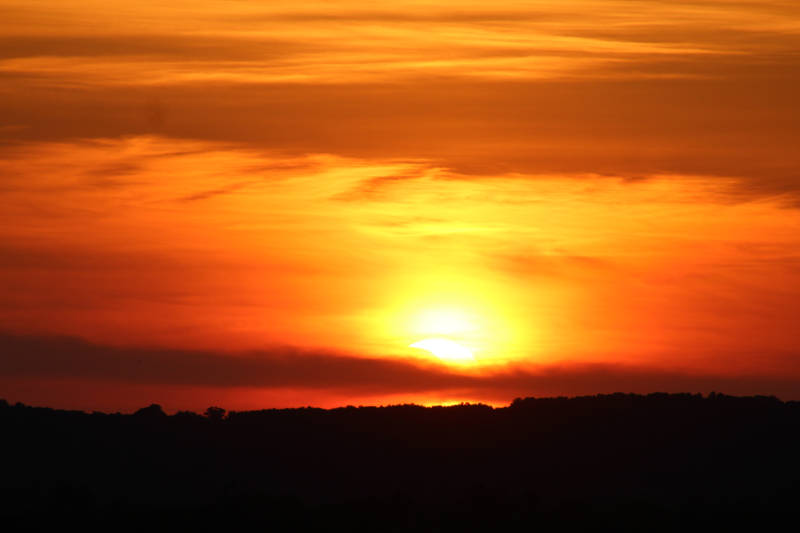
Here is an unfiltered shot of the Sun bisected by a cloud. Credit Bob Moler.
12/11/2020 – Ephemeris Extra – Venus will hide behind the Moon for W US, Canada and N Pacific Tomorrow
Tomorrow Saturday, December 12, 2020 Venus will be occulted, or covered, by the thin crescent Moon for the area bounded in the map below. The southern boundary is a thin red line denoting that the event will take place in daylight. For safety sake observe the event from the shadow of a building open to the sky west of the Sun to not inadvertently point binoculars or telescope toward the Sun and cause permanent damage to your eyes. Venus is visible in the daytime. A program like Stellarium will help in locating Venus and determination of the time of the event for your location. Also, for Stellarium, in the configuration window’s Tool tab make sure “Topocentric coordinates” is checked.
The event will NOT be visible from Michigan.
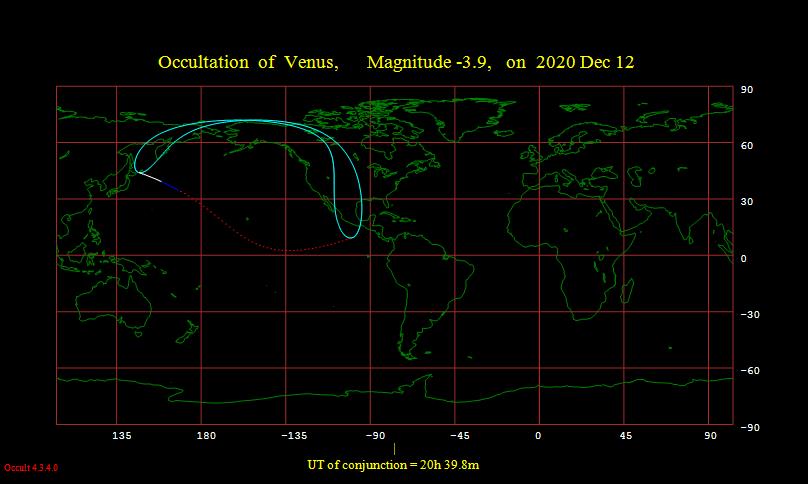
Occultation of Venus World map 12/12/2020. The occultation will be visible within the bounded area. For the area that looks like a lazy figure 8 the occultation will start (on the left) or end as Venus and the Moon rises or sets. For most areas within the bounded area the occultation is a daytime event. Credit Occult4.
 Bob Moler's Ephemeris Blog