Archive
Ephemeris: 10/27/2025 – Most of the mass in the universe is unseen
This is Ephemeris for Monday, October 27th. Today the Sun will be up for 10 hours and 23 minutes, setting at 6:38, and it will rise tomorrow at 8:15. The Moon, 2 days before first quarter, will set at 10:31 this evening.
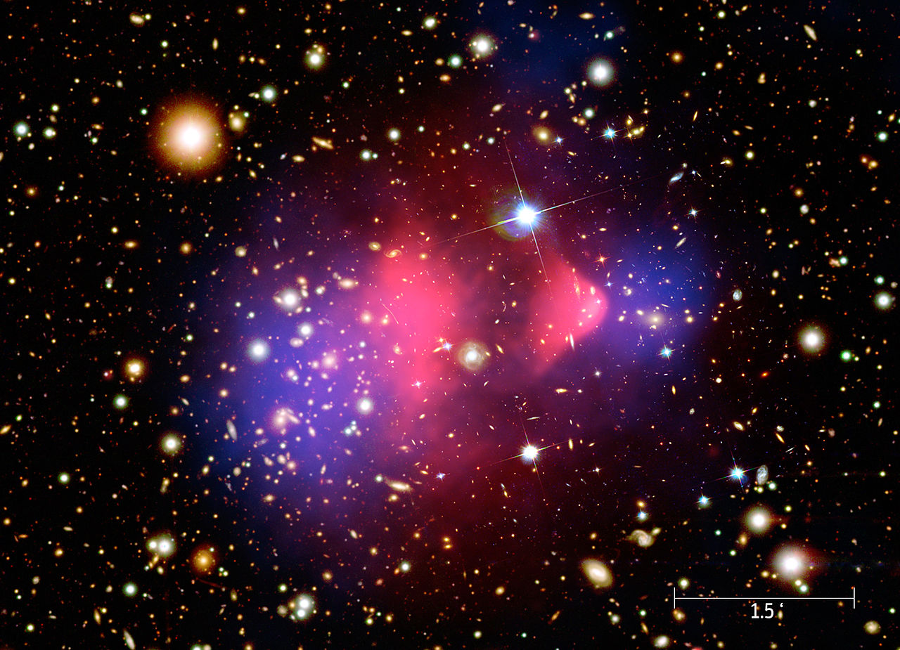
There is much more matter in the universe than we can see with our telescopes. This began to be apparent back in the 1930s when Fritz Zwicky discovered that galaxies in clusters were moving too rapidly. They should be flying apart, but they were not. Later, Vera Rubin found that stars moved around the center of galaxies at pretty much uniform speeds. One would expect stars farther from the center of a galaxy to move slower. So there must be some matter out there creating gravity by its mass that was invisible. This became what we call dark matter. No one knows exactly what it is, though there have been several hypotheses put forth. It can be detected by its warping of space-time, due to its mass, to distort the shapes of the galaxies beyond it.
The astronomical event times given in this blog are for the Traverse City/Interlochen area of Michigan (Lat 44.7° N, Long 85.7° W; EDT, UT – 4 hours) unless stated otherwise. Times will be different for other locations.
Addendum
Ephemeris: 10/24/2025 – How to spot the Double Cluster
This is Ephemeris for Friday, October 24th. Today the Sun will be up for 10 hours and 32 minutes, setting at 6:42, and it will rise tomorrow at 8:11. The Moon, 3 days past new, will set at 7:55 this evening.
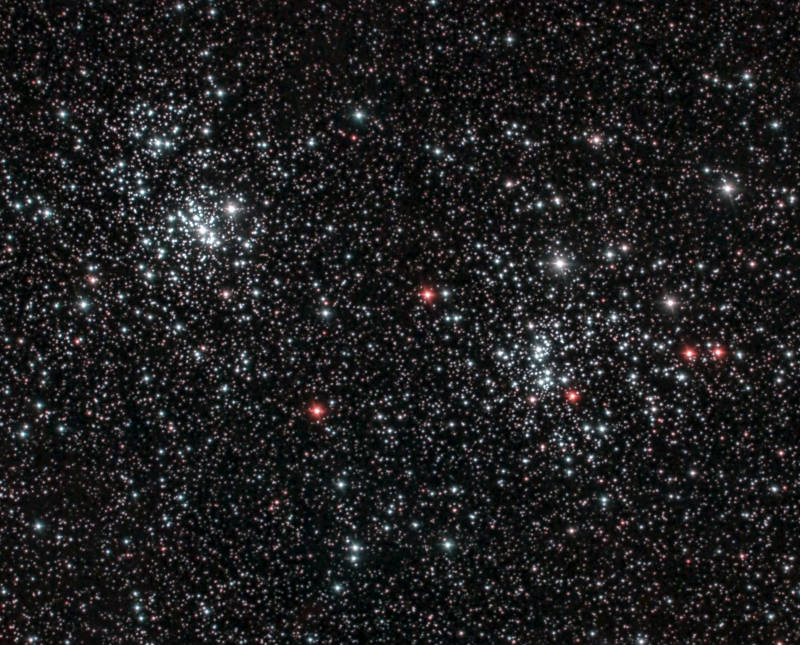
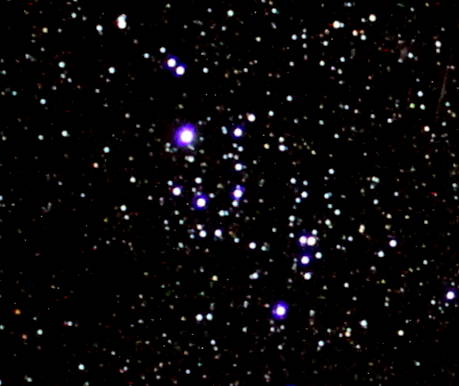
This pair of objects are about as dim as one can see with the naked eye, but very rewarding for binoculars or small telescope, the Double Cluster. It’s a fine pair of star clusters just below the W of the constellation of Cassiopeia the queen located in the northeast. Draw a vertical line down from the middle star of the W through the next star into the glow of the Milky Way. The Double Cluster appears to the unaided eye as a brighter glow of the Milky Way. This is confirmed with binoculars. But in a small telescope it becomes two clusters of sparkling diamonds. The clusters are much younger than the Sun, so their brightest stars are blue-white to our eyes. The average distance of the two from Earth is 7,500 light years.
The astronomical event times given in this blog are for the Traverse City/Interlochen area of Michigan (Lat 44.7° N, Long 85.7° W; EDT, UT – 4 hours) unless stated otherwise. Times will be different for other locations.
Addendum
Ephemeris: 10/23/2025 – Finding Perseus the hero
This is Ephemeris for Thursday, October 23rd. Today the Sun will be up for 10 hours and 35 minutes, setting at 6:44, and it will rise tomorrow at 8:10. The Moon, 2 days past new, will set at 7:21 this evening.
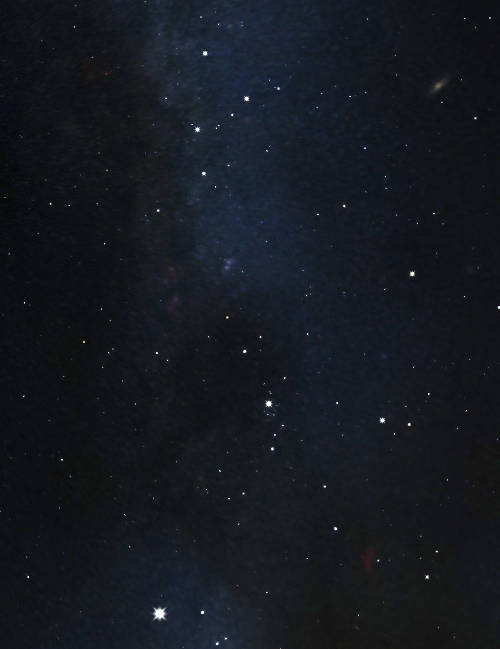
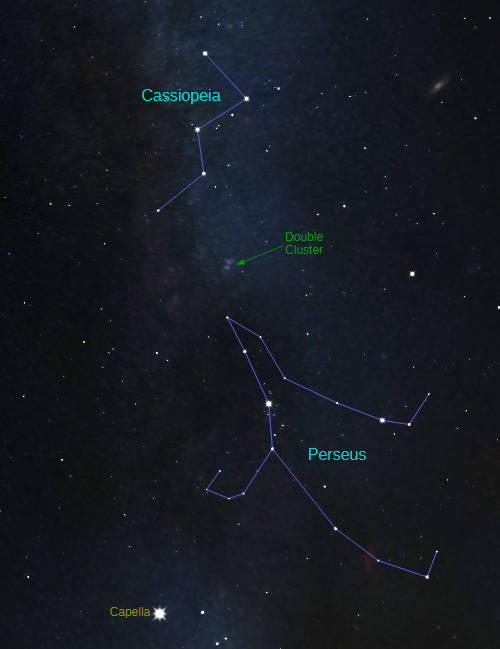
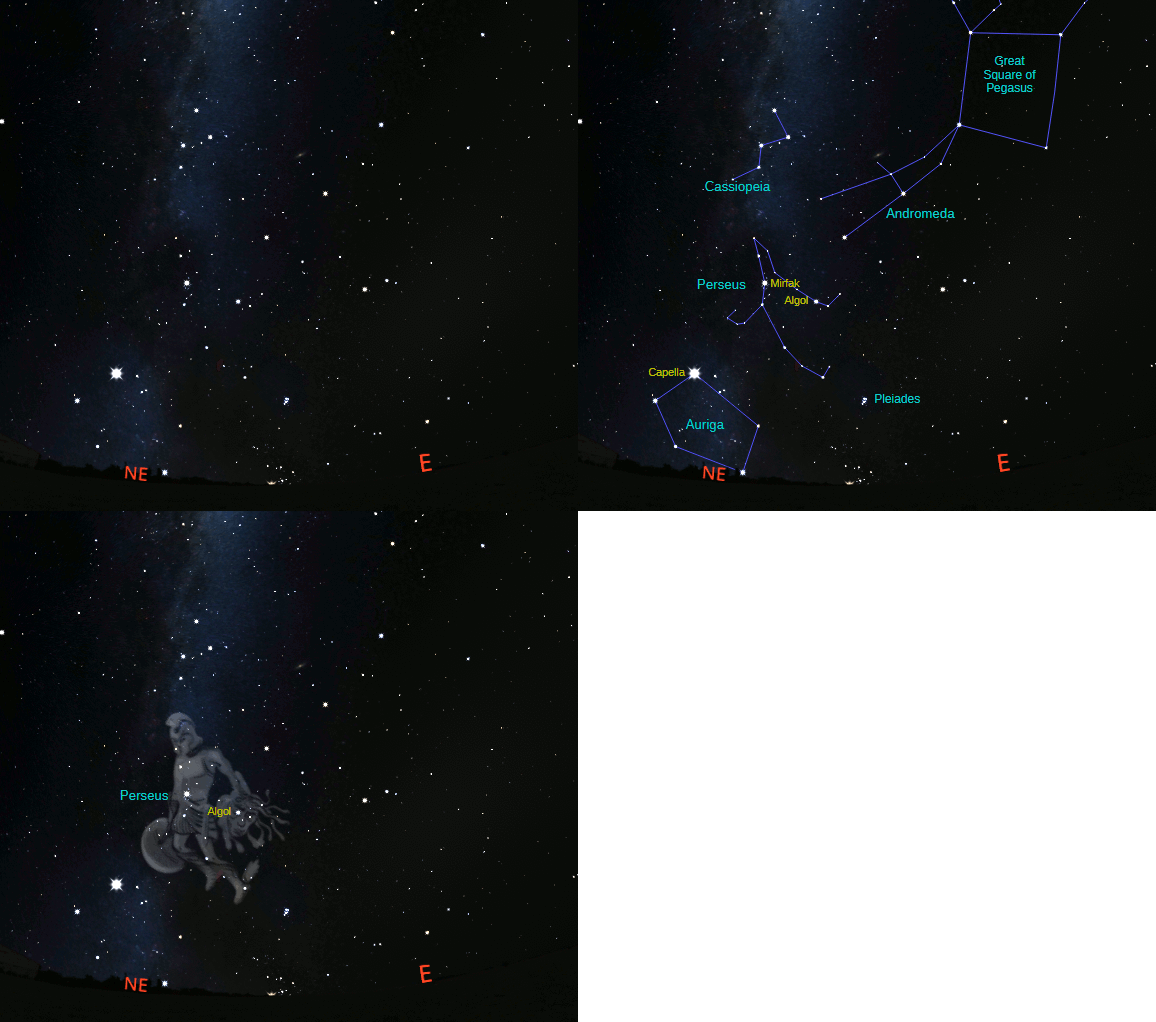
About a third the way from the east northeastern horizon to the zenith at 9 p.m. and below the letter W shaped constellation of Cassiopeia the queen is Perseus the hero. It’s kind of an odd shape for a hero, To me it looks kinda like the cartoon roadrunner. To those who’re mathematically inclined its shape is also like the Greek letter pi on its side. It’s two brightest stars are Mirfak and Algol the demon star, the still winking eye of Medusa. Look at the area around Mirfak with binoculars and a large group of stars just below naked eye visibility will appear. It’s called the Alpha Persei Association. That’s because Mirfak is also known as Alpha Persei. The group is about 560 light years away, which are farther away than the Pleiades, which is below and to the right of them.
The astronomical event times given in this blog are for the Traverse City/Interlochen area of Michigan (Lat 44.7° N, Long 85.7° W; EDT, UT – 4 hours) unless stated otherwise. Times will be different for other locations.
Addendum
Ephemeris: 10/22/2025 – Taking our weekly look at the whereabouts of the naked-eye planets
This is Ephemeris for Wednesday, October 22nd. Today the Sun will be up for 10 hours and 38 minutes, setting at 6:45, and it will rise tomorrow at 8:09. The Moon, 1 day past new, will set at 6:54 this evening.
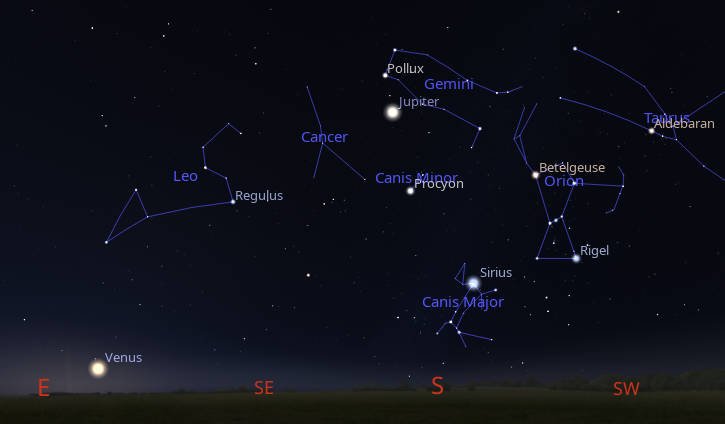
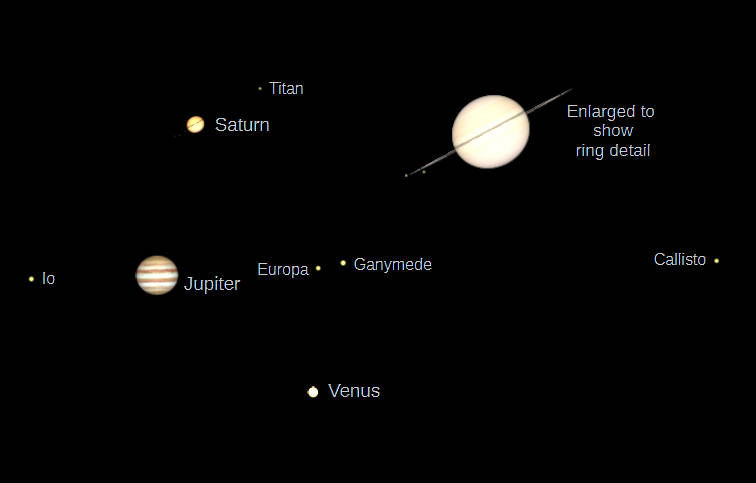
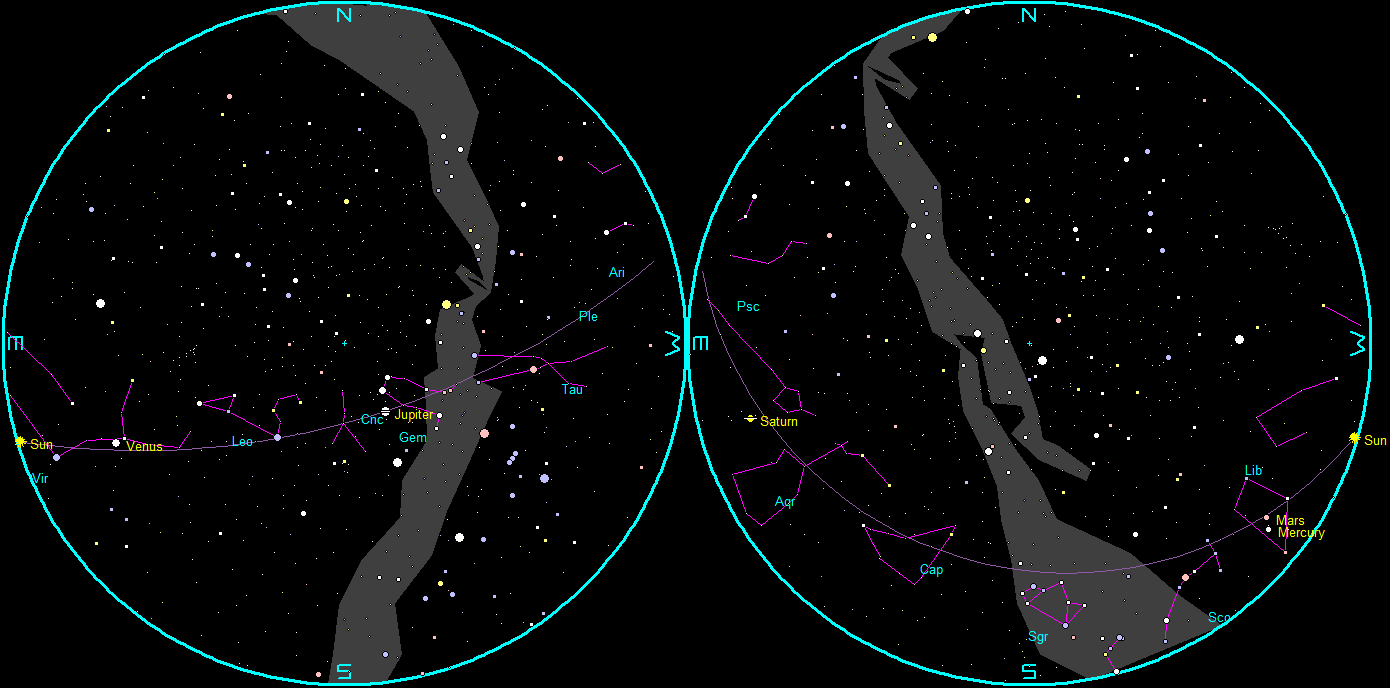
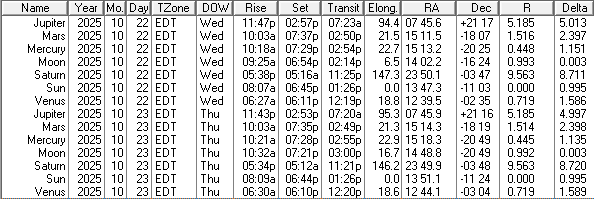
Let’s take our weekly look at the whereabouts of the naked-eye planets. Saturn is the brightest star like object in the east southeastern sky at 8 PM. In a telescope Saturn sports a very thin ring, eight tenths of a degree from being edge on in telescopes. Many times I’ve been asked whether they can see Saturn’s rings in their telescope. Normally I’d say yes. Currently, the rings appear very thin and can be difficult to pick up. Jupiter will finally rise before midnight, barely, at 11:50 PM. By 7 AM, it will appear high in the south-southeast, below the stars of Gemini, with Orion and the other bright stars of winter in the south. Brilliant Venus, which will rise at 6:30 AM will be very low in the east at 7 AM.
The astronomical event times given in this blog are for the Traverse City/Interlochen area of Michigan (Lat 44.7° N, Long 85.7° W; EDT, UT – 4 hours) unless stated otherwise. Times will be different for other locations.
Addendum
Ephemeris: 10/21/2025 – Finding Andromeda
This is Ephemeris for Tuesday, October 21st. Today the Sun will be up for 10 hours and 41 minutes, setting at 6:47, and it will rise tomorrow at 8:07. The Moon is new today, and won’t be visible.
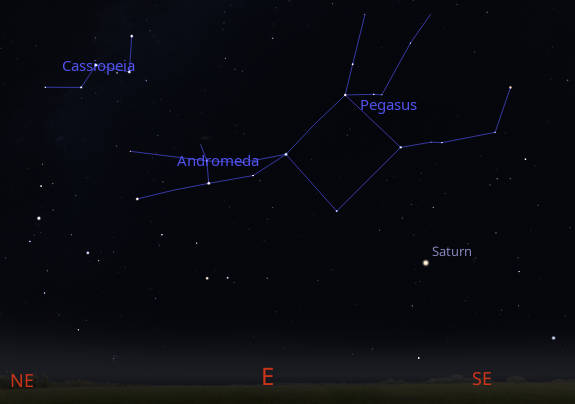
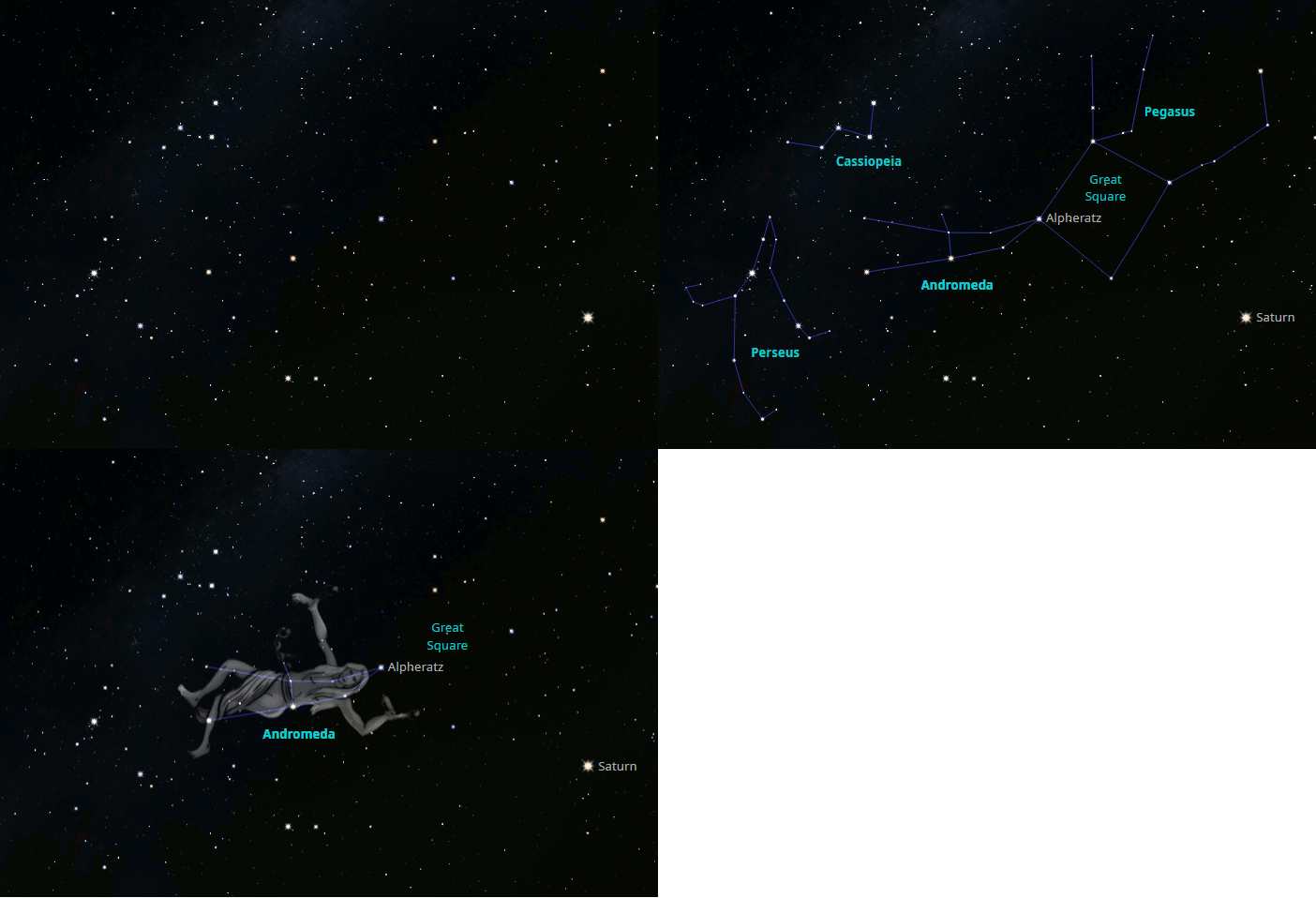
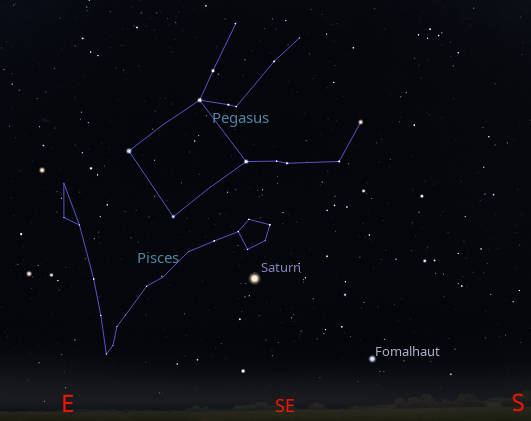
Tonight at 9:00 PM Saturn is in the southeast, with the Great Square of Pegasus above and to the left. Off the leftmost star of the Great Square, called Alpheratz, are two curved lines of stars to the left and a bit below, and slightly diverging. They might be mistaken for the hind legs of the horse, which is flying upside down. It’s another constellation, that of Andromeda the Princess, daughter of Cassiopeia, the W shaped constellation to the upper left. Andromeda was rescued by hero Perseus which is another constellation left of her, which we’ll get to later on this week. Andromeda’s claim to scientific fame is the large galaxy located there, the Great Andromeda Galaxy, probably the farthest thing one can spot with the naked eye.
The astronomical event times given in this blog are for the Traverse City/Interlochen area of Michigan (Lat 44.7° N, Long 85.7° W; EDT, UT – 4 hours) unless stated otherwise. Times will be different for other locations.
Addendum
Andromeda is part of the Great Star Story of Autumn. My take on it is linked Here.
Ephemeris: 10/20/2025 – The Fisher paints the autumn colors
This is Ephemeris for Monday, October 20th. Today the Sun will be up for 10 hours and 44 minutes, setting at 6:49, and it will rise tomorrow at 8:06. The Moon, 1 day before new, will rise at 8:19 tomorrow morning.
The leaves on the trees are beginning to turn to reds and yellows as we advance through autumn. The native Anishinaabe peoples, whose homeland we share, have a story about how that came to be. Of how a magical weasel-like creature called the Fisher or, in their native language, Ojiig Anung (Fisher Star), brought summer to the Earth from Skyland. For his trouble, he was shot with an arrow in his only vulnerable spot, the tip of his tail. As he fell to Earth Gichi Manitou, the Great Spirit, caught him and placed him in the sky where we see the Great Bear and the Big Dipper. Every late autumn night we see his tail, the handle of the dipper, slowly swooping down to the horizon in the north, where his bloody tail paints the trees with their autumn colors.
The astronomical event times given in this blog are for the Traverse City/Interlochen area of Michigan (Lat 44.7° N, Long 85.7° W; EDT, UT – 4 hours) unless stated otherwise. Times will be different for other locations.
Addendum
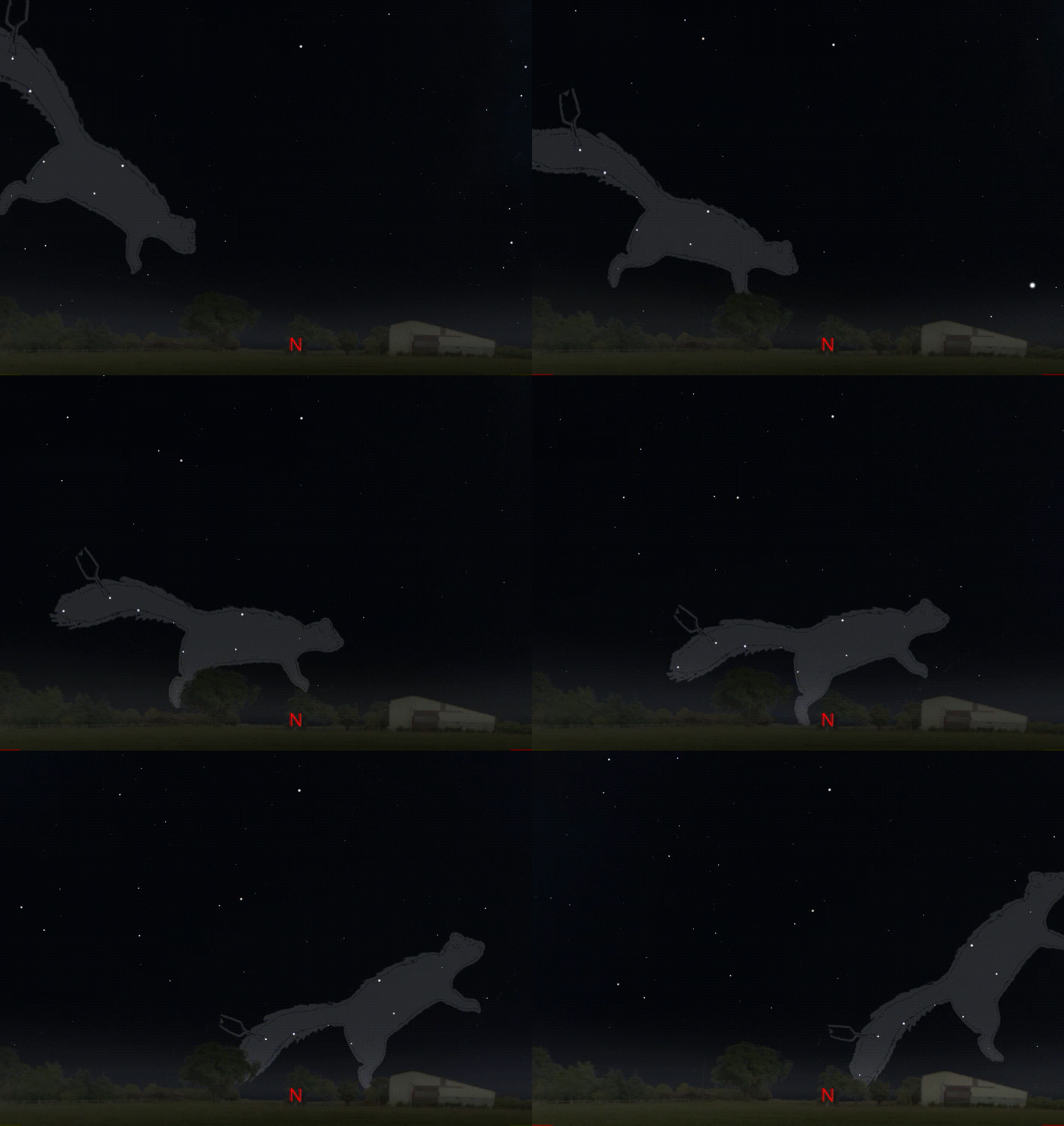
For my take on the story of how the Fisher brought summer to the Earth, click here.
Ephemeris: 10/17/2025 – Fomalhaut, lonely again
This is Ephemeris for Friday, October 17th. Today the Sun will be up for 10 hours and 52 minutes, setting at 6:54, and it will rise tomorrow at 8:02. The Moon, halfway from last quarter to new, will rise at 5:04 tomorrow morning.
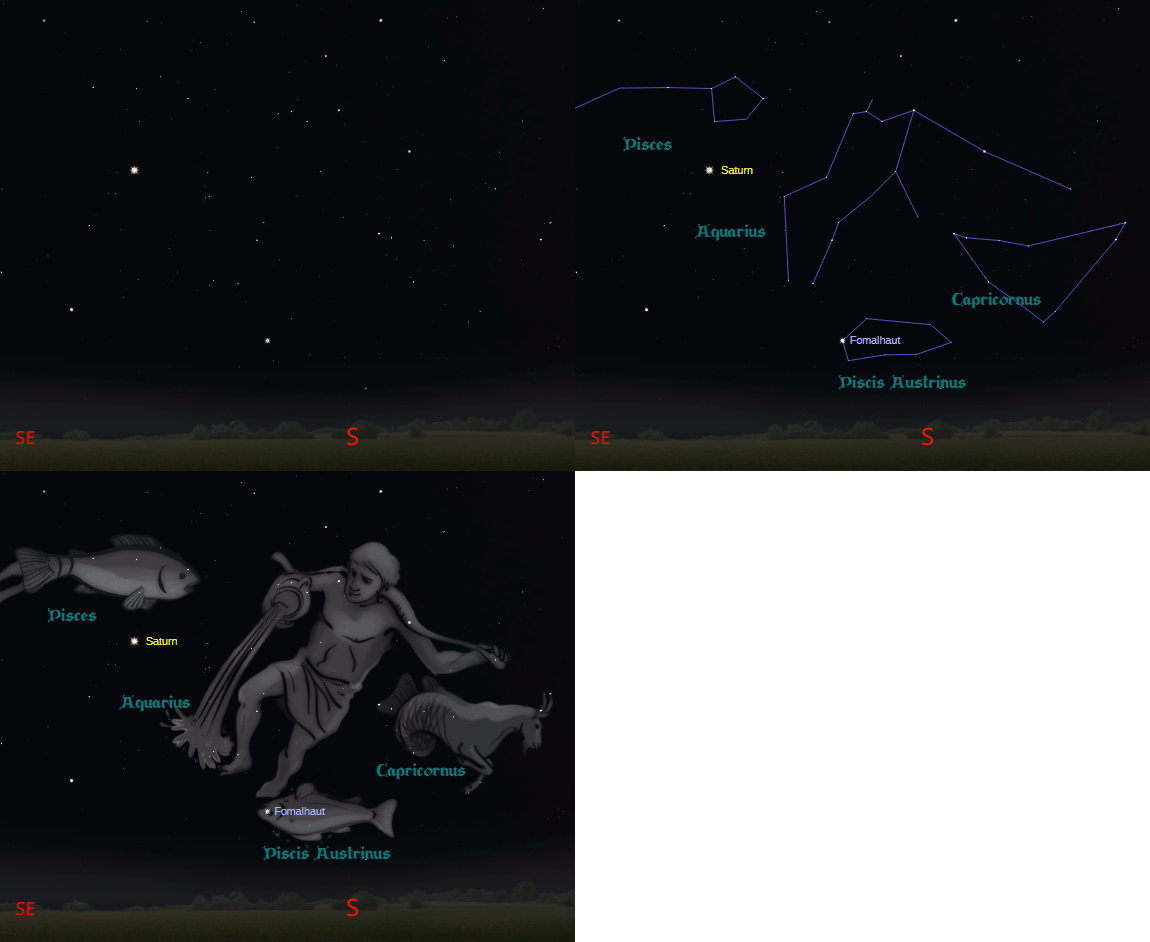
There’s a bright star that appears for only seven and a half hours on autumn evenings. Its appearance, low in the south in the evening, is a clear indication of autumn. It is currently below and right of the much brighter Saturn. The star’s name is Fomalhaut, which means fish’s mouth. That’s fitting because it’s in the constellation of Piscis Austrinus, the southern fish. At our latitude it’s kind of the fish that got away, because Fomalhaut is low in our skies where stars lose more than half their brightness. For the last few years Jupiter, then Saturn have kept it company. However, Saturn is moving on, having shifted into Pisces, leaving Fomalhaut to its lonely vigil in the south.
The astronomical event times given in this blog are for the Traverse City/Interlochen area of Michigan (Lat 44.7° N, Long 85.7° W; EDT, UT – 4 hours) unless stated otherwise. Times will be different for other locations.
Addendum
Ephemeris: 10/16/2025 – The Anishinaabe saw a Moose where Pegasus is
This is Ephemeris for Thursday, October 16th. Today the Sun will be up for 10 hours and 55 minutes, setting at 6:55, and it will rise tomorrow at 8:01. The Moon, 3 days past last quarter, will rise at 3:57 tomorrow morning.
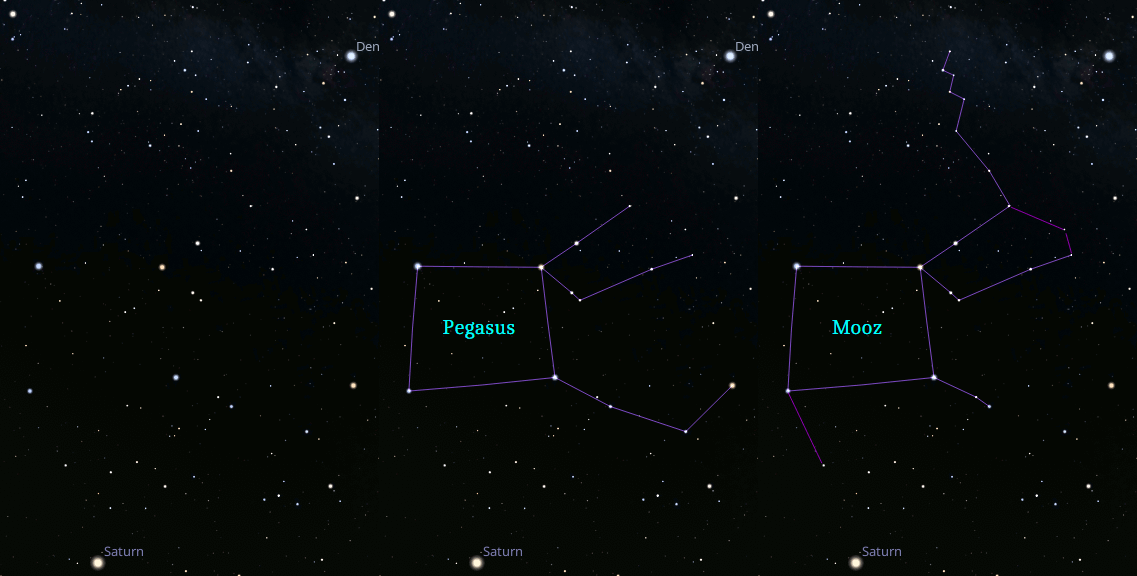
High in the southeast at 10 PM is the constellation officially called Pegasus the flying horse. The front part of his body is a pattern of stars we call the Great Square of Pegasus, and he’s flying upside down, quite an aerobatic horse. His wings are not seen in the stars, however his neck and head, up to his nose is, along with his front legs. The Anishinaabe peoples of this area call it Mooz, from which we get our word moose. He’s right side up, facing the west. His head is where we see the front legs of Pegasus, and his antlers are above it where there is another official constellation made of faint stars called Lacerta, which is a lizard. Not everyone sees the same figure in the stars.
The astronomical event times given in this blog are for the Traverse City/Interlochen area of Michigan (Lat 44.7° N, Long 85.7° W; EDT, UT – 4 hours) unless stated otherwise. Times will be different for other locations.
Addendum
Ephemeris: 10/15/2025 – Taking our weekly look at the whereabouts of the naked-eye planets
This is Ephemeris for Wednesday, October 15th. Today the Sun will be up for 10 hours and 58 minutes, setting at 6:57, and it will rise tomorrow at 7:59. The Moon, 2 days past last quarter, will rise at 2:47 tomorrow morning.
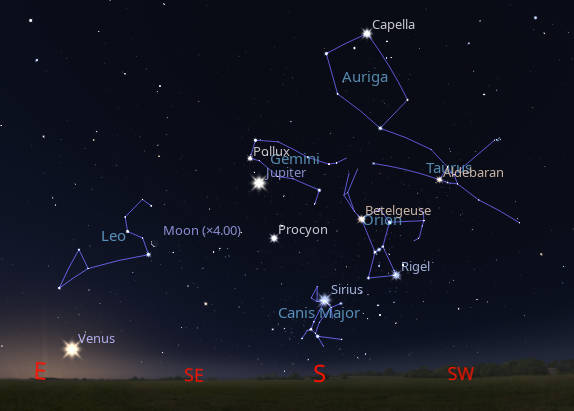
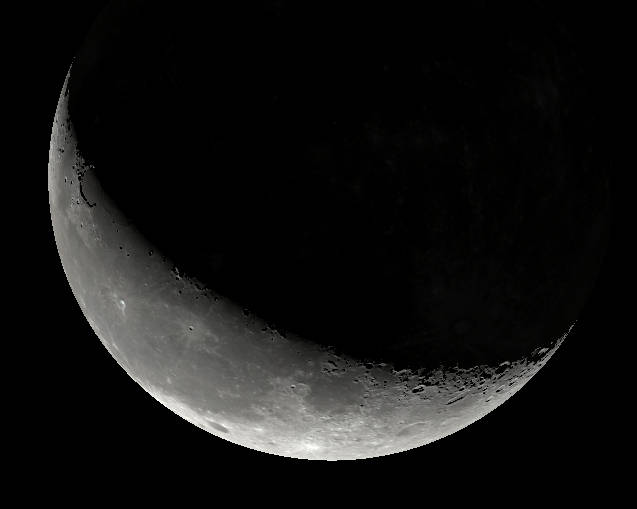
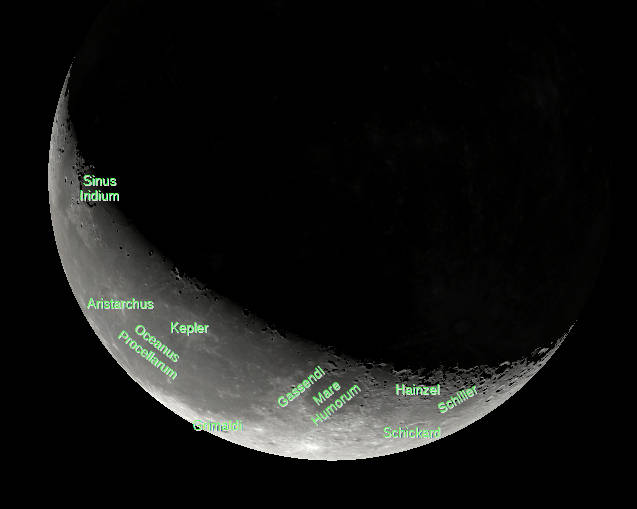
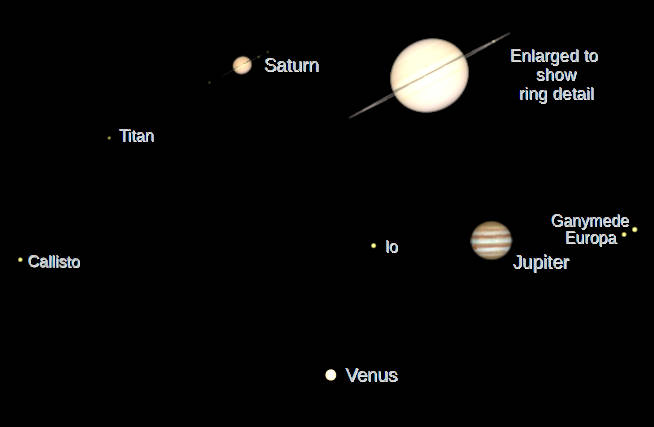
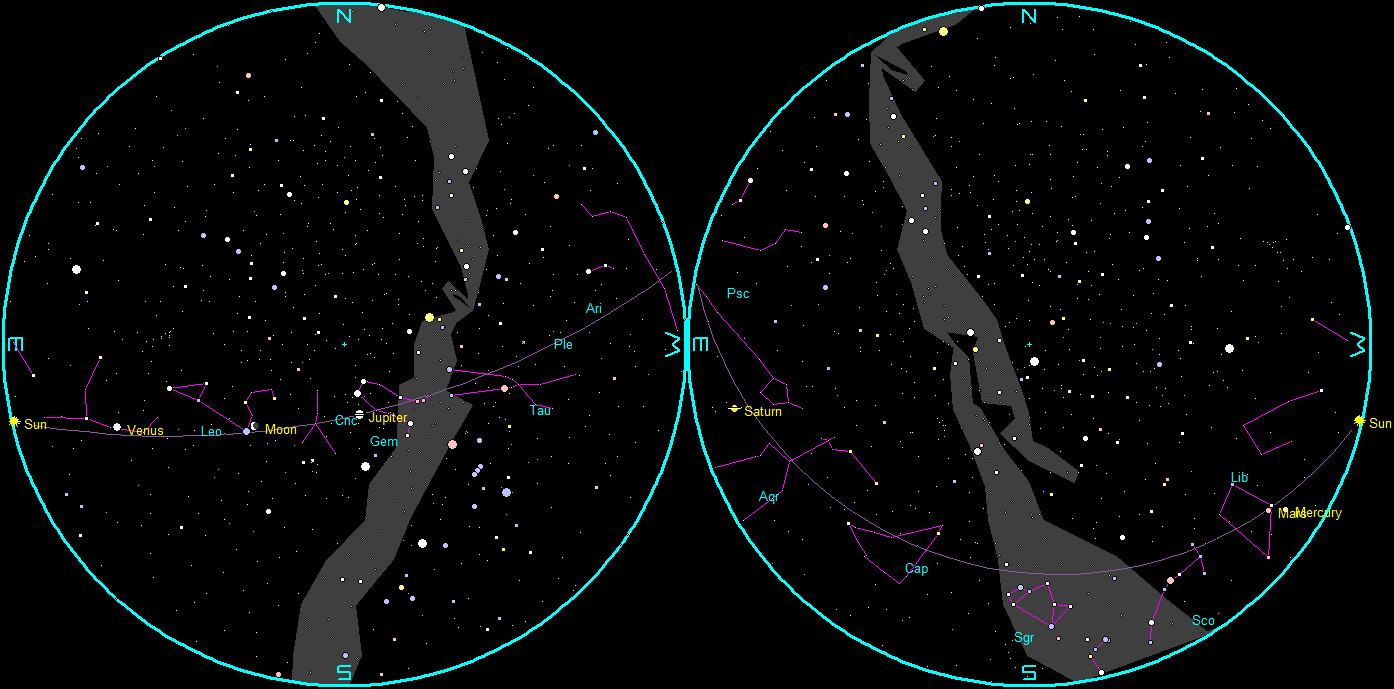
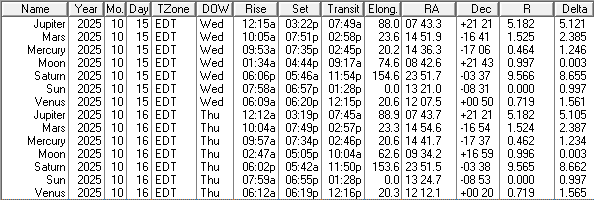
Let’s take our weekly look at the whereabouts of the naked-eye planets. Saturn is the brightest star like object in the east southeastern sky at 8 PM. In a telescope Saturn sports a very thin ring, 1° from being edge on in telescopes. Many times I’ve been asked whether they can see Saturn’s rings in their telescope. Normally I’d say yes. Currently, the rings appear very thin and can be difficult to pick up. Jupiter will rise at 12:11 AM. By 7 AM, it will appear high in the south-southeast, below the stars of Gemini, with Orion and the other bright stars of Winter in the south. Brilliant Venus, which will rise at 6:12 AM will be low in the east at 7 AM. Tomorrow morning the waning crescent of the Moon will appear between the two planets.
The astronomical event times given in this blog are for the Traverse City/Interlochen area of Michigan (Lat 44.7° N, Long 85.7° W; EDT, UT – 4 hours) unless stated otherwise. Times will be different for other locations.
Addendum
Ephemeris: 10/14/2025 – Ada Lovelace Day
This is Ephemeris for Ada Lovelace Day, Tuesday, October 14th. Today the Sun will be up for 11 hours and 1 minute, setting at 6:59, and it will rise tomorrow at 7:58. The Moon, 1 day past last quarter, will rise at 1:34 tomorrow morning.
Ada Lovelace (1815-1852), or more properly Augusta Ada King, Countess of Lovelace, was the daughter of Lord Byron and worked for Charles Babbage, a brilliant mechanical engineer and mathematician in the early 19th century. She is considered the first computer programmer. She devised a way to use the same punch cards that were used on the Jacquard loom to store and run her programs, even though Babbage was unable to complete his mechanical computer the Analytical Engine in the mid 1800s. This day is set aside to celebrate the accomplishments of all the women of Science, Technology, Engineering and Math, (STEM). The computer language, Ada, was named after her, and was created for the US Department of Defense or whatever they call it this week.
The astronomical event times given in this blog are for the Traverse City/Interlochen area of Michigan (Lat 44.7° N, Long 85.7° W; EDT, UT – 4 hours) unless stated otherwise. Times will be different for other locations.
Addendum


The reason I’m interested in Ada Lovelace and her story is that I spent 45 years as a systems analyst, creating and coding computer applications for small businesses and banks. I ended up heading the IT department for a local bank, from which I retired 12 years ago. Astronomy is my hobby, though I’ve made a few bucks at it in my earlier years as a planetarium technician and lecturer.
 Bob Moler's Ephemeris Blog