Archive
Ephemeris: 09/12/2025 – Cassiopeia through the year
This is Ephemeris for Friday, September 12th. Today the Sun will be up for 12 hours and 39 minutes, setting at 7:58, and it will rise tomorrow at 7:19. The Moon, 2 days before last quarter, will rise at 10:19 this evening.
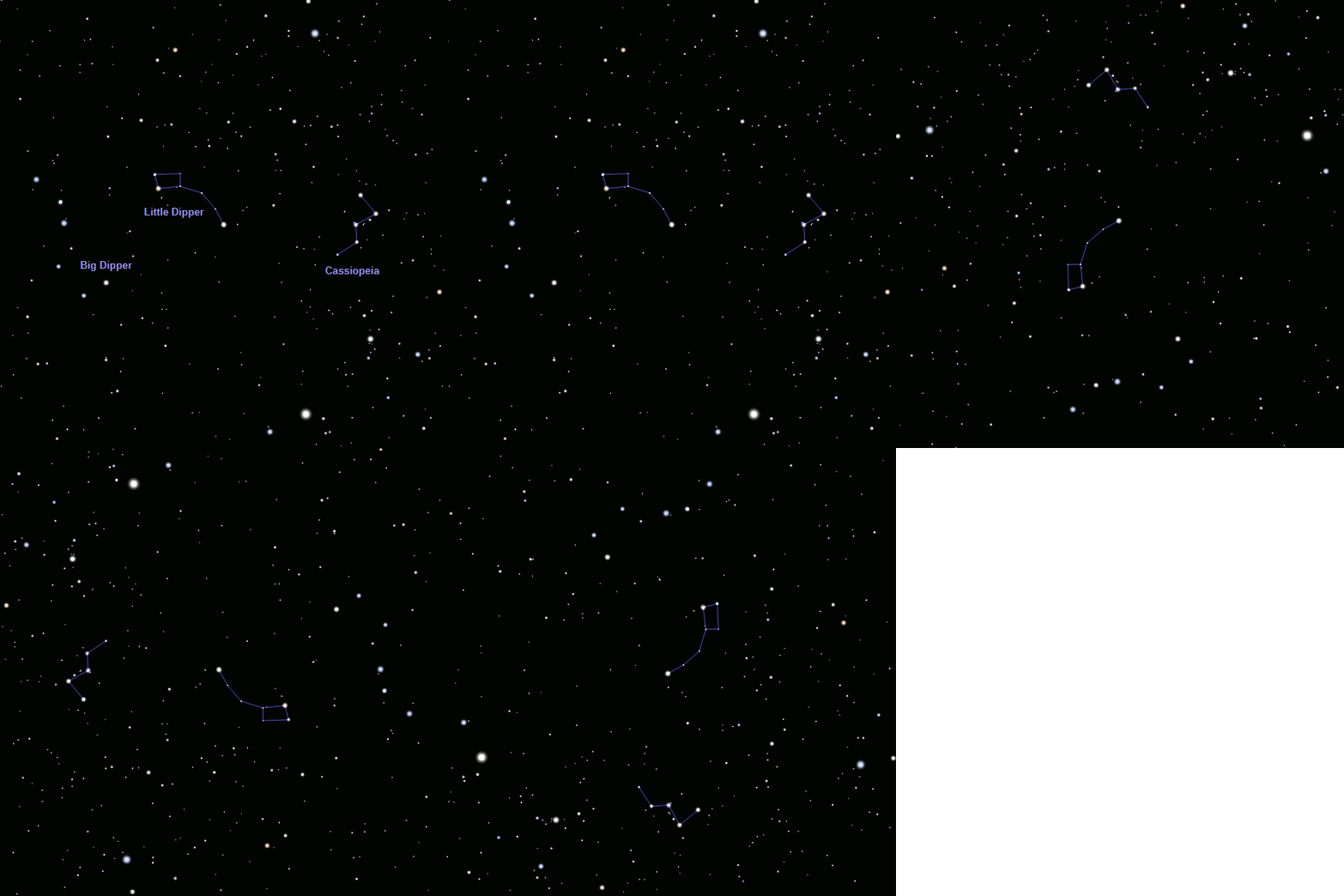
The constellation of Cassiopeia the queen looks to most of us like the letter W. However, since it is circumpolar, that is it seems to move around the North Pole of the sky without setting. It represents to us with various orientations. When it’s seen now in the evening in the northeast, it kind of looks like a misshapen number 3. In early winter it would be nearly overhead and be the letter M, not the University of Michigan block letter M, but the angular University of Minnesota M. In early spring, it’s in the northwestern sky as the Greek capital letter sigma. And finally in early summer it’ll be low in the north and become the upright letter W. I’ll return to Cassiopeia and tell her story later this autumn.
The astronomical event times given in this blog are for the Traverse City/Interlochen area of Michigan (Lat 44.7° N, Long 85.7° W; EDT, UT – 4 hours) unless stated otherwise. Times will be different for other locations.
Ephemeris: 09/11/2025 – Finding Pegasus the flying horse
This is Bob Moler with Ephemeris for Thursday, September 11th. Today the Sun will be up for 12 hours and 43 minutes, setting at 8:00, and it will rise tomorrow at 7:18. The Moon, 3 days before last quarter, will rise at 9:43 this evening.
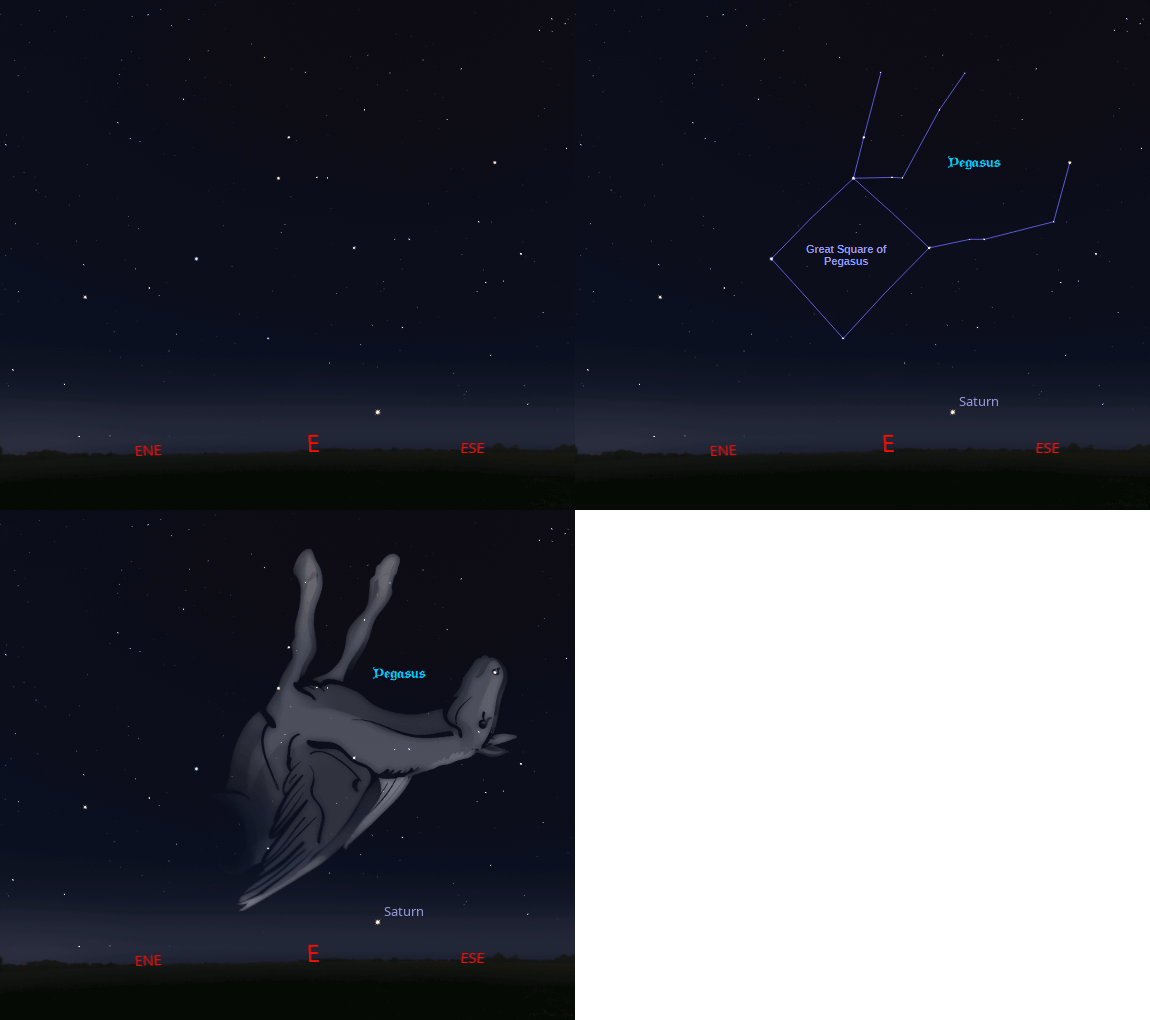
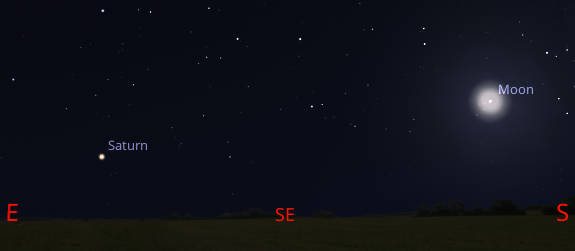
While we’ve been watching the stars and constellations of summer and the Milky Way, the constellations of autumn have been sneaking up on us from the east. Low in the east at 9 PM is one of the greatest constellations of autumn, Pegasus the flying horse. Her body or at least the front part of it is a large square of stars called the Great Square of Pegasus. It is an almost perfect rectangle. However, as she’s rising, it’s standing on one corner. This year it is above and left of Saturn. From the upper star are her front legs, from the rightmost star her neck and head extend in the stars. And from the left star of the square are what might look like her hind legs but aren’t. Only half of her body is in the stars. It’s another constellation, Andromeda.
The astronomical event times given in this blog are for the Traverse City/Interlochen area of Michigan (Lat 44.7° N, Long 85.7° W; EDT, UT – 4 hours) unless stated otherwise. Times will be different for other locations.
Addendum
Ephemeris: 09/10/2025 – Our weekly look at the naked-eye planets
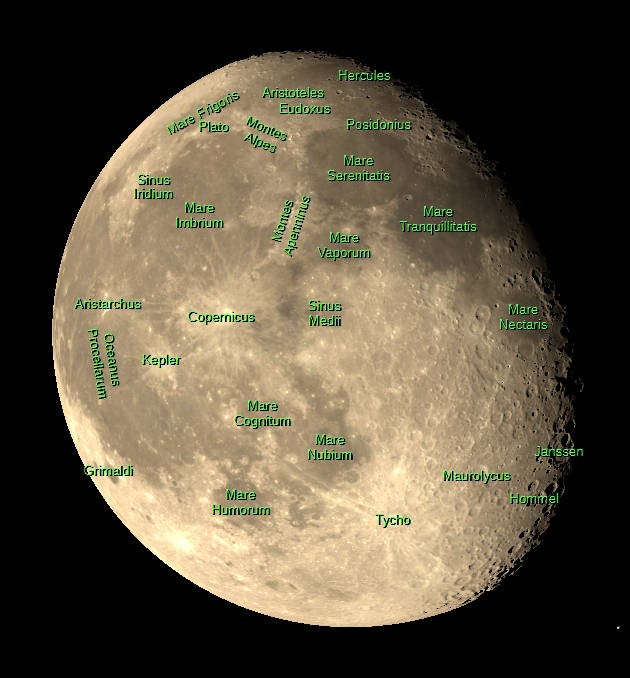
This is Bob Moler with Ephemeris for Wednesday, September 10th. Today the Sun will be up for 12 hours and 46 minutes, setting at 8:02, and it will rise tomorrow at 7:17. The Moon, 3 days past full, will rise at 9:14 this evening.
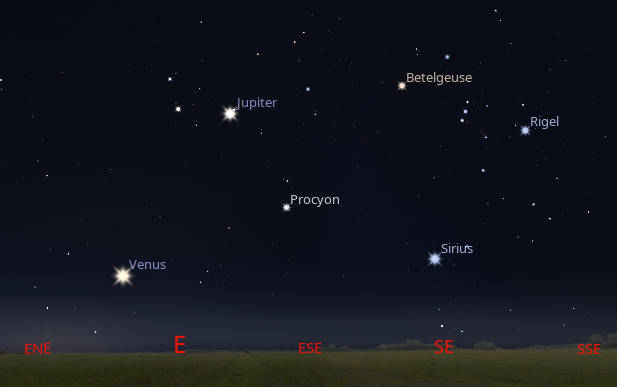
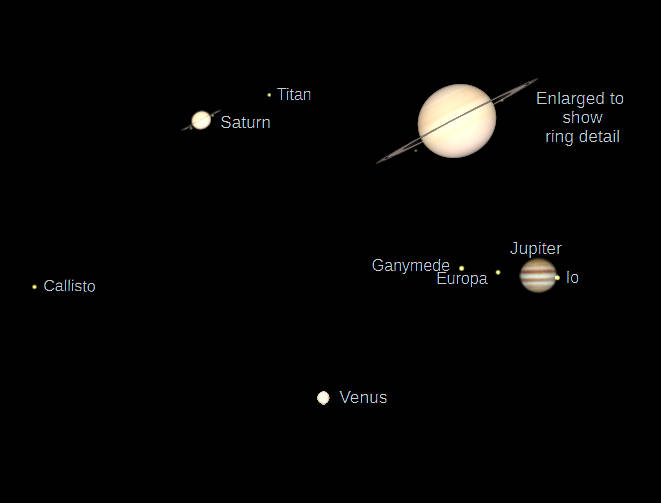
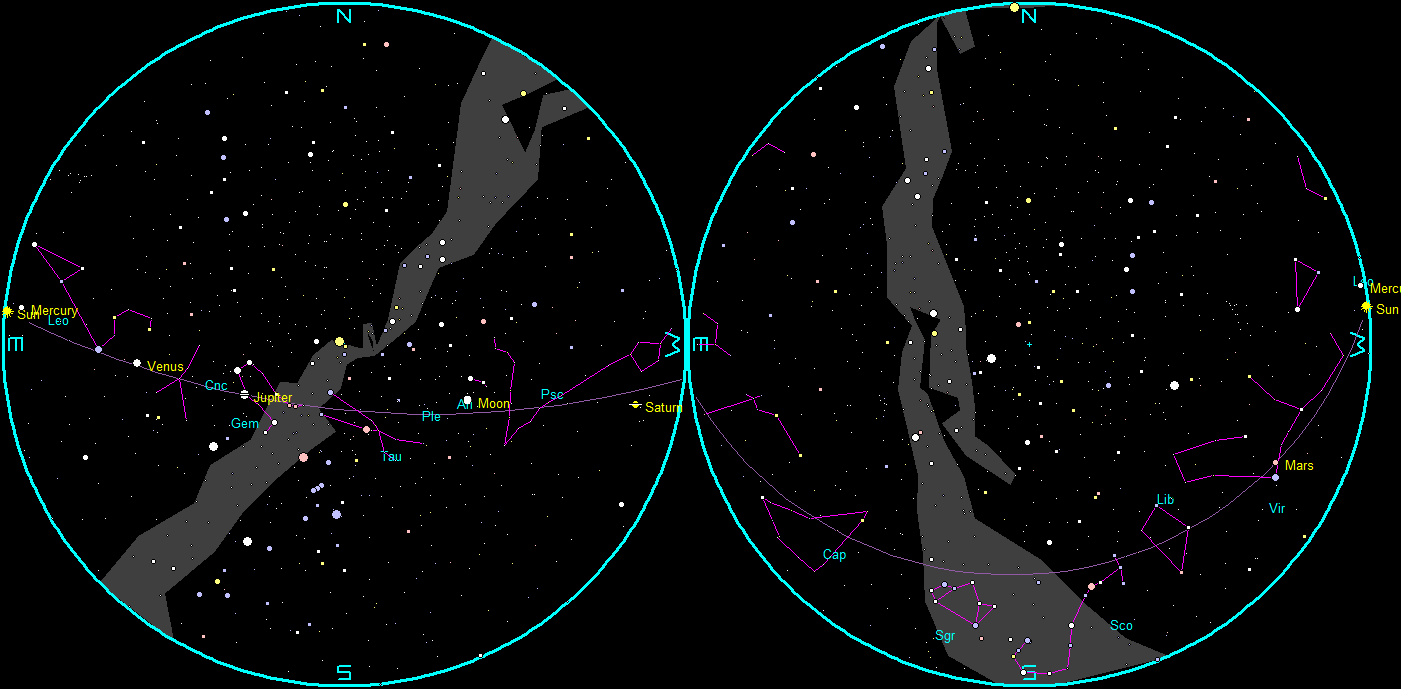
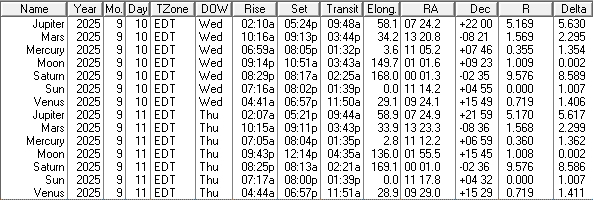
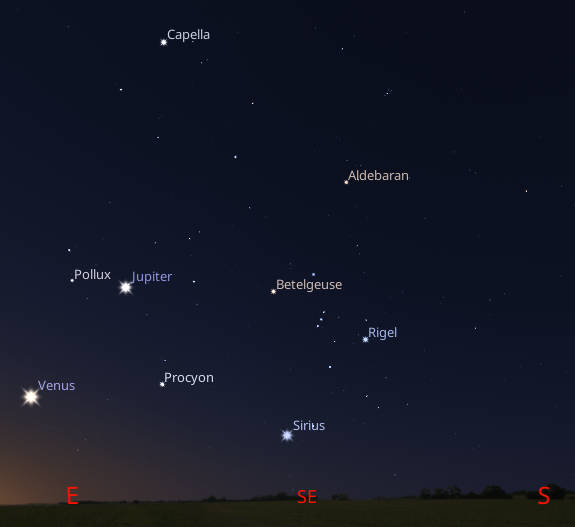
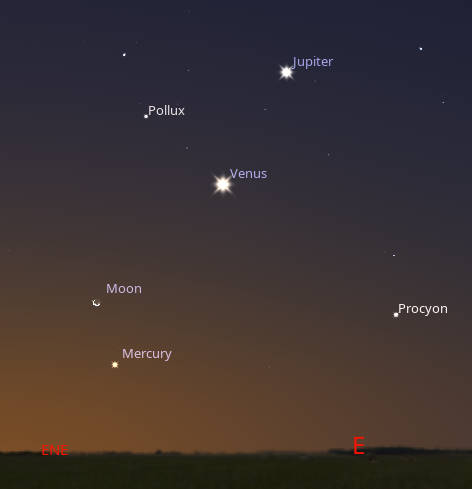
Let’s take our weekly look at the whereabouts of the naked-eye planets. Saturn now rises at 8:30 PM in the east. In a telescope Saturn sports a very thin ring, 2¼° from being edge on. Saturn has an axial tilt of about 27°, so it has seasons like the Earth and since its rings are over its equator, when the go edge on to the Sun, it is an equinox for it, which happened in May. Earth being close to the Sun and moving, see nearly the same thing. Now the ring angle will decrease to about a third of a degree by November 23rd before increasing. By 6 AM Jupiter will appear above the brighter Venus in the eastern sky and among the stars of Gemini. Venus and Jupiter are joining the bright winter stars, a beautiful sight in the morning twilight.
The astronomical event times given in this blog are for the Traverse City/Interlochen area of Michigan (Lat 44.7° N, Long 85.7° W; EDT, UT – 4 hours) unless stated otherwise. Times will be different for other locations.
Addendum
Ephemeris: 09/09/2025 – 3I/ATLAS, a minority view
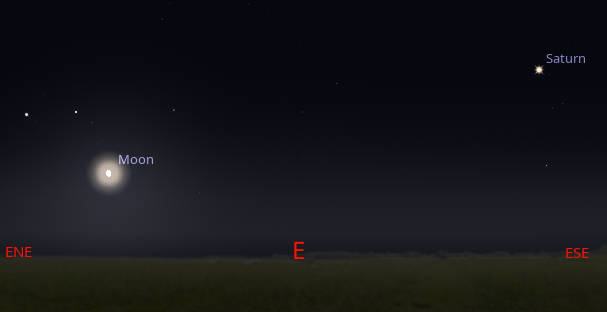
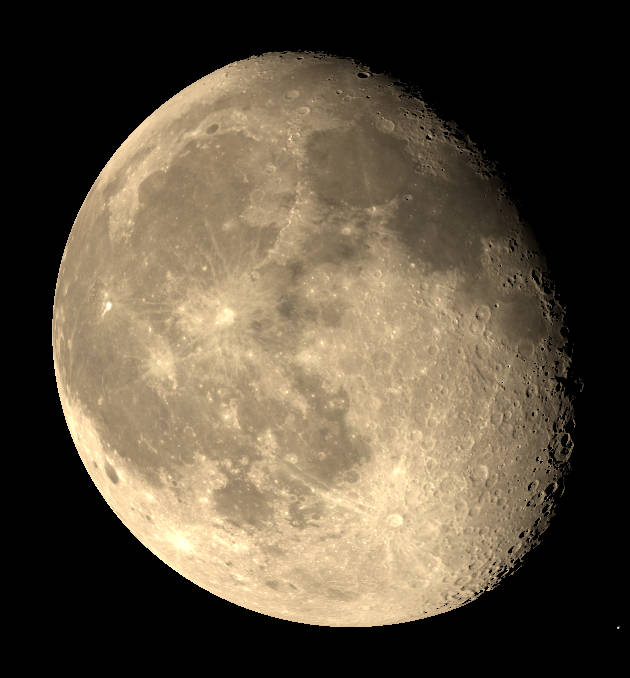
This is Ephemeris for Tuesday, September 9th. Today the Sun will be up for 12 hours and 49 minutes, setting at 8:04, and it will rise tomorrow at 7:16. The Moon, 2 days past full, will rise at 8:51 this evening.
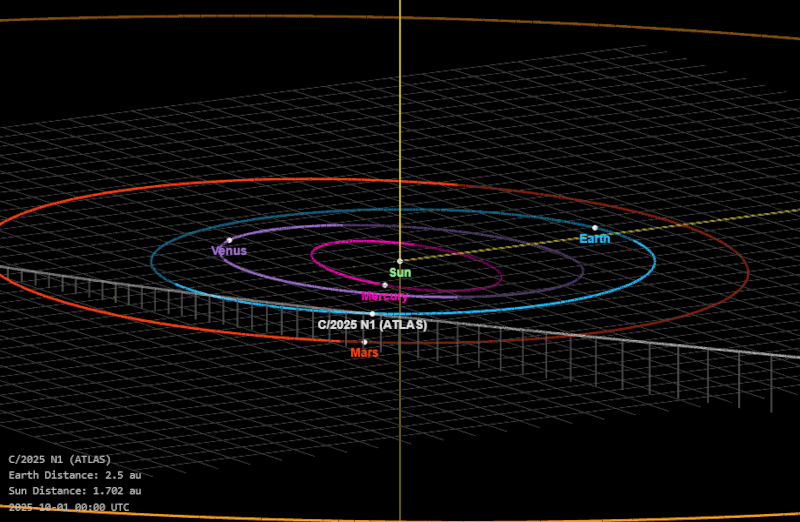
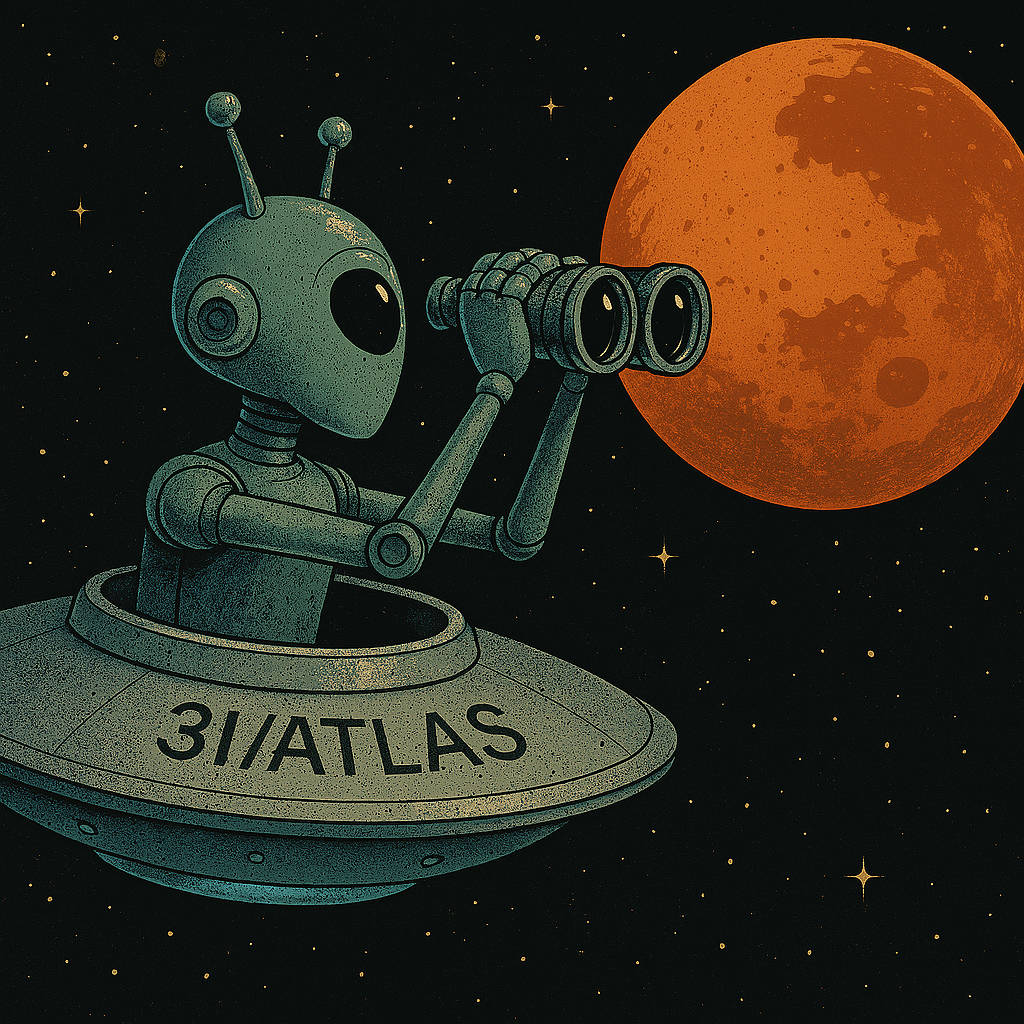
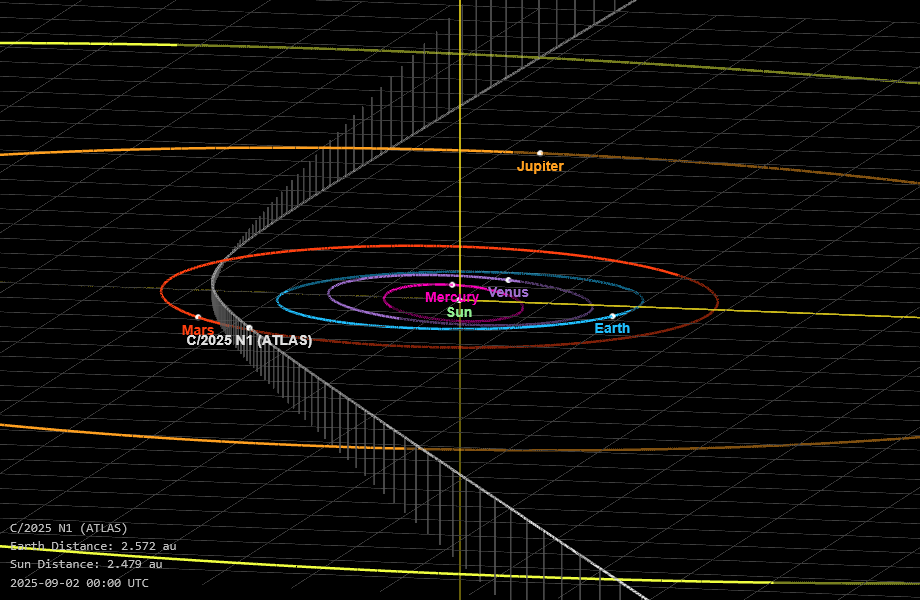
Interstellar object 3I/ATLAS is closing in on the planet Mars, which it will reach nearest to on October 1st. Some speculate, including one Harvard professor, that maybe it’s an alien probe. This object is much too slow to traverse the interstellar medium between stars with a biological crew, who are short-lived like us. More likely it would be crewed by robots run by artificial intelligence, like which we are beginning to perfect. 3I/ATLAS will not get very close to the Earth, but will get close to Mars. That got me to speculating, tongue in cheek of course, that being a machine intelligence they would be more interested in Mars. The reason being, that Mars is the only planet that’s entirely inhabited by robots, like themselves.
The astronomical event times given in this blog are for the Traverse City/Interlochen area of Michigan (Lat 44.7° N, Long 85.7° W; EDT, UT – 4 hours) unless stated otherwise. Times will be different for other locations.
Addendum
Ephemeris: 09/05/2025 – GTAS meeting tonight, a personal view of nebulae, interstellar clouds
This is Ephemeris for Friday, September 5th. Today the Sun will be up for 13 hours and 1 minute, setting at 8:11, and it will rise tomorrow at 7:11. The Moon, 2 days before full, will set at 5:36 tomorrow morning.
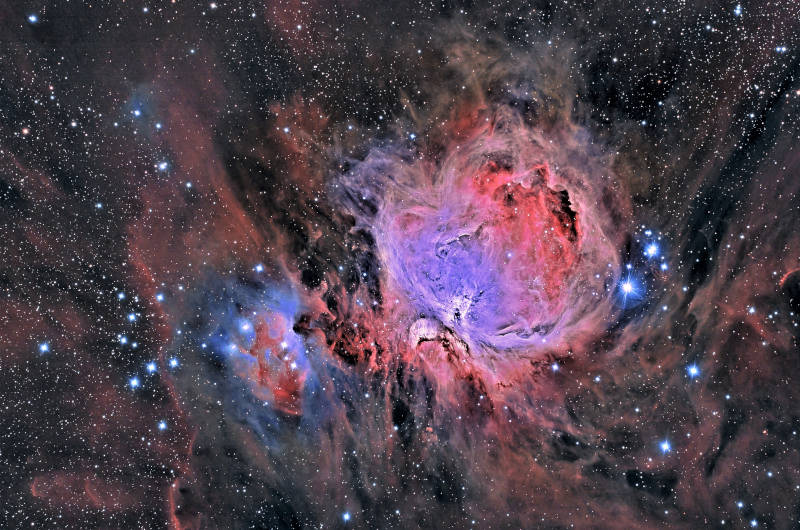
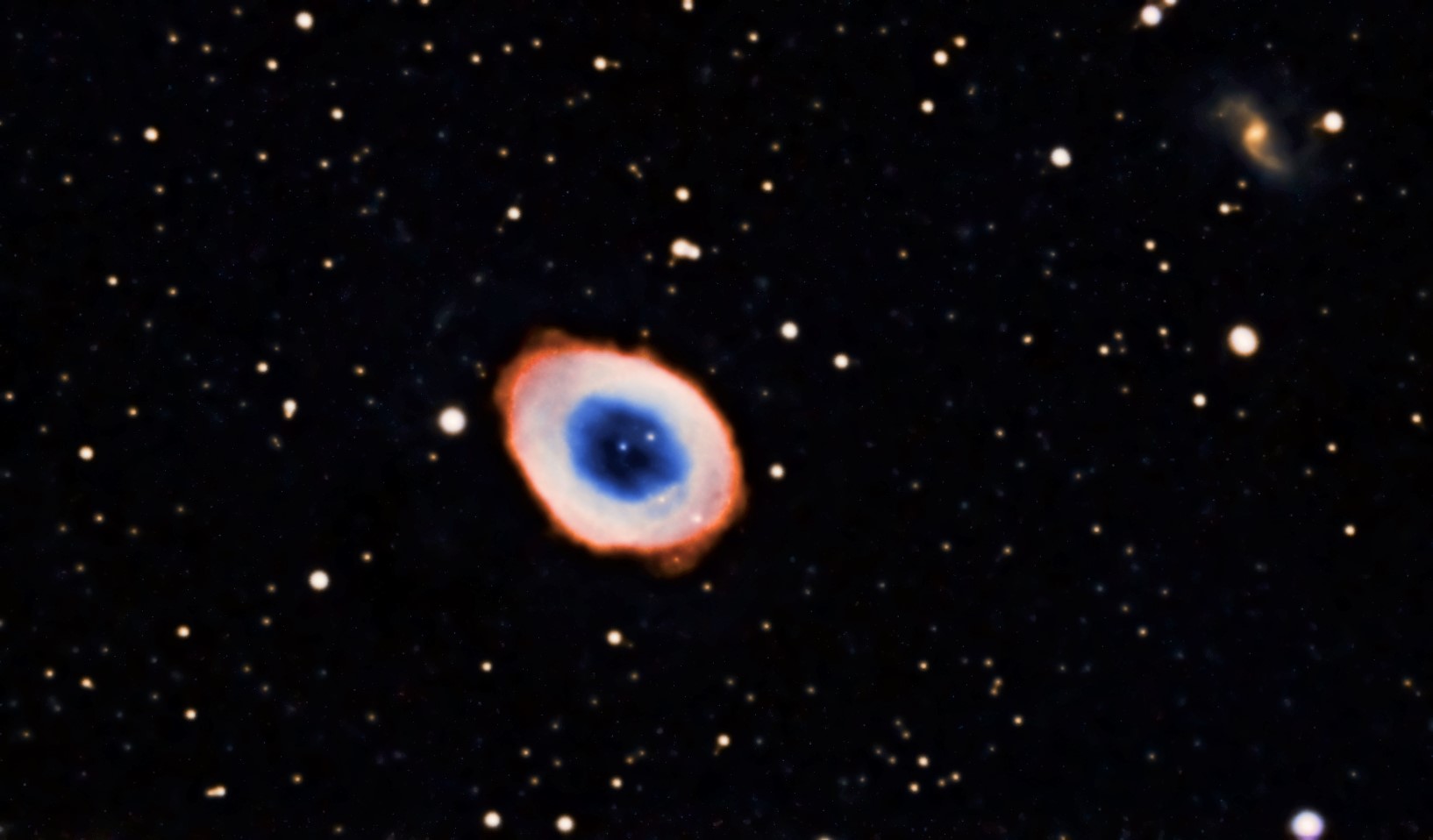
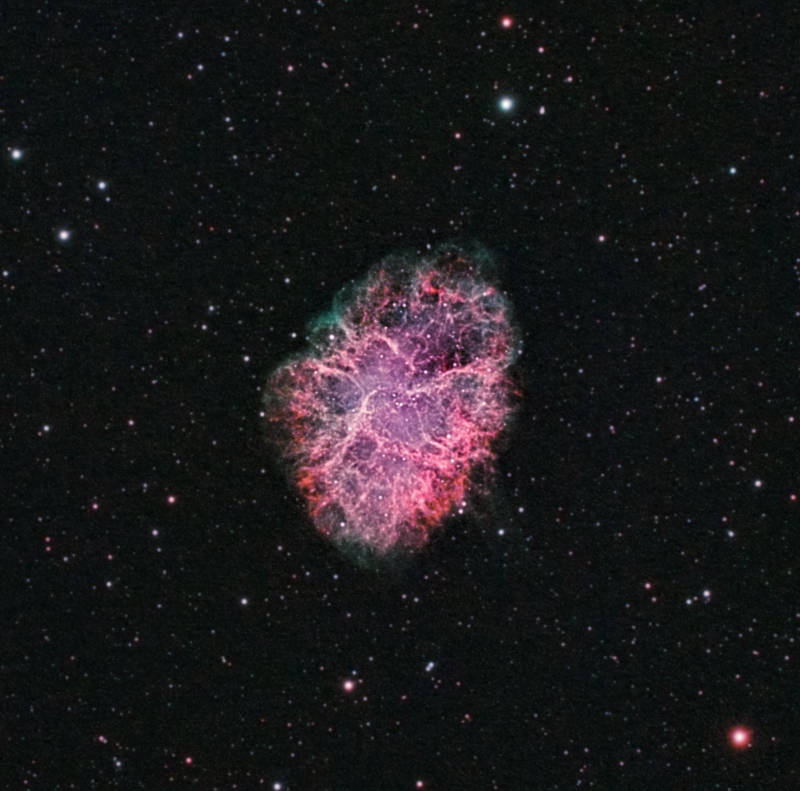
The Grand Traverse Astronomical Society will host its September meeting tonight at 8 PM at Northwestern Michigan College’s Joseph H Rogers Observatory. The talk for the evening will be given by Daniel Dall’Olmo, one of our members, who has had great success photographing the wonders of the universe. He will show and discuss the different types of nebulae he’s photographed. After the meeting, weather permitting, there will be viewing of the Moon and whatever we can find in the twilight. The observatory is located south of Traverse City on Birmley Rd. The meeting will also be available via Zoom, with instructions for joining the meeting on the society’s website, http://www.gtastro.org.
The astronomical event times given in this blog are for the Traverse City/Interlochen area of Michigan (Lat 44.7° N, Long 85.7° W; EDT, UT – 4 hours) unless stated otherwise. Times will be different for other locations.
Addendum
Ephemeris: 09/04/2025 – Venus, the Morning Star
This is Ephemeris for Thursday, September 4th. Today the Sun will be up for 13 hours and 4 minutes, setting at 8:13, and it will rise tomorrow at 7:10. The Moon, 3 days before full, will set at 4:19 tomorrow morning.
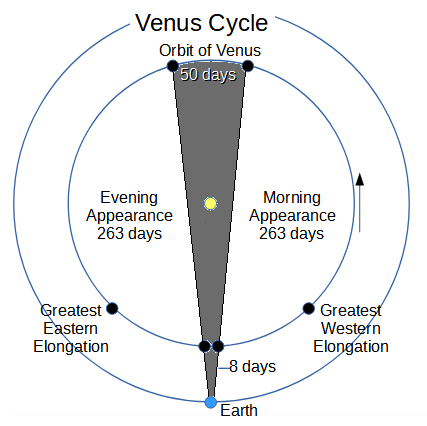
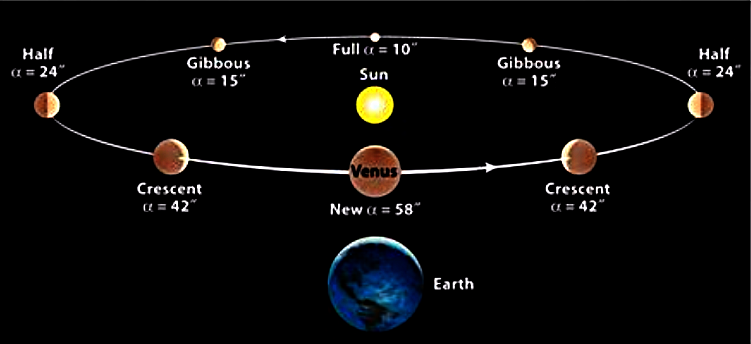
Venus graces our morning sky as the Morning Star. It is seen, this year, along with the planet Jupiter. They are the two brightest planets. The Greek and others of that part of the world, early on, thought the evening and morning appearances of Venus were two different planets. The Mayans of Pre-Columbian Central America were meticulous observers of Venus, as is seen in one of their surviving books, the Dresden Codex. A Venus cycle lasts 584 days, from first appearance in the morning sky, its heliacal rising, through its morning appearance, disappearance behind the Sun, through its evening appearance and disappearance to the next heliacal rising. Astronomers call that it’s synodic period. Five synodic periods equal almost exactly 8 years.
Addendum
Ephemeris: 09/03/2025 – Our weekly look at the naked-eye planets
This is Ephemeris for Wednesday, September 3rd. Today the Sun will be up for 13 hours and 7 minutes, setting at 8:15, and it will rise tomorrow at 7:09. The Moon, 3 days past first quarter, will set at 3:04 tomorrow morning.
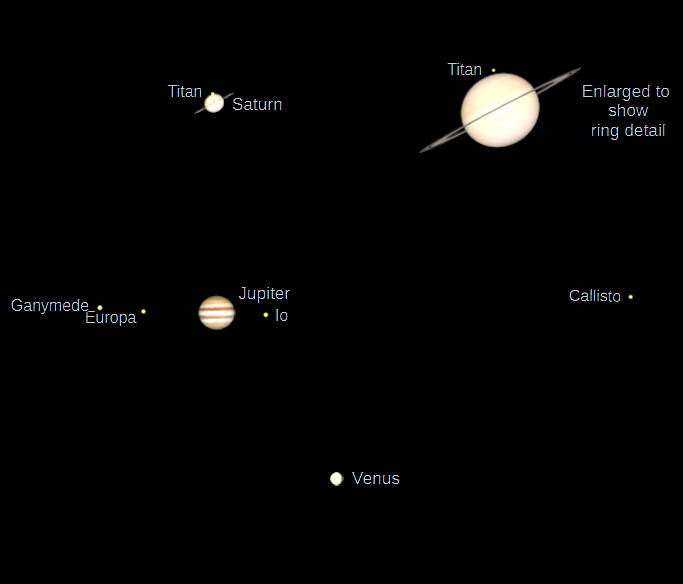
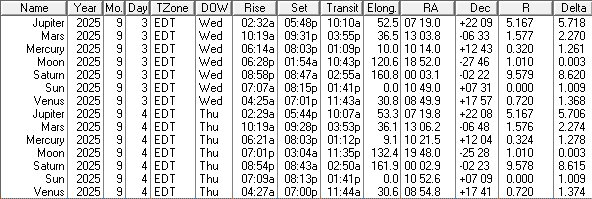
Let’s take our weekly look at the whereabouts of the naked-eye planets. The Red Planet Mars is too close to the direction of the Sun to spot. This is the curse of trying to view evening planets, which are near the direction of the Sun in late summer and early fall, for us at higher latitudes. Saturn now rises at 8:58 PM in the east. In a telescope Saturn sports a very thin ring, 2 ½° from being edge on. This angle will decrease to about a third of a degree by November 23rd before increasing. By 6 AM Saturn will be in the southwest. Jupiter will appear above the brighter Venus in the eastern sky and among the stars of Gemini. Venus and Jupiter are joining the bright winter stars, a beautiful sight in the morning twilight.
The astronomical event times given in this blog are for the Traverse City/Interlochen area of Michigan (Lat 44.7° N, Long 85.7° W; EDT, UT – 4 hours) unless stated otherwise. Times will be different for other locations.
Addendum
Ephemeris: 09/02/2025 – 3I/ATLAS, interstellar visitor
This is Ephemeris for Tuesday, September 2nd. Today the Sun will be up for 13 hours and 10 minutes, setting at 8:17, and it will rise tomorrow at 7:07. The Moon, 2 days past first quarter, will set at 1:54 tomorrow morning.
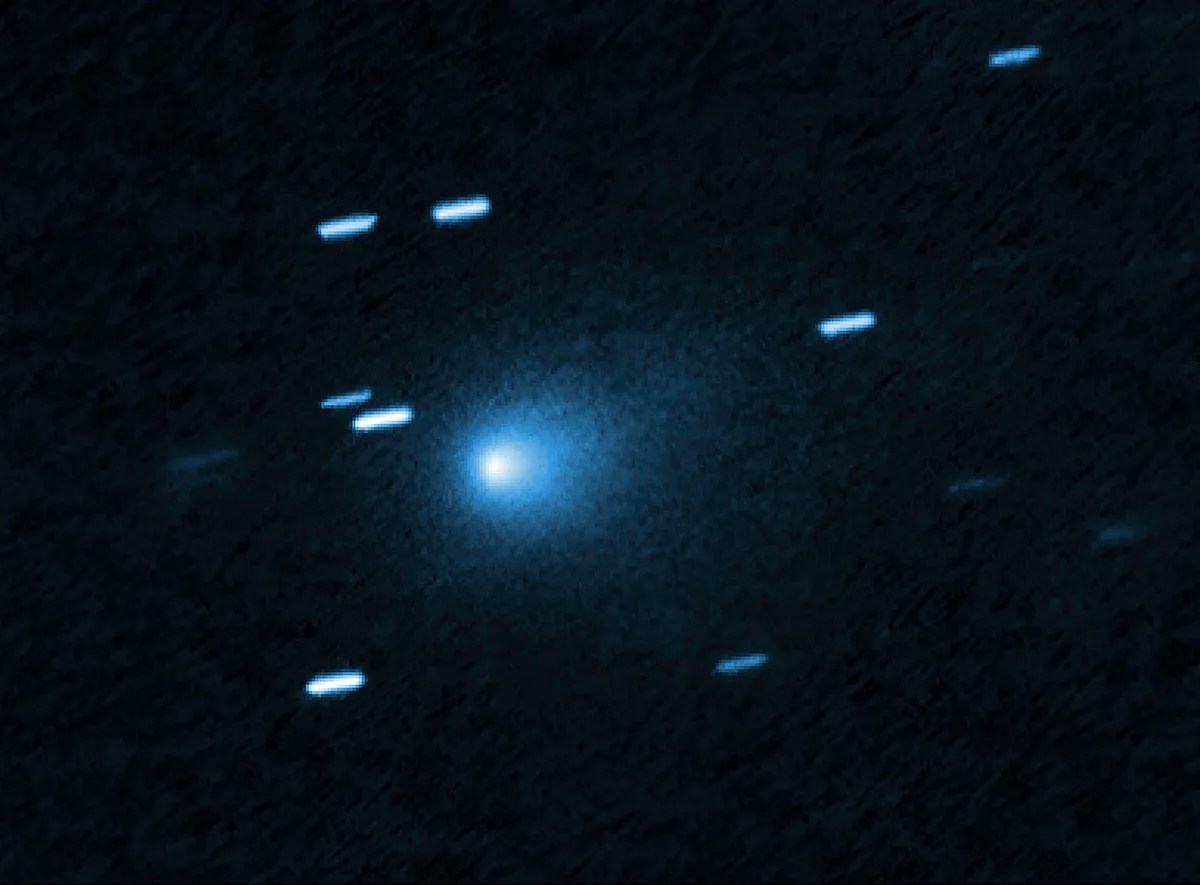
Interstellar visitor 3I/ATLAS was discovered a couple of months ago. We are lucky because it was discovered on its way into the inner solar system. The first interstellar visitor, 1I/‘Oumuamua, we didn’t spot until it had already passed and on its way out. It turns out that the chemical composition of this interstellar visitor, which astronomers think is a comet, has a great deal of carbon dioxide in its atmosphere compared to water. In the universe water is the third most common molecule after diatomic hydrogen and diatomic oxygen. But this comet appears to have about 8 times more carbon dioxide than water. Some astronomers think the 3I/ATLAS is 3 billion years older than the solar system making it 7 1/2 billion years old.
The astronomical event times given in this blog are for the Traverse City/Interlochen area of Michigan (Lat 44.7° N, Long 85.7° W; EDT, UT – 4 hours) unless stated otherwise. Times will be different for other locations.
Addendum
Ephemeris: 09/01/2025 – Previewing September skies
This is Ephemeris for Labor Day, Monday, September 1st. Today the Sun will be up for 13 hours and 13 minutes, setting at 8:18, and it will rise tomorrow at 7:06. The Moon, 1 day past first quarter, will set at 12:52 tomorrow morning.
Let’s look at the skies for the month of September. The sun will be moving at its greatest speed in its retreat to the south. Daylight hours in the Interlochen/Traverse City area and will drop from 13 hours and 13 minutes today to 11 hours and 44 minutes on the 30th. The altitude of the Sun above the southern horizon at local noon will be 54 degrees today, and will descend to 42 degrees on the 30th. Local noon at mid-month will be around 1:37 pm. The season of summer is getting short, so enjoy it while you can. Summer ends and autumn begins at 2:20 PM on September 22nd, the autumnal equinox. This year the Harvest Moon, the nearest full moon to the equinox, will fall next month, this month it’s the Corn Moon.
The astronomical event times given in this blog are for the Traverse City/Interlochen area of Michigan (Lat 44.7° N, Long 85.7° W; EDT, UT – 4 hours) unless stated otherwise. Times will be different for other locations.
Addendum
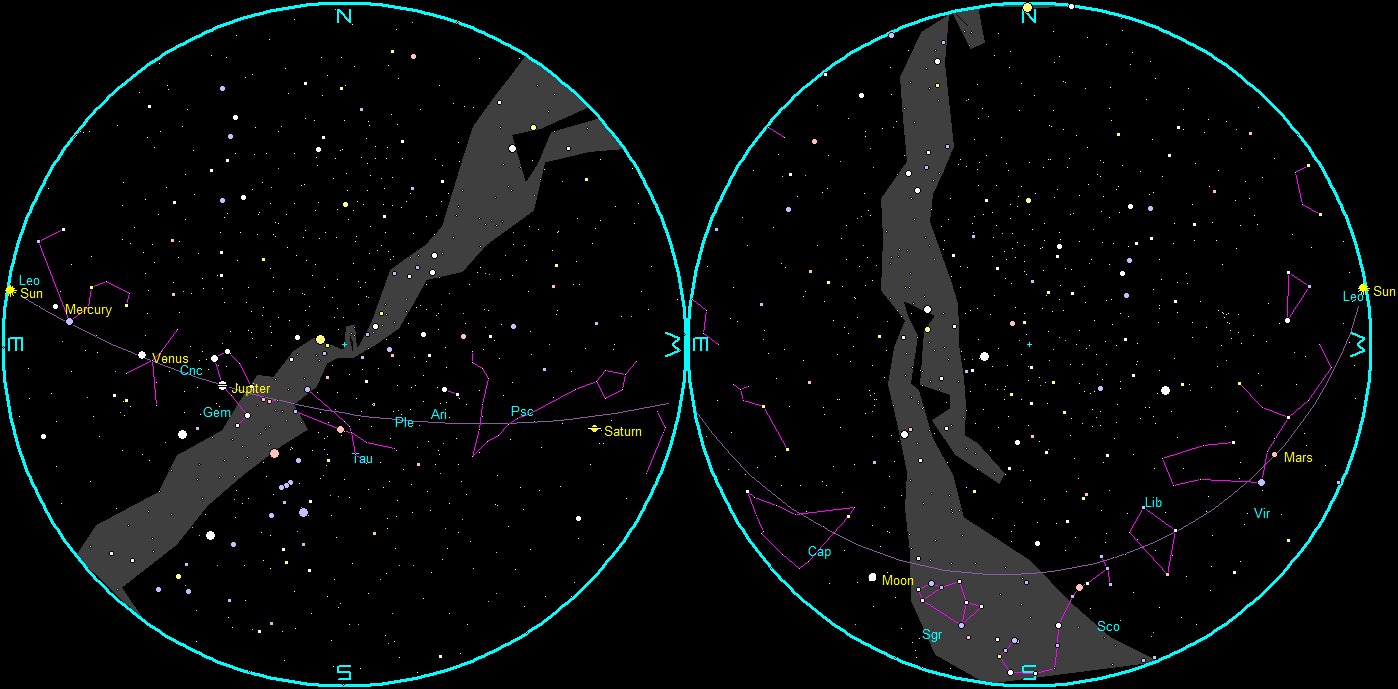
September Evening Star Chart
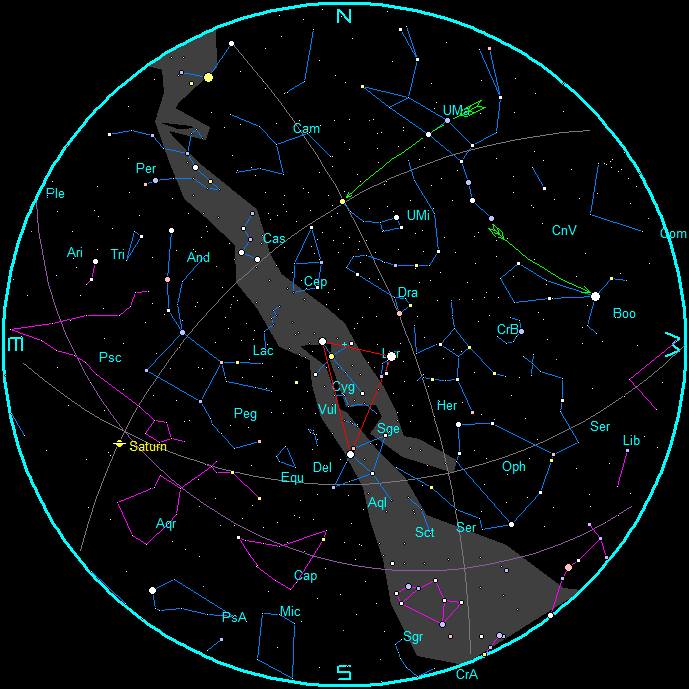
The planets and stars are plotted for the 15th at 10 p.m. EDT in the evening and 6 a.m. for the morning chart. These are the chart times. Note that Traverse City is located approximately 45 minutes behind our time meridian, West 75° longitude. (An hour 45 minutes behind our daylight saving time meridian during EDT). To duplicate the star positions on a planisphere you may have to set it to 1 hour 45 minutes earlier than the current time.
September Morning Star Chart
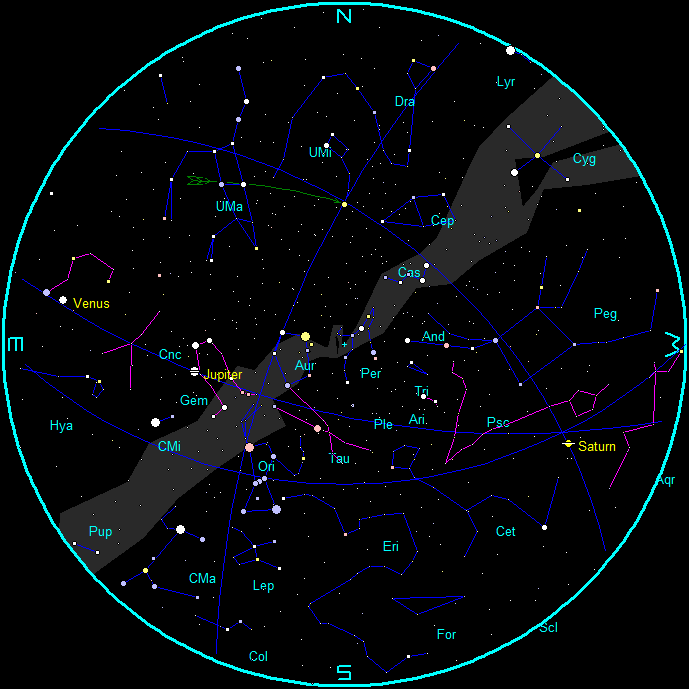
For a list of constellation names to go with the abbreviations, click here.
- Pointer stars at the front of the bowl of the Big Dipper point to Polaris, the North Star.
- Leaky dipper drips on Leo.
- Follow the arc of the handle of the Big Dipper to the star Arcturus.
- The Summer Triangle is in red.
Twilight Limits, Nautical and Astronomical
| EDT | |||||||
| Morning | Twilight | Evening | Twilight | Dark | Night | Moon | |
| Date | Astro. | Nautical | Nautical | Astro. | Start | End | Illum. |
| 2025-09-01 | 5h23m | 6h01m | 21h28m | 22h06m | 0h01m | 5h23m | 0.68 |
| 2025-09-02 | 5h24m | 6h02m | 21h26m | 22h04m | 0h53m | 5h24m | 0.77 |
| 2025-09-03 | 5h26m | 6h04m | 21h24m | 22h02m | 1h54m | 5h26m | 0.85 |
| 2025-09-04 | 5h27m | 6h05m | 21h22m | 22h00m | 3h05m | 5h27m | 0.92 |
| 2025-09-05 | 5h29m | 6h06m | 21h20m | 21h58m | 4h20m | 5h29m | 0.97 |
| 2025-09-06 | 5h30m | 6h08m | 21h18m | 21h55m | – | – | 1.00 |
| 2025-09-07 | 5h32m | 6h09m | 21h16m | 21h53m | – | – | 1.00 |
| 2025-09-08 | 5h33m | 6h10m | 21h14m | 21h51m | – | – | 0.97 |
| 2025-09-09 | 5h35m | 6h12m | 21h12m | 21h49m | – | – | 0.92 |
| 2025-09-10 | 5h36m | 6h13m | 21h10m | 21h47m | – | – | 0.84 |
| 2025-09-11 | 5h38m | 6h14m | 21h08m | 21h44m | – | – | 0.75 |
| 2025-09-12 | 5h39m | 6h16m | 21h06m | 21h42m | 21h42m | 22h19m | 0.64 |
| 2025-09-13 | 5h41m | 6h17m | 21h04m | 21h40m | 21h40m | 23h06m | 0.53 |
| 2025-09-14 | 5h42m | 6h18m | 21h02m | 21h38m | 21h38m | – | 0.41 |
| 2025-09-15 | 5h44m | 6h19m | 21h00m | 21h36m | 21h36m | 0h05m | 0.31 |
| 2025-09-16 | 5h45m | 6h21m | 20h58m | 21h34m | 21h34m | 1h15m | 0.21 |
| 2025-09-17 | 5h46m | 6h22m | 20h56m | 21h32m | 21h32m | 2h29m | 0.13 |
| 2025-09-18 | 5h48m | 6h23m | 20h54m | 21h29m | 21h29m | 3h44m | 0.07 |
| 2025-09-19 | 5h49m | 6h25m | 20h52m | 21h27m | 21h27m | 4h57m | 0.03 |
| 2025-09-20 | 5h51m | 6h26m | 20h50m | 21h25m | 21h25m | 5h51m | 0.00 |
| 2025-09-21 | 5h52m | 6h27m | 20h48m | 21h23m | 21h23m | 5h52m | 0.00 |
| 2025-09-22 | 5h53m | 6h28m | 20h46m | 21h21m | 21h21m | 5h53m | 0.02 |
| 2025-09-23 | 5h55m | 6h30m | 20h44m | 21h19m | 21h19m | 5h55m | 0.05 |
| 2025-09-24 | 5h56m | 6h31m | 20h42m | 21h17m | 21h17m | 5h56m | 0.10 |
| 2025-09-25 | 5h57m | 6h32m | 20h40m | 21h15m | 21h15m | 5h57m | 0.17 |
| 2025-09-26 | 5h59m | 6h33m | 20h38m | 21h13m | 21h20m | 5h59m | 0.25 |
| 2025-09-27 | 6h00m | 6h35m | 20h36m | 21h11m | 21h56m | 6h00m | 0.33 |
| 2025-09-28 | 6h01m | 6h36m | 20h35m | 21h09m | 22h43m | 6h01m | 0.42 |
| 2025-09-29 | 6h03m | 6h37m | 20h33m | 21h07m | 23h39m | 6h03m | 0.52 |
| 2025-09-30 | 6h04m | 6h38m | 20h31m | 21h05m | – | 6h04m | 0.62 |
Twilight calendar was generated using Cartes du Ciel (Sky Charts).
See my blog post: Twilight Zone for the definitions of the different periods of twilight here: https://bobmoler.wordpress.com/2018/09/27/.
NASA Calendar of Planetary Events
Sep  1  Mo            Venus: 31.2° W
     1  Mo   6:04 PM  Moon South Dec.: 28.6° S
     7  Su   2:09 PM  Full Moon
     7  Su   2:13 PM  Total Lunar Eclipse
     7  Su   7:08 PM  Moon Ascending Node
     8  Mo   4:09 PM  Moon-Saturn: 4° S
    10  We   8:10 AM  Moon Perigee: 364800 km
    12  Fr   5:48 PM  Moon-Pleiades: 1° S
    12  Fr  11:28 PM  Mars-Spica: 2.2° N
    13  Sa   6:46 AM  Mercury Superior Conjunction
    14  Su   6:33 AM  Last Quarter
    14  Su   5:23 PM  Moon North Dec.: 28.6° N
    16  Tu   7:06 AM  Moon-Jupiter: 4.7° S
    16  Tu   1:58 PM  Moon-Pollux: 2.5° N
    17  We   1:24 PM  Moon-Beehive: 2.1° S
    19  Fr   4:59 AM  Venus-Regulus: 0.5° N
    19  Fr   7:11 AM  Moon-Regulus: 1.4° S
    19  Fr   7:46 AM  Moon-Venus: 0.9° S
    20  Sa   7:13 PM  Moon Descending Node
    21  Su   1:10 AM  Saturn Opposition
    21  Su   3:42 PM  Partial Solar Eclipse (Not here.
                      In New Zealand and Antarctica)
    21  Su   3:54 PM  New Moon
    22  Mo   2:20 PM  Autumnal Equinox
    23  Tu   7:29 AM  Neptune Opposition
    23  Tu   5:31 PM  Moon-Spica: 1.2° N
    24  We  10:50 AM  Moon-Mars: 4.3° N
    26  Fr   5:46 AM  Moon Apogee: 405600 km
    27  Sa   1:34 PM  Moon-Antares: 0.7° N
    29  Mo   2:09 AM  Moon South Dec.: 28.6° S
    29  Mo   7:54 PM  First Quarter
Oct  1  We            Venus: 23.9° W
Sky Events Calendar by Fred Espenak and Sumit Dutta (NASA’s GSFC), with modifications by the author.
http://eclipse.gsfc.nasa.gov/SKYCAL/SKYCAL.html.
If you go to the above site, you can print out a list like the above for the entire year or calendar pages for your time zone.
Sun and Moon Rising and Setting Events
LU             Ephemeris of Sky Events for Interlochen/TC
September, 2025    Local time zone: EDT
+-----------------------------------------------------------------------+
| DATE |  SUN     SUN  DAYLIGHT|   TWILIGHT*    |MOON  RISE OR    ILLUM |
|      |  RISE    SET    HOURS |  END    START  |PHASE SET** TIME FRACTN|
+=======================================================================+
|Mon  1| 07:05a  08:18p  13:13 | 09:24p  05:59a |      Set  12:52a   66%|
|Tue  2| 07:06a  08:17p  13:10 | 09:22p  06:00a |      Set  01:54a   75%|
|Wed  3| 07:07a  08:15p  13:07 | 09:20p  06:01a |      Set  03:04a   84%|
|Thu  4| 07:09a  08:13p  13:04 | 09:18p  06:03a |      Set  04:19a   91%|
|Fri  5| 07:10a  08:11p  13:01 | 09:16p  06:04a |      Set  05:36a   96%|
|Sat  6| 07:11a  08:09p  12:58 | 09:14p  06:06a |      Set  06:53a   99%|
+------+-----------------------+----------------+-----------------------+
|Sun  7| 07:12a  08:07p  12:55 | 09:12p  06:07a |Full  Rise 08:10p  100%|
|Mon  8| 07:13a  08:05p  12:52 | 09:10p  06:08a |      Rise 08:30p   98%|
|Tue  9| 07:14a  08:04p  12:49 | 09:08p  06:10a |      Rise 08:51p   93%|
|Wed 10| 07:16a  08:02p  12:46 | 09:06p  06:11a |      Rise 09:14p   86%|
|Thu 11| 07:17a  08:00p  12:43 | 09:04p  06:12a |      Rise 09:43p   77%|
|Fri 12| 07:18a  07:58p  12:39 | 09:02p  06:14a |      Rise 10:19p   66%|
|Sat 13| 07:19a  07:56p  12:36 | 09:00p  06:15a |      Rise 11:06p   55%|
+------+-----------------------+----------------+-----------------------+
|Sun 14| 07:20a  07:54p  12:33 | 08:58p  06:16a |L Qtr Rise 12:05a   44%|
|Mon 15| 07:22a  07:52p  12:30 | 08:56p  06:17a |      Rise 01:14a   33%|
|Tue 16| 07:23a  07:50p  12:27 | 08:54p  06:19a |      Rise 02:29a   23%|
|Wed 17| 07:24a  07:49p  12:24 | 08:52p  06:20a |      Rise 03:44a   15%|
|Thu 18| 07:25a  07:47p  12:21 | 08:50p  06:21a |      Rise 04:56a    8%|
|Fri 19| 07:26a  07:45p  12:18 | 08:48p  06:23a |      Rise 06:06a    3%|
|Sat 20| 07:27a  07:43p  12:15 | 08:46p  06:24a |      Rise 07:13a    1%|
+------+-----------------------+----------------+-----------------------+
|Sun 21| 07:29a  07:41p  12:12 | 08:44p  06:25a |New   Set  07:33p    0%|
|Mon 22| 07:30a  07:39p  12:09 | 08:42p  06:26a |      Set  07:50p    1%|
|Tue 23| 07:31a  07:37p  12:06 | 08:40p  06:28a |      Set  08:07p    4%|
|Wed 24| 07:32a  07:35p  12:03 | 08:38p  06:29a |      Set  08:27p    9%|
|Thu 25| 07:33a  07:33p  12:00 | 08:37p  06:30a |      Set  08:50p   15%|
|Fri 26| 07:35a  07:32p  11:56 | 08:35p  06:31a |      Set  09:19p   23%|
|Sat 27| 07:36a  07:30p  11:53 | 08:33p  06:33a |      Set  09:56p   31%|
+------+-----------------------+----------------+-----------------------+
|Sun 28| 07:37a  07:28p  11:50 | 08:31p  06:34a |      Set  10:42p   40%|
|Mon 29| 07:38a  07:26p  11:47 | 08:29p  06:35a |F Qtr Set  11:38p   50%|
|Tue 30| 07:39a  07:24p  11:44 | 08:27p  06:36a |      Set  12:44a   60%|
+-----------------------------------------------------------------------+
* Nautical Twilight
** Moonrise or moonset, whichever occurs between sunset and sunrise
Generated using my LookingUp for DOS app.
Ephemeris: 08/29/2025 – Late August crescent Moon stays low in the western sky
This is Ephemeris for Friday, August 29th. Today the Sun will be up for 13 hours and 22 minutes, setting at 8:24, and it will rise tomorrow at 7:03. The Moon, 2 days before first quarter, will set at 10:48 this evening.
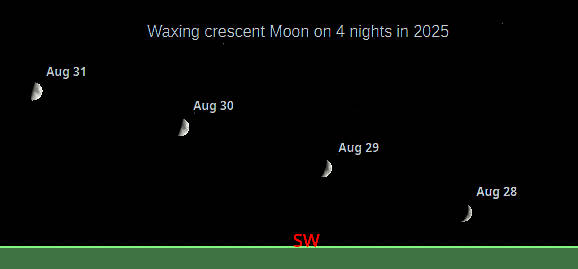
There’s an interesting feature that I’ve noticed about the Moon this time of year. When there’s a waxing crescent Moon in the evening, in late summer to early autumn, it’s seen pretty low in the southwestern sky after sunset. Tonight it’ll be two days before first quarter so it’ll be a fat crescent. However, when it’s seen after sunset, it will be very low in the southwestern sky. Contrast that for early risers, at this time of year the waning crescent Moon moves at a steep angle to the horizon, as do the planets now in the east. And of course the opposite is true for late winter and early spring moons. By the way, the Harvest Moon is in early October this year. The Harvest Moon is the nearest full moon to the autumnal equinox.
The astronomical event times given in this blog are for the Traverse City/Interlochen area of Michigan (Lat 44.7° N, Long 85.7° W; EDT, UT – 4 hours) unless stated otherwise. Times will be different for other locations.
Addendum
 Bob Moler's Ephemeris Blog