Archive
08/28/2018 – Ephemeris – Water on the Moon
Ephemeris for Tuesday, August 28th. The Sun will rise at 7:00. It’ll be up for 13 hours and 26 minutes, setting at 8:26. The Moon, 2 days past full, will rise at 9:47 this evening.
Ten years ago India launched its lunar orbiting Chandrayaan-1 spacecraft. On it was a NASA instrument the Moon Mineralogy Mapper to study the composition of the Moon’s crust. With it they discovered signatures of water at the Moon’s high latitudes, probably in water-bearing minerals. Water was also confirmed in craters near the Moon’s south pole by the LCROSS probe that was launched with the Lunar Reconnaissance Orbiter in 2009. It crashed near the Moon’s south pole in a crater following a centaur stage which it was observing. Though the expected visual show wasn’t visible from Earth the LCROSS satellite saw and returned its observations before it too crashed. It relayed that the Moon had ice near the south pole.
The times given are for the Traverse City/Interlochen area of Michigan. They may be different for your location.
Addendum
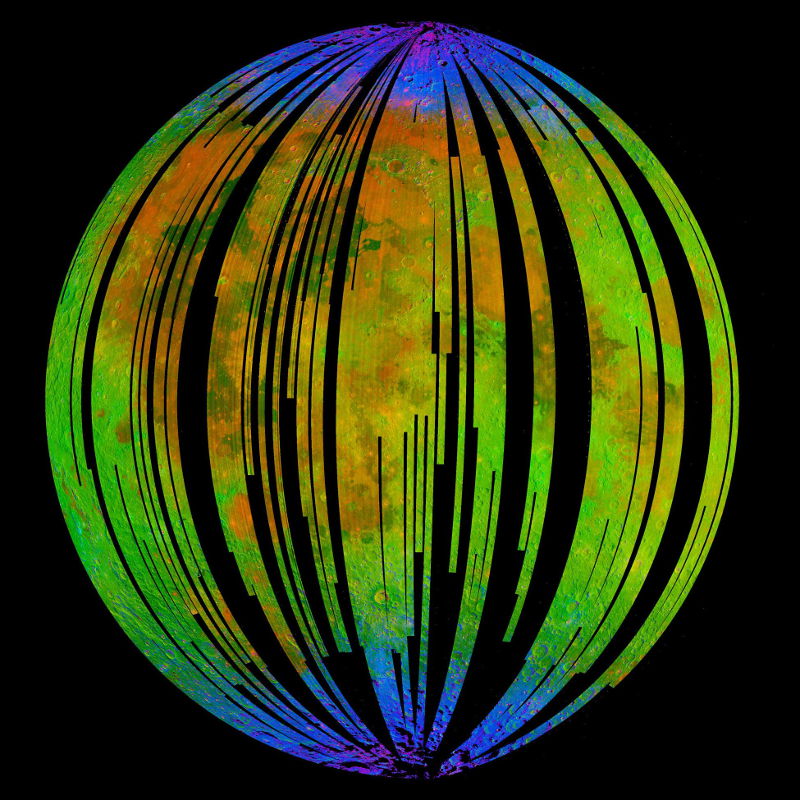
Water Detected at High Latitudes on the Moon by the Moon Mineralogy Mapper The water-bearing minerals are colored blue. Credit ISRO/NASA/JPL-Caltech/Brown Univ./USGS
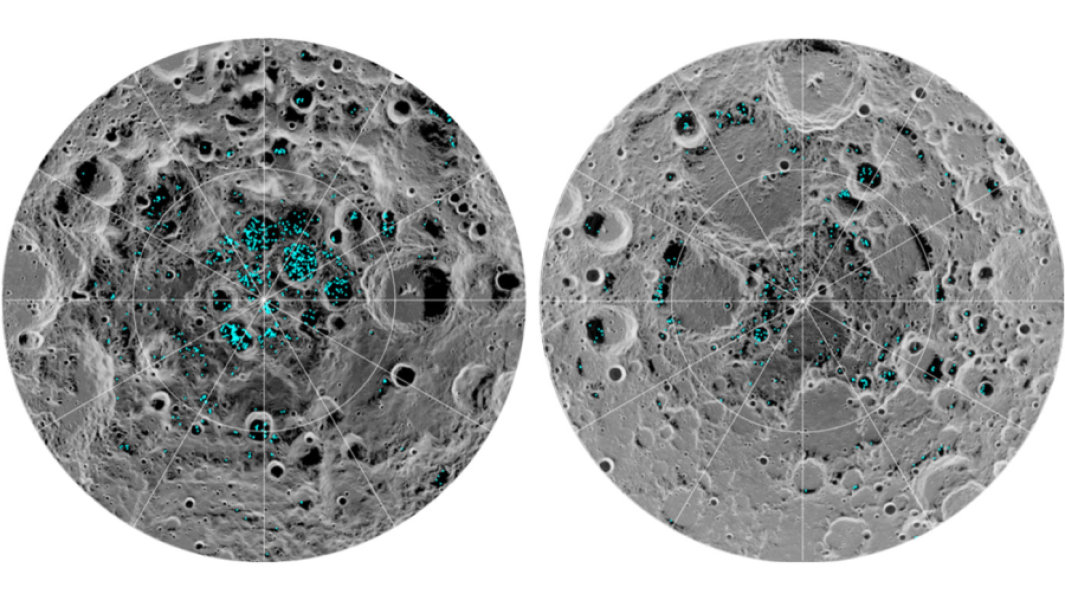
The Moon’s south pole area on the left and north pole on the right. The cyan color shows shadowed areas where ice is located. From data gathered by the Moon Mineralogy Mapper, and instruments on the Lunar Reconnaissance Orbiter, and LCROSS. Click on image to enlarge. Credit NASA.
Finding water is a big deal. It helps Moon colonists live off the land, so to speak. While the poles on Earth are foreboding places, those of the Moon could give colonists an advantage. First, that’s where the water is. The Moon has very little axial tilt so deep craters never see the sunlight, and high peaks see eternal sunlight, a great place to place solar panels for just about continuous energy production.
08/27/2018 – Ephemeris – It wasn’t the Harvest Moon but it has that effect
Ephemeris for Monday, August 27th. The Sun will rise at 6:59. It’ll be up for 13 hours and 29 minutes, setting at 8:28. The Moon, 1 day past full, will rise at 9:21 this evening.
Last night’s full moon wasn’t the Harvest Moon. That’s next month’s full moon. This full moon is the Sturgeon Full Moon. You’d think it should be the Corn Moon, That’s normally the September’s full moon, which is preempted this year by the Harvest Moon, the closest full moon to the autumnal equinox. What’s taking effect now is what I call the harvest moon effect, in that the nearly full Moon stays in the evening sky for almost a week, it seems, after full; while I’m waiting to spot the wonders of the summer Milky Way at a decent hour. On average the Moon rises about 50 minutes later each night. Now it’s decreasing to be less than 30 minutes. It won’t be until Thursday night that we’ll have a whole half hour of dark skies, and up to an hour by Friday night.
The times given are for the Traverse City/Interlochen area of Michigan. They may be different for your location.
Addendum
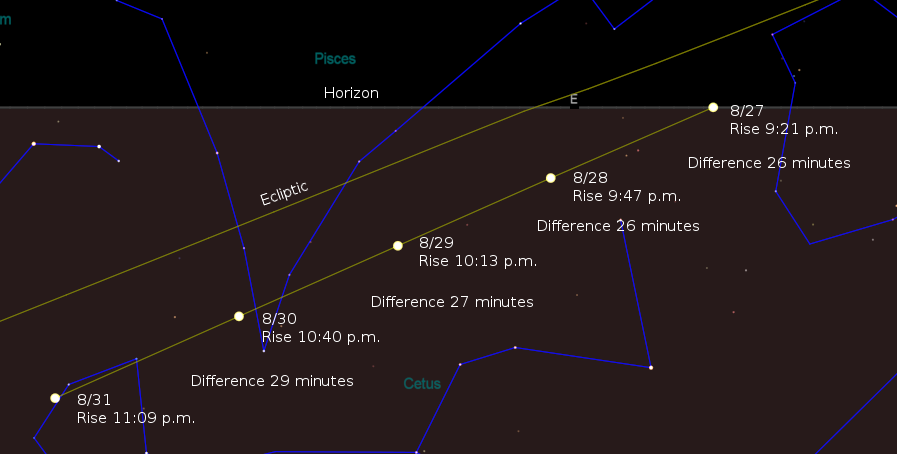
The motion of the Moon with respect to the eastern horizon from August 27 through August 31, 2018. It shows the difference in the rise times that create the harvest moon effect. Created using Cartes du Ciel (Sky Charts).
08/24/2018 – Ephemeris – The last Friday Night Live of the year is tonight
Ephemeris for Friday, August 24th. The Sun rises at 6:55. It’ll be up for 13 hours and 37 minutes, setting at 8:33. The Moon, 2 days before full, will set at 5:54 tomorrow morning.
The Grand Traverse Astronomical Society will be at the last Friday Night Live of the year tonight on Front Street in Traverse City. We have a lot of fun at these events, looking at the Sun and possibly Venus from 5:30 p.m. to 9 p.m., talking astronomy and what’s up in the sky, and NASA’s missions to the planets and now the Sun. After 9 p.m. if it’s clear we pull our telescopes off the street and onto the sidewalk to view the planets Jupiter, Saturn and Mars. Last week we had the Moon, but it’s no longer in the southern sky in the evening. Last week we didn’t pack our telescopes up until after 11 p.m. But it all depends on the clouds. Our next sidewalk event will be October 20th, International Observe the Moon Night.
The times given are for the Traverse City/Interlochen area of Michigan. They may be different for your location.
Addendum
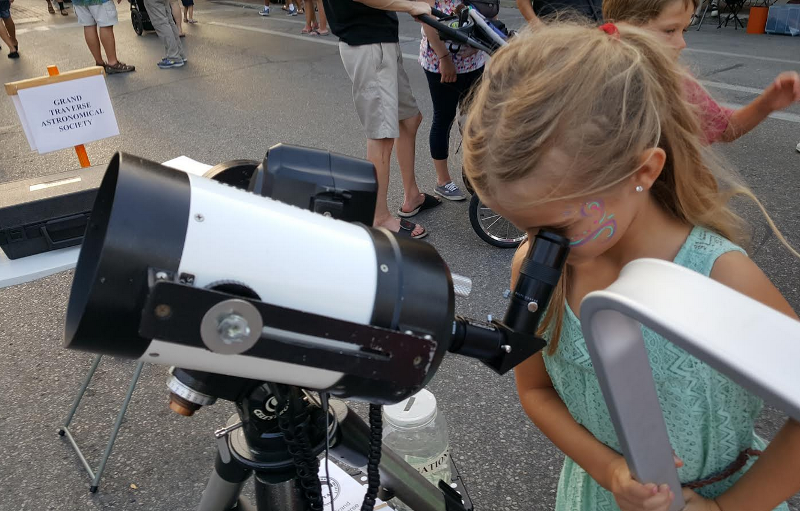
A girl looking through a telescope at the nearly first quarter Moon at Friday Night Live, August 17, 2018.

Looking down Front Street in Traverse City at the Friday Night Live August 17, 2018.
08/23/2018 – Ephemeris – Mercury’s morning appearance
Ephemeris for Thursday, August 23rd. The Sun rises at 6:54. It’ll be up for 13 hours and 40 minutes, setting at 8:35. The Moon, 3 days before full, will set at 4:56 tomorrow morning. | The tiny and elusive planet Mercury is making an appearance in the morning sky now. On Sunday afternoon our time Mercury will at its greatest elongation or separation west of the Sun. So Sunday or Monday mornings are the very best time to spot it. Look to the east-northeast at a low horizon to spot it. It should be visible from about 6 a.m. to about 6:40 a.m. before twilight swamps it. There are no stars of comparable brightness near it. It’s seen against the dim stars of Cancer the crab. The bright stars Pollux and Castor of Gemini will appear a ways above it. It should be visible from now through next week. Today is the day of the mini-Moon, its smallest of the month at 252 thousand miles (406 thousand km) away.
The times given are for the Traverse City/Interlochen area of Michigan. They may be different for your location.
Addendum
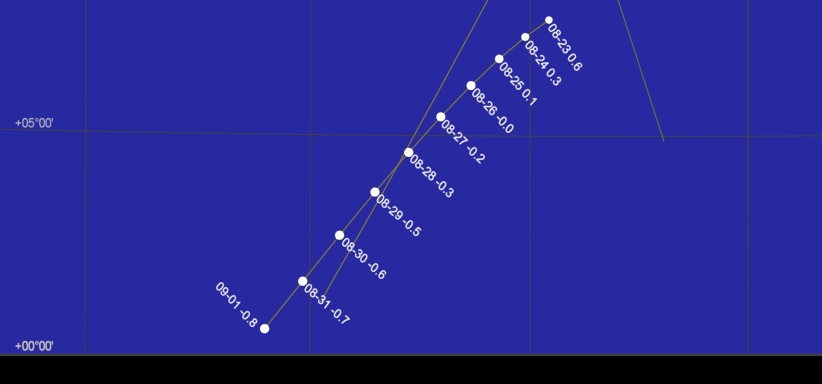
The motion of Mercury from August 23 to September 1, 2018. For each day the magnitude of Mercury is given. Note that gets brighter over the period. That is the magnitudes get more negative. The is due to Mercury’s increasing phase, getting fuller as it moves around the Sun. Created using Cartes du Ciel (Sky Charts).
08/22/2018 – Ephemeris – All five bright planets visible now
Ephemeris for Wednesday, August 22nd. The Sun rises at 6:53. It’ll be up for 13 hours and 43 minutes, setting at 8:37. The Moon, half way from first quarter to full, will set at 4:00 tomorrow morning.
It’s Wednesday and time to look for and at the bright planets. Four of them are visible in the evening sky. The brilliant Venus will be visible in the western twilight from about 9 p.m. until it sets at 10:02 p.m. Jupiter will be in the southwest as it gets dark. It is only outshone by Venus, the Moon, and currently Mars. Jupiter will set at 11:30 p.m. Saturn will start the evening low in the southern sky and will stay relatively low, above the Teapot of Sagittarius. It will be due south at 9:49 p.m. and will set at 2:15 a.m.. Mars will be low in the southeast as the skies darken tonight. and is now 38.9 million miles (62.7 million km) away. It will set at 3:51 a.m. The fifth planet Mercury will rise at 5:27 a.m. tomorrow morning.
The times given are for the Traverse City/Interlochen area of Michigan. They may be different for your location.
Addendum
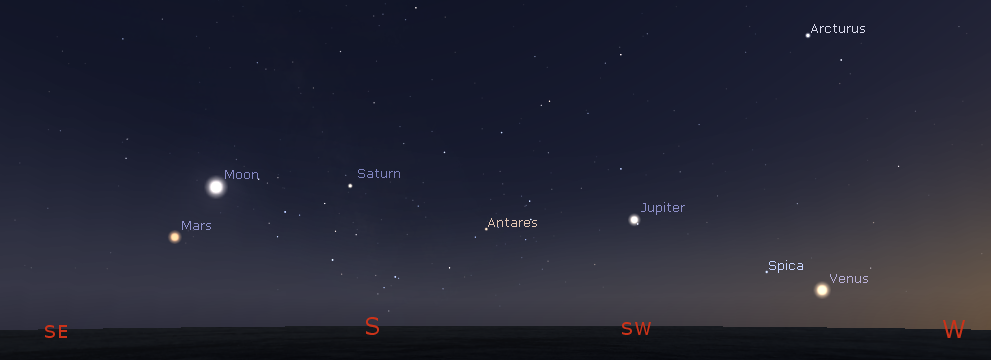
The evening planets visible at 9:30 p.m., almost an hour after sunset. August 22nd, 2018. Also shown is the Moon. Click on the image to enlarge. Created using Stellarium.
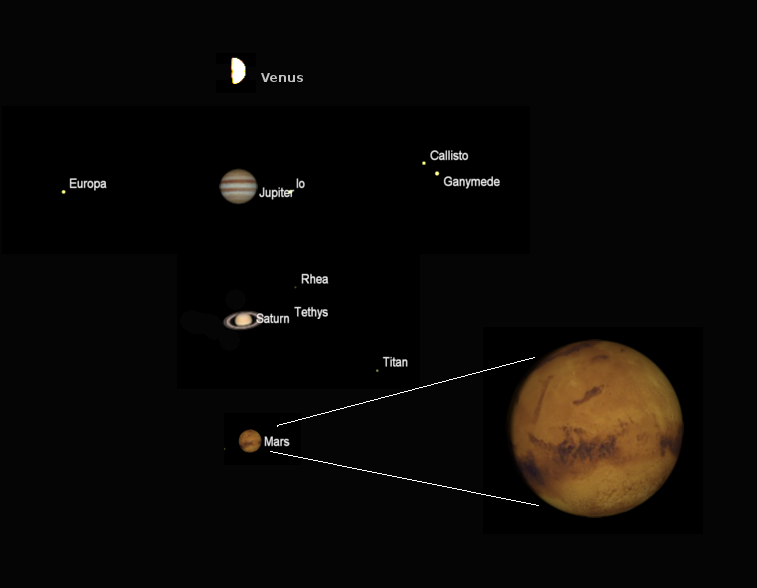
Venus, Jupiter, Saturn and Mars with the same magnification at 9:30 p.m. August 22, 2018. Mars is also shown enlarged. The global dust storm is abating, so the albedo features are beginning to be seen. Created using Cartes du Ciel (Sky Charts).
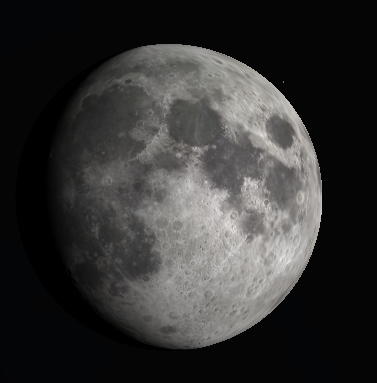
The gibbous Moon as it should appear tonight. Created using Stellarium. Stellarium.
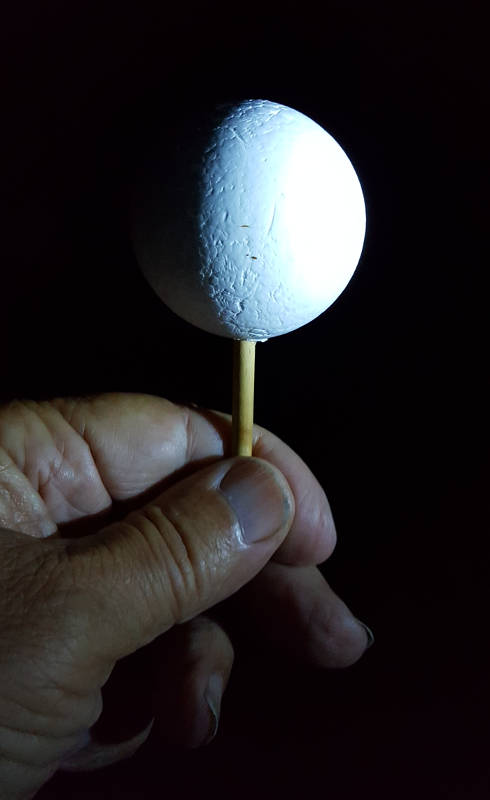
Demonstration of the Moon’s gibbous phase with the Styrofoam moon ball we use for Project Astro held up to a light off frame to the right. The night side of the ball is illuminated a bit by the translucency of the ball, and the reflection off my hand. Note the roughness of the ball is visible only at the terminator.
My program about the Moon’s crescent phase aired last Thursday and a demonstration of it using a moonball is here.
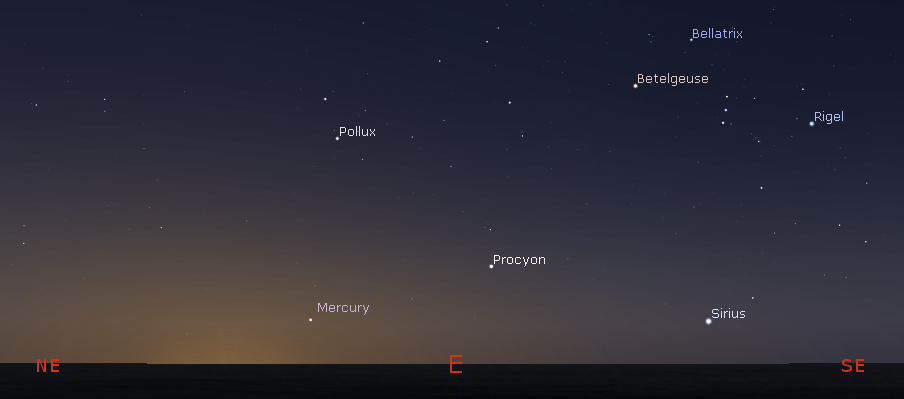
Mercury seen at 6 a.m., about an hour before sunrise. A bonus, the constellation Orion appears without the possibility of frostbite. Click on the image to enlarge. Created using Stellarium.
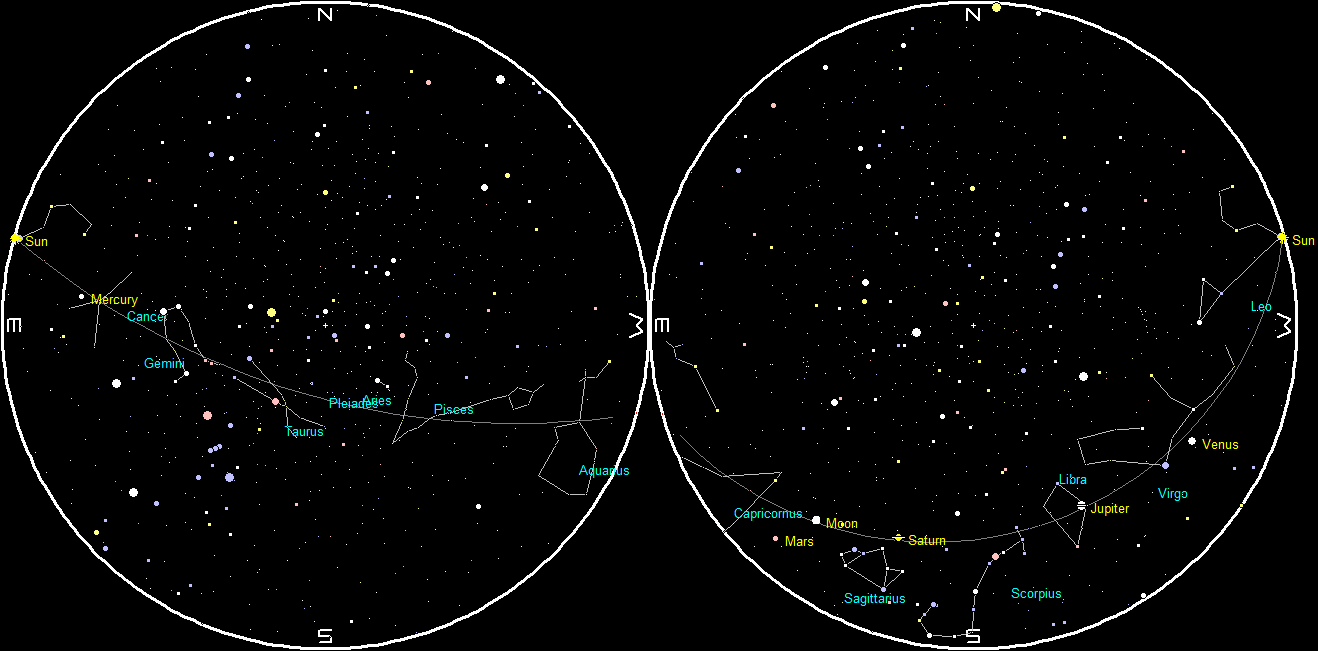
Planets and the Moon at sunset and sunrise of a single night starting with sunset on the right on August 22, 2018. The night ends on the left with sunrise on the 23rd. Click on the image to enlarge. Created using my LookingUp program.
08/21/2018 – Ephemeris – How will the Parker Solar Probe get near to the Sun?
Ephemeris for Tuesday, August 21st. The Sun rises at 6:52. It’ll be up for 13 hours and 46 minutes, setting at 8:38. The Moon, 3 days past first quarter, will set at 3:09 tomorrow morning.
I introduced the Parker Solar Probe yesterday. It’s on its way to Venus to have some of its velocity stolen by that planet as to drop to nearly 15 million miles (24 million km) of the Sun at its first perihelion, before heading almost all the way out to the Earth’s orbit. Its next encounter with Venus will steal even more velocity from the probe to drop even closer to the Sun. It will take nearly 7 years to reach as close as 3.9 million miles (6.2 million km) from he center of the Sun of 3.8 million miles (6.1 million km) from what looks like its surface, the photosphere, the bright ball we see of the Sun. The probe has a huge heat shield that will handle the over two thousand degree heat from the Sun. Even though the corona is several million degrees in temperature, it’s not dense enough to heat the probe.
The times given are for the Traverse City/Interlochen area of Michigan. They may be different for your location.
Addendum
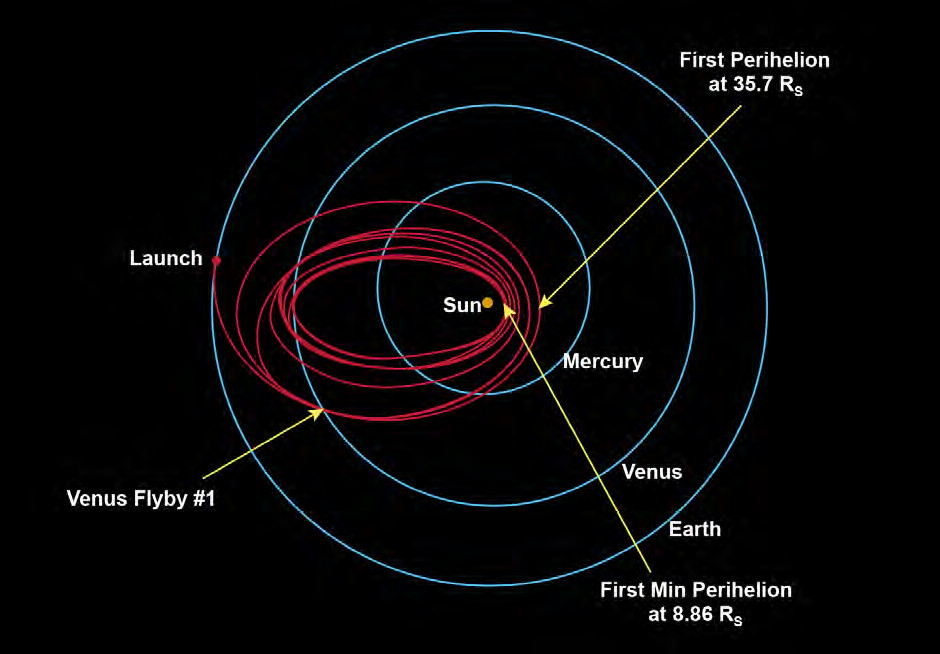
The planned orbits of the Parker Solar Probe. First flyby of Venus will occur on October 3rd 2018. The first perihelion passage a bit more than a month later on November 6th. Credit: NASA
A close look at the Sun
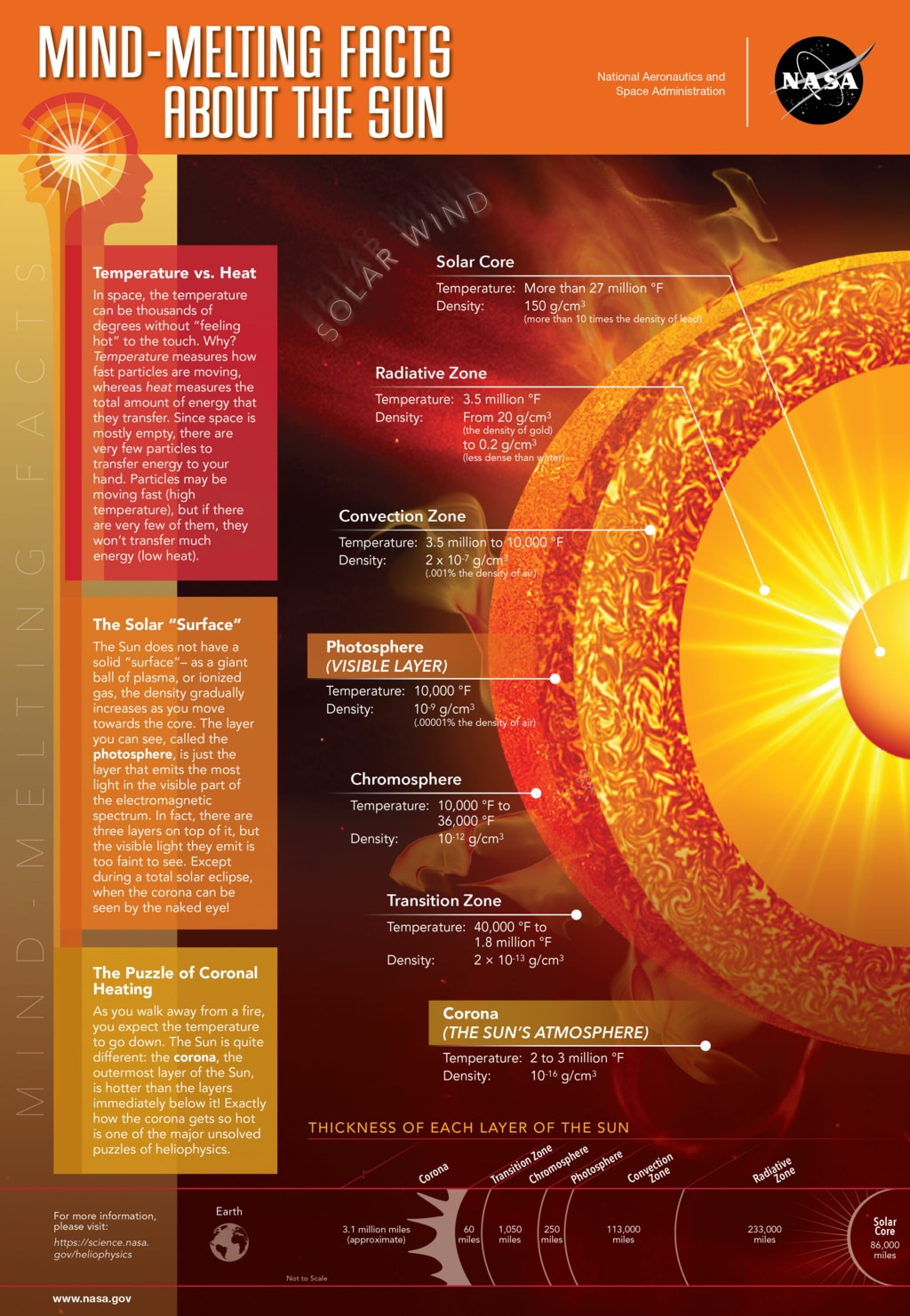
Click on image to enlarge. Credit NASA.
08/20/2018 – Ephemeris – The Parker Solar probe is on its way to skim through the Sun’s corona
Ephemeris for Monday, August 20th. The Sun rises at 6:51. It’ll be up for 13 hours and 49 minutes, setting at 8:40. The Moon, 2 days past first quarter, will set at 2:22 tomorrow morning.
Eight days ago the Parker Solar Probe was launched toward the Sun. It is the first NASA spacecraft named after a living person, Eugene Parker, a Michigander, born in Houghton in 1927, graduated from Michigan State, before moving on to Caltech. He eventually landed at the University of Chicago. In the 1950’s he put forth the theory of the supersonic solar wind of charged particles pervading the solar system. The theory was not initially accepted, but has been verified by satellites. The Parker Solar Probe will make multiple passes of Venus, giving up its velocity to fall closer to the Sun on each pass, taking almost 7 years to inch closer to the Sun at its perihelion until it gets down to about 3.8 million miles of our star.
The times given are for the Traverse City/Interlochen area of Michigan. They may be different for your location.
Addendum
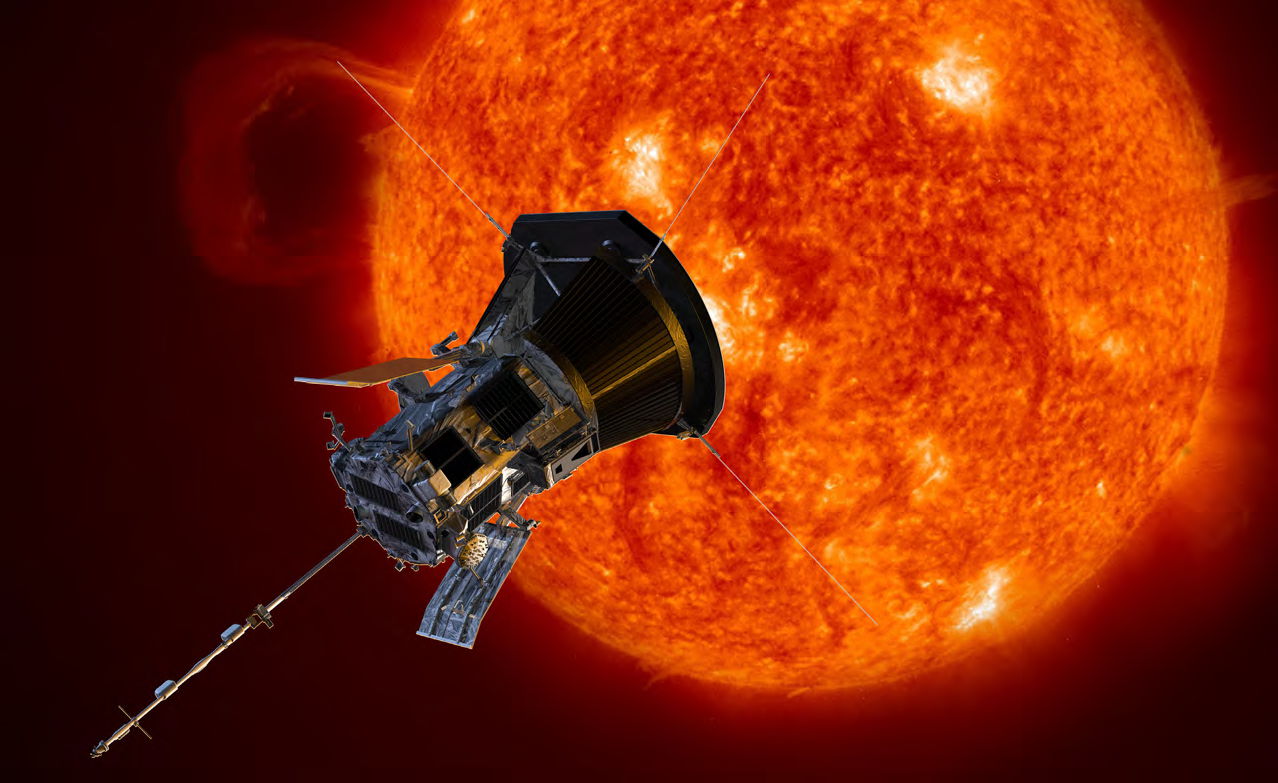
Artist’s visualization of the Parker Solar Probe near the Sun. Credit: NASA/Johns Hopkins APL/Steve Gribben.
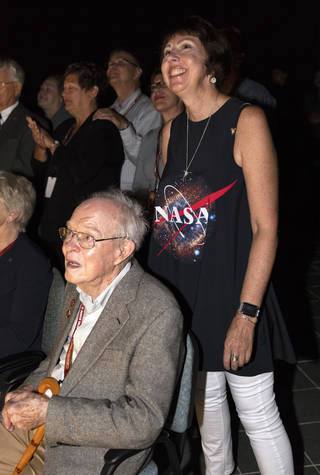
Dr. Eugene Parker (seated in the foreground), a pioneer in heliophysics and S. Chandrasekhar distinguished service professor emeritus for the Department of Astronomy and Astrophysics at the University of Chicago, watches the launch of NASA’s Parker Solar Probe. This is the first agency mission named for a living person. Standing behind Parker is Nicky Fox, Parker Solar Probe project scientist at Johns Hopkins Applied Physics Laboratory. The liftoff took place at 3:31 a.m. EDT on Sunday, Aug. 12, 2018. The spacecraft was built by the Johns Hopkins University Applied Physics Laboratory in Laurel, Maryland. The mission will perform the closest-ever observations of a star when it travels through the Sun’s atmosphere, called the corona. The probe will rely on measurements and imaging to revolutionize our understanding of the corona and the Sun-Earth connection. Credit: NASA/Glenn Benson.
08/17/2018 – Ephemeris – Another busy weekend for the GTAS
Ephemeris for Friday, August 17th. The Sun rises at 6:47. It’ll be up for 13 hours and 57 minutes, setting at 8:45. The Moon, 1 day before first quarter, will set at 12:29 tomorrow morning.
The Grand Traverse Astronomical Society (GTAS) has another busy weekend. Tonight the society members will bring their telescopes to downtown Traverse City and Friday Night Live. During the event we’ll be looking at the Sun and the planet Venus and staying after to view Saturn and the Moon if it’s clear. Saturn’s rings are, of course, spectacular. Tomorrow night society members will be at Northwestern Michigan College’s Rogers Observatory beginning at 9 p.m. for a star party viewing Venus, Jupiter, Saturn and Mars. Later as it gets really dark, some of the brighter stellar wonders will come into view if it’s clear. There’s stars in groups called clusters great and small, and stars that orbit each other and can have different colors.
The times given are for the Traverse City/Interlochen area of Michigan. They may be different for your location.
Addendum
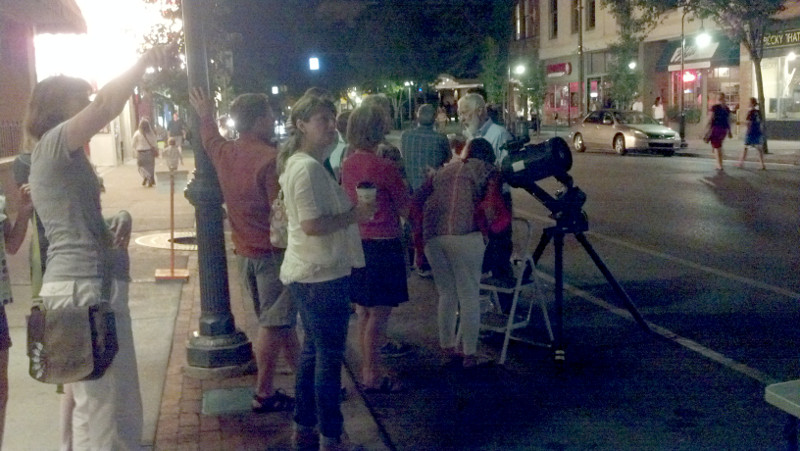
Ron Uthe (with the beard) explains that his telescope is pointed to Saturn after the 2013 Friday Night Live. Credit mine.
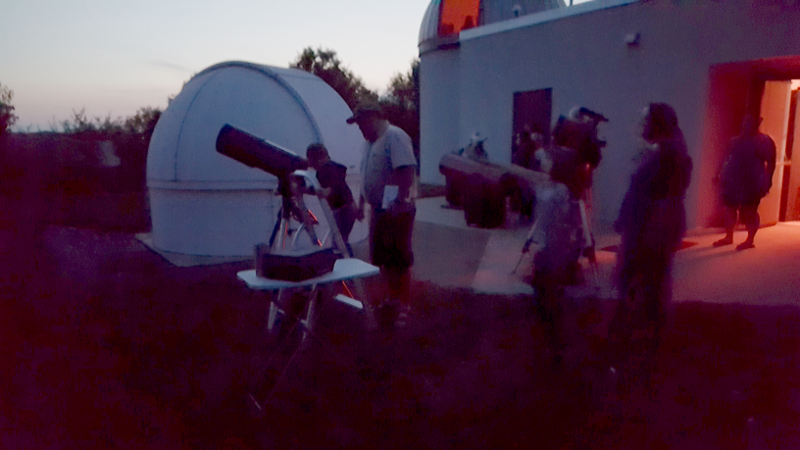
Telescopes set up by members of the Grand Traverse Astronomical Society at the back of Northwestern Michigan College’s Joseph H. Rogers Observatory on August 3, 2018. Credit mine.
08/16/2018 -Ephemeris – The Moon’s phase, a closer look
Ephemeris for Thursday, August 16th. The Sun rises at 6:46. It’ll be up for 14 hours exactly, setting at 8:46. The Moon, 2 days before first quarter, will set at 11:59 this evening.
With the Moon at a fat crescent tonight, it’s a good time to turn binoculars or a small telescope toward it. The demarcation between the bright part and the dark part is called the terminator. In the case before full moon, it is the sunrise line. After that the sunset line. The Moon’s entire day lasts about 29 ½ earthly days. I am sometimes asked “What’s blocking the light from the unlit side of the Moon?” It’s the Moon itself. It’s the night side of the Moon, just as when we are in night. The Earth itself is blocking the Sun’s light from us. The Moon, like the Earth and all the other planets are spheres lit on one side by the Sun. It’s near the terminator of the Moon where the most detail is revealed by the long shadows cast by the Moon’s features.
The times given are for the Traverse City/Interlochen area of Michigan. They may be different for your location.
Addendum
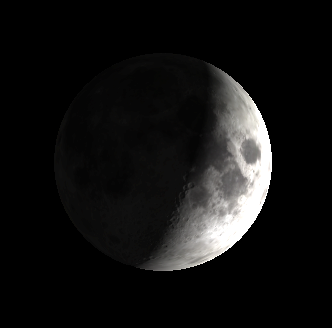
The crescent moon as it should appear tonight. Created using Stellarium. Stellarium always shows details on the night side of the Moon. The crescent phase of the Moon is now too fat to really see earthshine on it’s night side.
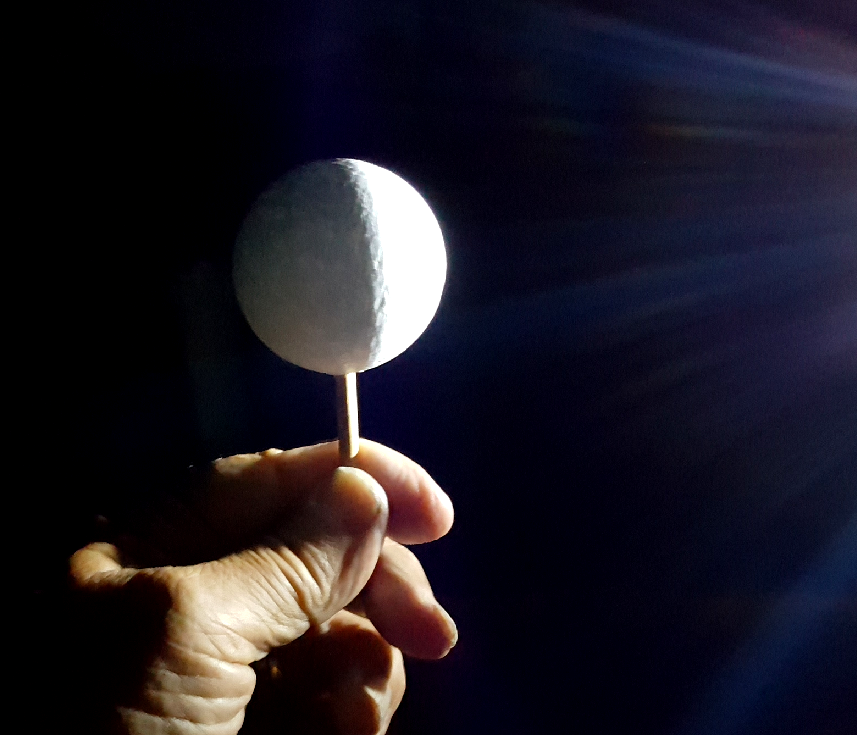
Demonstration of the Moon’s crescent phase with the Styrofoam moon ball we use for Project Astro held up to a light off frame to the right. The night side of the ball is illuminated a bit by the translucency of the ball, and the reflection off my hand. Note the roughness of the ball is visible only at the terminator.
08/15/2018 – Ephemeris – Spotting the bright planets this week
Ephemeris for Wednesday, August 15th. The Sun rises at 6:45. It’ll be up for 14 hours and 3 minutes, setting at 8:48. The Moon, 3 days before first quarter, will set at 11:29 this evening.
It’s Wednesday and time to look for and at the bright planets. Four of them are visible in the evening sky. The brilliant Venus will be visible in the western twilight from about 9:10 p.m. until it sets at 10:20 p.m. Jupiter will be in the southwest as it gets dark. It is only outshone by Venus, the Moon, and currently Mars. Jupiter will set at 11:52 p.m. Saturn will start the evening low in the southern sky and will stay relatively low, above the Teapot of Sagittarius. It will be due south at 10:18 p.m. and will set at 2:43 a.m.. Mars will be low in the southeast as the skies darken tonight. and is now 37.3 million miles (60.1 million km) away. It will set at 4:21 a.m. It is being slowly left behind by the faster moving Earth.
The times given are for the Traverse City/Interlochen area of Michigan. They may be different for your location.
Addendum
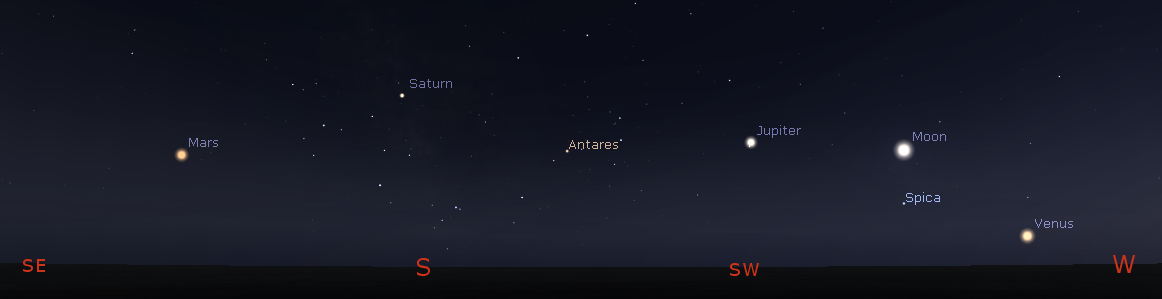
The evening planets and the Moon visible at 10 p.m., one hour after sunset. August 15th, 2018. Also shown are the constellations. Click on the image to enlarge. Created using Stellarium.
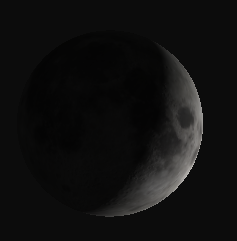
What the Moon might look like at 10 p.m., August 15th, 2018. Created using Stellarium.
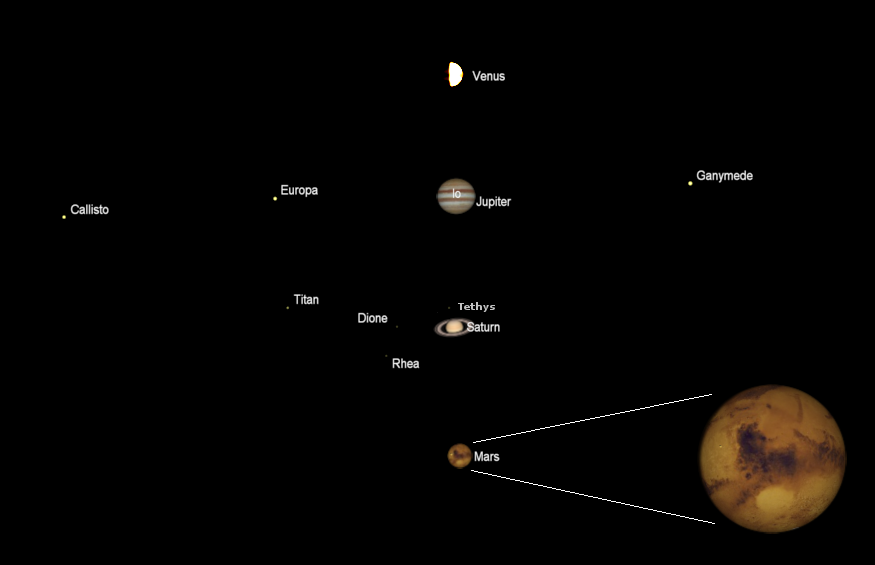
Venus, Jupiter, Saturn and Mars with the same magnification at 10 p.m. August 15, 2018. Jupiter’s satellite label Io is shown. However at 10 p.m. it’s occulted by Jupiter. The occultation began at 9:35 p.m. EDT (01:35 UT the 16th) and will emerge from Jupiter’s shadow at 1:02 a.m. EDT (05:02 UT) after Jupiter sets locally. Mars is also shown enlarged. It seems that the global dust storm is abating, so the albedo features are beginning to be seen. Created using Cartes du Ciel (Sky Charts)
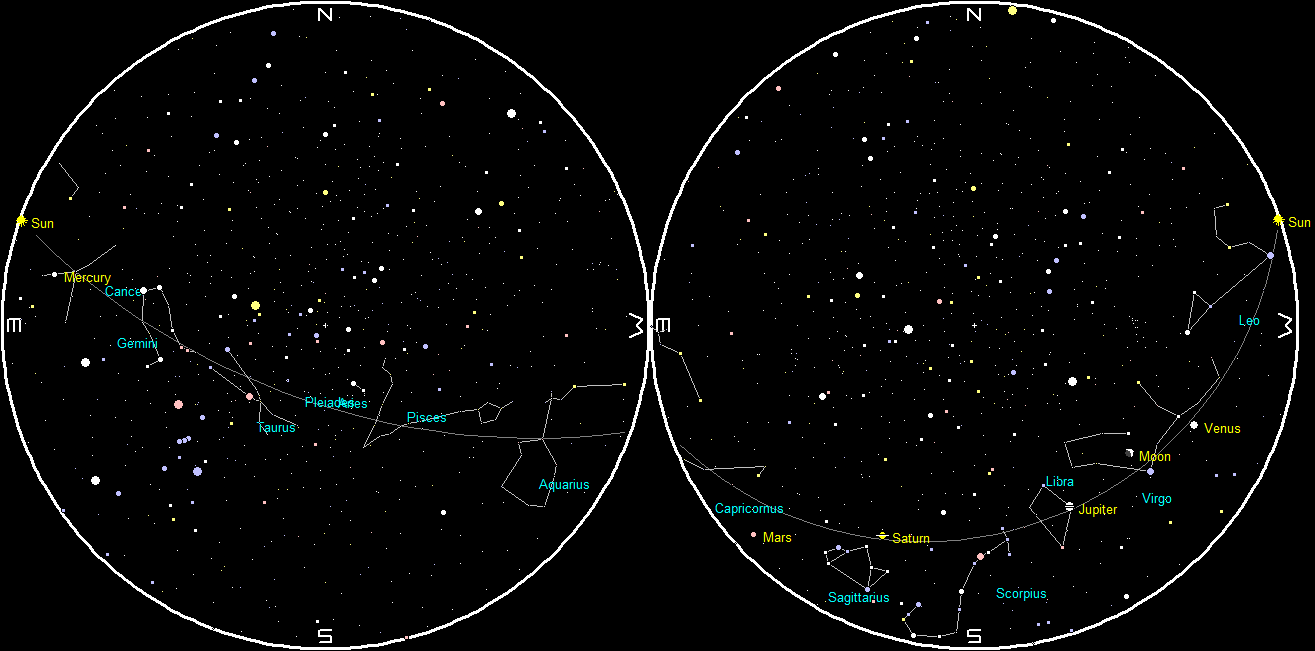
Planets and the Moon at sunset and sunrise of a single night starting with sunset on the right on August 15, 2018. The night ends on the left with sunrise on the 16th. Click on the image to enlarge. Created using my LookingUp program.

