Archive
12/13/2017 – Ephemeris – The bright planets of morning
Ephemeris for Wednesday, December 13th. The Sun will rise at 8:11. It’ll be up for 8 hours and 51 minutes, setting at 5:02. The Moon, 3 days past last quarter, will rise at 4:26 tomorrow morning.
Let’s take our weekly look at the bright planets. We have no bright planets in the evening sky now. While Uranus and Neptune are evening planets, they require binoculars or a telescope to spot. The morning sky is now host to three planets, though Venus, the brightest will rise too close to the Sun to spot. It’s way on the other side of the Sun, and it will pass behind the Sun in superior conjunction January 6th. At 7 this morning Mars is below the crescent Moon in the southeast while Jupiter is a lot brighter and below and left of it. The Moon will be above it tomorrow morning. Mars will rise tomorrow morning at 3:58. Jupiter will rise an hour later at 4:54. Remember that the Geminid meteor shower will reach its peak tonight through tomorrow morning. It’s the best meteor shower of the year.
The times given are for the Traverse City/Interlochen area of Michigan. They may be different for your location.
Addendum
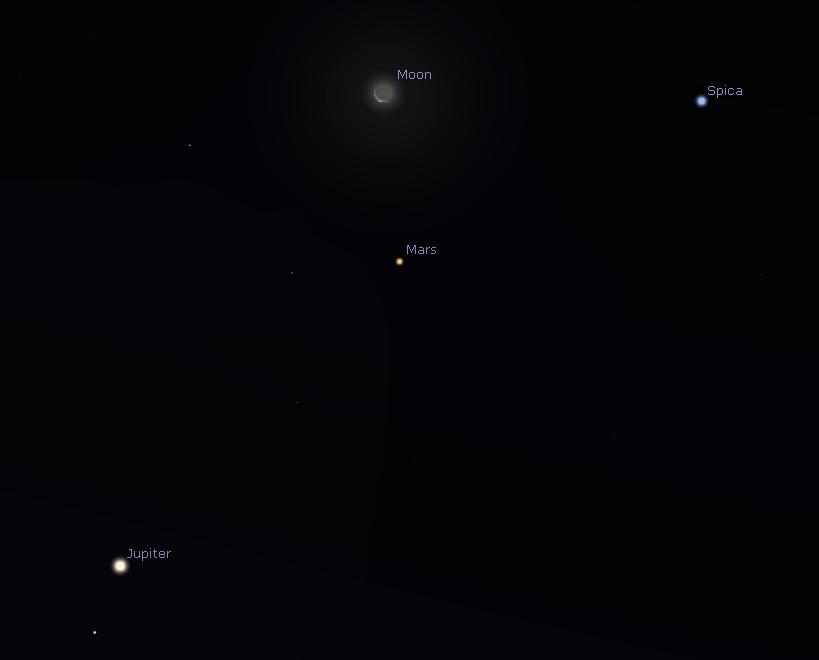
Mars, Jupiter and the Moon this morning at 7 a.m., December 13, 2017. Created using Stellarium.
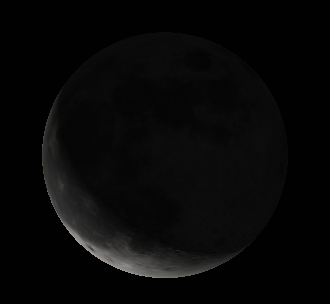
The Moon as it might be seen in binoculars this morning at 7 a.m. December 13, 2017. Created using Stellarium.
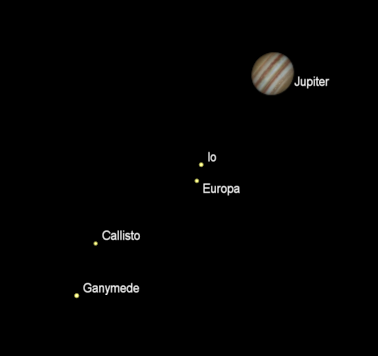
Jupiter and its 4 Galilean moons as they might be seen in a telescope at 7 a.m. this morning, December 13, 2017. Created using Cartes du Ciel (Sky Charts).
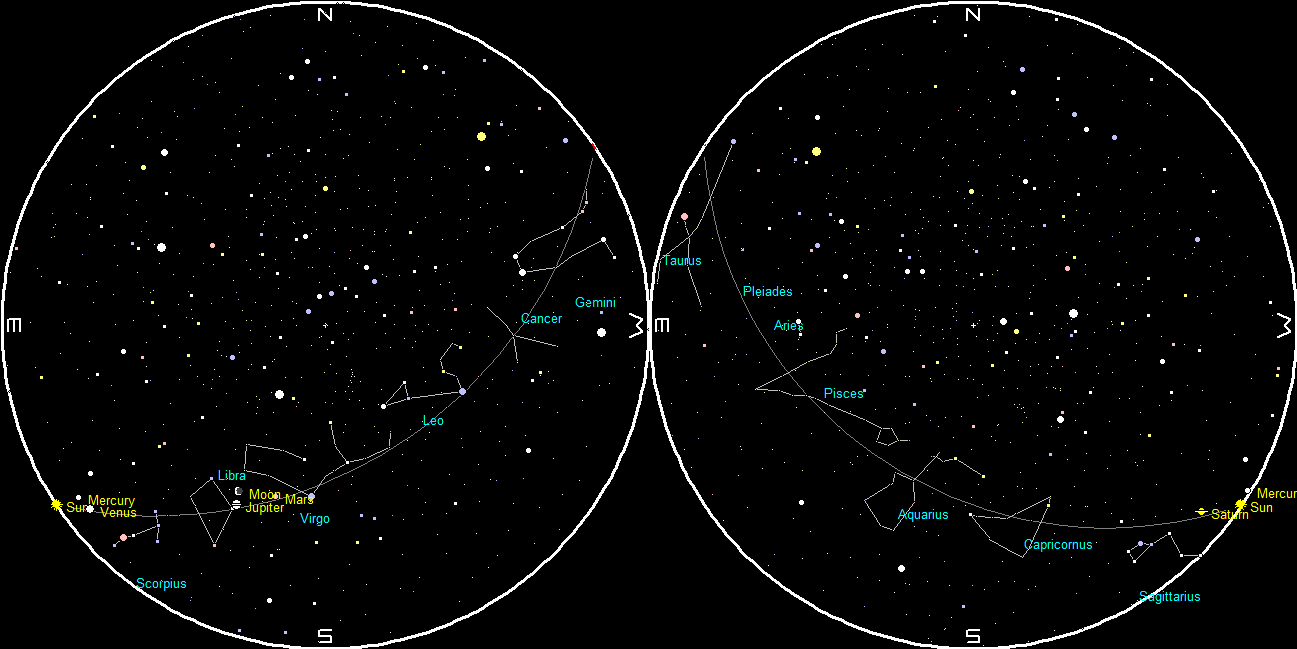
Planets at sunset and sunrise of a single night starting with sunset on the right on December 13, 2017. The night ends on the left with sunrise on the 14th. Click on the image to enlarge. Created using my LookingUp program.
12/12/2017 – Ephemeris – The Geminids are coming!
Ephemeris for Tuesday, December 12th. The Sun will rise at 8:10. It’ll be up for 8 hours and 52 minutes, setting at 5:02. The Moon, 2 days past last quarter, will rise at 3:25 tomorrow morning.
Tomorrow evening through Thursday morning we will have the chance to see the peak of the Geminid meteor shower. Some of its members can be seen tonight, but the meteors will be most numerous on the morning of Thursday the 14th. This shower is currently besting the Perseid meteor shower of August with a predicted 120 meteors per hour Thursday morning. The problems for us in viewing this fabulous shower are the cold temperatures and usually cloudy skies. However the Moon won’t be a problem. The source of the Geminids was discovered in 1983. It is a burnt out comet with the asteroid designation 3200 Phaethon which swoops down to only 13 million miles of the Sun, but will is near Earth this time around. The Geminids were first seen in 1862
The times given are for the Traverse City/Interlochen area of Michigan. They may be different for your location.
Addendum
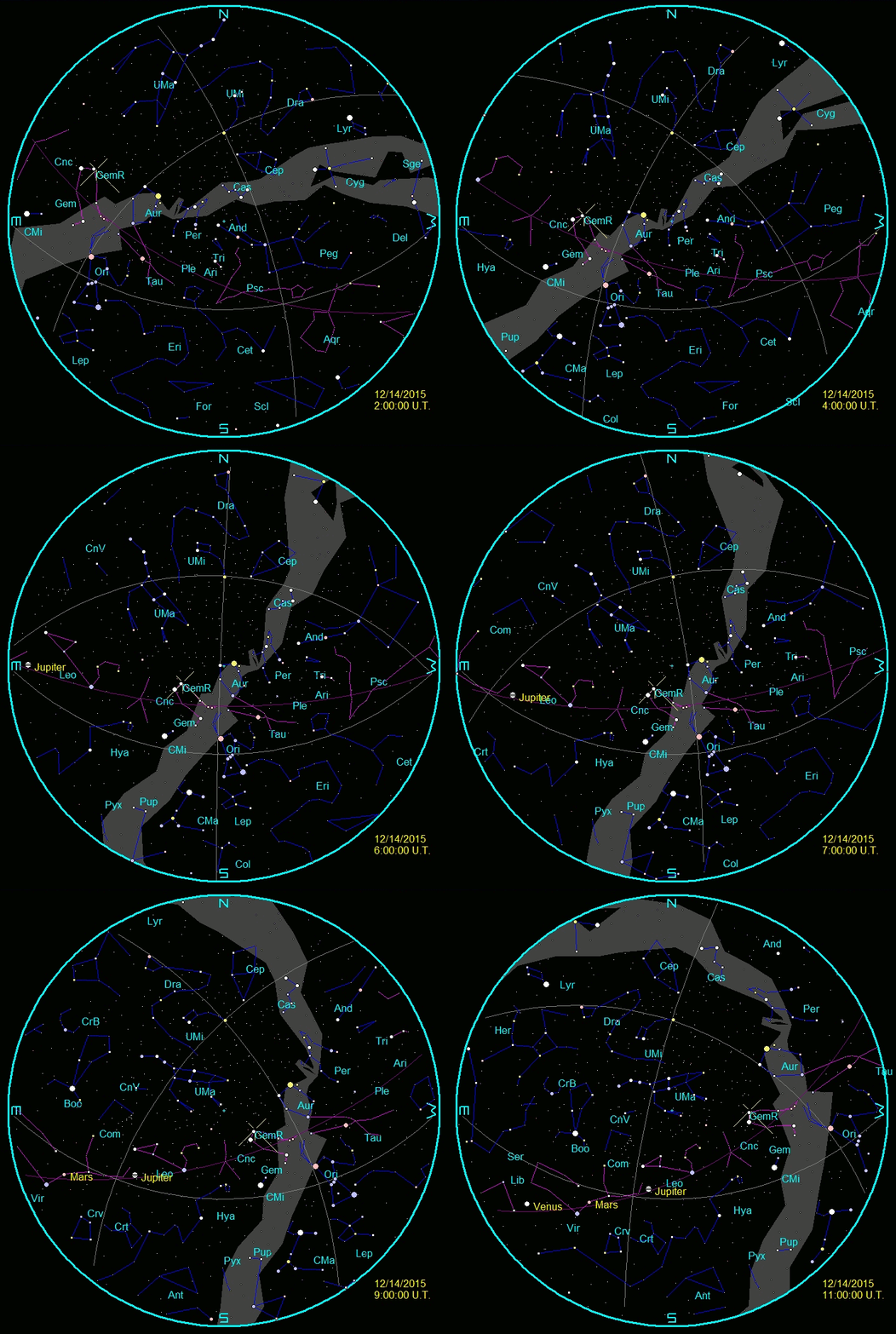
All sky view one hour intervals for The Geminid meteor shower the night of December 13-14, 2015.. Note the radiant “GemR”. Created with my LookingUp program and GIMP.
This is an animation from two years ago, so ignore the planet positions. Times are in Universal time for the Grand Traverse Region and Eastern Time. So subtract 5 hours from UT. The sequence starts at 9 p.m. EST and ends at 6 a.m.
12/11/2017 – Ephemeris – Orion rising
Ephemeris for Monday, December 11th. The Sun will rise at 8:09. It’ll be up for 8 hours and 52 minutes, setting at 5:02. The Moon, 1 day past last quarter, will rise at 2:22 tomorrow morning.
Off in the east-southeast at 9 in the evening the great constellation of Orion will be seen. This is the most famous of all constellations world-wide. We think the Big Dipper is a big deal. It’s not even a constellation, being the hind end of the great bear Ursa Major. Also it’s invisible if one travels far enough south of the equator. Orion is now a rectangle of stars tilted to the left as he rises. With three stars in a straight line in the center, his belt. They are aligned nearly vertically. Orion is a giant hunter. The rectangle depicts his shoulders and knees. Among its other bright stars Orion contains two of the brightest. The upper left star is the famous red giant star Betelgeuse. The lower left star is the blue-white super giant Rigel.
The times given are for the Traverse City/Interlochen area of Michigan. They may be different for your location.
Addenda
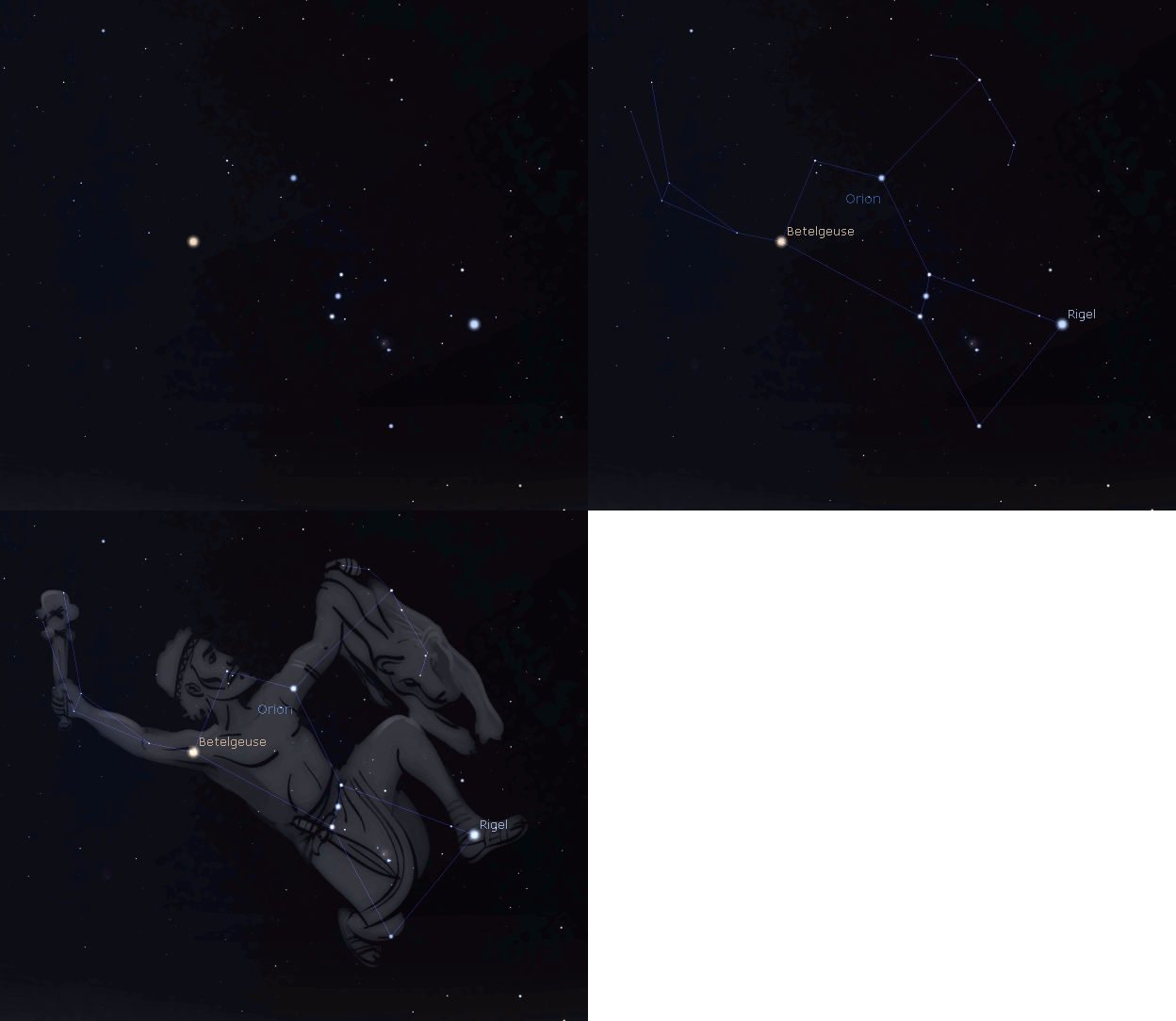
Orion fully risen in the east-southeast a 9 p,m, approximately 4 hours after sunset, December 11. Created using Stellarium and GIMP.
Note to Blog readers
As you probably know these posts are transcripts of my Ephemeris program. The length of the program is exactly 59 seconds, and the first paragraph takes approximately 14 of those seconds. So I don’t have much time for the topic at hand. Therefore I dole out information in rather small spoonfuls. I’ll be revisiting Orion many times over the winter, talking about the other stars, and wonders found among its stars, also its mythology. If you can’t wait, type Orion in the search bar for all the past programs on Orion. Don’t be surprised that much of the programs don’t change much from year to year. I post the week’s worth of Ephemeris program MP3s on my monthly website http://ephemeris.bjmoler.org/ under the Audio link.
Sunday night and into the wee hours of Monday morning is the time I usually write and record the programs for Tuesday through the next Monday. Blog postings are prepared the night before the air date.
12/08/2017 – Ephemeris – The earliest sunset of the year is tomorrow night
Ephemeris for Friday, December 8th. The Sun will rise at 8:06. It’ll be up for 8 hours and 55 minutes, setting at 5:02. The Moon, 2 days before last quarter, will rise at 11:04 this evening.
In thirteen days we will have the shortest day in terms of daylight hours. But the change isn’t uniformly distributed in the morning and evening. Tomorrow evening we will have the earliest sunset. Sunset times have been within the same minute for the last few days and will continue for the next few. The latest sunrise will occur on January second. The reason is that the Sun is traveling faster eastward than average, so the Earth’s rotation takes a little longer each day to catch up with it. Near the solstice the Sun is at a higher latitude, where the longitude lines are closer together, also the Earth is nearing its closest to the Sun, so moves faster its orbit adding to the effect. The effect exists in June but isn’t as noticeable.
The times given are for the Traverse City/Interlochen area of Michigan. They may be different for your location.
Addendum
I had more complete thoughts about earliest and latest sunrises and sunsets earlier this year: https://bobmoler.wordpress.com/2017/03/13/03132017-ephemeris-more-thoughts-about-yesterdays-time-change/. Check the addendum.
12/07/2017 – Ephemeris – The constellation of Auriga the Charioteer
Ephemeris for Thursday, December 7th. The Sun will rise at 8:05. It’ll be up for 8 hours and 56 minutes, setting at 5:02. The Moon, 3 days before last quarter, will rise at 9:54 this evening.
The constellation Auriga the charioteer is about two-thirds the way up the sky in the east at 9 p.m. It is a pentagon of stars, with the brilliant star Capella at the top corner. Capella represents a she goat he’s carrying. A narrow triangle of stars nearby Capella is her kids. The Kids is an informal constellation or asterism. Within and near that pentagon, binoculars and telescopes will find several star clusters, groups of hundreds of stars born in the clump we still see them in. These star clusters will appear as fuzzy spots in binoculars. One called M 38 is near the center of the pentagon, M 36 is to the east of it and M 37, is farther east yet. The M designations come from Charles Messier who two centuries ago ran into them while looking for comets.
The times given are for the Traverse City/Interlochen area of Michigan. They may be different for your location.
Addendum
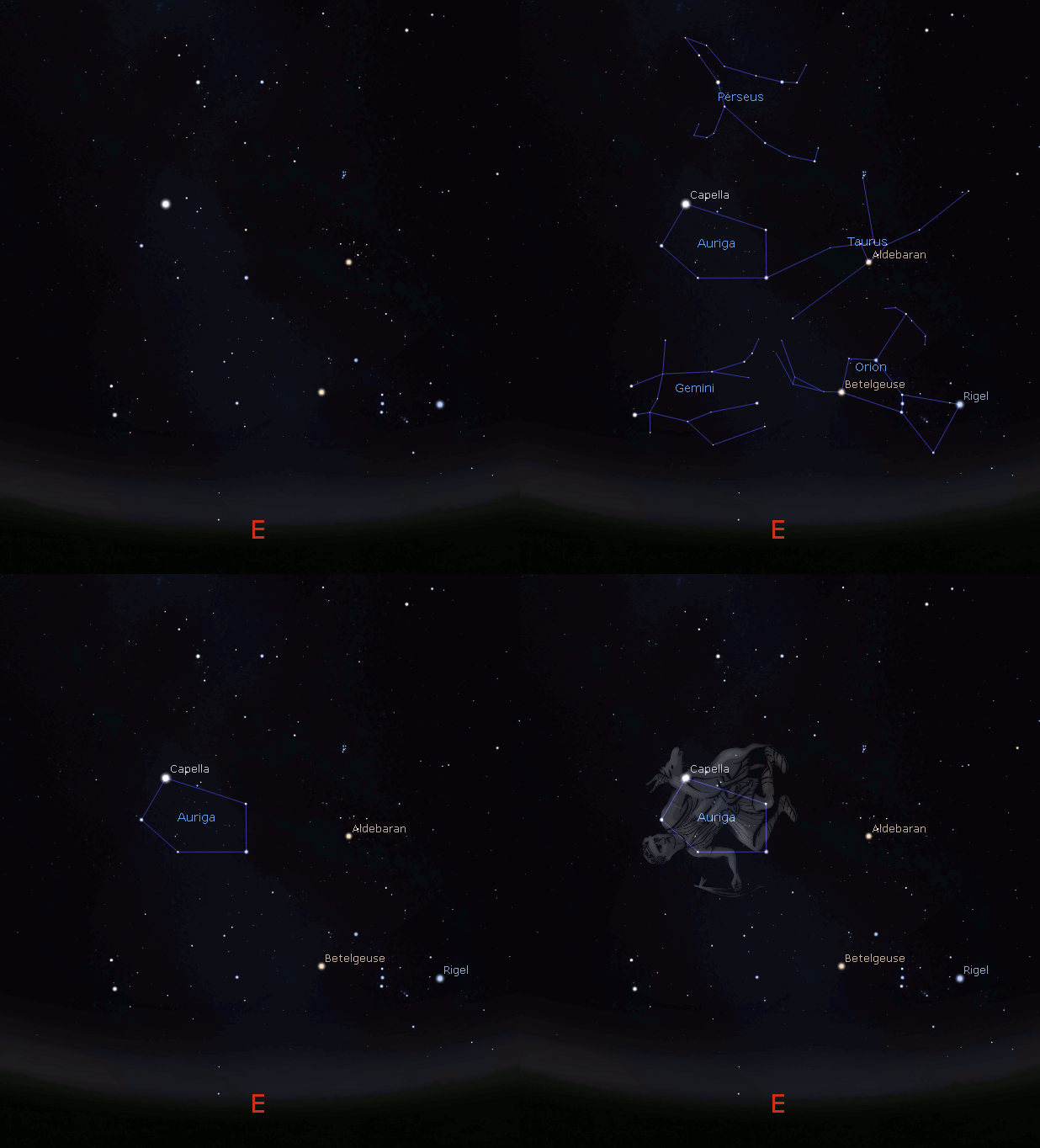
Auriga finder chart for 9 p.m. December 7th. any year. Created using Stellarium and GIMP.
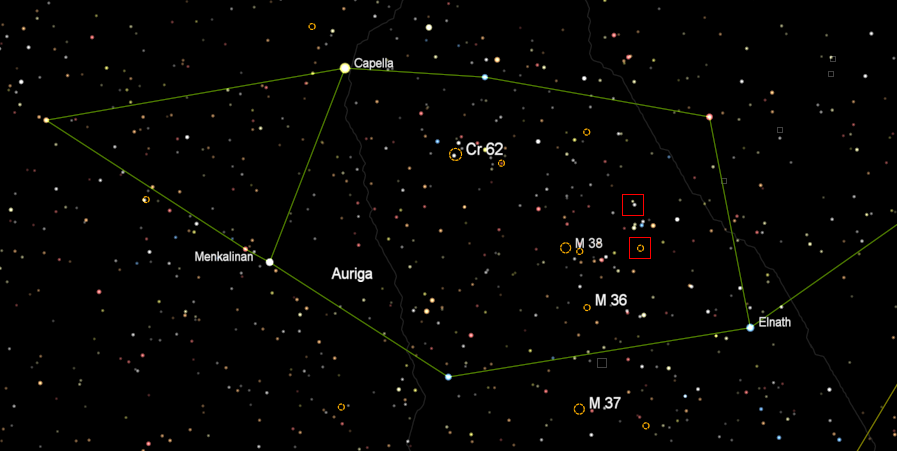
Auriga, showing, among other things the Messier star clusters M 36, M 37, and M 38. Created using Cartes du Ciel (Sky Charts).
Cr 62 is Collander 62, a real or accidental star cluster of 4 stars called Auriga’s Diamond. There’s an arc of stars just right of M 38 called the Cheshire Cat. You can find these on Phil Harringtons’s Binocular Universe on the Cloudy Night’s website: https://www.cloudynights.com/articles/cat/articles/new-articles-in-monthname/binocular-universe-aurigan-treasures-r2646
12/06/2017 – Ephemeris – Where did all the evening planets go?
Ephemeris for Wednesday, December 6th. The Sun will rise at 8:04. It’ll be up for 8 hours and 57 minutes, setting at 5:02. The Moon, 3 days past full, will rise at 8:43 this evening.
Let’s take our weekly look at the bright planets. Saturn and Mercury are very close together, but too low after sunset to spot from up North here. Mercury will set at 5:50, while Saturn will set 9 minutes later. While Uranus and Neptune are evening planets, they require binoculars or a telescope to spot. (This is beyond the scope of this program, which is geared to naked eye observing or easy things to find and observe with binoculars or a small telescope). The morning sky is now host to three planets, though Venus, the brightest will rise close to sun will rise at 7:24 this morning. It’s way on the other side of the Sun, and it will pass behind the Sun in superior conjunction a month from today. At 7 this morning Jupiter is bright, low in the east-southeast, while Mars, the Red Planet is just left of the brighter star Spica, which has a bluish hue. They are higher than Jupiter and to the southeast. Mars will rise tomorrow morning at 4:03. Jupiter will rise more than an hour later at 5:14.
The times given are for the Traverse City/Interlochen area of Michigan. They may be different for your location.
Addendum
Stellarium is unable to display Mercury or Saturn in twilight for tonight.
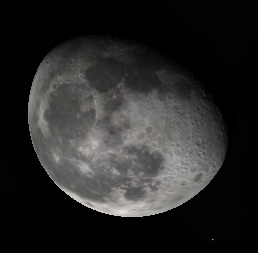
The Moon as it might be seen in binoculars at 9:30 p.m. December 6, 2017. Created using Stellarium.
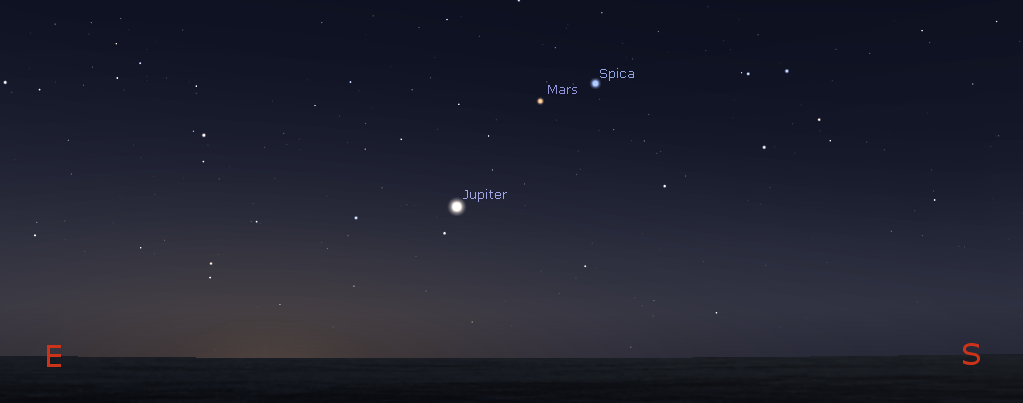
Mars and Jupiter in the morning at 7 a.m. December 7, 2017. Click on the image to enlarge. Created using Stellarium.
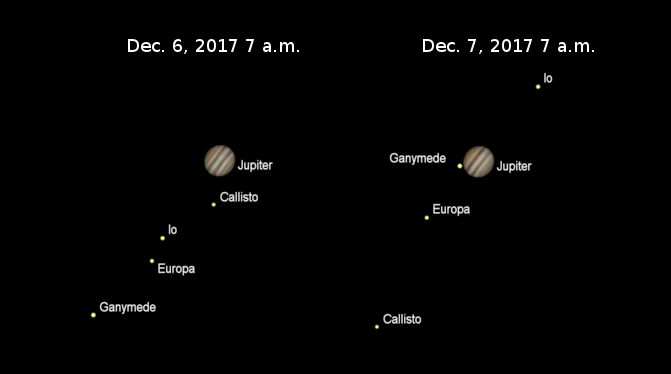
Jupiter and moons on the mornings of December 6th and 7th, 2017. Ganymede and Europa will transit the planet on the 7th later in the morning and in the afternoon to be visible for folks west of here. Created using Cartes du Ciel (Sky Charts).
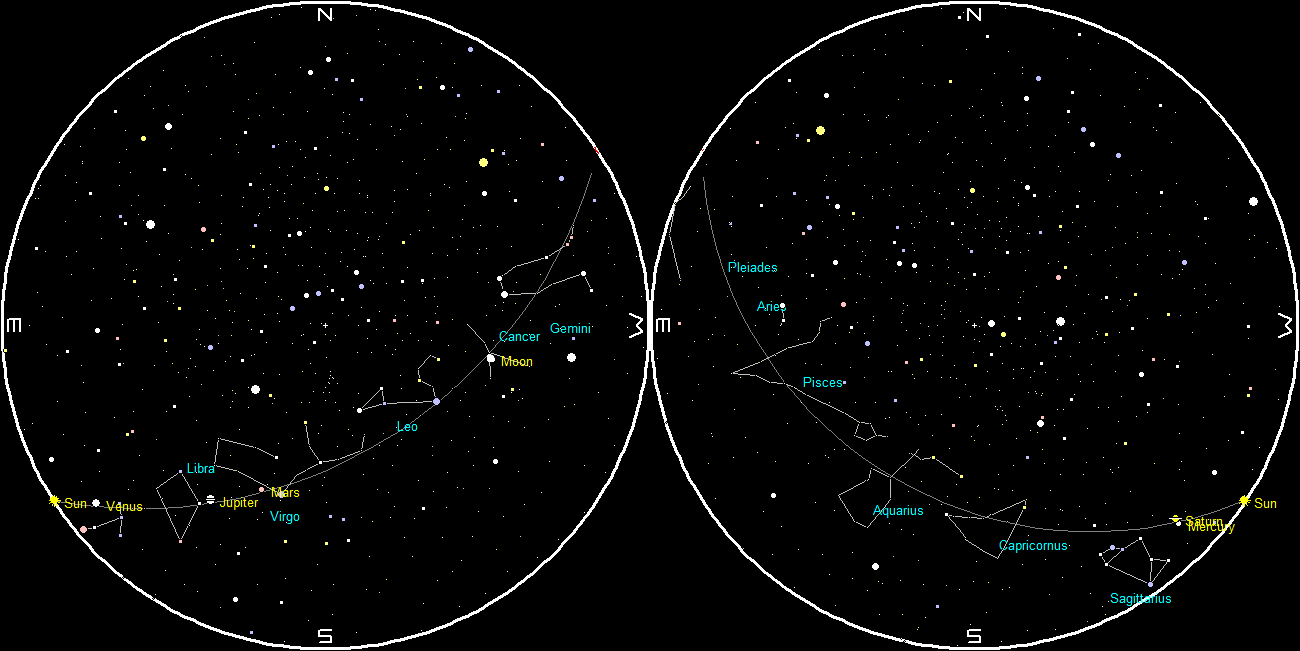
Planets at sunset and sunrise of a single night starting with sunset on the right on December 6, 2017. The night ends on the left with sunrise on the 7th. Click on the image to enlarge. Created using my LookingUp program.
12/05/2017 – Ephemeris – A flat Earth, come on, really?
Ephemeris for Tuesday, December 5th. The Sun will rise at 8:03. It’ll be up for 8 hours and 58 minutes, setting at 5:02. The Moon, 2 days past full, will rise at 7:35 this evening.
Last Friday night I gave a talk to the Grand Traverse Astronomical Society about the world view of mostly ancient peoples. They uniformly believed in a flat Earth. This includes the world of the Bible. The Greek geographer Eratosthenes calculated the circumference of the Earth way back in the third century BC. A flat Earth would normally be the conclusion of a person who never went more than a few hundred miles from home, especially in an east-west direction. However if one went north or south, the stars would slowly change. Head south and new stars would appear above the southern horizon, and in the north, stars that would never set would now set. Polaris would drop lower in the North. The round Earth is the simplest explanation.
The times given are for the Traverse City/Interlochen area of Michigan. They may be different for your location.
Addendum
Here’s an extension from my notes:
Those who profess to believe in a flat Earth tend to be Christian and believe that the Bible is literally true even to the physical description of the world found in its pages. Therefore the basis for the flat Earth is the Bible.
While there are those who have always believed in a flat earth, Eratosthenes pretty much put killed that notion in the 3rd century BC when he found that there was a 7.2 degree difference in the altitude of the Sun at local noon on the summer solstice between Syene and Alexandria in Egypt. The distance between the two cities was about 800 km, and 7.2 degrees is 1/50th that of a circle, so the Earth would have been 50 X 800 or 40,000 kilometers or 25,000 miles* in circumference. This of course meant that the Earth was round! The units he used were stadia, whose exact length has been in doubt.
Flat earth theories started to proliferate in the mid-19th century when most of the Earth’s coastlines had at least been mapped, though the polar regions had yet to be breached.
Zetetic Astronomy. Earth not a globe! An experimental inquiry… by Samuel Birly Rowbotham, 1865
Zetetic Cosmology: Conclusive evidence that the world is not a rotating-revolving-globe, but a stationary flat pane circle, second edition, by “Rectangle”, 1899. Rectangle is a pseudonym of T. Winship
These can be found on Archive.org.
The latest reincarnation of the Flat Earth Society was started in 2013. Their web page and wiki is here: https://www.tfes.org/.
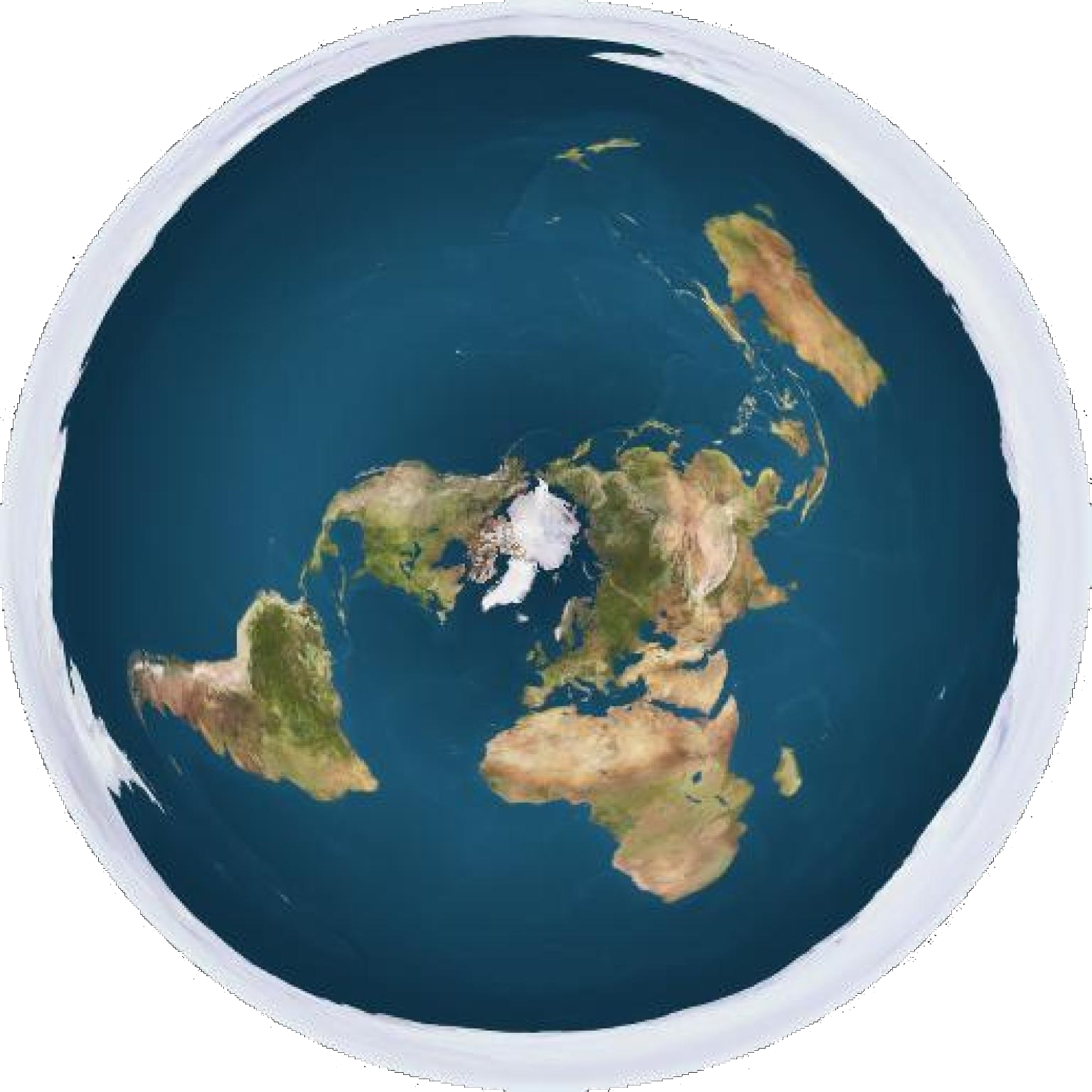
The Flat Earth by Trekky0623 at English Wikipedia, placed in the Public Domain.
Features:
- North Pole in the center.
- The firmament rotates around it.
- There is no South Pole.
- There are impassable mountains in Antarctica at the end of the Earth.
- Wouldn’t the Sun be always up for everybody?
- Apparently, the Sun orbits over the flat Earth in circles between the Tropic of Cancer and Tropic of Capricorn to produce the seasons.
- The Sun is 3000 miles away and is only about 30 miles in diameter.
- It shines like a spotlight over the earth.
- The moon is somewhat lower than the sun and can cause solar eclipses.
- The flat Earth’s shadow cannot cause a lunar eclipse, since the Moon is on the same side of the Earth as the Sun. The eclipse is caused by a “shadow object” that we can’t see that comes between the Sun and the Moon.
It boggles my mind how anyone in this day and age, who travels a lot cannot believe that the Earth is a spheroid. Maybe no one looks up anymore. Perhaps I’m just an oddball astronomer who like to look up and see the stars shift as I move south or north. In fact I plan on it when I travel.
* corrected this value from the original post
12/04/2017 – Ephemeris – Orion rising in the moonlight
Ephemeris for Monday, December 4th. The Sun will rise at 8:02. It’ll be up for exactly 9 hours, setting at 5:02. The Moon, 1 day past full, will rise at 6:32 this evening.
Now that the Moon is quite bright and making the fainter stars in the constellations harder to find, let’s look at one of the bright stars of Winter. Tonight at 8 p.m. the bright reddish star Betelgeuse is low in the east, but will be rising higher and moving slightly southward, as the rest of the bright stars in its constellation of Orion the hunter also clear the horizon. To its right are a nearly vertical line of three equally spaced stars, Orion’s belt. Betelgeuse is in Orion’s shoulder. The name Betelgeuse is a corruption of the Arabic phrase “Armpit of the Central One”, although there’s some debate about that translation. Betelgeuse is maybe only 7 million years old, but due to its great mass of up to 20 times that of the Sun, is already dying.
The times given are for the Traverse City/Interlochen area of Michigan. They may be different for your location.
Addendum
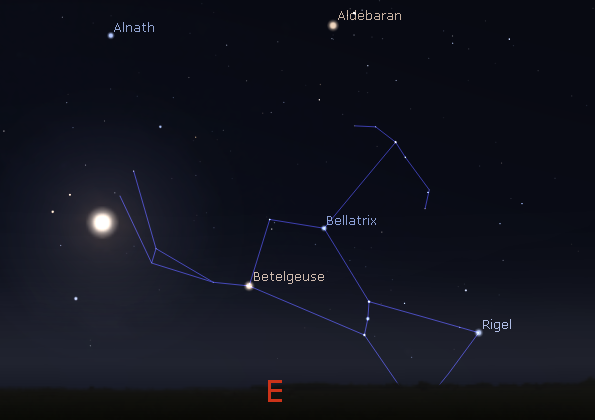
Orion rising in the light of a super moo at 8 p.m.,, about 3 hours after sunset, December 4, 2017. Created using Stellarium.
12/01/2017 – Ephemeris – A look at how the ancients saw their world at the Rogers Observatory tonight
Ephemeris for Friday, December 1st. The Sun will rise at 7:59. It’ll be up for 9 hours and 4 minutes, setting at 5:03. The Moon, 2 days before full, will set at 6:22 tomorrow morning.
This evening’s meeting of the Grand Traverse Astronomical Society starting at 8 p.m. at Northwestern Michigan College’s Rogers Observatory will be yours truly’s biennial December program on mostly Ancient Cosmologies, a look at the cosmologies or world view of many mostly pre-scientific cultures, including the Biblical world view. We’ll see how these ideas are alike and different for cultures spread across distance and time. I’ll finish with a modern unscientific and throwback cosmology of the believers in a flat Earth. At 9 p.m. there will be a star party at the observatory, and another program if it’s cloudy. All are welcome. The observatory is located south of Traverse City on Birmley Road.
The times given are for the Traverse City/Interlochen area of Michigan. They may be different for your location.
11/30/2017 – Ephemeris – Previewing December skies
Ephemeris for Thursday, November 30th. The Sun will rise at 7:58. It’ll be up for 9 hours and 5 minutes, setting at 5:03. The Moon, 3 days before full, will set at 5:07 tomorrow morning.
Tomorrow starts the last month of the 2017. We are now in the holiday season and about to celebrate the southernmost travel of the Sun in the sky and its return northward. The Sun will stop its travel south, the winter solstice on the 21st at 11:29 a.m. That will make that day the shortest day in terms of daylight hours. However the earliest sunset and latest sunrise don’t coincide with that date. The reason is the Earth is closer to the sun than average and moving faster in its orbit of the sun than it normally does. It skews the sunrise and sunset times, making them later than they would be on average. That makes the sunset times bottom out about December 9th. at 5:02 p.m. And that latest sunrise will top out on January 2nd at 8:20 a.m.
The times given are for the Traverse City/Interlochen area of Michigan. They may be different for your location.
Addenda
December Evening Sky Chart
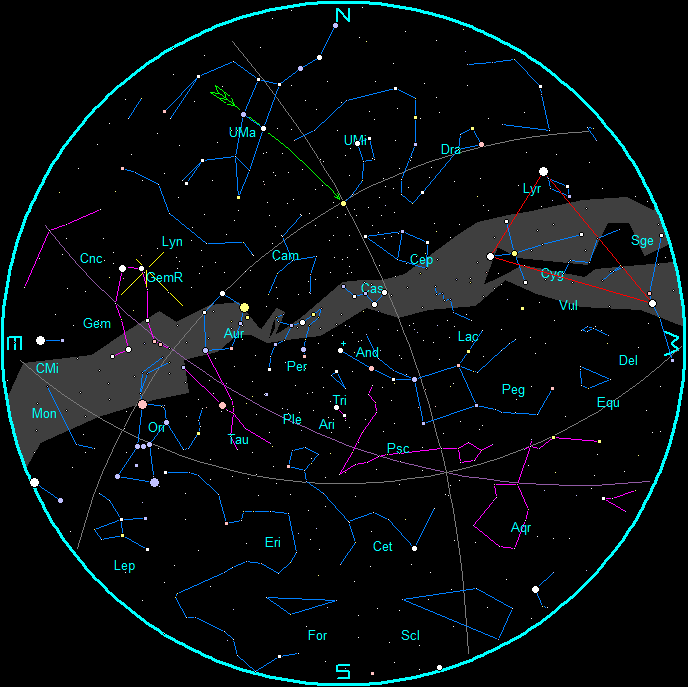
Star Chart for December 2017 (9 p.m. December 15, 2017). Created using my LookingUp program. Click on image to enlarge.
The planets and stars are plotted for the 15th at 9 p.m. EDT in the evening and 6 a.m. for the morning chart. These are the chart times. Note that Traverse City is located approximately 45 minutes behind our time meridian. (An hour 45 minutes behind our daylight saving time meridian. during EDT and 45 minutes behind our daylight standard time meridian. during EST). To duplicate the star positions on a planisphere you may have to set it to 1 hour 45 minutes (Daylight Time) or 45 minutes (Standard Time) earlier than the current time if you are near your time meridian.
Note the chart times of 9 p.m. and 6 a.m. are for the 15th. For each week before the 15th add ½ hour. For each week after the 15th subtract ½ hour. The planet positions are updated each Wednesday on this blog. For planet positions on dates other than the 15th, check the Wednesday planet posts on this blog.
December Morning Star Chart
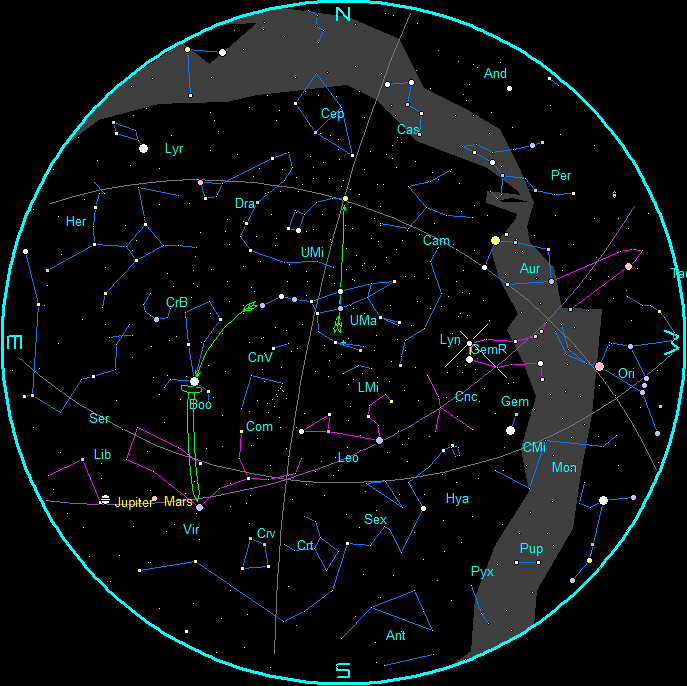
Star Chart for December 2017 mornings based on 6 a.m. December 15th. Created using my LookingUp program. Click on image to enlarge.
For a list of constellation names to go with the abbreviations click here.
- Pointer stars at the front of the bowl of the Big Dipper point to Polaris the North Star.
- Follow the arc of the handle of the Big Dipper to the star Arcturus.
- The Summer Triangle is in red
- GemR is the Geminid meteor shower radiant. Peaks on December 14th, the Moon will not interfere this year.
Twilight
Evening nautical twilight ends at 6:16 p.m. EST on the 1st, decreasing to 6:21 p.m. EDT on the 31st.
Evening astronomical twilight ends at 6:51 p.m. EST on the 1st, decreasing to 6:56 p.m. EDT on the 31st.
Morning astronomical twilight starts at 6:20 a.m. EST on the 1st, and increasing to 6:35 a.m. EDT on the 31st.
Morning nautical twilight starts at 6:56 a.m. EST on the 1st, and increasing to 7:10 a.m. EDT on the 31st.
NASA Calendar of Planetary Events
  Date      Time    Event
Dec 01  Fr          Venus: 9.4° W
    03  Su  8:00 am Moon-Aldebaran: 0.8° S
    03  Su 10:47 am Full Moon
    04  Mo  3:42 am Moon Perigee: 357500 km
    05  Tu  6:43 am Moon North Dec.: 20° N
    07  Th  4:30 am Moon-Beehive: 2.5° N
    07  Th  7:39 pm Moon Ascending Node
    08  Fr  5:25 pm Moon-Regulus: 0.7° S
    10  Su  2:51 am Last Quarter
    12  Tu  8:40 pm Mercury Inferior Conjunction with the Sun
    13  We 11:27 am Moon-Mars: 4.5° S
    14  Th  1:07 am Geminid Meteor Shower: ZHR = 120!
    14  Th  9:26 am Moon-Jupiter: 4.7° S
    18  Mo  1:31 am New Moon
    18  Mo  8:27 am Moon Apogee: 406600 km
    19  Tu  4:31 am Moon South Dec.: 20.1° S
    21  Th 11:29 am Winter Solstice
    21  Th  3:18 pm Saturn Conjunction with the Sun
    22  Fr  5:04 am Moon Descending Node
    22  Fr 10:00 am Ursid Meteor Shower: ZHR = 10
                    Note:  The Ursid radiant is near the Little Dipper’s
                           bowl
    26  Tu  4:20 am First Quarter
    30  Sa  7:25 pm Moon-Aldebaran: 0.7° S
Jan 01  Mo          Venus: 1.9° W
Sky Events Calendar by Fred Espenak and Sumit Dutta (NASA’s GSFC),
http://eclipse.gsfc.nasa.gov/SKYCAL/SKYCAL.html
If you go to the above site you can print out a list like the above for an entire year
or calendar pages for your time zone.
Sun and Moon Rising and Setting Events
     LU                  Ephemeris of Sky Events for Interlochen/TC
December, 2017    Local time zone: EST
+-----------------------------------------------------------------------+
| DATE |  SUN     SUN  DAYLIGHT|   TWILIGHT*    |MOON  RISE OR    ILLUM |
|      |  RISE    SET    HOURS |  END    START  |PHASE SET** TIME FRACTN|
+=======================================================================+
|Fri  1| 08:00a  05:03p  09:03 | 06:12p  06:50a |      Set  06:22a   96%|
|Sat  2| 08:01a  05:03p  09:01 | 06:12p  06:51a |      Set  07:38a   99%|
+------+-----------------------+----------------+-----------------------+
|Sun  3| 08:02a  05:02p  09:00 | 06:12p  06:52a |Full  Rise 05:36p  100%|
|Mon  4| 08:03a  05:02p  08:59 | 06:12p  06:53a |      Rise 06:32p   97%|
|Tue  5| 08:04a  05:02p  08:57 | 06:12p  06:54a |      Rise 07:35p   92%|
|Wed  6| 08:05a  05:02p  08:56 | 06:12p  06:55a |      Rise 08:43p   84%|
|Thu  7| 08:06a  05:02p  08:55 | 06:12p  06:56a |      Rise 09:54p   75%|
|Fri  8| 08:07a  05:02p  08:54 | 06:12p  06:57a |      Rise 11:04p   64%|
|Sat  9| 08:08a  05:02p  08:53 | 06:12p  06:58a |      Rise 12:13a   54%|
+------+-----------------------+----------------+-----------------------+
|Sun 10| 08:09a  05:02p  08:52 | 06:12p  06:59a |L Qtr Rise 01:19a   43%|
|Mon 11| 08:10a  05:02p  08:51 | 06:12p  06:59a |      Rise 02:23a   33%|
|Tue 12| 08:11a  05:02p  08:51 | 06:12p  07:00a |      Rise 03:25a   24%|
|Wed 13| 08:11a  05:02p  08:50 | 06:12p  07:01a |      Rise 04:27a   16%|
|Thu 14| 08:12a  05:02p  08:49 | 06:13p  07:02a |      Rise 05:27a   10%|
|Fri 15| 08:13a  05:02p  08:49 | 06:13p  07:02a |      Rise 06:26a    5%|
|Sat 16| 08:14a  05:03p  08:49 | 06:13p  07:03a |      Rise 07:22a    2%|
+------+-----------------------+----------------+-----------------------+
|Sun 17| 08:14a  05:03p  08:48 | 06:14p  07:04a |      Rise 08:16a    0%|
|Mon 18| 08:15a  05:03p  08:48 | 06:14p  07:04a |New   Set  05:46p    1%|
|Tue 19| 08:16a  05:04p  08:48 | 06:14p  07:05a |      Set  06:34p    3%|
|Wed 20| 08:16a  05:04p  08:48 | 06:15p  07:05a |      Set  07:27p    6%|
|Thu 21| 08:17a  05:05p  08:48 | 06:15p  07:06a |      Set  08:23p   12%|
|Fri 22| 08:17a  05:05p  08:48 | 06:16p  07:06a |      Set  09:22p   19%|
|Sat 23| 08:18a  05:06p  08:48 | 06:16p  07:07a |      Set  10:22p   27%|
+------+-----------------------+----------------+-----------------------+
|Sun 24| 08:18a  05:06p  08:48 | 06:17p  07:07a |      Set  11:24p   36%|
|Mon 25| 08:18a  05:07p  08:48 | 06:18p  07:08a |      Set  12:28a   46%|
|Tue 26| 08:19a  05:08p  08:49 | 06:18p  07:08a |F Qtr Set  01:35a   56%|
|Wed 27| 08:19a  05:08p  08:49 | 06:19p  07:08a |      Set  02:43a   67%|
|Thu 28| 08:19a  05:09p  08:50 | 06:20p  07:09a |      Set  03:55a   77%|
|Fri 29| 08:19a  05:10p  08:50 | 06:20p  07:09a |      Set  05:08a   86%|
|Sat 30| 08:19a  05:11p  08:51 | 06:21p  07:09a |      Set  06:22a   93%|
+------+-----------------------+----------------+-----------------------+
|Sun 31| 08:20a  05:12p  08:52 | 06:22p  07:09a |      Set  07:32a   98%|
+-----------------------------------------------------------------------+
* Nautical Twilight
** Moonrise or moonset, whichever occurs between sunset and sunrise

