Archive
11/29/2017 – Ephemeris – The Bright planets this week
Ephemeris for Wednesday, November 29th. The Sun will rise at 7:57. It’ll be up for 9 hours and 7 minutes, setting at 5:04. The Moon, 3 days past first quarter, will set at 3:54 tomorrow morning.
Let’s take our weekly look at the bright planets. Mercury is dropping back to the Sun and is fading as its phase changes to a crescent It will be below and left of Saturn tonight and actually brighter than Saturn. Saturn is sinking low in the southwestern sky. It is becoming harder to spot each evening. Tonight it will set at 6:24 p.m. The morning sky is now host to three planets, though Venus, the brightest will rise at 7:03 this morning and will be fighting twilight as it rises. It’s way on the other side of the Sun, and very tiny in telescopes, though nearly fully illuminated. It’s 156 million miles (251 million km) away. First to rise in the morning is Mars which will rise in the east at 4:07 a.m. tomorrow, Jupiter, will follow and rise at 5:34 a.m. tomorrow.
The times given are for the Traverse City/Interlochen area of Michigan. They may be different for your location.
Addendum
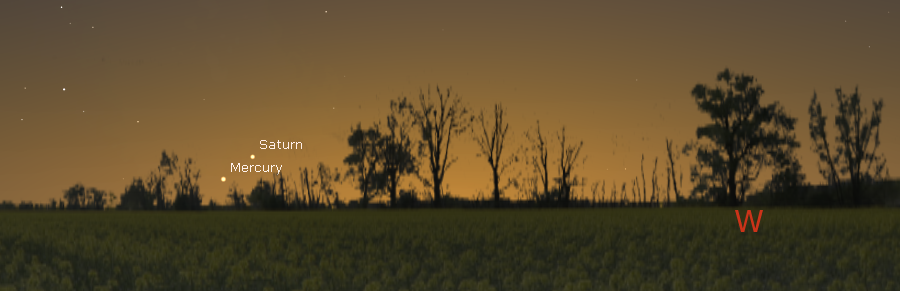
Mercury and Saturn at 5:45 p.m., about 45 minutes after sunset, November 29, 2017. Click on the image to enlarge. Created using Stellarium.
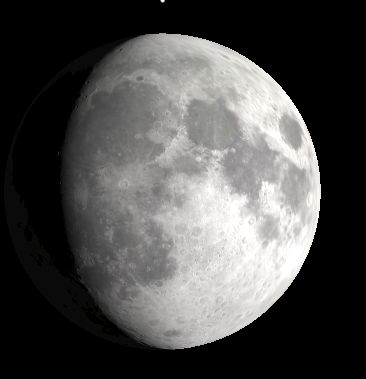
The Moon as it might be seen in binoculars at 7 p.m., November 29, 2017. Created using Stellarium.
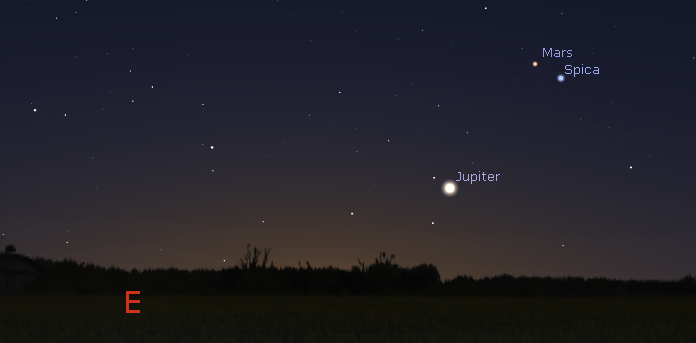
Mars and Jupiter at 7 a.m., November 30, 2017. Created using Stellarium.
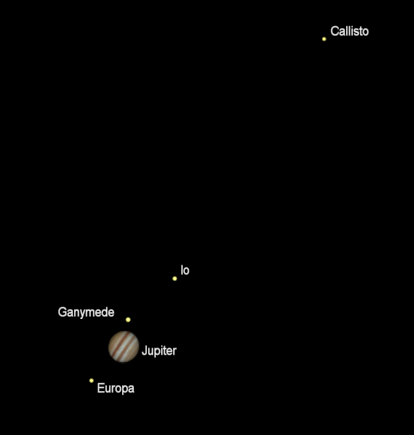
Jupiter and its 4 Galilean moons as they might be seen in a telescope at 7 a.m. November 30, 2017. Created using Cartes du Ciel (Sky Charts).
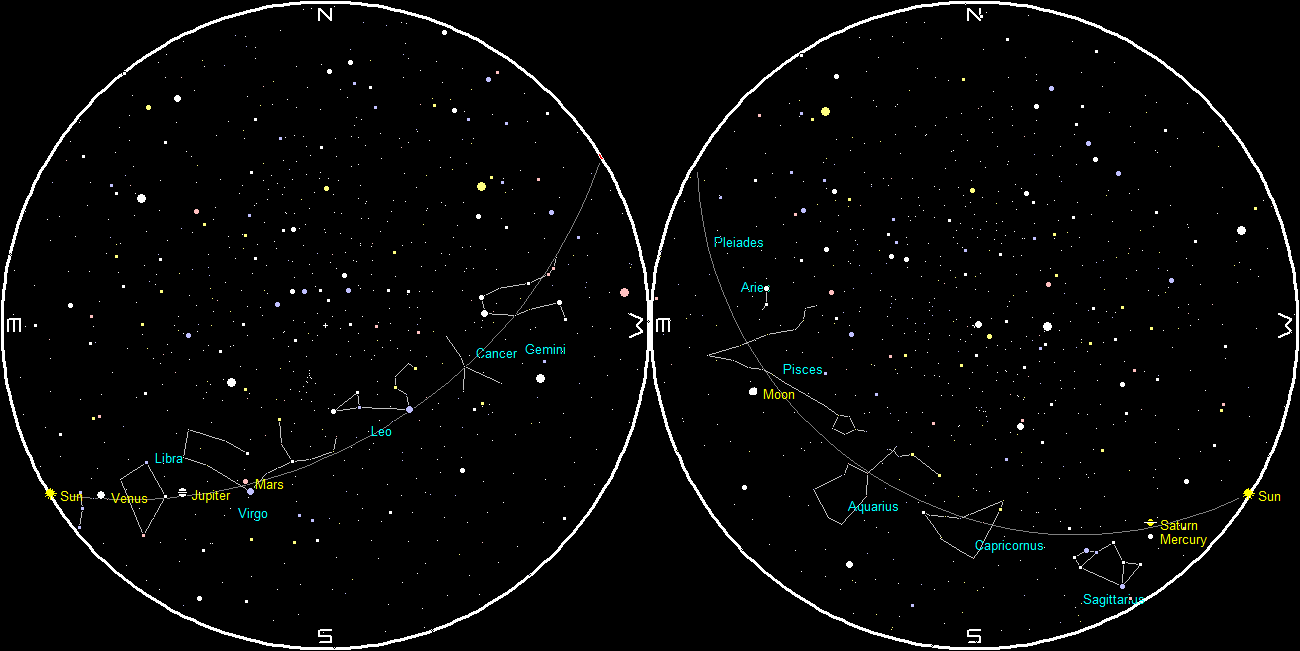
Planets at sunset and sunrise of a single night starting with sunset on the right on November 29, 2017. The night ends on the left with sunrise on the 30th. Click on the image to enlarge. Created using my LookingUp program.
11/28/2017 – Ephemeris – Though it appears bright, the Moon is pretty dirty
Ephemeris for Tuesday, November 28th. The Sun will rise at 7:56. It’ll be up for 9 hours and 8 minutes, setting at 5:04. The Moon, 2 days past first quarter, will set at 2:44 tomorrow morning.
The Moon tonight is a waxing gibbous phase, and each night until it’s full it will get brighter and brighter, drowning out the fainter stars. The Moon is almost too bright to comfortably view in a telescope. One can get a moon filter for the eyepiece, or wear sunglasses or opt for higher magnification. It is after all daytime on the Moon and it’s essentially the same distance from the Sun as we are. A saving grace is that the Moon isn’t white. It’s a dirty gray, reflecting on average only 13.6 percent of the light it gets from the Sun. Just think how bright it would appear if it were 100% reflective, over 7 times brighter than it appears now. The face of the Moon hasn’t appeared to change at all since before we landed there 48 years ago.
The times given are for the Traverse City/Interlochen area of Michigan. They may be different for your location.
Addendum
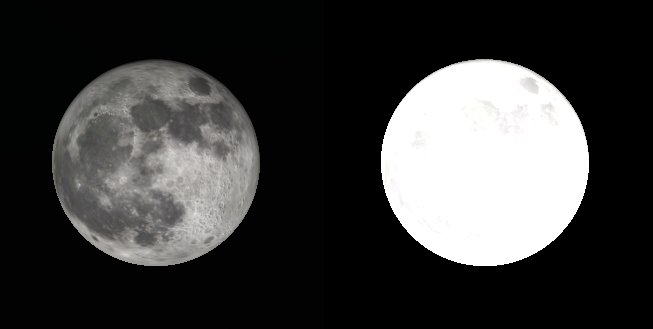
Moon albedo comparison. Actually about 50% vs. 100%. The Moon is less reflectant than that.. Sunday’s super moon image created via Stellarium.
11/27/2017 – Ephemeris – Ross 128b the second closest known exoplanet
Ephemeris for Monday, November 27th. The Sun will rise at 7:54. It’ll be up for 9 hours and 10 minutes, setting at 5:05. The Moon, 1 day past first quarter, will set at 1:37 tomorrow morning.
The second closest exoplanet to the solar system has been discovered. That was earlier this year around a star named Ross 128. It’s name is Ross 128 small letter b. The star Ross 128 is a nearby red dwarf star, whose distance is a shade under 11 light years away, The star is thought to be twice the age of the Sun, We’d be in big trouble if the Sun were that old, but Ross 128 is just getting started. The exoplanet is about 35% more massive than the Earth. It’s distance from the star averages 4.6 million miles and its year is a bit under 10 Earth days. At that rate I’d be over 28 hundred years old. Astronomers don’t know the size or the density of the planet since it doesn’t pass in front of its star. These measurements will have to wait on larger telescopes.
The times given are for the Traverse City/Interlochen area of Michigan. They may be different for your location.
Addendum
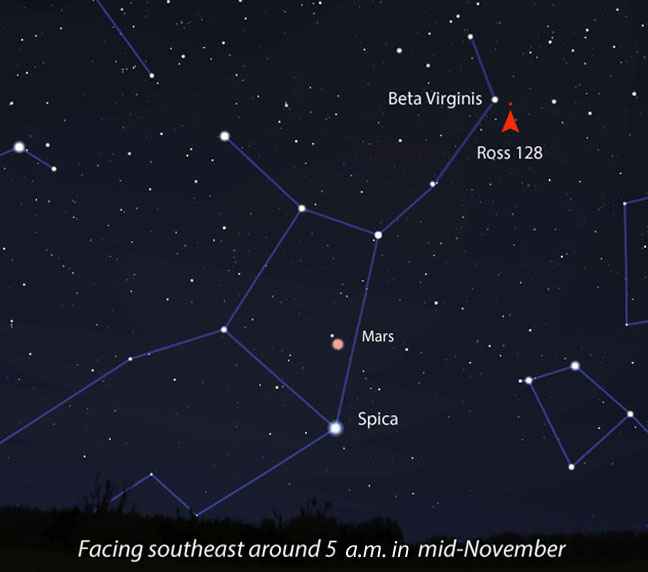
The star Ross 128. It’s actually much fainter than is suggested here in the diagram from Sky and Telescope magazine’s website.. Mars’ position is for November 2017.
11/24/2017 – Ephemeris – Fomalhaut, the loneliest star, has a little buddy
Ephemeris for Friday, November 24th. The Sun will rise at 7:51. It’ll be up for 9 hours and 15 minutes, setting at 5:07. The Moon, 2 days before first quarter, will set at 10:30 this evening.
The lonely bright star low in the south at 8 p.m. these evenings is Fomalhaut the harbinger of autumn in my book, and about to leave as winter approaches. Fomalhaut means fishes mouth and is located at the head of Piscis Austrinus, a very dim constellation. Fomalhaut is a young white star only about 400 million years old with a disk of dust surrounding it. Near an outer dust ring, 15 years ago the Hubble Space Telescope discovered a spot. Four years later astronomers discovered that the spot moved along the dust lane and announced the first direct discovery of an exoplanet. In 2010 and 2012 the planet now dubbed Fomalhaut b or Dagon was observed again and it really does orbit Fomalhaut in a very eccentric orbit.
The times given are for the Traverse City/Interlochen area of Michigan. They may be different for your location.
Addendum
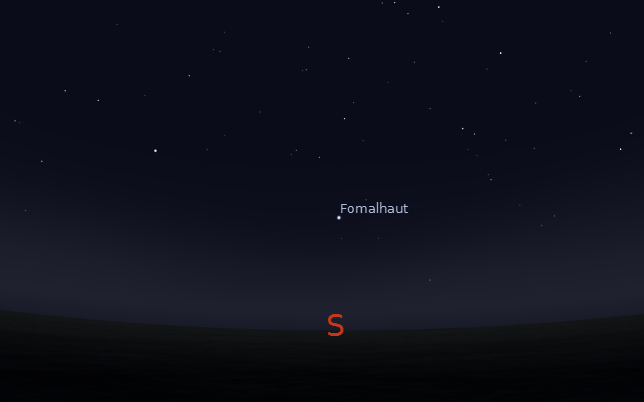
Fomalhaut in the south at 8 p.m. on November evenings. Created using Stellarium.
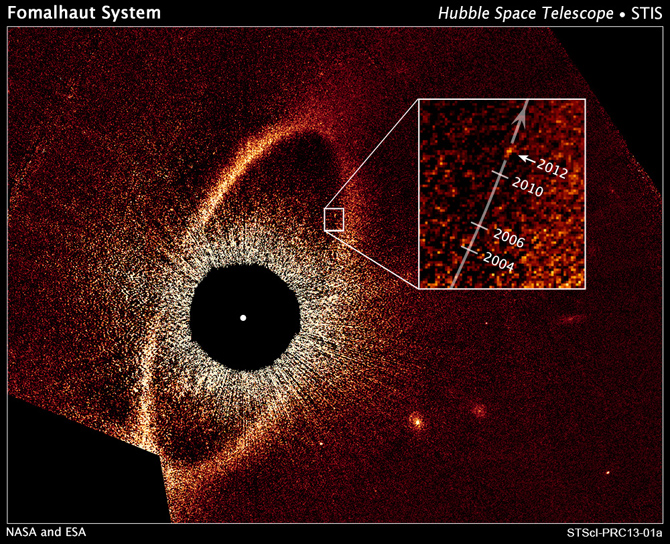
Fomalhaut b and it’s path around its star. Credit: NASA, ESA, and P. Kalas (University of California, Berkeley and SETI Institute)
11/23/2017 – Ephemeris – Mercury is at it’s greatest eastern elongation tonight
Ephemeris for Thanksgiving Day, Thursday, November 23rd. The Sun will rise at 7:49. It’ll be up for 9 hours and 17 minutes, setting at 5:07. The Moon, 3 days before first quarter, will set at 9:33 this evening.
Mercury is going to reach its greatest elongation or apparent separation from the Sun this evening. It will be 22 degrees east of the Sun. Because Mercury is the closest planet to the Sun, it is never seen far from it. And because it has the most eccentric orbit of all the planets its greatest elongations are between 17 and 27 degrees from the Sun. Other than that the best times of the year to see Mercury are late winter and early spring evenings and late summer and early autumn mornings. Being an autumn evening means that Mercury is almost too low to spot after sunset. The southern hemisphere is in spring, so Mercury tonight will be much easier seen. Also their best view is when Mercury is farther from the Sun.
The times given are for the Traverse City/Interlochen area of Michigan. They may be different for your location.
Addendum
There are rather clinical charts. The horizontal line through the W (western compass point) is the horizon. Grid marks are 10 degrees apart.
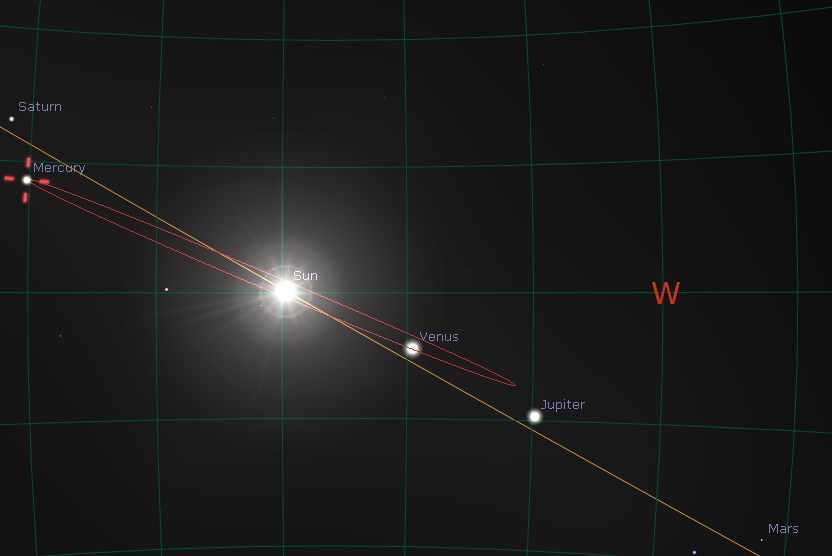
Diagram showing the poor placement of Mercury at greatest eastern elongation tonight in autumn from 45 degrees north latitude. Mercury is about 8.5 degrees altitude at sunset. The orange line is the ecliptic, the path pf the Sun on the celestial sphere. Created using Stellarium.
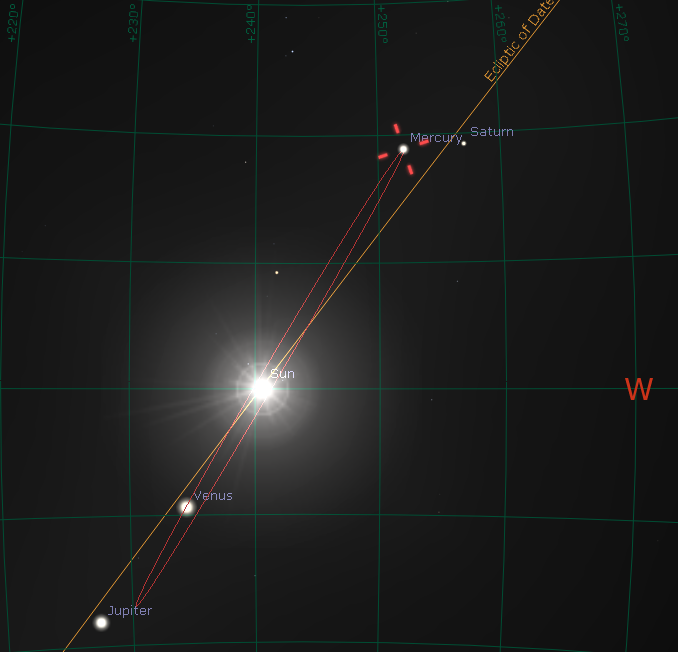
Diagram showing the great placement of Mercury at greatest eastern elongation tonight in southern hemisphere spring from 45 degrees south latitude. Mercury is nearly 19 degrees altitude at sunset. The orange line is the ecliptic, the path pf the Sun on the celestial sphere. Created using Stellarium.
11/22/2017 – Ephemeris – A look at the bright planets for Thanksgiving week
Ephemeris for Wednesday, November 22nd. The Sun will rise at 7:48. It’ll be up for 9 hours and 19 minutes, setting at 5:08. The Moon, half way from new to first quarter, will set at 8:39 this evening.
Let’s take our weekly look at the bright planets. Mercury is briefly visible in binoculars in the southwest in the evening, setting at 6:11 p.m., and will reach it’s greatest elongation from the Sun tomorrow evening. Saturn is sinking low in the southwestern sky. Saturn’s rings are still spectacular in telescopes, but since Saturn is so low in the sky the thick atmosphere makes Saturn fuzzy and seemingly to go in and out of focus. Saturn will set at 6:49 p.m. Tomorrow in the morning sky, Mars, heading away from the Sun will rise in the east at 4:11 a.m., Jupiter, also moving away from the Sun, will rise at in the east-southeast at 5:54 a.m., leaving Venus behind after their conjunction 9 days ago, which will rise at 6:47 a.m..
The times given are for the Traverse City/Interlochen area of Michigan. They may be different for your location.
Addendum
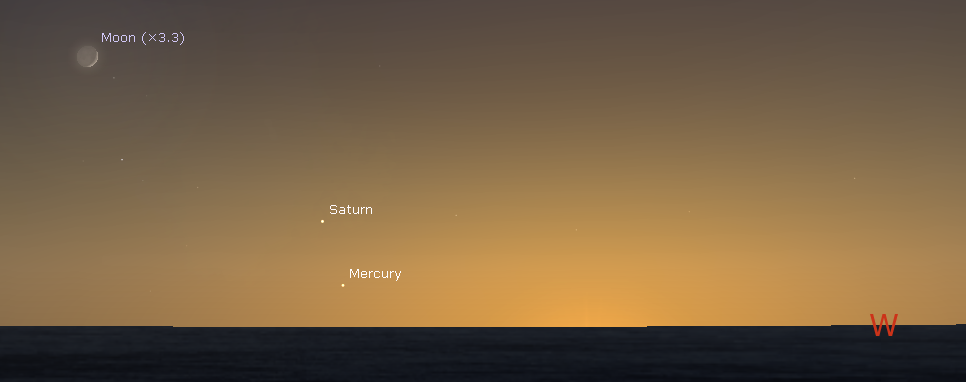
Mercury, Saturn and the Moon at 5:45 p.m., a bit more than a half hour after sunset, November 22, 2017. Click on the image to enlarge. Created using Stellarium.
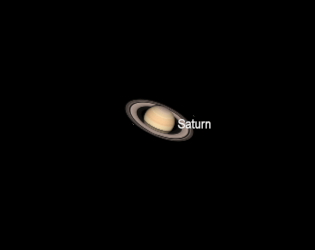
Saturn as it might be seen in a telescope tonight. Created using Cartes du Ciel (Star Charts).
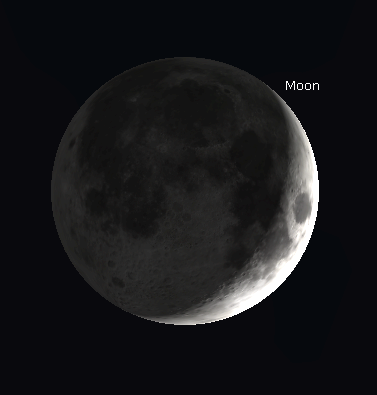
The Moon as it might be seen tonight. Created using Stellarium.
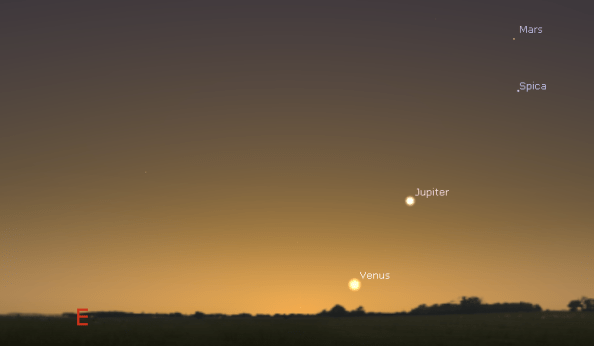
The morning planets Mars, Jupiter and Venus at 7:15 a.m. November 23, 2017, about a half hour before sunrise on a really flat horizon. Created using Stellarium.
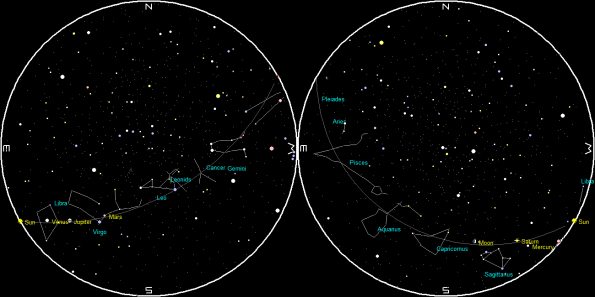
Planets at sunset and sunrise of a single night starting with sunset on the right on November 22, 2017. The night ends on the left with sunrise on the 22nd. Click on the image to enlarge. Created using my LookingUp program.
11/21/2017 – Ephemeris – The constellation of the fish has me looking for the fish
Ephemeris for Tuesday, November 21st. The Sun will rise at 7:47. It’ll be up for 9 hours and 21 minutes, setting at 5:09. The Moon, 3 days past new, will set at 7:50 this evening.
High in the south at 8 or 9 p.m. are the four bright stars of the Great Square of Pegasus, the upside down flying horse. Lying along the left and bottom sides of that square is the constellation of Pisces the fish, one of the 12 constellations of the Zodiac that lie along the path of the sun, moon and planets. Even though the constellation is called the fish, the two fish themselves are not represented in the stars, at least that’s how I see it. What can be traced in the stars is the rope, that’s tied to their tails, anchored at the extreme southeastern part of the constellation. The right or western end of the Pisces is the asterism, or informal constellation, of the Circlet. It’s the loop of 5 stars, the rope around the tail of one of the two fish. The other end, without a loop, ends up under Andromeda. Artists have always supplied the fish.
The times given are for the Traverse City/Interlochen area of Michigan. They may be different for your location.
Addendum
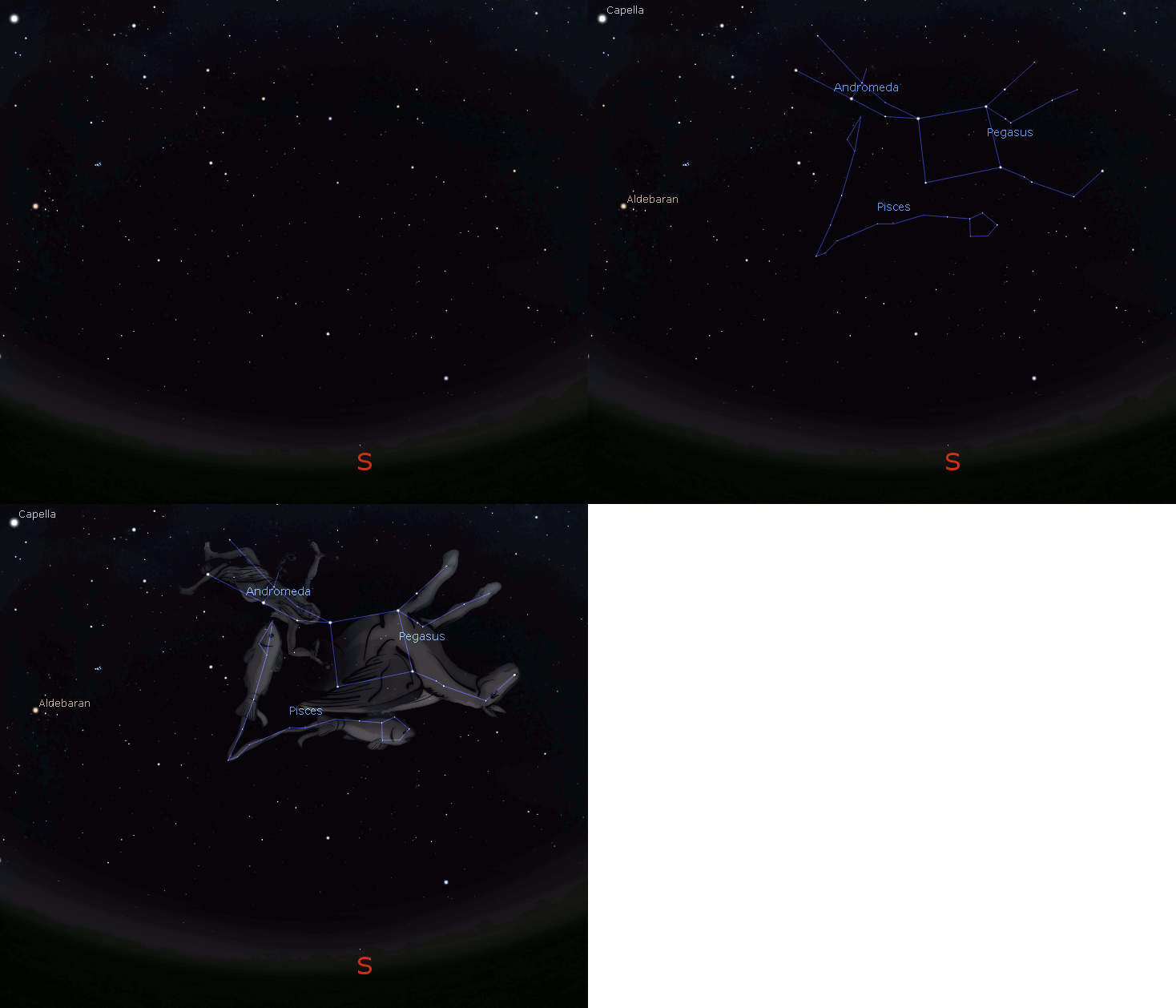
Animated Pisces finder chart base at November 21, at 9 p.m. Created using Stellarium and GIMP.
11/20/2017 – Ephemeris – The Moon is near Saturn tonight and the approaching signs of winter
Ephemeris for Monday, November 20th. The Sun will rise at 7:46. It’ll be up for 9 hours and 23 minutes, setting at 5:09. The Moon, 2 days past new, will set at 7:04 this evening.
Tonight the two day old Moon will appear near Saturn. The ringed planet will appear to the left and a bit below the thin crescent Moon before they set about an hour later. The approaching winter season and the resumption of standard time have dropped sunset to 5:09 in the Interlochen/Traverse City area. Our sunset will drop another 11 minutes before slowly recovering 19 days from now. Two to three hours later another sign of the approaching winter season will appear, as the constellation of the giant hunter Orion rises in the east. He is resplendent with his nearly vertical belt of three stars rising, framed to the left and right by the bright stars reddish Betelgeuse and bluish Rigel. He will dominate our evening skies until April.
The times given are for the Traverse City/Interlochen area of Michigan. They may be different for your location.
Addendum
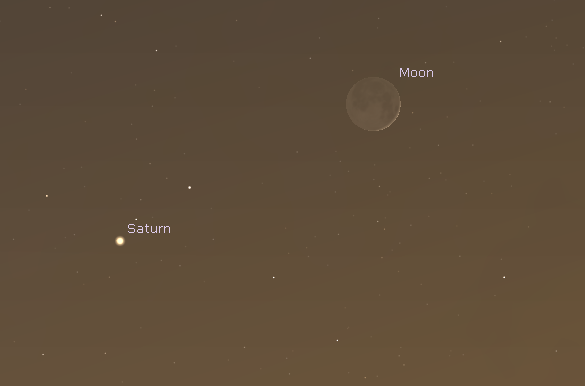
The Moon and Saturn at 6 p.m. November 20, 2017. Created using Stellarium.
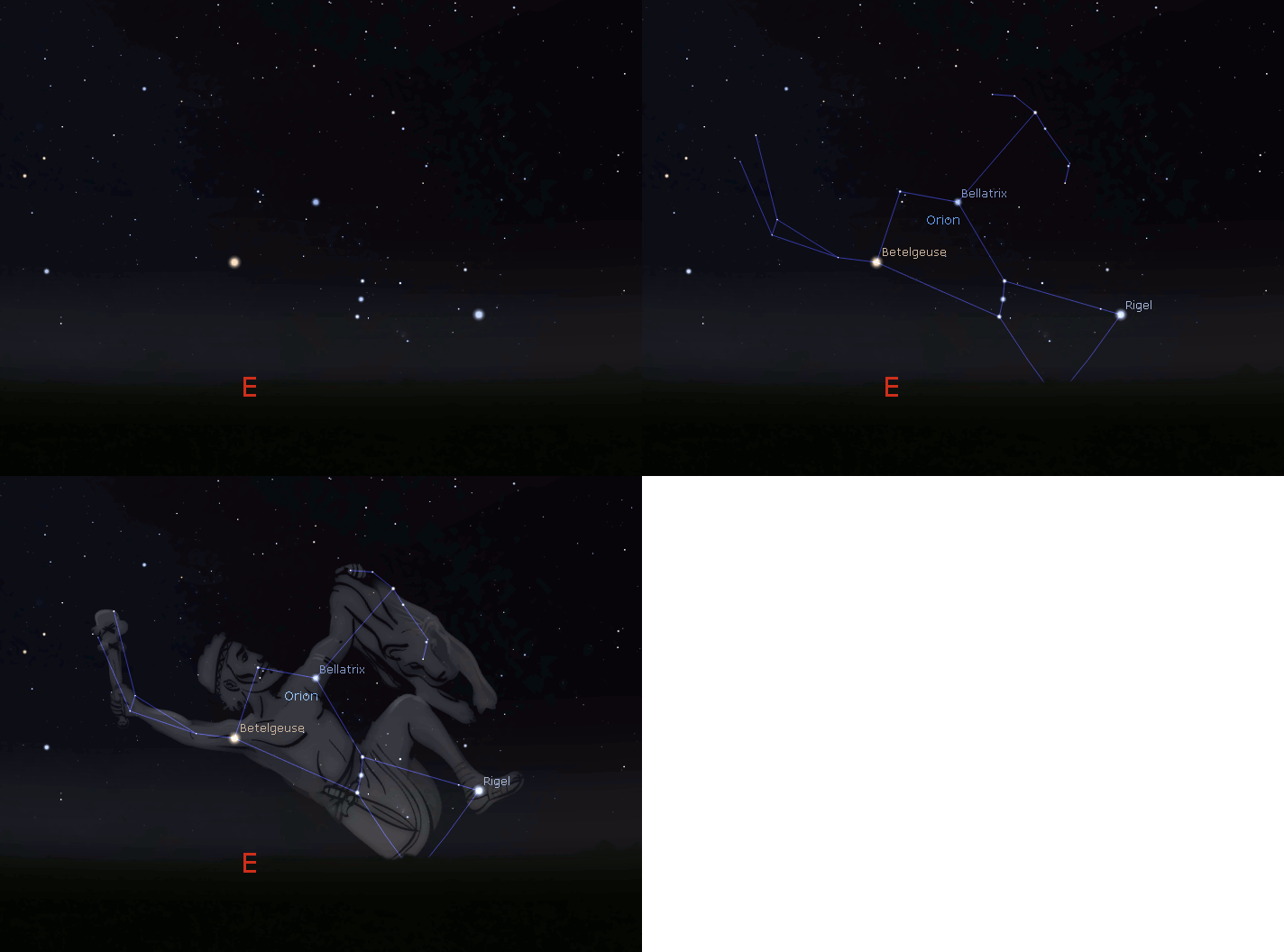
Finder chart for the rising Orion at 9 p.m., November 30, 2017. Created using Stellarium and GIMP.
11/17/2017 – Ephemeris – Capricornus the sea-goat
Ephemeris for Friday, November 17th. The Sun will rise at 7:42. It’ll be up for 9 hours and 30 minutes, setting at 5:12. The Moon, 1 day before new, will rise at 7:34 tomorrow morning.
This morning, if it’s clear the exceedingly thin crescent Moon will appear to the right of Venus at 7 a.m. or later with Jupiter above them. This evening, however we look to the constellation Capricornus the sea-goat and member of the Zodiac. 2000 years ago the southernmost of the constellations of the zodiac was Capricornus. That’s why the latitude on the earth where the Sun is overhead on the winter solstice is called the Tropic of Capricorn. Not any more, Sagittarius, one constellation west, has that honor today. Capricornus is large, but made up of dim stars. To me it looks like a 45 degree isosceles triangle, long side up, but which all the sides are sagging low in the southwest at 8 p.m. and tilted a bit from the upper left to the lower right The image that is supposed to be represented by the stars is that of a goat whose hind quarters are replaced by a fish’s tail.
The times given are for the Traverse City/Interlochen area of Michigan. They may be different for your location.
Addendum
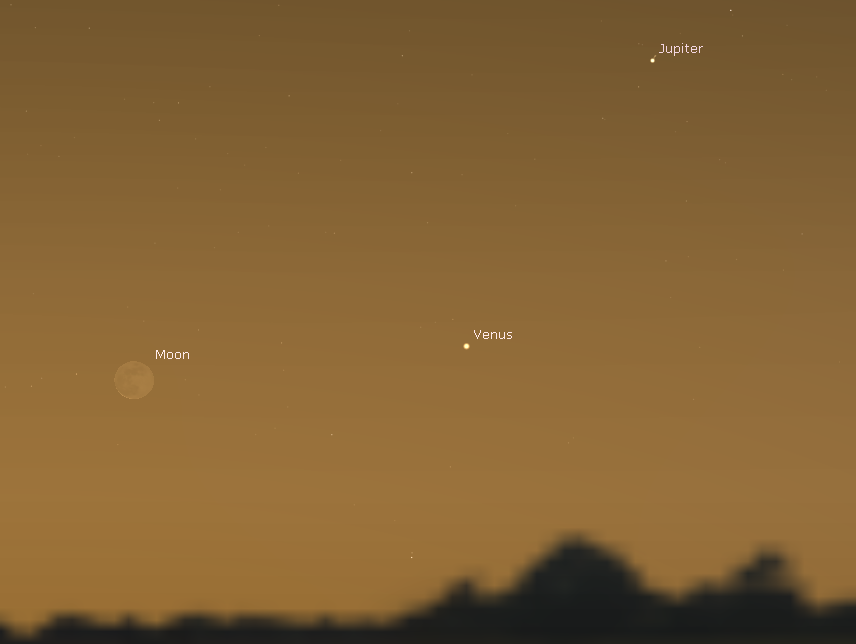
Jupiter, Venus and the Moon at 7 a.m. November 17, 2017. Created using Stellarium. The Moon’s crescent is too thin to record, however the earth shine glow is and will be visible.
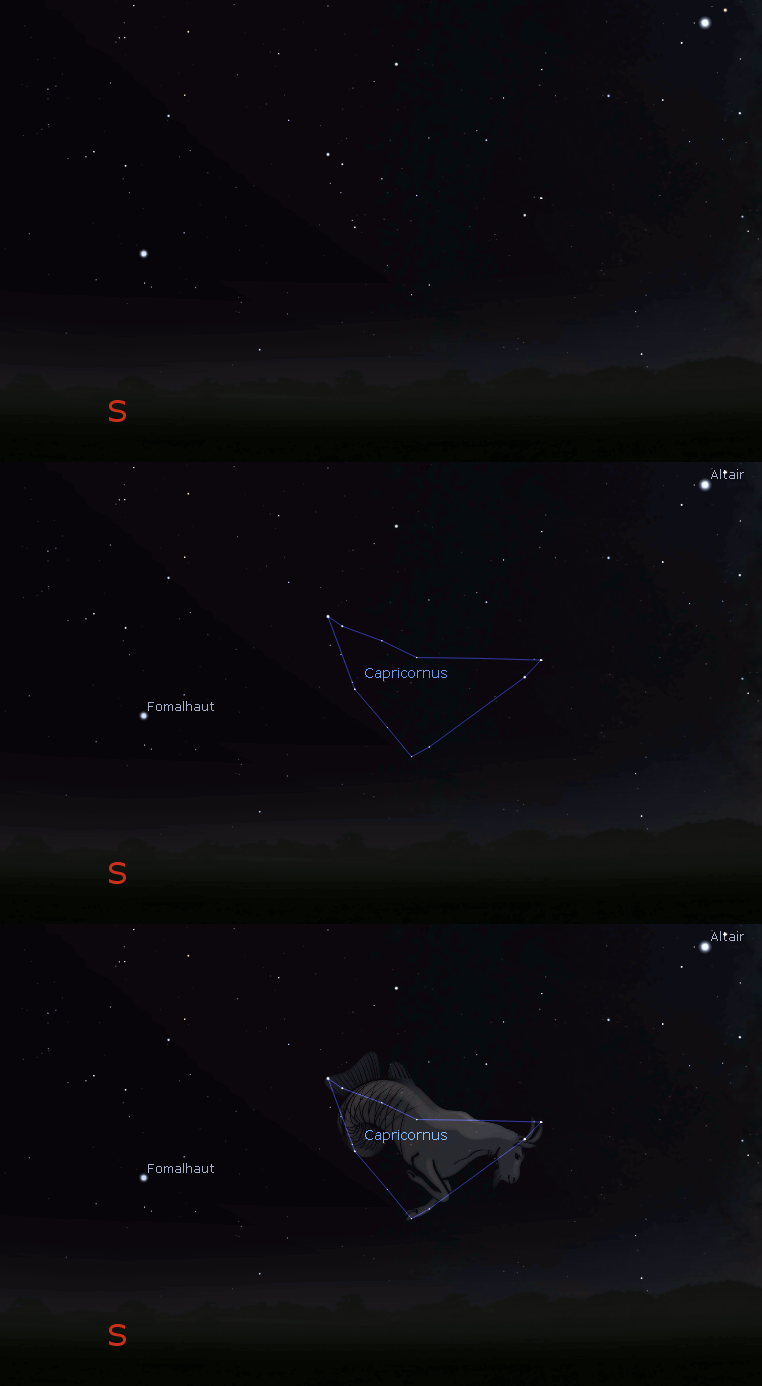
Animated Capricornus finder chart for 9 p.m. November 17, 2017. Created using Stellarium and GIMP.
11/16/2017 – Ephemeris – The Leonid meteors will reach their peak numbers tonight and tomorrow
Ephemeris for Thursday, November 16th. The Sun will rise at 7:40. It’ll be up for 9 hours and 32 minutes, setting at 5:13. The Moon, 2 days before new, will rise at 6:33 tomorrow morning.
The Famous Leonid meteor shower, which has had spectacular displays about every 33 years is forecast to reach two peaks this year, near noon our time, today and tomorrow. So the numbers of meteors, forecast during those peaks, of about 10 per hour near dawn our time probably won’t pan out, but you never know. None of these meteors will be seen before midnight. The last great 33 year peak was in 1998, so we’re a ways away from the next one. The responsible body for these meteors is the comet Tempel-Tuttle. Every time the comet passes through the inner solar system the sun’s heat liberates gas, dust and small grains of rock. These small grains end up in close orbits to the comet, and like the comet, return again and again.
The times given are for the Traverse City/Interlochen area of Michigan. They may be different for your location.
Addendum
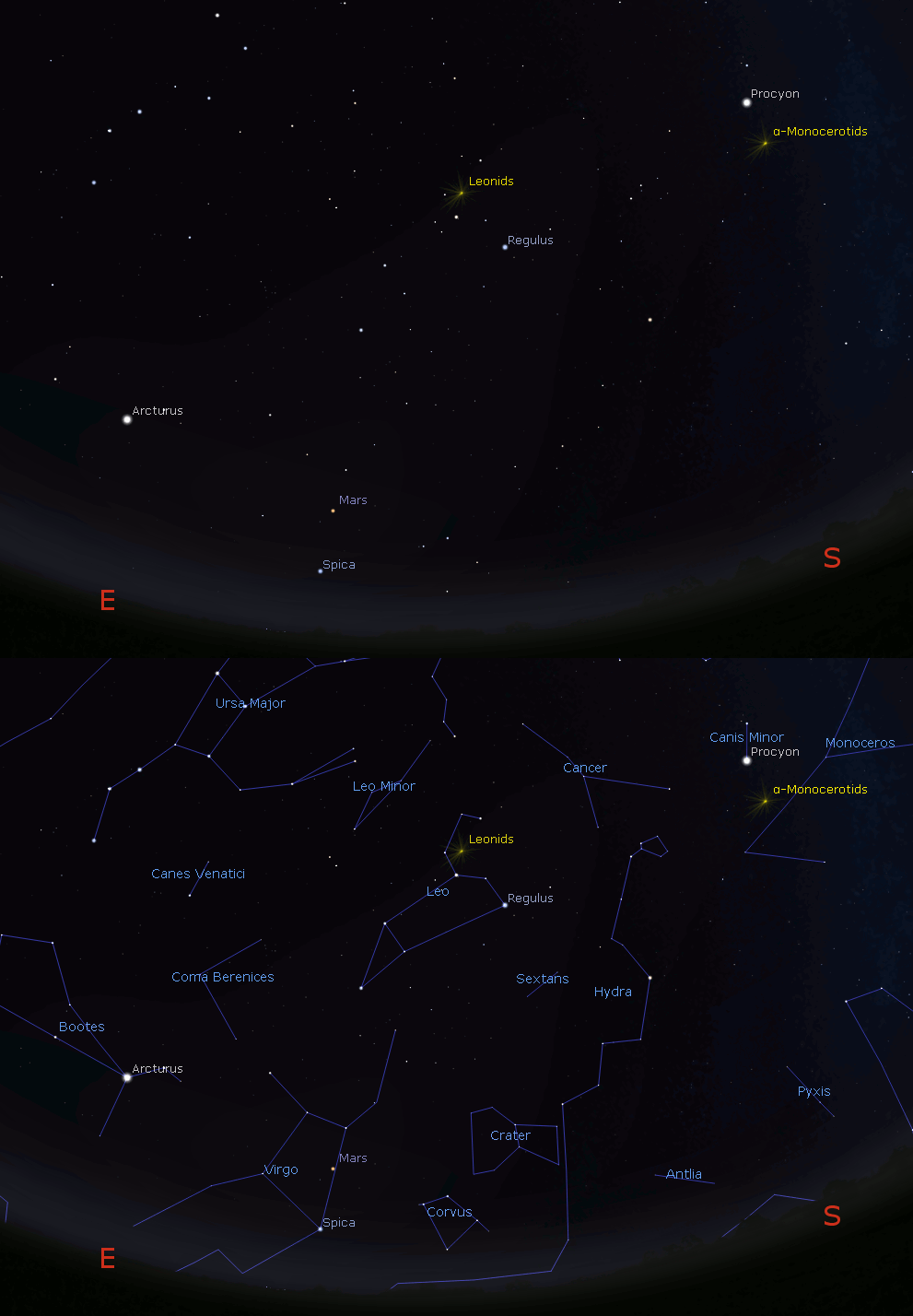
Leonid Meteor Shower Radiant finder chart fir 6 a.m., November 17, 2017. Click on image to enlarge. Created using Stellarium ans GIMP.
Note that there is another meteor shower radiant in the image, below the star Procyon. It’s the Alpha Monocerotids. It will reach its peak on the 21st. with an expected zenithal hourly rate (ZHR) of only 5 meteors an hour. By the way the zenithal hourly rate is the expected rate if the radiant was directly overhead, at the zenith. In 1995 this shower had for five minutes an estimated ZHR of 460, which was within a 30 minute outburst. The next big outburst isn’t expected until 2043, but not very much is known about this meteor shower. So keep an eye out, it could surprise us.
The radiant point wasn’t well known before the 1995 outburst, when it was thought to be closer to α Monocerotis, the unnamed bottom star in Monoceros the unicorn. There was a meteor shower called the Monocerotids listed before this shower was identified. So even though the radiant is actually in Canis Minor we are stuck with its name.
Much of the above information comes from the International Meteor Organization 2017 Meteor Shower Calendar. This and next years calendars are located at https://www.imo.net/resources/calendar/.

