Archive
06/08/2017 – Ephemeris – The late heavy bombardment of the inner planets
Ephemeris for Thursday, June 8th. Today the Sun will be up for 15 hours and 28 minutes, setting at 9:25, and it will rise tomorrow at 5:57. The Moon, 1 day before full, will set at 6:22 tomorrow morning.
The Moon and many bodies of the inner solar system have many craters which bear witness to many meteorite hits. In studying lunar samples brought back by the Apollo astronauts, from Russian lunar sample return missions and meteorites found on Earth that came from the Moon planetary scientists found that many of their ages correspond to a narrow range of dates of 3.8 to 4.1 billion years ago. Radioisotope dating of rocks would date them to the last time they were molten. This lead to the hypothesis that about a half billion years after the planets were formed, the inner solar system bodies were pelted with millions of asteroids in what is known as the late heavy bombardment. The reason is not completely understood, but one hypothesis is that the outer planets migrated destabilizing the asteroid belt causing the solar system to be a shooting gallery.
The times given are for the Traverse City/Interlochen area of Michigan. They may be different for your location.
Addendum
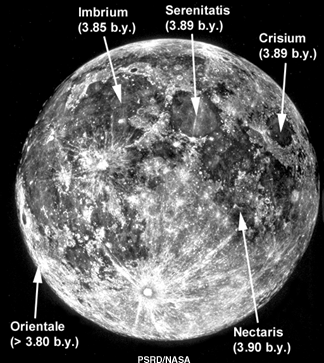
Lunar seas and their ages. Credit NASA.
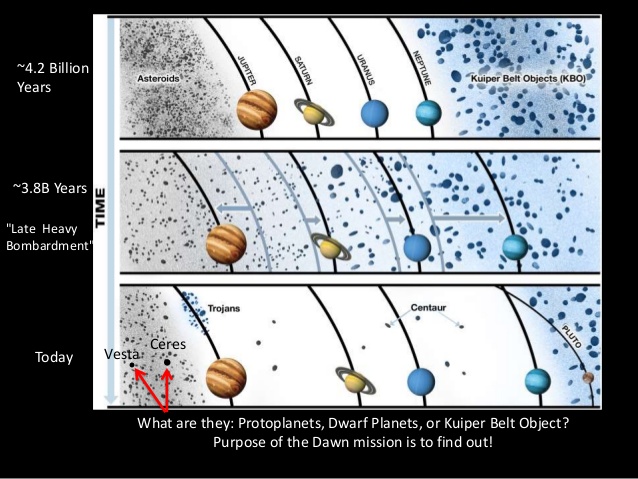
How the migration of the outer planets caused the Late Heavy Bombardment. Credit James Green, Director Planetary Science, NASA.
06/07/2017 – Ephemeris – It’s Wednesday and time to look at this week’s planets
Ephemeris for Wednesday, June 7th. Today the Sun will be up for 15 hours and 27 minutes, setting at 9:25, and it will rise tomorrow at 5:57. The Moon, 2 days before full, will set at 5:44 tomorrow morning.
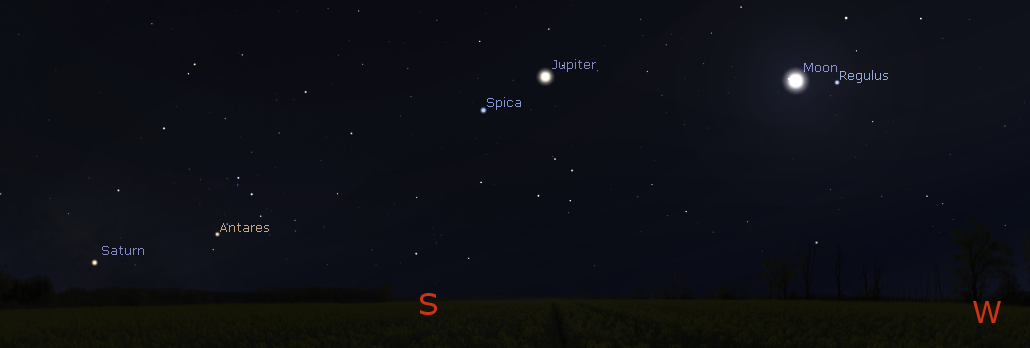
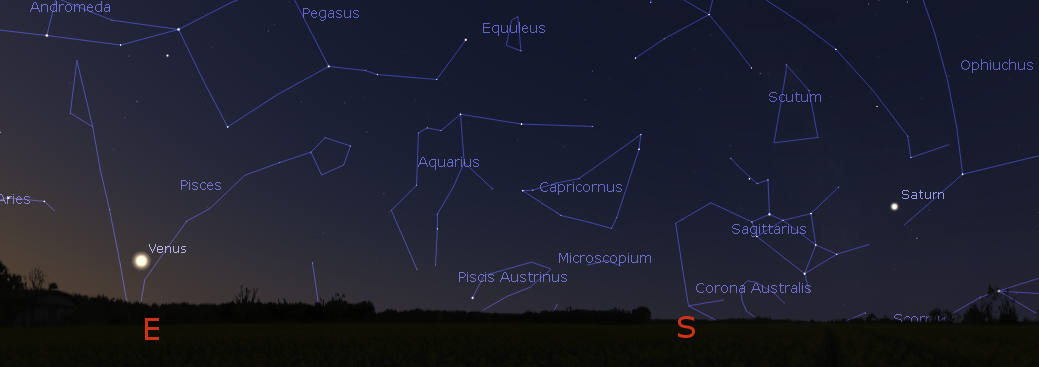
Let’s take our weekly look at the bright planets. I’m no longer going to cover Mars until it’s back in the morning sky next year. It’s too dim in twilight t really spot. Though next year July it will be closer to us than it’s been since 2003. Dominating the evening sky now besides the Moon is Jupiter in the south-southwest. The bright blue-white star Spica is seen left and below it. In even the smallest telescopes Jupiter’s four largest moons can be seen. They shift positions night from to night and sometimes even as you watch. Jupiter will set at 3:13 a.m. Saturn can now be seen late in the evening after it rises in the east-southeast at 9:46 p.m. At 5 a.m. both Saturn and Venus will be in the morning twilight. Brilliant Venus will be low in the east tomorrow morning after rising at 3:33 a.m.
The times given are for the Traverse City/Interlochen area of Michigan. They may be different for your location.
Addendum
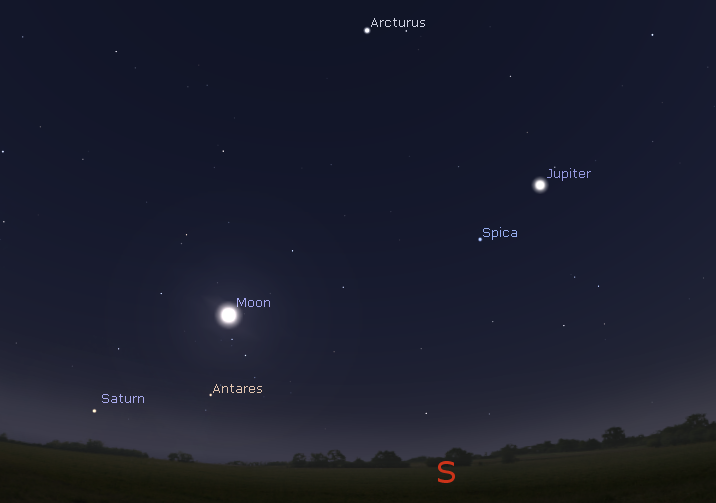
Jupiter and the Moon in twilight at 10:30 p.m., June 7, 2017. Created using Stellarium.
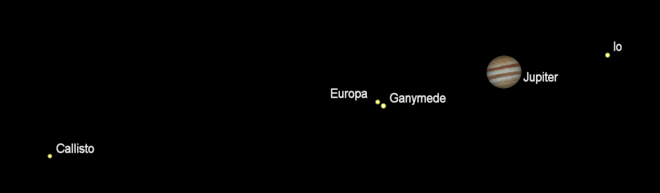
Jupiter and its four Galilean moons as they might be seen in a telescope at 10:30 p.m,. June 7, 2017. Created using Cartes du Ciel (Sky Charts).
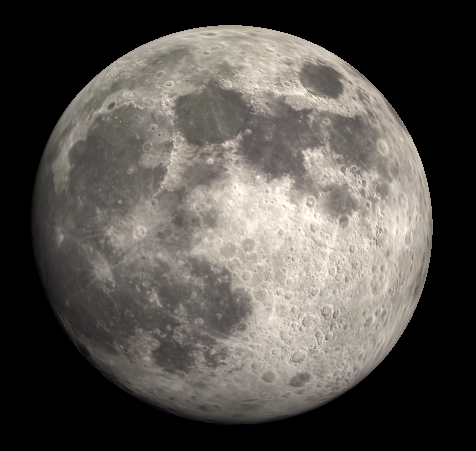
The moon as seen in binoculars, tonight at 10:30 p.m., June 7, 2017. Created using Stellarium.
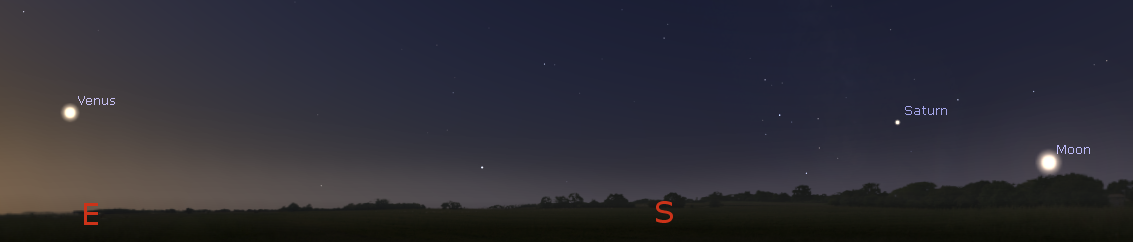
Venus, Saturn and the setting Moon at 5 a.m. June 8, 2017. Created using Stellarium. Click on the image to expand.
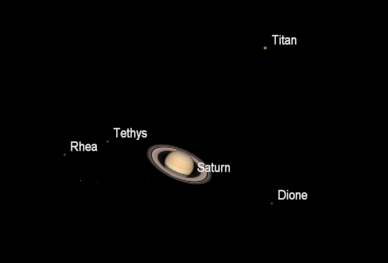
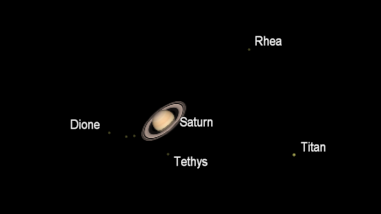
Saturn and its brightest moons overnight June 7/8, 2017. Created using Cartes du Ciel (Sky Charts).
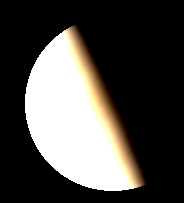
Venus as it might be seen through a telescope at 5 a.m. June 8, 2017. This is displayed at a larger scale/magnification than the Jupiter or Saturn images above. Created using Stellarium.
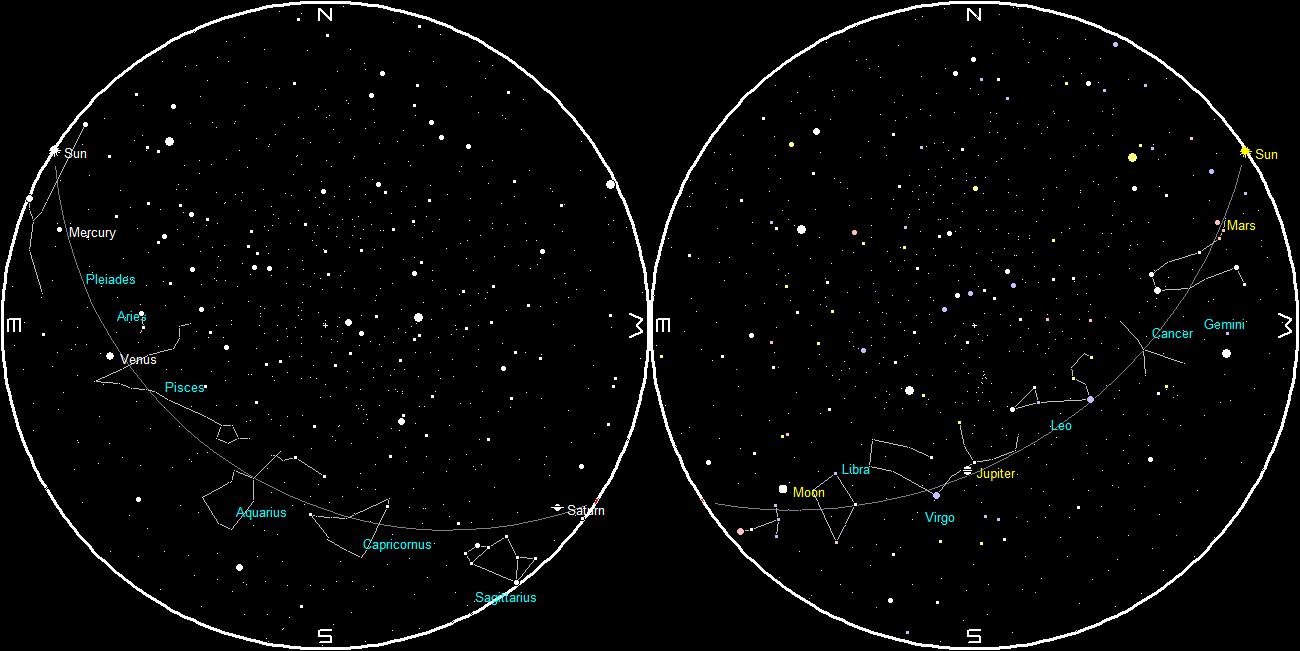
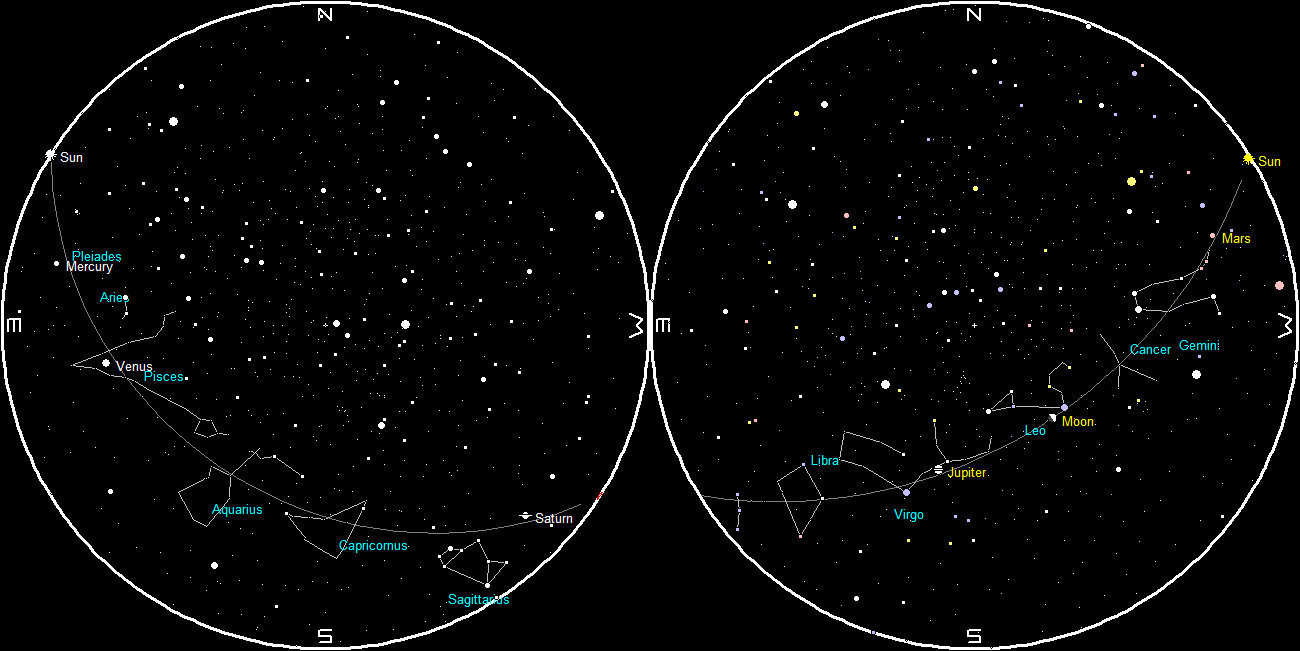
Planets at sunset and sunrise of a single night starting with sunset on the right on June 7, 2017. The night ends on the left with sunrise on June 8. Click on the image to enlarge. Created using my LookingUp program.
06/06/2017 – Ephemeris – Where did the Moon come from?
Ephemeris for Tuesday, June 6th. Today the Sun will be up for 15 hours and 26 minutes, setting at 9:24, and it will rise tomorrow at 5:57. The Moon, 3 days before full, will set at 5:10 tomorrow morning.
The origin of the Moon is a question that has vexed astronomers for years. Did it break off the molten Earth like a cell dividing? Was it captured by passing too close to the Earth? Neither is satisfactory. Chemical elements have different isotopes depending on the number of neutrons in their nucleus. The rocks brought back by the Apollo astronauts show that the isotopes of the elements in the rocks is that same as for the Earth. We know that Mars and the asteroids have different isotope ratios. The hypothesis that seems most likely is that another planet, the size of Mars collided with the 100 million year old Earth in a glancing blow that gave rise to a disk of material that eventually coalesced into the Moon.
The times given are for the Traverse City/Interlochen area of Michigan. They may be different for your location.
Addendum
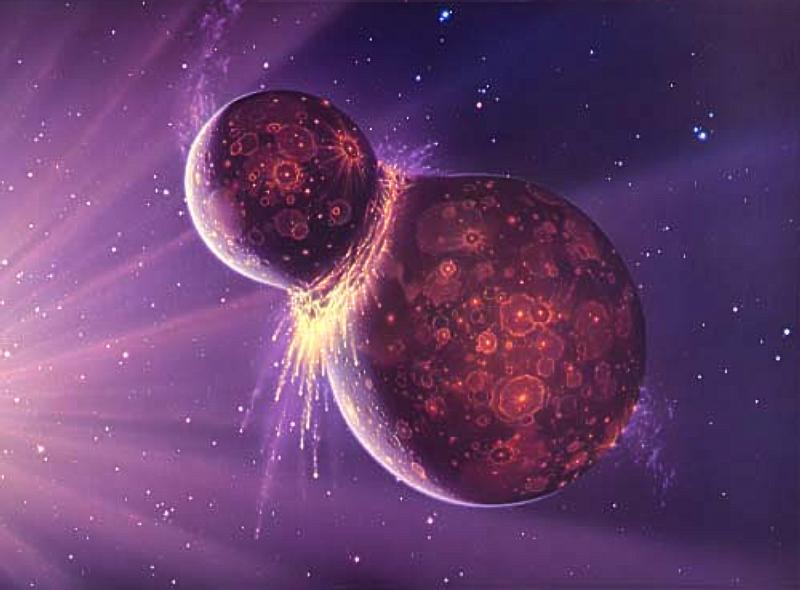
The hypothetical collision of a Mars sized body with the young Earth. Credit: Joe Tucciarone via NASA
06/05/2017 – Ephemeris – Why Venus is low in the eastern sky
Ephemeris for Monday, June 5th. Today the Sun will be up for 15 hours and 25 minutes, setting at 9:23, and it will rise tomorrow at 5:58. The Moon, half way from first quarter to full, will set at 4:40 tomorrow morning.
Saturday the planet Venus was at greatest western elongation from the Sun, That is it is the farthest west it will appear from the Sun. It’s still not very high in our sky. However for those in the southern hemisphere Venus will appear very high in the east. There is a rule about this: Planets which are east of the Sun, like Mars is now are easiest seen on spring evenings. Planets which are west of the Sun, like Venus is now are easiest seen on autumn mornings. Since the southern hemisphere has the opposite seasons as the north, this is their autumn, and morning planets are easiest seen. This is especially true for Mercury, which is even closer to the Sun than Venus. Generally it’s only seen when it appears on spring evenings and autumn mornings.
The times given are for the Traverse City/Interlochen area of Michigan. They may be different for your location.
Addendum
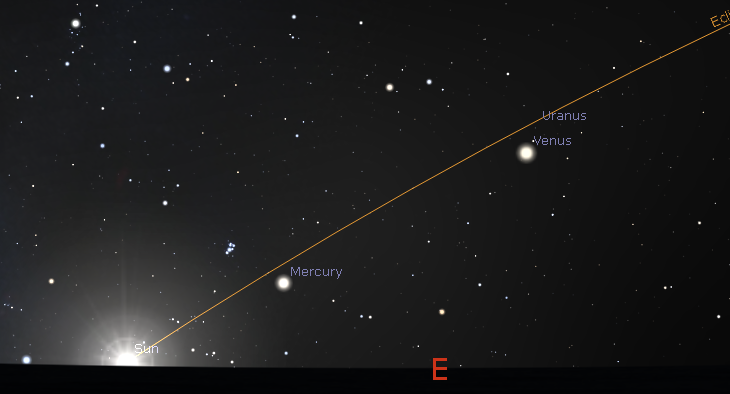
Venus’ low morning appearance is due to the fact that on spring mornings the ecliptic (red line path of the Sun in the sky and nearly that of the planets) lies low to the horizon. Created using Stellarium.
06/02/2017 – Ephemeris – Local astronomy events this weekend
Ephemeris for Friday, June 2nd. Today the Sun will be up for 15 hours and 21 minutes, setting at 9:21, and it will rise tomorrow at 5:59. The Moon, 1 day past first quarter, will set at 3:17 tomorrow morning.
This weekend there are two local astronomical events.
The first is tonight at 8 p.m. at the June meeting of the Grand Traverse Astronomical Society at the Northwestern Michigan College’s Rogers Observatory. I will be giving an illustrated talk about the Moon, its phases, tides and origin. After which there will be a star party starting at 9 p.m. The observatory is located south of Traverse City on Birmley Road.
Saturday, the society will have their telescopes at the Betsie Valley District Library in Thompsonville. I’ll also give a twilight talk there at 9 p.m. on the Moon with observation to follow. This last event will be postponed if the weather is completely cloudy to Friday, June 16th.
The times given are for the Traverse City/Interlochen area of Michigan. They may be different for your location.
06/01/2017 – Ephemeris – A look ahead at the month of June
Ephemeris for Thursday, June 1st. Today the Sun will be up for 15 hours and 20 minutes, setting at 9:20, and it will rise tomorrow at 5:59. The Moon, at first quarter today, will set at 2:49 tomorrow morning.
This is the 42nd anniversary of this program as we start our 43rd orbit of the Sun. Let’s take a look at June skies. There will be a lot of Sun this month. The daylight hours will increase a bit from 15 hours and 20 minutes today to 15 hours and 33 minutes on the 21st, retreating back to 15 hours 30 minutes at month’s end. At this time of the year the sunset times for Ludington, Interlochen, Petoskey and Mackinaw City are very nearly the same. However the sunrise times are at their most divergent. With Ludington’s sunrise being 14 minutes later than Mackinaw City’s. The altitude of the sun above the southern horizon on the solstice, June 21st will be 68 and three-quarters degrees in Interlochen. Summer will start at 12:25 a.m.
The times given are for the Traverse City/Interlochen area of Michigan. They may be different for your location.
Addenda
June Evening Star Chart
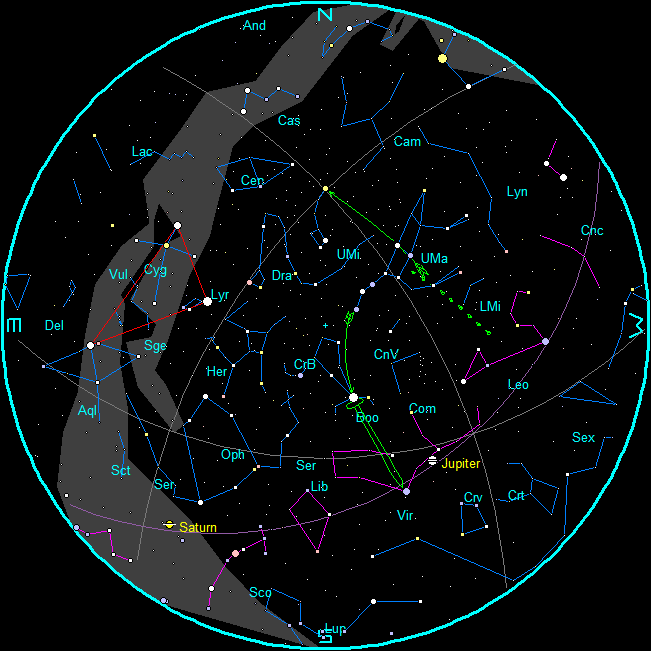
Star Chart for June 2017 (11 p.m. June 15, 2017). Created using my LookingUp program. Click on image to enlarge.
The planets and stars are plotted for the 15th at 11 p.m. EDT in the evening and 5 a.m. for the morning chart. These are the chart times. Note that Traverse City is located approximately 45 minutes behind our time meridian. (An hour 45 minutes behind our daylight saving time meridian. during EDT and 45 minutes behind our daylight standard time meridian. during EST). To duplicate the star positions on a planisphere you may have to set it to 1 hour 45 minutes (Daylight Time) or 45 minutes (Standard Time) earlier than the current time if you are near your time meridian.
Note the chart times of 11 p.m. and 5 a.m. are for the 15th. For each week before the 15th add ½ hour. For each week after the 15th subtract ½ hour. The planet positions are updated each Wednesday on this blog.
June Morning Star Chart
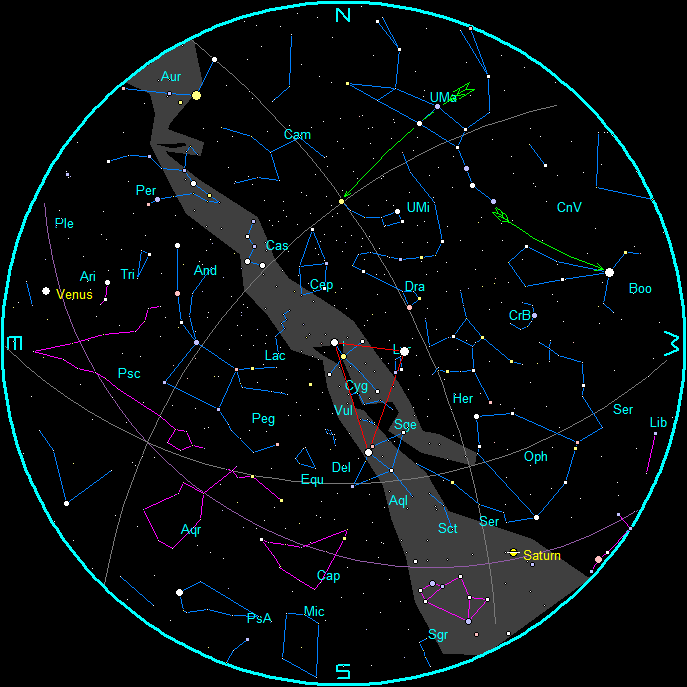
Star Chart for June 2017 mornings based on 4:30 a.m. June 15th. Created using my LookingUp program. Click on image to enlarge.
For a list of constellation names to go with the abbreviations click here.
- Pointer stars at the front of the bowl of the Big Dipper point to Polaris the North Star
- Leaky Big Dipper drips on Leo
- Follow the arc of the handle of the Big Dipper to the star Arcturus,
- Then follow the Spike to Spica
- The Summer Triangle is in red
Evening nautical twilight ends at 10:47 p.m. EDT on the 1st, increasing to 11:00 p.m. EDT on the 30th.
Evening astronomical twilight ends at 11:46 p.m. EDT on the 1st, increasing to 12:03 a.m. EDT on the 30th.
Morning astronomical twilight starts at 3:42 a.m. EDT on the 1st, and changing to 3:37 a.m. EDT on the 30th.
Morning nautical twilight starts at 4:41 a.m. EDT on the 1st, and changing to 4:40 a.m. EDT on the 30th.
NASA Calendar of Planetary Events
 Date Time Event
Jun 01 Th          Venus: 45.8° W
    01 Th  8:42 am First Quarter
    03 Sa  6:59 am Venus Greatest Western Elongation: 45.9°
    03 Sa  7:57 am Moon-Jupiter: 2.5° S
    06 Tu 11:19 pm Mercury-Pleiades: 5.5° S
    08 Th  6:21 pm Moon Apogee: 406400 km
    09 Fr  9:10 am Full Moon
    09 Fr  9:25 pm Moon-Saturn: 3.4° S
    10 Sa 11:36 pm Moon South Dec.: 19.4° S
    14 We 10:40 pm Moon Descending Node
    15 Th  5:15 am Saturn Opposition
    17 Sa  7:33 am Last Quarter
    20 Tu  5:13 pm Moon-Venus: 2.4° N
    21 We 12:25 am Summer Solstice
    21 We  9:55 am Mercury Superior Conjunction with the Sun
    22 Th 10:23 am Moon-Aldebaran: 0.5° S
    23 Fr  6:49 am Moon Perigee: 357900 km
    23 Fr 10:31 am New Moon
    24 Sa  7:12 am Moon North Dec.: 19.4° N
    26 Mo  7:18 am Moon-Beehive: 3.2° N
    27 Tu 12:26 pm Moon Ascending Node
    27 Tu  8:26 pm Moon-Regulus: 0.1° N
    30 Fr  8:51 pm First Quarter
Jul 01 Sa          Venus: 43.7° W
June 2017 Calendar
LU                  Ephemeris of Sky Events for Interlochen/TC
June, 2017    Local time zone: EDT
+-----------------------------------------------------------------------+
| DATE |  SUN     SUN  DAYLIGHT|   TWILIGHT*    |MOON  RISE OR    ILLUM |
|      |  RISE    SET    HOURS |  END    START  |PHASE SET** TIME FRACTN|
+=======================================================================+
|Thu  1| 06:00a  09:21p  15:21 | 10:44p  04:37a |F Qtr Set  02:49a   55%|
|Fri  2| 05:59a  09:22p  15:22 | 10:46p  04:36a |      Set  03:18a   65%|
|Sat  3| 05:59a  09:23p  15:23 | 10:47p  04:35a |      Set  03:45a   74%|
+------+-----------------------+----------------+-----------------------+
|Sun  4| 05:58a  09:23p  15:25 | 10:48p  04:34a |      Set  04:12a   82%|
|Mon  5| 05:58a  09:24p  15:26 | 10:49p  04:34a |      Set  04:40a   89%|
|Tue  6| 05:58a  09:25p  15:27 | 10:50p  04:33a |      Set  05:10a   94%|
|Wed  7| 05:57a  09:26p  15:28 | 10:50p  04:33a |      Set  05:44a   98%|
|Thu  8| 05:57a  09:26p  15:29 | 10:51p  04:32a |      Set  06:22a  100%|
|Fri  9| 05:57a  09:27p  15:30 | 10:52p  04:32a |Full  Rise 09:26p  100%|
|Sat 10| 05:57a  09:27p  15:30 | 10:53p  04:31a |      Rise 10:17p   98%|
+------+-----------------------+----------------+-----------------------+
|Sun 11| 05:56a  09:28p  15:31 | 10:54p  04:31a |      Rise 11:03p   95%|
|Mon 12| 05:56a  09:28p  15:32 | 10:54p  04:31a |      Rise 11:45p   89%|
|Tue 13| 05:56a  09:29p  15:32 | 10:55p  04:30a |      Rise 12:23a   83%|
|Wed 14| 05:56a  09:29p  15:33 | 10:55p  04:30a |      Rise 12:57a   75%|
|Thu 15| 05:56a  09:30p  15:33 | 10:56p  04:30a |      Rise 01:29a   65%|
|Fri 16| 05:56a  09:30p  15:34 | 10:56p  04:30a |      Rise 01:59a   55%|
|Sat 17| 05:56a  09:31p  15:34 | 10:57p  04:30a |L Qtr Rise 02:29a   44%|
+------+-----------------------+----------------+-----------------------+
|Sun 18| 05:56a  09:31p  15:34 | 10:57p  04:30a |      Rise 03:00a   34%|
|Mon 19| 05:56a  09:31p  15:34 | 10:57p  04:30a |      Rise 03:33a   23%|
|Tue 20| 05:57a  09:31p  15:34 | 10:58p  04:30a |      Rise 04:11a   14%|
|Wed 21| 05:57a  09:32p  15:34 | 10:58p  04:30a |      Rise 04:54a    7%|
|Thu 22| 05:57a  09:32p  15:34 | 10:58p  04:31a |      Rise 05:45a    2%|
|Fri 23| 05:57a  09:32p  15:34 | 10:58p  04:31a |New   Set  09:01p    0%|
|Sat 24| 05:58a  09:32p  15:34 | 10:58p  04:31a |      Set  10:03p    1%|
+------+-----------------------+----------------+-----------------------+
|Sun 25| 05:58a  09:32p  15:34 | 10:58p  04:32a |      Set  10:56p    5%|
|Mon 26| 05:58a  09:32p  15:33 | 10:58p  04:32a |      Set  11:41p   12%|
|Tue 27| 05:59a  09:32p  15:33 | 10:58p  04:33a |      Set  12:18a   20%|
|Wed 28| 05:59a  09:32p  15:32 | 10:58p  04:33a |      Set  12:51a   29%|
|Thu 29| 06:00a  09:32p  15:32 | 10:57p  04:34a |      Set  01:21a   39%|
|Fri 30| 06:00a  09:32p  15:31 | 10:57p  04:35a |F Qtr Set  01:49a   50%|
+-----------------------------------------------------------------------+
* Nautical Twilight
** Moonrise or moonset, whichever occurs between sunset and sunrise
05/31/2017 – Ephemeris – Wednesday is bright planets day on Ephemeris
Ephemeris for Wednesday, May 31st. Today the Sun will be up for 15 hours and 19 minutes, setting at 9:19, and it will rise tomorrow at 6:00. The Moon, 1 day before first quarter, will set at 2:19 tomorrow morning.
Let’s take our weekly look at the bright planets. Mars is still in the west-northwest after sunset and fading. It appears left of the bottom edge of the constellation Auriga. It will set at 10:43 p.m. Dominating the evening sky now is Jupiter in the south. The bright blue-white star Spica is seen below and left of it. In even the smallest telescopes Jupiter’s four largest moons can be seen. They shift positions night from to night and sometimes even as you watch. Jupiter will set at 4:09 a.m. Saturn can now be seen late in the evening after it rises in the east-southeast at 10:15 p.m. At 5 a.m. both Saturn and Venus will be in the morning twilight. Brilliant Venus will be low in the east tomorrow morning after rising at 4:05 a.m.
The times given are for the Traverse City/Interlochen area of Michigan. They may be different for your location.
Addendum
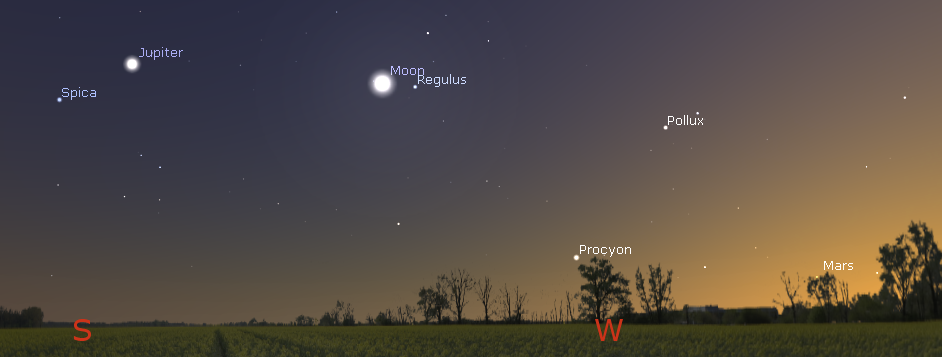
Mars, Jupiter and the Moon in twilight at 10 p.m., May 31, 2017. Created using Stellarium. Click on the image to enlarge.
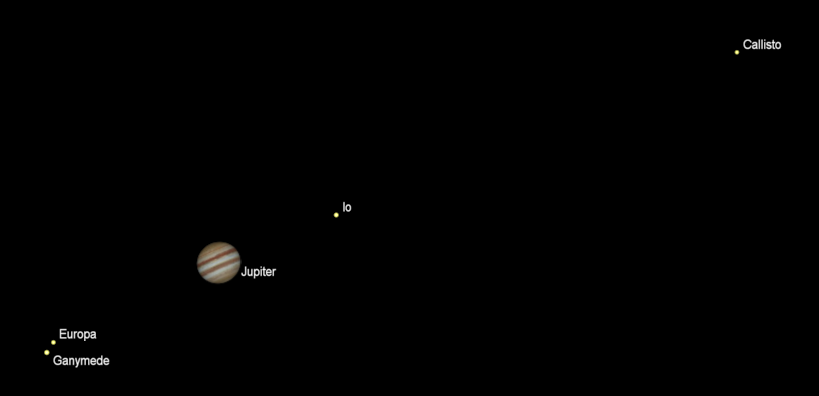
Jupiter and its four Galilean moons as they might be seen in a telescope at 10 p.m,. May 31, 2017. Created using Cartes du Ciel (Sky Charts).
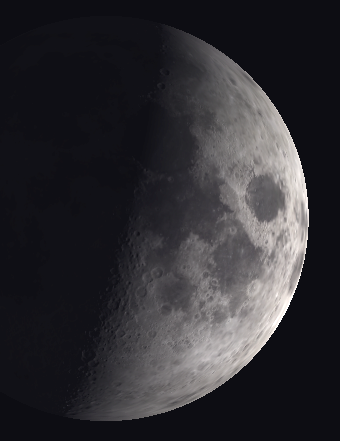
The moon as seen in binoculars, tonight at 10 p.m., May 31, 2017. Created using Stellarium.
At 11 p.m., May 31, 2017 Saturn can be seen low in the southeast. Created using Stellarium.
Saturn and its brightest moons overnight May 31/June 1, 2017. Created using Cartes du Ciel (Sky Charts).
Venus and Saturn at 5 a.m. June 1, 2017. Created using Stellarium. Click on the image to expand.

Venus as seen through a telescope at 5 a.m. June 1, 2017. This is displayed at a larger scale/magnification than the Jupiter or Saturn images above. Created using Stellarium.
Planets at sunset and sunrise of a single night starting with sunset on the right on May 31, 2017. The night ends on the left with sunrise on June 1. Click on the image to enlarge. Created using my LookingUp program.
05/30/2017 – Ephemeris – Amateur astronomer detects an impact on Jupiter
Ephemeris for Tuesday, May 30th. Today the Sun will be up for 15 hours and 17 minutes, setting at 9:19, and it will rise tomorrow at 6:00. The Moon, 2 days before first quarter, will set at 1:44 tomorrow morning.
Last Friday several amateur astronomers photographing Jupiter with video CCDs captured a flash in the high northern latitude of Jupiter. Part of the reason for videos is to stack the individual images to average out the turbulence of the atmosphere they were looking through. It’s a fantastic technique. The flash was probably due to the impact of an asteroid. The first objects to have been seen to crash into Jupiter were the chunks of Comet Shoemaker-Levy 9 that crashed into Jupiter over a one week period in July of 1994. Since then several flashes have been seen, all of them captured and confirmed by amateur astronomers. Amateurs have also discovered storms on Saturn for the Cassini spacecraft to study.
The times given are for the Traverse City/Interlochen area of Michigan. They may be different for your location.
Addendum
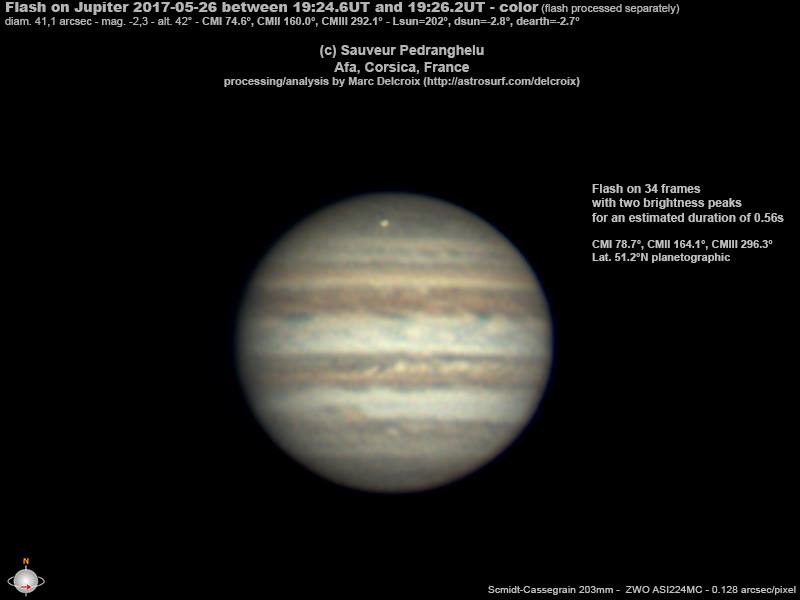
Jupiter Impact alert Image annotated. Note the white spot at the top of Jupiter. Credit Sauveer Pendranghelu, Afa, Corsica, France via Damian Peach’s tweet. Click on image to enlarge.
05/29/2017 – Ephemeris – We remember too those who died reaching for the stars
Ephemeris for Memorial Day, Monday, May 29th. Today the Sun will be up for 15 hours and 16 minutes, setting at 9:18, and it will rise tomorrow at 6:01. The Moon, 3 days before first quarter, will set at 1:04 tomorrow morning.
Today we pause to remember those who gave their lives for our country. For purposes of this program that includes those courageous enough to sit on top of or beside a million pounds of explosives to be launched into space. From the three astronauts who died in the Apollo one file in 1967, the explosion of the Space Shuttle Challenger in 1986, to the disintegration of the Columbia in 2003, 17 Americans and other nationals have died in NASA space accidents. The Russians too have lost cosmonauts in the exploration of space. Brothers and sisters in the quest for knowledge and to expand the horizons of human habitation. Per aspera, ad astra, Through difficulties to the stars!
The times given are for the Traverse City/Interlochen area of Michigan. They may be different for your location.
Addendum
A listing of Astronaut and Cosmonaut deaths: http://www.aerospaceweb.org/question/history/q0114.shtml
05/26/2017 – Ephemeris – Can you spot the extremely young Moon tonight?
Ephemeris for Friday, May 26th. Today the Sun will be up for 15 hours and 11 minutes, setting at 9:15, and it will rise tomorrow at 6:03. The Moon, 1 day past new, will set at 10:16 this evening.
It’s spring and a great time to see if you can spot the young moon. The official time when the moon was new was 3:44 p.m. yesterday afternoon (19:44 UT 25 May 2017), which would make the moon a bit less than 31 hours old if spotted before it sets an hour after the Sun. This requires crystal clear skies and a very low northwestern horizon. Binoculars are a definite help. Spotting the earliest moon after new moon is one of the challenges amateur astronomers pit their observing skills with. Another is the Messier Marathon, in which one tries to observe all 110 of Charles Messier’s catalog entries of dim objects on a single night, which is theoretically possible around March 24th.
The times given are for the Traverse City/Interlochen area of Michigan. They may be different for your location.
Addendum
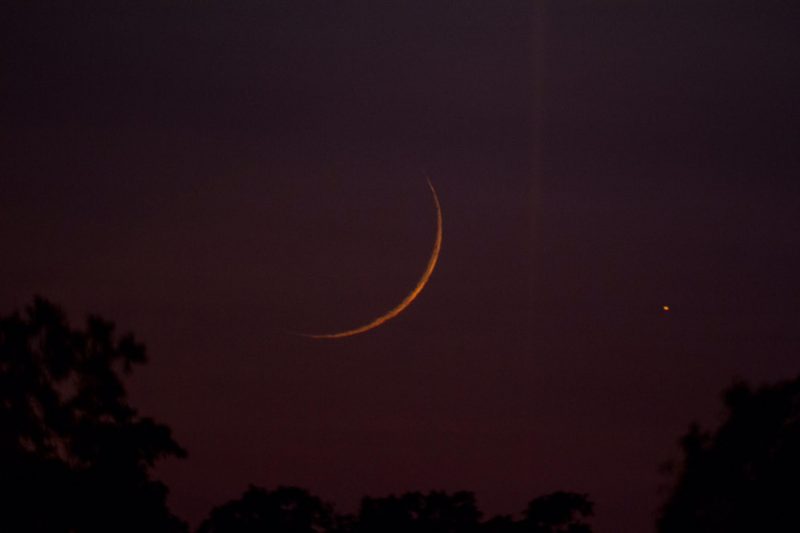
A 39 hour old Moon with Jupiter taken by Greg Hogan on September 2, 2016.
I got this from EarthSky.org. Here’s a search I made of the young moon that has some other images: http://earthsky.org/?s=young+moon

