Archive
06/23/2017 – Ephemeris – Astronomy events this weekend
Ephemeris for Friday, June 23rd. Today the Sun will be up for 15 hours and 33 minutes, setting at 9:31, and it will rise tomorrow at 5:58. The Moon is new today, and won’t be visible.
Tomorrow afternoon and evening will be what we call a Sun & Star Party at the Sleeping Bear Dunes National Lakeshore. This event will be at the Dune Climb. From 4 to 6 p.m., the Sun will be featured using two types of telescopes, one showing the sun’s photosphere in what we call white light, and another showing the chromosphere above it in the light of hydrogen giving a completely different view. Starting at 9 p.m. will be a star party, actually really a planet party, viewing the planets Jupiter and Saturn, plus other objects visible in the deepening twilight.
Sunday at 11 a.m. to 4 p.m. members of the society will be in the parking lot of the NMC Laboratory on Aero Park Drive in Traverse City to view the Sun as part of the Michigan Clean Energy Conference and Fair.
The times given are for the Traverse City/Interlochen area of Michigan. They may be different for your location.
Addendum
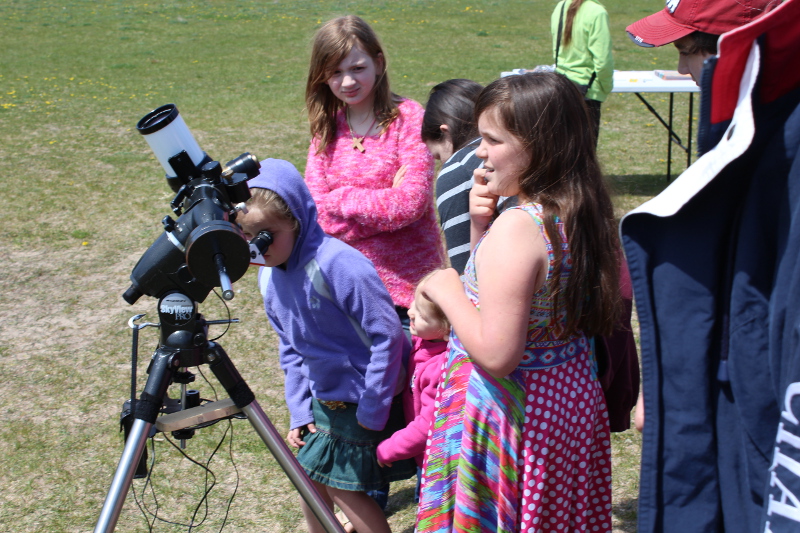
Kids viewing the Sun through the society’s Lunt hydrogen alpha solar telescope.
06/22/2017 – Ephemeris – Now that it’s summer, lets check out the Summer Triangle
Ephemeris for Thursday, June 22nd. Today the Sun will be up for 15 hours and 33 minutes, setting at 9:31, and it will rise tomorrow at 5:57. The Moon, 1 day before new, will rise at 5:45 tomorrow morning.
We’re a day into summer, and the asterism or informal constellation called the Summer Triangle can be seen rising in the east as it gets dark. Highest of the three bright stars is Vega in the constellation Lyra the harp, whose body is seen in a narrow parallelogram nearby. The second star of the triangle is Deneb lower and left of Vega, It appears dimmer than Vega because it is by far the most distant of the three. The third star of the Summer Triangle is seen farther below and a right of Vega. It is Altair in Aquila the eagle, and the closest. Altair is 16.5 light years away, Vega is 27 light years while Deneb may be a whopping 2600 light years away. One light year is 6 trillion miles (9 trillion km).
The times given are for the Traverse City/Interlochen area of Michigan. They may be different for your location.
Addendum
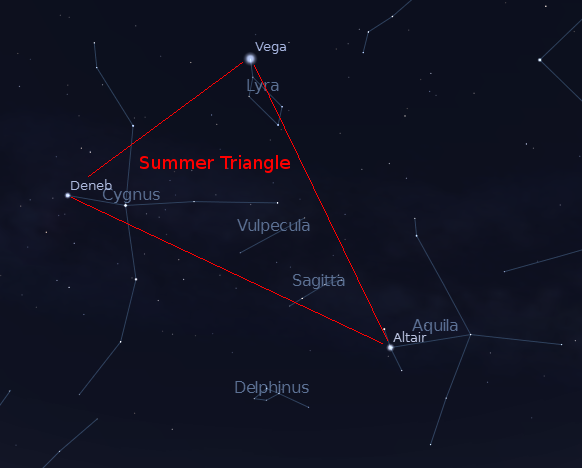
The Summer Triangle. Created using Stellarium and The Gimp.
06/21/2017 – Ephemeris – Checking out the bright planets on the first day of summer
Ephemeris for Wednesday, June 21st. Today the Sun will be up for 15 hours and 33 minutes, setting at 9:31, and it will rise tomorrow at 5:57. The Moon, 2 days before new, will rise at 4:54 tomorrow morning.
Let’s take our weekly look at the bright planets on this first day of summer. Dominating the evening sky now is Jupiter in the southwest. The bright blue-white star Spica, which pales in comparison to it, is seen left and below it. In even the smallest telescopes Jupiter’s four largest moons can be seen. They shift positions night from to night and sometimes even as you watch. Jupiter will set at 2:18 a.m. Saturn can now be seen in the evening as twilight fades in the southeast. It is now officially an evening planet after opposition last week. At 5 a.m. both Saturn and Venus will be seen in the morning twilight. Brilliant Venus will be low in the east tomorrow morning after rising at 3:37 a.m.
The times given are for the Traverse City/Interlochen area of Michigan. They may be different for your location.
Addendum
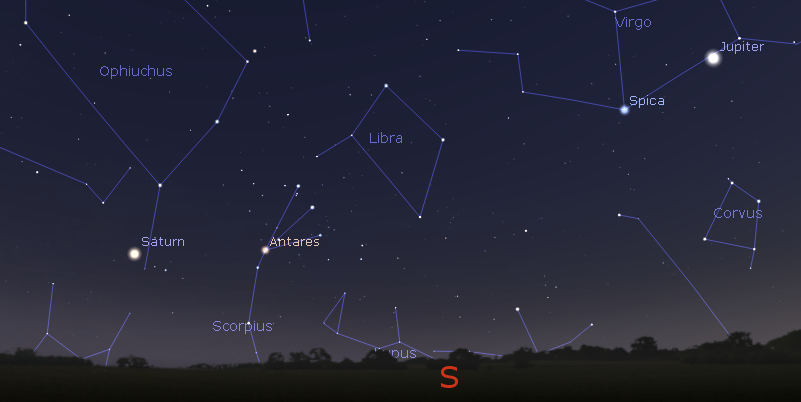
Jupiter and Saturn and the southern evening constellations at 10:30 p.m., June 21, 2017. Click on the image to enlarge. Created using Stellarium.
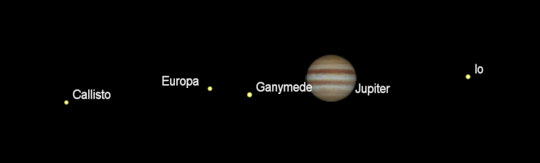
Jupiter and its four Galilean moons as they might be seen in a telescope at 10:30 p.m,. June 21, 2017. Created using Cartes du Ciel (Sky Charts).
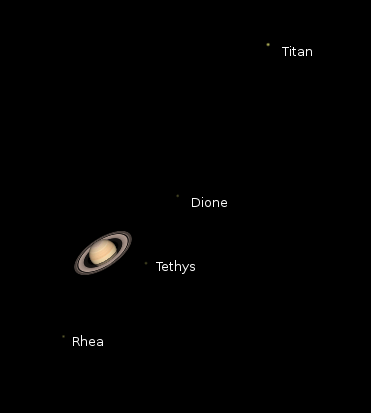
Saturn and its brightest moons overnight June 21/22, 2017. Created using Cartes du Ciel (Sky Charts).
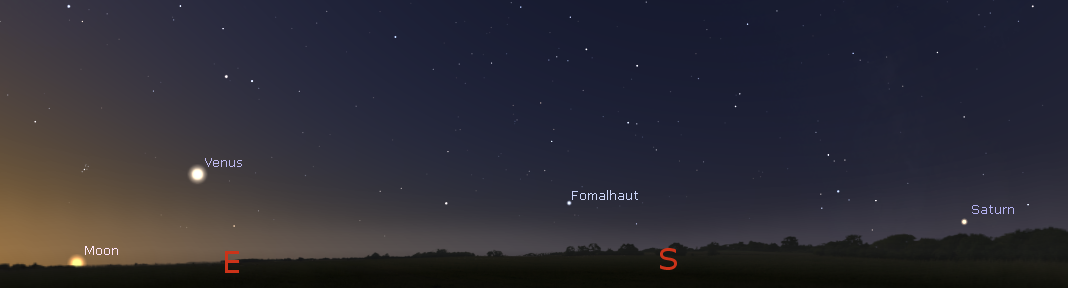
Saturn, Venus and the rising crescent Moon at 5 a.m. June 22, 2017. Click on the image to enlarge. Created using Stellarium. Click on the image to expand.
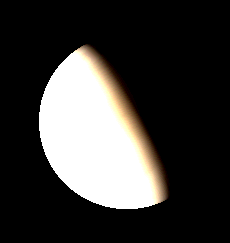
Venus as it might be seen through a telescope at 5 a.m. June 22, 2017. This is displayed at a larger scale/magnification than the Jupiter or Saturn images above. Created using Stellarium.

The skinny crescent moon as it might be seen in binoculars, after 5 a.m., June 22, 2017. Created using Stellarium.
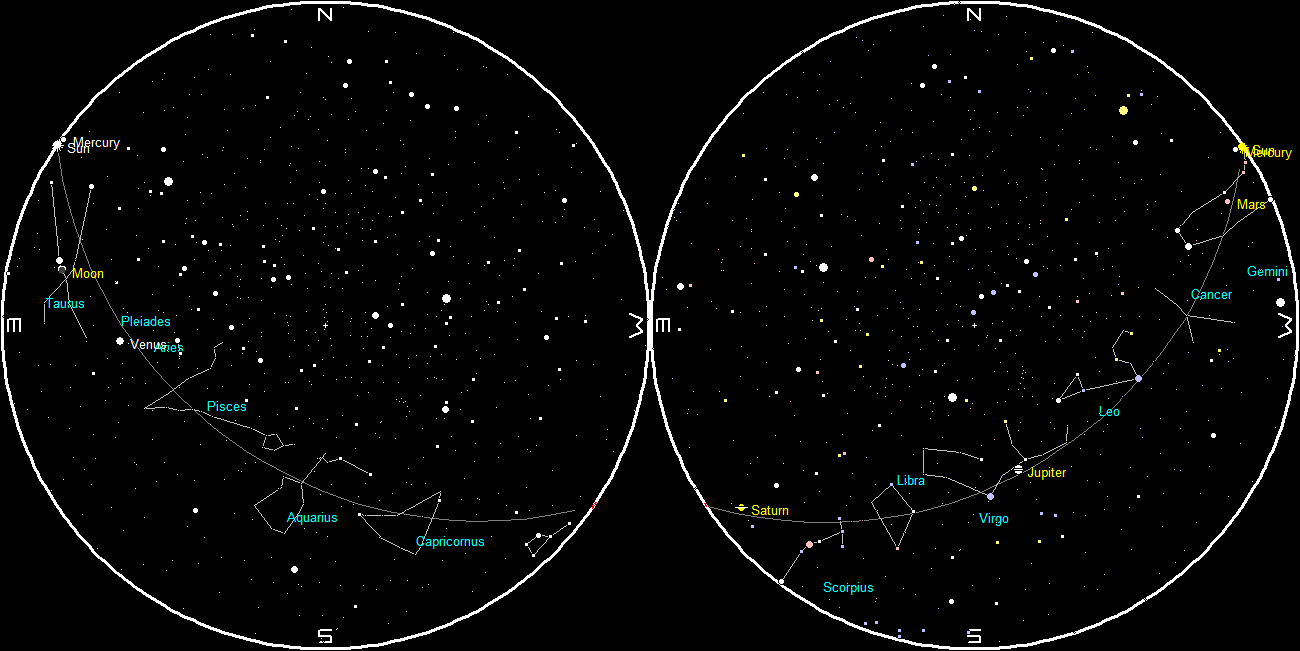
Planets at sunset and sunrise of a single night starting with sunset on the right on June 21, 2017. The night ends on the left with sunrise on June 22. Click on the image to enlarge. Created using my LookingUp program.
06/20/2017 – Ephemeris – Summer will begin overnight tonight
Ephemeris for Tuesday, June 20th. Today the Sun will be up for 15 hours and 33 minutes, setting at 9:31, and it will rise tomorrow at 5:57. The Moon, half way from last quarter to new, will rise at 4:11 tomorrow morning.
Summer will begin overnight at 12:25 a.m. (4:25 UT June 21, 2017) The sun will at its highest at noon today and tomorrow, well at local solar noon that is, which is 1:44 p.m. in the Interlochen Traverse City area. At that time the Sun will reach an altitude or angle above the southern horizon of nearly 69 degrees. If you want to get an idea of the difference between that and the Sun at the winter solstice, check out Saturn tonight. It is almost to the point in the sky where the Sun was at the winter solstice. Notice how low it is in the sky, and how few hours it is up. The cause is the tilt of the earth’s axis of 23 and a half degrees. It gives us a 47 degree span of altitudes of the sun over the year. It is not the sun’s distance that causes seasons, as we’ll see next month.
The times given are for the Traverse City/Interlochen area of Michigan. They may be different for your location.
Addendum
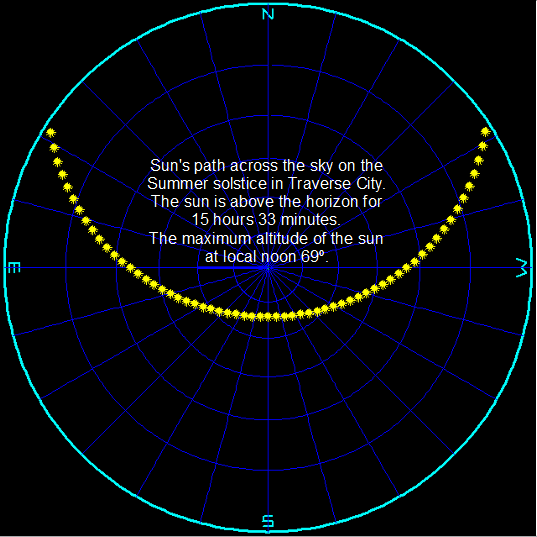
The Sun’s path through the sky on the summer solstice day from Traverse City, MI. Created using my LookingUp program.
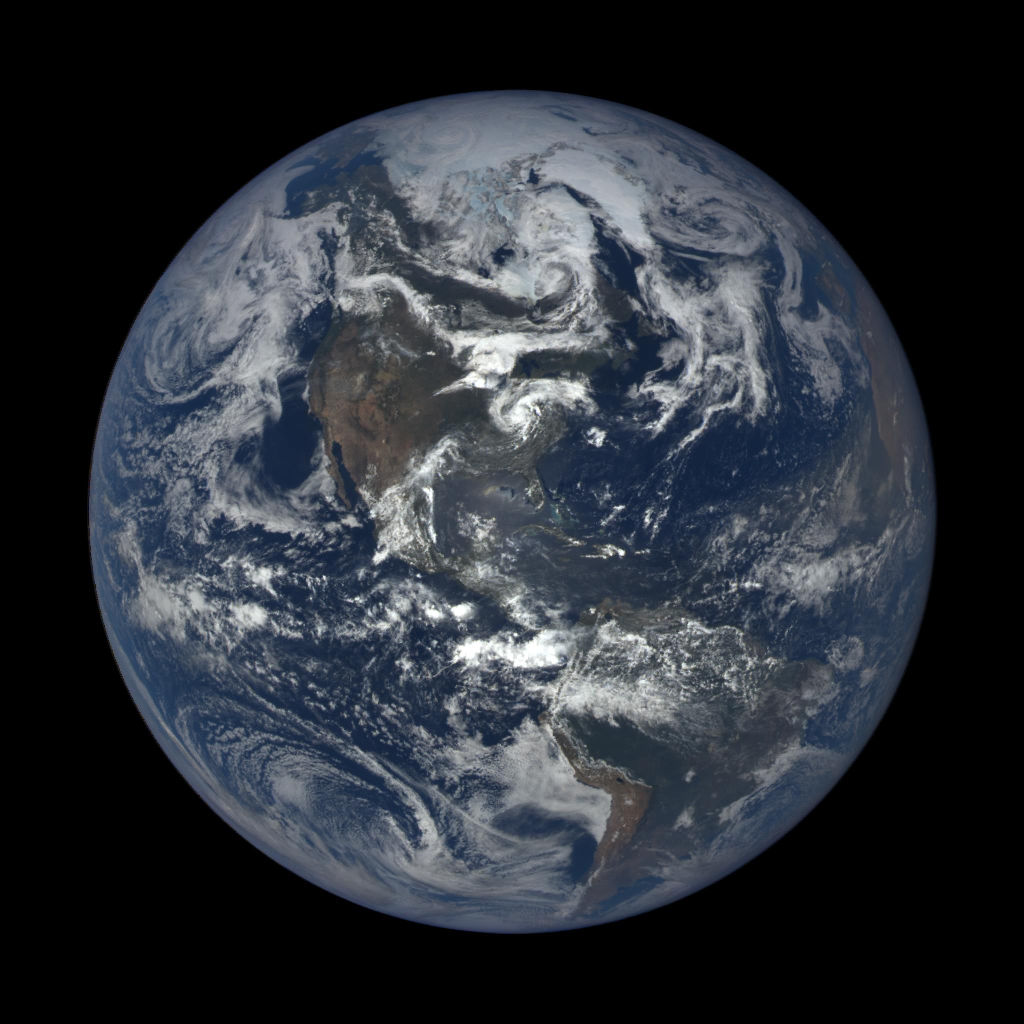
Earth from the DSCOVR satellite at the June solstice 2015. Credit NOAA
06/16/2017 – Ephemeris – Two astronomy events this weekend
Ephemeris for Friday, June 16th. Today the Sun will be up for 15 hours and 33 minutes, setting at 9:29, and it will rise tomorrow at 5:56. The Moon, 1 day before last quarter, will rise at 1:58 tomorrow morning.
There are two astronomy events in the Grand Traverse region this weekend, starting tonight with a twilight talk and a star party at the Betsie Valley District Library in Thompsonville. It starts at 9 p.m. with a talk about how to safely view the August 21st eclipse of the Sun from this area and from the path of totality, 600 miles south of here. After which Jupiter and Saturn will be visible. If cloudy, the talk will go on as scheduled, though the observing part will be canceled.
Tomorrow, Saturday there, will be viewing at the Northwestern Michigan College’s Rogers Observatory starting at 9 p.m. Jupiter and Saturn will be featured there too. The Observatory is located south of Traverse City on Birmley road.
The times given are for the Traverse City/Interlochen area of Michigan. They may be different for your location.
06/15/2017 – Ephemeris – Saturn is at opposition from the Sun today
Ephemeris for Thursday, June 15th. Today the Sun will be up for 15 hours and 32 minutes, setting at 9:29, and it will rise tomorrow at 5:56. The Moon, 2 days before last quarter, will rise at 1:28 tomorrow morning.
The Planet Saturn was in opposition with the Sun at 5:15 (09:15 UT) this morning. That means that it was 180 degrees from the Sun, well 178.6 degrees to be exact, because the Earth is a bit south of the Sun-Saturn line. This is a time when the shadows of the rings on the planet and planet on the rings almost disappear, due to our vantage point. Saturn is also closest now at 842 million miles (1.356 billion km). It average distance being about 940 million miles (1.5 billion km). In three months our emissary to Saturn, the Cassini spacecraft will dive beneath Saturn’s clouds to burn up after using up almost all its maneuvering fuel. Then we with our telescopes on and around Earth will remain the only link to the ringed planet.
The times given are for the Traverse City/Interlochen area of Michigan. They may be different for your location.
Addendum
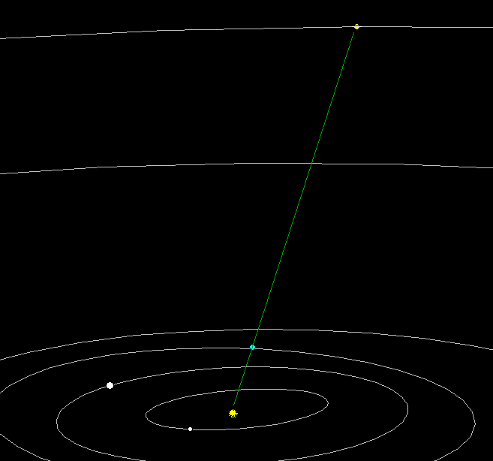
Saturn at opposition in a perspective view of the solar system which compresses the fact that Saturn is 10 times farther from the Sun as the Earth. Created using my LookingUp program.
06/14/2017 – Ephemeris – Let’s take our weekly look at the bright planets
Ephemeris for Flag Day, Wednesday, June 14th. Today the Sun will be up for 15 hours and 32 minutes, setting at 9:29, and it will rise tomorrow at 5:56. The Moon, 3 days before last quarter, will rise at 12:56 tomorrow morning.
Let’s take our weekly look at the bright planets. Dominating the evening sky now is Jupiter in the south-southwest. The bright blue-white star Spica, which pales in comparison to it, is seen left and below it. In even the smallest telescopes Jupiter’s four largest moons can be seen. They shift positions night from to night and sometimes even as you watch. Jupiter will set at 2:46 a.m. Saturn can now be seen in the evening as twilight fades in the southeast. Saturn will reach opposition from the Sun early tomorrow morning. At 5 a.m. both Saturn and Venus will be in the morning twilight. Brilliant Venus will be low in the east tomorrow morning after rising at 3:45 a.m.
The times given are for the Traverse City/Interlochen area of Michigan. They may be different for your location.
Addendum
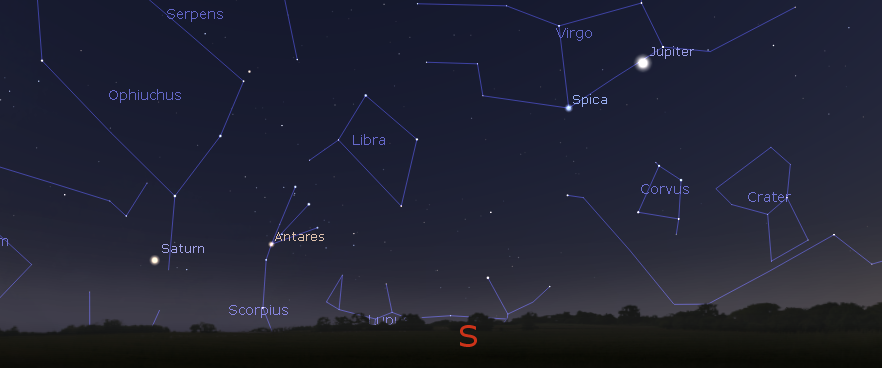
Jupiter and Saturn and the southern evening constellations at 10:30 p.m., June 14, 2017. Created using Stellarium.

Jupiter and its four Galilean moons as they might be seen in a telescope at 10:30 p.m,. June 14, 2017. Created using Cartes du Ciel (Sky Charts).
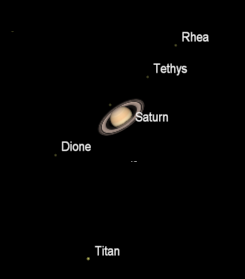
Saturn and its brightest moons overnight June 14/15, 2017. Created using Cartes du Ciel (Sky Charts).
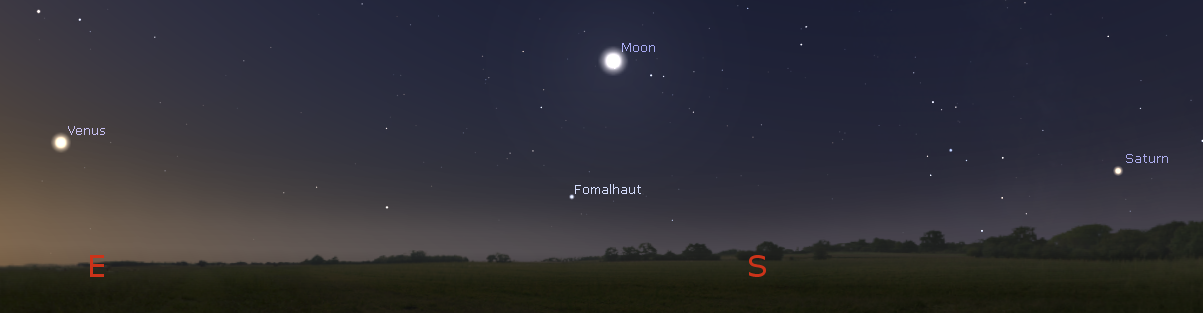
Venus, Saturn and the Moon at 5 a.m. June 15, 2017. Created using Stellarium. Click on the image to expand.
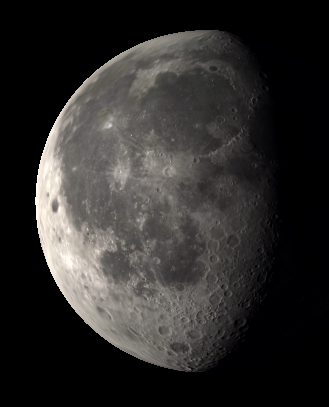
The moon as it might be seen in binoculars, at 5 a.m., June 15, 2017. Created using Stellarium.

Venus as it might be seen through a telescope at 5 a.m. June 15, 2017. This is displayed at a larger scale/magnification than the Jupiter or Saturn images above. Created using Stellarium.
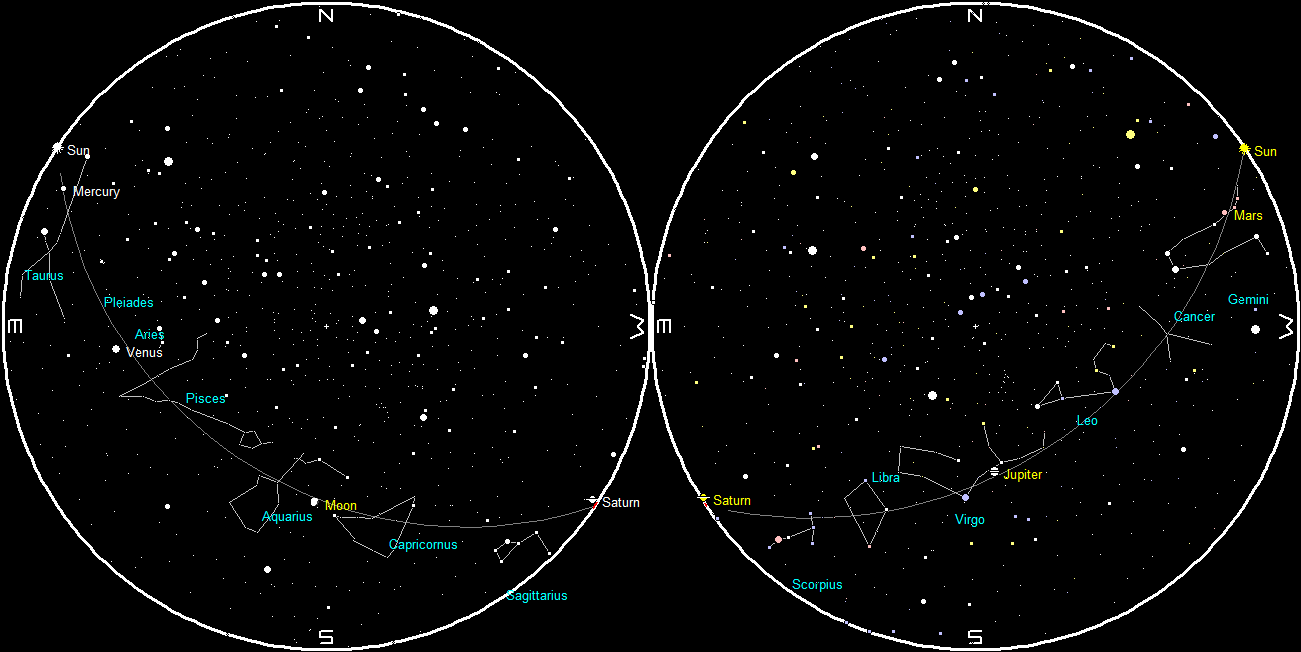
Planets at sunset and sunrise of a single night starting with sunset on the right on June 14, 2017. The night ends on the left with sunrise on June 15. Click on the image to enlarge. Created using my LookingUp program.
06/13/2017 – Ephemeris – I call Antares the UFO star
Ephemeris for Tuesday, June 13th. Today the Sun will be up for 15 hours and 31 minutes, setting at 9:28, and it will rise tomorrow at 5:56. The Moon, half way from full to last quarter, will rise at 12:22 tomorrow morning.
Last week I was observing and showing another person the sky when she remarked about that star low in the sky. That star happened to be Antares, which I call the UFO star. This is a red giant star which in Interlochen and Traverse City never rises above 19 degrees over the southern horizon. It is located in the heart of the constellation Scorpius the Scorpion. With the turbulence in the Earth’s atmosphere, being more marked for objects low in the sky, Antares twinkles mightily. And also being low in the sky, the atmosphere also breaks Antares’ light into a rainbow of colors which, under binocular and telescopic magnification can give the appearance of a multicolored sparkler.
The times given are for the Traverse City/Interlochen area of Michigan. They may be different for your location.
Addendum
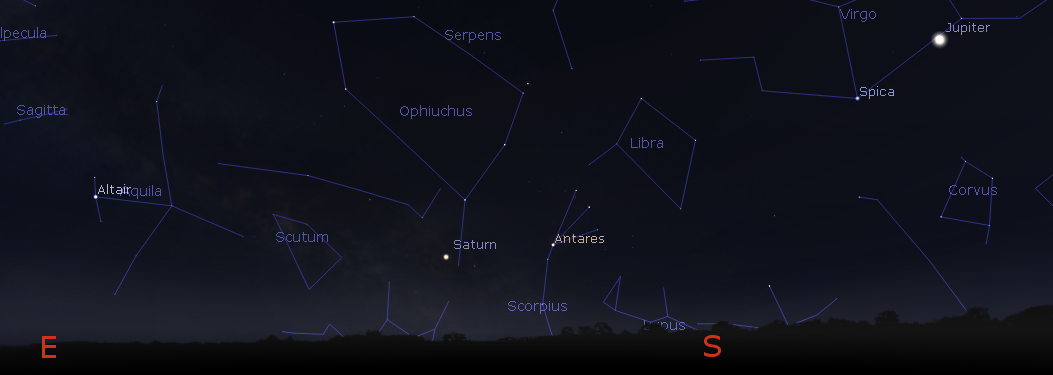
The star Antares in the heart of Scorpius and the planets Saturn and Jupiter at 11 p.m., June 1, 2017. Created using Stellarium.
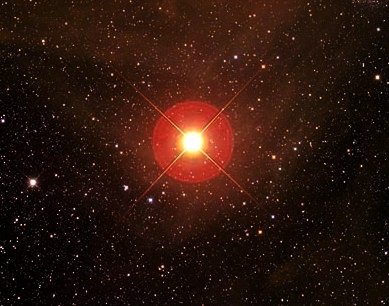
The star Antares in long exposure in this image probably taken from farther south than here. Source unknown, however because the star has four diffraction spikes the photograph was taken with a reflector telescope whose secondary mirror is supported by a 4 vane “spider”.
06/12/2017 – Ephemeris – Now is a great time to view Saturn
Ephemeris for Monday, June 12th. Today the Sun will be up for 15 hours and 31 minutes, setting at 9:28, and it will rise tomorrow at 5:56. The Moon, 3 days past full, will rise at 11:44 this evening.
In three days the planet Saturn will be opposite the Sun in the sky. Astronomers simply call it opposition. It’s the time Saturn will be closest to us, and appear biggest in telescopes. That’s not a big a deal as for a closer, smaller planet like Mars or Venus. Being ten times farther from the Sun than the Earth Saturn’s distance and thus it’s size varies by only plus or minus 10%. Another event happened on Saturn last month, Summer started in it’s northern hemisphere. Saturn’s rings orbit the planet over it’s equator, and Saturn’s axial tilt of obliquity is 26 degrees, similar to the Earth’s actually. This summer solstice means that the rings are at their most open because we are viewing Saturn from near the Sun, so a first glance through a telescope Saturn looks elliptical, with the planetary ball completely within the rings.
The times given are for the Traverse City/Interlochen area of Michigan. They may be different for your location.
Addendum
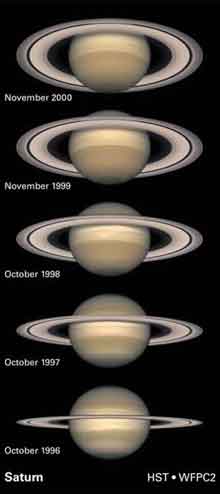
Saturn’s Rings over time as they closed. Credit NASA/HST/WFPC2
Now the rings are opened to their maximum extent with the northern hemisphere of Saturn uncovered by the rings and the southern hemisphere covered by them, the reverse of the top image.
06/09/2017 – Ephemeris – Watch the mini moon rise tonight
Ephemeris for Friday, June 9th. Today the Sun will be up for 15 hours and 29 minutes, setting at 9:26, and it will rise tomorrow at 5:57. The Moon, at full today, will rise at 9:26 this evening.
In recent years we’ve talked about the super moon, when the full Moon appears especially large because it’s at perigee, or closest to the Earth at that time. Well tonight’s full Moon will be a the opposite, a mini Moon. The Moon reached apogee, its farthest from the Earth in it’s orbit at 6:21 last night, and 15 hours later, at 9:10 this morning the Moon was full. However I bet that when the Moon rises tonight that it will appear just as big as it always does, especially if you forget that it’s supposed to be a mini moon. The Moon is in an elliptical orbit of the Earth that this month varies from 252,500 miles (406,400 km) yesterday down to 222,400 miles (357,900 km) on the 23rd. Thanks to the Sun, and especially Jupiter and Venus, those distances change a bit every month. Tonight Saturn will be seen just below the moon.
The times given are for the Traverse City/Interlochen area of Michigan. They may be different for your location.
Addendum
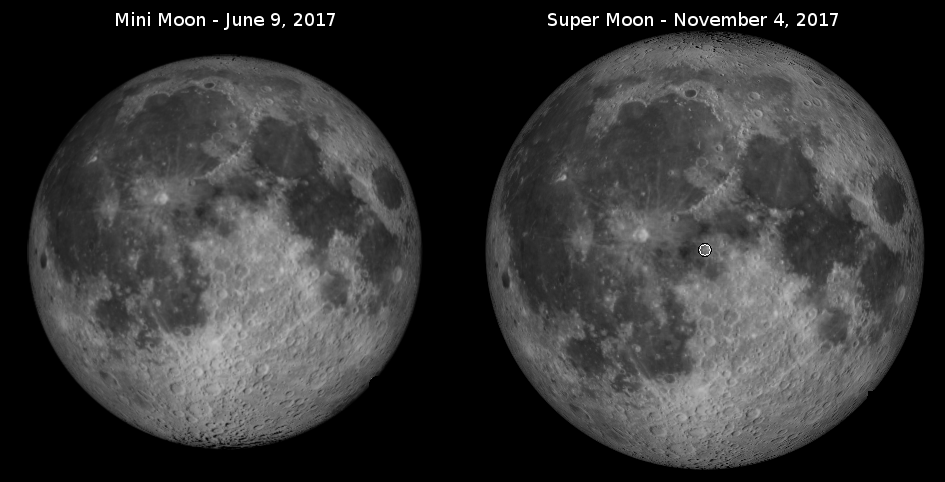
Mini Moon and Super Moon for 2017. Created using Cartes du Ciel (Sky Charts).

