Archive
05/25/2017 – Ephemeris – Another look at Leo the lion
Ephemeris for Ascension Thursday, Thursday, May 25th. Today the Sun will be up for 15 hours and 9 minutes, setting at 9:14, and it will rise tomorrow at 6:04. The Moon is new today, and won’t be visible.
The constellation Leo the lion is now high in the southwest at 10:30 pm. It’s below the Big Dipper higher up near the zenith. Leo is marked by two sets of easily recognizable stars. The front of him is a backward question mark of stars, also known as the Sickle that mark his head and mane, along with the front part of his body. Regulus is the star at the bottom of that backwards question mark. It’s the Little King Star. The hind end of him is a triangle of stars ending with another bright star, but not as bright as Regulus. It’s Denebola which means Lion’s tail. It was thought when the sun was in this constellation long ago that the lions were driven by the heat to quench their thirst in the Nile river. Ancient physicians thought medicines were poison when the Sun was here too.
The times given are for the Traverse City/Interlochen area of Michigan. They may be different for your location.
Addendum
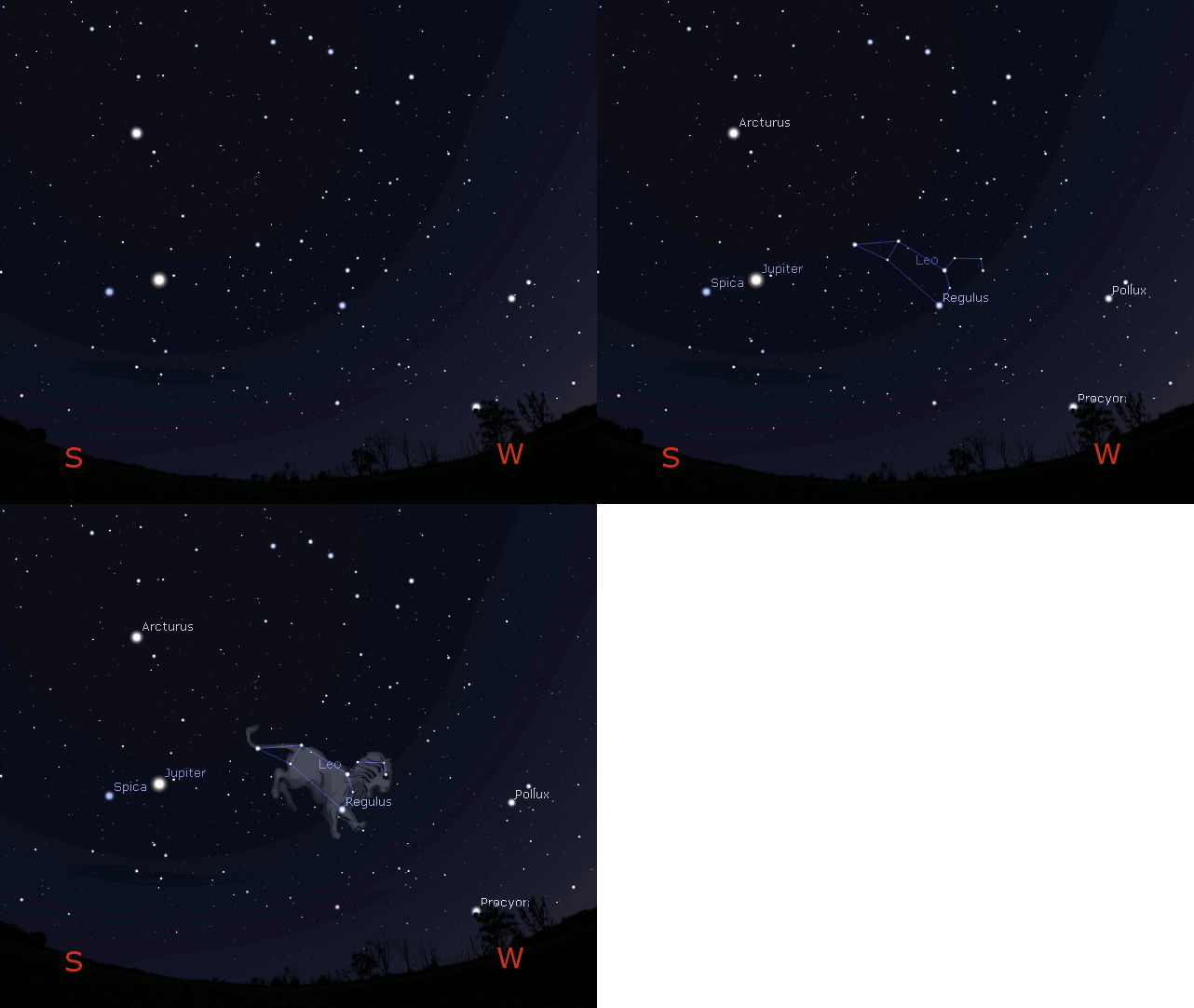
Animation on how to find Leo the lion at 10:30 p.m., May 25, 2017. Created using Stellarium and GIMP. Click on image to enlarge if necessary.
05/24/2017 – Ephemeris – Let’s take our weekly look at the bright naked eye planets
Ephemeris for Wednesday, May 24th. Today the Sun will be up for 15 hours and 7 minutes, setting at 9:13, and it will rise tomorrow at 6:04. The Moon, 1 day before new, will rise at 6:20 tomorrow morning.
Let’s take our weekly look at the bright planets. Mars is still in the west-northwest after sunset and fading. It appears near the left edge of the constellation Auriga. It will set at 10:49 p.m. Dominating the evening sky now is Jupiter in the south. The bright blue-white star Spica is seen below and left of it. In even the smallest telescopes Jupiter’s four largest moons can be seen. They shift positions night from to night and sometimes even as you watch. Jupiter will set at 4:09 a.m. At 5 a.m. both Saturn and Venus will be in the morning twilight. Saturn will be low in the south-southwest. It will rise in the east-southeast at 10:45 p.m. Brilliant Venus will be low in the east tomorrow morning after rising at 4:16 a.m.
The times given are for the Traverse City/Interlochen area of Michigan. They may be different for your location.
Addendum
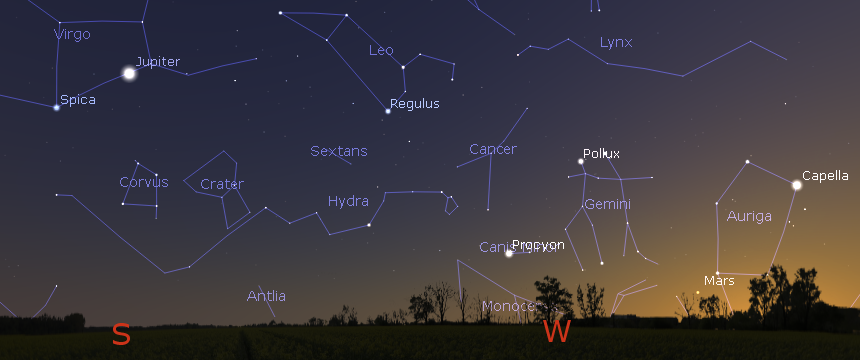
Mars and Jupiter with the spring constellations in the fading twilight at 10 p.m., May 24, 2017. Created using Stellarium.
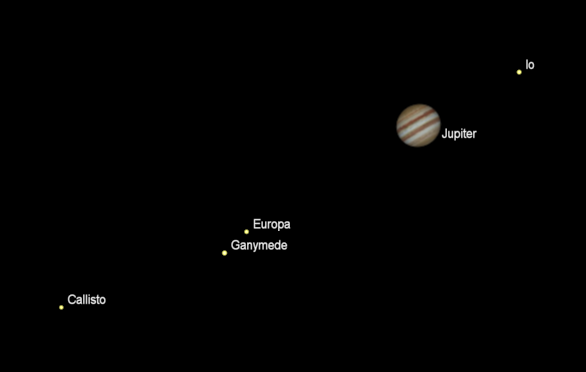
Jupiter and its four Galilean moons as they might be seen in a telescope at 10 p.m,. May 24, 2017. Created using Cartes du Ciel (Sky Charts).
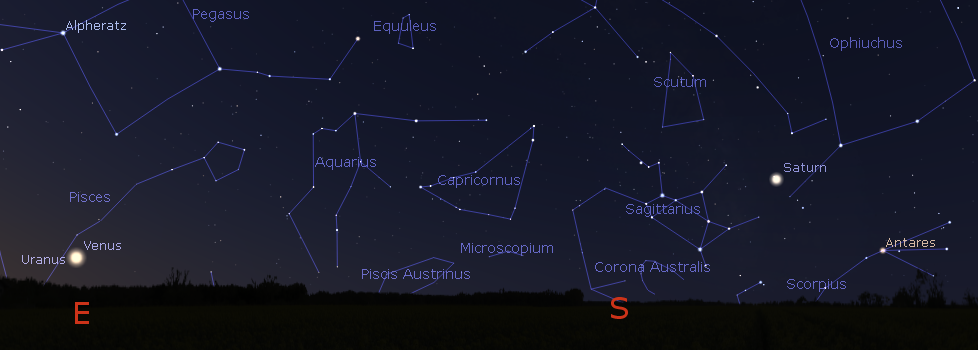
Venus and Saturn at 5 a.m. May 25, 2017. Created using Stellarium. Click on the image to expand.
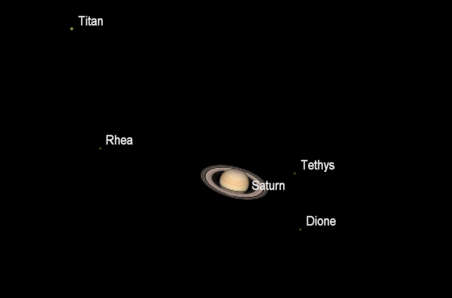
Saturn and its brightest moons at 5 a.m. May 25, 2017. Created using Cartes du Ciel (Sky Charts).
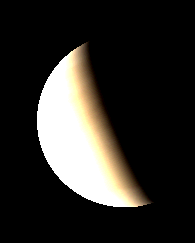
Venus as seen through a telescope at 5 a.m. May 25, 2017. This is displayed at a larger scale/magnification than the Jupiter or Saturn images above. Created using Stellarium.
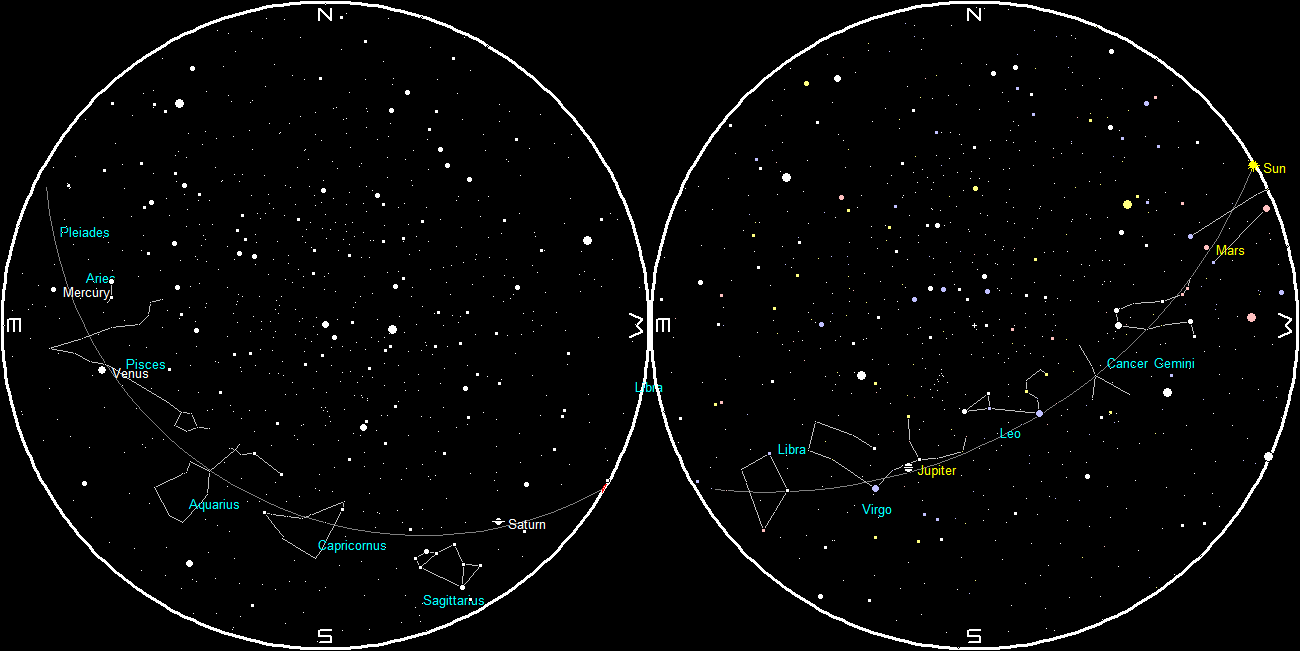
Planets at sunset and sunrise of a single night starting with sunset on the right on May 24, 2017. The night ends on the left with sunrise on May 25. Click on the image to enlarge. Created using my LookingUp program.
05/23/2017 – Ephemeris – The Big Dipper as seen in many lands
Ephemeris for Tuesday, May 23rd. Today the Sun will be up for 15 hours and 6 minutes, setting at 9:12, and it will rise tomorrow at 6:05. The Moon, 2 days before new, will rise at 5:38 tomorrow morning.
The Big Dipper is overhead at 10 in the evening, it’s seven stars shining brightly. The Big Dipper is not an actual constellation, recognized internationally. It’s part, the hind part, of Ursa Major, the great bear. The Big Dipper is an asterism or informal constellation. It is a distinctly North American constellation. For fugitive slaves, fleeing the southern states in the days before the Civil War, the Drinking Gourd, as they called it, showed the direction north to freedom. In England the dipper stars become the Plough, or Charles’ Wain (Charlemagne’s Wagon), In France, known for culinary delights it was the saucepan, or the cleaver. So many cultures saw what was familiar to them in these seven bright stars.
The times given are for the Traverse City/Interlochen area of Michigan. They may be different for your location.
Addendum
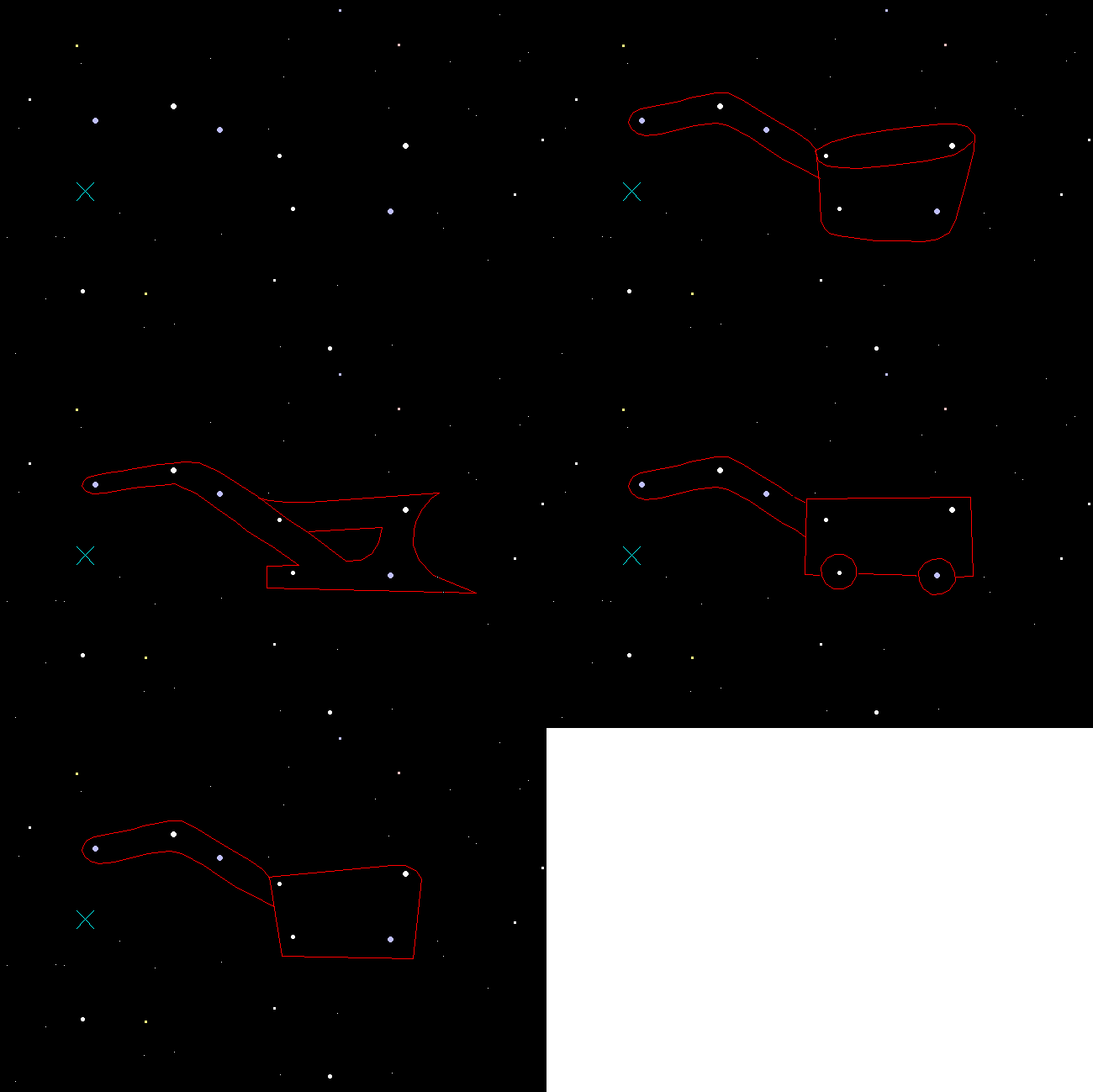
The Big Dipper as I imagine it from some lands facing southwest and looking straight up. The X in the picture is the zenith point. We cycle through the stars only, the Big Dipper or the Saucepan, The Plough (plow in the U.S.), Charles Wain, and finally the Cleaver. Created using my LookingUp program.
Do you know any other asterisms or informal constellations assigned to these stars, add a comment.
05/22/2017 – Ephemeris – Why does the Great Bear have a long tail?
Ephemeris for Monday, May 22nd. Today the Sun will be up for 15 hours and 4 minutes, setting at 9:11, and it will rise tomorrow at 6:06. The Moon, 3 days before new, will rise at 5:01 tomorrow morning.
The Great Bear, or Ursa Major as the Greeks, Romans and others saw it, has been handed down to us to this day. We see the Great Bear as the Big Dipper overhead in the evening now, which is just his hind end, with a long very unbearlike tail. The ancient Greek story goes that a god, not wishing to grab the end with the teeth, grabbed instead her stubby tail and in hurling her into the sky, and stretched the tail. Native Americans who also saw a bear here, saw the three stars of the dipper handle as three hunters following the bear. The local Anishinaabek people saw here instead the Fisher, a magical weasel-like animal who had a long tail naturally. He brought summer to the Earth, and was killed for his efforts, but was placed in the sky to show us the seasons.
The times given are for the Traverse City/Interlochen area of Michigan. They may be different for your location.
Addendum

The Big Dipper/Great Bear/Fisher as seen by western and Anishinaabek people. Created using Stellarium and GIMP.
Western art is by Johan Meuris.
The source for the Ojibwe constellation art in Stellarium is from Ojibwe Sky Star Map Constellation Guide (An introduction to Ojibwe Star Knowledge) by Annette S. Lee, William Wilson, Jeffrey Tibbetts, and Carl Gawboy, ISBN 978-0-615-98678-4. The illustrations are by Annette S. Lee and William Wilson. There is also a poster sized star map available. It should be available in book stores locally, or on Amazon. I found my copy at Enerdyne in Suttons Bay.
My retelling of the Fisher or Fisher Star is here: https://bobmoler.wordpress.com/2012/10/11/the-story-of-the-fisher-star/
05/18/2017 – Ephemeris – Finding Corona Borealis, the Northern Crown
Ephemeris for Thursday, May 18th. Today the Sun will be up for 14 hours and 56 minutes, setting at 9:07, and it will rise tomorrow at 6:10. The Moon, at last quarter today, will rise at 2:54 tomorrow morning.
In the east at 11 this evening can be seen a small nearly circular constellation of Corona Borealis, the Northern Crown. It is just below Boötes, the kite shaped constellation off the handle of the Big Dipper. According to Greek myth the crown was given by the gods to the princess Ariadne, daughter of King Minos of Crete. The crown is more like a tiara with the bright star Alphecca at the front. To the Anishinaabek people, who are natives of our region it is the Sweat Lodge. Part of what we call Hercules next to it is the Exhausted Bather, who is lying on the ground after the ceremony. The seven stones that are heated for the Sweat Lodge are the Pleiades, now too close to the Sun to be seen.
The times given are for the Traverse City/Interlochen area of Michigan. They may be different for your location.
Addendum
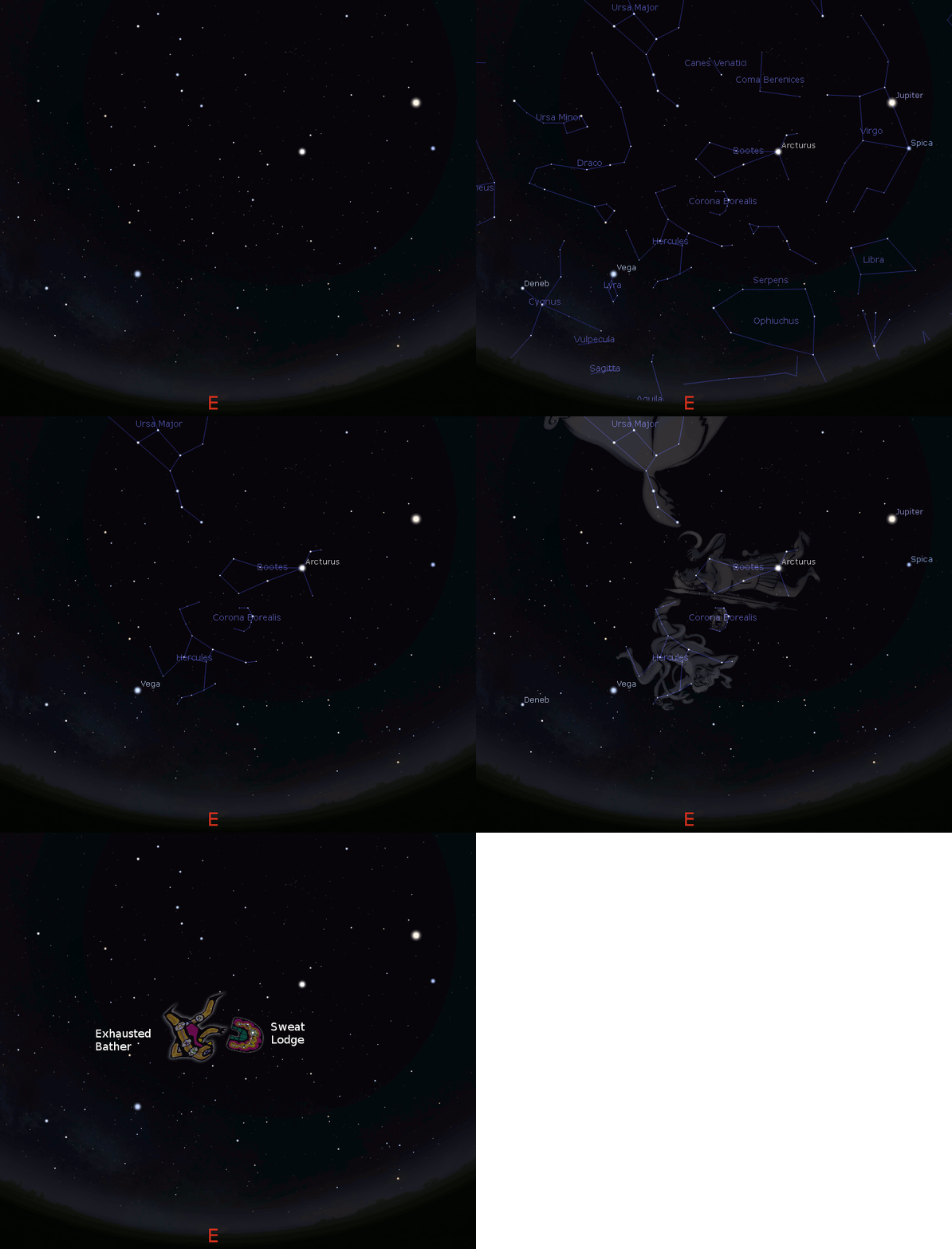
Animation for finding and showing Corona Borealis, the Sweat Lodge and nearby constellations. Created using Stellarium and GIMP. Click on the image to enlarge.
The source for the Ojibwe constellation art in Stellarium is from Ojibwe Sky Star Map Constellation Guide (An introduction to Ojibwe Star Knowledge) by Annette S. Lee, William Wilson, Jeffrey Tibbetts, and Carl Gawboy, ISBN 978-0-615-98678-4. The illustrations are by Annette S. Lee and William Wilson. There is also a poster sized star map available. It should be available in book stores locally, or at Amazon. I found my copy at Enerdyne in Suttons Bay.
05/17/2017 – Ephemeris – Let’s look at the bright planets for this week
Ephemeris for Wednesday, May 17th. Today the Sun will be up for 14 hours and 54 minutes, setting at 9:06, and it will rise tomorrow at 6:11. The Moon, 1 day before last quarter, will rise at 2:20 tomorrow morning.
Let’s take our weekly look at the bright planets. Mars is still in the west-northwest after sunset and fading. It appears under the left edge of the constellation Auriga. It will set at 10:54 p.m. Dominating the evening sky now is Jupiter in the south-southeast. The bright blue-white star Spica is seen below and left of it. In even the smallest telescopes Jupiter’s four largest moons can be seen. They shift positions night from to night and sometimes even as you watch. Jupiter will set at 4:42 a.m. At 5:30 a.m. both Saturn and Venus will be in the morning twilight. Saturn will be low in the south-southwest. It will rise in the east-southeast at 11:14 p.m. Brilliant Venus will be low in the east tomorrow morning after rising at 4:27 a.m.
For us Mercury, at greatest western elongation of 25.8°will be on the horizon at 5:30, but those south of the equator it will be well placed for viewing in the morning.
The times given are for the Traverse City/Interlochen area of Michigan. They may be different for your location.
Addendum
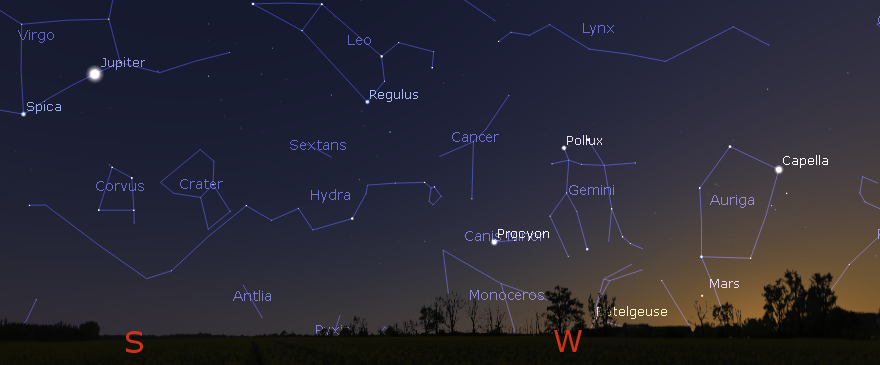
Mars and Jupiter with the spring constellations in the fading twilight at 10 p.m., May 17, 2017. Created using Stellarium.
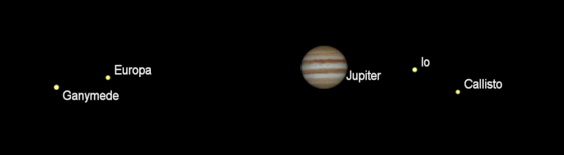
Jupiter and its four Galilean moons as they might be seen in a telescope at 10 p.,. May 17, 2017. Created using Cartes du Ciel (Sky Charts).
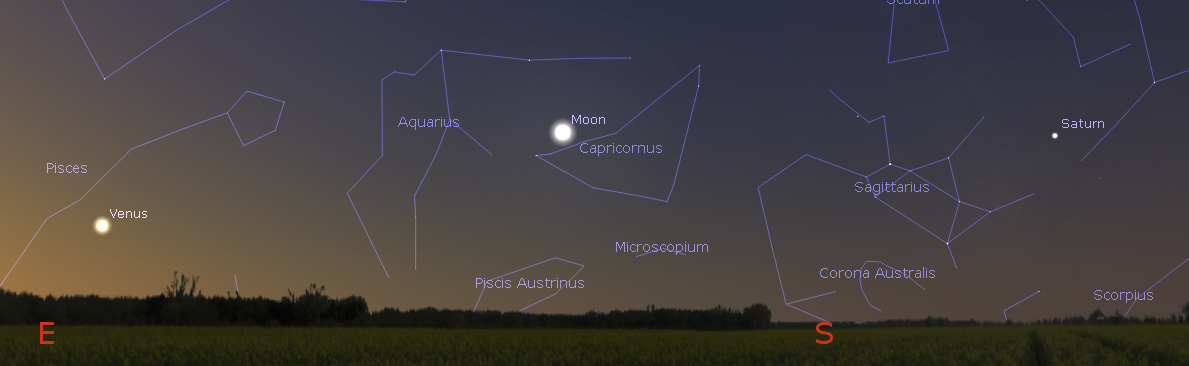
Venus, Saturn and the Moon at 5:30 a.m. May 18, 2017. Created using Stellarium. Click on the image to expand.
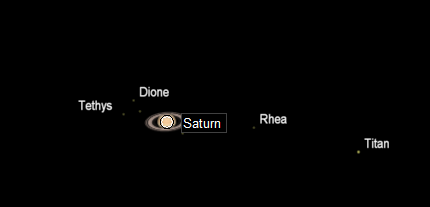
Saturn and its brightest moons at 5:30 a.m. May 18, 2017. This is displayed at the same scale/magnification as the Jupiter image above. Created using Cartes du Ciel (Sky Charts).
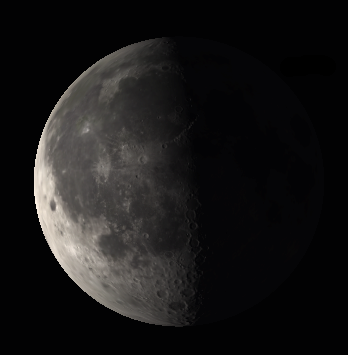
The Moon as it might be seen in binoculars at 5:30 a.m., May 18, 2017. Created using Stellarium.
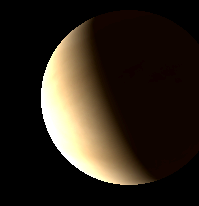
Venus as seen through a telescope at 5:30 a.m. May 18, 2017. This is displayed at a larger scale/magnification than the Jupiter and Saturn images above. Created using Stellarium.
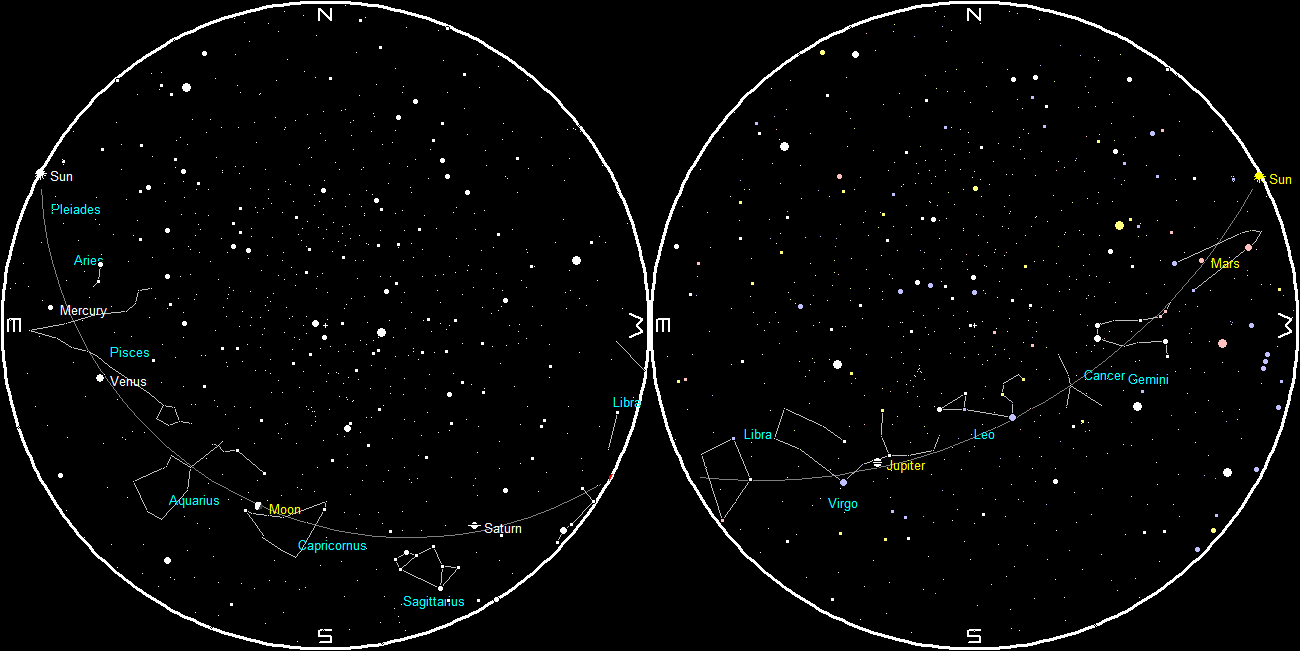
Planets and the Moon at sunset and sunrise of a single night starting with sunset on the right on May 17, 2017. The night ends on the left with sunrise on May 18. Click on the image to enlarge. Created using my LookingUp program.
05/16/2017 – Ephemeris – The Virgo Cluster of Galaxies
Ephemeris for Tuesday, May 16th. Today the Sun will be up for 14 hours and 51 minutes, setting at 9:05, and it will rise tomorrow at 6:12. The Moon, 2 days before last quarter, will rise at 1:43 tomorrow morning.
Yesterday I talked about the constellation of Virgo the virgin. When we are looking at the constellation of Virgo, we are looking out the thin side of our galaxy, the Milky Way. The Milky Way galaxy is a flat disk. When we look into the disk we see the milky band we call the Milky Way. That band, what we can see of if is now low in the north, So the stars are much more sparse with the exception of those relatively close to us, like those of the big Dipper. Beyond the stars of Virgo is a huge cluster of over a thousand galaxies. Charles Messier, a comet hunter of the late 18th century, ran into quite a few fuzzy spots between Virgo and Leo to the upper right. Because they didn’t move in relation to the stars, they couldn’t be comets, so he added them to his list of nuisance objects, which we now enjoy looking at.
The times given are for the Traverse City/Interlochen area of Michigan. They may be different for your location.
Addendum
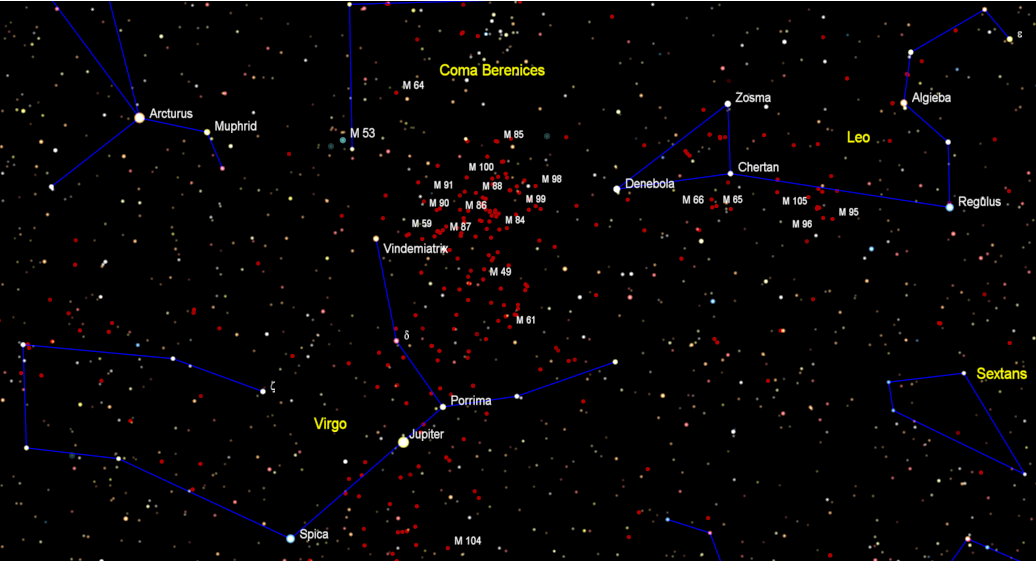
Some of the brighter members of the Virgo Cluster (of galaxies) as tiny red ovals. The galaxies marked with an ‘M’ number are part of Charles Messier’s catalog. It took a telescope of 8 inch diameter for me to spot them. Someone with better vision, like Messier himself can spot them with a smaller telescope. Created using Cartes du Ciel (Sky Charts). Click on image to enlarge.
05/15/2017 – Ephemeris – A look at the constellation of Virgo the virgin
Ephemeris for Monday, May 15th. Today the Sun will be up for 14 hours and 49 minutes, setting at 9:03, and it will rise tomorrow at 6:13. The Moon, 3 days before last quarter, will rise at 1:03 tomorrow morning.
Tonight at 10 p.m. in the south-southeast, is the constellation and member of the of the zodiac: Virgo the virgin. Now Jupiter is seen against the constellation appearing above and right of its brightest star, Spica. Virgo is a large constellation of a reclining woman holding a stalk of wheat. Spica, is the head of that spike of wheat; and as such it ruled over the harvest in two of Virgo’s guises as the goddesses Persephone and Ceres. Virgo is also identified as Astraea the goddess of justice. The constellation of Libra, the scales, which she is associated with, is found just east of her low in the east-southeast. Early Christians who sought to de-paganize the heavens saw Virgo as the Virgin Mary. Virgo is the host to a grand cluster of galaxies.
The times given are for the Traverse City/Interlochen area of Michigan. They may be different for your location.
Addendum
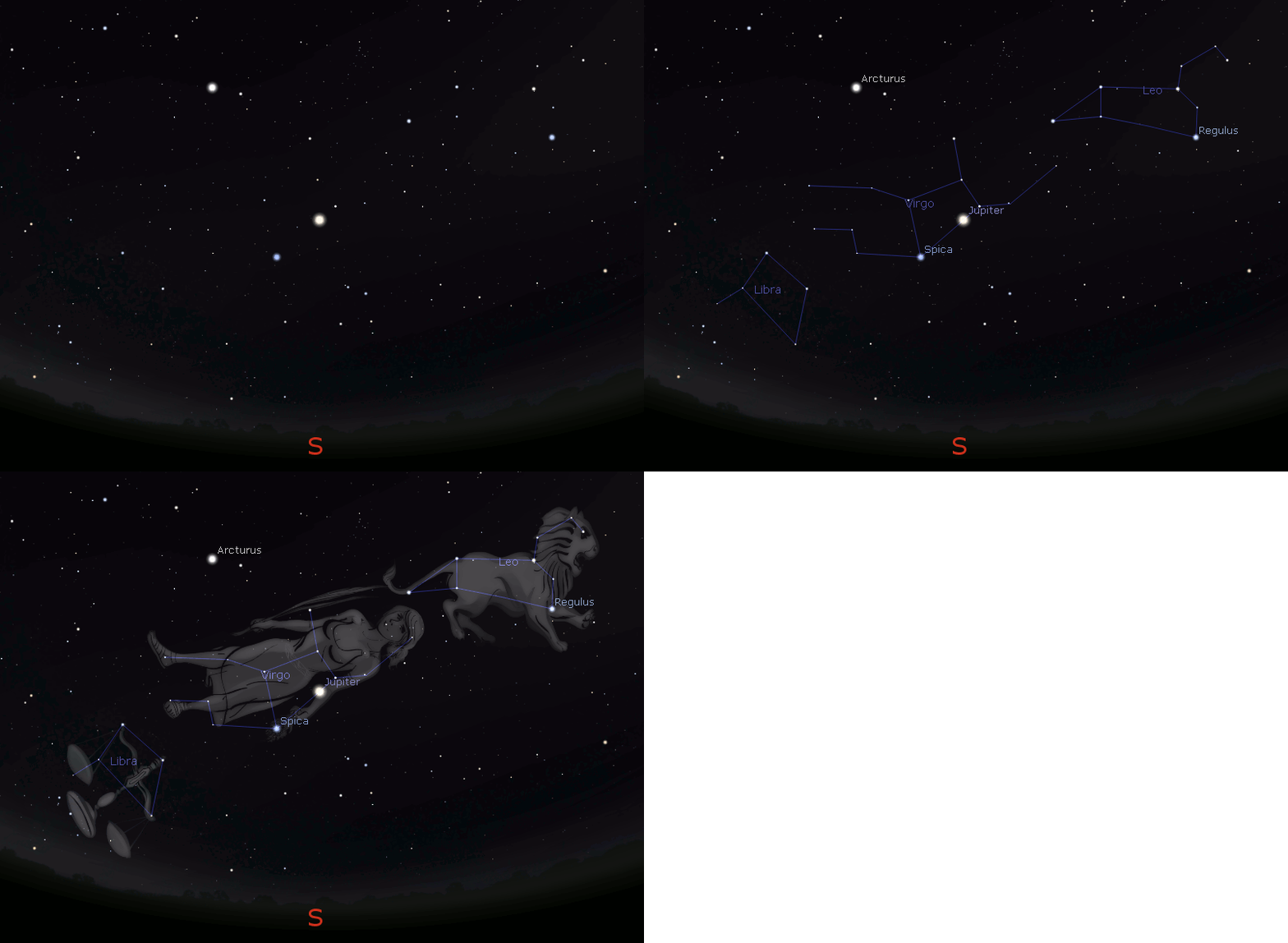
Animated Virgo finder chart for 11 p.m., May 15, 2017. Created using Stellarium and GIMP.
05/12/2017 – Ephemeris – There will be a star party at the Sleeping Bear Dunes National Lakeshore Saturday night the 13th
Ephemeris for Friday, May 12th. Today the Sun will be up for 14 hours and 42 minutes, setting at 9:00, and it will rise tomorrow at 6:16. The Moon, 2 days past full, will rise at 10:37 this evening.
Tomorrow night May 13th there will be, weather permitting a star party at Sleeping Bear Dunes National Lakeshore, this time the venue is Pierce Stocking Scenic Drive at Stop number 3, the Dunes Overlook. The event starts at 9 p.m., while it’s still light out and the location can be found. Park at Picnic Mountain, which is after Stop 2, and right before stop 3, and walk over. The planet Jupiter and all four of its bright moons and cloud bands will be featured. Sharp eyed observers will also be able to see the Great Red Spot. As the sky darkens there will be a twilight talk about the wonders of the spring sky. Near the last half hour it will be dark enough to spot some of the galaxies and globular star clusters of spring. The star party is made possible by the rangers of the park and the Grand Traverse Astronomical Society.
The times given are for the Traverse City/Interlochen area of Michigan. They may be different for your location.
Addendum
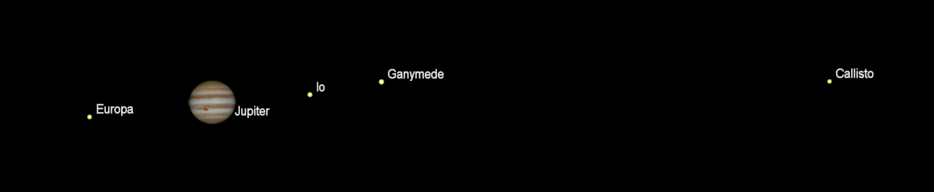
Jupiter, its cloud bands, Great Red Spot and moons as it might be seen around 10 p.m. at the star party. The actual orientation will depend on the telescope used to view them. Created using Cartes du Ciel (Sky Charts).

