Archive
05/11/2017 – Ephemeris – Cassini is surviving its death-defying dives under the rings of Saturn
Ephemeris for Thursday, May 11th. Today the Sun will be up for 14 hours and 40 minutes, setting at 8:59, and it will rise tomorrow at 6:17. The Moon, 1 day past full, will rise at 9:42 this evening.
The Cassini spacecraft has been redirected by passing Titan on a special trajectory that sent it into a fatal set of orbits that take it a few thousand miles above Saturn’s cloud tops and under the innermost rings. So far after two passes Cassini survives. One discovery of the first pass was a storm, perhaps a hurricane, whose clear eye is at Saturn’s north pole. Cassini has yet to turn its cameras to the rings on these passes inside the rings, but it will before its final orbit. Currently it is flying communication dish first to protect its delicate instruments from ring particles. So far the gap between the rings and the planet are more free of particles than expected. Which is a good omen for the last 20 passes between the rings and planet.
The times given are for the Traverse City/Interlochen area of Michigan. They may be different for your location.
Addendum
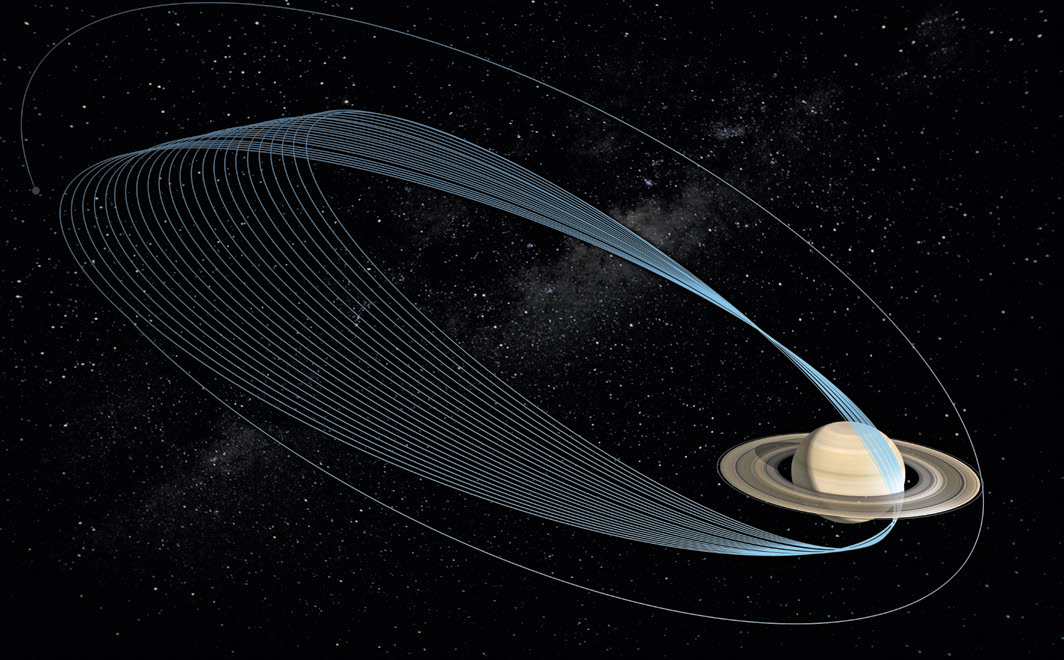
In its planned last 22 orbits of Saturn, the Cassini spacecraft will pass between the innermost ring and the planet itself. Credit NASA, JPL.
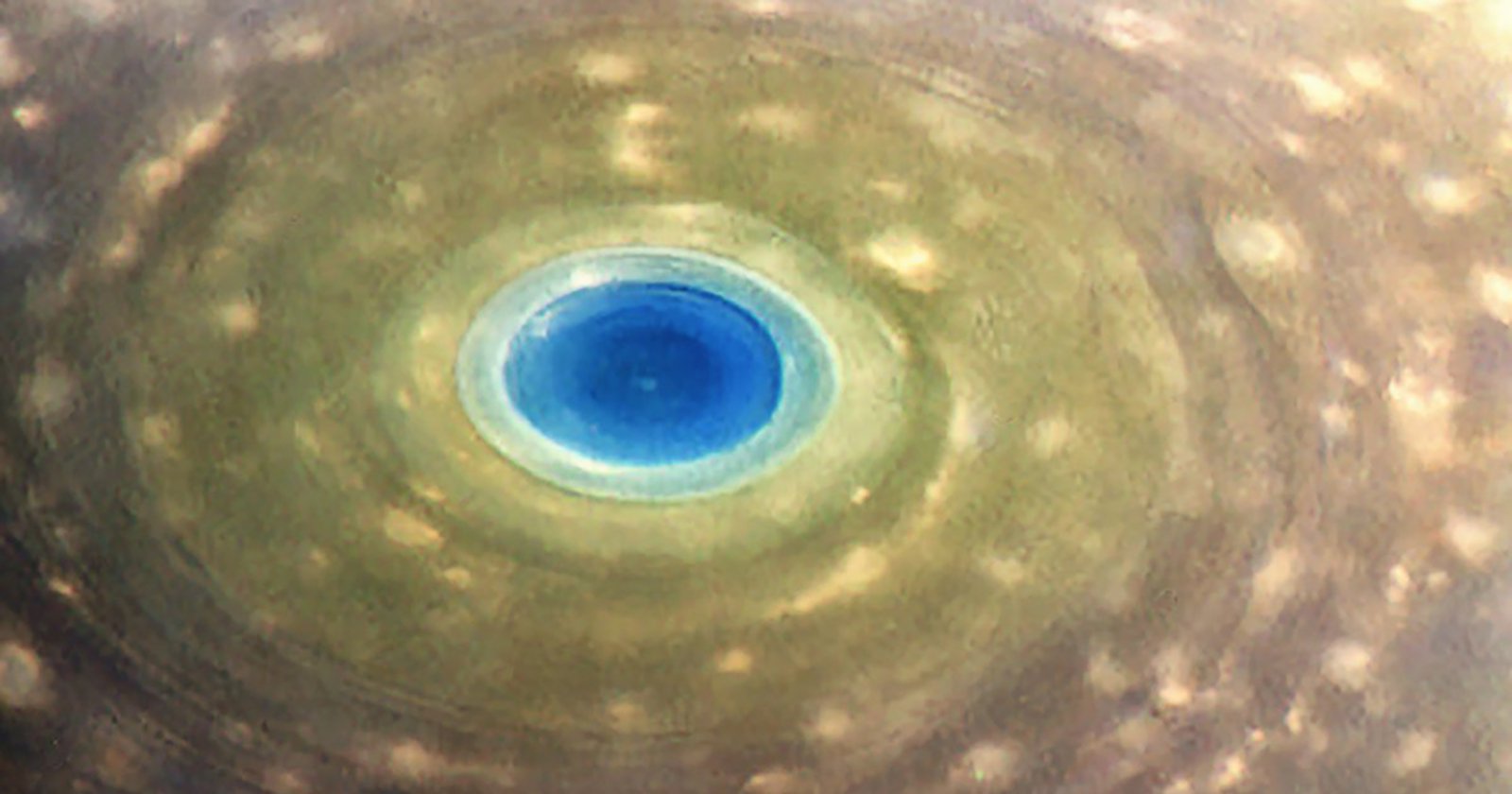
The clearing (blue sky) in the clouds at Saturn’s north pole spotted by Cassini on its first pass under the rings. Credit: NASA/JPL-Cal Tech/S Si/Sophia Nasr
05/10/2017 – Ephemeris – Our weekly look at the bright planets
Wednesday, May 10th. The Sun rises at 6:20. It’ll be up for 14 hours and 38 minutes, setting at 8:58. The Moon, at full today, will rise at 8:44 this evening.
Let’s take our weekly look at the bright planets. Mars is still in the west after sunset and fading. It appears above the brighter star Aldebaran in Taurus now. It will set at 10:58 p.m. Not quite dominating the evening sky now due to the Moon is Jupiter in the south-southeast. The bright blue-white star Spica is seen below and left of it. In even the smallest telescopes Jupiter’s four largest moons can be seen. They shift positions night from to night and even as you watch. Jupiter will set at 5:11 a.m. At 6 a.m. both Saturn and Venus will be in the morning twilight. Saturn will appear to be a bit to the west of south compass point. It will rise in the east-southeast at 11:44 p.m. Venus will be low in the east at 6 a.m. tomorrow morning after rising at 4:41.
The times given are for the Traverse City/Interlochen area of Michigan. They may be different for your location.
Addendum
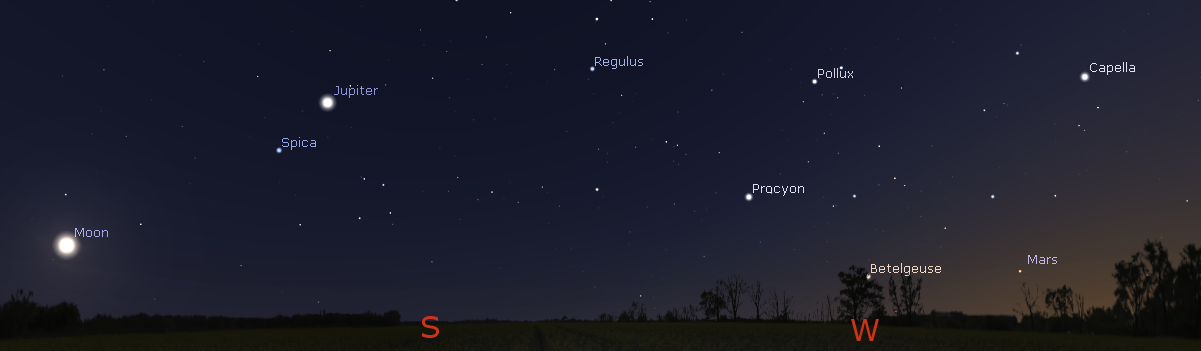
Mars, Jupiter and the full Moon with the brighter stars at 10 p.m., May 10, 2017. Created using Stellarium. Click on the image to enlarge.
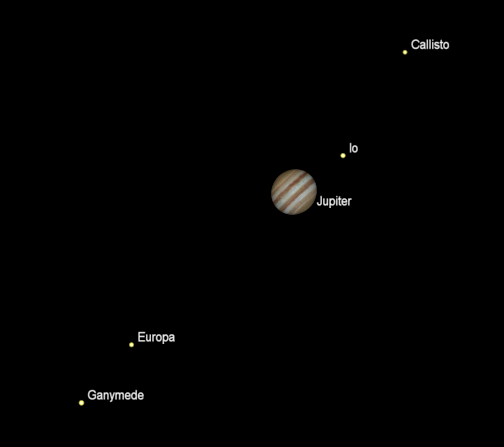
Jupiter and its four Galilean moons as they might be seen in a telescope at 10 p.,. May 10, 2017. Created using Cartes du Ciel (Sky Charts).
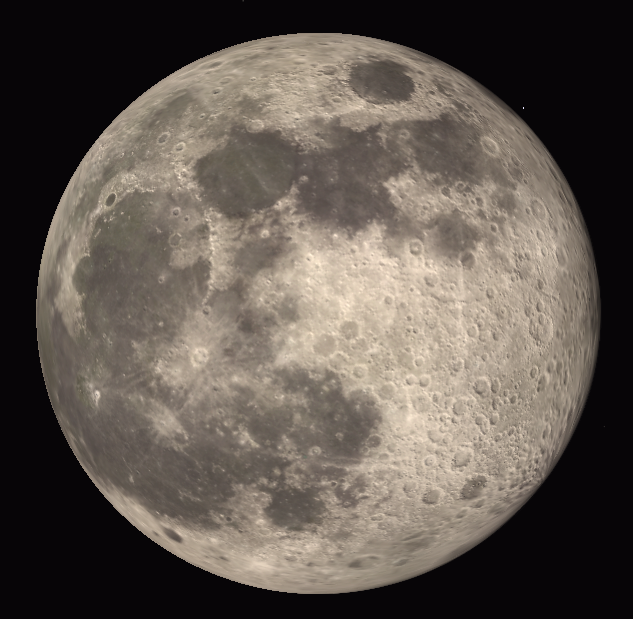
The Full Moon at 10 p.m., May 10, 2017. Created using Stellarium.
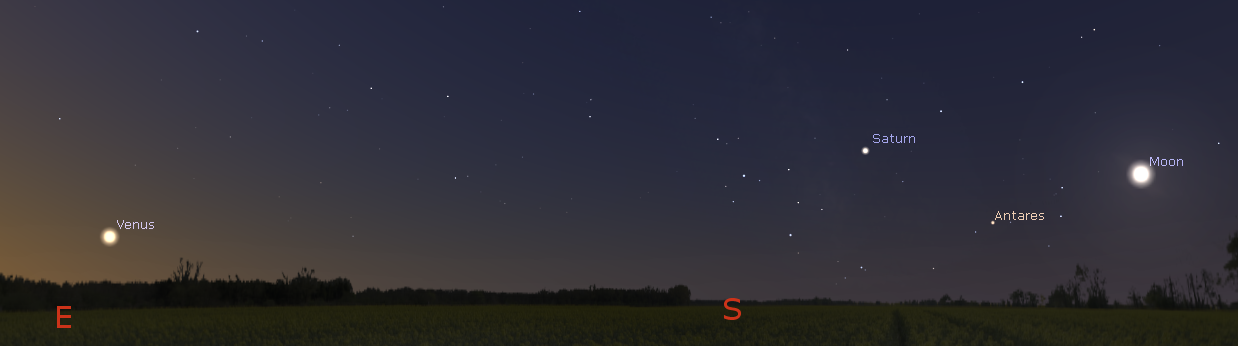
Venus, Saturn and the Moon at 5:30 a.m. May 11, 2017. Created using Stellarium. Click on the image to expand.
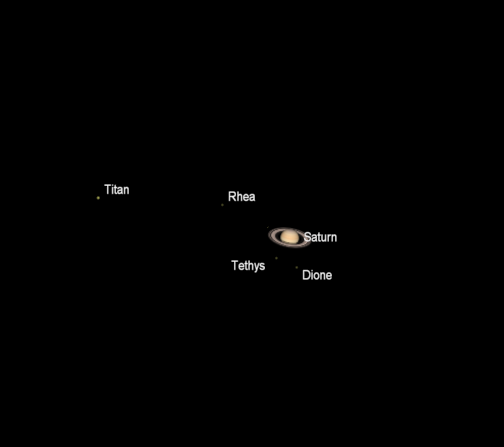
Saturn and its brightest 4 moons at 5:30 a.m. May 11, 2017. This is displayed at the same scale/magnification as the Jupiter image above. Created using Cartes du Ciel (Sky Charts).
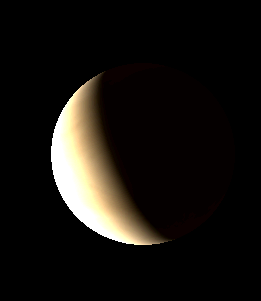
Venus as seen through a telescope at 5:30 a.m. May 11, 2017. This is displayed at a larger scale/magnification than the Jupiter and Saturn images above. Created using Stellarium.
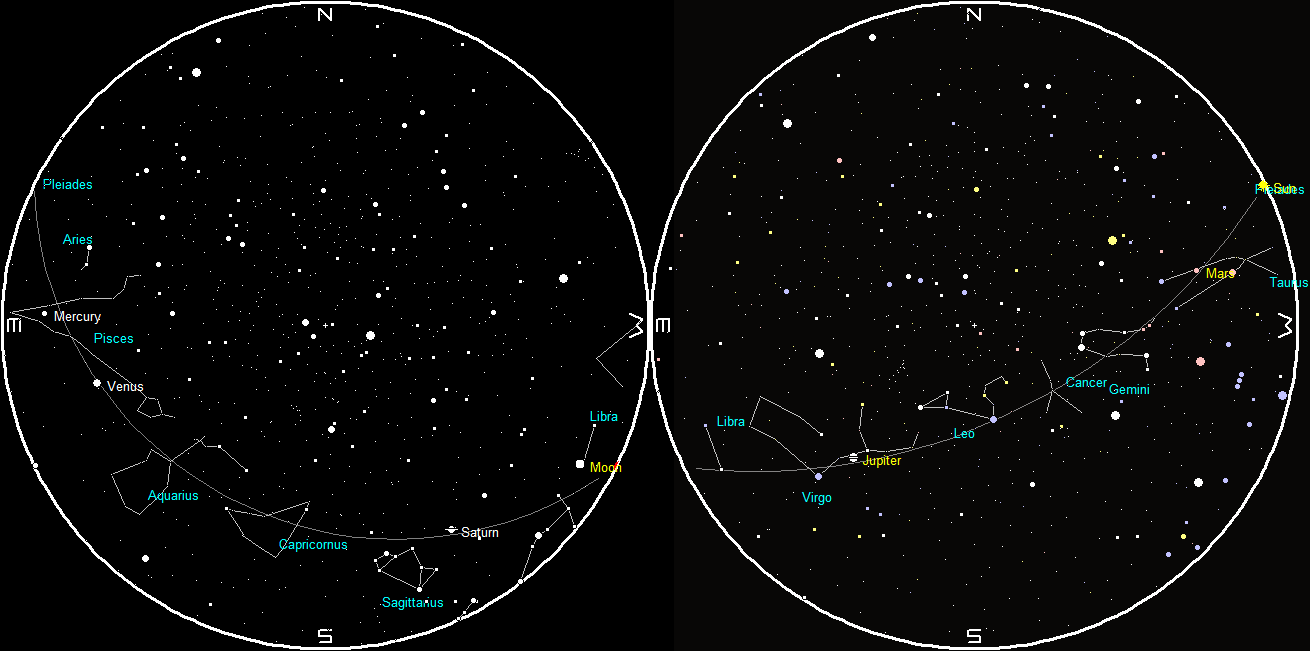
Planets and the Moon at sunset and sunrise of a single night starting with sunset on the right on May 10, 2017. The night ends on the left with sunrise on May 11. Click on the image to enlarge. Created using my LookingUp program.
05/09/2017 – Ephemeris – Looking at Jupiter through a telescope
Ephemeris for Tuesday, May 9th. The Sun rises at 6:21. It’ll be up for 14 hours and 35 minutes, setting at 8:57. The Moon, 1 day before full, will set at 6:36 tomorrow morning.
The first thing one sees by turning a telescope to the planet Jupiter are it’s moons, that change position night to night. A closer look at the planet itself will reveal that it is not exactly circular, but a bit squashed, making Jupiter fatter in the direction of the line of moons. Jupiter has only a 3 degree axial tilt, and its four large moons orbit over Jupiter’s equator, so even though they have nearly circular orbits, appear to move back and forth in a straight line. On the face of the planet itself appear parallel cloud bands of cream and reddish-brown. The parallel cloud bands and the squashed appearance of the planet have the same cause. Jupiter, though over a thousand times the Earth’s volume rotates, that is has a day, of a bit less than 10 hours.
The times given are for the Traverse City/Interlochen area of Michigan. They may be different for your location.
Addendum
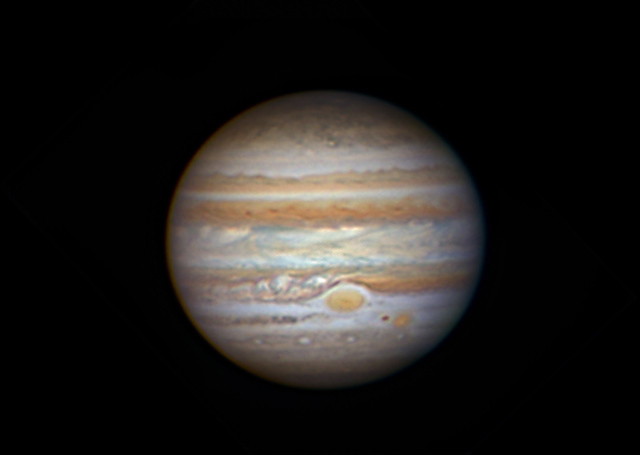
A slightly squished Jupiter with its Great Red Spot November 18, 2012 by Scott Anttila.
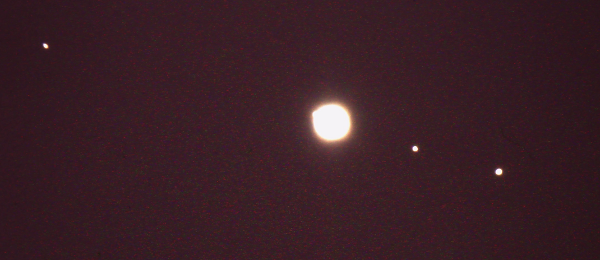
Overexposed Jupiter and its moons. Note the moon that looks like a bump on the left edge of the planet. My archival image.
05/08/2017 – Ephemeris – Europe and the Chinese are talking about a joint Moon village
Ephemeris for Monday, May 8th. The Sun rises at 6:22. It’ll be up for 14 hours and 33 minutes, setting at 8:55. The Moon, 2 days before full, will set at 6:07 tomorrow morning.
NASA, so far has no plans to return to the Moon to set up a base in preparation to heading out to Mars or an asteroid. That could change. The United States has a problem with long-term goals and planning with a change in administration every 4 or 8 years. The European Space Agency, and the China National Space Administration have no such problem. And it seems that these two entities are talking about together creating a Moon Village. The raw resource that they may hope to mine is Helium 3, which can be used in earthly fusion reactors to produce power. Helium 3 comes via the solar wind from the Sun. A base could be setup at the south pole of the Moon, which has virtually no axial tilt to receive perpetual sunlight for power and water from eternally shadowed crater bottoms.
The times given are for the Traverse City/Interlochen area of Michigan. They may be different for your location.
Addendum
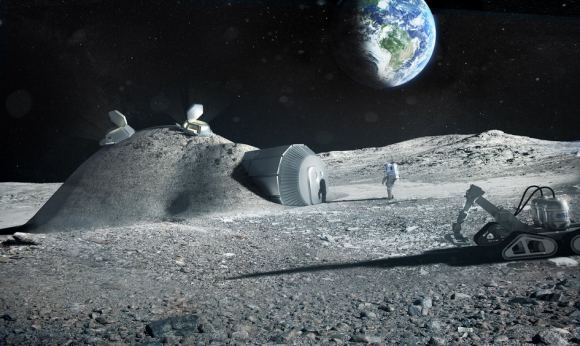
Artist visualization of a near polar moon base. Credits: ESA/Foster + Partners via Universe Today
I got this story from Universe Today: https://www.universetoday.com/135270/europe-china-discuss-moonbase-partnership/
05/05/2017 – Ephemeris – A preview of the upcoming total solar eclipse and two star parties this weekend
Ephemeris for Friday, May 5th. The Sun rises at 6:26. It’ll be up for 14 hours and 25 minutes, setting at 8:52. The Moon, 3 days past first quarter, will set at 4:44 tomorrow morning.
On August 21st this year there will be a total solar eclipse visible from a narrow band that crosses the continental United States from Oregon to South Carolina. It will be a fantastic sight. From around here the eclipse will be a deep partial eclipse with the moon covering 75% of the Sun’s disk. This evening yours truly will show how to view the eclipse safely at the 8 p.m. meeting of the Grand Traverse Astronomical Society at the Northwestern Michigan College’s Observatory.
At 9 p.m. there will be a star party. Tomorrow night there will be, weather permitting a 9 p.m. star party that will be held at the Interlochen Center for the Arts at the soccer field, on the Duck Lake side of the Campus. Parking is off Lyon Street.
The times given are for the Traverse City/Interlochen area of Michigan. They may be different for your location.
05/04/2017 – Ephemeris – Bits of Halley’s Comet will fill our skies for the next few mornings
Ephemeris for Thursday, May 4th. The Sun rises at 6:28. It’ll be up for 14 hours and 23 minutes, setting at 8:51. The Moon, 2 days past first quarter, will set at 4:15 tomorrow morning.
Look out for the Eta Aquariids meteors in the early morning sky for the next few days. This is like 5 a.m. These are sand grain sized debris from “Hawley’s” Comet. That’s the same guy we pronounce “Hayley” or “Hal-ley”. The authority on the pronunciation is a contemporary of his, Samuel Pepys, who spelled his name H-a-w-l-e-y. Anyway, this is one of two meteor showers every year that are attributed to Halley’s Comet, where the Earth crosses the debris stream. The other, the Orionids of late October see the debris stream entering the inner solar system, while the Eta Aquariids, which seem to come from the southeast are the debris stream leaving the inner solar system, and heading back out toward Neptune’s orbit.
The times given are for the Traverse City/Interlochen area of Michigan. They may be different for your location.
Addendum
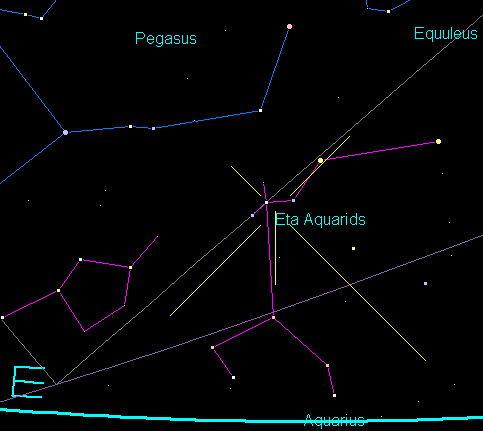
The Eta Aquariid radiant at the peak of the shower. The radiant moves slowly to the east with time. Credit: Bob Moler’s LookingUp program.
05/03/2017 – Ephemeris – First look at the bright planets for May
Ephemeris for Wednesday, May 3rd. The Sun rises at 6:29. It’ll be up for 14 hours and 20 minutes, setting at 8:49. The Moon, 1 day past first quarter, will set at 3:43 tomorrow morning.
Let’s take our weekly look at the bright planets. Mars is still in the west after sunset and fading. It’s approaching the star Aldebaran in Taurus now. It will set at 11:01 p.m. Not quite dominating the evening sky now due to the Moon is Jupiter in the southeast. It’s seen above the bright blue-white star Spica. In even the smallest telescopes Jupiter’s four largest moons can be seen. They shift positions night to night and even as you watch. Tonight early in the evening all 4 bright moons can be seen, but the one closest to Jupiter will disappear behind the planet at 10:11 p.m. It will reappear on the other side at 12:48 a.m. Jupiter will set at 5:36 a.m. At 6 a.m. both Saturn and Venus will be in the morning twilight. At 6 a.m. Saturn will appear to be a bit to the west of south compass point. It will rise in the east-southeast at 12:13 a.m. tomorrow. Venus will be low in the east at 6 a.m. tomorrow morning after rising at 4:52.
The times given are for the Traverse City/Interlochen area of Michigan. They may be different for your location.
Addendum
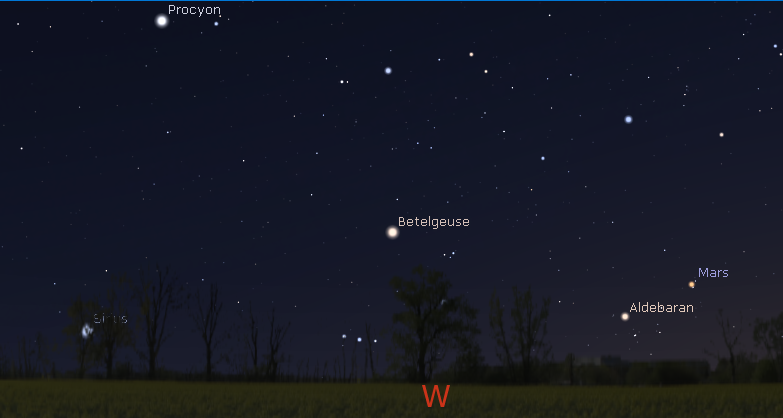
Mars in the west with bright stars at 10 p.m. May 3, 2017. Created using Stellarium.
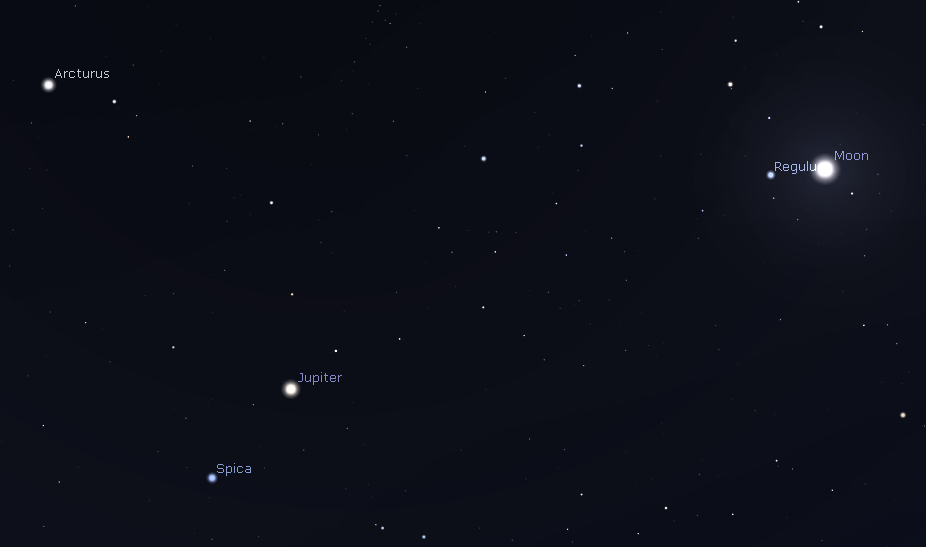
Jupiter above Spica and the Moon with the bright stars 10 p.m. May 3, 2017. Created using Stellarium.
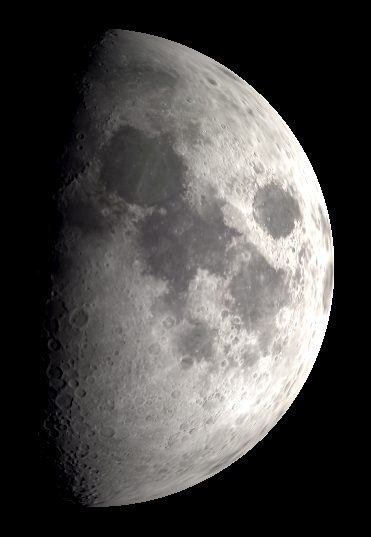
The Moon as it might be seen in binoculars at 10 p.m. May 3, 2016. Created using Stellarium.
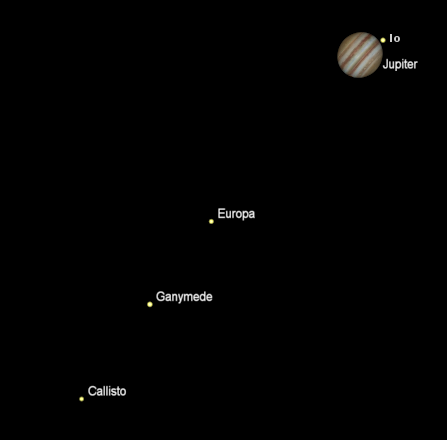
Jupiter and its moons at 10 p.m. May 3, 2017. The moon Io here is about to be occulted, that is pass behind Jupiter, which it will do at 10:11 p.m. (2:11 UT the 4th) It will reappear at 12:58 a.m. (4:58 UT). Created using Cartes du Ciel (Sky Charts).
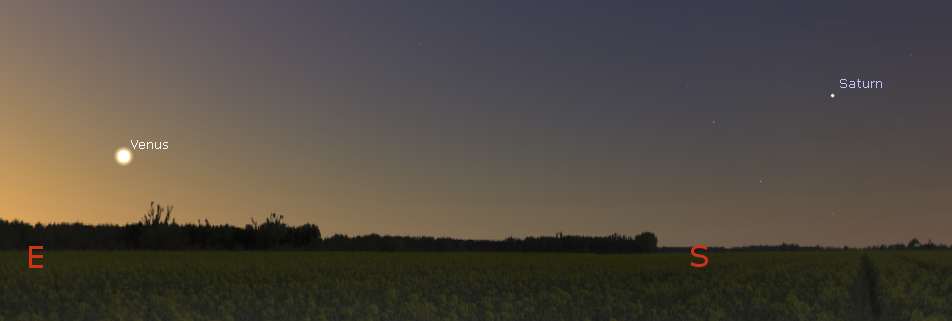
Saturn and Venus at 6 a.m. May 4, 2017 in morning twilight. Created using Stellarium.
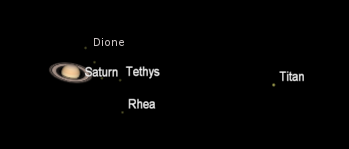
Saturn and its moons at 6 a.m. May 4, 2017. Created using Cartes du Ciel (Sky Charts).
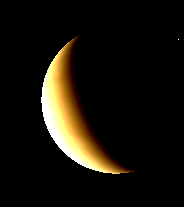
Venus as seen in a telescope at 6 a.m., May 4, 2017. Magnified much more than the other planet images seen here. Created using Stellarium.
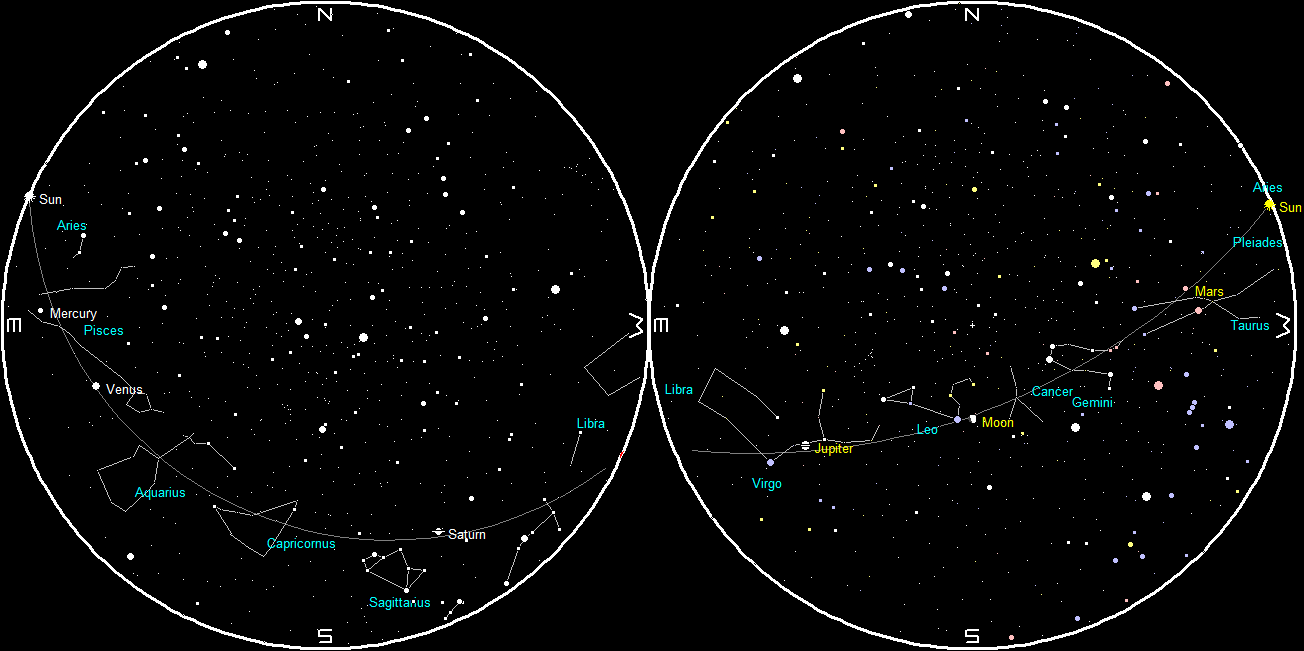
Planets and the Moon at sunset and sunrise of a single night starting with sunset on the right on May 3, 2017. The night ends on the left with sunrise on May 4. Click on the image to enlarge. Created using my LookingUp program.
05/02/2017 – Ephemeris – Puzzling out the Moon’s history
Ephemeris for Tuesday, May 2nd. The Sun rises at 6:30. It’ll be up for 14 hours and 17 minutes, setting at 8:48. The Moon, at first quarter today, will set at 3:06 tomorrow morning.
The Moon will be at exactly first quarter at 10:47 p.m., so it should be split exactly in half by the sunrise line or terminator. On the illuminated face of the Moon can be seen the dark gray spots called seas. In dating the moon rocks brought back by the Apollo astronauts the dates tell the amount of time since the rocks were molten due to collisions. The dates turn out to give clues to when the seas were formed, because they are actually large impact craters, which were filled in by the lava from the moon’s interior. The oldest rocks on the Moon are 4.5 billion years old, dating from the formation of the Moon. There’s another group about 3.9 billion years old dating to when many of the seas were formed in a cataclysm called the late heavy bombardment.
The times given are for the Traverse City/Interlochen area of Michigan. They may be different for your location.
Addendum
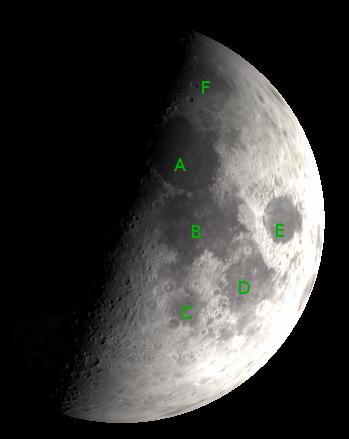
First quarter Moon with key to the lunar seas. Created using Stellarium.
Sym Latin Name           English Name       Age
 A  Mare Serenitatis     Sea of Serenity    3.85 to 3.92 billion years
 B  Mare Tranquillitatis Sea of Tranquility 3.92 to 4.55 billion years
 C  Mare Nectaris        Sea of Nectar      3.85 to 3.92 billion years
 D  Mare Fecunditatis    Sea of Fertility   3.92 to 4.55 billion years
 E  Mare Crisium         Sea of Crises      3.85 to 3.92 billion years
 F  Mare Frigoris        Sea of Cold        3.85 to 4.55 billion years
Data are from Virtual Moon Atlas
05/01/2017 – Ephemeris – Previewing May 2017 Skies
Ephemeris for Monday, May 1st. The Sun rises at 6:32. It’ll be up for 14 hours and 15 minutes, setting at 8:47. The Moon, 1 day before first quarter, will set at 2:24 tomorrow morning.
Today starts the month of May when the promise of spring is finally fulfilled. Daylight hours in the Interlochen/Traverse City area will increase from 14 hours and 15 minutes today to 15 hours 19 minutes on the 31st. The altitude, or angle, of the Sun above the southern horizon at local noon will ascend from 61 degrees now to 67 degrees at month’s end. The altitude of the sun in the Straits area will be a degree lower than that but your daylight hours will be a few minutes longer. Local apparent noon this month, when the sun passes due south, will be about 1:38 p.m.
This is the month of the Eta Aquariid meteor shower which will reach its peak this Thursday and Friday. There will be dark skies around 5 a.m. to see the meteors coming from the southeast.
The times given are for the Traverse City/Interlochen area of Michigan. They may be different for your location.
Addenda
May Evening Star Chart
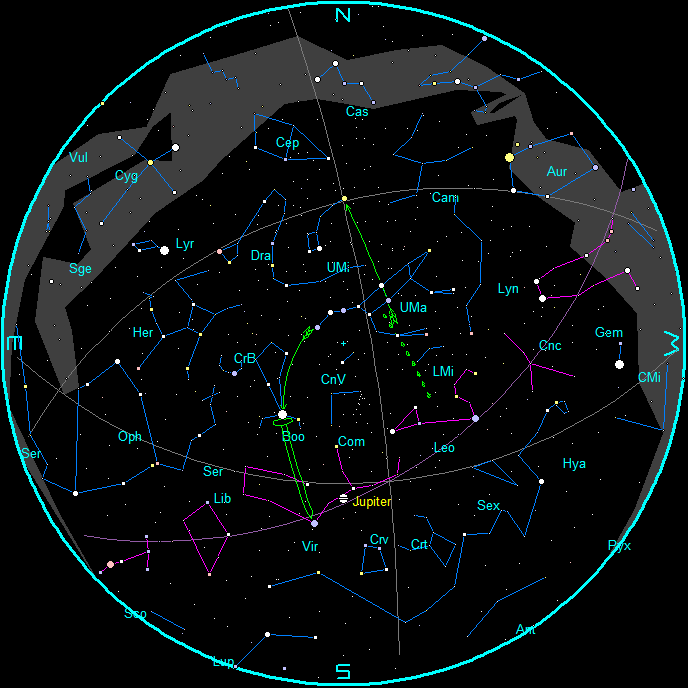
Evening Star Chart for May 2017 (11 p.m. May 15, 2017). Created using my LookingUp program. Click on image to enlarge.
The planets and stars are plotted for the 15th at 11 p.m. EDT in the evening and 5 a.m. for the morning chart. These are the chart times. Note that Traverse City is located approximately 45 minutes behind our time meridian. (An hour 45 minutes behind our daylight saving time meridian. during EDT and 45 minutes behind our daylight standard time meridian. during EST). To duplicate the star positions on a planisphere you may have to set it to 1 hour 45 minutes (Daylight Time) or 45 minutes (Standard Time) earlier than the current time if you are near your time meridian.
Note the chart times of 11 p.m. and 5 a.m. are for the 15th. For each week before the 15th add ½ hour. For each week after the 15th subtract ½ hour. The planet positions are updated each Wednesday on this blog.
May Morning Star Chart
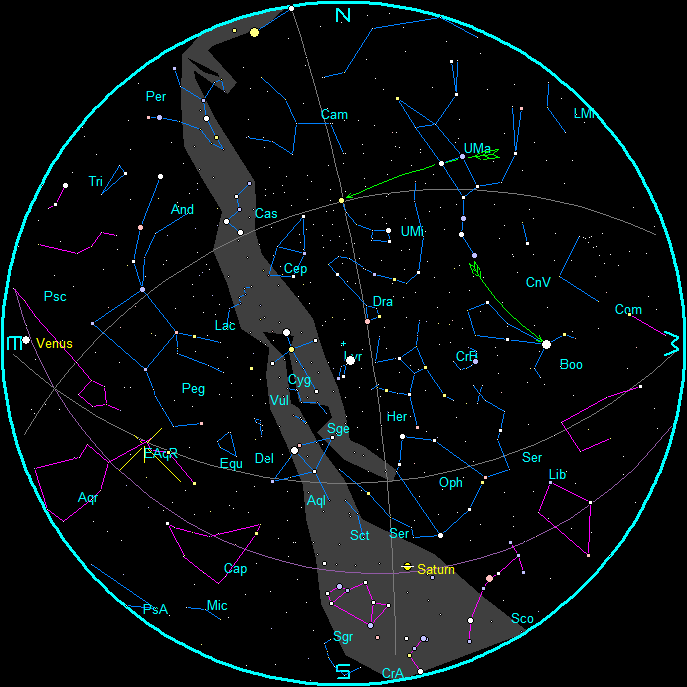
Star Chart for May 2017 mornings based on 5 a.m. May 15th. Created using my LookingUp program. Click on image to enlarge.
For a list of constellation names to go with the abbreviations click here.
- Pointer stars at the front of the bowl of the Big Dipper point to Polaris the North Star
- Follow the arc of the handle of the Big Dipper to the star Arcturus
- The Summer Triangle is in red
- The Eta Aquariid meteor shower radiant is in yellow and marked EAqR is active from April 19th to May 28th and peaks May 6th. Zenithal Hourly Rate at peak is expected to be 50, though considerably less than that is expected due to its radiant’s low position in our skies. Data from the International Meteor Organization 2017 calendar.
Evening nautical twilight ends at 10:02 p.m. EDT on the 1st, increasing to 10:46 p.m. EDT on the 31st.
Evening astronomical twilight ends at 10:47 p.m. EDT on the 1st, increasing to 11:44 p.m. EDT on the 31st.
Morning astronomical twilight starts at 4:40 a.m. EDT on the 1st, and increasing to 3:44 a.m. EDT on the 31st.
Morning nautical twilight starts at 5:24 a.m. EDT on the 1st, and Increasing to 4:42 a.m. EDT on the 31st.
NASA Calendar of Planetary Events
Credit: Sky Events Calendar by Fred Espenak and Sumit Dutta (NASA’s GSFC)
To generate your own calendar go to http://eclipse.gsfc.nasa.gov/SKYCAL/SKYCAL.html
Times are Eastern Time and follow the time change dates for Michigan, US
Date        Time    Event
May 01  Mo          Venus: 39.9° W
    02  Tu  2:23 pm Moon-Beehive: 3.7° N
    02  Tu 10:47 pm First Quarter
    04  Th  5:49 am Moon-Regulus: 0.6° N
    04  Th  6:42 am Moon Ascending Node
    04  Th 10:54 pm Eta Aquariid Shower: ZHR = 60
    05  Fr  9:51 am Mars-Aldebaran: 6.2° N
    07  Su  5:24 pm Moon-Jupiter: 2.3° S
    10  We  5:43 pm Full Moon
    12  Fr  3:51 pm Moon Apogee: 406200 km
    13  Sa  7:07 pm Moon-Saturn: 3.4° S
    14  Su  4:29 pm Moon South Dec.: 19.3° S
    17  We  6:59 pm Mercury Elongation: 25.8° W
    18  Th  8:33 pm Last Quarter
    18  Th  9:30 pm Moon Descending Node
    22  Mo  8:32 am Moon-Venus: 2.4° N
    23  Tu  9:20 pm Moon-Mercury: 1.6° N
    25  Th  3:44 pm New Moon
    25  Th  9:23 pm Moon Perigee: 357200 km
    27  Sa  7:36 pm Moon North Dec.: 19.4° N
    29  Mo  9:50 pm Moon-Beehive: 3.4° N
    31  We  7:56 am Moon Ascending Node
    31  We 12:08 pm Moon-Regulus: 0.3° N
Jun 01  Th          Venus: 45.8° W
May 2017 Calendar
LU                  Ephemeris of Sky Events for Interlochen/TC
May, 2017    Local time zone: EDT
+-----------------------------------------------------------------------+
| DATE |  SUN     SUN  DAYLIGHT|   TWILIGHT*    |MOON  RISE OR    ILLUM |
|      |  RISE    SET    HOURS |  END    START  |PHASE SET** TIME FRACTN|
+=======================================================================+
|Mon  1| 06:32a  08:48p  14:15 | 10:00p  05:20a |      Set  02:24a   38%|
|Tue  2| 06:30a  08:49p  14:18 | 10:02p  05:18a |F Qtr Set  03:07a   49%|
|Wed  3| 06:29a  08:50p  14:21 | 10:03p  05:16a |      Set  03:43a   59%|
|Thu  4| 06:28a  08:51p  14:23 | 10:05p  05:15a |      Set  04:16a   70%|
|Fri  5| 06:26a  08:52p  14:26 | 10:06p  05:13a |      Set  04:45a   78%|
|Sat  6| 06:25a  08:54p  14:28 | 10:08p  05:11a |      Set  05:12a   86%|
+------+-----------------------+----------------+-----------------------+
|Sun  7| 06:24a  08:55p  14:31 | 10:09p  05:09a |      Set  05:39a   92%|
|Mon  8| 06:22a  08:56p  14:33 | 10:11p  05:08a |      Set  06:07a   97%|
|Tue  9| 06:21a  08:57p  14:36 | 10:13p  05:06a |      Set  06:36a   99%|
|Wed 10| 06:20a  08:58p  14:38 | 10:14p  05:04a |Full  Rise 08:45p  100%|
|Thu 11| 06:18a  09:00p  14:41 | 10:16p  05:03a |      Rise 09:42p   99%|
|Fri 12| 06:17a  09:01p  14:43 | 10:17p  05:01a |      Rise 10:38p   96%|
|Sat 13| 06:16a  09:02p  14:45 | 10:19p  05:00a |      Rise 11:30p   91%|
+------+-----------------------+----------------+-----------------------+
|Sun 14| 06:15a  09:03p  14:48 | 10:20p  04:58a |      Rise 12:19a   85%|
|Mon 15| 06:14a  09:04p  14:50 | 10:22p  04:57a |      Rise 01:03a   78%|
|Tue 16| 06:13a  09:05p  14:52 | 10:23p  04:55a |      Rise 01:44a   70%|
|Wed 17| 06:12a  09:06p  14:54 | 10:25p  04:54a |      Rise 02:21a   60%|
|Thu 18| 06:11a  09:08p  14:56 | 10:26p  04:52a |L Qtr Rise 02:54a   50%|
|Fri 19| 06:10a  09:09p  14:58 | 10:28p  04:51a |      Rise 03:26a   40%|
|Sat 20| 06:09a  09:10p  15:00 | 10:29p  04:50a |      Rise 03:57a   30%|
+------+-----------------------+----------------+-----------------------+
|Sun 21| 06:08a  09:11p  15:02 | 10:30p  04:48a |      Rise 04:28a   20%|
|Mon 22| 06:07a  09:12p  15:04 | 10:32p  04:47a |      Rise 05:02a   12%|
|Tue 23| 06:06a  09:13p  15:06 | 10:33p  04:46a |      Rise 05:38a    5%|
|Wed 24| 06:05a  09:14p  15:08 | 10:35p  04:45a |      Rise 06:20a    1%|
|Thu 25| 06:04a  09:15p  15:10 | 10:36p  04:44a |New   Set  09:04p    0%|
|Fri 26| 06:04a  09:16p  15:12 | 10:37p  04:42a |      Set  10:16p    2%|
|Sat 27| 06:03a  09:17p  15:13 | 10:39p  04:41a |      Set  11:21p    7%|
+------+-----------------------+----------------+-----------------------+
|Sun 28| 06:02a  09:18p  15:15 | 10:40p  04:40a |      Set  12:18a   15%|
|Mon 29| 06:02a  09:19p  15:17 | 10:41p  04:39a |      Set  01:05a   24%|
|Tue 30| 06:01a  09:19p  15:18 | 10:42p  04:38a |      Set  01:45a   34%|
|Wed 31| 06:00a  09:20p  15:19 | 10:43p  04:38a |      Set  02:19a   44%|
+-----------------------------------------------------------------------+
* Nautical Twilight
** Moonrise or moonset, whichever occurs between sunset and sunrise
04/28/2017 – Ephemeris – Astronomy Day star party tomorrow night
Ephemeris for Arbor Day, Friday, April 28th. The Sun rises at 6:36. It’ll be up for 14 hours and 7 minutes, setting at 8:43. The Moon, 2 days past new, will set at 11:28 this evening.
Tomorrow is Astronomy Day, the Grand Traverse Astronomical Society will hold a special star party at the Northwestern Michigan College’s Joseph H. Rogers Observatory from 9 to 11 p.m. Featured objects will be the three day old Moon, the planet Jupiter, its four largest moons and planet girdling cloud bands. As it gets darker some spring star clusters will become visible, and maybe some galaxies, because in the spring we are looking out the thin side of our Milky Way galaxy, with the milky band banished to near the northern horizon. Two of these star clusters are even visible to the naked eye. One, the Beehive cluster is a feast for the small telescope, the other an entire constellation of Coma Berenices, or Berenices hair. The observatory is located south of Traverse City, MI on Birmley Road which is between Garfield and Keystone roads.
The times given are for the Traverse City/Interlochen area of Michigan. They may be different for your location.

