Archive
04/13/2017 – Ephemeris – Venus is in the morning sky
Ephemeris for Thursday, April 13th. The Sun will rise at 7:01. It’ll be up for 13 hours and 23 minutes, setting at 8:25. The Moon, 2 days past full, will rise at 10:52 this evening.
Venus is beginning to make its morning appearance now, rising just before 6 a.m. It’s north and west of the Sun, but it’s path away from the Sun is at a low angle to the horizon. Venus is now in its crescent phase, which is getting fatter, as it separates from the Sun. It is also getting smaller in our telescopes as it recedes from us. Venus has no natural satellites, however it currently has a small robotic one. It is Japan’s Akatsuki or Dawn spacecraft. Launched in 2010, it failed to fire its rocket engine for the entire time needed to drop it into orbit of Venus. The engineers devised a plan to chase Venus for 5 years and gently maneuver the spacecraft into orbit using only its attitude thrusters. This they accomplished in December of 2015.
The times given are for the Traverse City/Interlochen area of Michigan. They may be different for your location.
Addendum
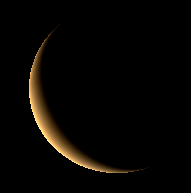
Telescopic Venus as created with Stellarium for early morning April 14, 2017. Stellarium is coloring Venus as it would be colored low in the sky.
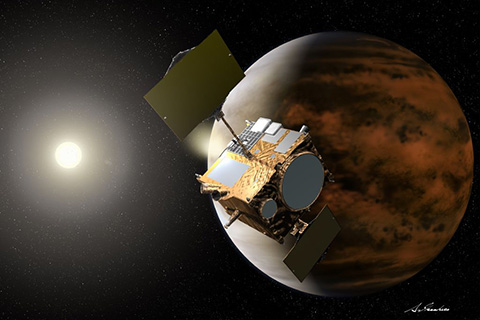
Artists drawing of Akatsuki orbiting Venus. Credit Japanese Institute of Space and Astronautical Science (ISAS)
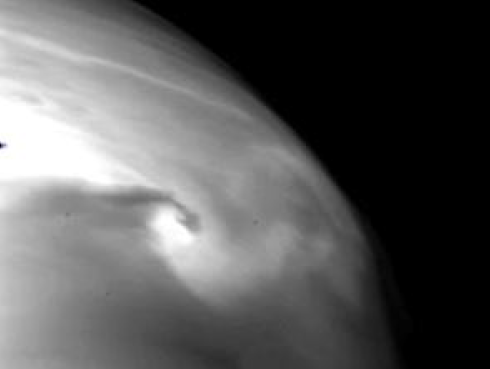
A localized vortex in the clouds of Venus captured by Akatsuki. Credit ISAS.
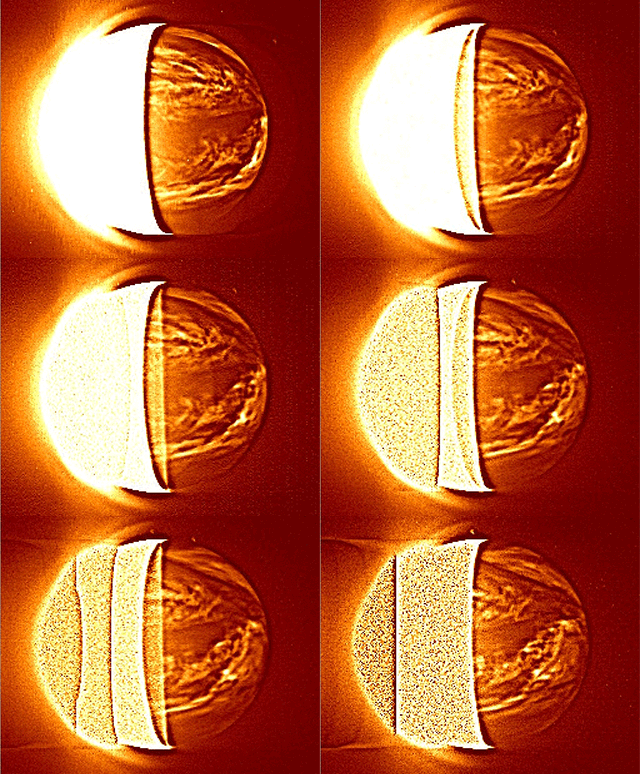
An animation of the clouds rotating on Venus’ night side by Akatsuki. Credit ISAS
04/12/2017 – Ephemeris – It’s Wednesday, do you know where your bright planets are?
Ephemeris for Wednesday, April 12th. The Sun will rise at 7:03. It’ll be up for 13 hours and 20 minutes, setting at 8:23. The Moon, 1 day past full, will rise at 9:53 this evening.
Tonight is Yuri’s Night the anniversary of Yuri Gagarin’s first human orbital flight in 1961. Now celebrated around the world. Mars is still in the west after sunset and fading. It will set at 11:08 p.m. Coming to dominate the evening sky low in the east in evening twilight is Jupiter. It will rise to be low in the east-southeast at 10 p.m. At 6 a.m. Jupiter is still hanging on in the western sky, and will be below and right of the Moon at that time. At the same time Saturn be about due south. It will rise in the east-southeast at 1:38 a.m. tomorrow. Venus is beginning to make an appearance in the morning sky. It will rise at 5:40 tomorrow morning but will have to compete with the ever brightening twilight in the morning, but each morning it will rise about 6 minutes earlier.
The times given are for the Traverse City/Interlochen area of Michigan. They may be different for your location.
Addendum
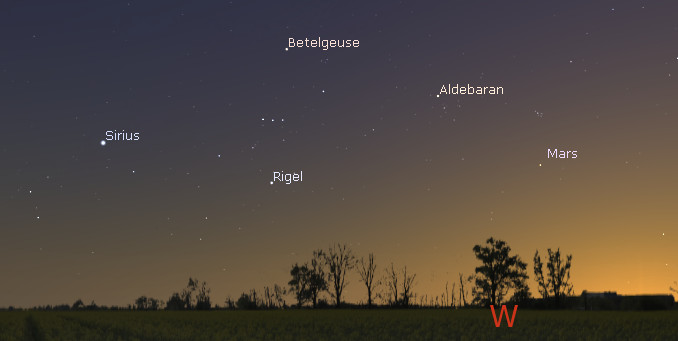
Mars in the west with bright stars at 9 p.m. April 12, 2017. Created using Stellarium.
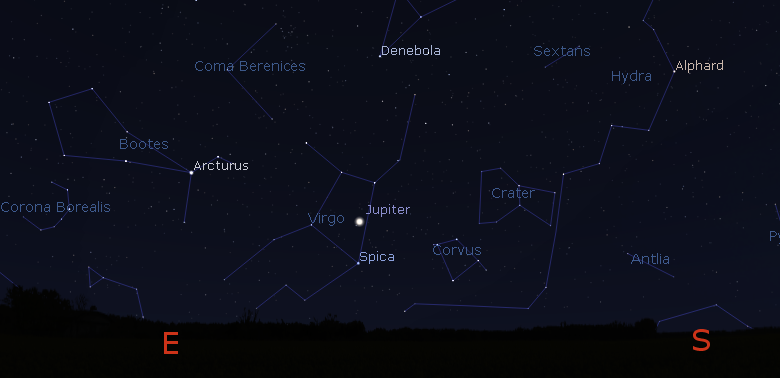
Jupiter in dark skies with some southern spring constellations on April 12, 2017. Created using Stellarium.
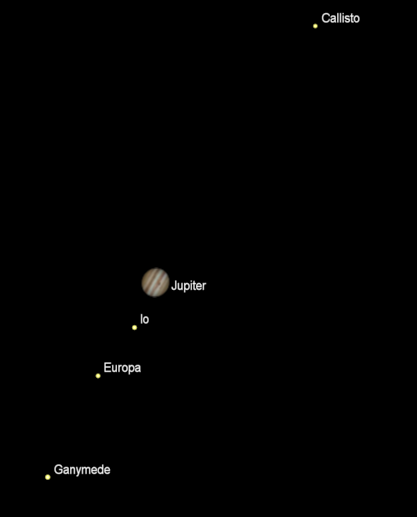
Jupiter and moons at 10 p.m. April 12, 2017 The Great Red Spot is near the central meridian of the planet at that time. Created using Cartes du Ciel (Sly Charts).
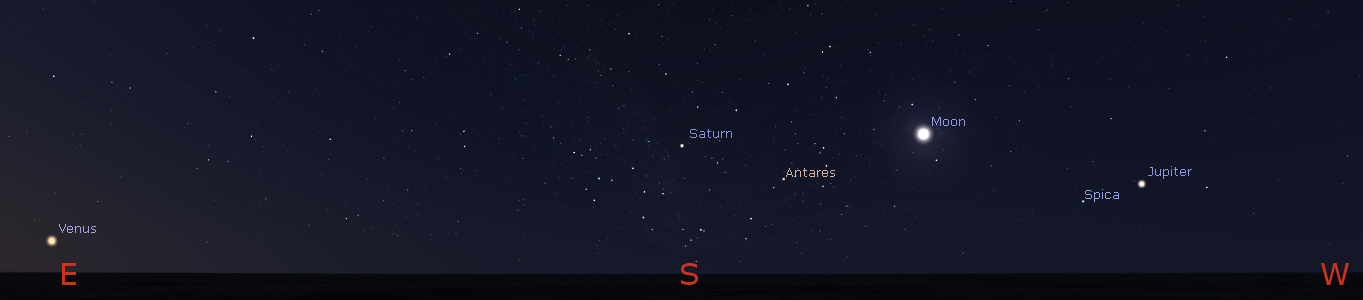
Jupiter, the Moon, Saturn and Venus at the eastern horizon at 6 a.m. April 13, 2017. Created using Stellarium.
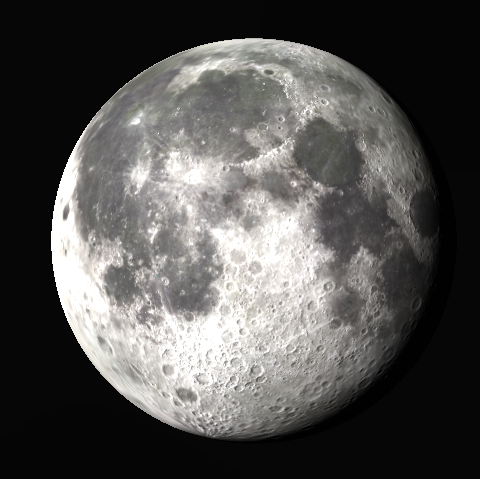
The waning gibbous Moon as it might be seen in binoculars at 6 a.m. April 13, 2017. Created using Stellarium.
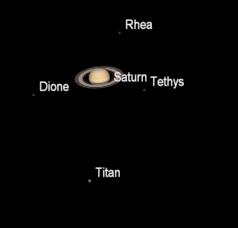
Saturn and moons in telescopes at 6 a.m. April 13, 2017. Created using Cartes du Ciel (Sky Charts).
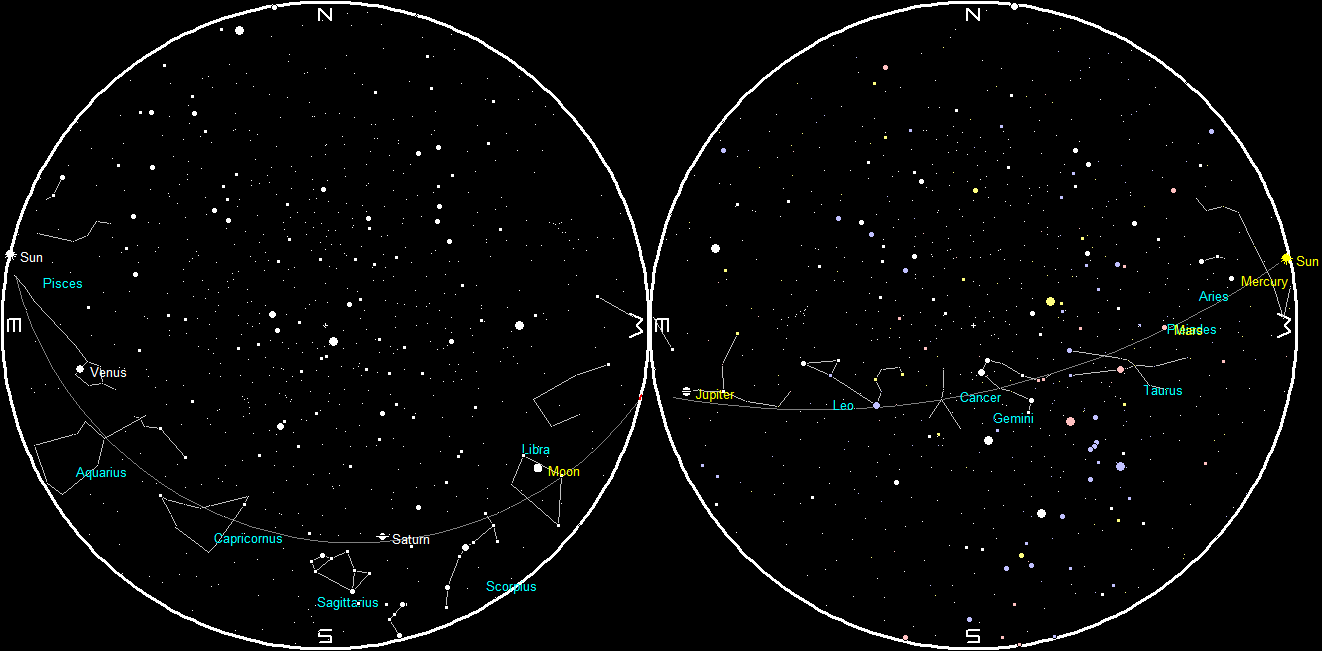
Planets and the Moon at sunset and sunrise of a single night starting with sunset on the right on April 12, 2017. The night ends on the left with sunrise on April 13. Click on the image to enlarge. Created using my LookingUp program.
04/11/2017 – Ephemeris – What’s under Jupiter’s cloud tops?
Ephemeris for Tuesday, April 11th. The Sun will rise at 7:04. It’ll be up for 13 hours and 17 minutes, setting at 8:22. The Moon, at full today, will rise at 8:54 this evening.
I made an error in yesterday’s on-air program which I fixed before posting this blog version. The moon Io will be over the face of Jupiter from when it rises tonight until 8:58 p.m.*, thereafter it will be seen just to the west of the planet. What we see of Jupiter are its cloud tops. Planetary astronomers have some very educated guesses as to what lies beneath them. An atmosphere of mainly hydrogen and helium, ending in a hot liquid ocean of hydrogen. Beneath that a core of metallic hydrogen that generates the planet’s huge magnetic field. Below that maybe a core of solid iron and other metals. NASA’s Juno spacecraft now orbiting Jupiter is tasked with finding out the interior structure by measuring the velocity of the spacecraft as it flies just above the cloud tops of this giant planet.
The times given are for the Traverse City/Interlochen area of Michigan. They may be different for your location.
* Observers in other locations around the world can check out the table from yesterday’s post of other Jovian satellite events after this entry is posted at 4:01 UT, April 11, 2017.
Addendum
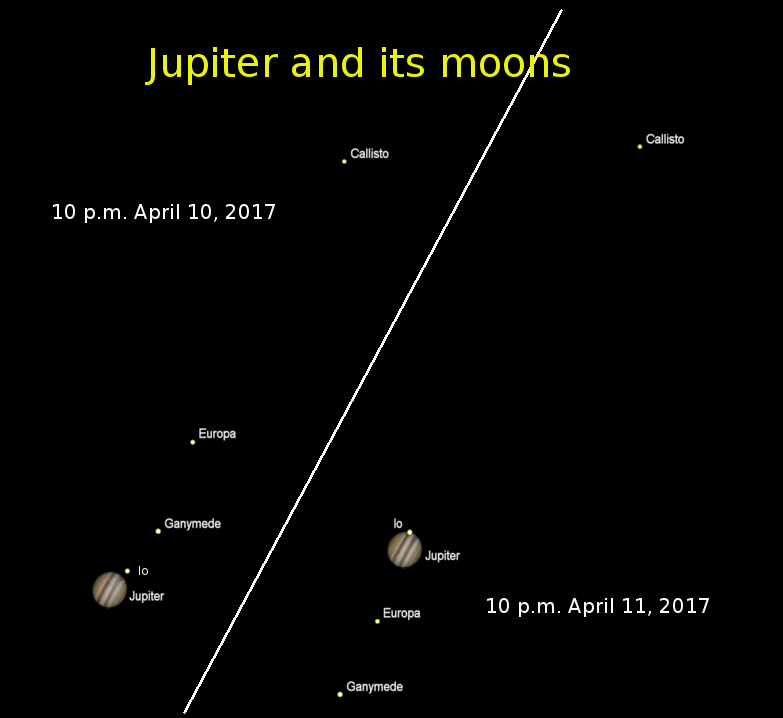
Jupiter and its moons in a telescope at 10 p.m. both April 10th & 11th, 2017. Created using Cartes du Ciel (Sky Charts).
For a year’s worth of Jovian satellite events and when the Great Red Spot crosses Jupiter’s central meridian, go to: http://www.projectpluto.com/jevent.htm.
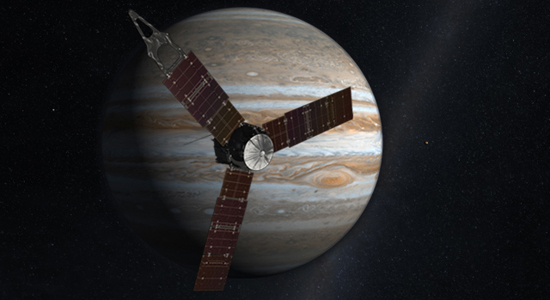
The Juno spacecraft. Credit: NASA.
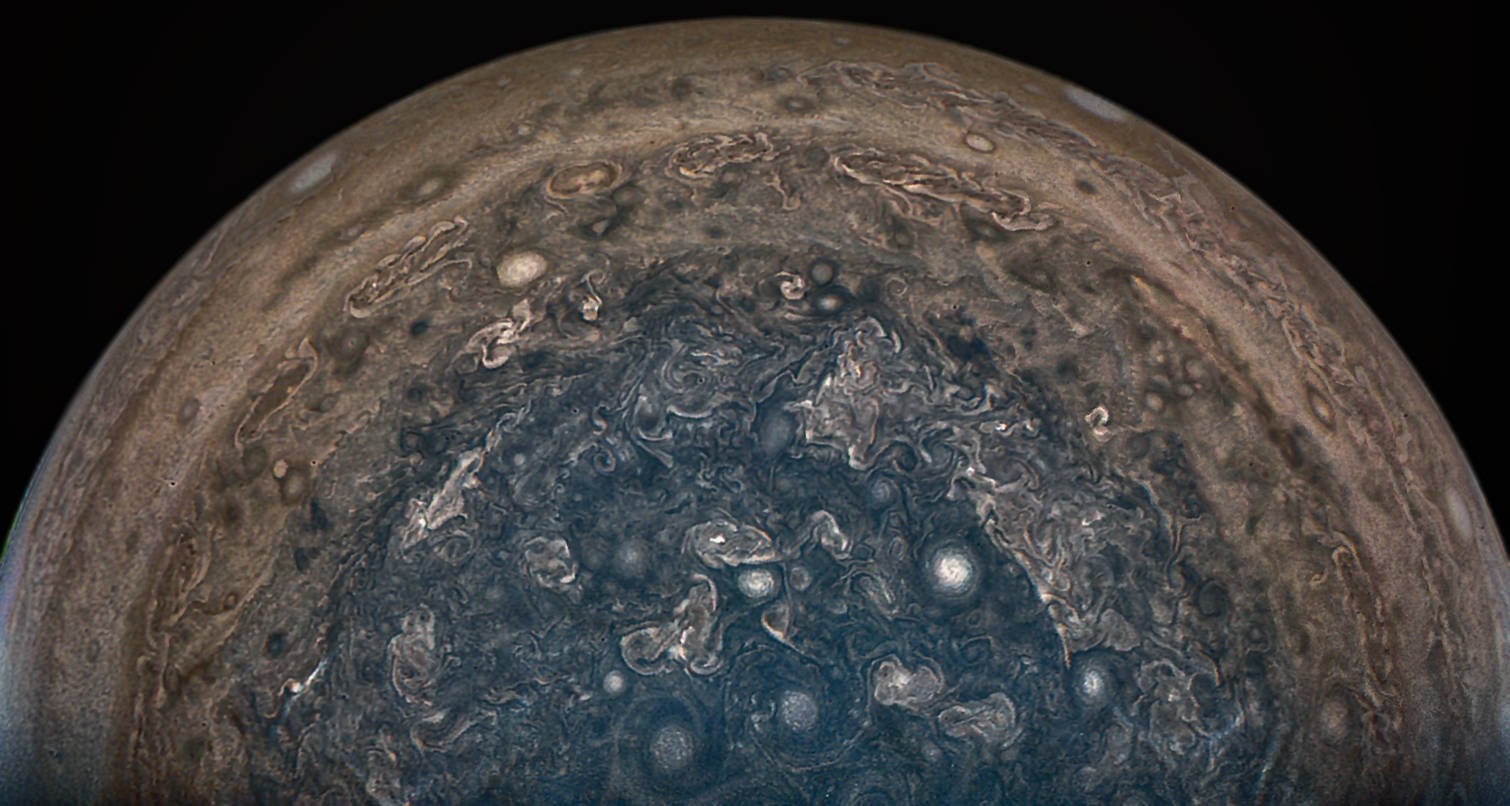
A February 2, 2017 Juno image of Jupiter’s south pole and its chaotic storm clouds. I think I have a paisley tie that looks like that. Credit NASA/JPL-Caltech/SwRI/MSSS/John Landino.
04/10/2017 – Ephemeris – Jupiter takes over as king of the evening sky
Ephemeris for Monday, April 10th. The Sun will rise at 7:06. It’ll be up for 13 hours and 14 minutes, setting at 8:21. The Moon, 1 day before full, will set at 7:36 tomorrow morning.
By the time we see the Moon tonight it will be about 5 hours from officially being full. However bright planet Jupiter should be easily visible about 5 moon diameters to the right and a bit above the Moon. In a small telescope it is easy to see the disk of Jupiter, and possible see the cloud bands in the atmosphere, due to the planet’s rapid rotation, of less than 10 hours. Jupiter’s mass is over 300 times the Earth’s, while one could squeeze over a thousand Earth’s into its volume. Jupiter has something like 67 satellites, but only for are visible in small to medium telescopes. Tonight they will be strung out all on one side of Jupiter, tomorrow night two will be on the other side of the planet, and another will be playing peek-a-boo in front of Jupiter.
The times given are for the Traverse City/Interlochen area of Michigan. They may be different for your location.
Addendum
Jupiter and its moons in a telescope at 10 p.m. both April 10th & 11th, 2017. Created using Cartes du Ciel (Sky Charts).
| Event | Date & Time EDT | Date & Time UT |
| Io Occultation Start | 10 April 2017 10:31 p.m. | 11 April 2017 2:31 |
| Io Eclipse ends | 11 April 2017 12:28 a.m. | 11 April 2017 4:46 |
| Ganymede Occultation start | 11 April 2017 4:28 a.m. | 11 April 2017 8:28 |
| Ganymede Eclipse end | Not visible | 11 April 2017 11:02 |
| Europa Occultation start | Not visible | 11 April 2017 18:44 |
| Europa Eclipse ends | Not visible | 11 April 2017 21:19 |
| Io Transit starts | Not visible | 11 April 2017 23:48 |
| Io Shadow ingress | Not visible | 11 April 2017 23:54 |
| Io Transit ends | 11 April 2017 8:58 p.m. | 12 April 2017 1:58 |
| Io Shadow egress | 11 April 2017 10:05 p.m. | 12 April 2017 2:05 |
Where times EDT show as not visible, Jupiter is below the horizon. Date and time UT are for observers in other locations. UT is Universal Time, or Greenwich Mean Time.
Occultation = moon passes behind Jupiter
Eclipse = moon in Jupiter’s shadow
Transit = moon passes in front of Jupiter
Shadow = moon’s shadow is cast on the face of Jupiter
04/07/2017 – Ephemeris – Learn about light pollution tonight
Ephemeris for Friday, April 7th. The Sun will rise at 7:12. It’ll be up for 13 hours and 5 minutes, setting at 8:17. The Moon, half way from first quarter to full, will set at 6:11 tomorrow morning.
This evening at 8 p.m. the Grand Traverse Astronomical Society will hold its monthly meeting at Northwestern Michigan College’s Rogers Observatory featuring a talk by observatory director Jerry Dobek about light pollution and what can be done about it to help preserve our dark night skies. I expect he will give us a progress report on the effort to make the Sleeping Bear Dunes National Lakeshore a Dark Sky Park. Special emphasis will be LEDs, now that they are proliferating, the good the bad and the ugly. At 9 p.m. there will be a star party with the gibbous Moon and Jupiter at opposition from the Sun and about at its closest to us at 414 million miles (666 million km) away.
Times are for the Traverse City/Interlochen area of Michigan. They may be different for your location.
Addendum
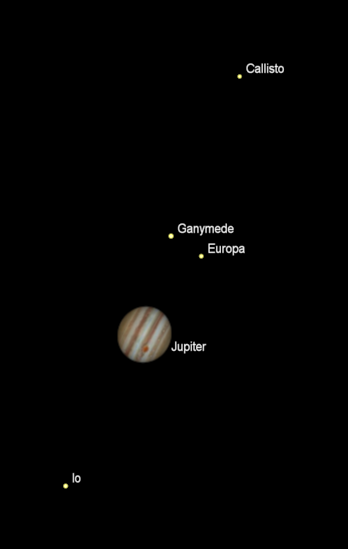
Jupiter and its moons as it should appear tonight at 10 p.m. April 7, 2017 (2 hr UT April 8). Note also the Great Red Spot, which may be paler than it appears here. I double checked the transit time of the red spot across Jupiter’s central meridian, which is predicted for 10:42 p.m. (2:42 UT, April 8) across Jupiter’s central meridian. The position of the Red Spot is correct for 10 p.m.
Times are from Project Pluto: https://www.projectpluto.com/jeve_grs.htm
04/06/2017 – Ephemeris – Jupiter will be opposite the Sun in the sky tomorrow
Ephemeris for Thursday, April 6th. The Sun will rise at 7:13. It’ll be up for 13 hours and 2 minutes, setting at 8:16. The Moon, 3 days past first quarter, will set at 5:39 tomorrow morning.
The planet Jupiter now rises around sunset. Tomorrow at 4:58 p.m. it will be officially in opposition from the Sun. This isn’t some conflict, but the simple fact that Jupiter will be opposite the Sun in our sky. It then will become an evening planet and in the next month or so will become a dazzling fixture in our evening sky, that it is now later in the evening. Jupiter is the second brightest planet after Venus, which is now emerging from the morning Sun’s twilight glare. Watch for it in next Wednesday’s planet report. Though the second brightest planet Jupiter by far is the largest planet. It’s mass exceeds the combines masses of all the other planets times two. Currently NASA’s Juno spacecraft is orbiting it.
Times are for the Traverse City/Interlochen area of Michigan. They may be different for your location.
Addendum
In a telescope the Jupiter system is quite dynamic. It’s four largest moons change position from night to night, and sometimes while you watch. The satellites sometimes duck behind Jupiter or through its shadow, or pass in front of the planet, casting their shadow on it. Close observation of Jupiter reveals details in its clouds. It rotates in less than 10 hours, over twice as fast as the Earth, which apparently whips the clouds into alternate light colored zones and darker brownish belts. There’s the Great Red Spot, which last I spotted it has faded to a pale pink, and located in the south edge of the south equatorial belt. The clouds rotate faster at the equator than at higher latitudes.
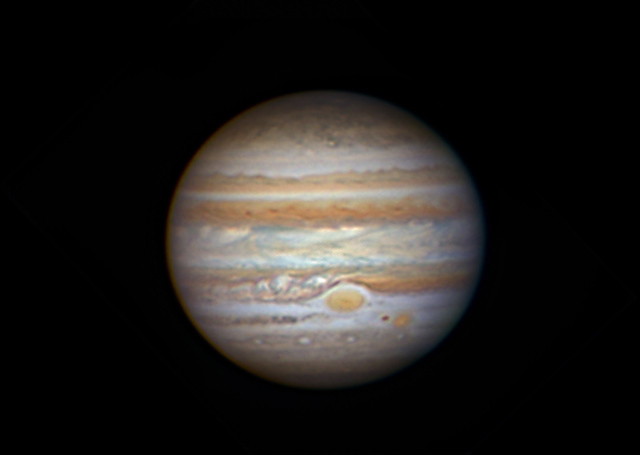
Jupiter with its Great Red Spot November 18, 2012 by Scott Anttila.
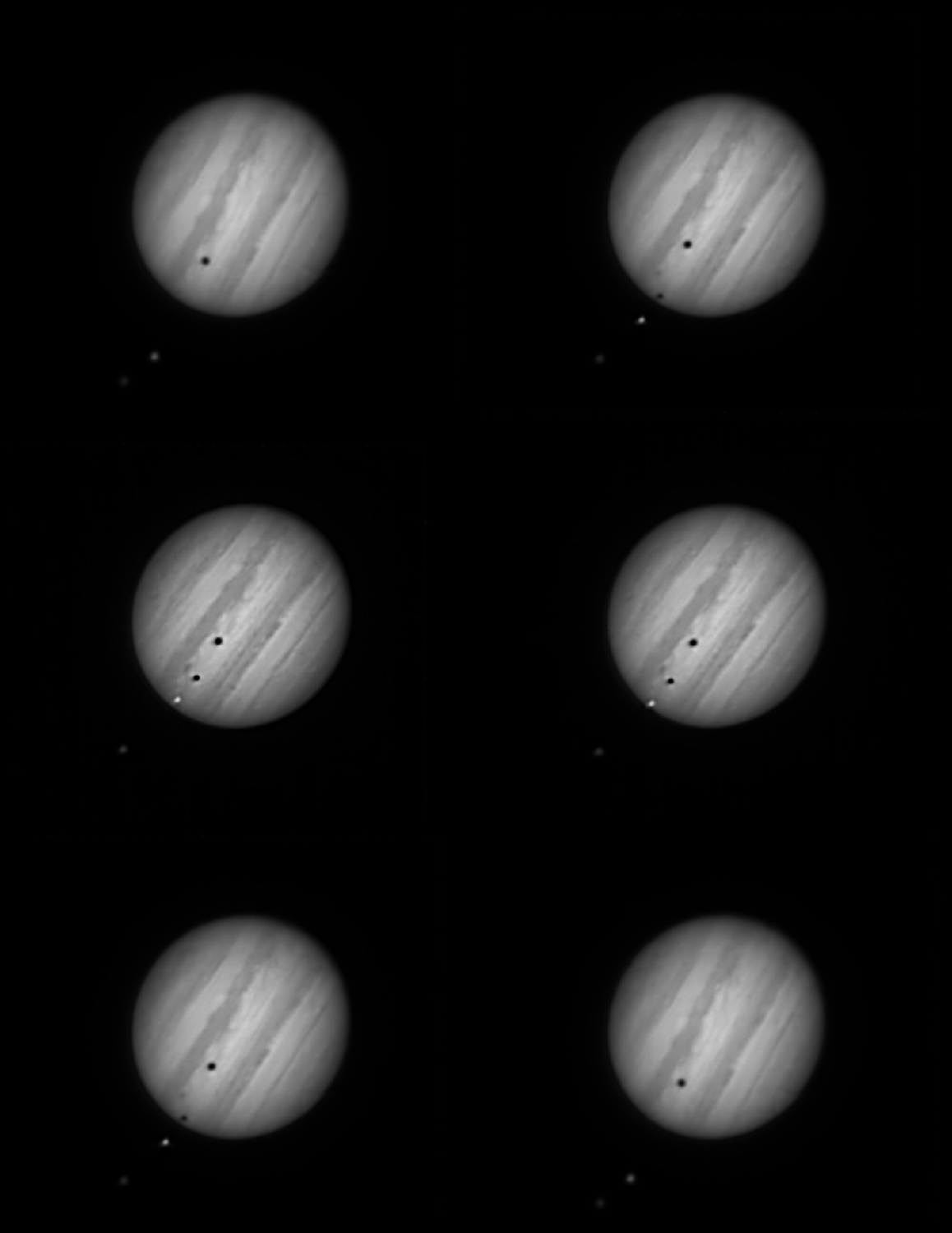
Rocking animation of the early stages of the shadow show on Jupiter. Callisto’s shadow already on the planet while Io’s shadow is just entering. Also Io’s transit is starting., following it’s shadow on the planet. Credit: Scott Anttila
04/05/2017 – Ephemeris – It’s Wednesday, do you know where your bright planets are?
Ephemeris for Wednesday, April 5th. The Sun will rise at 7:15. It’ll be up for 12 hours and 59 minutes, setting at 8:15. The Moon, 2 days past first quarter, will set at 5:04 tomorrow morning.
In the evening twilit sky tonight will feature the elusive planet Mercury. This tiny planet might be seen to the upper right of the Sun’s setting point starting about 9 p.m. It will set at 9:55 p.m. Mercury is getting rapidly fainter because it’s now exhibiting a diminishing crescent to us. It takes a good telescope and very steady skies to spot Mercury’s phase. Mars is still hanging on, in the west above and left of Mercury, and will set at 11:09 p.m. Jupiter will rise about sunset a half hour before the star Spica, which it will be seen to hang out with this year. Jupiter will be still seen in the morning sky low in the southwest at 6 a.m. Saturn then is in the south above the Teapot figure of Sagittarius. It will rise at 2:06 a.m. in the east-southeast.
Times are for the Traverse City/Interlochen area of Michigan. They may be different for your location.
Addendum
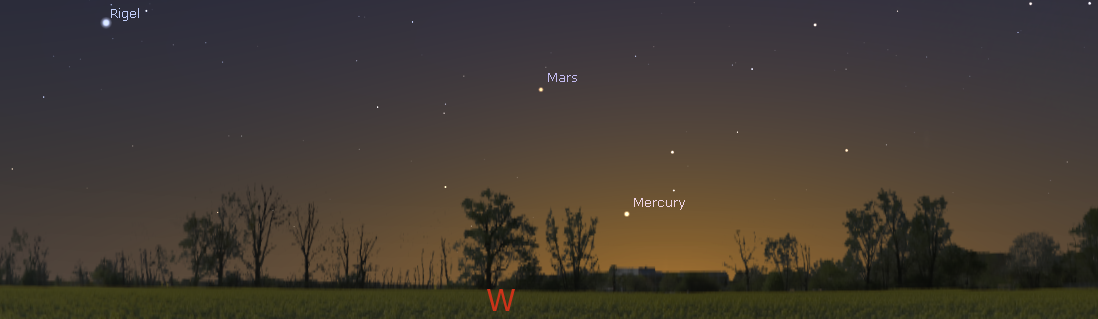
Mercury and Mars low in the west at 9 p.m. April 5, 2017. Created using Stellarium.
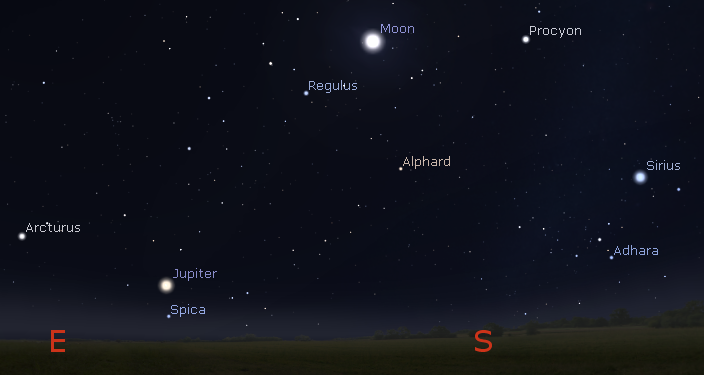
Jupiter and the Moon at 9:30 p.m. Created using Stellarium.
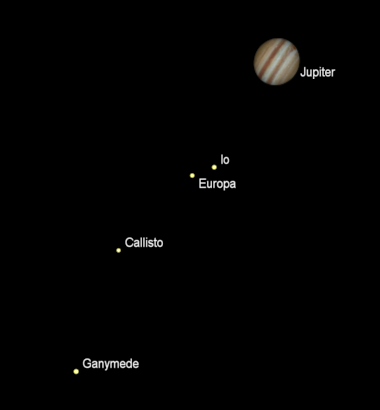
Jupiter and its moons as they might be seen in a telescope at 11 p.m. April 5, 2017. It is usually best to let planets rise a bit to minimize the atmospheric effects on the image. Created using Cartes du Ciel.
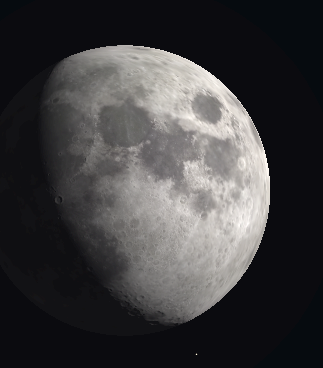
The Moon as it might be seen in binoculars at 9:30 p.m. April 5, 2016. Note the prominent crater Copernicus emerging into sunlight on the left of the Moon. Created using Stellarium.
If you’d like to check out the Moon in a telescope tonight, check out this posting : https://bobmoler.wordpress.com/2014/03/10/03102014-ephemeris-observibg-the-moon-tonight-and-the-crater-copernicus/
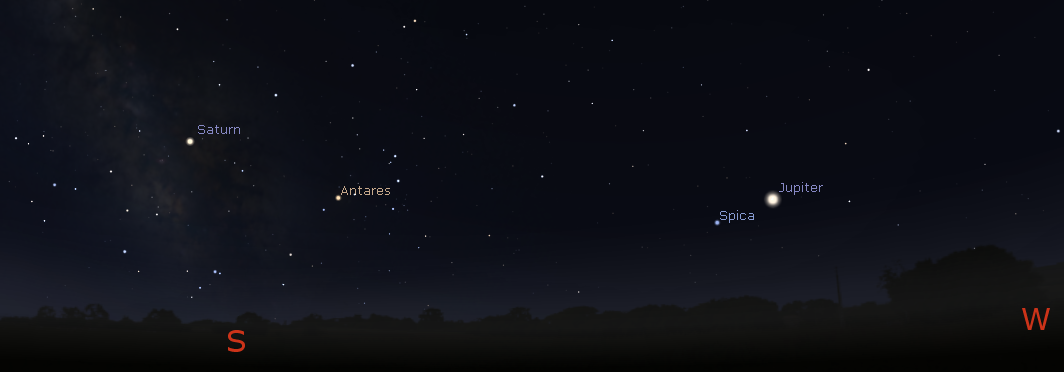
The planets visible at 6 a.m. April 6, 2017 Venus is just below the eastern horizon at this hour. Created using Stellarium.
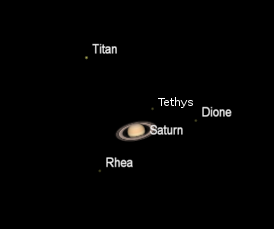
Saturn and its moons at 6 a.m. April 6th, 2017. Created using Cartes du Ciel (Sky Charts).
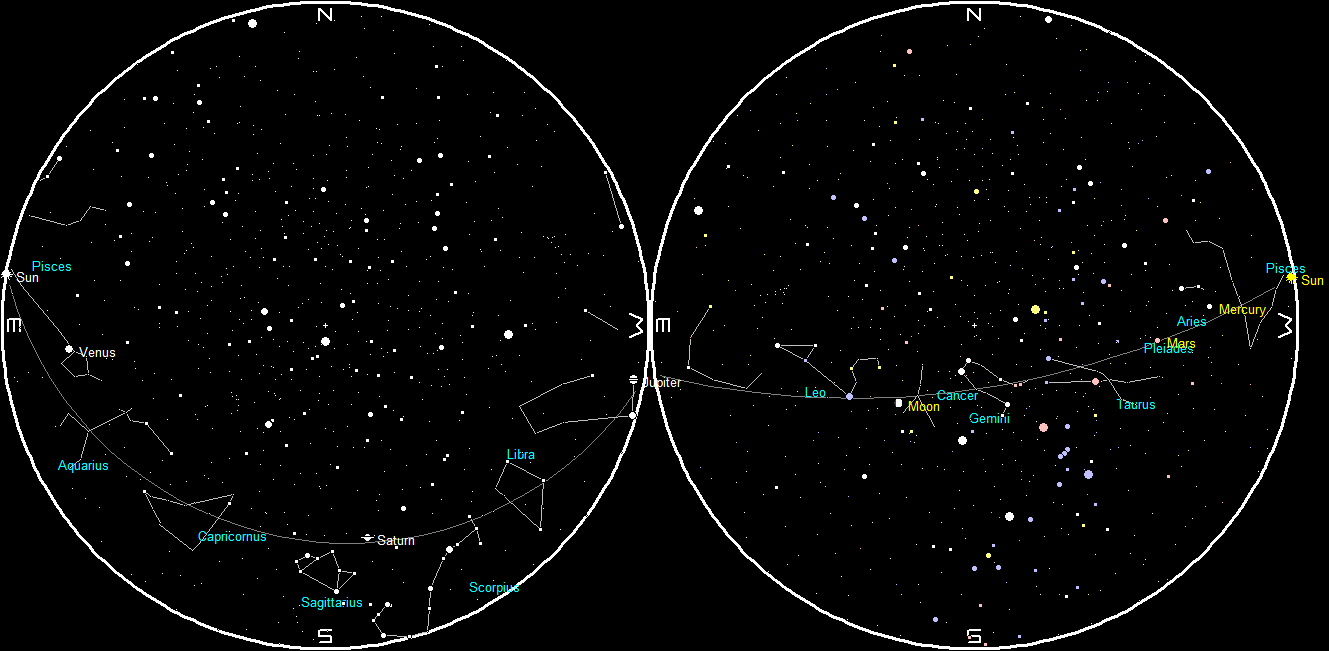
Planets and the Moon at sunset and sunrise of a single night starting with sunset on the right on April 5, 2017. The night ends on the left with sunrise on April 6. Click on the image to enlarge. Created using my LookingUp program.
A comet dramatically brightens
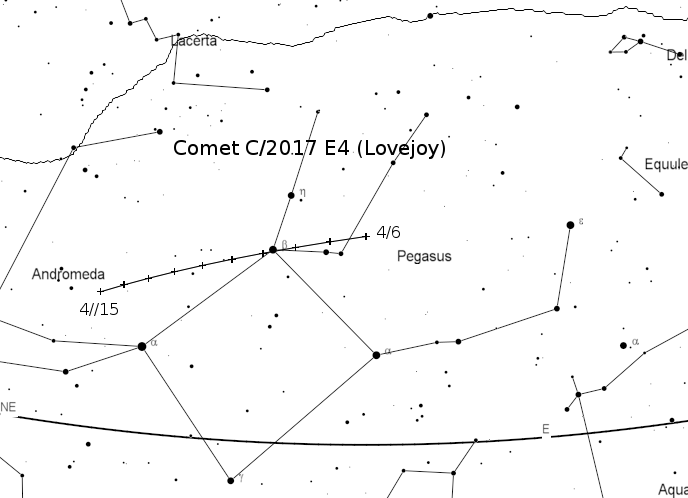
Here is the track for Comet 2017 E4 Lovejoy. This comet was expected to be 14th magnitude, but it’s brightness shot up to around 6.5, within range of binoculars. I’m only plotting 10 days. It should be brightest about mid-month, but is poorly placed for observation, plus we’re fighting a bright Moon. The curved horizontal line near the bottom is the Horizon on April 4, 2017. Created using Cartes du Ciel.
Universe today has lots more on the new Comet Lovejoy here: https://www.universetoday.com/134848/surprise-comet-e4-lovejoy-brightens/
04/03/2017 – Ephemeris – A two bit* Moon today
Ephemeris for Monday, April 3rd. The Sun will rise at 7:19. It’ll be up for 12 hours and 53 minutes, setting at 8:12. The Moon, at first quarter today, will set at 3:38 tomorrow morning.
The Moon will be at exactly first quarter at 2:12 this afternoon (18:12 UT). By this evening for us the terminator line, which is the sunrise line on the Moon as the Moon’s phase waxes will be bowed to the left a bit. The names of the primary phases of the Moon are a bit odd. The quarter moons are named for their positions one quarter or 90 degrees from the Sun. The full moon describes it appearance as fully illuminated. New moon is odd too. To the Jews and the Arabs the New moon was the name for the first sighting of the crescent Moon after it disappeared from the morning sky. Astronomers use that term today for when the Moon is in conjunction with the Sun, day zero of a lunation or lunar month, about a day before its first appearance in the evening.
Times are for the Traverse City/Interlochen area of Michigan. They may be different for your location.
* If “two bit” is foreign to you. It dates back to US colonial times when the most prevalent coin around was the Spanish Dollar, also known as a piece of eight. A quarter of that was two bits, 25 cents in modern parlance. It lives on in the tune and knock sequence “Shave and a haircut, two bits” or five rapid knocks a pause and two more. See the movie “Who Framed Roger Rabbit?”.
Addendum
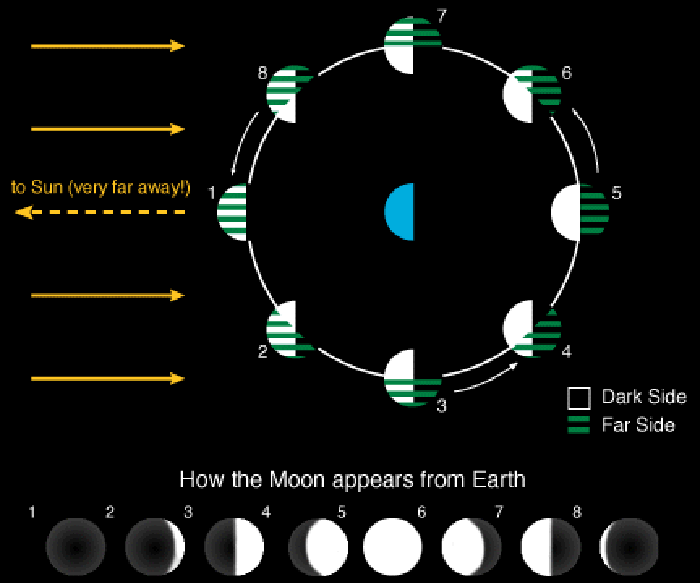
This is the best diagram of the Moon’s phases and how the it appears from the Earth. Credit http://planetfacts.org/phases-of-the-moon/ which I recommend.
However I do not like the label Dark Side. It is simply the night side. The Far Side is what many people mistakenly call the dark side, because we can never see it from the Earth. However the far side sees more sunlight than the near side. One, it is never darkened by an eclipse of the Moon, because it’s night-time there normally at that time. Two, at new moon it is fully facing the Sun, and also a quarter of a million miles closer to the Sun than the Earth is. So how can it be the dark side. Really. Come on people.
03/31/2017 – Ephemeris – Previewing April Skies
Ephemeris for Friday, March 31st. The Sun will rise at 7:24. It’ll be up for 12 hours and 44 minutes, setting at 8:09. The Moon, 3 days before first quarter, will set at 12:35 tomorrow morning.
The second quarter of the year begins with April Fools Day tomorrow. Daylight hours in the Interlochen/Traverse City area and will increase from 12 hours and 47 minutes tomorrow to 14 hours 12 minutes on April 30th as spring really takes hold. The altitude, or angle, of the sun above the southern horizon at local noon will be 50 degrees tomorrow and will ascend to 60 degrees on April 30th. The altitude of the sun in the Straits area will be a degree lower. The actual time of local apparent noon this month for the Interlochen/Traverse City area, when the sun passes due south, will be about 1:43 p.m. Jupiter will reach opposition from the Sun this month, and be a great planet to view in a telescope all night long.
Times are for the Traverse City/Interlochen area of Michigan. They may be different for your location.
Addenda
April Evening Star Chart
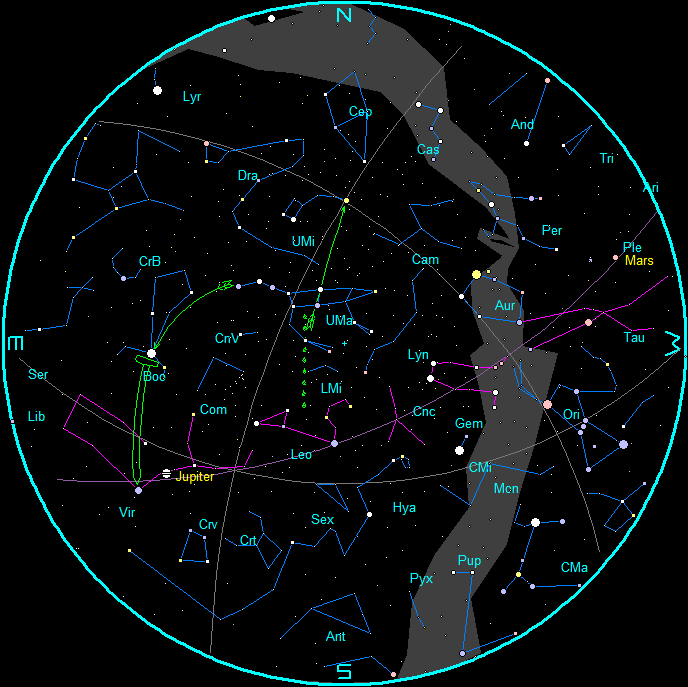
Star Chart for April 2017. Created using my LookingUp program. Click on image to enlarge.
The planets and stars are plotted for the 15th at 10 p.m. EDT in the evening and 5 a.m. for the morning chart. These are the chart times. Note, Traverse City is located approximately 45 minutes behind our time meridian. (An hour 45 minutes behind our daylight saving time meridian. during EDT and 45 minutes behind our daylight standard time meridian. during EST). To duplicate the star positions on a planisphere you may have to set it to 1:45 or 0:45 earlier than the current time if you were near your time meridian.
April Morning Chart
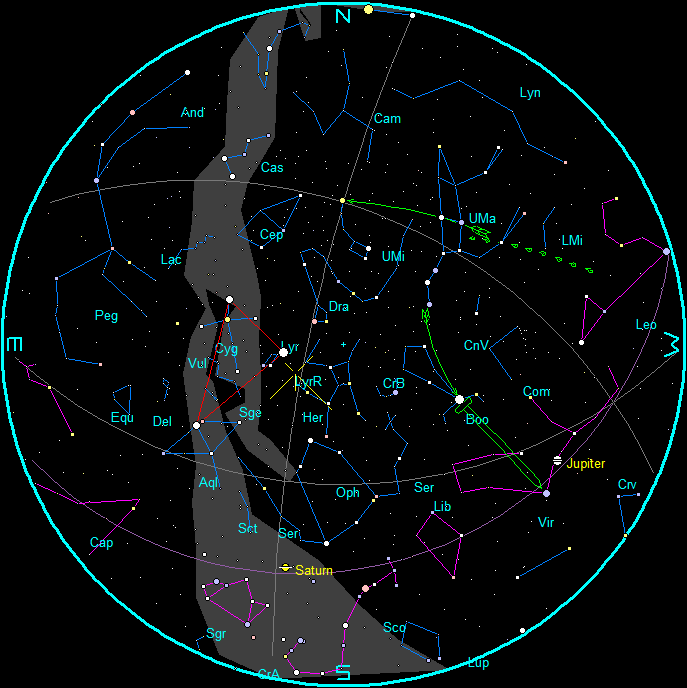
Star Chart for April 2017 mornings. Created using my LookingUp program. Click on image to enlarge.
For a list of constellation names to go with the abbreviations click here.
- Pointer stars at the front of the bowl of the Big Dipper point to Polaris the North Star
- Follow the arc of the handle of the Big Dipper to the star Arcturus, and
- Straighten to a spike to Spica
- The Summer Triangle is in red
- The Lyrid meteor shower radiant is in yellow and marked LyrR
Evening nautical twilight ends at 9:17 p.m. EDT on the 1st, increasing to 10:01 p.m. EDT on the 30th.
Evening astronomical twilight ends at 9:54 p.m. EDT on the 1st, increasing to 10:45 p.m. EDT on the 30th.
Morning astronomical twilight starts at 5:46 a.m. EDT on the 1st, and increasing to 4:42 a.m. EDT on the 30th.
Morning nautical twilight starts at 6:23 a.m. EDT on the 1st, and Increasing to 5:26 a.m. EDT on the 30th.
NASA Calendar of Planetary Events
Credit: Sky Events Calendar by Fred Espenak and Sumit Dutta (NASA’s GSFC)
To generate your own calendar go to http://eclipse.gsfc.nasa.gov/SKYCAL/SKYCAL.html
Times are Eastern Time and follow the time change dates.
Date        Time    Event
Apr 01  Sa  Venus: 13.4° W
    01  Sa 04:49 Moon-Aldebaran: 0.3° S
    01  Sa 05:59 Mercury Greatest Eastern Elongation: 19°
    03  Mo 02:12 Moon North Dec.: 19° N
    03  Mo 14:39 First Quarter
    05  We 08:45 Moon-Beehive: 4° N
    07  Fr 00:30 Moon-Regulus: 0.8° N
    07  Fr 05:14 Moon Ascending Node
    07  Fr 16:58 Jupiter Opposition from the Sun
    10  Mo 17:20 Moon-Jupiter: 2.4° S
    11  Tu 02:08 Full Moon
    14  Fr 01:43 Uranus Conjunction with the Sun
    15  Sa 06:05 Moon Apogee: 405500 km
    16  Su 14:39 Moon-Saturn: 3.6° S
    17  Mo 09:12 Moon South Dec.: 19.1° S
    19  We 05:57 Last Quarter
    20  Th 01:46 Mercury Inferior Conjunction with the Sun
    21  Fr 04:16 Mars-Pleiades: 3.5° S
    21  Fr 18:30 Moon Descending Node
    22  Sa 07:40 Lyrid Meteor Shower: ZHR = 20
    23  Su 13:59 Moon-Venus: 5.3° N
    26  We 08:16 New Moon
    27  Th 12:18 Moon Perigee: 359300 km
    28  Fr 13:20 Moon-Aldebaran: 0.5° S
    30  Su 09:33 Moon North Dec.: 19.2° N
May 01  Mo  Venus: 39.9° W
April 2017 Calendar
     LU                  Ephemeris of Sky Events for Interlochen/TC
April, 2017    Local time zone: EDT
+-----------------------------------------------------------------------+
| DATE |  SUN     SUN  DAYLIGHT|   TWILIGHT*    |MOON  RISE OR    ILLUM |
|      |  RISE    SET    HOURS |  END    START  |PHASE SET** TIME FRACTN|
+=======================================================================+
|Sat  1| 07:23a  08:10p  12:47 | 09:15p  06:18a |      Set  01:43a   30%|
+------+-----------------------+----------------+-----------------------+
|Sun  2| 07:21a  08:12p  12:50 | 09:16p  06:16a |      Set  02:44a   41%|
|Mon  3| 07:19a  08:13p  12:53 | 09:18p  06:14a |F Qtr Set  03:38a   53%|
|Tue  4| 07:17a  08:14p  12:56 | 09:19p  06:12a |      Set  04:25a   63%|
|Wed  5| 07:15a  08:15p  12:59 | 09:21p  06:10a |      Set  05:05a   74%|
|Thu  6| 07:14a  08:17p  13:02 | 09:22p  06:08a |      Set  05:40a   82%|
|Fri  7| 07:12a  08:18p  13:06 | 09:24p  06:06a |      Set  06:11a   90%|
|Sat  8| 07:10a  08:19p  13:09 | 09:25p  06:04a |      Set  06:40a   95%|
+------+-----------------------+----------------+-----------------------+
|Sun  9| 07:08a  08:20p  13:12 | 09:27p  06:02a |      Set  07:08a   98%|
|Mon 10| 07:06a  08:21p  13:15 | 09:28p  06:00a |      Set  07:36a  100%|
|Tue 11| 07:05a  08:23p  13:18 | 09:29p  05:58a |Full  Rise 08:54p   99%|
|Wed 12| 07:03a  08:24p  13:21 | 09:31p  05:56a |      Rise 09:54p   97%|
|Thu 13| 07:01a  08:25p  13:24 | 09:32p  05:54a |      Rise 10:52p   93%|
|Fri 14| 06:59a  08:26p  13:27 | 09:34p  05:52a |      Rise 11:49p   87%|
|Sat 15| 06:58a  08:28p  13:30 | 09:35p  05:50a |      Rise 12:43a   80%|
+------+-----------------------+----------------+-----------------------+
|Sun 16| 06:56a  08:29p  13:33 | 09:37p  05:48a |      Rise 01:34a   72%|
|Mon 17| 06:54a  08:30p  13:36 | 09:38p  05:46a |      Rise 02:22a   64%|
|Tue 18| 06:52a  08:31p  13:39 | 09:40p  05:44a |      Rise 03:05a   54%|
|Wed 19| 06:51a  08:33p  13:41 | 09:41p  05:42a |L Qtr Rise 03:45a   44%|
|Thu 20| 06:49a  08:34p  13:44 | 09:43p  05:40a |      Rise 04:21a   34%|
|Fri 21| 06:47a  08:35p  13:47 | 09:44p  05:39a |      Rise 04:55a   25%|
|Sat 22| 06:46a  08:36p  13:50 | 09:46p  05:37a |      Rise 05:27a   16%|
+------+-----------------------+----------------+-----------------------+
|Sun 23| 06:44a  08:38p  13:53 | 09:48p  05:35a |      Rise 05:59a    9%|
|Mon 24| 06:43a  08:39p  13:56 | 09:49p  05:33a |      Rise 06:33a    3%|
|Tue 25| 06:41a  08:40p  13:59 | 09:51p  05:31a |      Rise 07:08a    1%|
|Wed 26| 06:39a  08:41p  14:01 | 09:52p  05:29a |New   Set  09:01p    1%|
|Thu 27| 06:38a  08:43p  14:04 | 09:54p  05:27a |      Set  10:16p    4%|
|Fri 28| 06:36a  08:44p  14:07 | 09:55p  05:25a |      Set  11:29p    9%|
|Sat 29| 06:35a  08:45p  14:10 | 09:57p  05:23a |      Set  12:35a   17%|
+------+-----------------------+----------------+-----------------------+
|Sun 30| 06:33a  08:46p  14:13 | 09:58p  05:22a |      Set  01:34a   27%|
+-----------------------------------------------------------------------+
* Nautical Twilight
** Moonrise or moonset, whichever occurs between sunset and sunrise
03/30/2017 – Ephemeris – Have you ever seen zodiacal light?
Ephemeris for Thursday, March 30th. The Sun will rise at 7:26. It’ll be up for 12 hours and 41 minutes, setting at 8:07. The Moon, 3 days past new, will set at 11:23 this evening.
After you spot the moon tonight, hang around outside at the end of astronomical twilight, about 9:50 p.m. look to the west at Taurus the bull and Gemini, trying to block out the Moon. Then broaden your gaze. There will be a very faint triangular glow with broad base at the horizon leaning a bit to the left, with its apex near the V of the face of Taurus the bull and the bright star Aldebaran to the right of Orion. This glow is called Zodiacal Light, caused by the reflected sunlight off a cloud of dust located in the plane of the solar system. Most of the large bodies of the solar system orbit the sun close to a single plane. Zodiacal Light is best seen on spring evenings and autumn mornings where it tilts to the right.
Times are for the Traverse City/Interlochen area of Michigan. They may be different for your location.
Addendum
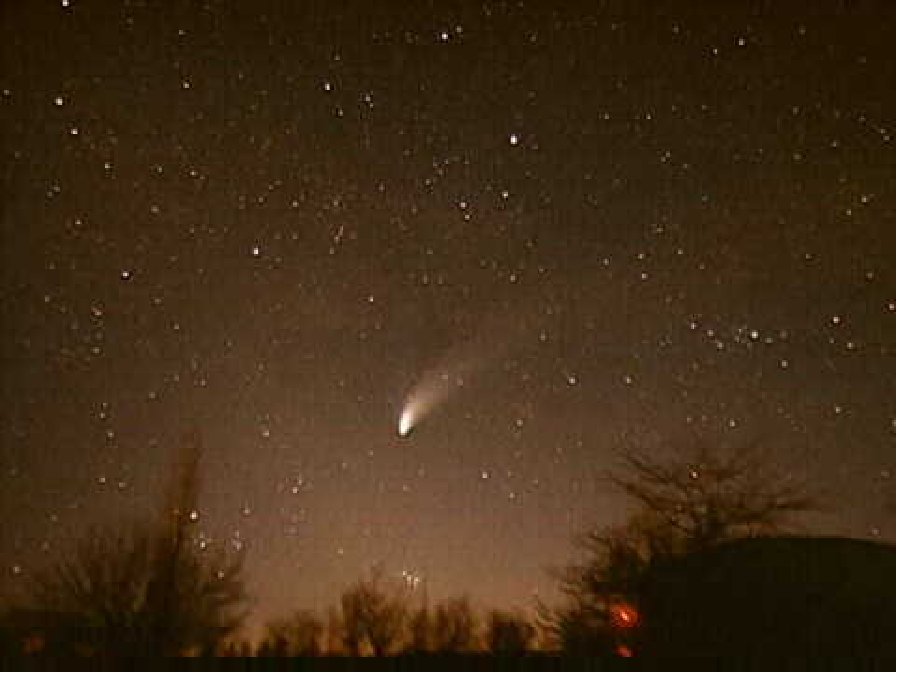
Zodiacal Light and Comet Hale-Bopp April 1997. My image.

