Archive
01/03/2017 – Ephemeris – The Earth will be closest to the Sun tomorrow
Ephemeris for Tuesday, January 3rd. The Sun will rise at 8:19. It’ll be up for 8 hours and 55 minutes, setting at 5:15. The Moon, 2 days before first quarter, will set at 11:06 this evening.
The Earth has as elliptical orbit of the Sun, as do all planets. It is close to circular but not quite. The Earth’s distance from the Sun is 93 million miles (150 million km) plus or minus a million and a half miles. Tomorrow at about 6 a.m. the Sun will be at a point called perihelion, only 91.4 million miles (147 million km). It makes only a tiny difference in the Sun’s intensity, but since the Earth moves faster when closest to the Sun, it makes winter the shortest season at 89 days. Aphelion, Earth’s farthest distance from the sun occurs around July 4th which makes summer the longest season at 93 days. The eccentricity of an orbit can modify the seasons, but the seasons themselves are caused by the tilt of the planet’s axis alone.
Times are for the Traverse City/Interlochen area of Michigan. They may be different for your location.
Addendum
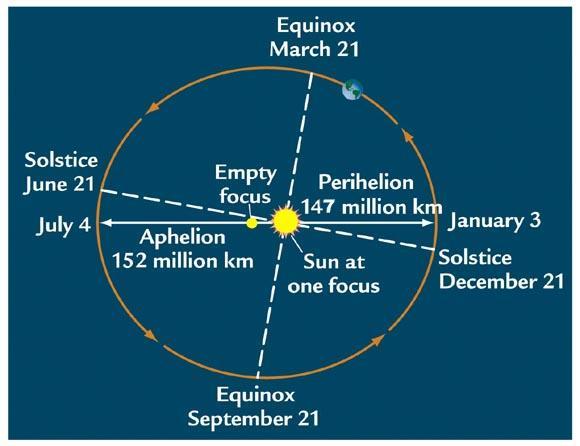
The Earth’s orbit, somewhat exaggerated, showing perihelion and the seasons. Credit “Starts with a Bang” blog by Ethan Siegel.
01/02/2017 – Ephemeris – Looking ahead at January 2017
Ephemeris for Monday, January 2nd. 2017. The Sun will rise at 8:19. It’ll be up for 8 hours and 54 minutes, setting at 5:14. The Moon, 3 days before first quarter, will set at 10:00 this evening.
Let’s look ahead at the month of January. Today we will have out latest sunrise at 8:19. That time will drop to 8:02 on the 31st. Sunset times are already increasing, now at 5:14, will extend to 5:50 at month’s end, which will push the daylight hours to 9 hours 48 minutes by then. The altitude of the Sun at local noon will increase from under 23 degrees today to 28 degrees at month’s end. Tomorrow morning will see the peak of the Quadrantid meteor shower. They will be best seen in the early morning and seem to come from near the handle of the Big Dipper, where possibly more than 60 meteors an hour might be seen. On Wednesday we will reach our closest distance from the Sun of the year at 91.3 million miles.
Times are for the Traverse City/Interlochen area of Michigan. They may be different for your location.
Addendum
January Star Charts
Evening
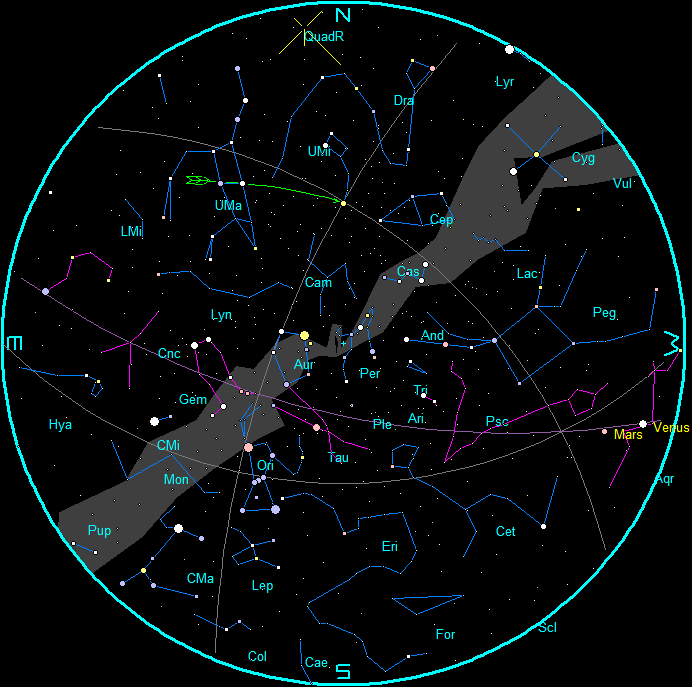
Star Chart for January 2017 evenings. Created using my LookingUp program. Click on image to enlarge.
Morning
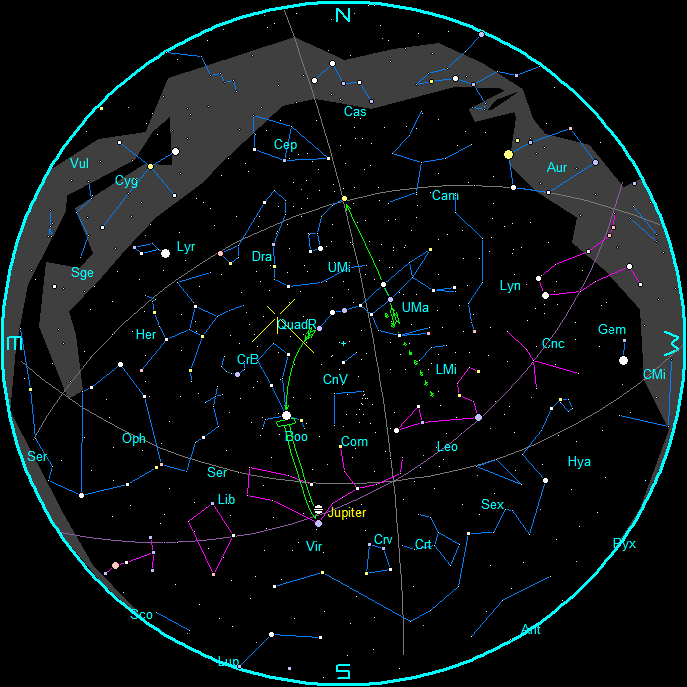
Star Chart for January 2017 mornings. Created using my LookingUp program. Click on image to enlarge.
Since the night time hours are long I’ve decided to add a morning star chart .
The planets and stars are plotted for the 15th at 9 p.m. EST, and again at 6 a.m. Those are chart times. Note, Traverse City is located approximately 45 minutes behind our time meridian. (An hour 45 minutes behind our daylight saving time meridian. during EDT and 45 minutes behind our daylight standard time meridian. during EST). To duplicate the star positions on a planisphere you may have to set it to 1:45 or 0:45 earlier than the current time if you were near your time meridian.
Add a half hour to the chart time every week before the 15th and subtract a half hour for every week after the 15th.
For a list of constellation names to go with the abbreviations click here.
- Pointer stars at the front of the bowl of the Big Dipper point to Polaris the North Star
- Follow the arc of the handle of the Big Dipper to the star Arcturus, and
- Straighten to a spike to Spica
- QuadR is the Radiant of the Quadrantid meteor shower
Evening nautical twilight ends at 6:22 p.m. EST on the 1st, increasing to 6:55 p.m. EST on the 31st.
Evening astronomical twilight ends at 6:57 p.m. EST on the 1st, increasing to 7:29 p.m. EST on the 31st.
Morning astronomical twilight starts at 6:35 a.m. EST on the 1st, and increasing to 6:23 a.m. EST on the 31st.
Morning nautical twilight starts at 7:10 a.m. EST on the 1st, and Increasing to 6:57 a.m. EST on the 31st.
NASA Calendar of Planetary Events
Credit: Sky Events Calendar by Fred Espenak and Sumit Dutta (NASA’s GSFC)
To generate your own calendar go to http://eclipse.gsfc.nasa.gov/SKYCAL/SKYCAL.html
Times are Eastern Time and follow the time change dates.
    Date   Time  Event
Jan 01  Su       Venus: 46.8° E
    02  Mo 04:20 Moon-Venus: 2° S
    02  Mo 13:14 Moon Descending Node
    03  Tu 01:47 Moon-Mars: 0.3° S
    03  Tu 09:10 Quadrantid Meteor Shower: ZHR = 120
    04  We 05:59 Perihelion: 0.9833 AU
    05  Th 14:47 First Quarter
    09  Mo 04:03 Mercury-Saturn: 6.7° N
    09  Mo 09:07 Moon-Aldebaran: 0.4° S
    10  Tu 01:07 Moon Perigee: 363200 km
    11  We 04:32 Moon North Dec.: 18.9° N
    12  Th 06:34 Full Moon
    12  Th 07:59 Venus Greatest Elongation: 47.1° East
    14  Sa 23:07 Moon-Regulus: 0.9° N
    15  Su 05:45 Moon Ascending Node
    19  Th 00:26 Moon-Jupiter: 3° S
    19  Th 04:59 Mercury Greatest Elongation: 24.1° West
    19  Th 17:14 Last Quarter
    21  Sa 19:14 Moon Apogee: 404900 km
    24  Tu 05:37 Moon-Saturn: 4° S
    25  We 06:59 Moon South Dec.: 18.9° S
    25  We 19:46 Moon-Mercury: 4° S
    27  Fr 19:07 New Moon
    29  Su 17:21 Moon Descending Node
    31  Tu 01:12 Jupiter-Spica: 3.5° N
    31  Tu 09:34 Moon-Venus: 4.2° N
    31  Tu 20:09 Moon-Mars: 2.4° N
Feb 01  We       Venus: 45.5° E
January 2017 Calendar
LU                  Ephemeris of Sky Events for Interlochen/TC
January, 2017    Local time zone: EST
+-----------------------------------------------------------------------+
| DATE |  SUN     SUN  DAYLIGHT|   TWILIGHT*    |MOON  RISE OR    ILLUM |
|      |  RISE    SET    HOURS |  END    START  |PHASE SET** TIME FRACTN|
+=======================================================================+
|Sun  1| 08:20a  05:13p  08:53 | 06:23p  07:09a |      Set  08:55p   13%|
|Mon  2| 08:20a  05:14p  08:54 | 06:24p  07:09a |      Set  10:00p   21%|
|Tue  3| 08:20a  05:15p  08:55 | 06:25p  07:10a |      Set  11:06p   31%|
|Wed  4| 08:20a  05:16p  08:56 | 06:26p  07:10a |      Set  12:14a   41%|
|Thu  5| 08:19a  05:17p  08:57 | 06:27p  07:10a |F Qtr Set  01:24a   52%|
|Fri  6| 08:19a  05:18p  08:58 | 06:28p  07:09a |      Set  02:35a   63%|
|Sat  7| 08:19a  05:19p  08:59 | 06:29p  07:09a |      Set  03:47a   74%|
+------+-----------------------+----------------+-----------------------+
|Sun  8| 08:19a  05:20p  09:01 | 06:30p  07:09a |      Set  04:58a   83%|
|Mon  9| 08:19a  05:21p  09:02 | 06:31p  07:09a |      Set  06:07a   91%|
|Tue 10| 08:18a  05:22p  09:04 | 06:32p  07:09a |      Set  07:11a   97%|
|Wed 11| 08:18a  05:23p  09:05 | 06:33p  07:09a |      Set  08:07a  100%|
|Thu 12| 08:17a  05:25p  09:07 | 06:34p  07:08a |Full  Rise 06:04p  100%|
|Fri 13| 08:17a  05:26p  09:08 | 06:35p  07:08a |      Rise 07:12p   97%|
|Sat 14| 08:16a  05:27p  09:10 | 06:36p  07:08a |      Rise 08:20p   92%|
+------+-----------------------+----------------+-----------------------+
|Sun 15| 08:16a  05:28p  09:12 | 06:37p  07:07a |      Rise 09:26p   85%|
|Mon 16| 08:15a  05:30p  09:14 | 06:38p  07:07a |      Rise 10:31p   77%|
|Tue 17| 08:15a  05:31p  09:16 | 06:39p  07:06a |      Rise 11:33p   68%|
|Wed 18| 08:14a  05:32p  09:18 | 06:40p  07:06a |      Rise 12:33a   59%|
|Thu 19| 08:13a  05:33p  09:20 | 06:42p  07:05a |L Qtr Rise 01:32a   49%|
|Fri 20| 08:13a  05:35p  09:22 | 06:43p  07:05a |      Rise 02:30a   40%|
|Sat 21| 08:12a  05:36p  09:24 | 06:44p  07:04a |      Rise 03:27a   31%|
+------+-----------------------+----------------+-----------------------+
|Sun 22| 08:11a  05:37p  09:26 | 06:45p  07:03a |      Rise 04:23a   23%|
|Mon 23| 08:10a  05:39p  09:28 | 06:46p  07:03a |      Rise 05:18a   15%|
|Tue 24| 08:09a  05:40p  09:30 | 06:47p  07:02a |      Rise 06:09a    9%|
|Wed 25| 08:08a  05:42p  09:33 | 06:49p  07:01a |      Rise 06:57a    4%|
|Thu 26| 08:07a  05:43p  09:35 | 06:50p  07:00a |      Rise 07:41a    1%|
|Fri 27| 08:06a  05:44p  09:37 | 06:51p  07:00a |New   Set  05:43p    0%|
|Sat 28| 08:05a  05:46p  09:40 | 06:52p  06:59a |      Set  06:45p    1%|
+------+-----------------------+----------------+-----------------------+
|Sun 29| 08:04a  05:47p  09:42 | 06:54p  06:58a |      Set  07:51p    4%|
|Mon 30| 08:03a  05:49p  09:45 | 06:55p  06:57a |      Set  08:58p   10%|
|Tue 31| 08:02a  05:50p  09:47 | 06:56p  06:56a |      Set  10:06p   17%|
+-----------------------------------------------------------------------+
* Nautical Twilight
** Moonrise or moonset, whichever occurs between sunset and sunrise
12/30/2016 – Ephemeris – Looking ahead at the eclipses of 2017
Ephemeris for Friday, December 30th. The Sun will rise at 8:19. It’ll be up for 8 hours and 51 minutes, setting at 5:11. The Moon, 1 day past new, will set at 6:53 this evening.
Looking ahead at astronomical events of the 2017. There is one big one that all of us astronomers, both amateur and professional are looking forward to. That is the total eclipse of the Sun on August 21st, where the center of the Moon’s shadow will sweep across the continental United States from Oregon to South Carolina. The closest this path of totality will get to our area is around Carbondale, Illinois. For the Grand Traverse area the Sun will be some 75% covered by the Moon. As kind of a warm up event, we’ll have a slight eclipse of the Moon February 10th, where the Moon will enter the Earth’s outer partial shadow, nearly grazing the Earth’s inner shadow in the early evening. It’s called a penumbral lunar eclipse.
Times are for the Traverse City/Interlochen area of Michigan. They may be different for your location.
Addendum
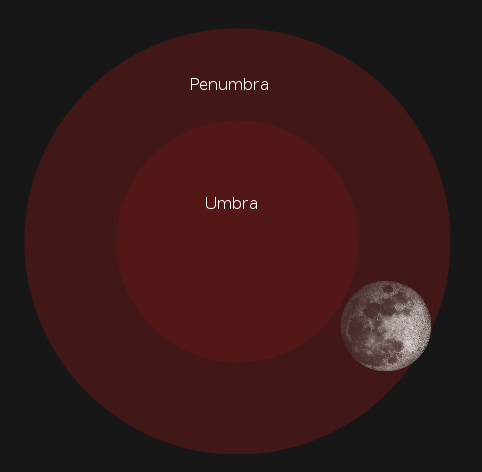
This is the maximum of the February 10th penumbral lunar eclipse. The Moon will appear to move diagonally down to the left. It is shown at maximum eclipse at 7:45 p.m. (0:45 UT February 11). Created using Cartes du Ciel.
Shadows are, of course, invisible unless they are cast on an object, so the Moon would appear alone, though the upper left part of it would be noticeably dimmer than the opposite side.
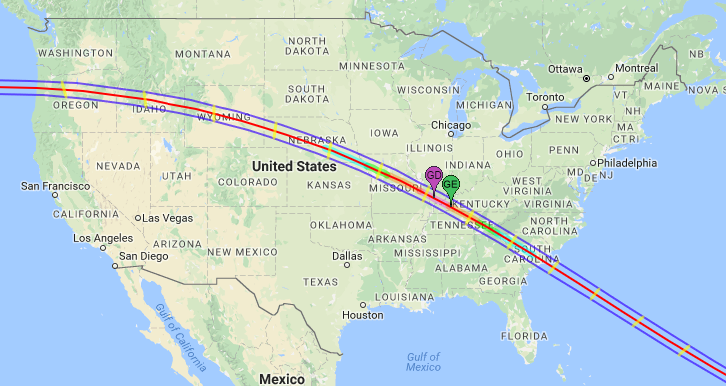
A screen cap of the map showing the path of totality of the August 21, 2017 total solar eclipse from NASA’s eclipse page. Credit: NASA and Google Maps. Click on image to enlarge.
Click here to go to the page where this interactive map is located. The magenta marker with GD is the point with the greatest duration of totality of 2 minutes 40.2 seconds. The green marker with GE denotes where the Moon’s umbral shadow is the widest. Clicking on any point on the map will pop a balloon shows all the eclipse information for viewing it from that place. The partial eclipse can be seen from all fifty states, though in Hawai’i the Sun rises with the eclipse in progress.
Here in the Grand Traverse Region, the Moon will encroach on about 8/10ths of the Sun’s diameter, covering 75% of the Sun’s face.
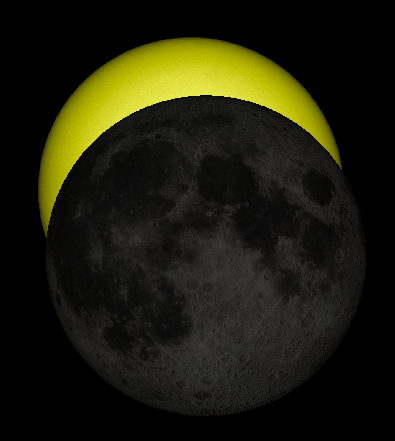
What the maximum eclipse would look like with proper filtering at Traverse City, MI. Created using Stellarium.
Eclipse Times for Traverse City
Eclipse Starts 12:58:03 p.m.
Maximum Eclipse 2:20:15 p.m.
Eclipse Ends 3:40:51 p.m.
Magnitude of the eclipse 0.798
Obscuration of the Sun 75.1%
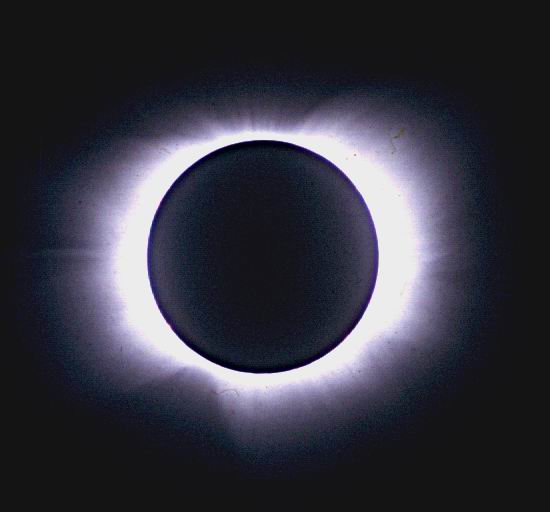
This is an inkling of what a totally eclipsed Sun looks like. No photograph can do it justice. Ya gotta be there! The solar corona displayed during the July 10, 1972* total solar eclipse from Prince Edward Island. Credit Bob Moler.
* Update: Thanks for the heads up on the typo: NationalEclipse.com.
Program Note:
I’ve developed a PowerPoint slide presentation highlighting my four total eclipses and a look at future eclipses. I will be happy to give this presentation to school groups and organizations free of charge except for mileage reimbursement over 50 miles. Contact me at bob@bjmoler.org.
December 31st – the longest day, really.
December 31st will be 24 hours and 1 second long. This “leap second” will be added as the 61st second of the minute 6:59 p.m. EST (23:59 UT). The reason is that the Earth’s rotation is slowing down ever so slightly, compared to the atomic clocks at the Bureau of Time. There is some discussion of eliminating this leap second. Most scientists want to use a constant time stream, and don’t give a hang about the rotation of the Earth. The exact time which is also affected by special and general relativity is used by GPS navigation satellites. A one second jump in time, at our latitude (45° north) is equivalent of the earth’s rotation of about two tenths of a mile. I hope everyone’s coordinated on this.
12/29/2016 – Ephemeris – Astronomical milestones of 2016
Ephemeris for Thursday, December 29th. The Sun will rise at 8:19. It’ll be up for 8 hours and 50 minutes, setting at 5:10. The Moon is new today, and won’t be visible.
Looking back at 2016 the biggest astronomical news was the detection of gravitational waves coming from two separate collisions of black holes far beyond our Milky Way galaxy. The two detectors in Washington state and in Louisiana recorded these events in September and December 2015, but the first announcement was made in February this year after the signals were cleaned up and studied. The year saw the end of the European Space Agency’s Rosetta Mission to the comet we’ve come to call 67P after orbiting it for over two years. The Opportunity and Curiosity rovers continued their exploration of Mars along with a fleet of satellites. On a sad note, we lost pioneering Mercury astronaut John Glenn at the age of 95.
Times are for the Traverse City/Interlochen area of Michigan. They may be different for your location.
Addendum
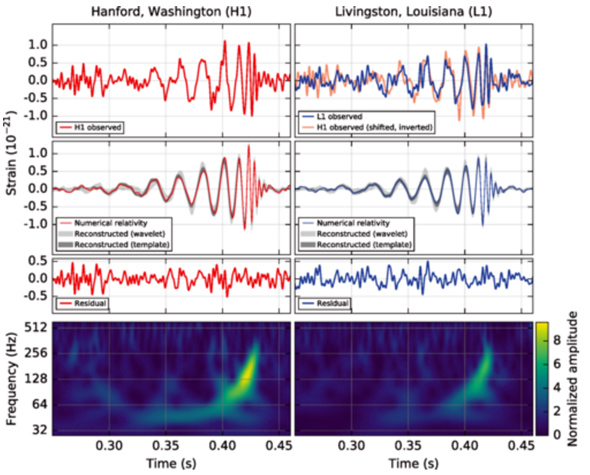
The chirp heard ’round the world and indeed the universe. Credit: LIGO/Abbot et al. 2016. Hat tip: Phil Plait, the Bad Astronomer.
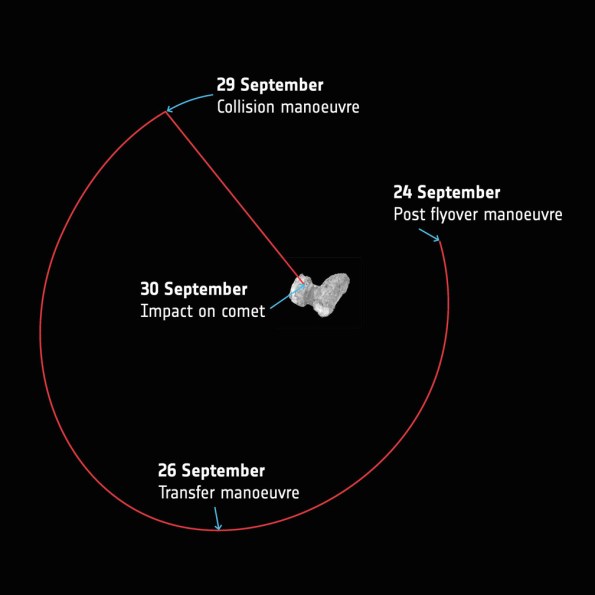
Rosetta, Final orbit. Credit & copyright European Space Agency (ESA)
12/28/2016 – Ephemeris – Our last weekly look at the bright planets for 2016
Ephemeris for Wednesday, December 28th. The Sun will rise at 8:19. It’ll be up for 8 hours and 50 minutes, setting at 5:09. The Moon, 1 day before new, will rise at 8:16 tomorrow morning.
Let’s take our last look at the bright planets for 2016. In the southeast to south before 7:30 these mornings. Jupiter can be glimpsed as the sky brightens. Jupiter will rise tomorrow at 1:53 a.m. Venus and Mars are in the evening sky. At 6:30 p.m. these planets will be seen in the southwestern sky. Venus is unmistakable as the brilliant evening star, Mars will be above and left of it and much dimmer. Venus will set at 9:01 p.m. Mars will set at 10:12. Mars’ setting time hasn’t changed much in the last 2 months. Venus is slowly heading northward for the rest of it’s evening appearance, and is moving higher in the sky, and is closing in on it’s greatest eastern elongation from the Sun.
Times are for the Traverse City/Interlochen area of Michigan. They may be different for your location.
Addendum
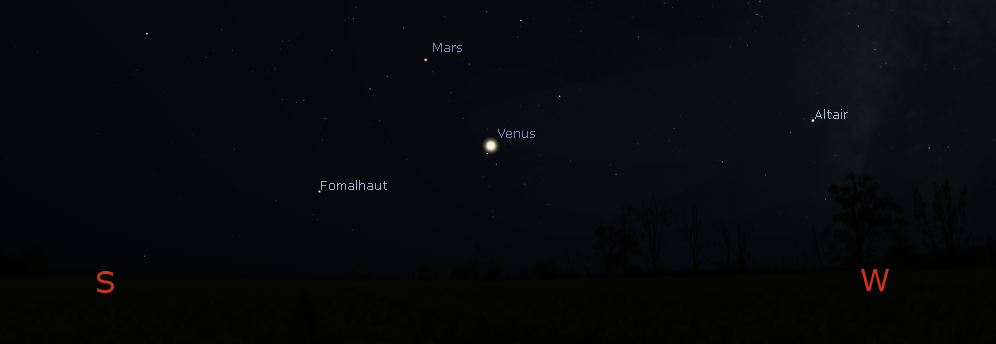
Venus and Mars in the evening twilight of about an hour and tree quarters after sunset. 7 p.m. December 28, 2016. Created using Stellarium. Click on the image to enlarge.
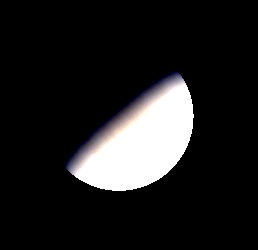
Venus as it might appear in a telescope at 7 p.m. December 28, 2016. It is 21.1′ (seconds or arc) in diameter. and 58% illuminated by the Sun.
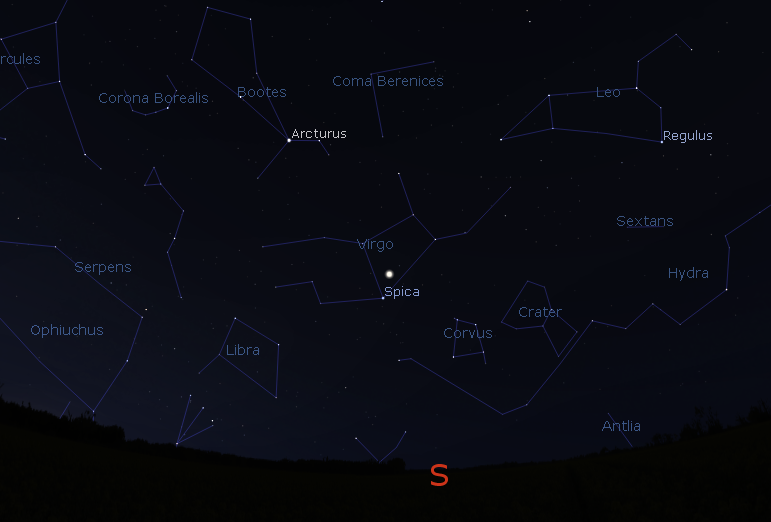
Jupiter among a preview of the spring constellations at 7 a.m. now. Created using Stellarium. Click on the image to enlarge.
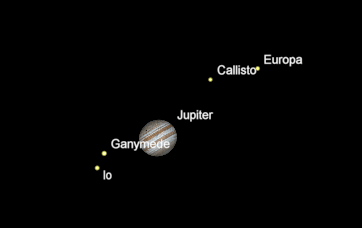
Jupiter and its moons this morning, December 28, 2016 at 7 a.m. Note the compact grouping. Created using Cartes du Ciel (Sky Charts).
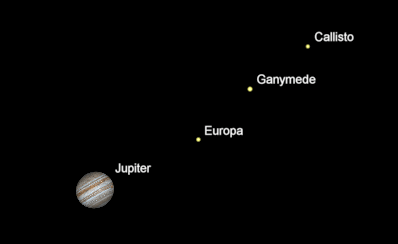
Jupiter and its moons tomorrow morning, December 29, 2016 at 7 a.m. Note that Io is missing. It was eclipsed by Jupiter’s shadow on the west (right) side of the planet at 6:10 a.m. (11:10 UT). It will reappear from behind Jupiter on the other side at 14:33 UT for observers a few time zones west of here. Created using Cartes du Ciel (Sky Charts).
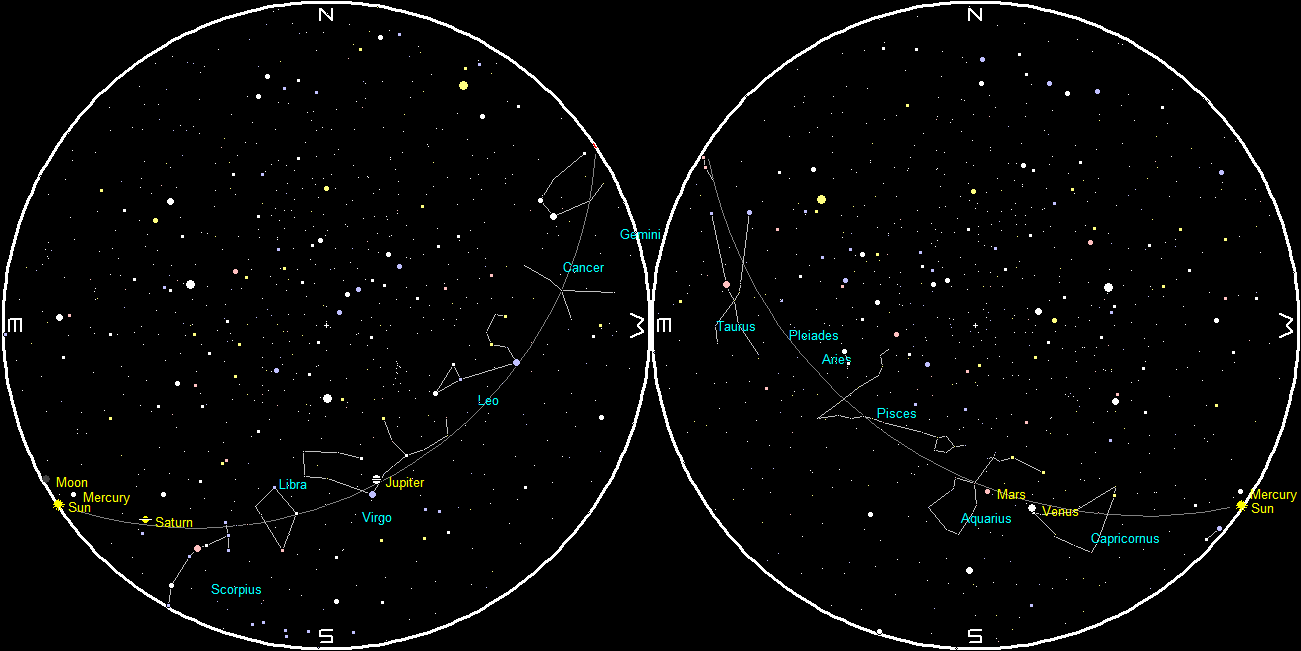
Planets and Moon at sunset and sunrise of a single night starting with sunset on the right on December 28, 2016. The night ends on the left with sunrise on December 29. Click on image to enlarge. Created using my LookingUp program.
12/27/2016 – Ephemeris – The stars of Orion
Ephemeris for Tuesday, December 27th. The Sun will rise at 8:19. It’ll be up for 8 hours and 49 minutes, setting at 5:09. The Moon, 2 days before new, will rise at 7:26 tomorrow morning.
The large and bright constellation of Orion the hunter is in the southeast at 9 p.m., with the bright star Sirius below it near the horizon. The equally spaced line of three stars of Orion’s belt are nearly vertical and point down to Sirius, also known as the Dog Star in Canis Major, Orion’s greater dog. The whole of its constellation stars aren’t up at 9 p.m., but they will all clear the horizon by 10 p.m. Those three belt stars are in the center of an elongated rectangle of stars At the top left of Orion’s shoulder stars is the red giant star Betelgeuse. The right shoulder star is Bellatrix. Both Bellatrix and Sirius along with the names of other stars and constellations should be familiar to fans of the Harry Potter novels and movies, as members of the house of Black. The knee stars at the bottom of the rectangle are, from left to right Saiph and the brilliant blue giant star Rigel. Between his belt and knees are stars of his sword.
Times are for the Traverse City/Interlochen area of Michigan. They may be different for your location.
Addendum
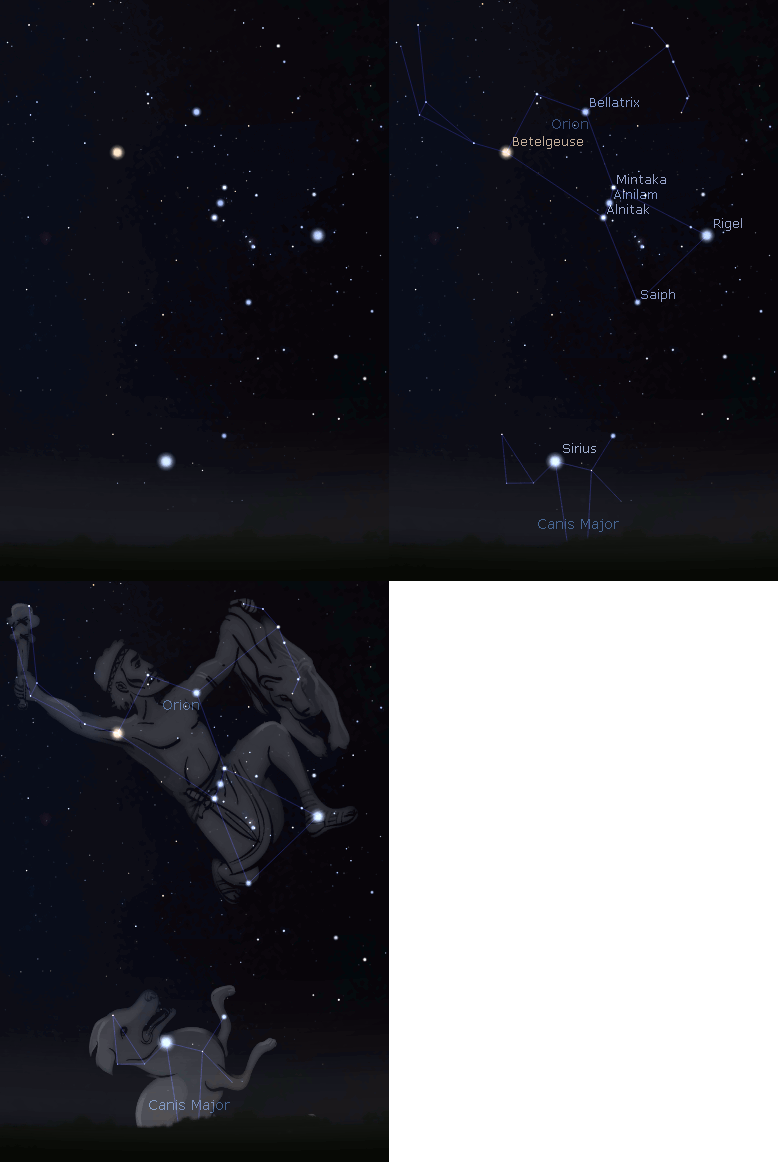
Orion, star names, and constellation art animation position for 9 p.m. December 27. Created using Stellarium and GIMP. Artist: Johan Meuris.
In the image above I’ve added the belt star names, though they are generally covered in a program of their own.
12/26/2016 – Ephemeris – Orion takes its place as the central winter constellation
Ephemeris for Monday, December 26th. The Sun will rise at 8:19. It’ll be up for 8 hours and 49 minutes, setting at 5:08. The Moon, 3 days before new, will rise at 6:33 tomorrow morning.
The great constellation of Orion the hunter has claimed his rightful position as the central winter constellation. It’s the most famous constellation of all. Think the Big Dipper is a big deal? They can’t even see it from the large population centers of Australia. Parts of Orion can be seen from every part of the Earth from pole to pole. Orion’s distinctive feature is his belt of three bright stars in a row. This tilted belt is in the center of a large rectangle of bright stars. The upper left star is Betelgeuse a red giant star. The lower right star is Rigel a blue giant star. Orion was an unlucky fellow of Greek myth. One wonders why he gets this splashy constellation in Winter while Hercules gets a dim upside down constellation in the spring sky.
Times are for the Traverse City/Interlochen area of Michigan. They may be different for your location.
Addendum
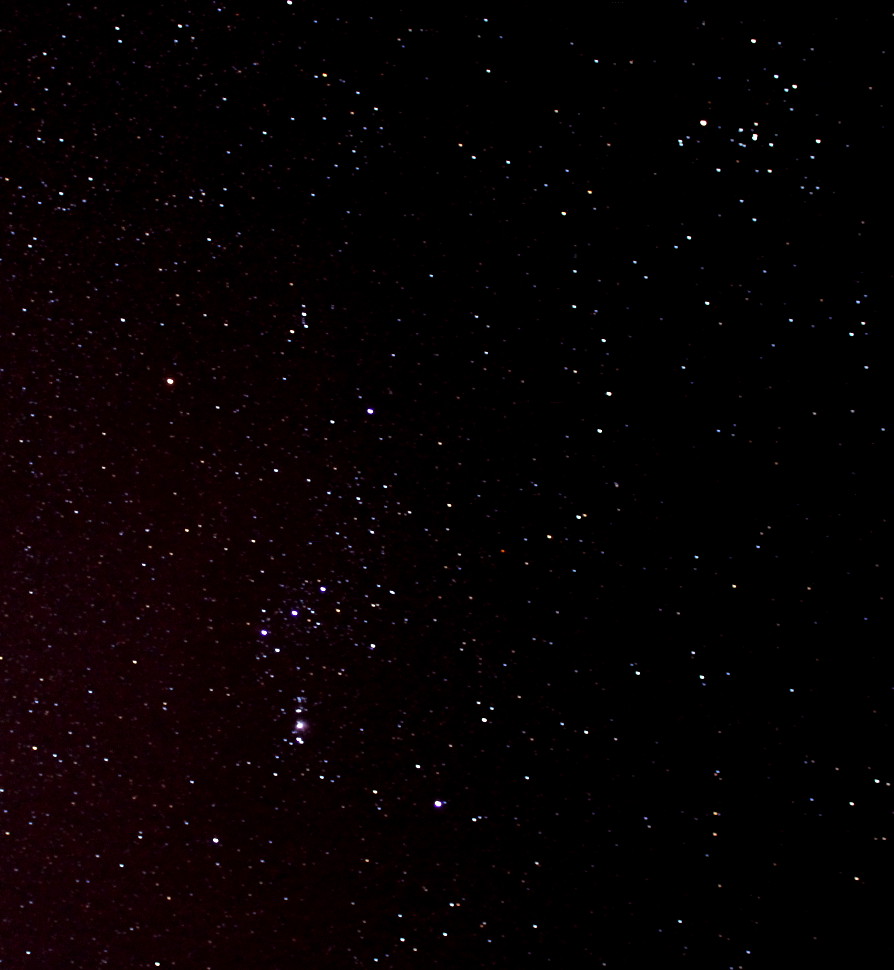
Orion and the head of Taurus photograph by myself January 4, 2016 at 11:30 p.m. It’s a stack of unguided 20 second exposures.
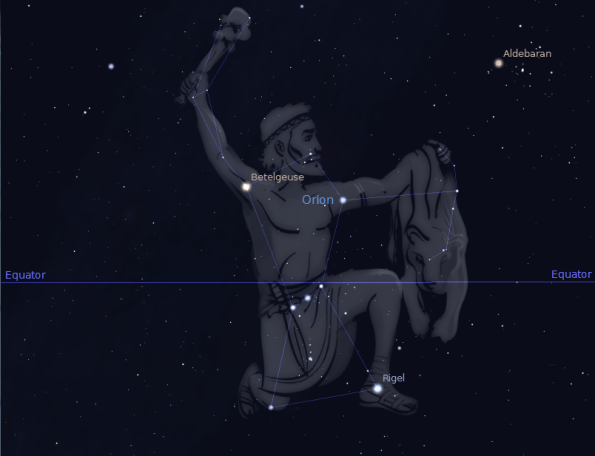
Orion from mid latitudes north of the equator. Orion would be upside down if viewed south of the equator. Created using Stellarium.
The Ephemeris radio programs are very short (59 seconds) so I will visit Orion several times during the winter to explore its mythology and deep sky wonders within, or search past posts for Orion.
12/23/2016 – Ephemeris – Another possible set of events that could have been the Star of Bethlehem
Ephemeris for Friday, December 23rd. The Sun will rise at 8:18. It’ll be up for 8 hours and 48 minutes, setting at 5:06. The Moon, 3 days past last quarter, will rise at 3:43 tomorrow morning.
The brilliant planet Venus is out evening star now, and one could say that’s its our Christmas Star. And perhaps it was, or was part of the Star of Bethlehem. Back in August of 3 BC the planet Jupiter and Venus appeared to come very close to one another. The term for such an apparent close approach is called a conjunction. Astrologers make a big deal out of such a chance alignment. It’s like a trick photo of someone in the foreground appearing to hold up or leaning on a more distant object. Anyway, 10 months later in June of 2 BC Jupiter again appeared to join Venus, this time so close they could not be separated by the human eye. This all occurred against the constellation of Leo the lion which in Genesis is the symbol of Judah.
Times are for the Traverse City/Interlochen area of Michigan. They may be different for your location.
Addendum
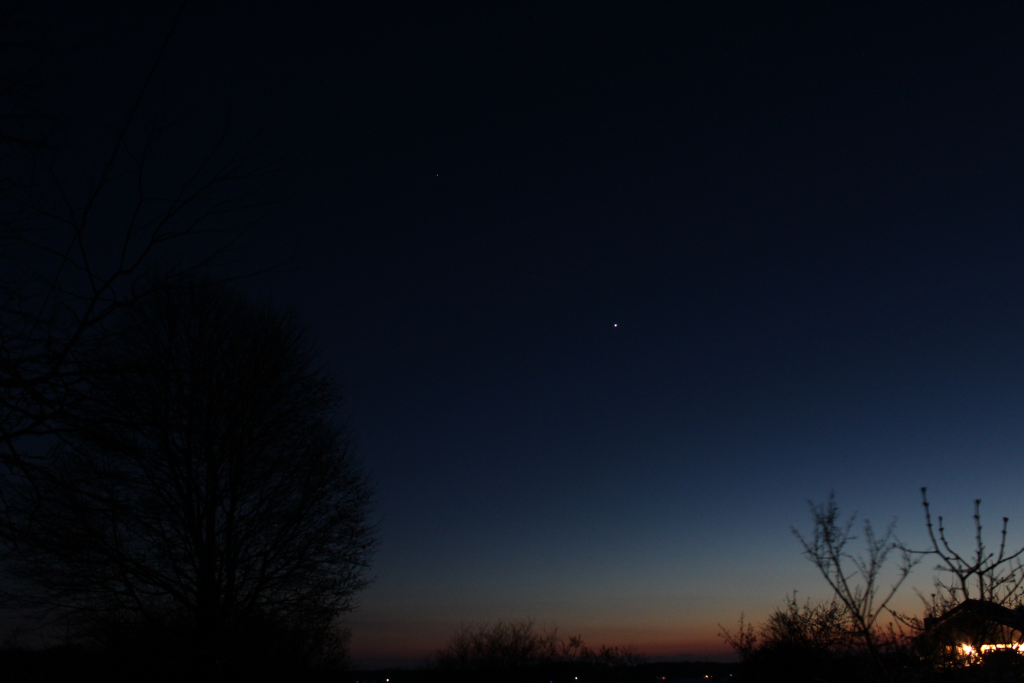
Venus and Mars in the twilight last night at 6 p.m., December 22, 2016. Photograph by Bob Moler. Click on the image to enlarge.
I have more information on this set of conjunctions in my December 2 post announcing my program on the Star of Bethlehem: https://bobmoler.wordpress.com/2016/12/02/12022016-ephemeris-my-talk-about-the-star-of-bethlehem-is-tonight/
12/22/2016 – Ephemeris – Could Jupiter and Saturn have combined to be the Star of Bethlehem?
Ephemeris for Thursday, December 22nd. The Sun will rise at 8:17. It’ll be up for 8 hours and 48 minutes, setting at 5:05. The Moon, 2 days past last quarter, will rise at 2:45 tomorrow morning.
This morning the planet Jupiter is seen right below the waning crescent Moon. It reminds me of one of the possible answers to the questions to what the Star of Bethlehem was. Back in 7 BC Jupiter passed Saturn three times in that year. This is a reasonably rare occurrence especially against a particular constellation, which in this case was Pisces the fish, which would occur every 800 plus years. Early in the run of this program there was another so-called triple conjunction of Jupiter and Saturn. This time it was against the constellation of Virgo the virgin in 1980 and 81. Jupiter passes Saturn every 20 years, but only when it does so when they are opposite the Sun in the sky is there a chance for a triple conjunction. Tomorrow I’ll look at two really close conjunctions of Jupiter and Venus that also could have been seen by the Magi as the Star of Bethlehem.
Times are for the Traverse City/Interlochen area of Michigan. They may be different for your location.
Addendum
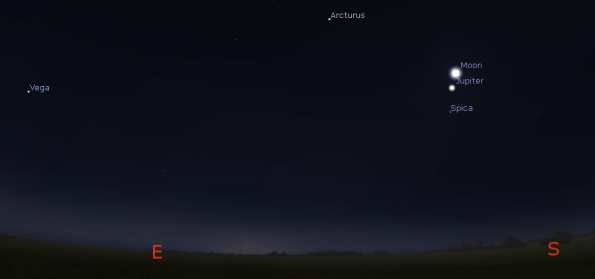
Jupiter and the Moon at 7 a.m. this morning, December 22, 2016. Created using Stellarium.
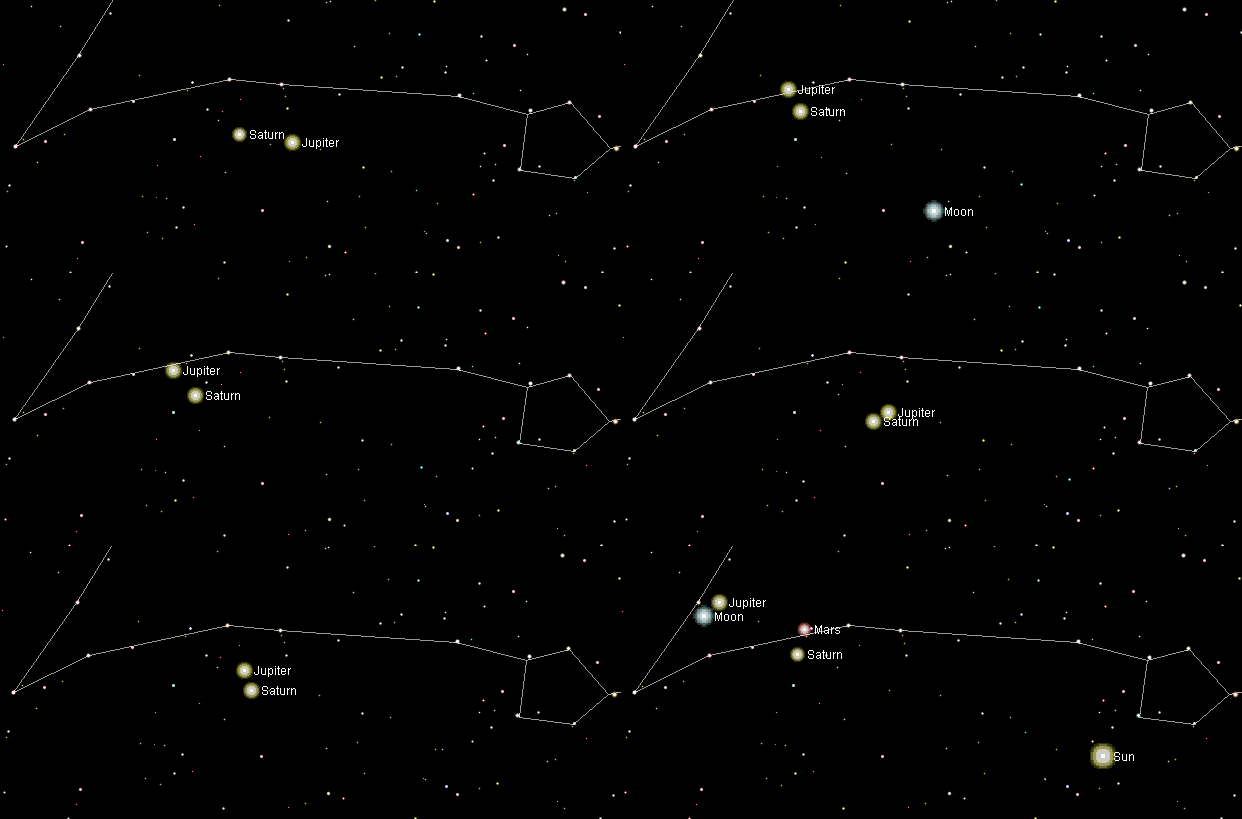
Jupiter and Saturn pass each other three times from May to December in 7 BC. Created using Cartes du Ciel (Sky Charts) and GIMP. Click image to enlarge.
12/21/2016 – Ephemeris – A look at the bright planets at the start of winter
Ephemeris for the winter solstice Wednesday, December 21st. The Sun will rise at 8:17. It’ll be up for 8 hours and 48 minutes, setting at 5:05. The Moon, 1 day past last quarter, will rise at 1:46 tomorrow morning.
Let’s look at the naked eye planets now that it’s officially winter as of 5:45 a.m. In the east-southeast before 7:30 these mornings. Jupiter can be glimpsed in the morning twilight. Jupiter will rise tomorrow at 2:16 a.m. and will appear below the Moon. Venus and Mars are in the evening sky. At 6 p.m. these planets will be seen in the southwest and low in the sky. Venus is unmistakable as the brilliant evening star, Mars will be above and left of it. Venus will set at 8:46. Mars will set at 10:12. Mars’ setting time hasn’t changed much in the last 2 months. Venus is slowly heading northward for the rest of it’s evening appearance, and is moving higher in the sky, and is closing in on it’s greatest eastern elongation from the Sun.
Times are for the Traverse City/Interlochen area of Michigan. They may be different for your location.
Addendum
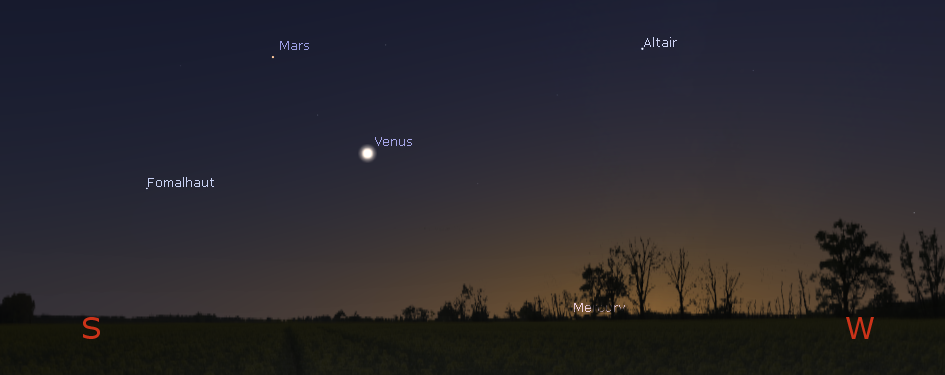
Venus and Mars in the evening twilight of about an hour after sunset. 6 p.m. December 21, 2016. Created using Stellarium.
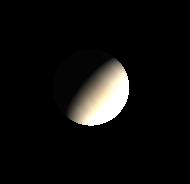
Venus as it might be seen in a telescope at 6 p.m. December 21, 2016. Created using Stellarium.
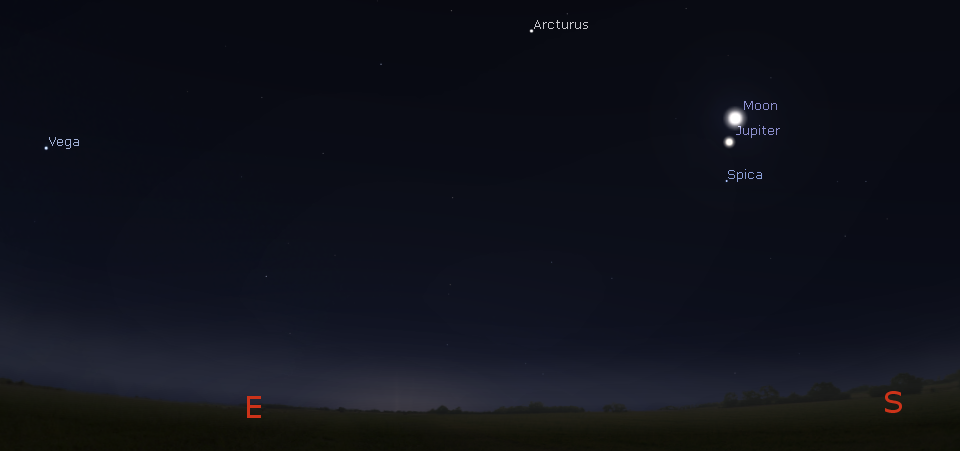
Jupiter and the Moon at 7 a.m. December 22, 2016. Created using Stellarium.
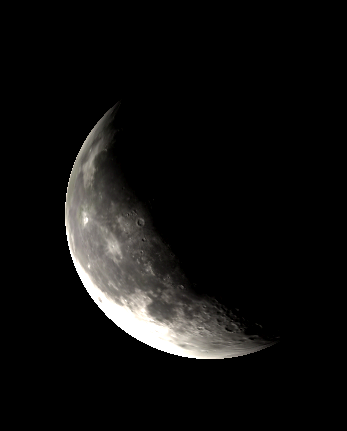
The Moon as it might appear in binoculars at 7 a.m. December 22, 2016. Created using Stellarium.
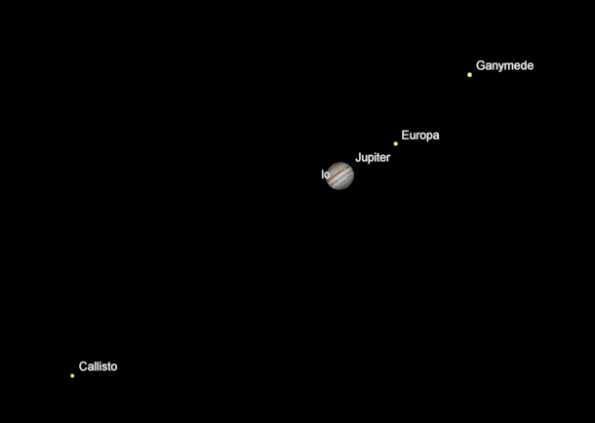
Jupiter and its Galilean moons at 7 a.m. December 22, 2016. Io is behind Jupiter at this time, however it will clear the planet by 7:38 a.m. EST (12:38 UT). Created using Cartes du Ciel (Sky Charts).
Update 8:10 a.m.
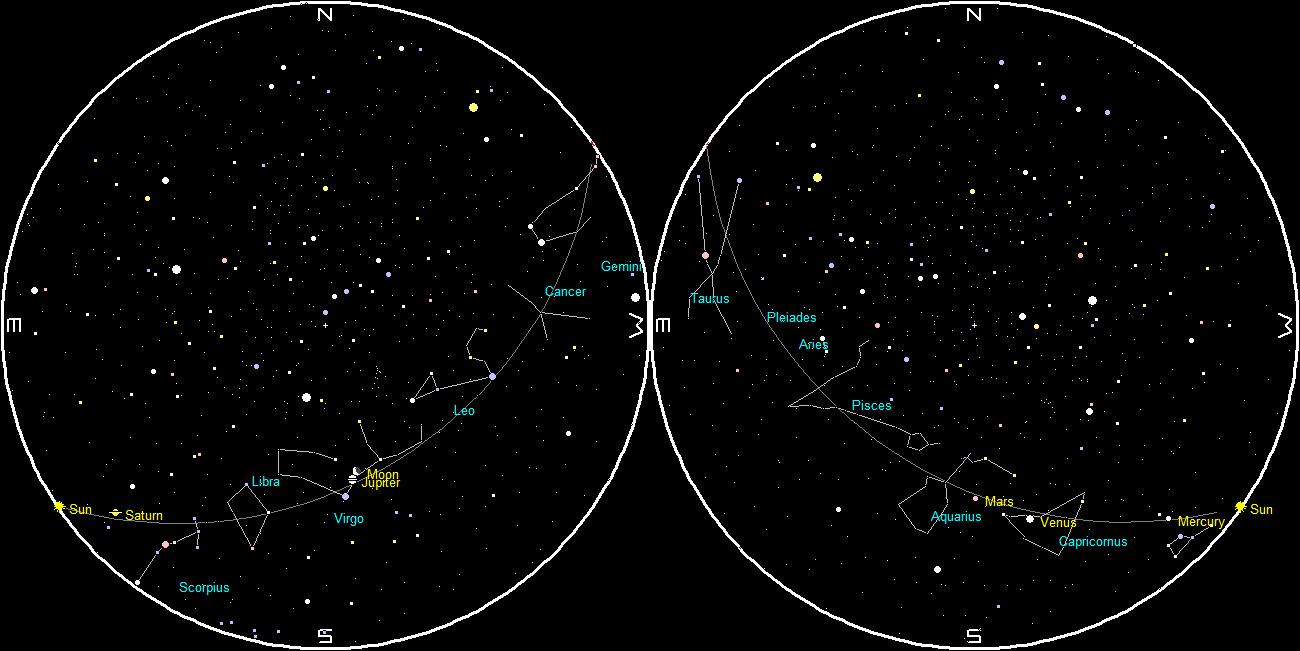
Planets and Moon at sunset and sunrise of a single night starting with sunset on the right on December 21, 2016. The night ends on the left with sunrise on December 22. Click on image to enlarge. Created using my LookingUp program.

