Archive
05/16/2016 – Ephemeris – The Sun rises on the Bay of Rainbows
Ephemeris for Monday, May 16th. Today the Sun will be up for 14 hours and 53 minutes, setting at 9:06. The Moon, 3 days past first quarter, will set at 4:23 tomorrow morning. Tomorrow the Sun will rise at 6:11.
One of my favorite lunar formations is creeping into sunlight on the Moon this evening. Look to the upper left edge of the moon tonight. The large sea or dark area of the Moon, the Man in the Moon’s right eye as he’s looking at us is Mare Imbrium, the Sea of Showers. At the top left edge of that sea is a large notch. And keeping with of seas these of the first telescopic astronomers its name is Sinus Iridium, or Bay of Rainbows, a colorful name for something as colorless as the rest of the Moon. The terminator which is the sunrise line will be cutting across that bay, illuminating the semicircular mountain ring that surrounds it before all of the floor is illuminated. It can be seen in binoculars or a small telescope.
Times are for the Traverse City/Interlochen area of Michigan. They may be different for your location.
Addendum
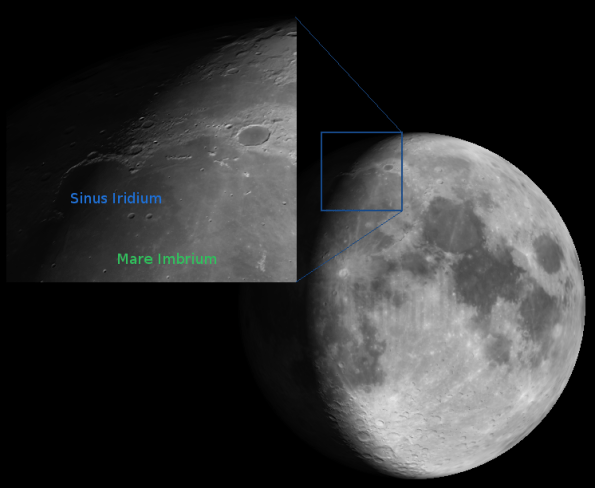
Image showing the Moon tonight at 10 p.m., May 16, 2016 (2 hr, May 17, 2016 UT) with Sinus Iridium (Bay of Rainbows) just coming into sunlight. Created using the Virtual Moon Atlas.
05/13/2016 – Ephemeris – GTAS Astronomy Day tomorrow
Ephemeris for Friday, May 13th. Today the Sun will be up for 14 hours and 46 minutes, setting at 9:02. The Moon, at first quarter today, will set at 2:59 tomorrow morning. Tomorrow the Sun will rise at 6:15.
The Grand Traverse Astronomical Society will host a public viewing night for Astronomy Day tomorrow night, that’s Saturday the 14th, starting at 9 p.m. It will be at Northwestern Michigan College’s Joseph Rogers Observatory. If its clear the slightly gibbous moon will be featured along with Jupiter, Mars and the ringed planet Saturn and other wonders of the spring sky. The observatory is located south of Traverse City, on Birmley Road between Garfield and Keystone roads. For the society these, twice monthly star parties at the observatory and sidewalk astronomy outings by members, to the Sleeping Bear Dunes National Lakeshore and other locations are what they do.
Times are for the Traverse City/Interlochen area of Michigan. They may be different for your location.
Other thoughts
I was checking out the Solar and Heliospheric Observatory (SOHO) LASCO C3 animation and Venus is making an entrance from the right as it heads for superior conjunction on June 6. June 6? Hmm. Wasn’t that last transit or Venus on June 5th 2012. We and Venus should be near the line of nodes again, where the planes of our respective orbits cross. I cranked up Stellarium, and sure enough the Sun will occult Venus that day… Not that we could see it.
05/12/2016 – Ephemeris – The Moon tonight
Ephemeris for Thursday, May 12th. Today the Sun will be up for 14 hours and 44 minutes, setting at 9:01. The Moon, 1 day before first quarter, will set at 2:26 tomorrow morning. Tomorrow the Sun will rise at 6:16.
The moon tonight is a fat crescent. In binoculars the small Sea of Crises is prominently located as a gray patch at the edge of the moon. The Sea of Fertility is below it, while the sea of Tranquility is between them and near the terminator, the sunrise line on the moon. In telescopes there are three craters south of Tranquility, most prominent of which is Theophilus. With its prominent central peak. Farther to the north of Crises and near the partially exposed Sea of Serenity is the crater Posidonius, larger than Theophilus, but has a double crater wall on one side. Larger telescopes can see cracks in its floor . It has no central peak, and shows its age of maybe three and a half billion years.
Times are for the Traverse City/Interlochen area of Michigan. They may be different for your location.
Addendum
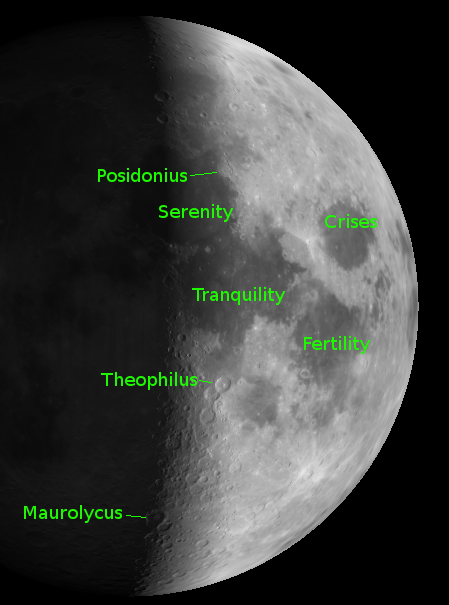
The Moon at 10 p.m. May 12, 2016. Created using Virtual Moon Atlas.
05/11/2016 – Ephemeris – Three of the bright planets are seen before midnight
Ephemeris for Wednesday, May 11th. Today the Sun will be up for 14 hours and 41 minutes, setting at 9:00. The Moon, 2 days before first quarter, will set at 1:48 tomorrow morning. Tomorrow the Sun will rise at 6:17.
Let’s see what the bright naked eye planets are up to. Mercury is now officially in the morning sky but too close to the Sun to be seen. Jupiter is in the south in the early evening, and will pass due south at 9:22 p.m., and will set at 3:55a.m. It’s below the stars of Leo this year. Binoculars can make out some of Jupiter’s moons, but a telescope is required to see all four bright moons and Jupiter’s cloud features. Mars will rise at 10:33 p.m. in the east-southeast. It’s still above its look-a-like star Antares, whose name means Rival of Mars. Mars is getting closer to the Earth now, only 50 million miles away It will be closest on the 30th. Saturn will rise at 10:41 p.m. in the east-southeast. It’s just left of Mars.
Times are for the Traverse City/Interlochen area of Michigan. They may be different for your location.
Addendum
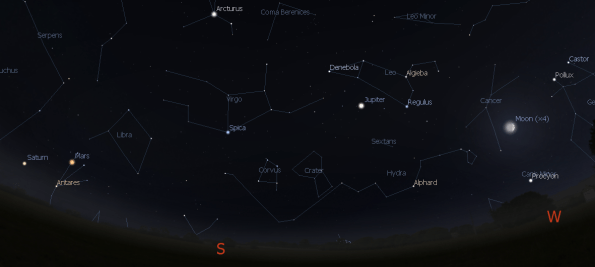
The evening sky tonight at 11:30 p.m. Created using Stellarium.
05/10/2016 – Ephemeris – The lunar Sea of Crises
Ephemeris for Tuesday, May 10th. The Sun rises at 6:19. It’ll be up for 14 hours and 39 minutes, setting at 8:59. The Moon, 3 days before first quarter, will set at 1:04 tomorrow morning.
Tonight the Moon shows one remarkable sea: Mare Crisium or the Sea of Crises. It is a large gray basin. The largest feature visible in binoculars. Because it’s near the Moon’s limb or edge it is foreshortened into an ellipse, with the long axis running north and south. In actuality it is elliptical with the long axis east and west. It looks funny on a geologic map of the whole moon or a Moon globe. Its dimensions are 345 by 375 miles (570 by 620km). It’s really a crater as are all seas whose impact asteroid reached down to the Moon’s magma and caused lava to well up to produce the flat floor. When the sunlight is low as it is now wrinkle ridges will appear showing where successive lava flows have stopped and solidified.
Times are for the Traverse City/Interlochen area of Michigan. They may be different for your location.
Addendum
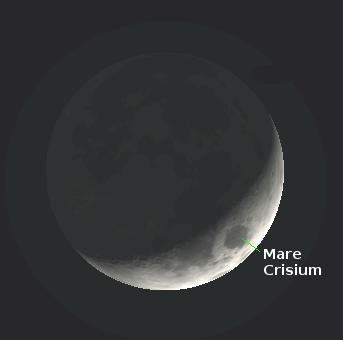
The Moon’s approximate orientation and phase at May 10, 2016. Created using Stellarium.
05/09/2016 – Ephemeris – The transit of Mercury is today!
Ephemeris for Monday, May 9th. The Sun rises at 6:21. It’ll be up for 14 hours and 36 minutes, setting at 8:58. The Moon, 3 days past new, will set at 12:12 tomorrow morning.
In less than an hour from now the planet Mercury will begin to cross the face of the Sun. It starts at 7:12 a.m. The transit will end at 2:42 this afternoon. Mercury is a tiny planet making a tiny dot against the face of the Sun, and smaller than any sunspot. If it’s clear or when its clear come out and view part of the transit. The Northwestern Michigan College’s Rogers Observatory will be open for that period. Also telescopes with be stationed at the Dune Climb at the Sleeping Bear Dunes National Lakeshore by yours truly to view the transit. The event is not visible to the naked eye and dangerous to even attempt. If you miss this transit, there will be another in 2019, 3 ½ years from now. After that, a Mercury transit visible from here will have to wait until 2049.
Times are for the Traverse City/Interlochen area of Michigan. They may be different for your location.
Addendum
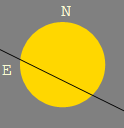
The track of Mercury across the face of the Sun. Mercury will travel from upper left to lower right. Mercury will not be visible until it impinges upon the disk of the Sun. Credit IOTA’s program Occult4.
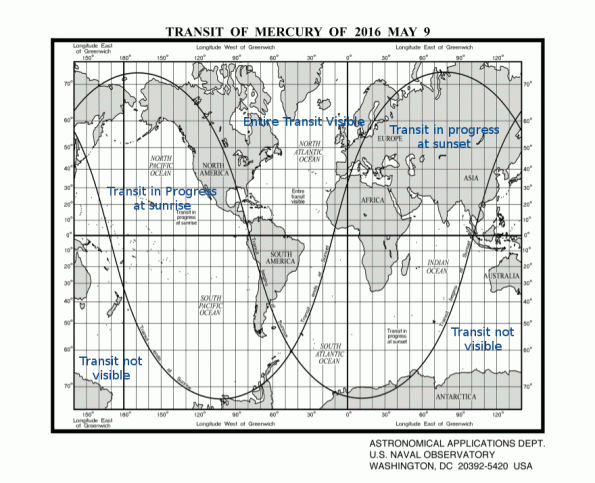
Transit visibility map with added captions to make it more readable. Credit United States Naval Observatory, The Astronomical Almanac Online.
For more information see my prior day’s posts.
05/06/2016 – Ephemeris – Learn about Monday’s transit of Mercury tonight
Ephemeris for Friday, May 6th. The Sun rises at 6:25. It’ll be up for 14 hours and 29 minutes, setting at 8:54. The Moon is new today, and won’t be visible.
Learn more about next Monday’s transit of Mercury across the Sun at tonight’s meeting of the Grand Traverse Astronomical Society at 8 p.m. at the Northwestern Michigan College’s Rogers Observatory, on Birmley Road, South of Traverse City. Afterward at 9 p.m., there will be another program and weather permitting there will be viewing of Jupiter, and later Mars. On Monday the Society will host transit viewing at two locations. The transit runs 6 ½ hours from 7:12 a.m. to 2:42 p.m. The Rogers Observatory will be open for that period. Also telescopes with be stationed at the Dune Climb at the Sleeping Bear Dunes National Lakeshore by yours truly to view the transit. The event is not visible to the naked eye and dangerous to even attempt it.
The program will also preview the coming opposition of Mars and closest approach since 2003 on the 30th.
Times are for the Traverse City/Interlochen area of Michigan. They may be different for your location.
Addendum
I posted these yesterday, but here they are again:
Transit visibility map with added captions to make it more readable. Credit United States Naval Observatory, The Astronomical Almanac Online.
The track of Mercury across the face of the Sun. Mercury will travel from upper left to lower right. Mercury will not be visible until it impinges upon the disk of the Sun. Credit IOTA’s program Occult4.
From IOTA’s Occult4 program
Transit of Mercury on 2016 May 9 (TT)
   {'+' => next day; '-' => previous day }
                                           Overhead at
     Geocentric Event      UTC         P.A.  Long  Lat
                         h  m  s       o      o    o
[1]  Exterior Ingress   11 12 16     83.1     11   17
[2]  Minimum Separation 14 57 38             -45   18
[3]  Exterior Egress    18 42 23    224.4   -102   18

Minimum sepn 318.5";  Radii - Sun 950.4", Mercury 6.0"
delta T =  68.2 secs,  Ephemeris = DE0
Note: These timings are geocentric. Occult4 has timings for various cities of the world. Occult4.0.2 can be downloaded here. They can vary by several minutes for different cities due to parallax.
I will post more information on the transit in an Ephemeris Extra tomorrow.
05/05/2016 – Ephemeris – Previewing Monday’s transit of Mercury
Ephemeris for Thursday, May 5th. The Sun rises at 6:26. It’ll be up for 14 hours and 26 minutes, setting at 8:53. The Moon, 1 day before new, will rise at 6:38 tomorrow morning.
Next Monday, the 9th, the tiny planet Mercury will be seen to cross that face of the Sun. Astronomers call such an event a transit. The last time a planet crossed the face of it Sun, it was Venus on June 5th, 2012, almost 4 years ago. Very few, who were alive in 2012 will be around to see the next transit of Venus in 2117. Transits of Mercury are more frequent. Mercury will cross the face of the Sun from 7:12 a.m. to 2:42 p.m. on Monday. Mercury is too small to see with eclipse filters or with the naked eye. The latter could cause blindness. Only telescopes with solar filters that fit over the front of the telescope are safe to use. Mercury will be a tiny black dot, smaller than most sunspots. Tomorrow I’ll have information about where to go to see it.
Times are for the Traverse City/Interlochen area of Michigan. They may be different for your location.
Addendum
Transit visibility map with added captions to make it more readable. Credit United States Naval Observatory, The Astronomical Almanac Online! 2016
The track of Mercury across the face of the Sun. Mercury will travel from upper left to lower right. Mercury will not be visible until it impinges upon the disk of the Sun. Credit IOTA’s program Occult4.
From IOTA’s Occult4 program
Transit of Mercury on 2016 May 9 (TT)
   {'+' => next day; '-' => previous day }
                                           Overhead at
     Geocentric Event      UTC         P.A.  Long  Lat
                         h  m  s       o      o    o

[1]  Exterior Ingress   11 12 16     83.1     11   17
[2]  Minimum Separation 14 57 38             -45   18
[3]  Exterior Egress    18 42 23    224.4   -102   18

Minimum sepn 318.5";  Radii - Sun 950.4", Mercury 6.0"
delta T =  68.2 secs,  Ephemeris = DE0
Note: These timings are geocentric. Occult4 has timings for various cities of the world. Occult4.0.2 can be downloaded here. They can vary by several minutes for different cities due to parallax.
05/04/2016 – Ephemeris – There are three bright planets out by midnight
Ephemeris for Wednesday, May 4th. The Sun rises at 6:27. It’ll be up for 14 hours and 24 minutes, setting at 8:52. The Moon, 2 days before new, will rise at 5:59 tomorrow morning.
Let’s see what the bright naked eye planets are up to. Mercury is too close to the Sun to be seen. However next Monday it will be so close to the Sun that we’ll see it cross the Sun’s face. Jupiter is in the south in the early evening, and will pass due south at 9:49 p.m., and will set at 4:23 a.m. It’s below the stars of Leo this year. Binoculars can make out some of Jupiter’s moons, but a telescope is required to see all four bright moons and Jupiter’s cloud features. Mars will rise at 10:33 p.m. in the east-southeast. It’s still above its look-a-like star Antares, whose name means Rival of Mars. Mars is getting closer to the Earth now, only 52.2 million miles. 5 and a half million miles to go. Saturn will rise at 11:06 p.m. in the east-southeast. It’s just left of Mars.
Times are for the Traverse City/Interlochen area of Michigan. They may be different for your location.
Addendum
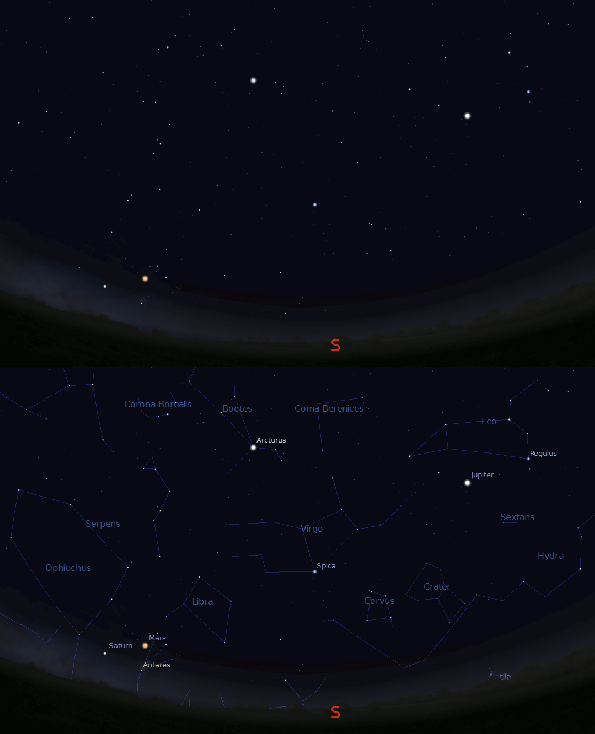
Jupiter, Mars and Saturn at midnight 12:00 a.m. May 5, 2016. Created using Stellarium.
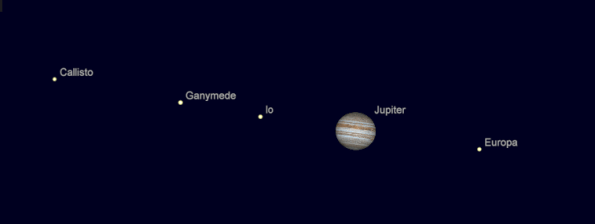
Jupiter and its moons as they might be seen through a telescope at 12 midnight May 5, 2016. It’s 40.3″ in diameter. Created using Cartes du Ciel (Sky Charts).
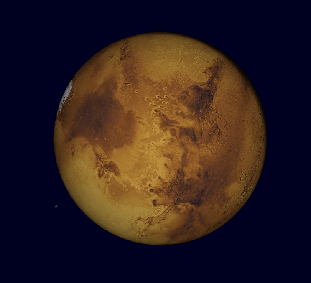
Mars as it might be seen in a large telescope with high power at midnight May 5, 2016. Mars apparent diameter is 16.7″. The central meridian will be 26.77 degrees. Syrtis Major is the large feature in the north near the polar cap. Created using Cartes du Ciel (Sky Charts).
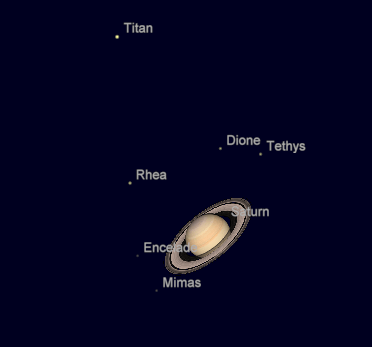
Saturn and its moons at midnight May 5, 2016. The apparent diameter of the planet will be 18.2″. The rings span 42.4″, a bit larger than the apparent diameter of Jupiter. Created using Cartes du Ciel (Sky Charts).
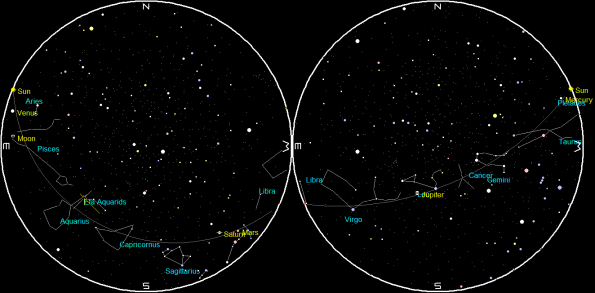
Planets at Sunrise and Sunset of a single night starting with sunset on the right on May 4, 2016. The night ends on the left with sunrise on May 5. I’ve also plotted the Eta Aquariid meteor shower radiant. If using Firefox right-click on the image and select View Image to enlarge the image. That goes for all the large images.
05/03/2016 – Ephemeris – Halley’s Comet is back… In little bitty pieces
Ephemeris for Tuesday, May 3rd. The Sun rises at 6:29. It’ll be up for 14 hours and 21 minutes, setting at 8:50. The Moon, 3 days before new, will rise at 5:23 tomorrow morning.
There’s a meteor shower happening this week that’s a tough one for observers as far north as we are. It’s the Eta Aquariids: seeming to come from the Water Jar asterism of the constellation Aquarius the water bearer. It will reach peak on Thursday the 5th, however the radiant point rises around 3:30 a.m., and twilight starts an hour and a half later. The radiant is also low in the southeastern part of the sky. The meteors are fast-moving and many of them are bright. They are bits shed by Halley’s Comet and left in its orbit. The Earth passes close to Halley’s orbit twice a year: In late October as the particles come in from the outer solar system, and again in early May as they head back out again. We’ll see souvenirs of Halley’s Comet before it returns in 2061.
Times are for the Traverse City/Interlochen area of Michigan. They may be different for your location.
Addendum
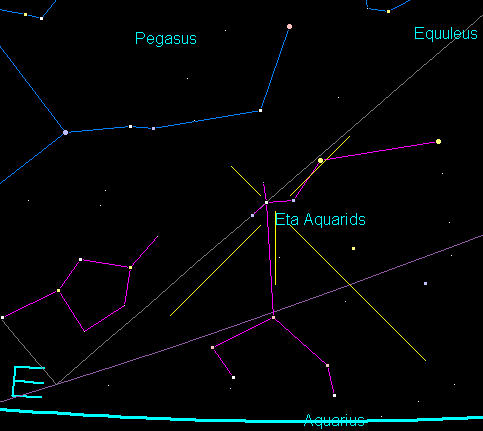
The Eta Aquarid radiant at the peak of the shower. The radiant moves slowly to the east with time. Credit: Bob Moler’s LookingUp program.
This meteor shower is low for us in the Northern Hemisphere, but it will be great for those Down Under. The Moon is even cooperating this year, by getting out of the way. The active dates for the shower are April 19th to May 28th. The velocity of the meteoroids that strike the atmosphere is 66 km/s. Halley’s Comet, and thus its debris is traveling in a retrograde orbit, going the wrong way in a one way solar system, which is why the speed of the particles is so high.

