Archive
11/09/2015 – Ephemeris – The celestial sisters
Ephemeris for Monday, November 9th. The Sun will rise at 7:31. It’ll be up for 9 hours and 50 minutes, setting at 5:21. The Moon, 2 days before new, will rise at 6:15 tomorrow morning.
A marvelous member of the autumn skies can be found rising in the east at 8 in the evening. It is the famous star cluster called the Pleiades or the Seven Sisters. I might also add the ‘Tiny Dipper’. Many people can spot a tiny dipper shape in its six or seven stars, and mistake it for the Little Dipper. As nearsighted as I am, though corrected, I’ve never been able to see more than a few stars and a bit of fuzz. However with binoculars, over a hundred stars appear along with the dipper shape of the brightest. The fuzz I saw was unresolved stars, but in photographs the Pleiades actually contains wisps of dust that reflect the star’s blue light which the cluster is passing through. In Greek and Plains Indian mythology the sisters were young maidens.
Times are for the Traverse City/Interlochen area of Michigan. They may be different for your location.
Addenda
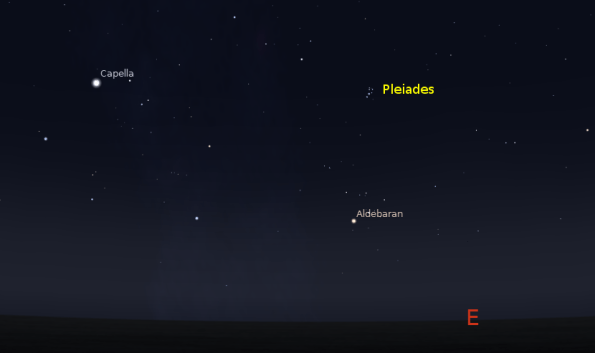
The Pleiades rising at 8 p.m. November 9th. Created using Stellarium.
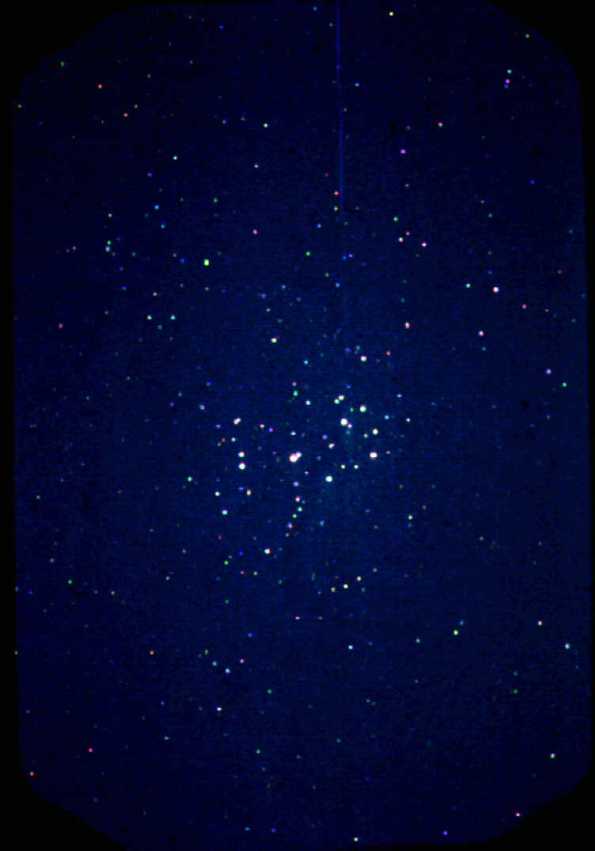
The Pleiades, about what you’d see in binoculars.
I’ll be in Cadillac tonight
I’ll be giving an illustrated talk tonight to the Cadillac Garden Club at St. Ann’s Parish in Cadillac at 7 p.m. I’ll be talking about all the ways the Sun affects the Earth. At 8 p.m., if it’s clear, I and other members of the Grand Traverse Astronomical Society will have some telescopes set up in the parking lot to view the wonders of the heavens. The meeting appears to be open to the public and the viewing after definitely is.
11/06/2015 – Ephemeris – A program about the contributions of women astronomers
Ephemeris for Friday, November 6th. The Sun will rise at 7:27. It’ll be up for 9 hours and 57 minutes, setting at 5:25. The Moon, 3 days past last quarter, will rise at 3:21 tomorrow morning.
The Moon will be close to the planet Jupiter this morning and closer to Venus tomorrow morning. Check them out if it’s clear. Tonight however, there is a meeting of the Grand Traverse Astronomical Society featuring a graduate from Northwestern Michigan College and the astronomy program: Becky Shaw who will present a talk Women in Astronomy. I especially recommend this for girls interested in the STEM fields, that is Science, Technology, Engineering and Math to find out the wonderful contributions these women have made. Astronomy, by the way encompasses all the STEM fields. The meeting starts at 8 p.m. at Northwestern Michigan College’s Rogers Observatory on Birmley Road, south of Traverse City. At 9 p.m. the will also be star party if it’s clear.
Times are for the Traverse City/Interlochen area of Michigan. They may be different for your location.
Addendum
From yesterday’s post a reminder of the Moon’s procession past the morning planets starting this a.m.
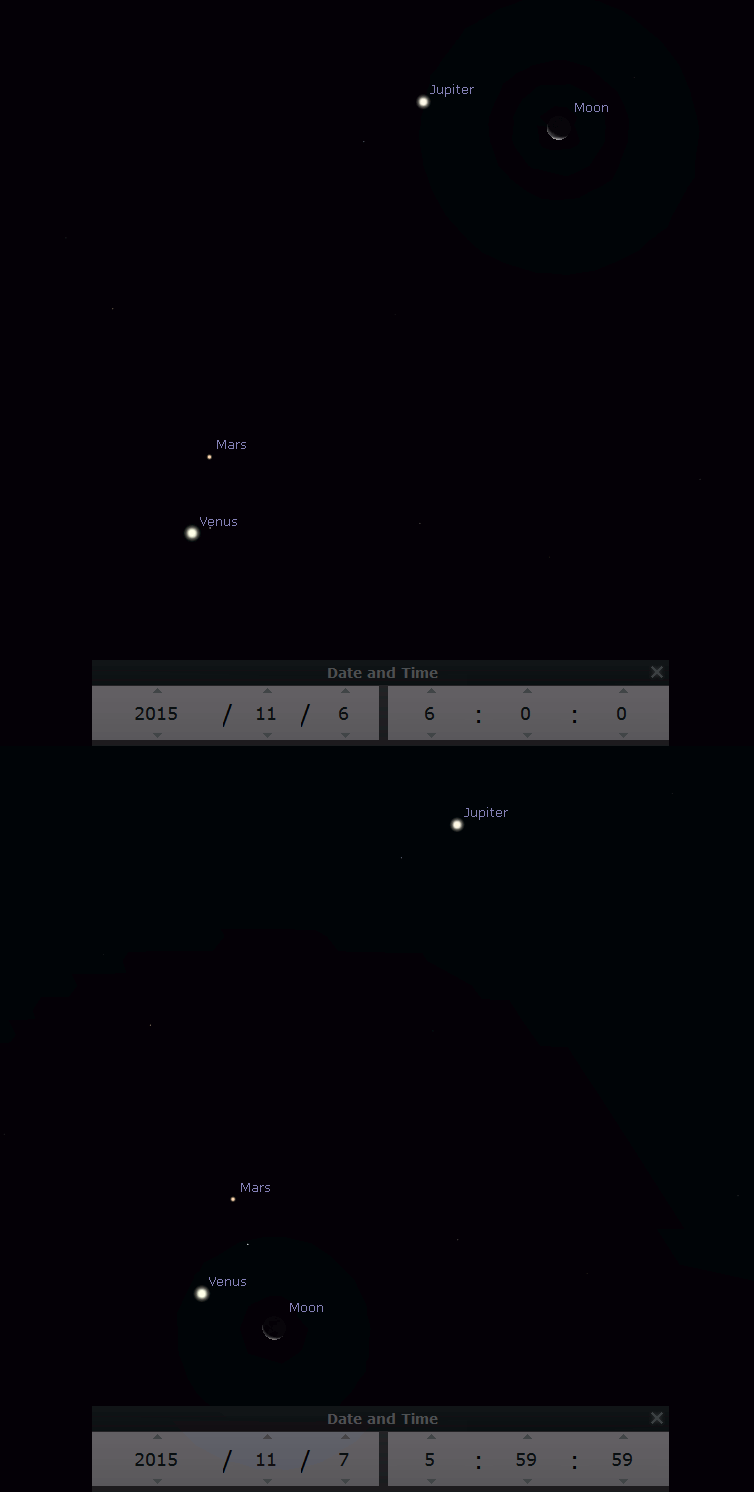
Animation of the Moon passing Jupiter this morning ans Mars and Venus tomorrow morning. Created using Stellarium and GIMP.
What’s with the 5:59:59 time for the 7th? This is what happens when you store and compute time as a binary computer value (base 2) and display it as a sexagesimal (base 60) number. Thanks Sumerians.
11/05/2015 – Ephemeris – The Moon will be among the morning planets in the next two days
Ephemeris for Thursday, November 5th. The Sun will rise at 7:25. It’ll be up for 10 hours and 0 minutes, setting at 5:26. The Moon, 2 days past last quarter, will rise at 2:23 tomorrow morning.
Over the next two mornings the Moon will pass, first, the planet Jupiter and then on Saturday Mars and Venus. These will be readily visible at 6 a.m. and less so at 7 a.m. when twilight is brighter. This month and next we will have two times the Moon will actually pass in front of another bright celestial object. Both will occur in the morning. These events are called occultations. The first will be an occultation of the bright star Aldebaran, the bright star in Taurus the bull, which I sometimes call the bull’s angry bloodshot eye. That will occur on the morning of November 26th. The next will be really spectacular. On December 7th the crescent Moon will occult the planet Venus. I’ll keep you updated on both these events.
Times are for the Traverse City/Interlochen area of Michigan. They may be different for your location.
Addendum
Animation of the Moon passing Jupiter tomorrow morning and Mars and Venus Saturday morning. Created using Stellarium and GIMP.
11/04/2015 – Ephemeris – Most of the bright planet action is in the morning
Ephemeris for Wednesday, November 4th. The Sun will rise at 7:24. It’ll be up for 10 hours and 3 minutes, setting at 5:27. The Moon, 1 day past last quarter, will rise at 1:25 tomorrow morning.
Let’s check out the whereabouts of the bright naked eye planets. The numbers of visible planets is getting a bit thin. The planet Saturn will be low in the west-southwest after sunset and will set at 6:41 p.m. It would be as hard to find as Mercury would be at its best in the evening sky. And Mercury itself is too close to the direction of the Sun to be spotted. However in the morning sky there are three bright planets. Jupiter will be the first to rise, at 2:34 a.m. in the east-northeast. Mars and Venus will rise within 5 minutes of each outer by 3:20 a.m. Mars will be almost directly above Venus by a degree or two Moon diameters. Friday and Saturday mornings the Moon will appear near these planets.
Times are for the Traverse City/Interlochen area of Michigan. They may be different for your location.
Addendum
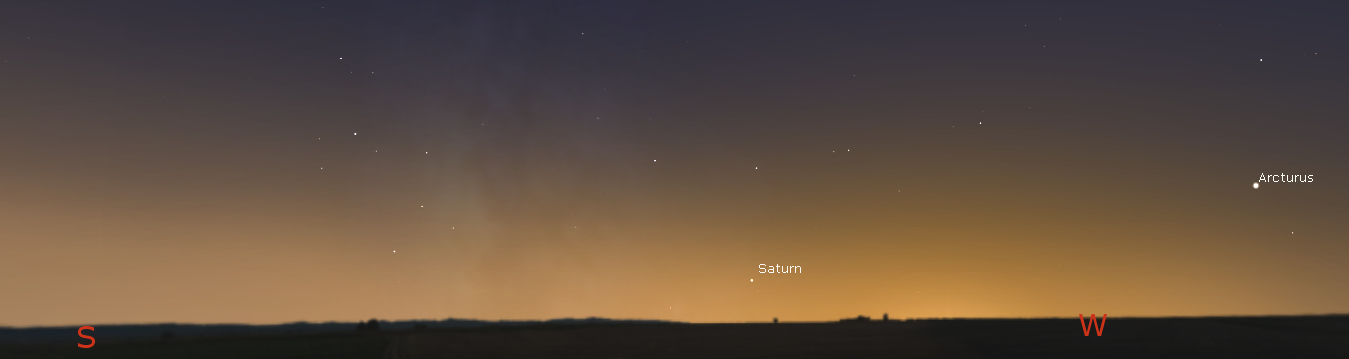
Saturn’s pretty low to the horizon at 6:15 p.m. November 4, 2015. Created using Stellarium. Click on image to enlarge.
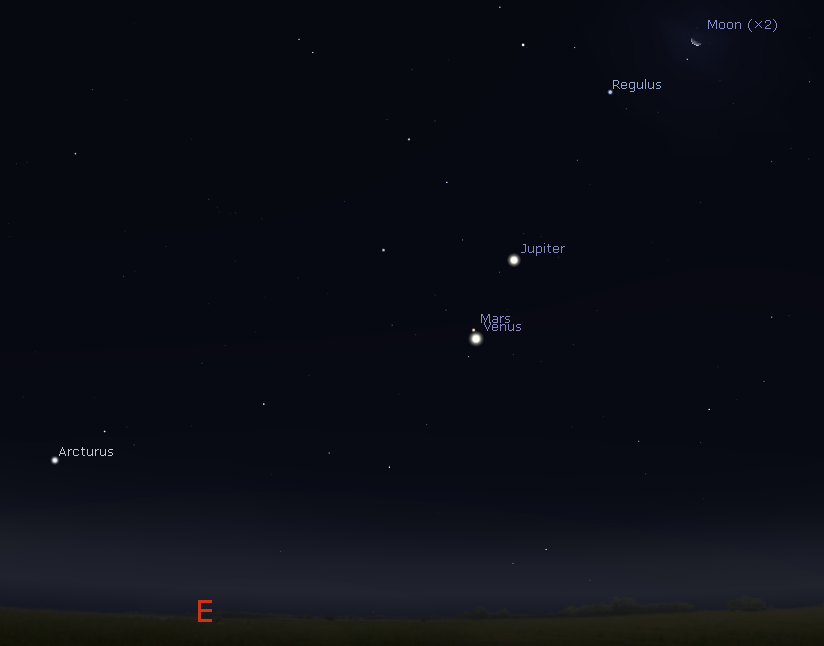
Mars is still close to Venus with Jupiter nearby in the southeast at 6 a.m. November 5, 2015. Created using Stellarium.
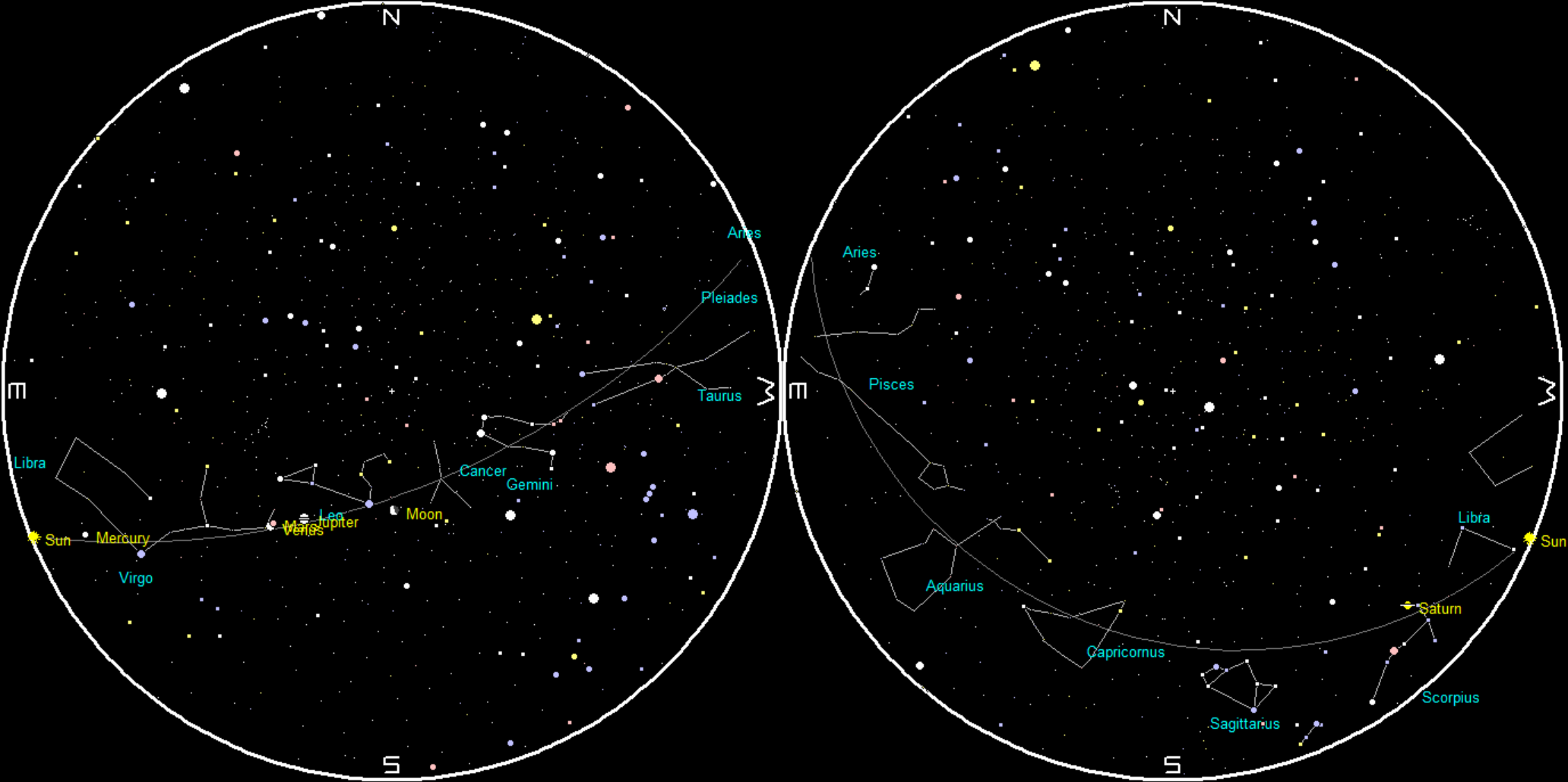
This is a chart showing the sunrise and sunset skies for November 4, 2015 showing the location of the planets and the Moon at that time. Created using my LookingUp program. Click on the image to enlarge.
10/03/2015 – Ephemeris – Venus and Mars pass each other this morning
Ephemeris for Tuesday, November 3rd, election day for some localities. The Sun will rise at 7:23. It’ll be up for 10 hours and 5 minutes, setting at 5:29. The Moon, at last quarter today, will rise at 12:26 tomorrow morning.
This morning the planets Mars and Venus will cross paths. Mars, which is much dimmer, will appear about 2 Moon diameters above and left of Venus. In fact if you view them at 7 a.m., binoculars may be your only hope to spot the red planet. Mars is a small planet, half the size of the Earth or Venus. It also farther from the Sun than either Venus or the Earth. When Mars is at its closest to the Earth it is actually brighter than Jupiter, but Mars varies its distance from the Earth by a great range, from 240 million miles (386 million km) at its greatest distance to about 35 million miles (56 million km) at its nearest. At its farthest, Mars is only as bright as a Big Dipper star. Venus and Jupiter also vary their brightness but to a smaller degree than Mars.
Times are for the Traverse City/Interlochen area of Michigan. They may be different for your location.
Addendum
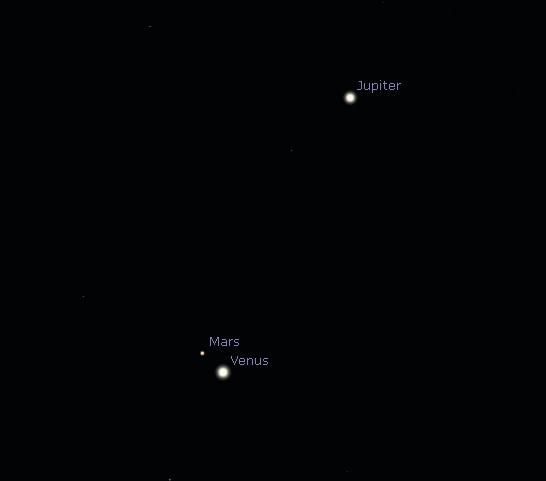
Venus in conjunction with Mars with Jupiter nearby in the southeast at 6 a.m. November 3, 2015. Created using Stellarium.
Venus is magnitude -3.95, distance is 113 million km, or 72 million miles away.
Mars is magnitude 1.88, distance is 326 million km or 203 million miles away.
Jupiter is magnitude -1.40, distance is 886 million km or 550 million miles away.
11/02/2015 – Ephemeris – Previewing November Skies
Ephemeris for Monday, November 2nd. The Sun will rise at 7:21. It’ll be up for 10 hours and 8 minutes, setting at 5:30. The Moon, 1 day before last quarter, will rise at 11:27 this evening.
November snuck up on us yesterday with the time change and everything. So let’s reconnoiter and look what November will bring us in the skies. The time change back to standard time set us back an hour on sunrise and sunset times, so it’s brighter in the morning and darker in the evening. Out east in New York, the Sun is already setting before 5 p.m. It will never set that early here. The Sun is up for 10 hours 8 minutes today and that will dwindle down to 9 hours and 5 minutes at month’s end. The Sun reaches 30 and a half angular degrees above the southern horizon at local apparent solar noon, which is 12:25 p.m. today. We will officially lose Saturn as the evening planet later this month, but it’s all but invisible now. Venus, Jupiter and Mars are seen in the morning.
Times are for the Traverse City/Interlochen area of Michigan. They may be different for your location.
Addendum
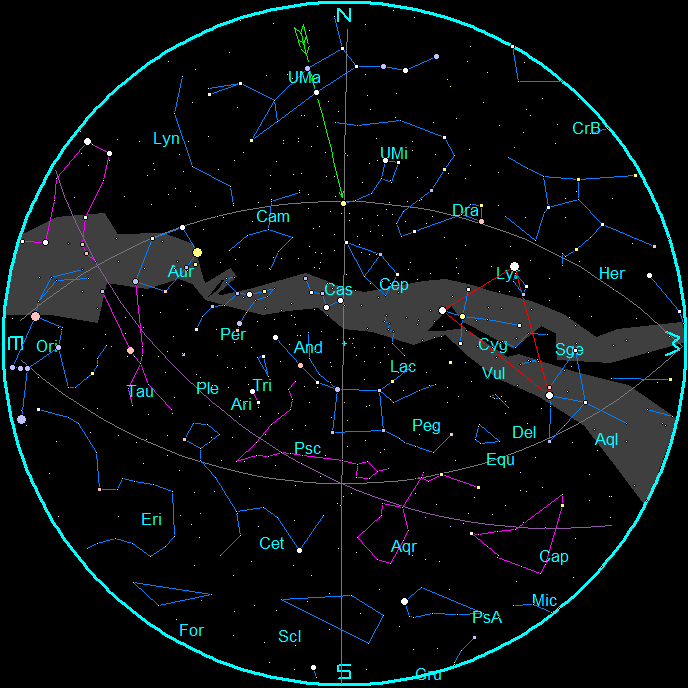
Star Chart for November 2015. Created using my LookingUp program. Click on image to enlarge.
The planets and stars are plotted for the 15th at 9 p.m. EST. That is chart time. Note, Traverse City is located 45 minutes behind our time meridian. To duplicate the star positions on a planisphere you may have to set it to 45 minutes earlier than the current time.
Evening astronomical twilight ends at 7:10 p.m. EST on November 1st, decreasing to 6:48 p.m. EST on the 30th.
Morning astronomical twilight starts at 5:41 a.m. EST on November 1st, and increasing to 6:14 a.m. EST on the 30th.
Add a half hour to the chart time every week before the 15th and subtract and hour for every week after the 15th.
For a list of constellation names to go with the abbreviations click here.
- Pointer stars at the front of the bowl of the Big Dipper point to Polaris the North Star.
- The Summer Triangle is shown in red.
Calendar of Planetary Events
Credit: Sky Events Calendar by Fred Espenak and Sumit Dutta (NASA’s GSFC)
To generate your own calendar go to http://eclipse.gsfc.nasa.gov/SKYCAL/SKYCAL.html
Times are Eastern Daylight Time on a 24 hour clock. Some additions made to aid clarity.
Conjunctions like the Venus-Regulus: 2.5° S means Venus will appear 2.5° South of Regulus.
Date	     Local     Event
           Time EST
Nov 01 Su            Venus: 46.3° W
    03 Tu  2:20 a.m. Venus-Mars: 0.7° N
    03 Tu  7:24 a.m. Last Quarter
    05 Th  6:04 p.m. South Taurid Shower: ZHR = 10
    06 Fr 10:49 a.m. Moon-Jupiter: 2.5° N
    07 Sa  4:56 a.m. Moon-Mars: 2° N
    07 Sa  8:54 a.m. Moon-Venus: 1.4° N
    07 Sa 10:53 a.m. Moon Ascending Node
    07 Sa  4:48 p.m. Moon Apogee: 405700 km
    11 We 12:47 p.m. New Moon
    12 Th  5:20 p.m. North Taurid Shower: ZHR = 15
    14 Sa  7:39 p.m. Moon South Dec.: 18.3° S
    17 Tu  9:45 a.m. Mercury Superior Conj.
    17 Tu 11:38 p.m. Leonid Shower: ZHR = 15
    19 Th  1:27 a.m. First Quarter
    21 Sa  8:56 a.m. Moon Descending Node
    23 Mo  3:06 p.m. Moon Perigee: 362800 km
    25 We  5:44 p.m. Full Moon
    26 Th  4:33 a.m. Moon-Aldebaran: 0.7° S Occultation*
    27 Fr  3:13 p.m. Moon North Dec.: 18.4° N
    29 Su  2:20 p.m. Venus-Spica: 4.2° N
    29 Su  6:31 p.m. Saturn Conjunction with the Sun
Dec 01 Tu	  	   Venus: 43.3° W
* The occultation will be visible in northern US, Canada, eastern Siberia. In the Grand Traverse area of Michigan the occultation starts around 5:38 a.m. and ends arpund 6:29 a.m. Note that the actual time depends on your exact location.
The Occultation map is here.
10/30/2015 – Ephemeris – The spookiest star
Ephemeris for Friday, October 30th. The Sun will rise at 8:17. It’ll be up for 10 hours and 16 minutes, setting at 6:34. The Moon, 3 days past full, will rise at 9:33 this evening.
Tomorrow night is the spookiest night of the year, so lets look at the spookiest star of all. It’s Algol, from Ghoul Star or Demon Star. The Chinese had a name for it that meant ‘piled up corpses’. It’s the second brightest star in the constellation Perseus the hero, rising in the northeast this evening. The star is located where artists have drawn the severed head of Medusa, whom he had slain. Medusa was so ugly that she turned all who gazed upon her to stone. Algol is her still glittering eye. Astronomers finally found out what was wrong with Algol. It does a slow 6 hour wink every two days 21 hours, because it is two stars that eclipse each other. It winked this morning and it will again centered on 11:45 p.m. Sunday night.
Times are for the Traverse City/Interlochen area of Michigan. They may be different for your location.
Addendum
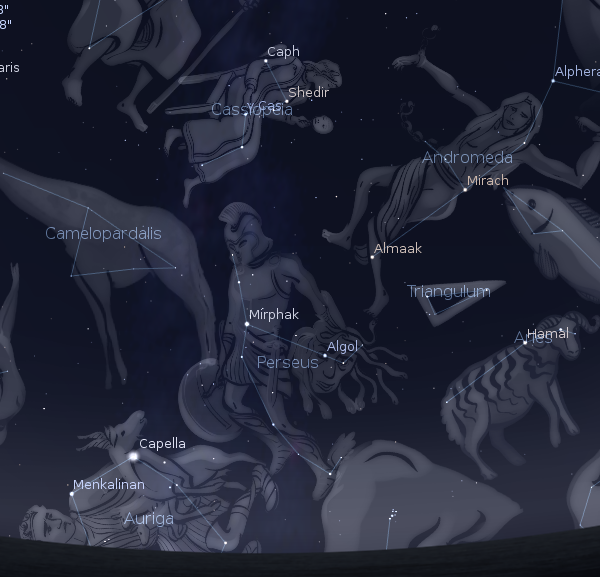
Algol at 7:30 p.m. on Halloween, in a modern portrayal. Created using Stellarium.
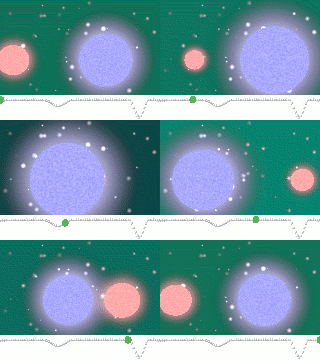
Animation of an eclipsing binary star like Algol. Credit: Wikimedia Commons h/t Earth and Sky
10/29/2015 – Ephemeris – The blue skies of Pluto
Ephemeris for Thursday, October 29th. The Sun will rise at 8:16. It’ll be up for 10 hours and 19 minutes, setting at 6:36. The Moon, 2 days past full, will rise at 8:40 this evening.
Images from the New Horizons spacecraft are streaming back slowly. It’s like trying to download a modern megapixel camera image using a thousand to two thousand bits per second telephone modem back in the ’90s. That’s why the images are dribbling out. They are released each Thursday or Friday. One of the last images was a colored image of the ring of atmosphere of Pluto backlit by the Sun, showing that the dwarf planet had a blue sky. The reason is still debated because there appear to be minute particles thought to be tholins in Pluto’s atmosphere. These would be colored brown or red. However they seen to preferentially scatter blue light like the nitrogen molecules in our atmosphere.
Times are for the Traverse City/Interlochen area of Michigan. They may be different for your location.
Addendum
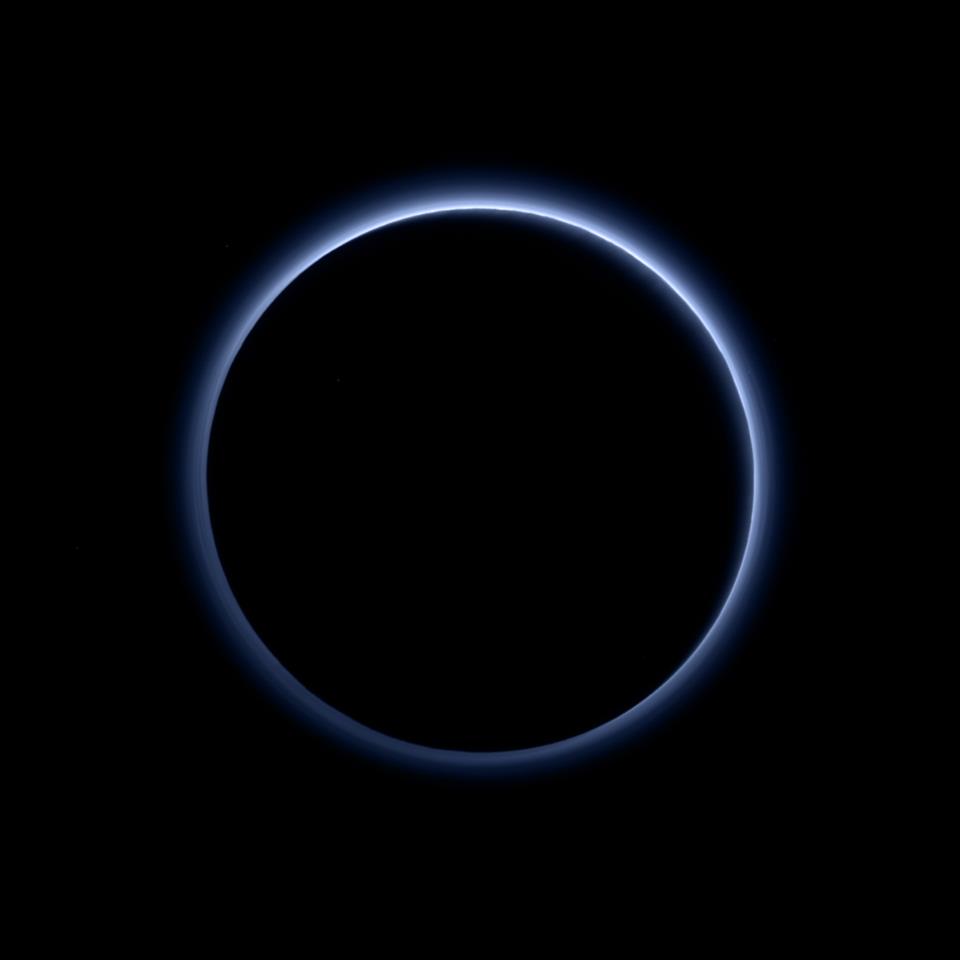
Pluto seen in silhouette, backlit by the Sun in color. Released October 10, 2015 by NASA/JHUAPL/SwRI
10/28/2015 – Ephemeris – The bright planets are gathered near the Sun in the evening and morning sky
Ephemeris for Wednesday, October 28th. The Sun will rise at 8:15. It’ll be up for 10 hours and 22 minutes, setting at 6:37. The Moon, 1 day past full, will rise at 7:52 this evening.
Let’s check out the whereabouts of the bright naked eye planets. The numbers of visible planets is getting a bit thin. The planet Saturn will be low in the west-southwest after sunset and will set at 8:06 p.m. It will be hard to find in evening twilight. In the morning sky the brilliant planet Venus will rise at 4:11 tomorrow morning. Jupiter will beat it above the horizon, rising at 3:33. Both will be quite high in the southeast by this program’s air time today. Jupiter will be just above Venus today and tomorrow morning. Mars will be below and to the left of these two. Mars will pass north of Venus next Tuesday. That will be a real contrast in brightness with Mars much fainter than Venus. Mercury has retreated back toward the Sun.
Times are for the Traverse City/Interlochen area of Michigan. They may be different for your location.
Addendum
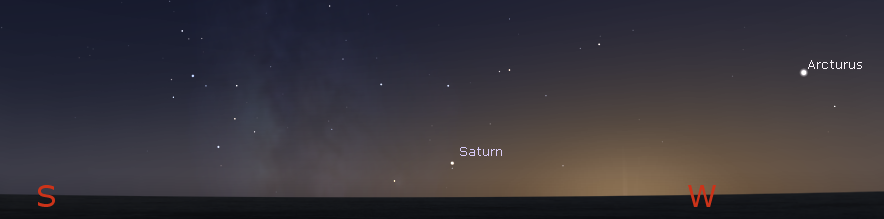
Saturn’s’ getting low in the twilight at 7:30 p.m. October 28, 2015. Created using Stellarium.
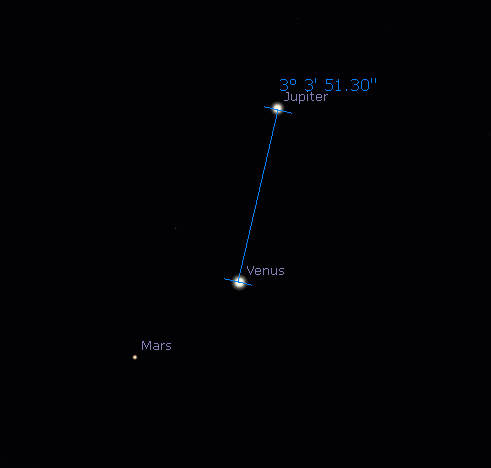
Venus with Jupiter 3 degrees above, with Mars below in the east-southeast at 7 a.m. October 29, 2015. Created using Stellarium.
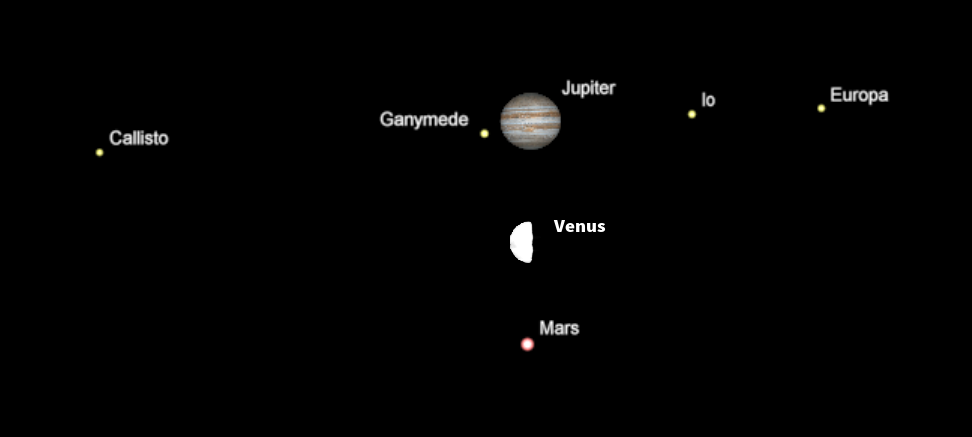
Apparent sizes of the morning planets Venus, Mars and Jupiter as seen through a telescope on October 29, 2015. Created using Cartes du Ciel (Sky Charts).
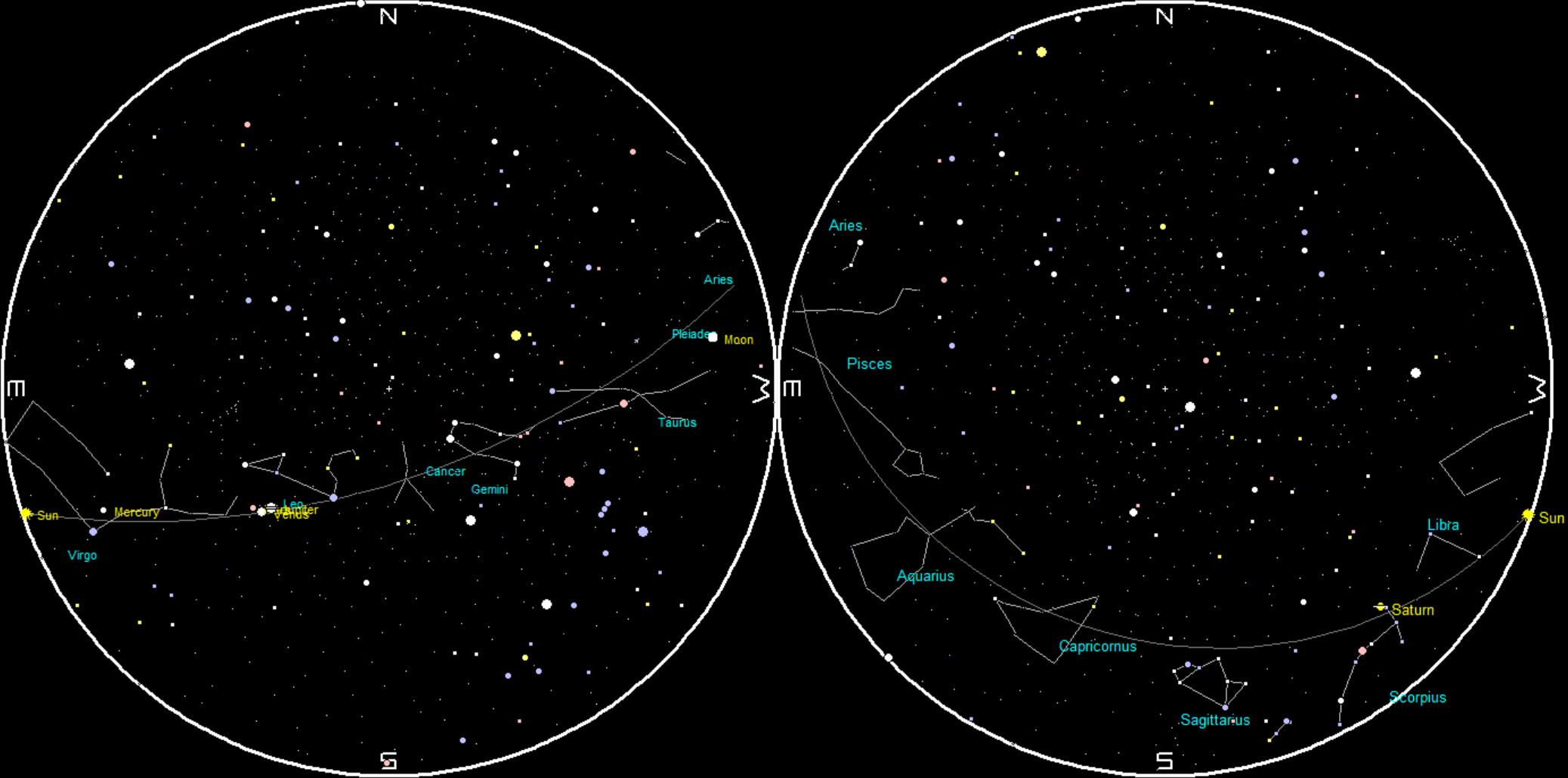
This is a chart showing the sunrise and sunset skies for October 28, 2015 showing the location of the planets and the Moon at that time. Created using my LookingUp program. Click on the image to enlarge.
10/27/2015 – Ephemeris – Hunter’s Moon
Ephemeris for Tuesday, October 27th. The Sun will rise at 8:13. It’ll be up for 10 hours and 25 minutes, setting at 6:39. The Moon, at full today, will rise at 7:09 this evening.
Tonight’s full moon is known as the Hunter’s Moon because it is the full moon after the harvest moon. The minute the Moon will be full will be at 7:05 this morning, about an hour before it sets. This was the time Native Americans and Europeans went out to secure the meat for the winter. And it also coincides with the time of year of our hunting seasons. So in that regard it fits nicely. The names of the full moons throughout the year generally mesh with the activities or weather conditions of that month. For instance December’s full moon is the Cold Moon or the Long Nights Moon. December has the longest nights. This list is taken from farmersalmanac.com, the website of the Old Framers Almanac, from which I’ve been getting folklore tidbits for years.
Times are for the Traverse City/Interlochen area of Michigan. They may be different for your location.
Addendum
Other sources for full moon names:
- Wikipedia
- EarthSky
- MoonConnection
- Or just search for: full moon names

