Archive
Ephemeris: 03/13/2025 – Get ready for tomorrow morning’s total lunar eclipse
This is Ephemeris for Thursday, March 13th. Today the Sun will be up for 11 hours and 48 minutes, setting at 7:46, and it will rise tomorrow at 7:56. The Moon, 1 day before full, will set at 8:06 tomorrow morning.
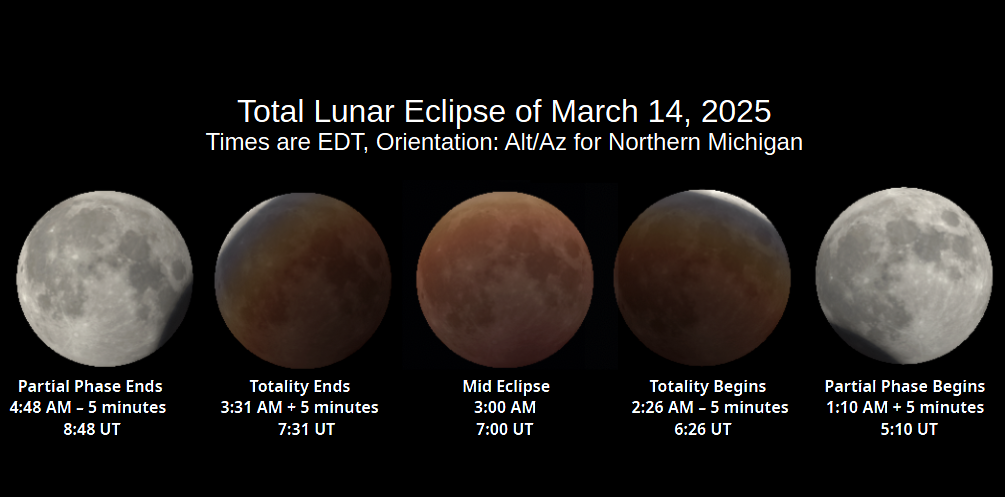
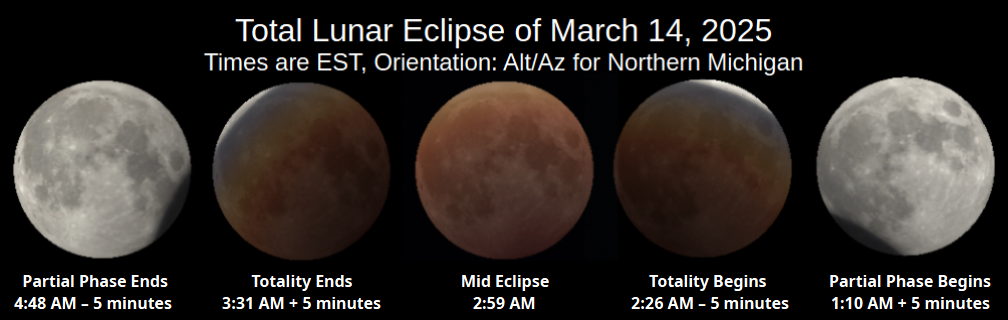
Late, late, late, tonight, or actually early tomorrow morning there will be a total eclipse of the Moon. The moment of full moon, which is necessary for a lunar eclipse will occur at 2:55 AM tomorrow, and the middle of the eclipse will be 5 minutes later. The partial phase of the lunar eclipse will start at 1:10 AM. This partial phase will grow until 2:26 AM when totality will begin. During this period of time the Moon should have a dull reddish color because it is illuminated only by the light filtering through the Earth’s atmosphere from the combined sunrises and sunsets around the world at that time. The total phase will end at 3:31 AM. The ending partial phase will continue until 4:48 AM.
The astronomical event times given are for the Traverse City/Interlochen area of Michigan (EDT, UT – 4 hours). Times will be different for other locations.
Addendum
Ephemeris: 03/12/2025 – Last chance to see four naked-eye planets in the evening
This is Ephemeris for Wednesday, March 12th. Today the Sun will be up for 11 hours and 45 minutes, setting at 7:45, and it will rise tomorrow at 7:58. The Moon, 2 days before full, will set at 7:49 tomorrow morning.
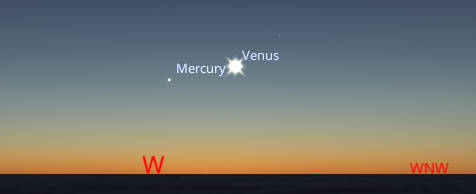
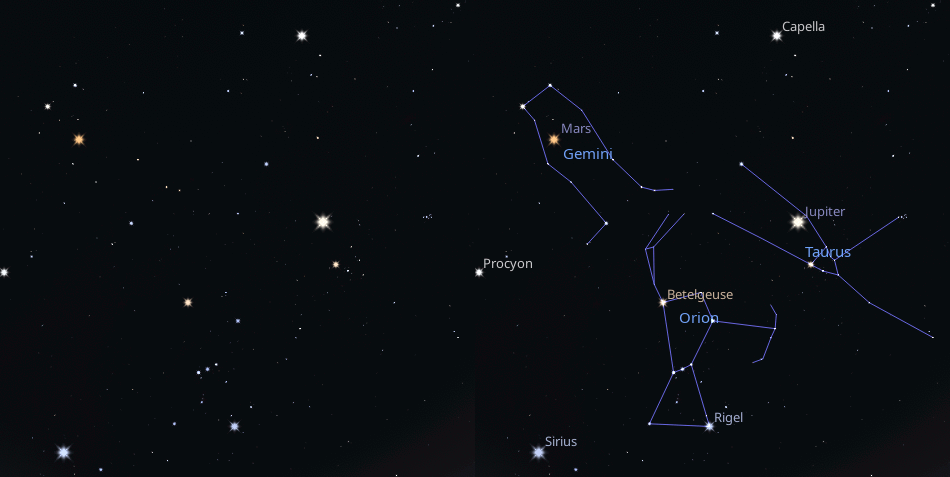
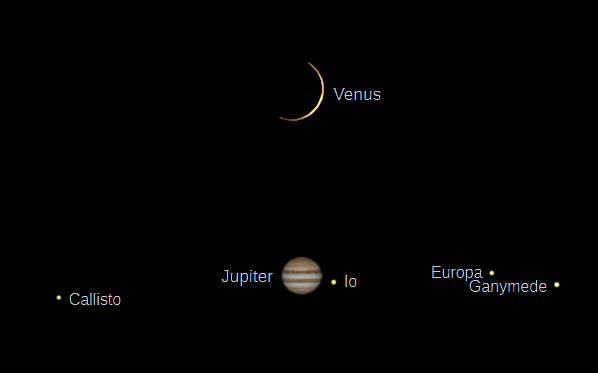
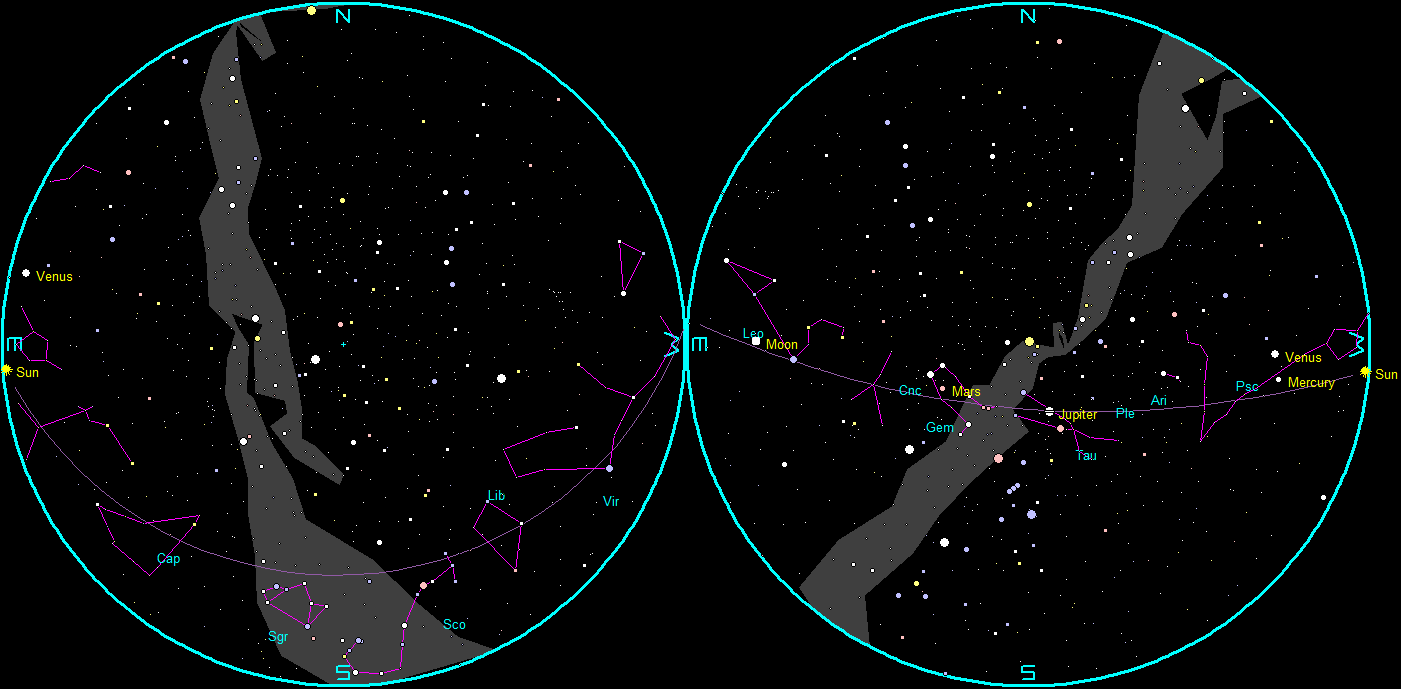
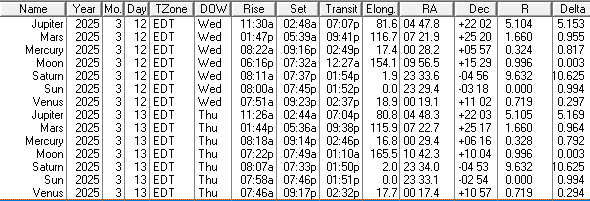
Let’s take our weekly look at the whereabouts of the naked-eye planets. At 8:30 PM this evening four of the five naked eye planets will be out. Starting from the West we have Venus the brightest of all. Left and a bit below is the much dimmer Mercury. Both will rapidly disappear in evening twilight in a less than a week. Venus will pass in conjunction with the Sun on March 22nd, Mercury will do the same two days later. Jupiter, the second-brightest planet will be high in the southwest. Mars, the third-brightest planet now, with its distinctive reddish hue, is high in the south-southeast, below and right of the stars Castor and Pollux in Gemini. By the end of the month only two planets, Mars and Jupiter will be left in the evening sky.
The astronomical event times given are for the Traverse City/Interlochen area of Michigan (EDT, UT – 4 hours). Times will be different for other locations.
Addendum
Ephemeris: 03/11/2025 – There will be a lunar eclipse early Friday morning
This is Ephemeris for Tuesday, March 11th. Today the Sun will be up for 11 hours and 42 minutes, setting at 7:44, and it will rise tomorrow at 8:00. The Moon, 3 days before full, will set at 7:32 tomorrow morning.
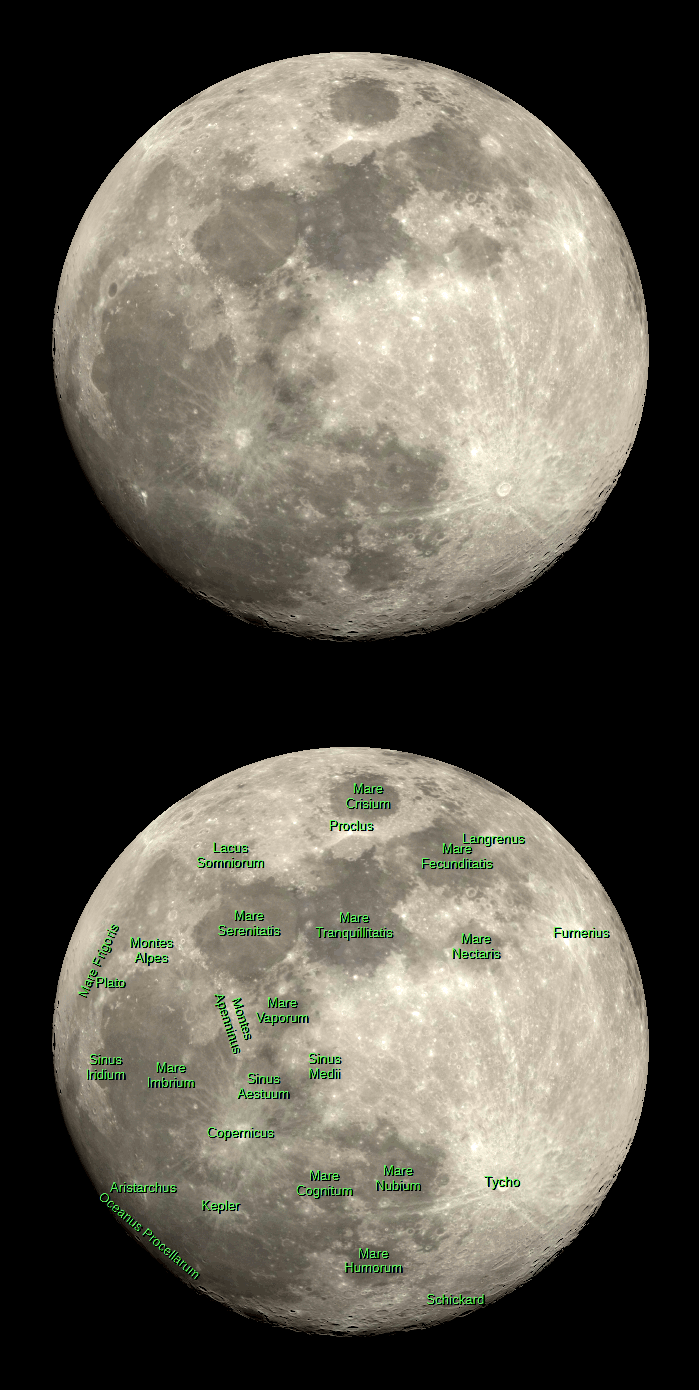
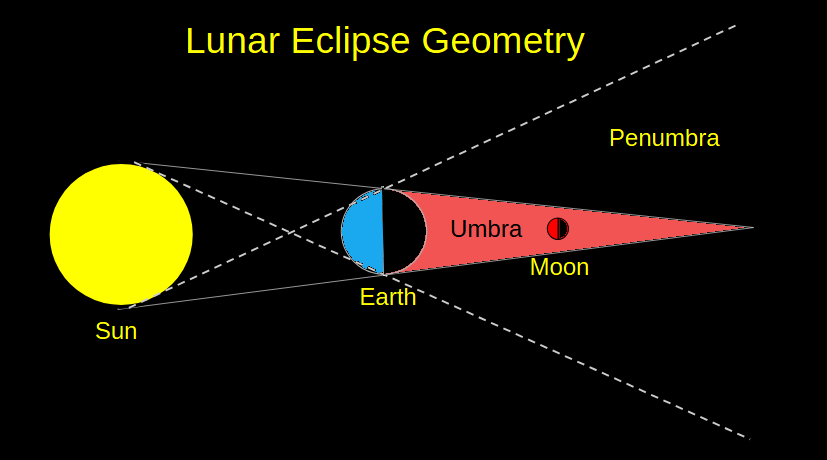
Early Friday morning, the 14th there will be a total eclipse of the Moon. Of course, we all hope for clear skies, but this is March. About 12:30 AM, keen observers might notice that the lower left side of the Moon seems to be a bit dimmer than the opposite side rather than the Moon being evenly illuminated. That’s because that leading edge of the Moon is witnessing a partial eclipse of the Sun. The moon is in the Earth’s penumbra or partial shadow where the Sun is being gradually cut off from the eastern part of the moon to the western part. The partial phase will begin at 1:10 AM Friday morning. Totality will begin at 2:26 AM and last until 3:31 AM. The ending partial phase will continue to 4:48 AM.
The astronomical event times given are for the Traverse City/Interlochen area of Michigan (EDT, UT – 4 hours). Times will be different for other locations.
Addendum
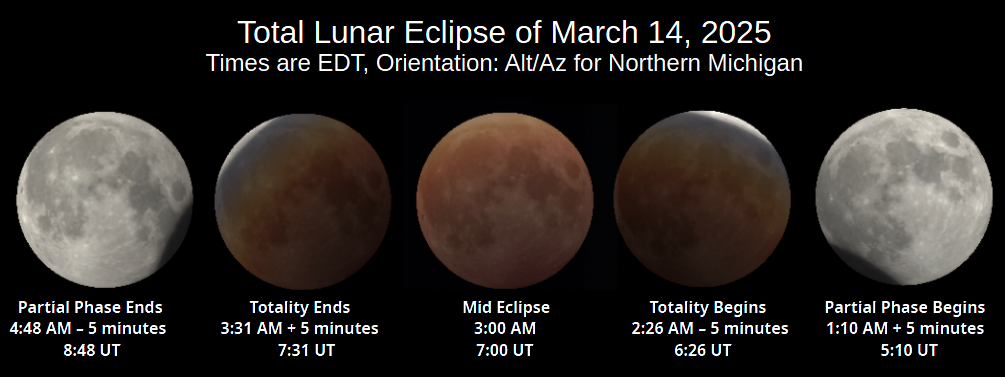
I don’t show the Moon when it enters or leaves the penumbra is because nothing is noticeable. About a half hour before the Moon enters the umbra to begin the partial phase of the eclipse, the side of the Moon nearest the umbra will be noticeably duller than the other side. The same is true after the partial phase is over. The effect of the deepening penumbra is more easily seen in sunglasses, that will darken the still bright Moon.
Ephemeris: 03/10/2025 – Aristarchus, the brightest spot on the Moon, but not tonight
This is Ephemeris for Monday, March 10th. Today the Sun will be up for 11 hours and 39 minutes, setting at 7:42, and it will rise tomorrow at 8:01. The Moon, 4 days before full, will set at 7:11 tomorrow morning.
The moon tonight is bright. The sunrise line or terminator on the moon is crossing the large gray plain called Oceanus Procellarum, the largest of the moon’s seas. These seas were figments of the first telescopic observer’s imagination. They are really huge impact basins into which interior lava flowed. On the left edge of the Moon, just below center, this evening, at the terminator is a small shadow filled crater that might be visible in binoculars, but definitely telescopes. It’s called Aristarchus. It is a fairly new crater, probably less than a billion years old. As a rule the brighter the crater the newer it is. Aristarchus is the brightest spot on the Moon, when it is full. Visual astronomers have seen hazes and bright spots on rare occasions in and near Aristarchus.
The astronomical event times given are for the Traverse City/Interlochen area of Michigan (EST, UT – 5 hours). Times will be different for other locations.
Addendum
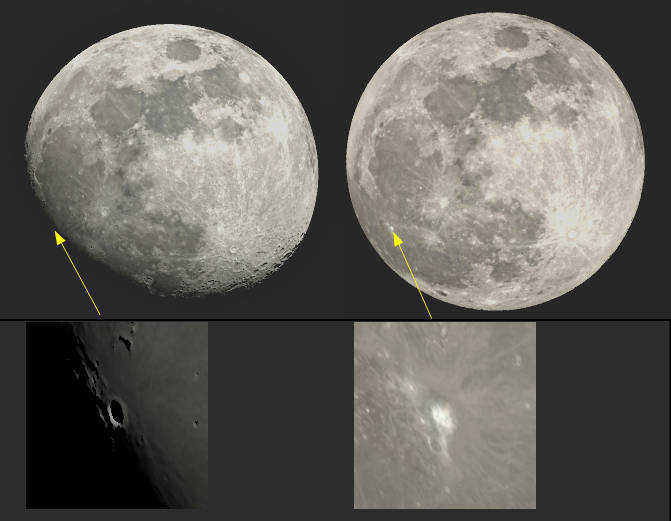
Aristarchus tonight, March 10, 2025, on the terminator (left), and Friday night, the 14th, before the total lunar eclipse starts. The enlargements show the telescopic view. Created using Stellarium, LibreOffice Draw and GIMP. The Moon doesn’t actually appear larger on the 14th. Apparently my field of view changed while getting the 14th’s image.
Ephemeris: 03/07/2025 – GTAS Meeting tonight (also on Zoom): Previewing 3/14’s total lunar eclipse
This is Ephemeris for Friday, March 7th. Today the Sun will be up for 11 hours and 29 minutes, setting at 6:38, and it will rise tomorrow at 7:07. The Moon, 1 day past first quarter, will set at 4:28 tomorrow morning.
The Grand Traverse Astronomical Society will host its February meeting tonight at 8 PM at Northwestern Michigan College’s Joseph H Rogers Observatory. The talk for the evening will be given by yours truly. One week from today, Friday, March 14th in the early morning hours, there will be a total eclipse of the Moon. That is my subject. I will explore some notable lunar eclipses of the past, what they are, and why we don’t see them every full moon. I’ll talk about other facts about lunar eclipses. The observatory is located on Birmley Rd. South of Traverse City between Garfield and Keystone roads. The meeting will also be available via Zoom. Instructions to join the meeting will be on the society’s website, gtastro.org.
The astronomical event times given are for the Traverse City/Interlochen area of Michigan (EST, UT – 5 hours). Times will be different for other locations.
Addendum
Ephemeris: 03/06/2025 – The Moon at first quarter
This is Ephemeris for Thursday, March 6th. Today the Sun will be up for 11 hours and 26 minutes, setting at 6:37, and it will rise tomorrow at 7:09. The Moon, at first quarter today, will set at 3:31 tomorrow morning.
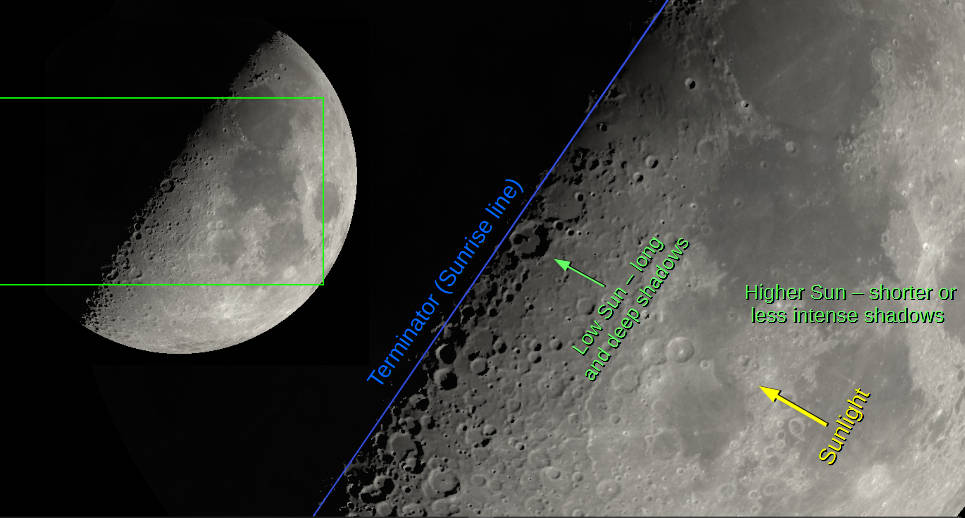
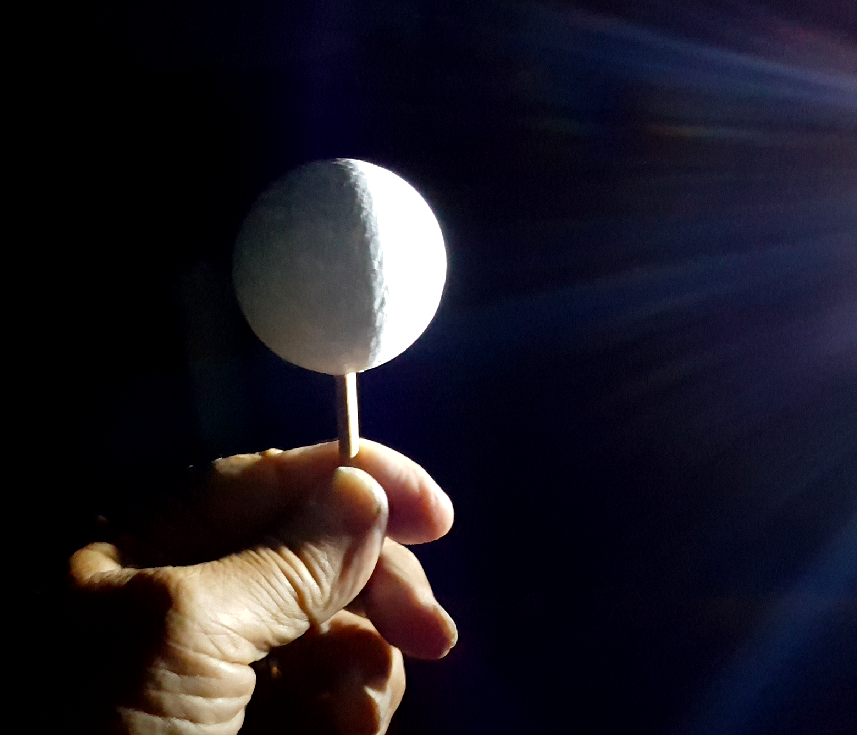
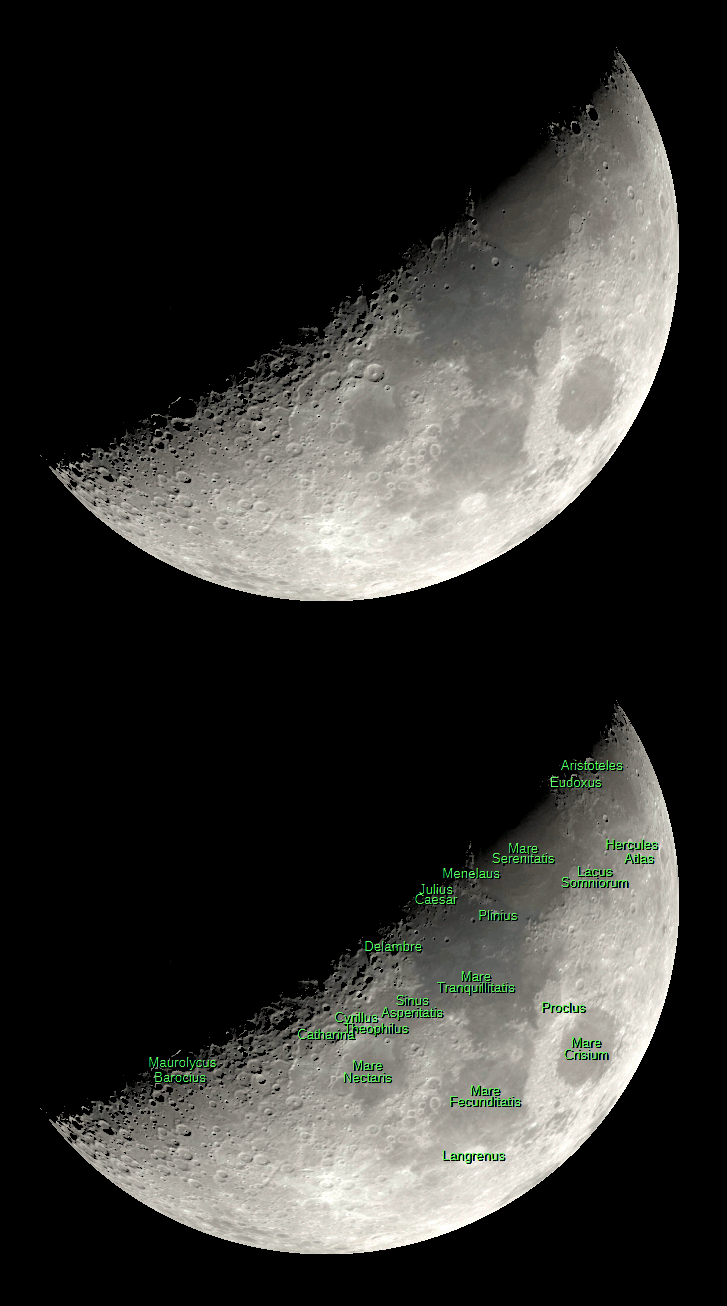
The Moon is indeed at first quarter today with the instant of being 90° from the Sun coming at 11:32 this morning. To me the first quarter moon is the best time to view because there are a lot of craters that are visible in deep shadow. The terminator, the sunrise line, on the Moon cuts the disk in half and a lot of craters can even be seen in binoculars. With a small telescope the jumble of craters provides a wonderful view of the destruction of the early bombardment of the Moon in its early days. The reason the Moon has all these craters and the Earth does not is the fact that the Earth has an active surface with volcanoes, plate tectonics, water and wind to erode and deform the surface. The Moon has really none of that.
The astronomical event times given are for the Traverse City/Interlochen area of Michigan (EST, UT – 5 hours). Times will be different for other locations.
Addendum
Ephemeris: 03/05/2025 – Taking our weekly look at the whereabouts of the naked-eye planets
This is Ephemeris for Ash Wednesday, March 5th. Today the Sun will be up for 11 hours and 23 minutes, setting at 6:36, and it will rise tomorrow at 7:10. The Moon, 1 day before first quarter, will set at 2:21 tomorrow morning.
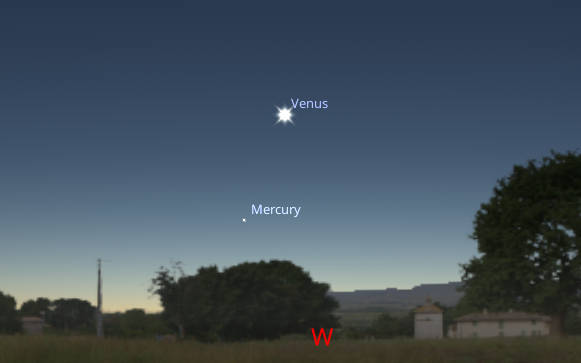
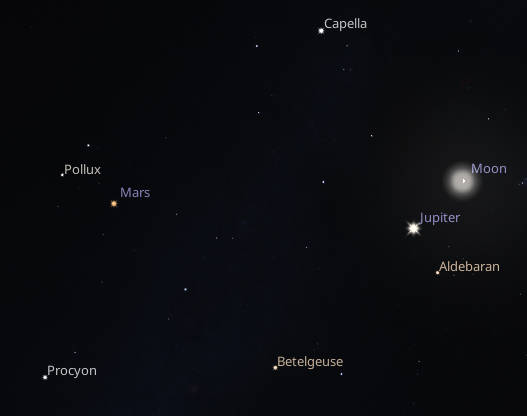
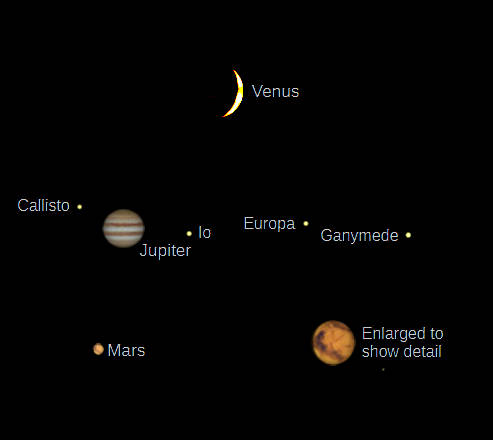
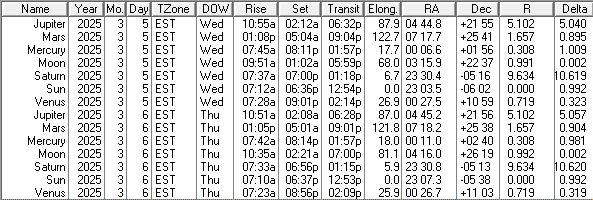
Let’s take our weekly look at the whereabouts of the naked-eye planets. At 7:10 PM this evening four of the five naked eye planets will be out. Starting from the West we have Venus the brightest of all. Below it at the 7 o’clock position and halfway to the horizon is the much dimmer Mercury, three days from its greatest separation from the Sun. Jupiter, the second-brightest planet will be high in the south-southwest below and right of the Moon tonight. The 4th planet out is Mars, the third-brightest planet now, with its distinctive reddish hue, west of the stars Castor and Pollux in Gemini, and in the southeast. By the end of the month both Venus and Mercury will be gone out of the evening sky, leaving only two, Mars and Jupiter.
The astronomical event times given are for the Traverse City/Interlochen area of Michigan (EST, UT – 5 hours). Times will be different for other locations.
Addendum
Ephemeris: 03/04/2025 – Looks like asteroid 2024 YR4 will miss the Earth
This is Ephemeris for Fat Tuesday, March 4th. Today the Sun will be up for 11 hours and 20 minutes, setting at 6:35, and it will rise tomorrow at 7:12. The Moon, 2 days before first quarter, will set at 1:02 tomorrow morning.
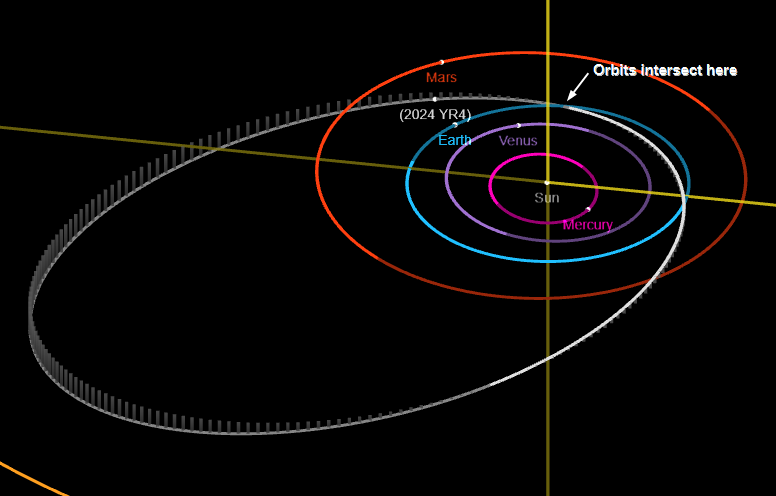
I’ve got some good news for a change. The recently discovered small asteroid with the provisional designation 2024 YR4 it’s not going to hit the Earth on December 22nd, 2032. More precisely the percentage chance of hitting the Earth is now down to four thousandths of a percent. The recalculation was due to observations from the Subaru Telescope in Hawaii. Three separate organizations calculated the chances of the asteroid to hit. That means this number is of very high confidence. The new center of the locus that they calculated for the asteroid’s passage by the Earth now comes closer to the orbit of the Moon than it does the Earth. So that’s one less thing to worry about, although astronomers will be keeping tabs on it.
The astronomical event times given are for the Traverse City/Interlochen area of Michigan (EST, UT – 5 hours). Times will be different for other locations.
Addendum
Ephemeris: 03/03/2025 – The Moon tonight
This is Bob Moler with Ephemeris for Monday, March 3rd. Today the Sun will be up for 11 hours and 17 minutes, setting at 6:33, and it will rise tomorrow at 7:14. The Moon, 3 days before first quarter, will set at 11:40 this evening.
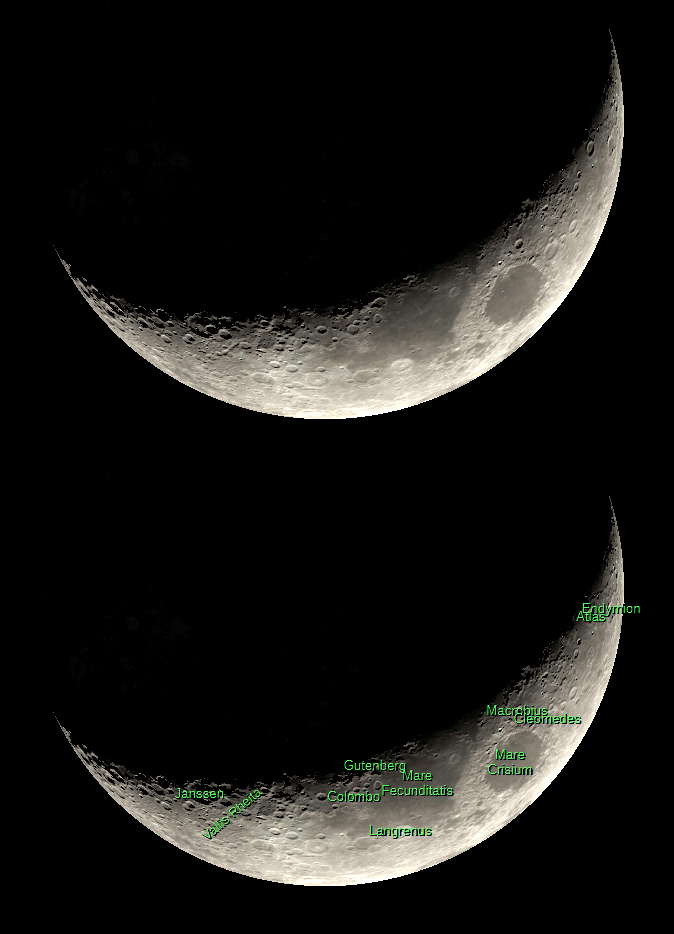
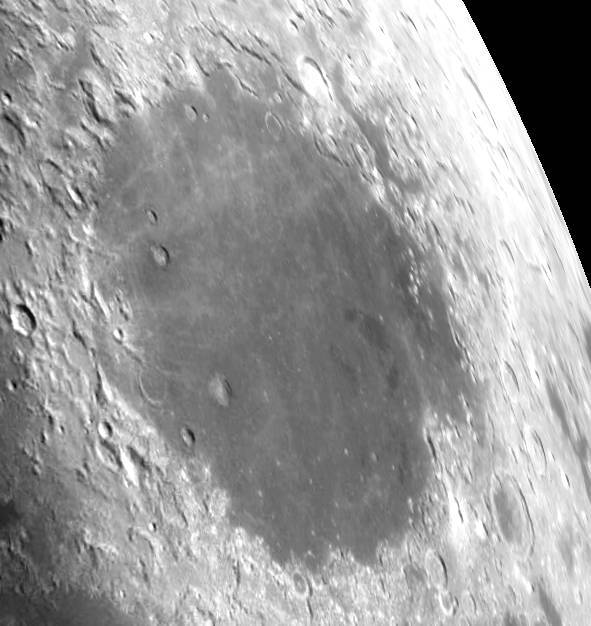
Tonight the moon will be four days old. The age of the moon is the number of days since the new moon which ranges from 1 to 28 or 29 for the lunar month. I usually don’t use that, being more concerned with the phase of the Moon so at the top of the program I give the moon’s relation to its new, quarter, or full phase. Being in its waxing crescent phase right now, the only features to the naked eye on the Moon besides the crescent itself are the dark Sea of Crises, Mare Crisium, target of Firefly Aerospace’s Blue Ghost Lander, and the larger Sea of Fruitfulness, Mare Fecunditatis. The Moon rotates about 1/28th the speed of the Earth, and it’s also smaller, about a quarter of the Earth’s diameter. So one would have to use a supersonic jet to fly around the Earth to keep up with the rotation, but on the Moon one could do that with the Apollo moon rover.
The astronomical event times given are for the Traverse City/Interlochen area of Michigan (EST, UT – 5 hours). Times will be different for other locations.
Addendum
Ephemeris: 02/28/25 – Previewing March Skies
Ephemeris: 02/28/25 – Previewing March Skies
This is Ephemeris for Friday, February 28th. Today the Sun will be up for 11 hours and 8 minutes, setting at 6:29, and it will rise tomorrow at 7:19. The Moon, 1 day past new, will set at 7:34 this evening.
Let’s preview the month of March. In March the increase in daylight hours is at its greatest, with spring 3 weeks away. Daylight hours will increase from 11 hours and 11 minutes tomorrow to 12 hours and 44 minutes on the 31st. Along with that the altitude of the Sun at local noon will increase from 38 degrees tomorrow to 49 ½ degrees at month’s end. Local noon tomorrow, by the way, for Interlochen and Traverse City is 12:54 pm, which is mainly due to the fact that our standard time meridian happens to run through Philadelphia. That’s before daylight time starts on the 9th. On that date local noon will be 1:52 pm. Spring will begin later this month on the 20th when the Sun will pass overhead on the equator heading northward.
We change to Daylight Saving Time on the 9th. EST to EDT. Bah, Humbug!
The astronomical event times given are for the Traverse City/Interlochen area of Michigan (EST, UT – 5 hours). Times will be different for other locations.
Addendum
Addendum
March Evening Star Chart
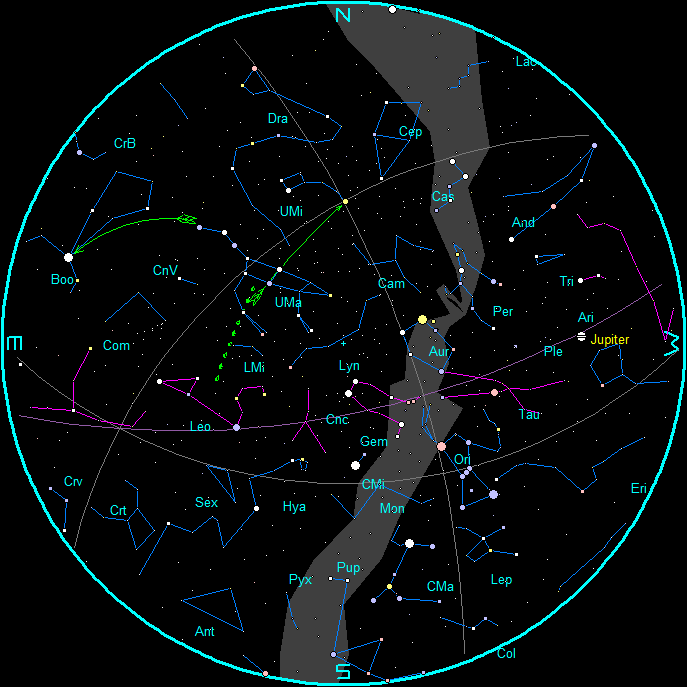
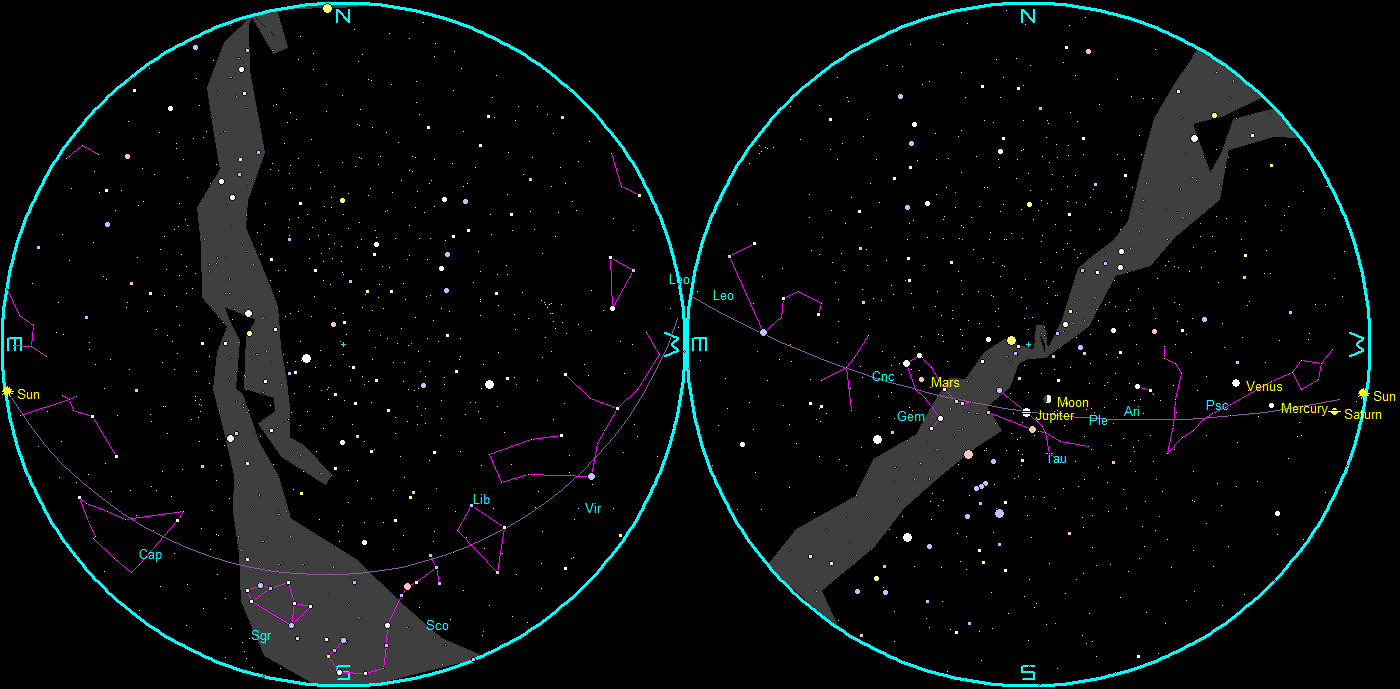
The planets and stars are plotted for the 15th at 10 p.m. EDT in the evening and 6 a.m. on the 16th for the morning chart. These are the chart times. Note that Traverse City is located approximately 45 minutes behind our time meridian. (An hour and 45 minutes behind our Daylight Saving Time meridian during EDT). To duplicate the star positions on a planisphere (rotating star finder) you may have to set it to 45 minutes or 1 hour 45 minutes earlier than your current time.
Note the chart times of 10 PM on the 15th, and 6 AM on the 16th. For each week before then, add ½ hour (28 minutes if you’re picky). For each week after then, subtract ½ hour. For planet positions on dates other than the dateshere, check the Wednesday planet posts on this blog.
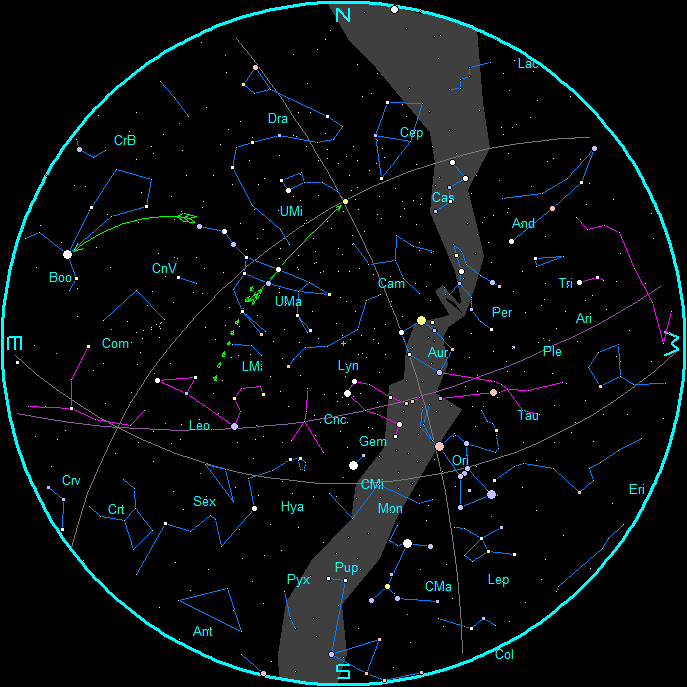
March Morning Star Chart
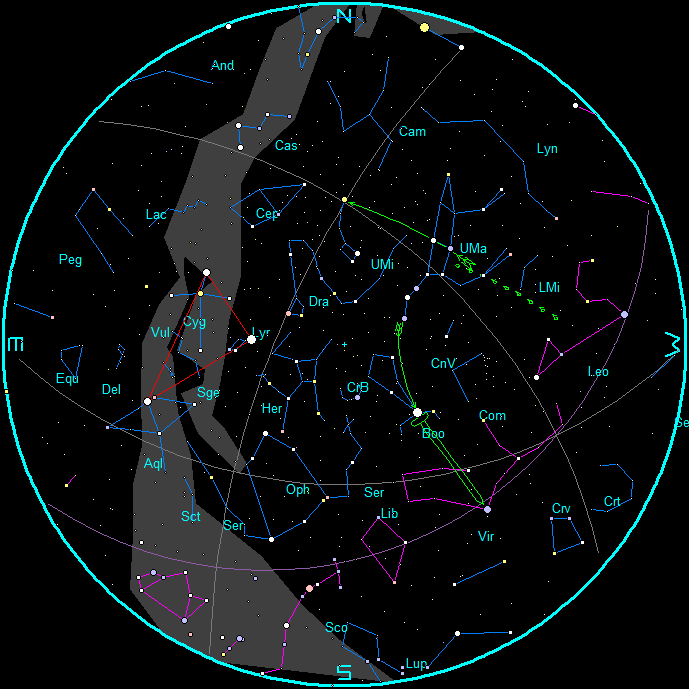
For a list of constellation names to go with the abbreviations click here.
- Pointer stars at the front of the bowl of the Big Dipper point to Polaris the North Star.
- The leaky bowl of the Big Dipper drips on Leo.
- Follow the arc of the handle of the Big Dipper to the star Arcturus, and
- Extend it as a spike to Spica.
- The Summer Triangle appears in red.
Twilight Limits, Nautical and Astronomical
Omitted due to WordPress issues
NASA Calendar of Planetary Events
     Date   Time EST  Event
Mar  1  Sa            Venus: 30.4° E
     1  Sa  12:40 AM  Moon Ascending Node
     1  Sa   4:18 PM  Moon Perigee: 362000 km
     1  Sa   6:18 PM  Moon-Venus: 6.4° N
     5  We   7:32 AM  Moon-Pleiades: 0.6° S
     6  Th  11:32 AM  First Quarter
     7  Fr  10:56 AM  Moon North Dec.: 28.7° N
     8  Sa  12:59 AM  Mercury Elongation: 18.2° E
     8  Sa   7:27 PM  Moon-Mars: 1.8° S
                 EDT
     9  Su   6:06 AM  Moon-Pollux: 2.1° N
    10  Mo   7:10 AM  Moon-Beehive: 2.8° S
    12  We   2:07 AM  Moon-Regulus: 2.4° S
    12  We   6:03 AM  Saturn Conjunction
    12  We   1:52 PM  Mercury-Venus: 5.5° N
    14  Fr   2:55 AM  Full Moon
    14  Fr   3:00 AM  Total Lunar Eclipse
    14  Fr   9:45 AM  Moon Descending Node
    16  Su   3:16 PM  Moon-Spica: 0.4° N
    17  Mo  12:37 PM  Moon Apogee: 405800 km
    19  We   6:20 PM  Neptune Conjunction
    20  Th   5:02 AM  Vernal Equinox
    20  Th  11:58 AM  Moon-Antares: 0.5° N
    22  Sa   2:47 AM  Moon South Dec.: 28.7° S
    22  Sa   7:29 AM  Last Quarter
    22  Sa   9:26 PM  Venus Inferior Conj.
    24  Mo   3:47 PM  Mercury Inferior Conj.
    28  Fr  12:29 PM  Moon Ascending Node
    29  Sa   6:48 AM  Partial Solar Eclipse
    29  Sa   6:58 AM  New Moon
    29  Sa   3:27 PM  Mars-Pollux: 4° S
    30  Su   1:26 AM  Moon Perigee: 358100 km
Sky Events Calendar by Fred Espenak and Sumit Dutta (NASA’s GSFC),
http://eclipse.gsfc.nasa.gov/SKYCAL/SKYCAL.html
If you go to the above site you can print out a list like the above for the entire year or calendar pages for your time zone.
Note that the site is now kept up for archival purposes. Fred Espenak retired from NASA several years ago and has his own site, AstroPixels, which contains much the same information: http://astropixels.com/almanac/almanac.html.
Sun and Moon Rising and Setting Events
LU              Ephemeris of Sky Events for Interlochen/TC
March, 2025    Local time zone: EST
+-----------------------------------------------------------------------+
| DATE |  SUN     SUN  DAYLIGHT|   TWILIGHT*    |MOON  RISE OR    ILLUM |
|      |  RISE    SET    HOURS |  END    START  |PHASE SET** TIME FRACTN|
+=======================================================================+
|Sat  1| 07:19a  06:31p  11:11 | 07:34p  06:16a |      Set  08:55p    5%|
+------+-----------------------+----------------+-----------------------+
|Sun  2| 07:18a  06:32p  11:14 | 07:35p  06:15a |      Set  10:17p   12%|
|Mon  3| 07:16a  06:33p  11:17 | 07:36p  06:13a |      Set  11:40p   21%|
|Tue  4| 07:14a  06:35p  11:20 | 07:38p  06:11a |      Set  01:02a   31%|
|Wed  5| 07:12a  06:36p  11:23 | 07:39p  06:09a |      Set  02:21a   42%|
|Thu  6| 07:10a  06:37p  11:26 | 07:40p  06:08a |F Qtr Set  03:31a   53%|
|Fri  7| 07:09a  06:38p  11:29 | 07:41p  06:06a |      Set  04:28a   64%|
|Sat  8| 07:07a  06:40p  11:32 | 07:43p  06:04a |      Set  05:12a   74%|
+------+-----------------------+----------------+-----------------------+
| EDT  |      Time Change      |                |                       |
|Sun  9| 08:05a  07:41p  11:36 | 08:44p  07:02a |      Set  06:45a   83%|
|Mon 10| 08:03a  07:42p  11:39 | 08:45p  07:00a |      Set  07:11a   90%|
|Tue 11| 08:01a  07:44p  11:42 | 08:47p  06:59a |      Set  07:32a   95%|
|Wed 12| 08:00a  07:45p  11:45 | 08:48p  06:57a |      Set  07:49a   98%|
|Thu 13| 07:58a  07:46p  11:48 | 08:49p  06:55a |      Set  08:06a  100%|
|Fri 14| 07:56a  07:48p  11:51 | 08:51p  06:53a |Full  Rise 08:27p  100%|
|Sat 15| 07:54a  07:49p  11:54 | 08:52p  06:51a |      Rise 09:30p   97%|
+------+-----------------------+----------------+-----------------------+
|Sun 16| 07:52a  07:50p  11:57 | 08:53p  06:49a |      Rise 10:35p   93%|
|Mon 17| 07:50a  07:51p  12:01 | 08:55p  06:47a |      Rise 11:40p   88%|
|Tue 18| 07:49a  07:53p  12:04 | 08:56p  06:45a |      Rise 12:47a   81%|
|Wed 19| 07:47a  07:54p  12:07 | 08:57p  06:43a |      Rise 01:53a   73%|
|Thu 20| 07:45a  07:55p  12:10 | 08:59p  06:42a |      Rise 02:57a   64%|
|Fri 21| 07:43a  07:56p  12:13 | 09:00p  06:40a |      Rise 03:55a   55%|
|Sat 22| 07:41a  07:58p  12:16 | 09:01p  06:38a |L Qtr Rise 04:45a   45%|
+------+-----------------------+----------------+-----------------------+
|Sun 23| 07:39a  07:59p  12:19 | 09:03p  06:36a |      Rise 05:25a   35%|
|Mon 24| 07:37a  08:00p  12:22 | 09:04p  06:34a |      Rise 05:58a   25%|
|Tue 25| 07:36a  08:02p  12:26 | 09:05p  06:32a |      Rise 06:24a   16%|
|Wed 26| 07:34a  08:03p  12:29 | 09:07p  06:30a |      Rise 06:47a    9%|
|Thu 27| 07:32a  08:04p  12:32 | 09:08p  06:28a |      Rise 07:08a    3%|
|Fri 28| 07:30a  08:05p  12:35 | 09:10p  06:26a |      Rise 07:29a    0%|
|Sat 29| 07:28a  08:07p  12:38 | 09:11p  06:24a |New   Set  08:48p    0%|
+------+-----------------------+----------------+-----------------------+
|Sun 30| 07:26a  08:08p  12:41 | 09:12p  06:22a |      Set  10:13p    4%|
|Mon 31| 07:24a  08:09p  12:44 | 09:14p  06:20a |      Set  11:39p   10%|
+-----------------------------------------------------------------------+
* Nautical Twilight
** Moonrise or moonset, whichever occurs between sunset and sunrise
Created using my LookingUp for DOS output as text.
 Bob Moler's Ephemeris Blog