Archive
01/08/2015 – Ephemeris -Venus and Mercury quasi-conjunction Saturday – I
Ephemeris for Thursday, January 8th. The sun will rise at 8:19. It’ll be up for 9 hours even, setting at 5:19. The moon, 4 days past full, will rise at 9:08 this evening.
The planets Venus and Mercury are closing their positions in the southwest in the early evening. They will appear their closest Saturday. For the last few years these two planets without natural satellites have hosted an artificial satellite each. Venus is orbited by the European Space Agency’s Venus Express spacecraft since 2006. Just a few weeks ago it’s fuel tanks ran dry, so it could no longer point its solar panels toward the sun and antenna toward the earth. It will soon plunge into Venus’ thick atmosphere. A like fate will also befall the MESSENGER spacecraft now orbiting close to Mercury. It took 7 years to get to Mercury and so far orbited it for nearly 4 years. It too is running out of fuel and will soon crash on the planet.
Times are for the Traverse City/Interlochen area of Michigan. They may be different for your location.
Addendum
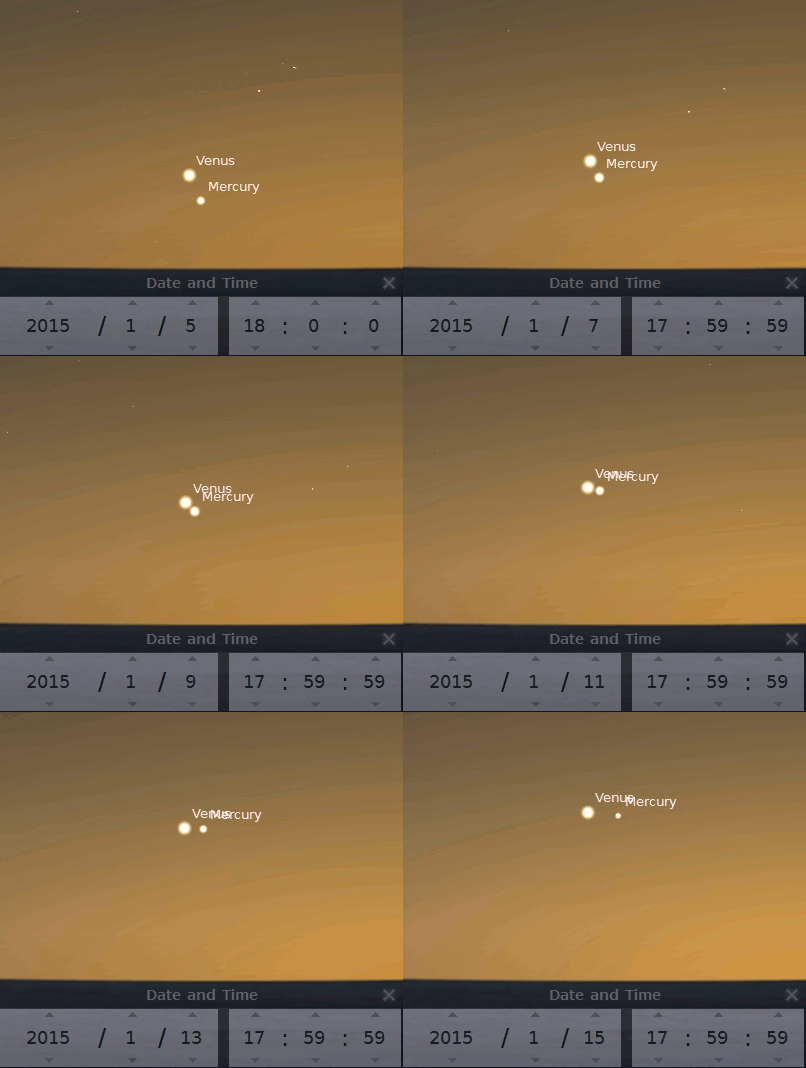
Animation of the Quasi-conjunction of Venus and Mercury. Time span 1/05/2015 to 1/15/2015 at 7 p.m. Created by Bob Moler using Stellarium and GIMP.
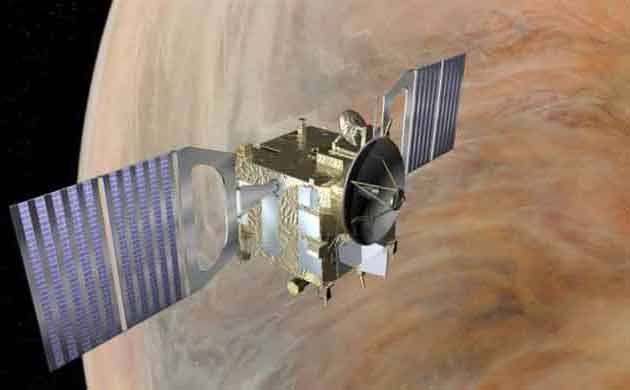
Artist rendition of Venus Express at Venus. Credit: ESA/AP.
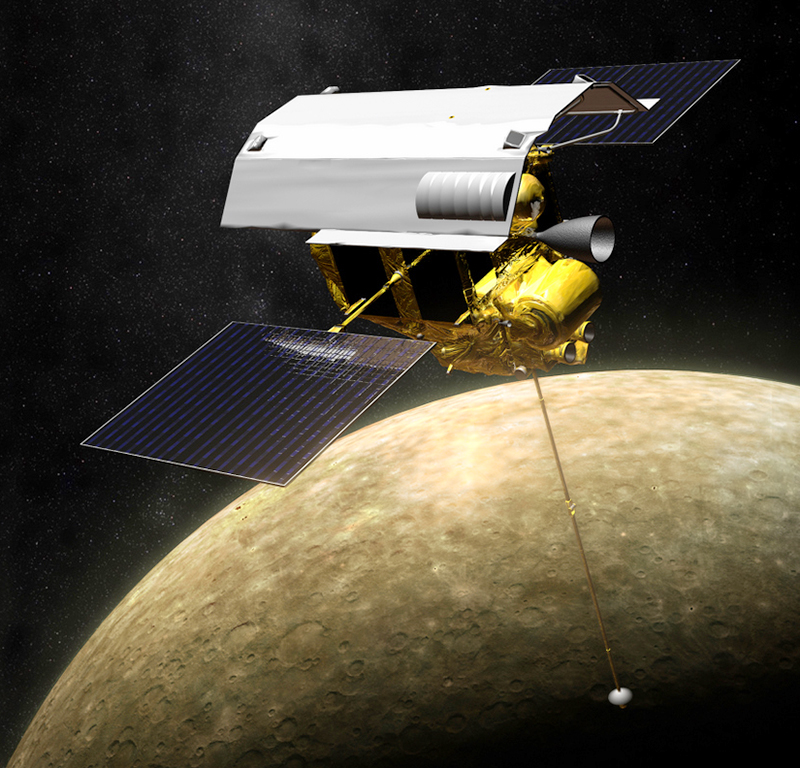
MESSENGER spacecraft at Mercury an artist’s concept. Credit NASA/JPL/APL.
01/07/2015 – Ephemeris – Lets take our first looks at the bright planets and a pretty bright comet
Ephemeris for Wednesday, January 7th. The sun will rise at 8:19. It’ll be up for 8 hours and 59 minutes, setting at 5:18. The moon, 3 days past full, will rise at 8:10 this evening.
Lets take our first look at the bright planets for 2015. Mercury is visible below right of Venus by about 2 moon widths low in the southwest shortly after sunset. On Saturday Mercury will be its closest to Venus. Mercury will set at 6:38, while Venus will set at 6:44 p.m. They will be visible low in the southwestern twilight by 6 p.m. Mars is low in the southwest at 7 p.m. and is in the constellation of Capricornus and will cross the boundary into Aquarius tomorrow. The Red Planet will set tonight at 8:37 p.m. Jupiter will rise in the east at 8:02 p.m. It’s near the sickle-shaped head of Leo the lion. Early risers will be able to spot Saturn which will rise in the east-southeast at 4:46 a.m. On the 18th it will cross the border from Libra to Scorpius.
Times are for the Traverse City/Interlochen area of Michigan. They may be different for your location.
Addendum
Animation of the Quasi-conjunction of Venus and Mercury. Time span 1/05/2015 to 1/15/2015 at 7 p.m. Created by Bob Moler using Stellarium and GIMP.
Note that Mercury gets dimmer as the days go by. This is because its phase moves from gibbous to half illuminated on the 14th at its greatest elongation from the Sun.
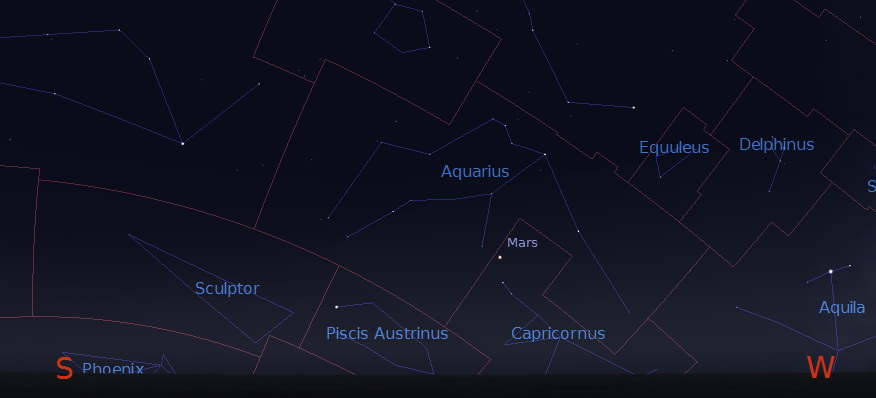
Mars and the setting constellations, with constellation boundaries in red. at 7 p.m. on January 7, 2015. Created using Stellarium.
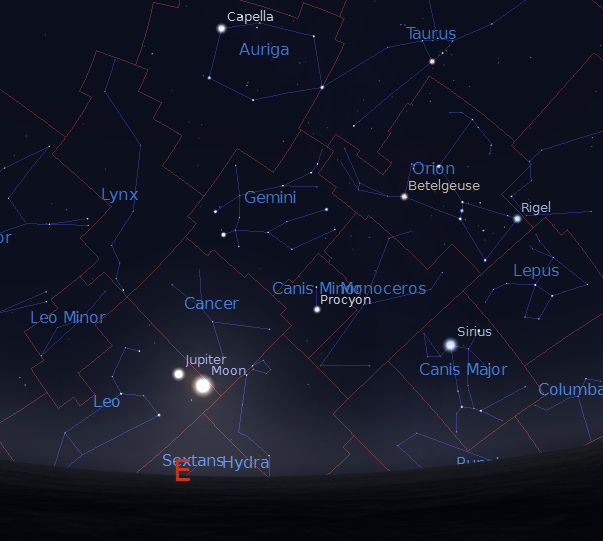
Jupiter, the Moon and the winter constellations at 10 p.m. on January 7, 2015. Created using Stellarium.
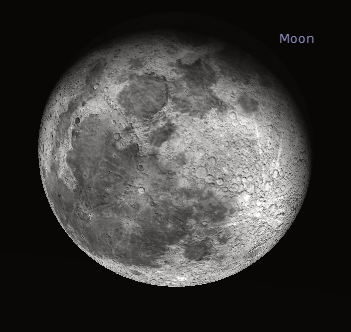
The Moon as seen through binoculars at 10 p.m. on January 7, 2015. Created using Stellarium.
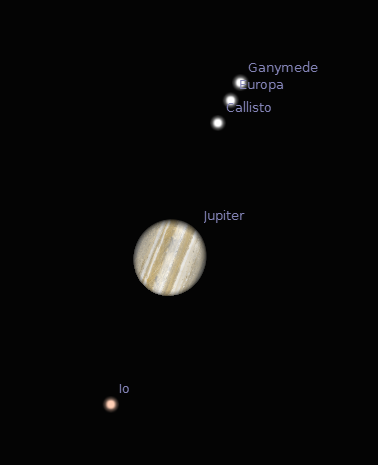
Jupiter and its satellites as seen through a telescope at 10 p.m. on January 7, 2015. Created using Stellarium.
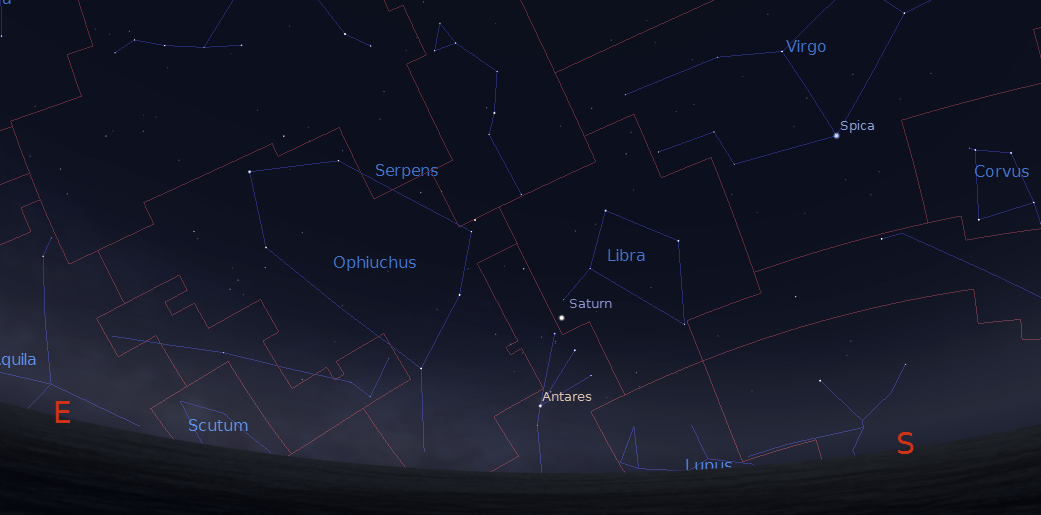
Saturn and the spring constellations at 7 p.m. on January 8, 2015. Created using Stellarium.
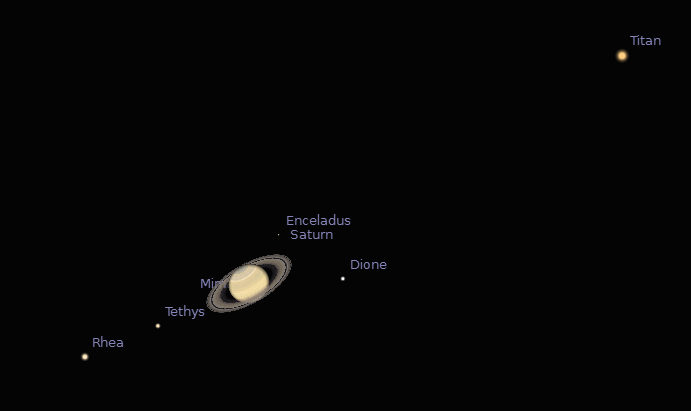
Saturn and satellites through a telescope at 7 a.m. January 8, 2015. Note that the moons other than Titan will be difficult to spot. Created using Stellarium.
Comet C/2014 Q2 (Lovejoy)
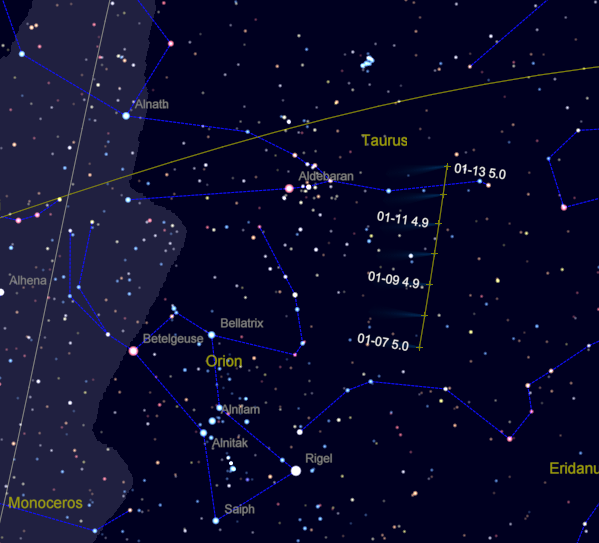
Comet Lovejoy track for January 7 to January 13, 2015. Despite the magnitudes being less than 6, binoculars will, most likely, be needed to spot it. Every other day is marked with month-day and magnitude of the comet.
01/06/2015 – Ephemeris – Star to stir up solar system’s comets, but you’re gotta wait a bit.
Ephemeris for Tuesday, January 6th. The sun will rise at 8:19. It’ll be up for 8 hours and 57 minutes, setting at 5:17. The moon, 2 days past full, will rise at 7:12 this evening.
In about a quarter to half a million years from now a star with the name HIP 85605 will pass through the Oort cloud of comets that is the extreme outer part of the solar system. The star’s name comes from the Hipparcos catalog created from data from the European satellite which created improved distances of nearby stars. HIP 85605 star is nearby and very faint. The star should pass through the Oort cloud twice, coming and going. What happens is the star will tend to scatter small bodies in its wake, throwing some comets in toward the sun and others it will eject from the solar system. There were all kinds of scare headlines out of this. Something like this “Will a comet shower end life on the Earth?” No it won’t. This kind of thing happens every few million years.
Times are for the Traverse City/Interlochen area of Michigan. They may be different for your location.
Addendum
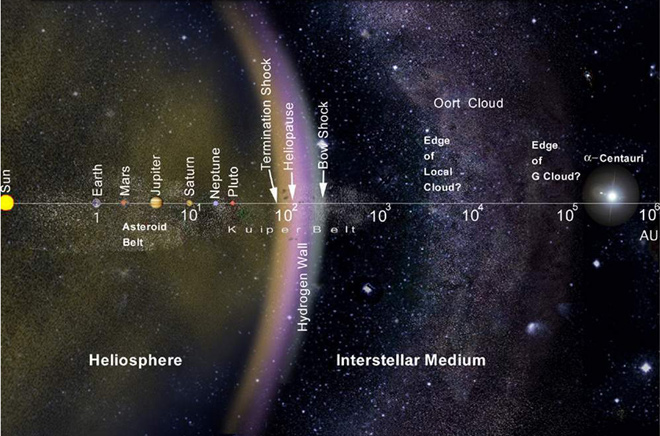
NASA diagram of the solar system on a logarithmic scale. Each interval is ten times longer than the one on the left. On this scale the star HIP 85605 will penetrate to the inner part of the Oort cloud. Click to enlarge.
Tip o’the old astronomer’s cap to Universe Today where I found this story.
01/05/2015 – Ephemeris – Ephemeris’ dirty little secret
Ephemeris for Monday, January 5th. The sun will rise at 8:19. It’ll be up for 8 hours and 56 minutes, setting at 5:16. The moon, 1 day past full, will rise at 6:14 this evening.
With the bright moon, blocking all but the brightest stars, it’s a good time to do some housekeeping. When I started this program 39 ½ years ago IPR had only one transmitter and a single antenna pattern. The sunrise and sunset times worked well for that. However since then with transmitters from Manistee to the Straits I cannot hope to cover all that in a single program. The differences in the times vary with the seasons. To get help on the Internet go to my monthly site ephemeris.bjmoler.org and click on Calendars. There are calendars for Ludington, Cadillac, Interlochen/Traverse City, Petoskey and Mackinaw City. Select a month to view or printout a whole year. Use the email link to request a sunrise, sunset, and Moon calendar for your town.
Times are for the Traverse City/Interlochen area of Michigan. They may be different for your location.
Addendum
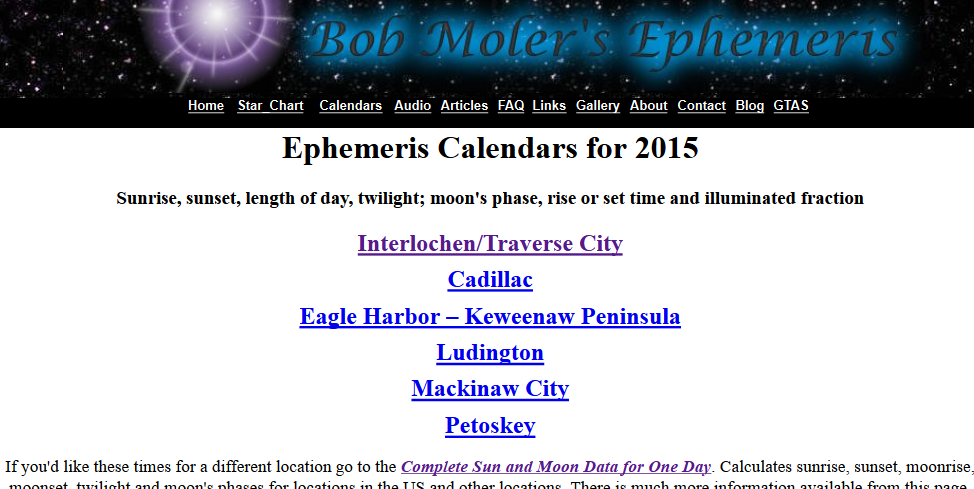
Click on Calendars in the header. and you will get this page.
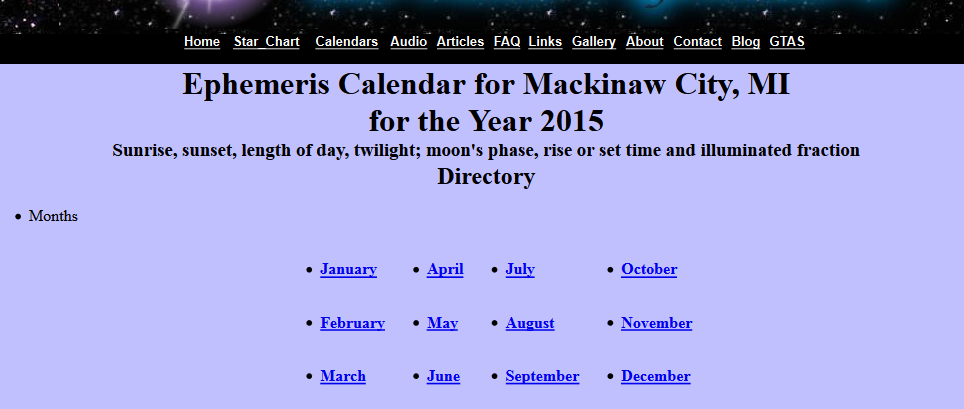
This is the top of the Mackinaw City calendar where you can select to start at any month.
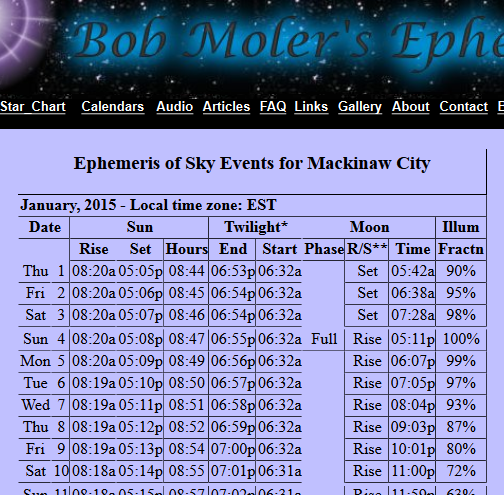
Partial image of the January calendar for Mackinaw City. The last column illum Fractn is the moon’s illuminated fraction. It is set for 24h UT, which is early evening on the date listed.
Interesting note: You can draw a straight line through Ludington, Interlochen/Traverse City, Petoskey and Mackinaw City. The angle with that line and the meridian is about 23 1/2 degrees. The same as the tilt of the Earth’s axis. Therefore near the winter solstice the sunrise times are nearly the same, but the sunset times can differ greatly. Conversely at the summer solstice the sunset times are nearly the same, but the sunrise times are the most divergent.
01/02/2015 – Ephemeris – Telescope Clinic tonight in Traverse City
Ephemeris for Friday, January 2nd. The sun will rise at 8:20, the latest sunrise of the year. It’ll be up for 8 hours and 53 minutes, setting at 5:13. The moon, 2 days before full, will set at 6:38 tomorrow morning.
Did you or someone in your family get a telescope for Christmas, or have one in a closet or attic because you don’t know how to put it together or operate? Or maybe you are trying to figure out which one to buy. Well, tonight’s your night. The Grand Traverse Astronomical Society will host a telescope clinic at Northwestern Michigan College’s Rogers Observatory on Birmley Road, south of Traverse City starting at 8 p.m. Telescope experts from the society will help you set up your telescope and give you observing tips. So bring ’em if you’ve got ’em. If it’s clear, at 9 p.m., there will be a star party to try out your telescope, or try them out on the lights of Traverse City. Can’t make it? We can help you after any meeting.
Times are for the Traverse City/Interlochen area of Michigan. They may be different for your location.
Addenda
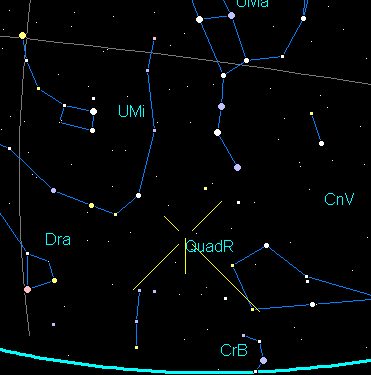
Remember the Quadrantid meteor shower tomorrow evening and into Sunday morning:
The moon will interfere with the meteor shower, so only the brightest will be visible. The radiant will rise from the northeast. The radiant will be nearly overhead at the start of twilight. On a dark night up to 120 meteors per hour may be seen according to the International Meteor Organization.
01/01/2015 – Ephemeris – Happy New Year – a look at January
Ephemeris for New Years Day, Thursday, January 1st. The sun will rise at 8:20. It’ll be up for 8 hours and 52 minutes, setting at 5:12. The moon, 3 days before full, will set at 5:43 tomorrow morning.
Happy New Year. Let’s preview the month of January. We’re a day from the latest sunrise at about the same time as today, 8:20 a.m. and will back down to 8:02 by the 31st. Sunset times are currently increasing by a minute a day from 5:12 p.m. today to 5:49 at month’s end. Listeners near the shore of Lake Michigan will have about the same sunrise time in Ludington, Interlochen/Traverse City, Petoskey and Mackinaw City, but the sunset times will vary markedly. The Quadrantid meteor shower whose radiant is near the end of the Big Dipper’s handle will reach peak on the 3rd, but it will have interference from the full moon,. On the 4th the Earth will be its closest to the sun of the entire year.
Times are for the Traverse City/Interlochen area of Michigan. They may be different for your location.
Addenda
Monthly Star Chart
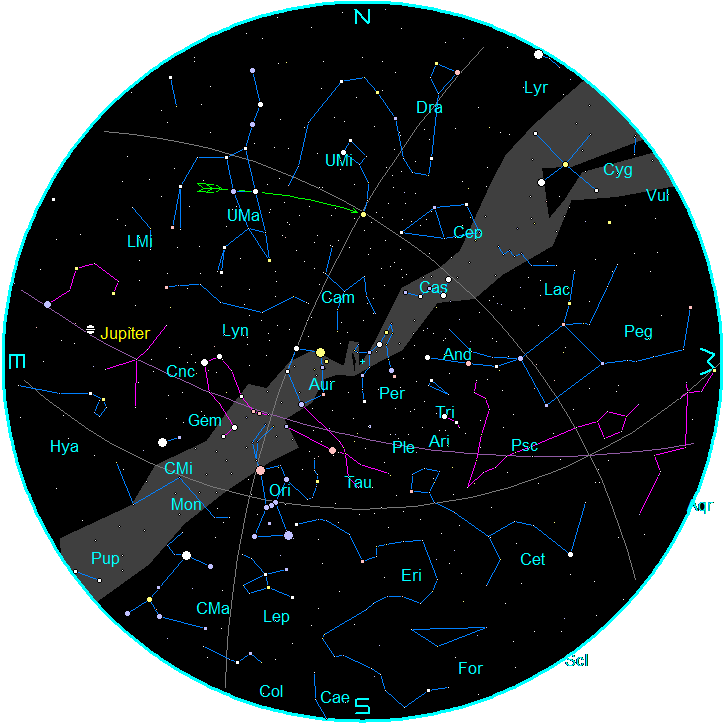
Star Chart for January 2015. Created using my LookingUp program.
The Moon is not plotted. The planets and stars are plotted for the 15th at 9 p.m. That is chart time.
Evening astronomical twilight ends at 6:58 p.m. on January 1st, and increasing to 7:30 p.m. on the 31st.
Morning astronomical twilight starts at 6:34 a.m. on January 1st, and decreasing to 6:22 a.m. on the 31st.
Add a half hour to the chart time every week before the 15th and subtract and hour for every week after the 15th.
For a list of constellation names to go with the abbreviations click here.
The green pointer from the Big Dipper is the pointer stars at the front of the bowl of the Big Dipper that point to Polaris the North Star.
The Quadrantid meteor shower
The moon will interfere with the meteor shower, so only the brightest will be visible. The radiant will rise from the northeast. The radiant will be nearly overhead at the start of twilight. On a dark night up to 120 meteors per hour may be seen according to the International Meteor Organization.
Quadrantid meteor shower radiant at 1:30 a.m.
The Earth at Perihelion
This is the closest the Earth gets to the Sun in its orbit this year. The Sun will be 91,402,000 miles or 147,096,000 kilometers away at around 1 a.m. January 4th, 2015 EST or 6 hr UT January 5th 2015. It makes winter the shortest season because the Earth is moving its fastest during perihelion. It’s only by a few days. And in northern Michigan where it seems that winter overlaps half of fall and spring besides, that few days difference is buried under snow.
Quasi-conjunction between Venus and Mercury on the evening of January 10th.
A quasi-conjunction. Conjunctions occur when two solar system bodies have the same right ascension. Mercury will get to within 0.6 degrees of Venus before retreating back sun-ward.
Animation of the Quasi-conjunction of Venus and Mercury. Time span 1/05/2015 to 1/15/2015 at 7 p.m. Created by Bob Moler using Stellarium and GIMP.
Comet C/2014 Q2 (Lovejoy)
Here is a finder chart for 9 p.m. for January. Every other position is marked with the month-day and predicted magnitude. Recently the comet has shown to be brighter than predicted by up to one magnitude. Note that magnitudes in astronomy are like golf scores – the lower the number, the brighter the object. So the comet should reach 4th magnitude.
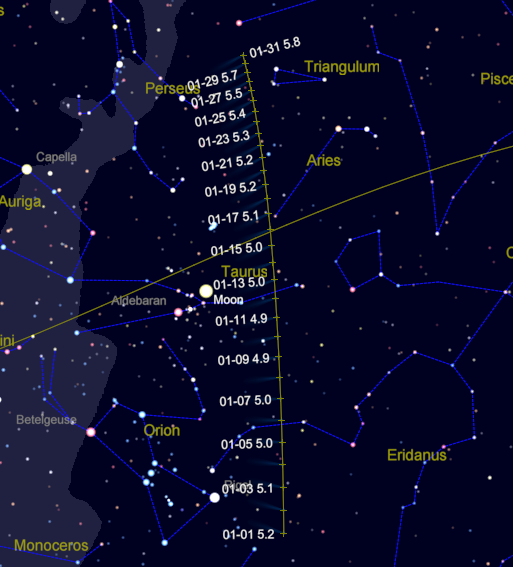
Nightly plot of Comet Lovejoy (C/2014 Q2) for the month of January, 2015 at 9 p.m.
Created using Cartes du Ceil (Sky Charts).
12/31/2014 – Ephemeris – A New Year’s look at the bright planets and a comet
Ephemeris for New Years Eve, Wednesday, December 31st. The sun will rise at 8:19. It’ll be up for 8 hours and 52 minutes, setting at 5:11. The moon, 3 days past first quarter, will set at 4:42 tomorrow morning.
Lets take a last look at the bright planets for 2014. Mercury joins Venus low in the southwest. It will be below and right of Venus and will set at 6:07 p.m. Venus is low in the southwest shortly after sunset. It now sets at 6:26 p.m., an hour and 15 minutes after the sun. It will be seen low in the southwestern twilight by 5:55 p.m. Mars is low in the southwest at 7 p.m. and is in the constellation of Capricornus. The Red Planet will set tonight at 8:36 p.m. Jupiter will rise in the east at 8:33 p.m. It’s near the sickle-shaped head of Leo. Jupiter is now moving slowly westward. This is an effect that happens because the Earth is passing Jupiter, a motion shared by all the planets that baffled the ancients who thought the Earth to be motionless. Early risers will be able to spot Saturn which will rise in the east-southeast at 5:10 a.m.
Times are for the Traverse City/Interlochen area of Michigan. They may be different for your location.
Addendum
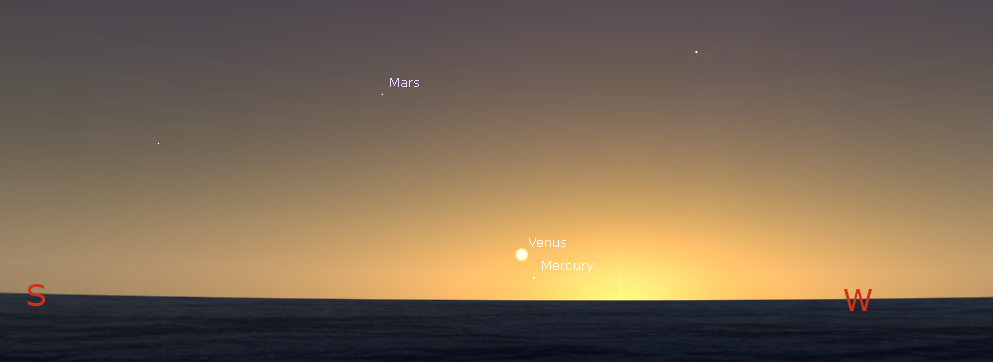
Mercury, Venus and Mars are seen in the southwestern sky shortly after sunset. In this case 5:45 p.m. December 31, 2014, only 34 minutes after sunset. Created using Stellarium.
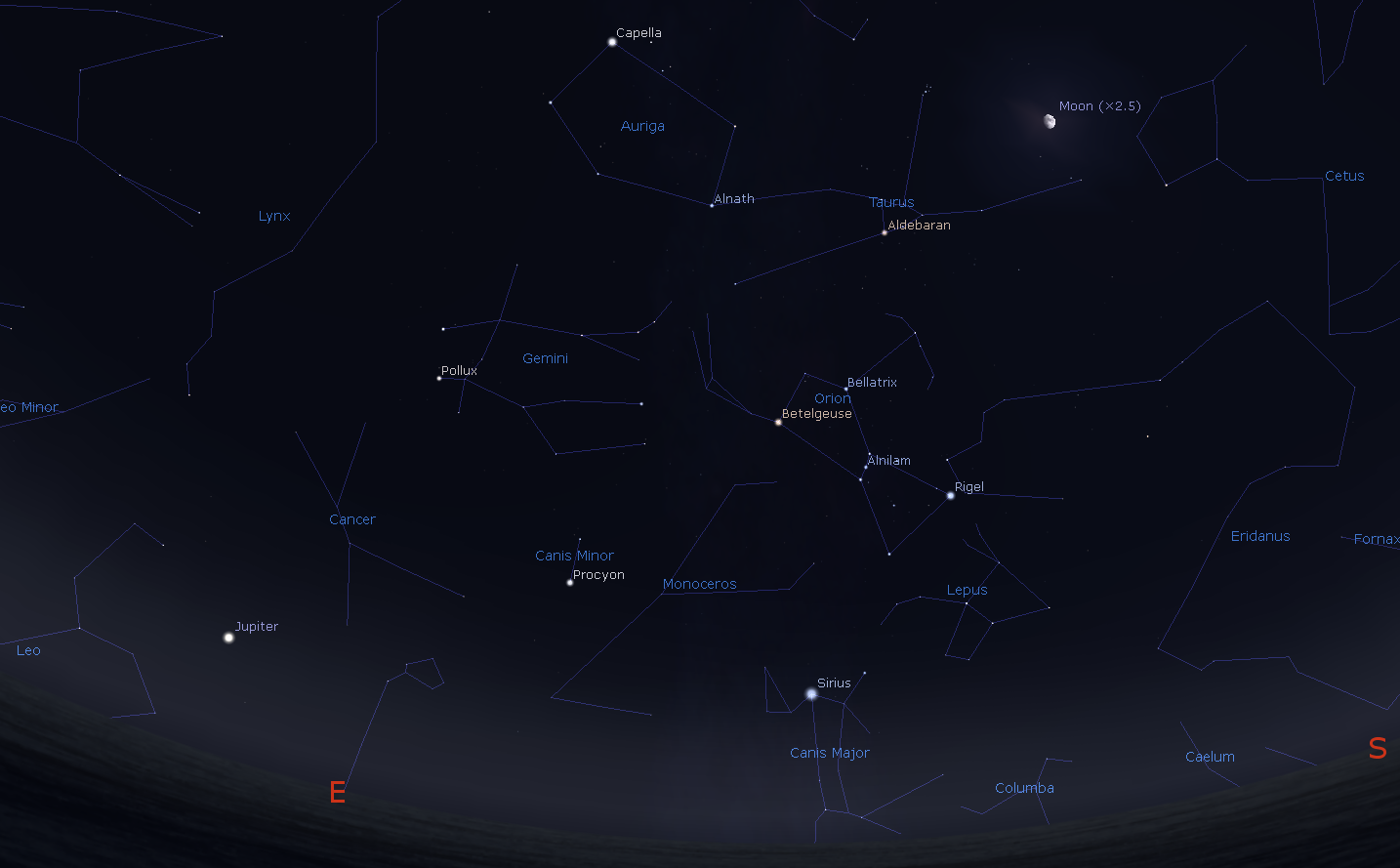
Jupiter, the Moon and the winter constellations at 9:30 p.m. December 31, 2014. Created using Stellarium.
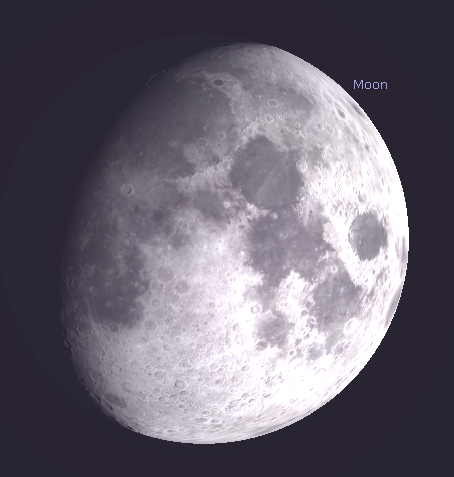
The Moon as it will appear in binoculars at 9:30 p.m. December 31, 2014. Created using Stellarium.
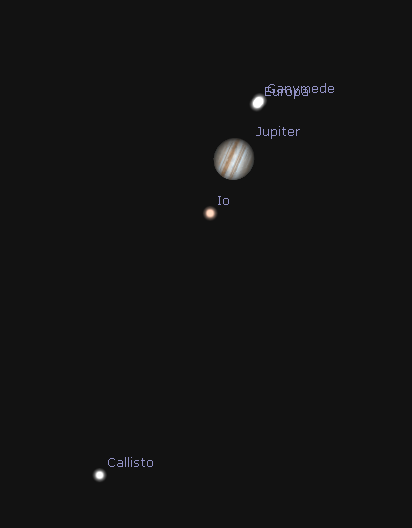
Jupiter seen through a telescope at 9:30 p.m. December 31, 2014. Note that Ganymede and Europa will appear very close to each other. Created using Stellarium.
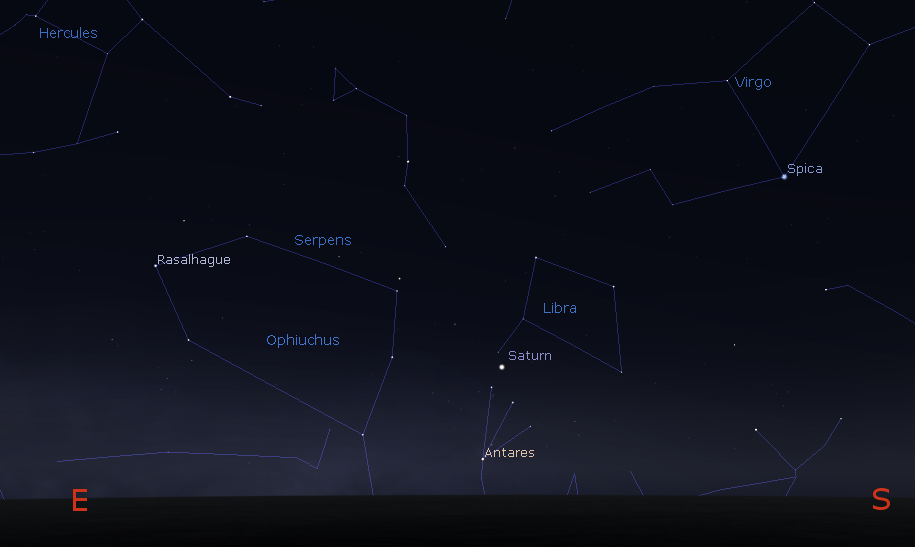
Saturn and the late spring and early summer constellations at 7 a.m. New Year’s Day 2015. Created using Stellarium.
Comet Lovejoy
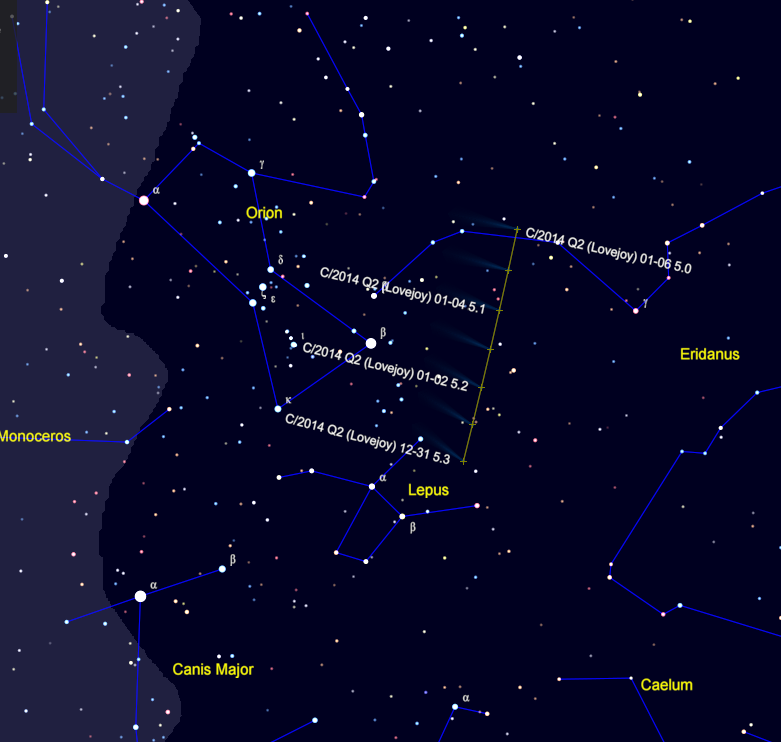
Comet Lovejoy (C/2014 Q2) plotted for 9 p.m. from 12/31/2014 to 1/06/2015. Created using Cartes du Ceil (Sky Charts).
12/30/2014 – Ephemeris – Looking ahead at some local and space astronomical events in 2015
Ephemeris for Tuesday, December 30th. The sun will rise at 8:19. It’ll be up for 8 hours and 51 minutes, setting at 5:11. The moon, 2 days past first quarter, will set at 3:38 tomorrow morning.
Let’s look ahead at a few astronomical and space events that will take place in 2015. Visible for us will be the partial phase of a lunar eclipse in morning twilight of April 4th, plus there’s a total lunar eclipse visible during the evening hours of September 27th. Out in space in the asteroid belt the Dawn spacecraft will enter orbit of Ceres, the largest asteroid and dwarf planet Ceres, a spherical world of rock and ice in April. Further out past the last planet the New Horizons spacecraft will fly by the dwarf planet Pluto and its system of at least 5 satellites: Charon, Nix, Hydra, Styx, and Kerberos on July 14th. It will take several months to transmit the data and images back to Earth after which the spacecraft will be redirected to a new target.
Times are for the Traverse City/Interlochen area of Michigan. They may be different for your location.
Addendum
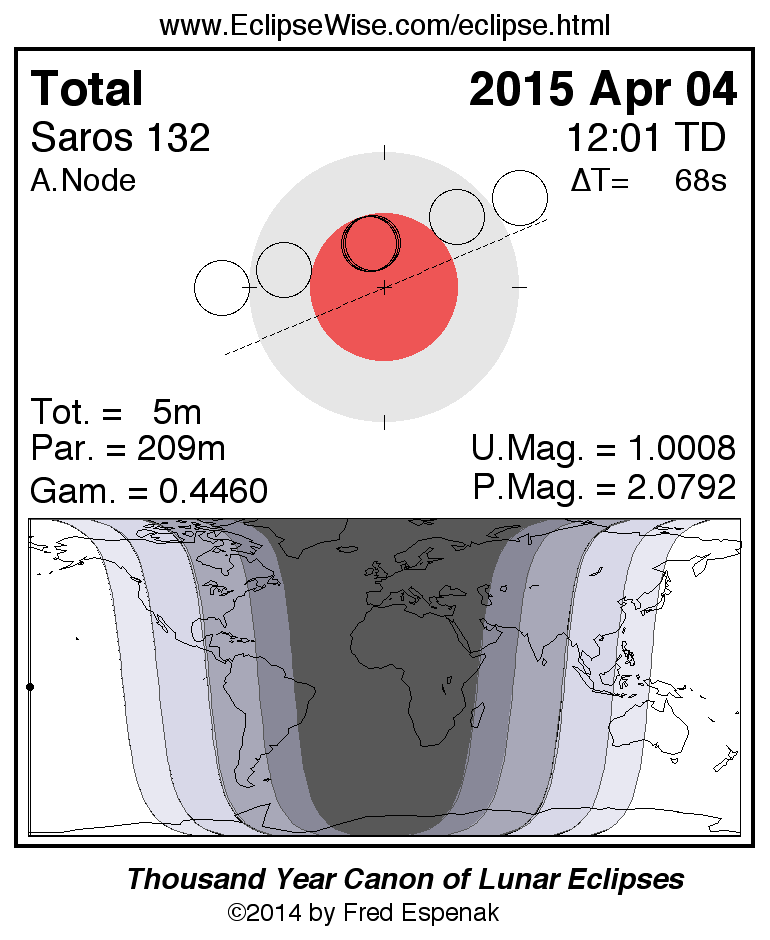
Chart for the total lunar eclipse of April 4, 2015. In Michigan we will see on;y the beginning partial phase in morning twilight. Credit: Fred Espenak, NASA/GSFC
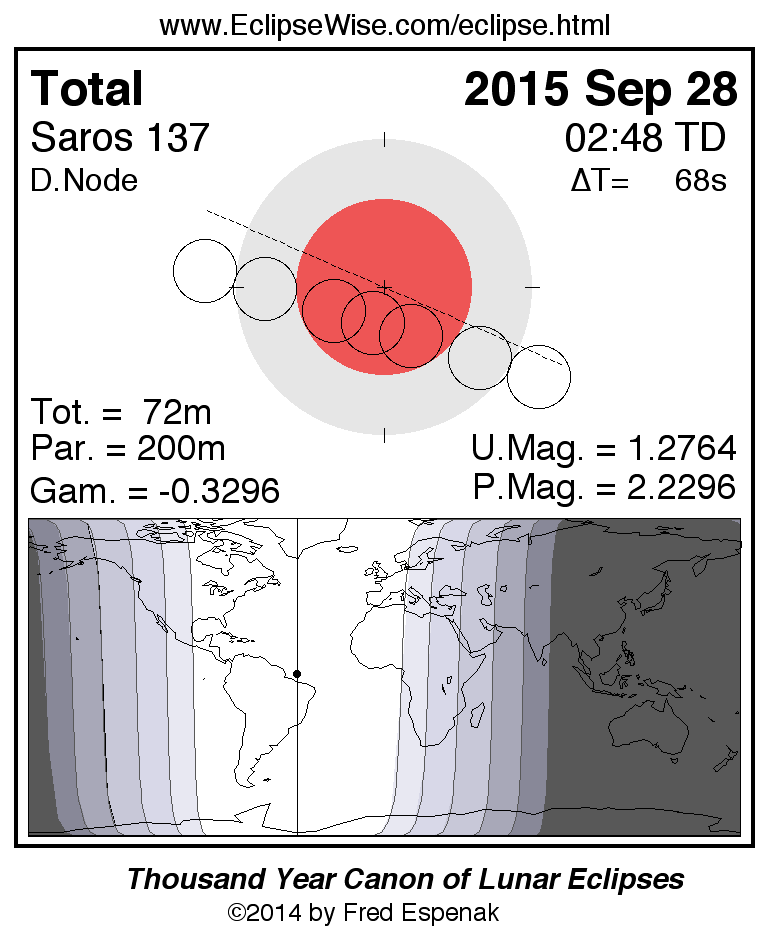
Chart for the total lunar eclipse of September 28, 2015. This is the evening of the 27th, EDT in Michigan. Credit: Fred Espenak, NASA/GSFC.
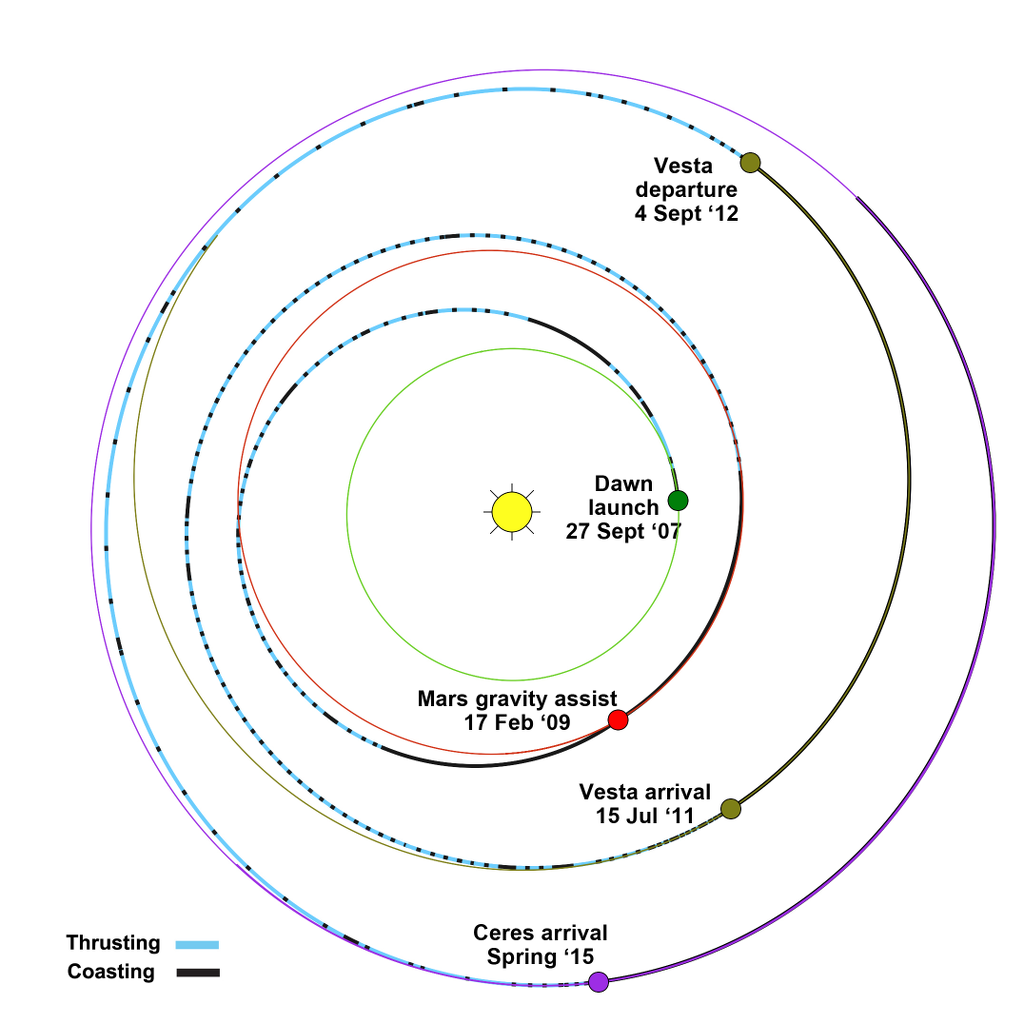
Dawn orbital track past Mars, stopping at Vesta and continuing to Ceres. Credit: NASA/JPL.
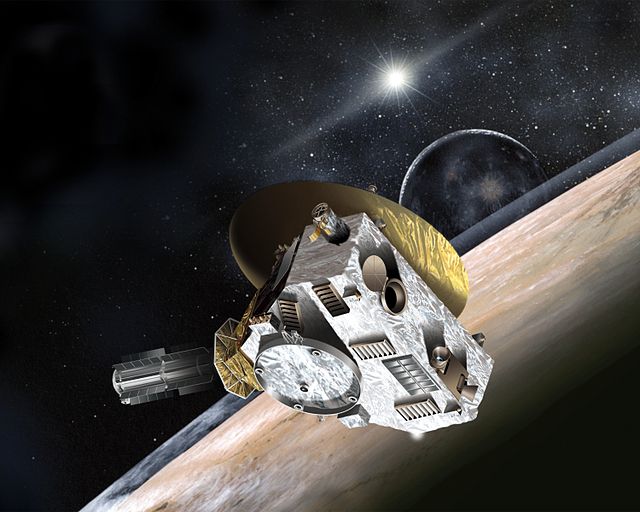
Artist conception of the New Horizons spacecraft at Pluto. Credit: NASA/Johns Hopkins University Applied Physics Laboratory/Southwest Research Institute
12/29/2014 – Ephemeris – More events from 2014
Ephemeris for Monday, December 29th. The sun will rise at 8:19. It’ll be up for 8 hours and 51 minutes, setting at 5:10. The moon, 1 day past first quarter, will set at 2:32 tomorrow morning.
2014 has been a year of eclipses for northern Michigan. A total lunar eclipse on the morning of April 15th, another on the morning of October 8th. Plus we had a partial solar eclipse at sunset on October 23rd. All of them were hampered by clouds, for this observer. One of the cool events of this year was the close approach of Comet Siding Spring with Mars. The five functioning orbiters and two rovers were not able to get any spectacular pictures of the comet, but there was one heck of a meteor shower on Mars when the planet was closest to the comet’s path. None of the satellites could see it because they were hiding behind the planet at the time. But later the martian atmosphere was filled with the chemical signatures of the meteors.
Times are for the Traverse City/Interlochen area of Michigan. They may be different for your location.
Addendum
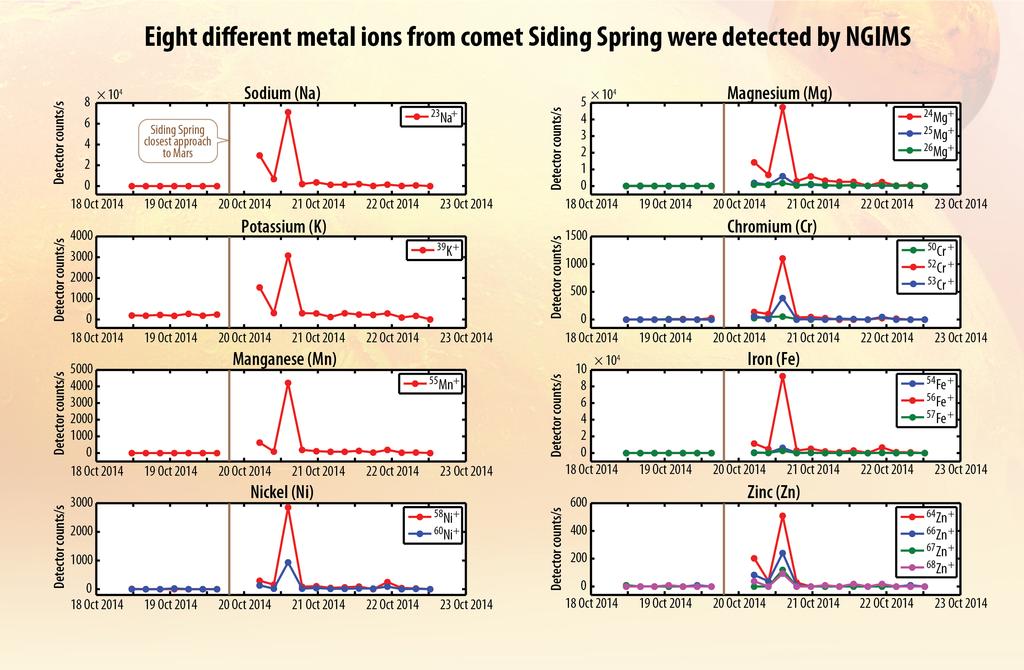
Metals in the atmosphere of Mars before and after the passage of Comet Siding Spring by Mars measured by the MAVEN spacecraft. Credit NASA.
12/26/2014 – Ephemeris – Tragedies and triumphs of 2014
Ephemeris for Friday, December 26th. The sun will rise at 8:18. It’ll be up for 8 hours and 49 minutes, setting at 5:08. The moon, 2 days before first quarter, will set at 11:02 this evening.
2014 was a year of personal tragedy and also tragedy and triumph in space. The Space tragedies came in October with the destruction and loss of Orbital Science’s third supply mission to the International Space Station when the their Antares rocket blew up right after launch. A few days later Virgin Galactic’s SpaceShipTwo disintegrated on a test flight killing a pilot. In the Triumph department the European Space Agency’s Rosetta caught up and orbited its comet 67P, for short, in August and bounced down its lander Philae in November. It wasn’t supposed to bounce, but stick the landing. Bruised and battered Philae delivered its science before its batteries died. And this month an unmanned Orion capsule made its maiden voyage into space.
Times are for the Traverse City/Interlochen area of Michigan. They may be different for your location.
Addendum

Orbital Sciences Antares rocket explodes seconds after liftoff on October 28, 2014. Credit NASA.

SpaceShipTwo disintegrates October 31, 2014 killing a pilot. Credit USA Today.
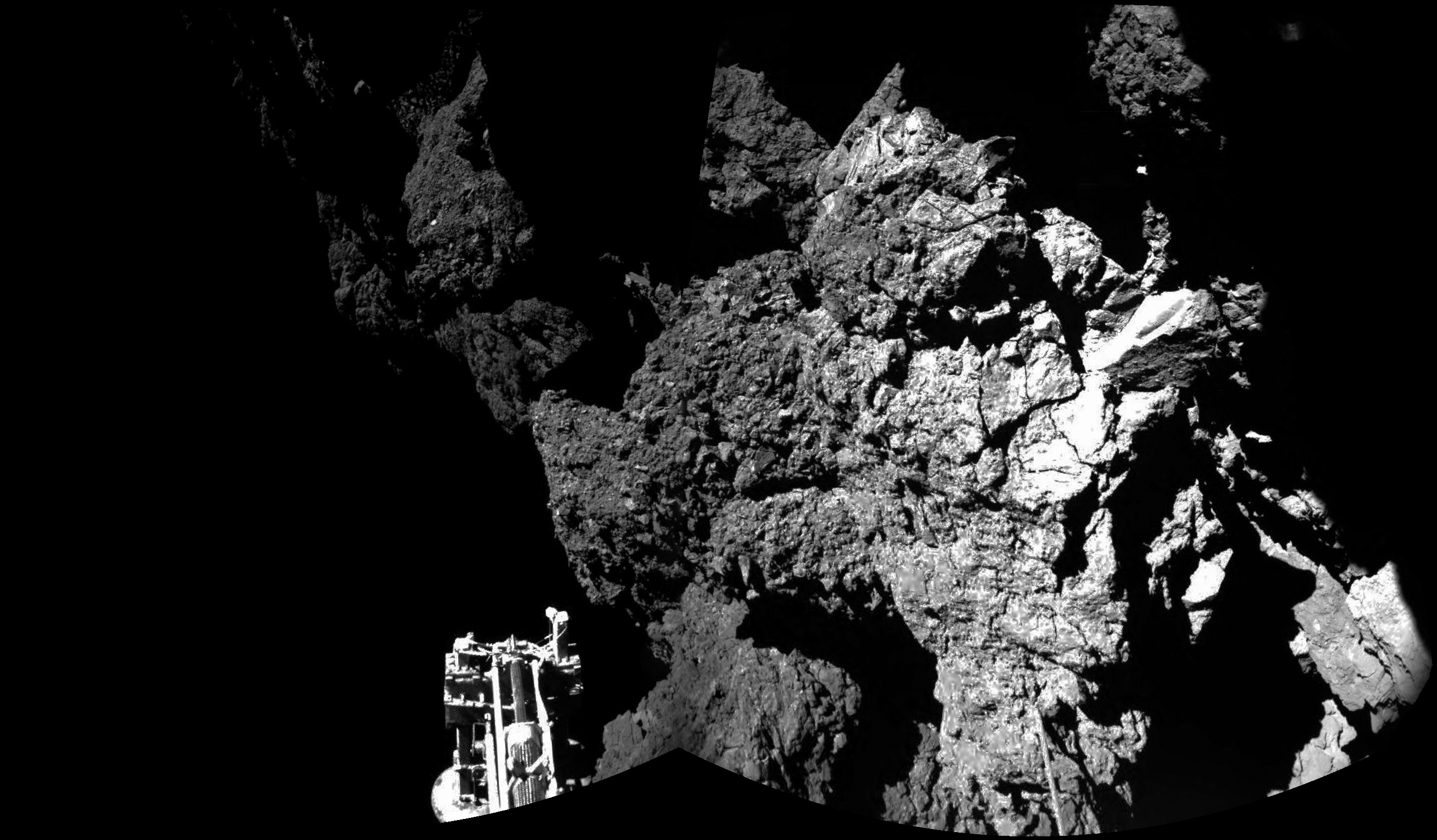
After a second bounce on the Comet 67P the Philae lander ended up sideways apparently on the base of a cliff. Researchers were able to get data from just about all the instruments before the battery discharged. The team hopes and the comet gets closer to the sun and the sun angle changes they can revive Philae. Credit: ESA.
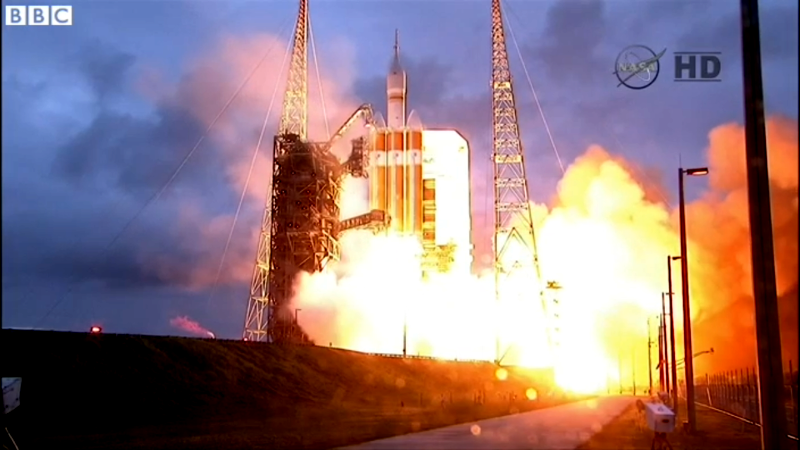
Screen capture of Delta IV Heavy rocket liftoff carrying the Orion test article into orbit on December 4, 2014. Credit .NASA via BBC
Ride back to the earth with Orion via a camera mounted in a window. The window is facing aft as the capsule re-enters the atmosphere heat shield first at 20,000 miles per hour. You’ll experience everything except the G forces. It comes with appropriate spacey music. It’s as close as I’ll ever get to ride in one of these things.

