Archive
12/25/2014 – Ephemeris – My recollections of spotting the Southern Cross for the first time.
Merry Christmas. This is Ephemeris for Christmas Day, Thursday, December 25th. The sun will rise at 8:17. It’ll be up for 8 hours and 49 minutes, setting at 5:07. The moon, 3 days before first quarter, will set at 9:50 this evening.
My one and only sighting of the constellation the Southern Cross came two and a half years ago from a cruise ship traveling between the Hawaiian island of Maui and Hilo on the Big Island. I had plotted it out before the trip. Our ship would be traveling in a south-southeasterly direction and at 3 a.m., the Southern Cross would be low above the southern horizon from our latitude which I surmised would be about 20 degrees north. The southern cross would be visible from the bow of the ship. The only really dark location to view it was on Deck 14 with an unobstructed view with some subdued lights behind me. I easily found it, and verified it with the fifth star of the cross. Nearby was Alpha Centauri the closest star to the sun.
Times are for the Traverse City/Interlochen area of Michigan. They may be different for your location.
Addendum
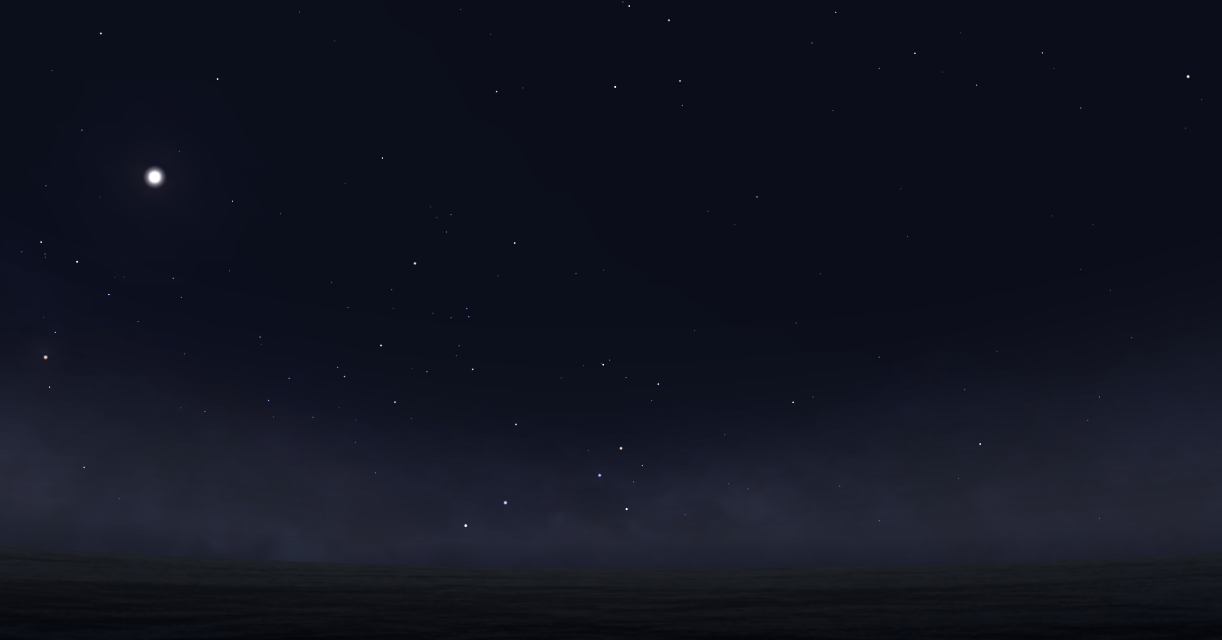
The approximate sky that I saw from the bow of the ship at 3:15 a.m. HST February 14, 2012. The moon was a slight gibbous phase. Recreated using Stellarium.
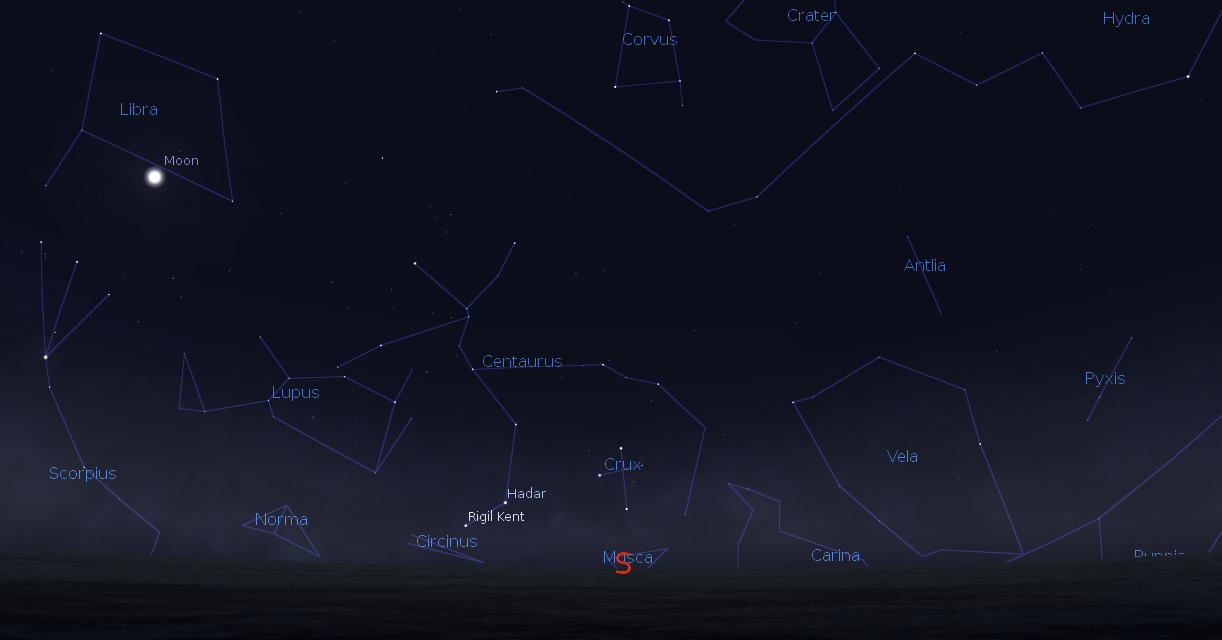
The approximate sky that I saw from the bow of the ship at 3:15 a.m. HST February 14, 2012, annotated. The moon was a slight gibbous phase. Recreated using Stellarium.
Note that the star named Rigil Kent is truncated. It’s Rigil Kentaurus, better known by its catalog name Alpha Centauri. The fifth star of the cross, my check star, is on the right side of the cross, just below the crosspiece. The Southern Cross’s real name is Crux, which simply means cross. The Northern Cross is not an official constellation. It’s part of Cygnus the swan.
I’ve heard folks say the Beta Centauri is Alpha Centauri’s companion star. That is not true. Beta Centauri is Hadar, seen near Alpha in the sky, but is much farther away. There are three stars in the Alpha Centauri system: Alpha Centauri A, Alpha Centauri B, and Proxima Centauri, a telescopic red dwarf, a bit away from the other two. Alpha Centauri A & B are a wide double, visible in a telescope. I saw and photographed them when on Key Largo in April 1986 for Halley’s Comet’s closest approach to the Earth. Note it wasn’t all that close, some 40 million miles, and it had a tail disconnection that week. Bummer.
12/24/2014 – Ephemeris – Twas the night before Christmas and only the planets and a comet were stirring
Ephemeris for Christmas Eve, Wednesday, December 24th. The sun will rise at 8:17. It’ll be up for 8 hours and 49 minutes, setting at 5:06. The moon, 3 days past new, will set at 8:37 this evening.
Twas the night before Christmas and only the planets were stirring. Venus is low in the southwest shortly after sunset. It now sets at 6:09 p.m., 63 minutes after the sun. It will be tough to spot at all. New Year’s Eve might be a good time to start to see it. Mars, low in the southwest at 7 p.m. has the Moon just to the right of it tonight. Mars will set tonight at 8:34 p.m. Jupiter, which will be our Christmas Star this year will rise in the east at 8:59 p.m. It’s near the sickle shaped head of Leo. Jupiter is now moving slowly westward. This is an effect that happens because the Earth is passing Jupiter, a motion shared by all the planets that baffled the ancients who thought the Earth to be motionless. Saturn will rise in the east-southeast at 5:34 a.m.
Times are for the Traverse City/Interlochen area of Michigan. They may be different for your location.
Addenda
The Planets tonight
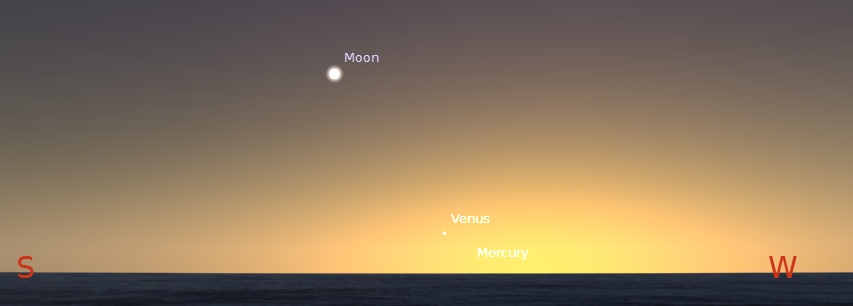
Venus low on the horizon, and the Moon, at 5 30 p.m. on December 24, 2014. Created using Stellarium.
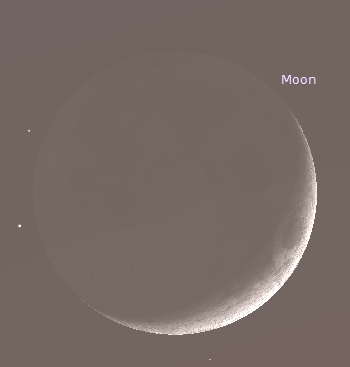
The crescent Moon through binoculars, at 5 30 p.m. on December 24, 2014. Created using Stellarium.
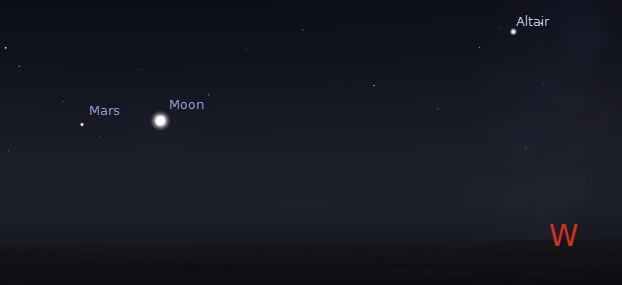
Mars and the Moon at 7:30 p.m. on December 24, 2014. Created using Stellarium.
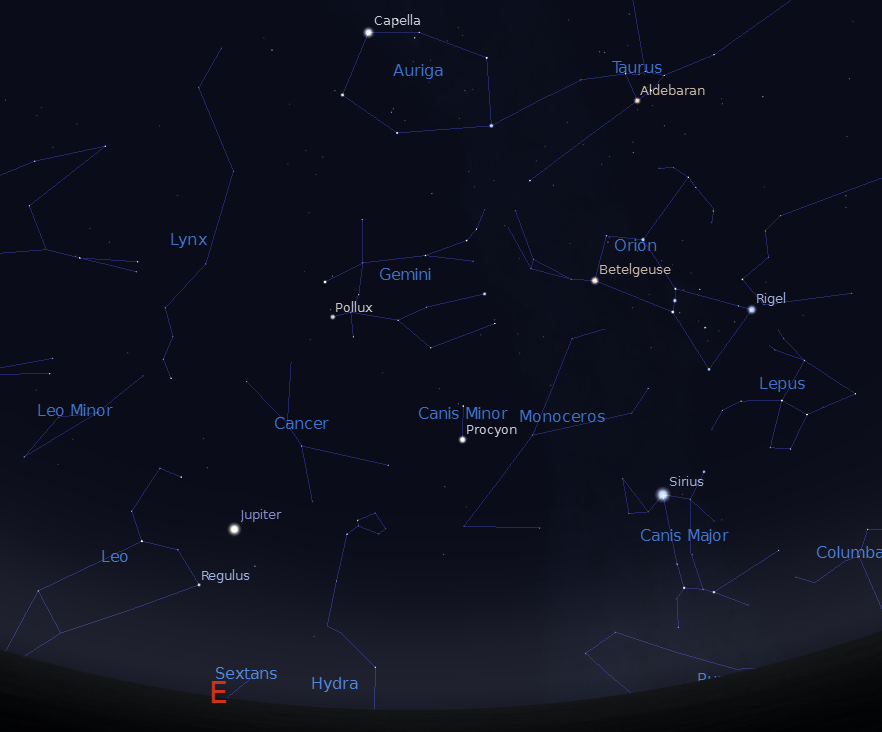
Jupiter and the winter constellations at 11 p.m. on December 24, 2014. Created using Stellarium.
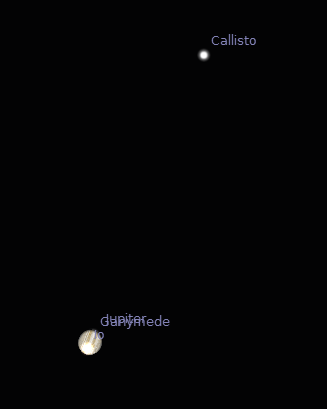
Jupiter with three hidden satellites, with only Callisto showing at 11 p.m. on December 24, 2014. See blow by blow of the satellite disappearances below. Created using Stellarium.
Jovian satellite events of the night of December 24-25, 2014
Ganymede starts eclipse (enters Jupiter’s shadow) 6:20 p.m.
Europa starts eclipse 8:27p.m.
Io’s shadow starts crossing Jupiter 9:32 p.m.
Ganymede leaves Jupiter’s shadow 10:00 p.m.
Ganymede starts being occulted by Jupiter 10:11 p.m.
Io’s transit across the face of Jupiter starts 10:29 p.m.
Io’s shadow leaves the face of Jupiter 11:50 p.m.
Io’s transit of Jupiter ends 12:46 a.m.
Europa’s occultation by Jupiter ends 1:10 a.m.
Ganymede’s occultation by Jupiter ends 1:50 a.m.
Note that Europa’s occultation by Jupiter starts before its eclipse ends, so unlike the more distant Ganymede there isn’t an interval of visibility between the two.
Jovian satellite event timings provided by Project Pluto www.projectpluto.com
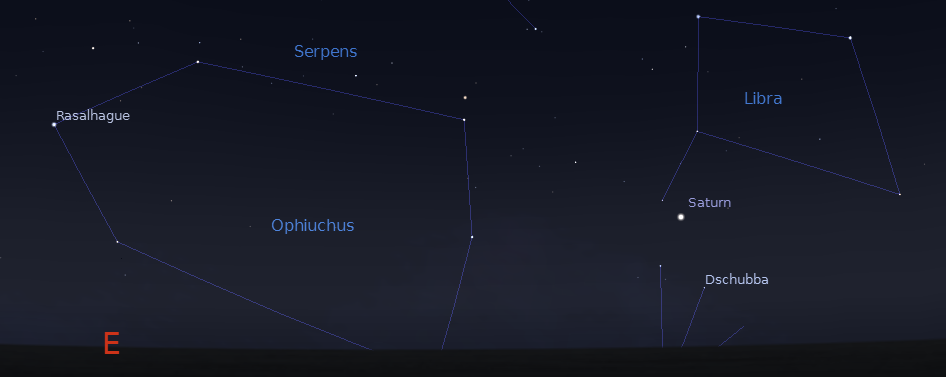
Saturn low in the east-southeast among the constellations of late spring and early summer at 6:30 a.m. on Christmas morning 2014 . Created using Stellarium.
Comet C/2014 Q2 (Lovejoy)
Normally my Ephemeris program deals with celestial objects that are visible to the naked eye. While Comet Lovejoy will, for a few weeks become brighter than 6th magnitude the normal limit for the unaided human eye, a comet is a diffuse object and always looks dimmer than a star of the same magnitude. This comet was discovered August 17, 2014 by Australian amateur astronomer Terry Lovejoy. He has discovered 5 comets. His most famous find was C/2011 W3 (Lovejoy) that buzzed the Sun and survived becoming a magnificent comet for southern hemisphere observers.
Recently Comet Lovejoy became brighter than expected. The data for the charts below are from Minor Planet Center and do not include new brightness estimates that include the outburst. They have the comet reaching magnitude 4.9. The aerith.net website gives the maximum brightness next month of 4. (Magnitudes are like golf scores the lower the magnitude the brighter the object). Each magnitude step is a brightness difference of about 2 and a half times. To check on the comet go to http://www.aerith.net/comet/weekly/current.html. Currently Comet Lovejoy is the brightest comet now visible and is the first comet on the list. Clicking on the comet ‘s name will give you the comet’s page. The last chart on the page is a chart tracking the comet’s brightness from reports vs. prediction. That chart predicts a magnitude of 4 just after the first of the year.
Photographs of the comet show a gaseous coma (head) and a very faint ion tail, which may not be visible visually in binoculars and telescopes. Right now the comet is highest around midnight.
The finder charts below designate the comet by month-day and the predicted magnitude
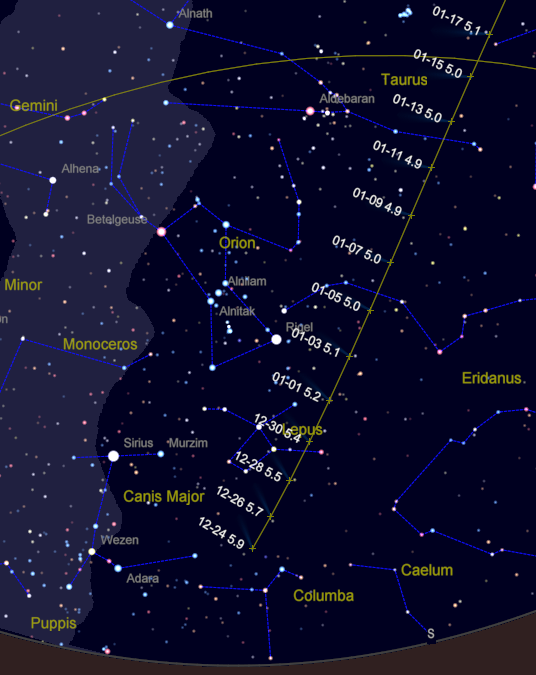
Comet C/2014 Q2 (Lovejoy) at 11 p.m. at 2 day intervals from tonight 12/24/2014 to 1/17/2015. Created using Cartes du Ceil (Sky Charts).
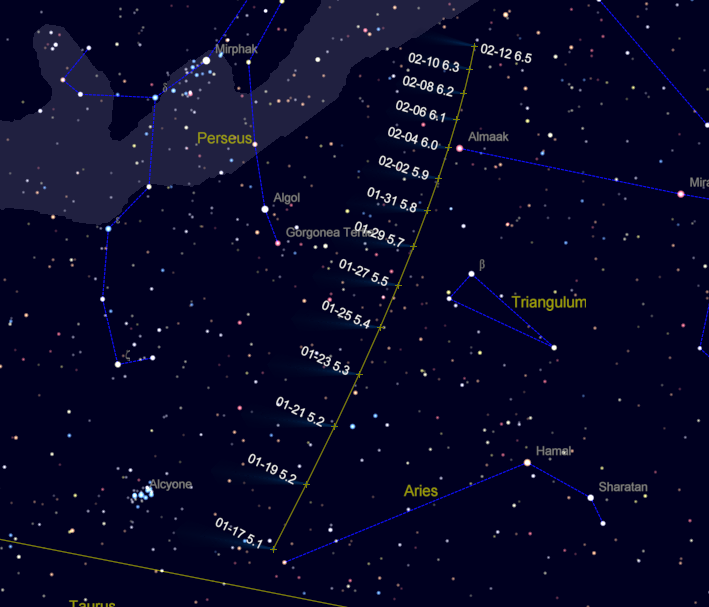
Comet C/2014 Q2 (Lovejoy) at 8 p.m. at 2 day intervals from tonight 1/17/2015 to 2/12/2015. Created using Cartes du Ceil (Sky Charts).
On December 28th Comet Lovejoy will appear to pass the globular cluster M79.
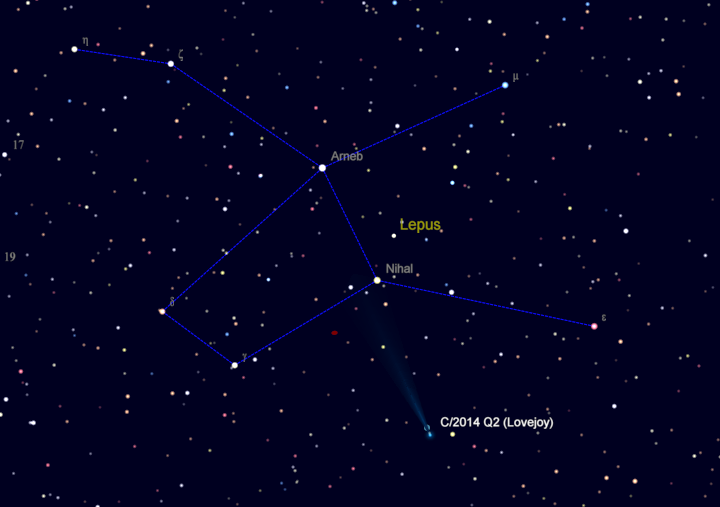
Comet Lovejoy and M79 a distant globular star cluster, in the constellation of Lepus the hare, will appear together at 11 p.m. December 28th, 2014. Note the that M79 is the unlabeled blue dot in the tail of the comet, next to the head. Created using Cartes du Ceil (Sky Charts).
12/23/2014 – Ephemeris – Is the constellation of Cetus a whale or a sea monster?
Ephemeris for Tuesday, December 23rd. The sun will rise at 8:17. It’ll be up for 8 hours and 49 minutes, setting at 5:06. The moon, 2 days past new, will set at 7:25 this evening.
The identity of the constellation Cetus is a bit mixed up. Officially it’s a whale, but in the story of the constellations above it, (Cassiopeia, Pegasus, Andromeda, Perseus and Cepheus) it is the monster sent to ravage the Ethiopian coast, and to whom the sacrifice of Andromeda was to stop. Either can be seen in the stars in the south at 8 p.m. It is a large constellation of dim stars below and left of the Great Square of Pegasus and Pisces. The whale can be seen diving, its tail of 5 stars in a squished pentagon, is seen to the upper left. If you see the stars differently and put the head of the sea monster where the tail of whale is the dreaded Cetus of the story appears. One of its stars is variable and will not be visible without a telescope, it’s Mira, the wonderful.
Times are for the Traverse City/Interlochen area of Michigan. They may be different for your location.
Addendum
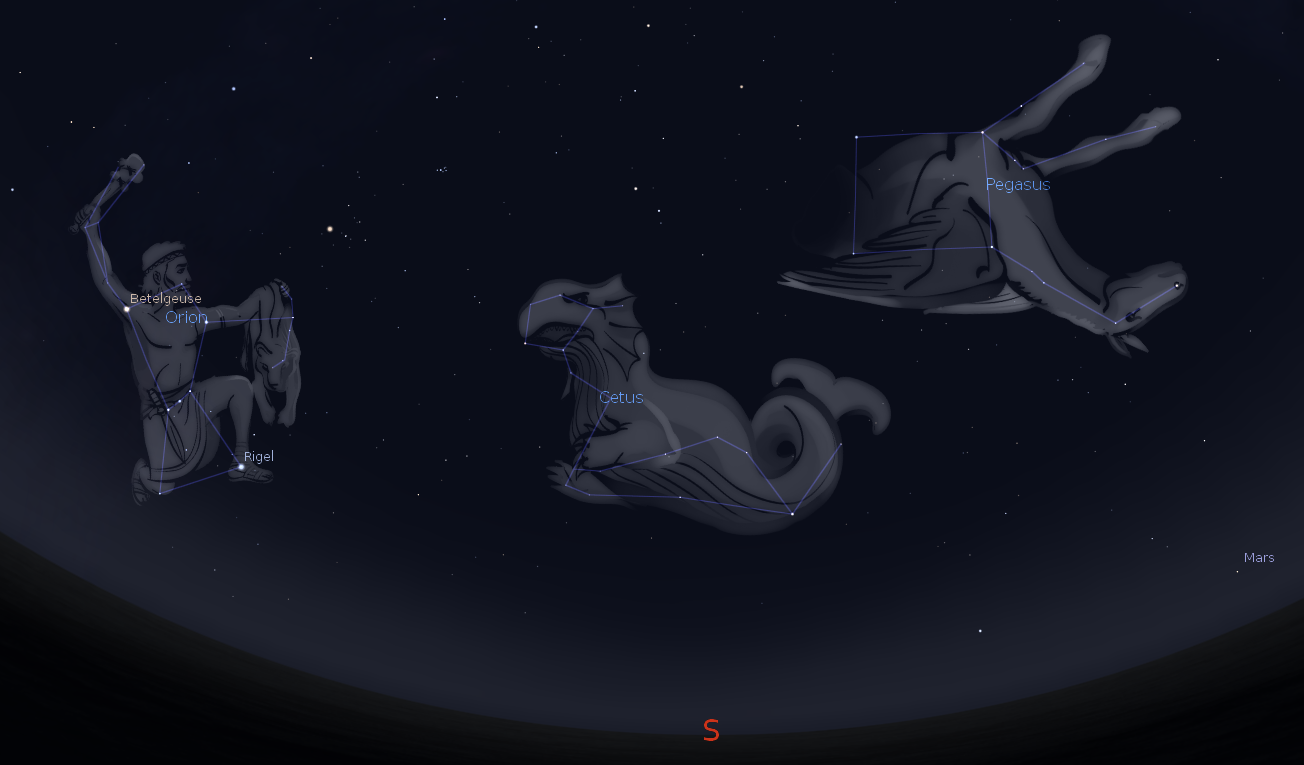
Cetus with Pegasus and Orion displaying mythological images at 8 p.m. on December 23, 2014. Created using Stellarium.
12/22/2014 – Ephemeris Extra – New broadcast time on IPR News Radio
As of December 1st National Public Radio has changed the format for their morning news program Morning Edition. As a result Interlochen Public Radio has moved my Ephemeris program to around 6:49 a.m., a half hour later.
Here’s the current schedule
Ephemeris Radio Schedule Monday – Friday
Ephemeris air times (ET)
6:49 a.m. – News stations (New as of December 1, 2104)
6:59 a.m.- Classical stations
The Stations of Interlochen Public Radio
Classical:
WIAA 88.7 FM Interlochen
94.7 FM Traverse City
WIAB 88.5 FM Mackinaw City
WICV 100.9 FM East Jordan, Charlevoix
News:
WICA 91.5, FM Traverse City
WLNM 89.7 FM Manistee
WHBP 90.1 FM Harbor Springs, Petoskey
There’s another local program on astronomy on the News stations. It’s a 2 minute weekly program on about 6:30 a.m. Mondays. It’s producer is Mary Stewart Adams, Program Director Headlands International Dark Sky Park, near Mackinaw City, MI. She tends more toward folklore than science which is fun and entertaining. On her Linked In page she lists herself as an Astrosopher/Program Director Headlands Internat’l Dark Sky Park. Near as I could find out astrosophy is a kind of new age astrology. Astronomy broke the link to astrology some 400 years ago. So as long as the program doesn’t drift into astrology, or astrosophy as being real. I’ll enjoy the program.
12/22/2014 – Ephemeris – Roman solstice festivals that seem like our holiday season
Ephemeris for Monday, December 22nd. The sun will rise at 8:16. It’ll be up for 8 hours and 48 minutes, setting at 5:05. The moon, 1 day past new, will set at 6:17 this evening.
The Romans, around the time of Christ knew that the Sun would turn northward after the winter solstice. Their ancestors may not have been. They had two festivals around this time of year. Saturnalia, from the 17th to the 23rd. A time of gift giving, parties, kind of like now. The feast of Sol Invictus or the Unconquerable Sun was set on December 25th the then date to have thought to be the winter solstice. I’m not sure if the Roman calendars were off 4 days or that it was the date they detected northward movement in the Sun. Anyway that’s the date the Christians decided to celebrate Christ’s birth. The Gospel of Luke with its shepherds being out all night guarding the sheep suggests that the birth was actually in the spring.
Times are for the Traverse City/Interlochen area of Michigan. They may be different for your location.
Addendum
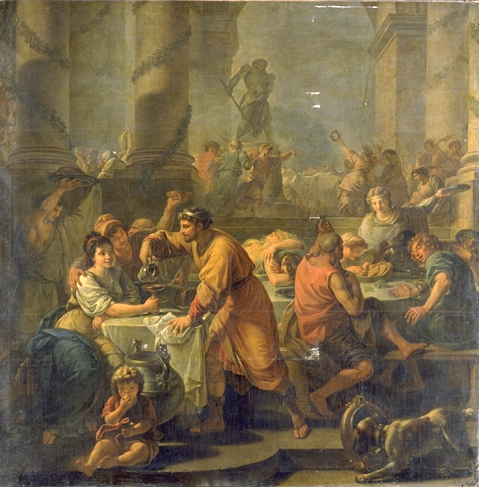
Saturnalia depiction.
12/19/2014 – Ephemeris – Winter starts on Sunday
Ephemeris for Friday, December 19th. The sun will rise at 8:15. It’ll be up for 8 hours and 49 minutes, setting at 5:04. The moon, 2 days before new, will rise at 6:27 tomorrow morning.
It’s looking like November and December should trade places in the calendar this year. And whatever the prognosis for a white Christmas this year winter will arrive on time at 6:03 p.m. Sunday the 21st. At that moment the Sun will hover over the Tropic of Capricorn before slowly beginning its journey northward. It is the winter of December solstice. In the sky the Sun will be moving about its fastest eastward near the border between Ophiuchus and Sagittarius along the great circle in the sky called the ecliptic that will bring it northward. The Sun’s motion will slowly bring longer daylight hours and a higher altitude that will counteract the cold generated in the last month or so, and will start to warm the northern hemisphere up again.
Times are for the Traverse City/Interlochen area of Michigan. They may be different for your location.
Addendum
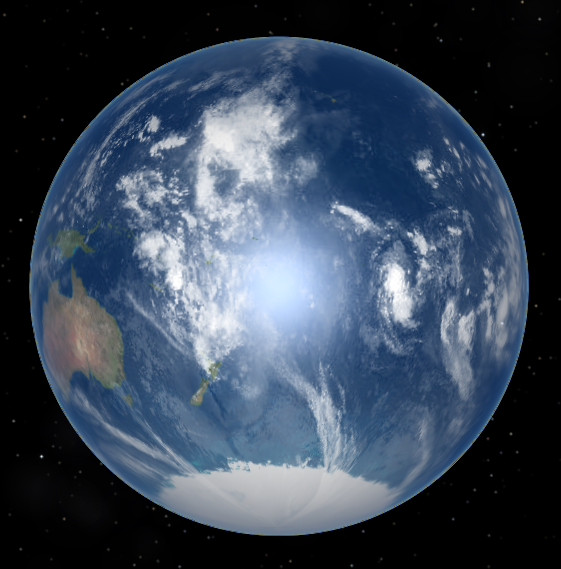
The Earth as seen from the direction of the Sun at 6:03 p.m. EST (23:03 UT) December 21, 2014. The sun would be overhead at 23.5 degrees south latitude in the South Pacific. Created using Celestia.
12/18/2014 – Ephemeris – Capella’s kids
Ephemeris for Thursday, December 18th. The sun will rise at 8:14. It’ll be up for 8 hours and 49 minutes, setting at 5:03. The moon, 3 days before new, will rise at 5:23 tomorrow morning.
Tuesday I talked about the bright star Capella in the constellation Auriga the charioteer, the brightest star in the eastern sky until Jupiter rises around 9:30. I mentioned a slim triangle of stars called the Kids, offspring of the mama goat Capella. The star at the tip of that slim triangle is designated by the Greek letter epsilon and so in known as Epsilon Aurigae. It was discovered to be variable in brightness in 1821. It turns out to be an eclipsing binary, where stars eclipse each other. Only the period between eclipses is 27 years, and the eclipses last about 2 years. Typical eclipsing binary stars have periods of days and the eclipses last hours. The eclipsing star has a large debris ring around it that’s also eclipsing the other star.
Times are for the Traverse City/Interlochen area of Michigan. They may be different for your location.
Addendum
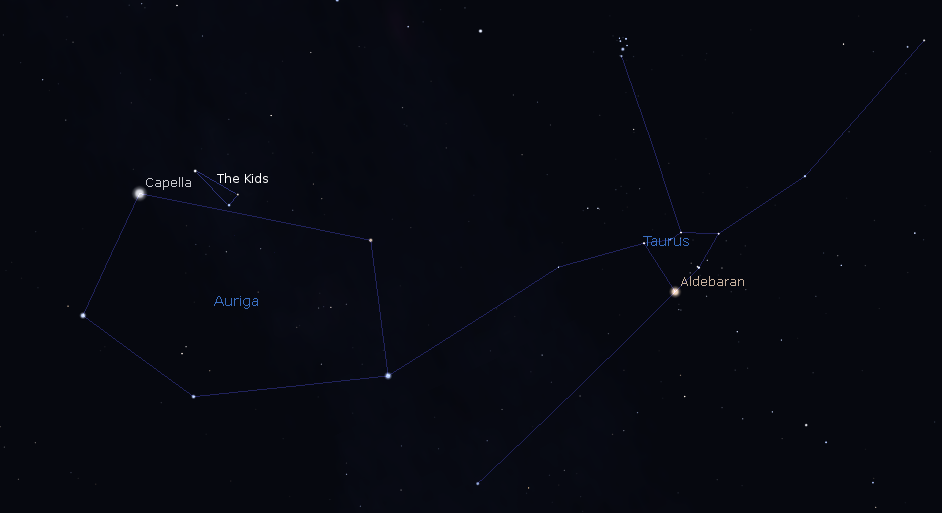
Capella and her kids. at 9 p.m. December 18, 2014. Created using Stellarium.
12/16/2014 – Ephemeris – Capella, the winter star that won’t set
Ephemeris for Tuesday, December 16th. The Sun will rise at 8:13. It’ll be up for 8 hours and 49 minutes, setting at 5:03. The moon, 2 days past last quarter, will rise at 3:17 tomorrow morning.
The bright star Capella is the only winter star I mention in the summer that still can be seen in the evening. That’s because it never sets for observers north of Ludington. It’s a constant reminder that winter is always just around the corner. Well this week it really is. It’s the brightest star in the eastern sky at 8 p.m. and for some time thereafter until Jupiter rises. Capella is in the constellation of Auriga the charioteer, a pentagonal constellation to my eyes. Capella means, essentially mama goat. Her three kids are the stars in a thin triangle to her right. Capella is actually a very close binary star, where the stars are too close to be optically separated. Breaking up the light with a spectroscope reveals its true nature.
Times are for the Traverse City/Interlochen area of Michigan. They may be different for your location.
Addendum
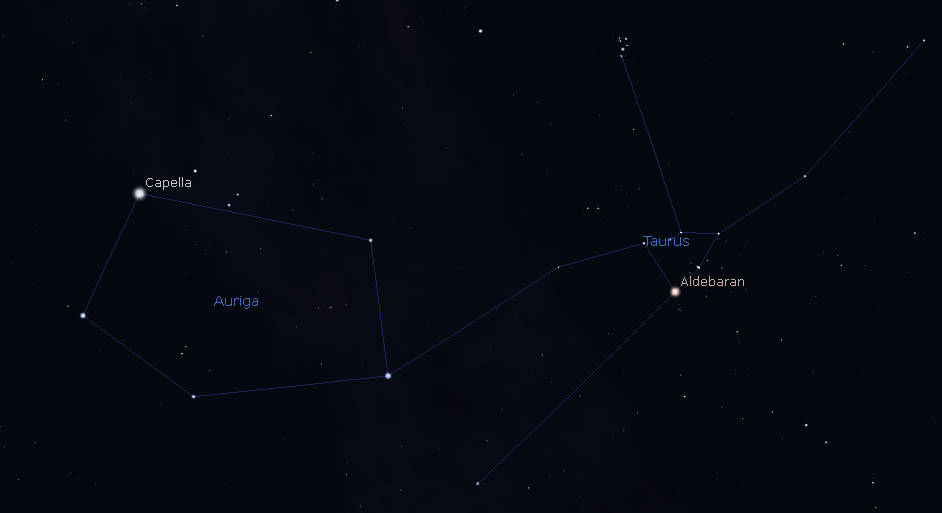
Capella in the constellation of Auriga at 9 p.m. on December 16, 2014. Created using Stellarium.
12/17/2014 – Ephemeris – Your weekly look at the bright planets
Ephemeris for Wednesday, December 17th. The sun will rise at 8:13. It’ll be up for 8 hours and 49 minutes, setting at 5:03. The moon, 3 days past last quarter, will rise at 4:19 tomorrow morning.
Venus is slowly moving from around the sun into the evening sky. It now sets at 5:55 p.m., 52 minutes after the sun. It will be tough to spot at all New Year’s Eve might be a good time to start to see it. Mars is still low in the southwest at 7 p.m. It’s now moving through the constellation of Capricornus and will set tonight at 8:32 p.m. Jupiter, which will be our Christmas Star this year will rise in the east at 9:32 p.m. It’s near the sickle-shaped head of Leo. Jupiter has just started to turn from eastward or direct motion to retrograde, or westward motion among the stars. This is an effect that happens because the Earth is passing Jupiter, a motion shared by all the planets that baffled the ancients who thought the Earth to be motionless. Saturn will rise in the east-southeast at 5:58 a.m.
Times are for the Traverse City/Interlochen area of Michigan. They may be different for your location.
Addendum
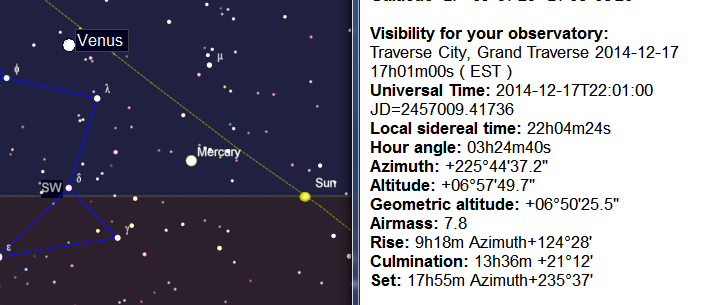
Venus at Sunset. Only 7 degrees above the horizon. Created using Cartes du Ceil (Sky Charts).
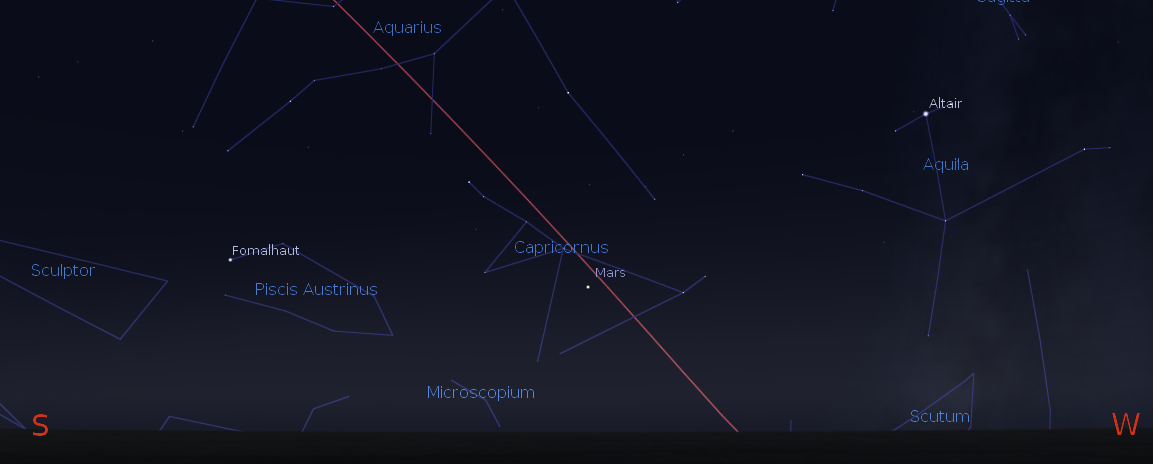
Mars and the constellations plus the ecliptic (red line) at 7 p.m. on December 17, 2014. Created using Stellarium.
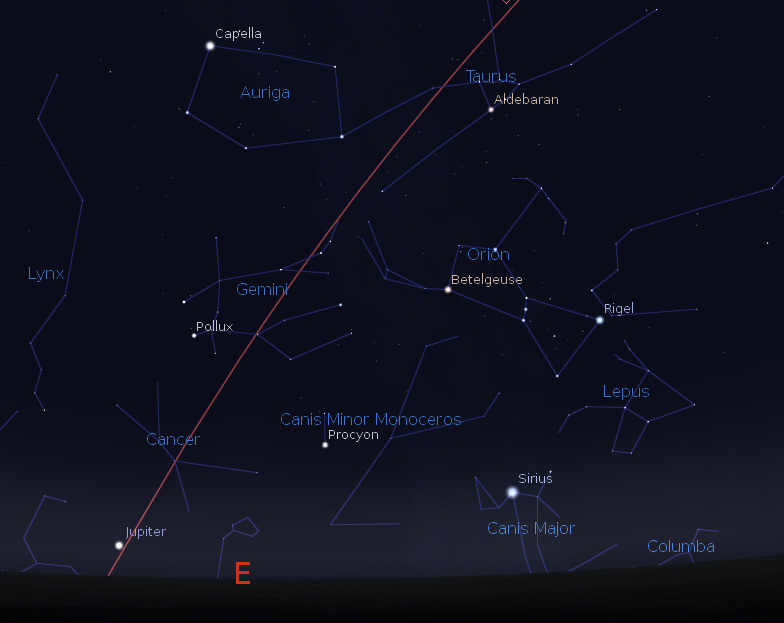
Jupiter and the winter constellations at 11 p.m. on December 17, 2014. Created using Stellarium.
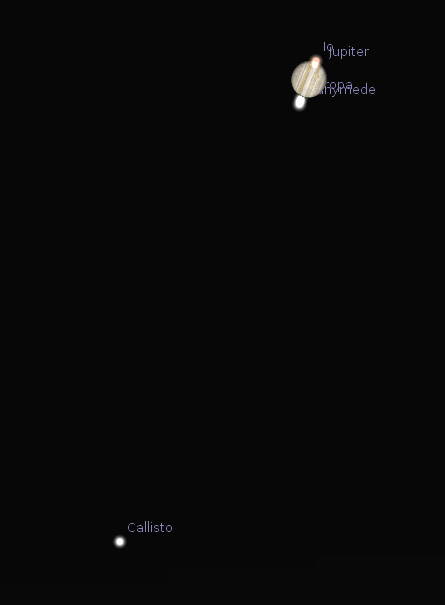
Jupiter and moons in a telescope. The moons Io, Europa and Ganymede all will be moving away from Jupiter over the evening and morning. Image as of 11 p.m. December 17, 2014. Created using Stellarium.
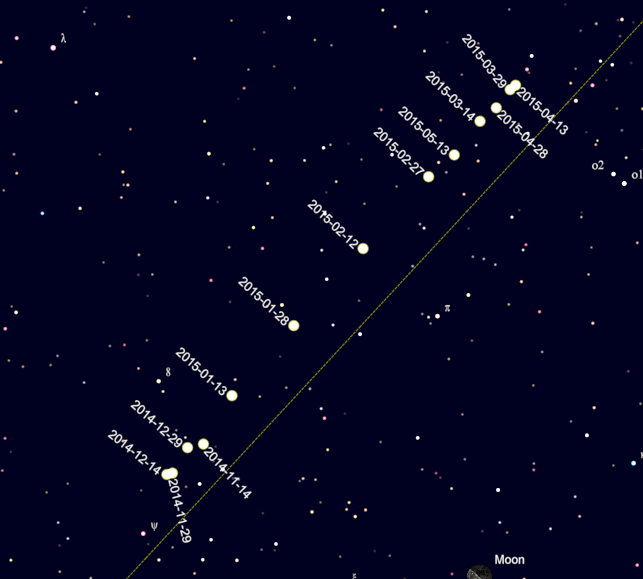
Jupiter’s Retrograde motion. Created using Cartes du Ceil (Sky Charts).
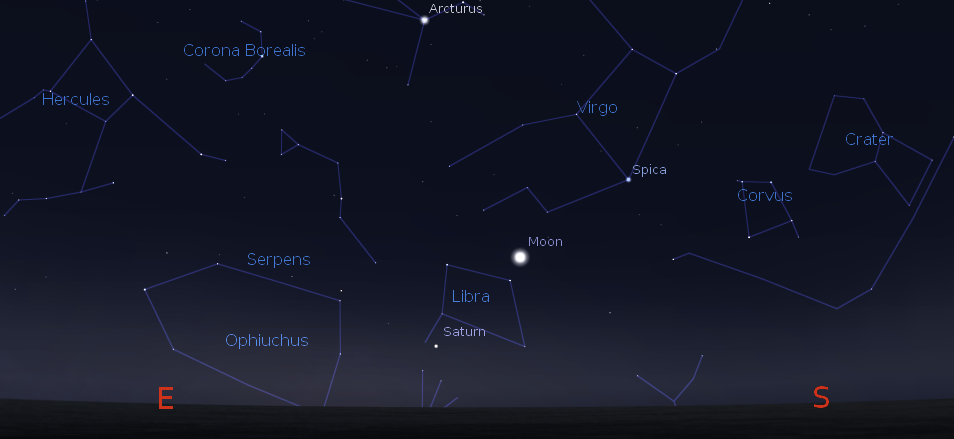
Saturn and the Moon at 7 a.m. on December 18, 2014. Created using Stellarium.
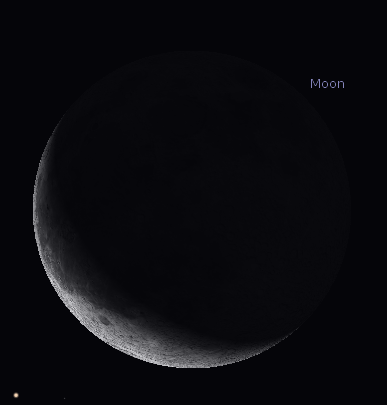
The Moon as it would appear in binoculars on December 18, 2014. Created using Stellarium.
12/15/2014 – Ephemeris – How to find Orion through the evening
Ephemeris for Monday, December 15th. The sun will rise at 8:12. It’ll be up for 8 hours and 50 minutes, setting at 5:02. The moon, 1 day past last quarter, will rise at 2:15 tomorrow morning.
At 7 p.m. tonight the great central constellation of winter Orion is struggling to rise, with the top half of him in the eastern sky. By 9 p.m. he’s whole and low in the east-southeast. By midnight he has taken his rightful place as the central winter constellation. In the evening now his distinctive belt of three stars in a straight line, by which most folks can find him, is more or less vertical in the sky. His brightest stars are Betelgeuse a red star to the left of the belt and blue-white Rigel to the right. When Orion’s the highest in the south we’ll explore the wonders within this constellation, the most famous constellation world over. Parts of it can be seen at the north and south poles of the Earth. The Big Dipper, which isn’t a real constellation, doesn’t hold a candle to it.
Times are for the Traverse City/Interlochen area of Michigan. They may be different for your location.
Addendum
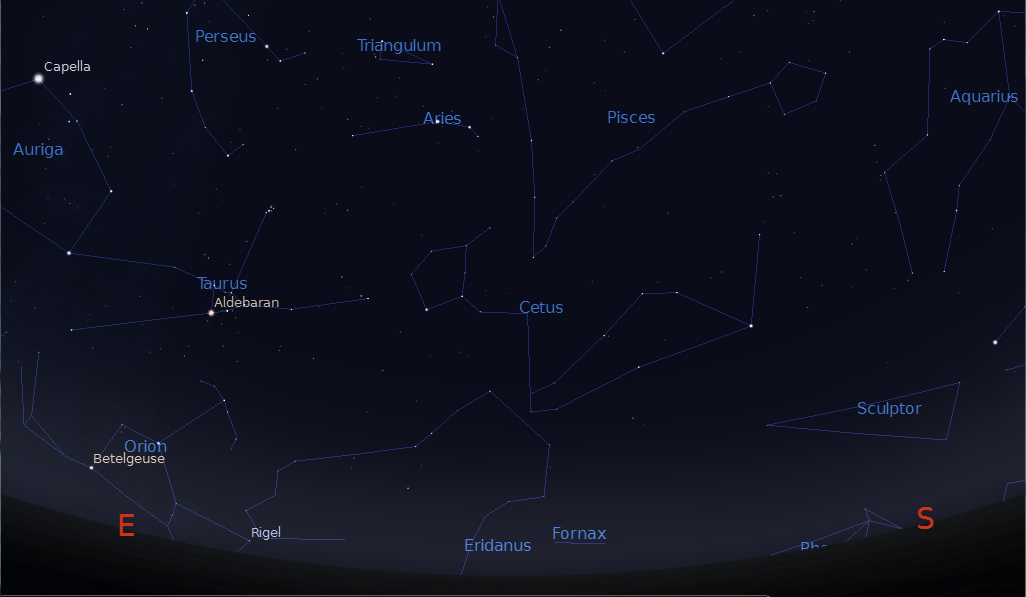
Orion rising at 7 p.m. December 15, 2014. Created using Stellarium.
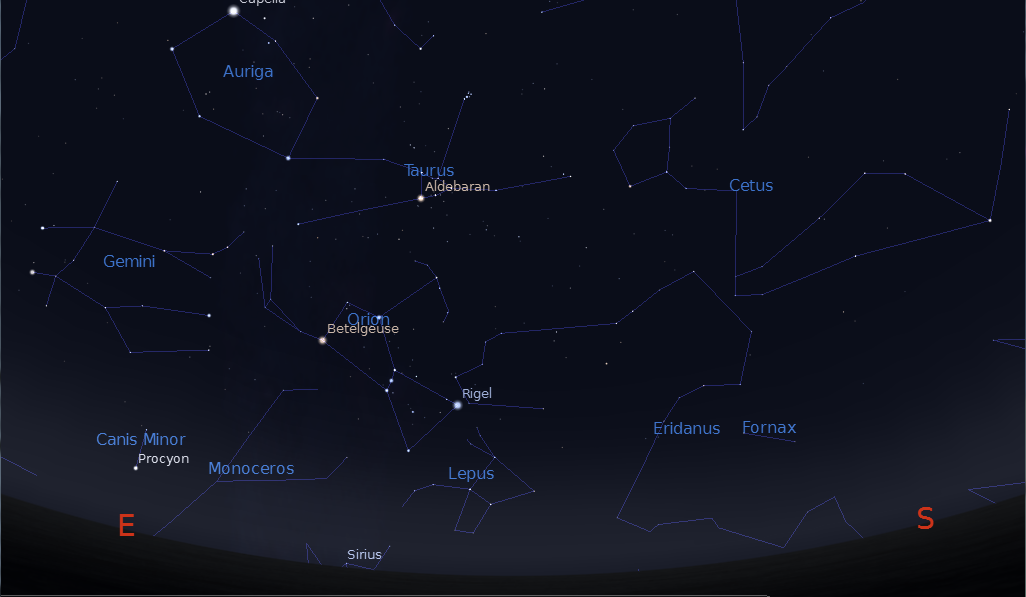
Orion rising higher at 9 p.m. December 15, 2014. Created using Stellarium.
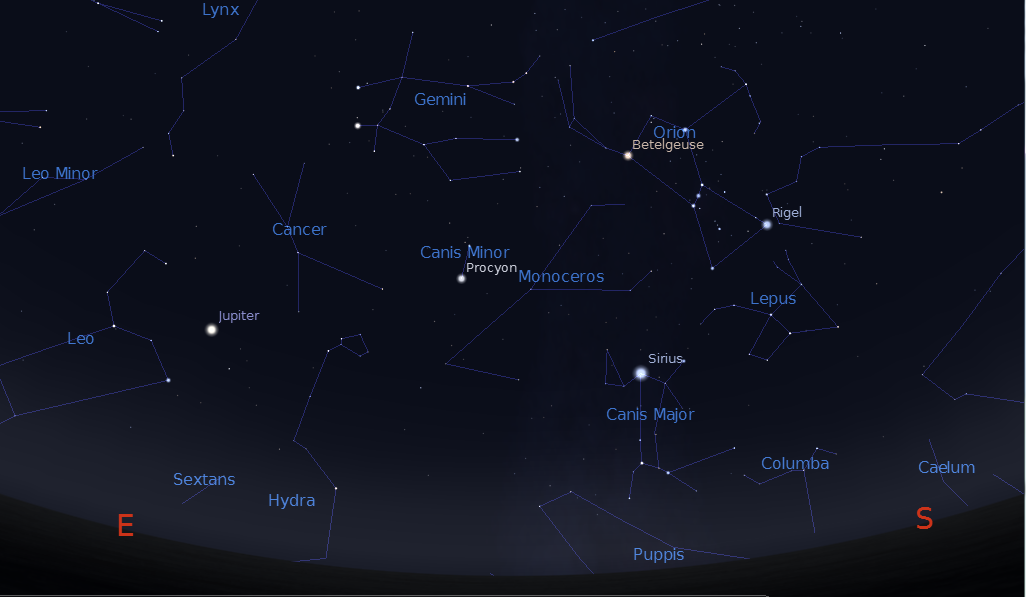
Orion close to the meridian at 12 midnight, December 16, 2014. There is distortion in this projection. Orion is standing straighter in the real sky than shown here. Created using Stellarium.

