Archive
12/04/2013 – Ephemeris – Where are the bright planets this week?
Ephemeris for Wednesday, December 4th. The sun will rise at 8:02. It’ll be up for 9 hours even, setting at 5:02. The moon, 2 days past new, will set at 7:15 this evening.
Let’s see where the bright planets are this week. Venus is brilliant in the southwest after sunset. It will set at 7:51 p.m. The thin crescent moon will be to the right and a bit below Venus tonight. Venus is itself a crescent, and we’re coming to the point where the crescent can be visible in binoculars. Venus is as close to us now as the debris from Comet ISON will ever get to us. The giant planet Jupiter will rise at 7:31 p.m. in the east northeast. It’s cruising against the stars of Gemini now. It will pass due south at 3:08 a.m. Mars will rise at 1:31 a.m. in the east. Reddish Mars is midway between Regulus in Leo and Spica in Virgo. Saturn will rise at 5:47 a.m. and should be visible low in the east south east by 6:30.
Times are for the Traverse City/Interlochen area of Michigan. They may be different for your location.
Addendum
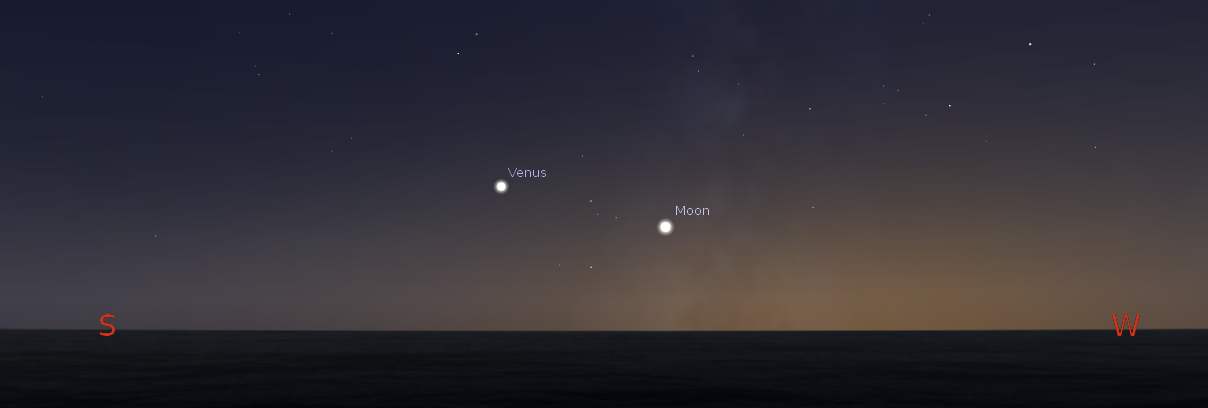
Venus and the Moon in the southwest at 6 p.m. on December 4, 2013. Created using Stellarium.
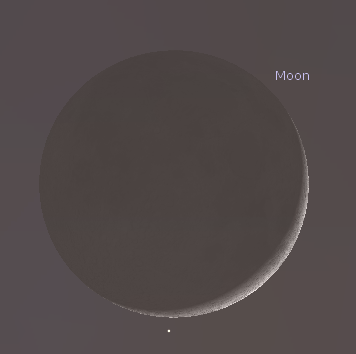
The Moon magnified at 6 p.m. on December 4, 2013. Created using Stellarium.
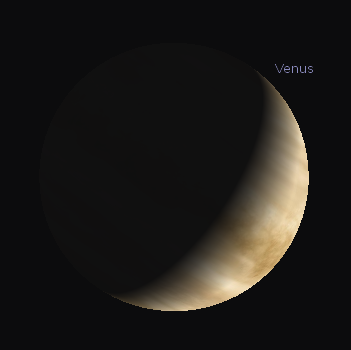
Venus as seen in a telescope at 6 p.m. December 4, 2013. The crescent will be blindingly bright with no detail. Created using Stellarium.
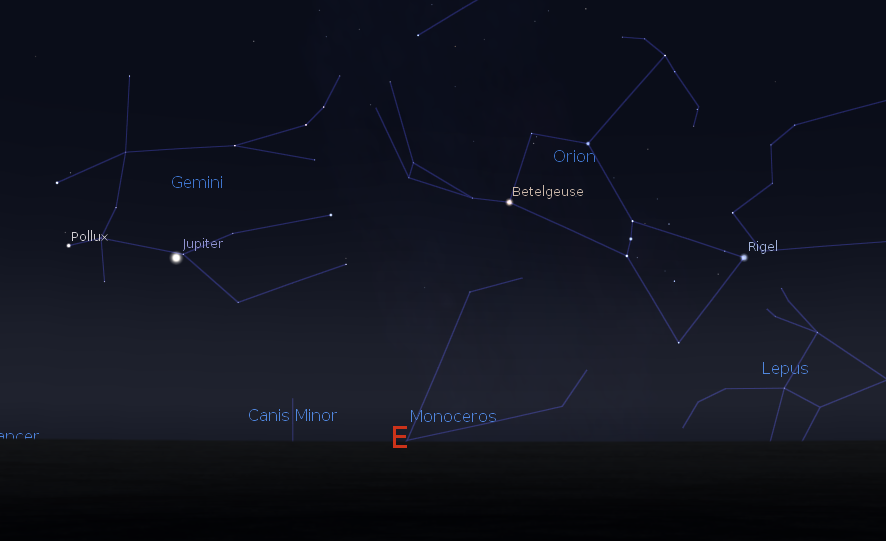
Jupiter and some winter constellations at 9 p.m. on December 4, 2013. Created using Stellarium.
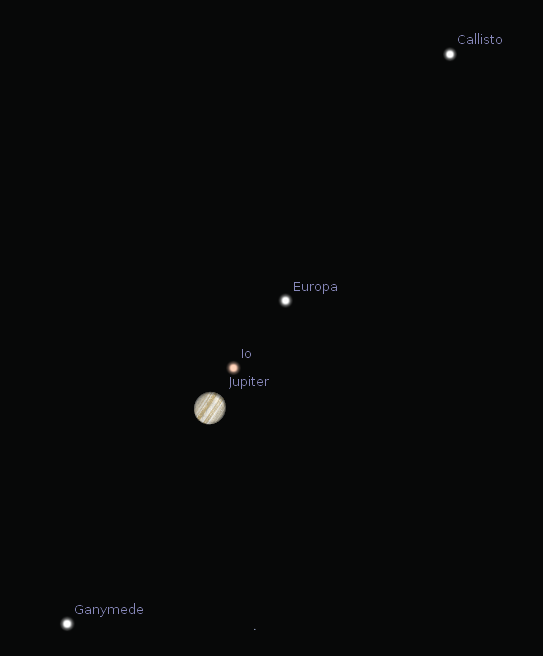
Jupiter and its moons as seen in a telescope at 9 p.m. December 4, 2013. The orientation may be rotated or even mirror image. Created using Stellarium.
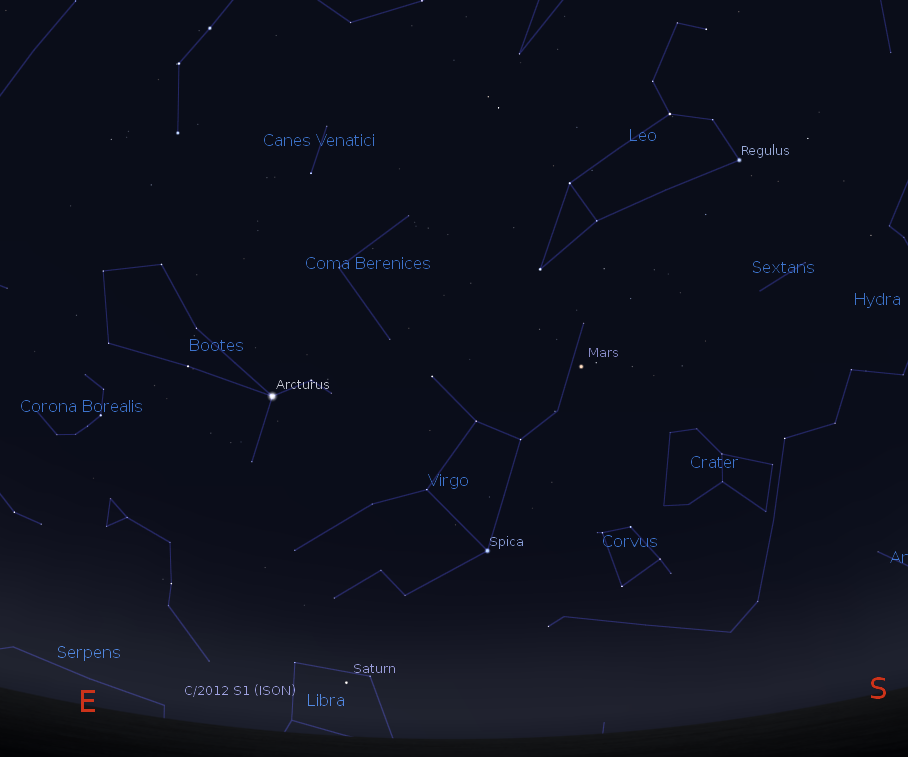
Mars, Saturn and the ghost of Comet ISON at 6:30 a.m. on December 5, 2013. Created using Stellarium.
12/03/2013 – Ephemeris – Orion rises
Ephemeris for Tuesday, December 3rd. The sun will rise at 8:01. It’ll be up for 9 hours and 1 minute, setting at 5:03. The moon, 1 day past new, will set at 6:07 this evening.
At 9 p.m. the constellation of Orion the giant hunter will be rising in the east southeast, with its belt stars nearly vertically aligned. The belt stars are contained within a tilted rectangle of four bright stars that’s leaning to the left. The brightest of the top stars is Betelgeuse a bright red star about the hue of the planet Mars. It’s a huge red giant star. Both top stars are Orion’s shoulders. The other shoulder star is Bellatrix. The bottom stars are Orion’s knees. The brightest, diagonally opposite from Betelgeuse is Rigel, a bright blue-white giant star. The other knee star is named Saiph. Orion is home to a beautiful nebula or cloud of gas, which we’ll explore later this winter. Jupiter is the bright stellar looking object to the left of Orion.
Times are for the Traverse City/Interlochen area of Michigan. They may be different for your location.
Addendum
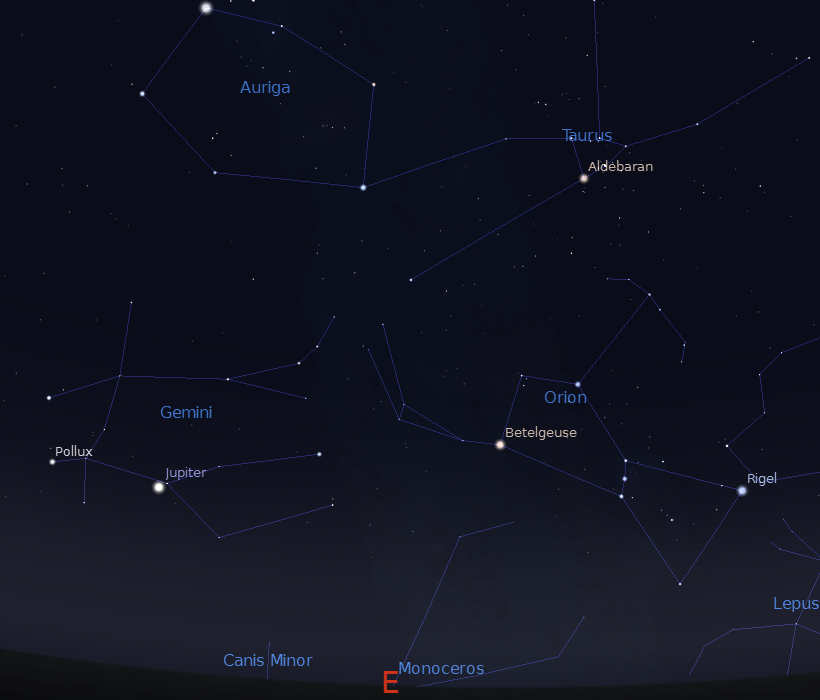
Orion Rising and other winter constellations at 9 p.m. December 3, 2013. Created using Stellarium
12/02/2013 – Ephemeris – Comet ISON: RIP (Rest In Pieces)
Ephemeris for Monday, December 2nd. The sun will rise at 8:00. It’ll be up for 9 hours and 2 minutes, setting at 5:03. The moon is new today, and won’t be visible. | I had originally intended to spend today’s program explaining how to view Comet ISON this week. That’s not to be. What can we say to Comet ISON but “Rest in Pieces”. It looks like going in to perihelion last Thursday, its closest point to the sun, ISON finally exhausted all its ices, the glue that holds all its rock and dust together. Coming out from perihelion there was a dense knot of material that gave us hope against hope that the comet survived. But alas the material spread out and got dimmer, what tail there was was definitely a dust tail, no fast moving ion tail from gas could be seen. What will be seen in the morning sky this week will probably be below naked eye visibility, but of great interest to professional astronomers.
Times are for the Traverse City/Interlochen area of Michigan. They may be different for your location.
Addendum
This is a video made from The STEREO Ahead Coronograph 2 camera of Comet ISON passing the sun.
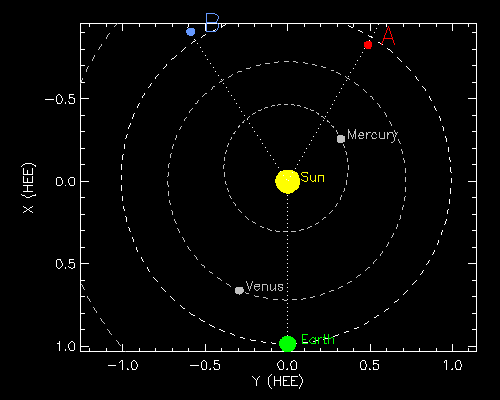
The current positions of the Earth, Sun and STEREO Ahead (A) and STEREO Behind (B) spacecraft. Credit NASA/STEREO.
Here’s Phil Plait, the Bad Astronomer‘s take on it. Besides the video above he put together another video from the SOHO LASCO C3 imager.
11/29/2013 – Ephemeris – What is left of Comet ISON?
Ephemeris for Friday, November 29th. The sun will rise at 7:57. It’ll be up for 9 hours and 7 minutes, setting at 5:04. The moon, 3 days before new, will rise at 5:02 tomorrow morning. | A funny thing happened to Comet ISON on its way to perihelion yesterday. It’s nucleus disappeared. It was dimming all morning as it approached the sun. Most of this was visible in the SOHO LASCO C3 and C2 views. The comet was also visible from the STEREO spacecraft currently on the other side of the sun. These cameras are called chronographs because they hide the bright face of the sun with a disk called an occulting disk. Just before the head of the comet was to disappear behind the disk, it disappeared all by it self, what was left was it’s tail. However later something emerged from behind the disk where the comet was supposed to be. I’m guessing it’s the large cloud of debris from the nucleus.
Times are for the Traverse City/Interlochen area of Michigan. They may be different for your location.
Addendum
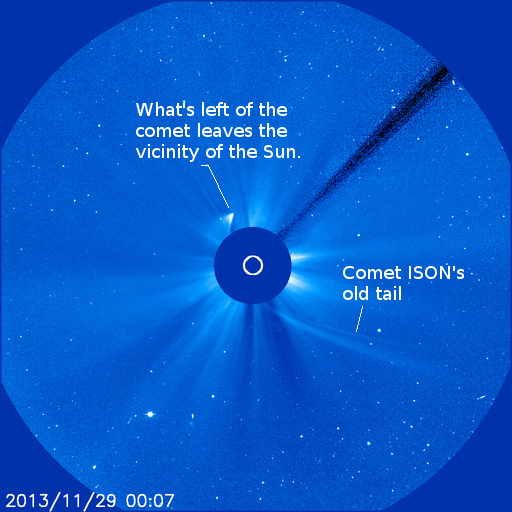
Comet ISON or what’s left of it leaving the sun at 7:07 p.m. (EST) November 28, 2013. Credit NASA/ESA/SOHO LASCO C3. Annotation: mine.
11/28/2013 – Ephemeris – Comet ISON T minus Zero day
Ephemeris for Thanksgiving Day, Thursday, November 28th. The sun will rise at 7:55. It’ll be up for 9 hours and 8 minutes, setting at 5:04. The moon, 3 days past last quarter, will rise at 3:53 tomorrow morning.
This is T minus Zero day for Comet ISON. At 1:35 this afternoon it will pass perihelion, its closest point to the sun, only a bit more than the sun’s diameter above the bright ball of the sun’s photosphere. It’s will look closer than that because the comet will be slightly behind the sun. It will still be visible in the Solar Dynamic Observatory’s telescopes. To check on the comet throughout the day go on the Internet go to spaceweather.com at the page bottom click on STEREO, then click on Latest Images You can call up the Solar Dynamics Observatory (SDO) and the SOHO LASCO images, or go to bobmoler.wordpress.com. I’m sure by tomorrow there will be time-lapse movies on Universe Today.
Times are for the Traverse City/Interlochen area of Michigan. They may be different for your location.
Addendum
There is a NASA sponsored Google + Hangout that will be transmitted on all NASA TV channels.
November 28, Thursday
1 – 3:30 p.m. EST – NASA Google+ Hangout: Comet ISON – GSFC (All Channels)
Here’s a link to NASA-TV: http://www.nasa.gov/multimedia/nasatv/
SOHO LASCO C3 image as of this update (10:10 EST 11/27/13):
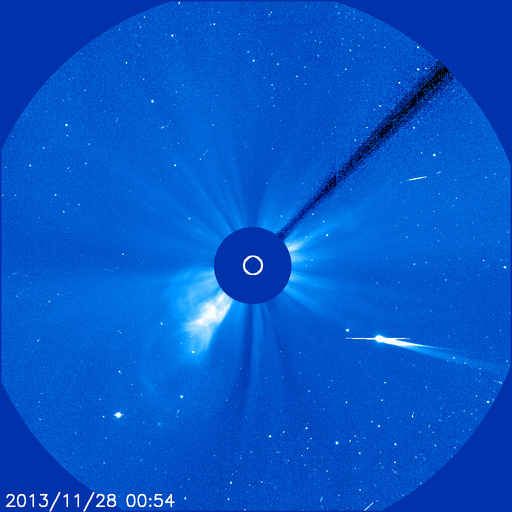
SOHO LASCO C3 image of the sun and Comet ISON. Image timestamped 11/28/13 at 00:54 UT. 7:54 p.m. November 27, 2013 EST. Credit NASA/ESA.
11/27/2013 – Ephemeris – Where are the bright planets and what’s up with Comet ISON?
Ephemeris for Wednesday, November 27th. The sun will rise at 7:54. It’ll be up for 9 hours and 10 minutes, setting at 5:05. The moon, 2 days past last quarter, will rise at 2:46 tomorrow morning.
Let’s see where the bright planets are this eventful week. Venus is brilliant in the southwest after sunset. It will set at 7:53 p.m. The giant planet Jupiter will rise at 8:01 p.m. in the east northeast. It’s cruising against the stars of Gemini now. It will pass due south at 3:38 a.m. Mars will rise at 1:47 a.m. also in the east northeast. Reddish Mars is midway between Regulus in Leo and Spica in Virgo and tomorrow morning will be about 12 moon diameters above left of the moon. Mercury and Saturn will be together in the east southeast by 7 a.m. Mercury is the lower and brighter of the two. Comet ISON is now too close to the sun to be seen. Check bobmoler.wordpress.com (see below) for how to view Comet ISON near the sun.
Times are for the Traverse City/Interlochen area of Michigan. They may be different for your location.
Addendum
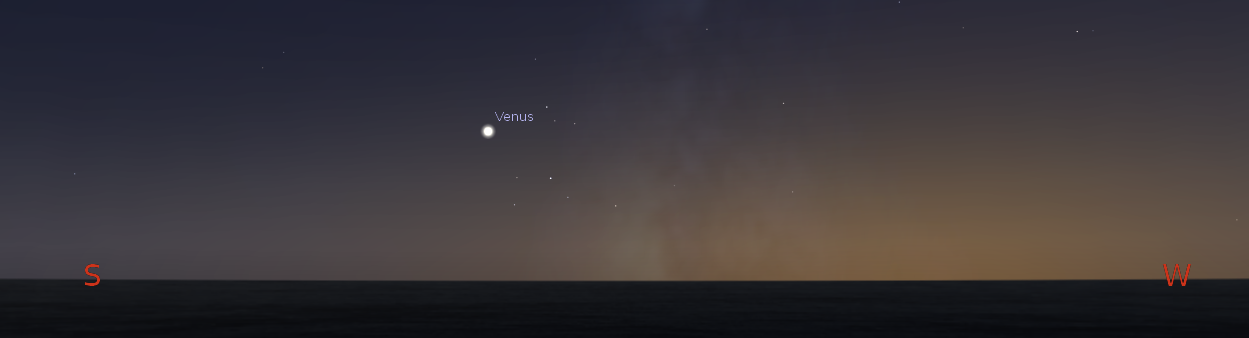
Venus as it should appear at 6 p.m. on 11/27/2013. Created using Stellarium.
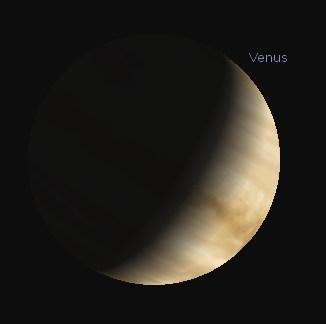
Telescopic view of Venus as it should appear at 6 p.m. on 11/27/2013. Created using Stellarium.
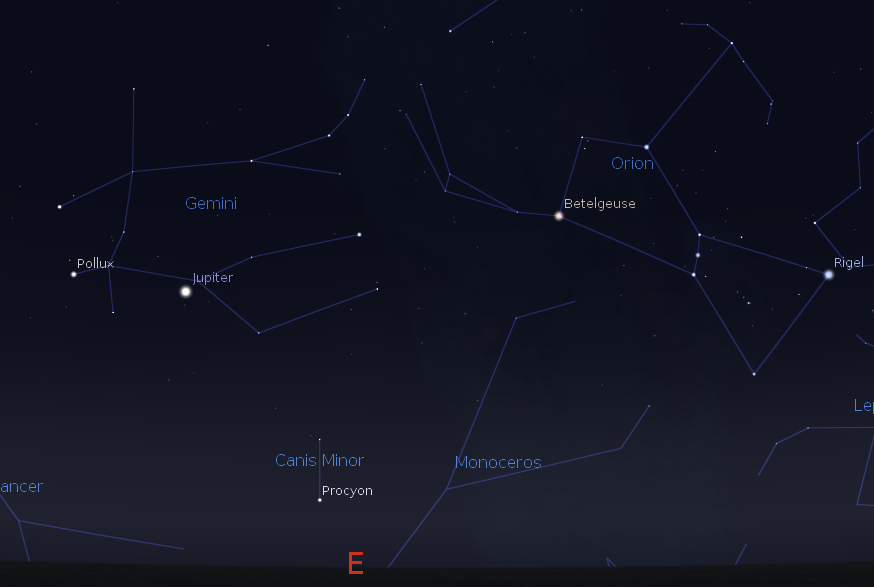
Jupiter and some winter constellations as they should appear at 10 p.m. on 11/27/2013. Created using Stellarium.
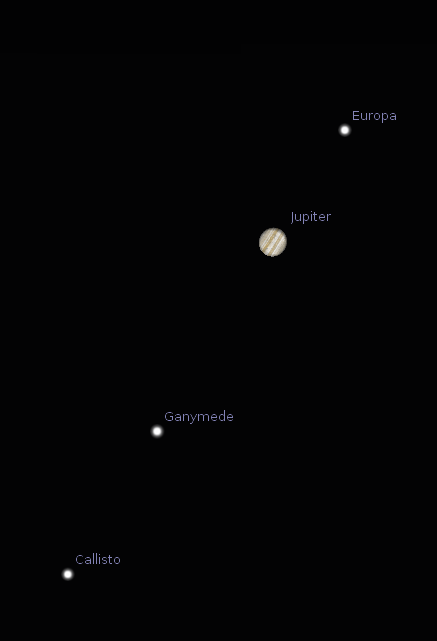
Telescopic view of Jupiter and its satellites as they should appear at 10 p.m. on 11/27/2013. The satellite Io is behind the planet and won’t appear until after midnight. Created using Stellarium.
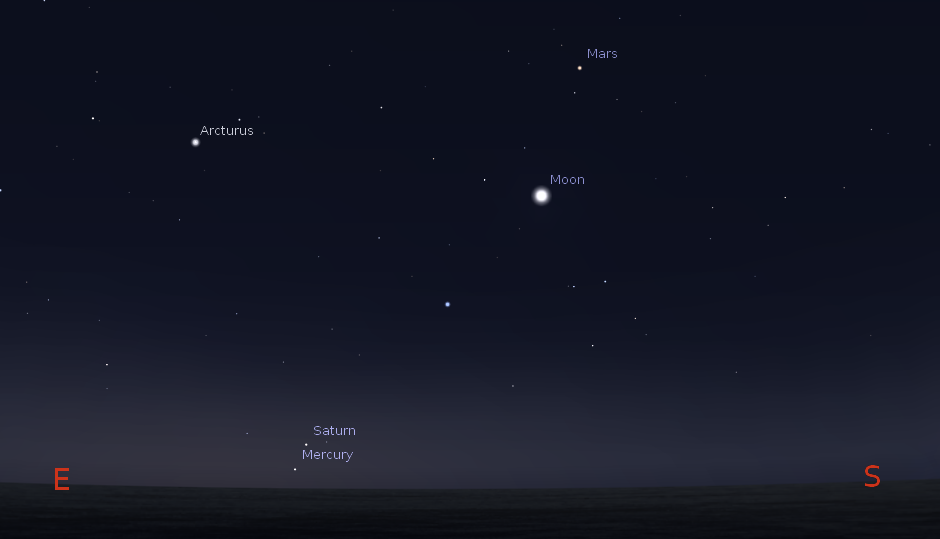
The morning planets Mars, Saturn and Mercury plus the Moon at 6:45 a.m. November 28, 2013. Created using Stellarium
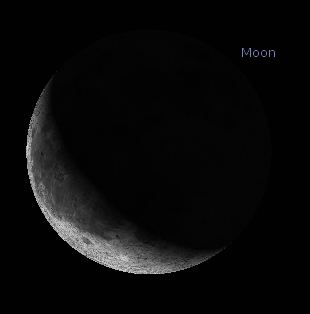
The Moon at 6:45 a.m. November 28, 2013. Created using Stellarium.
Comet ISON
Phil Plait the Bad Astronomer reported Monday that Comet ISON had suddenly decreased the amount of ices that it was emitting and pretty much simultaneously greatly increased the amount of dust it was producing. One of the possible explanations was that its nucleus had been disrupted. The comet’s nucleus is the small, maybe 2 km diameter, solid part of the comet. All the other parts of the comet are the thin ejected gas and dust from that nucleus. The head and tail of the comet is still a pretty good vacuum by earthly standards. There is still questions about it today. Here’s a YouTube video posted by the Planetary Society’s Emily Lakdawalla created by Emily from images taken by the STEREO Ahead spacecraft. It seems to be holding its own:
Here is the Planetary Society Blog entry that discusses Comet ISON’s then current status.
At the time of this posting (10 p.m. 11/26) the STEREO Behind COR 2 image shows Comet ISON entering on the lower left. Also SOHO’s LASCO C3 imager shows Comet ISON entering the view from the lower right. There’s also a coronal mass ejection (CME) erupting toward the comet. It could pass behind it, in front of it or actually toward it. It should be interesting.
Live programming of NASA-TV Thanksgiving Day
November 28, Thursday
1 – 3:30 p.m. – NASA Google+ Hangout: Comet ISON – GSFC (All Channels)
Here’s a link to NASA-TV: http://www.nasa.gov/multimedia/nasatv/
11/26/2013 – Ephemeris – Have a helping of comet with your turkey on Thursday
Ephemeris for Tuesday, November 26th. The sun will rise at 7:53. It’ll be up for 9 hours and 12 minutes, setting at 5:05. The moon, 1 day past last quarter, will rise at 1:42 tomorrow morning.
Comet ISON is now invisible from the earth, being too close to the direction of the sun to be seen. However it is and will be in view of NASA’s fleet of solar observation spacecraft at least until the end of the month. The comet is already in view of the STEREO Ahead spacecraft, looking back toward the Earth and Mercury. Later tonight of early tomorrow it will be in the view of the Solar and Heliospheric Observatory or SOHO parked a million miles sun-ward from the earth. It will appear on the LASCO C3 imager first. Thursday it will also be visible to the Solar Dynamics Observatory or SDO. On the Internet go to spaceweather.com at the page bottom click on STEREO, then click on Latest Images, or go to bobmoler.wordpress.com.
Times are for the Traverse City/Interlochen area of Michigan. They may be different for your location.
Addendum
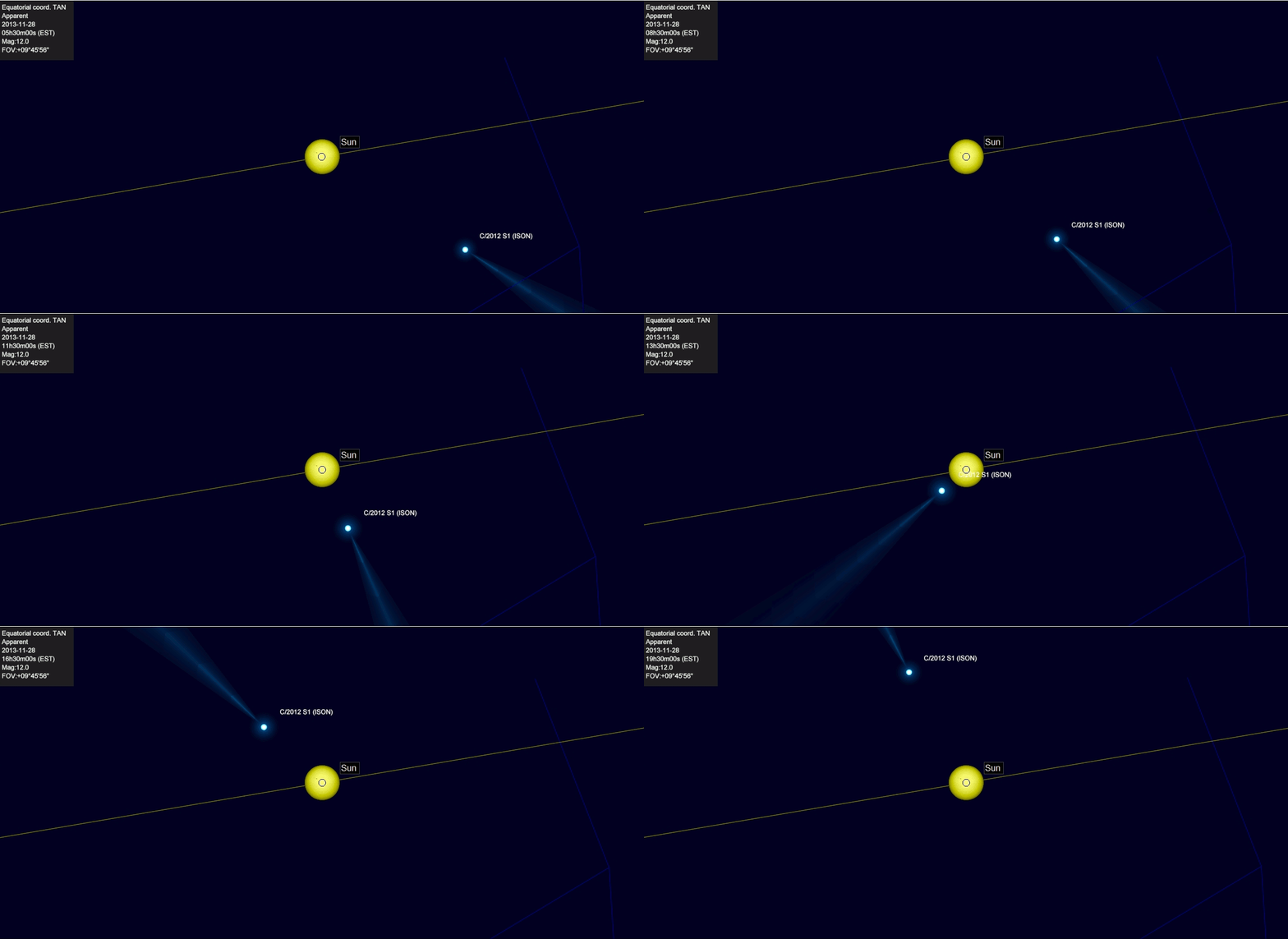
Animation of Comet ISON rounding the sun on Thanksgiving Day, November 28, 2013. Created using Cartes du Ciel (Sky Charts).
Click on the image to enlarge and animate.
11/25/2013 – Ephemeris – Comet ISON and the week ahead
Ephemeris for Monday, November 25th. The sun will rise at 7:52. It’ll be up for 9 hours and 14 minutes, setting at 5:06. The moon, at last quarter today, will rise at 12:40 tomorrow morning.
Comet ISON, a bit more than 4 days from its closest approach to the sun on Thanksgiving Day, is now well within the orbit of Mercury only 22 million miles from the sun. The comet should be hard to spot this morning. It rises at 6:58 in pretty bright twilight. The cool thing is that since the tail points away from the sun, it will rise first. That may be something to look for a quarter to a half hour before the head or coma rises, and in darker skies. The tail will point to the upper right of the comet’s head. This too will be something to look for after the comet passes perihelion on Thursday, except the tail will point to the upper left. I’ll have more on comet viewing for Thanksgiving day on tomorrow’s program.
Times are for the Traverse City/Interlochen area of Michigan. They may be different for your location.
Addendum
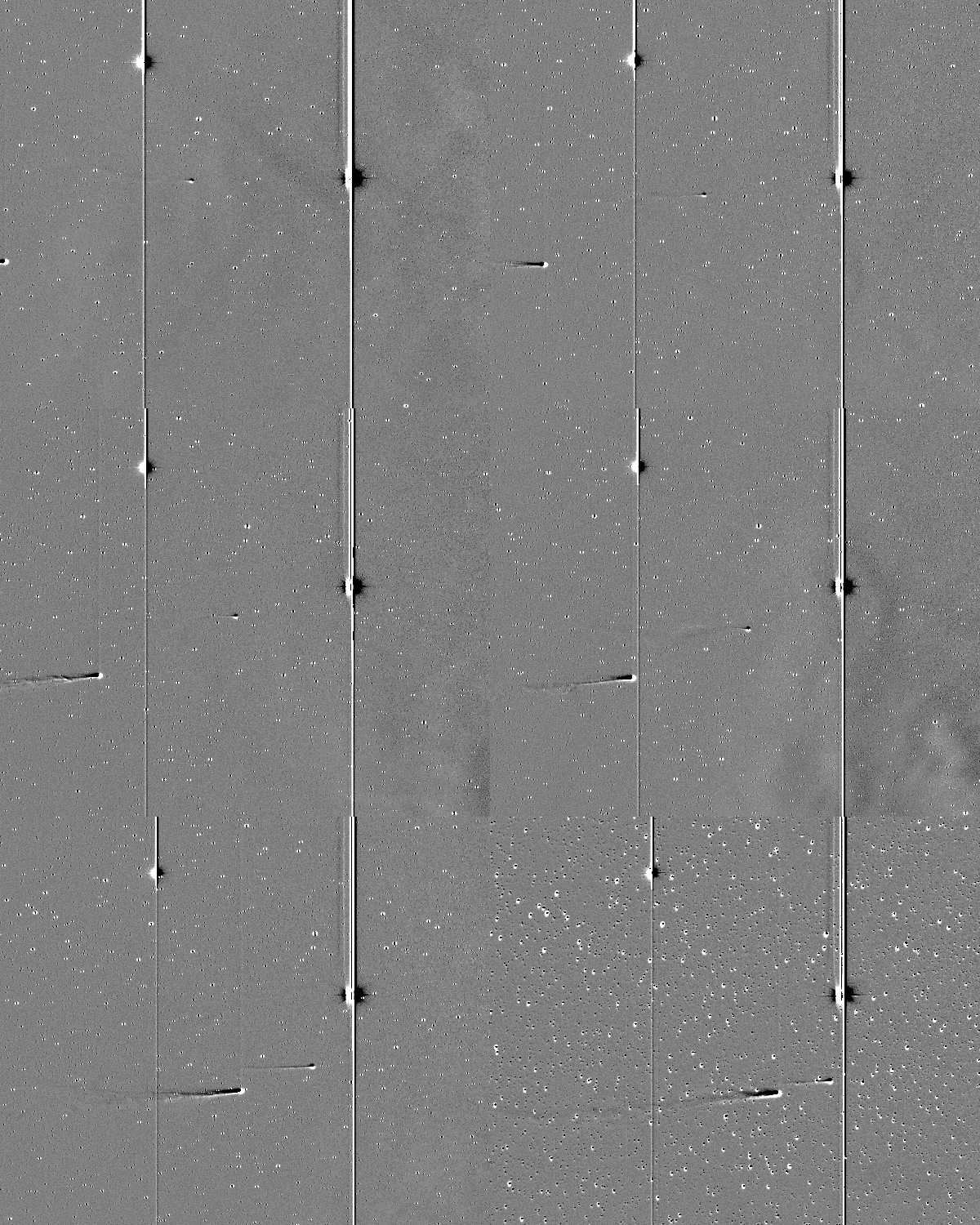
Animation of Comets ISON and Encke for November 19th thru 23rd, 2013 from the STEREO Ahead spacecraft. [Image Credit: Karl Battams/NRL/NASA/CIOC]. Click on the image to start the animation.
11/22/2013 – Ephemeris – President Kennedy and the quest for the Moon plus Comet ISON finder charts
Ephemeris for Friday, November 22nd. The sun will rise at 7:48. It’ll be up for 9 hours and 19 minutes, setting at 5:08. The moon, 3 days before last quarter, will rise at 9:43 this evening.
Today marks the 50th anniversary of the assassination of President John F. Kennedy. Yes I remember where I was when I heard the news. Being a program about astronomy and space I’d like to think about the challenge he laid down “to send a man to the moon and return him safely to the Earth by the end of the decade”. This was in the midst of the Cold War in response to the Soviet’s triumph in sending Yuri Gagarin into orbit. It was made almost a sacred vow due to Kennedy’s assassination. No NASA program since was funded to the extent that the Gemini and Apollo programs were, so that on July 20, 1969 that promise was fulfilled. All of money spent in NASA’s 55 years is actually less than that of the recent bank bailout.
Times are for the Traverse City/Interlochen area of Michigan. They may be different for your location.
Comet ISON
Finder charts for Comet ISON for this morning, Saturday, Sunday and Monday mornings.
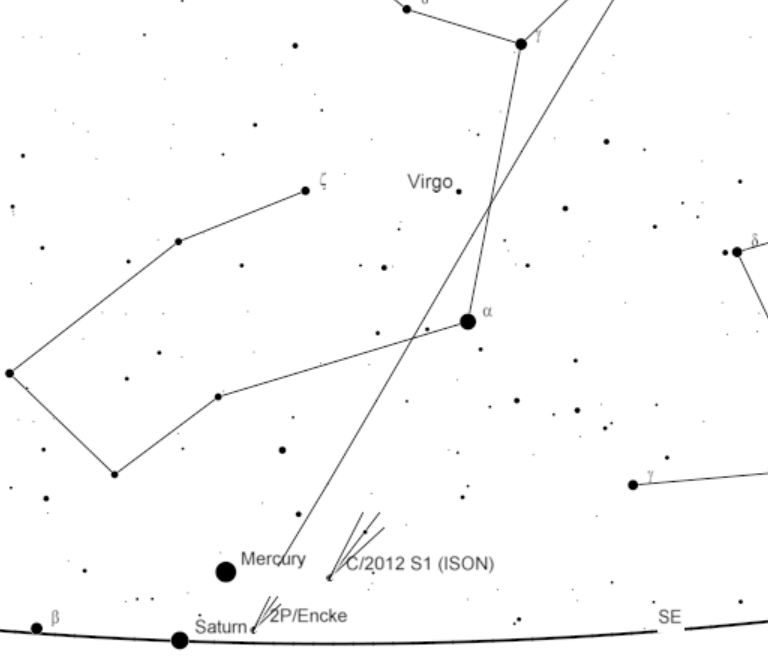
Chart for finding Comet ISON this morning (November 22, 2013 at 6:30 a.m.). Chart created using Cartes du Ciel.
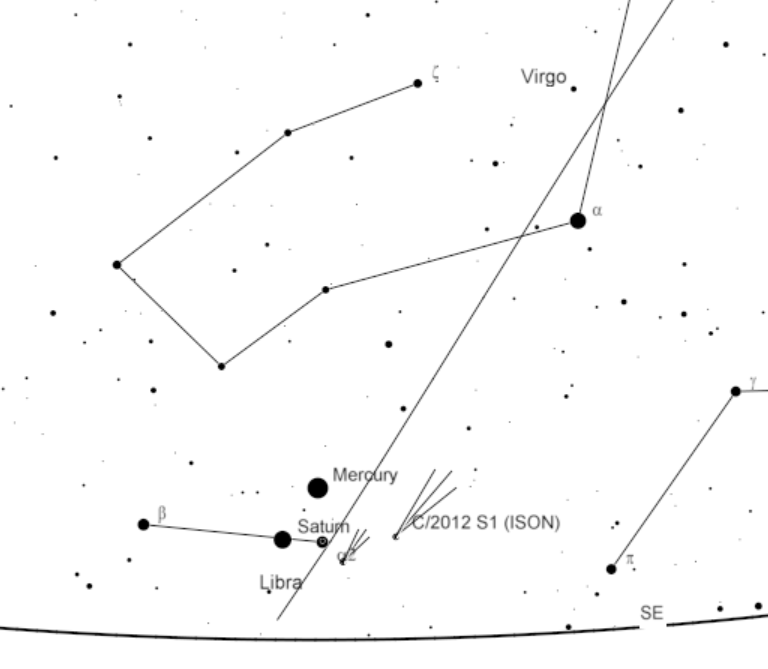
Chart for finding Comet ISON Saturday morning (November 23, 2013 at 7:00 a.m.). Chart created using Cartes du Ciel.
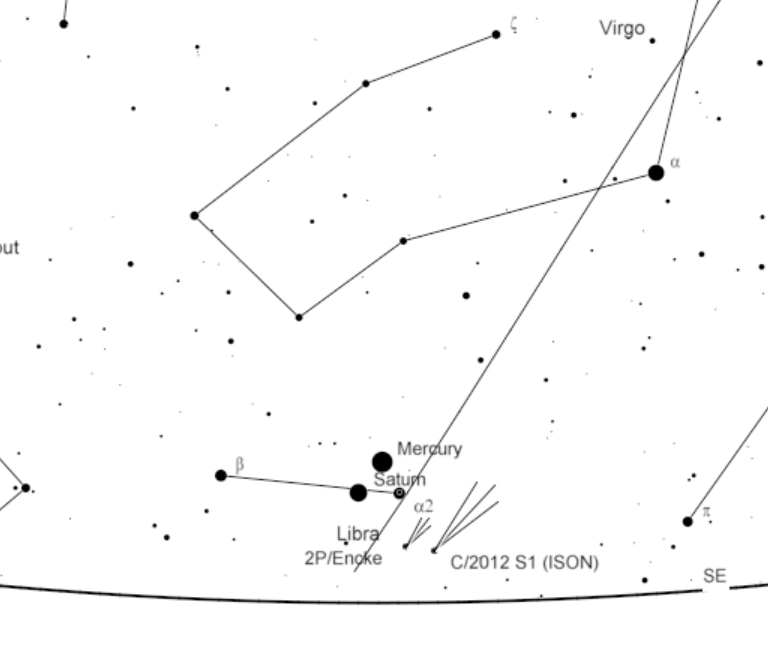
Chart for finding Comet ISON Sunday morning (November 24, 2013 at 7:00 a.m.). Chart created using Cartes du Ciel.
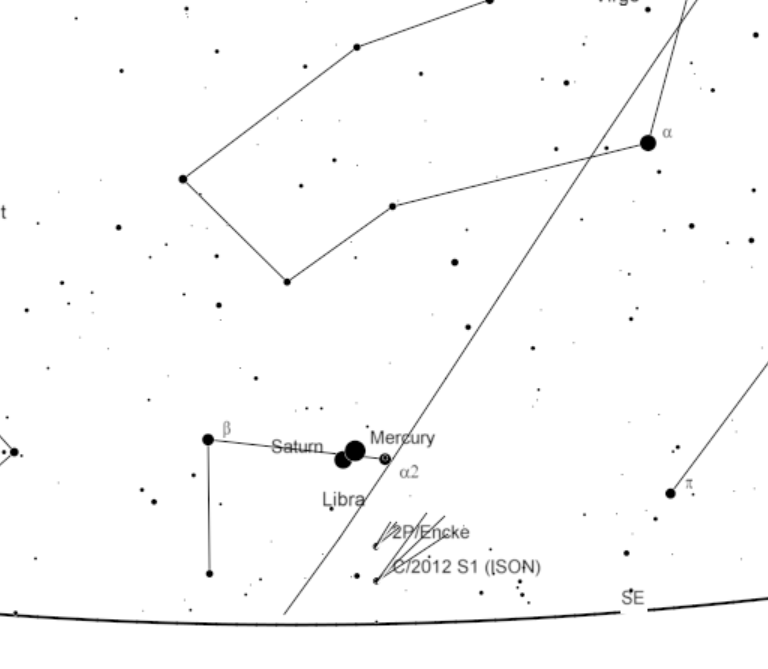
Chart for finding Comet ISON Monday morning (November 25, 2013 at 7:15 a.m.). Chart created using Cartes du Ciel.
11/21/2013 – Ephemeris – Comets are unpredictable
Ephemeris for Thursday, November 21st. The sun will rise at 7:47. It’ll be up for 9 hours and 21 minutes, setting at 5:09. The moon, half way from full to last quarter, will rise at 8:46 this evening.
Comet ISON has been full of surprises. I expect that to continue. I’ve seen quite a few since my first two in 1957. In 1973 the much hyped Comet Kohoutek failed to be spectacular as hoped. Not quite a sungrazer, the comet’s nucleus broke up and it turned out to be a rather dustless comet that, though naked eye was not especially bright. Usually when a nucleus breaks into large chunks it brightens. That was the case with Comet West in 1976. While rounding the sun its nucleus broke into 4 pieces. The three surviving pieces threw out a great sweeping dust tail. That comet had little publicity in the popular media, after being burnt by Kohoutek three years before. It was actually the second comet covered by this program.
Times are for the Traverse City/Interlochen area of Michigan. They may be different for your location.
Addendum

Comet West on March 8, 1976. Image tilted due to the camera being piggybacked on an equatorial mount. Horizon to the lower left. That’s the constellation Delphinus to the upper right. My photo.
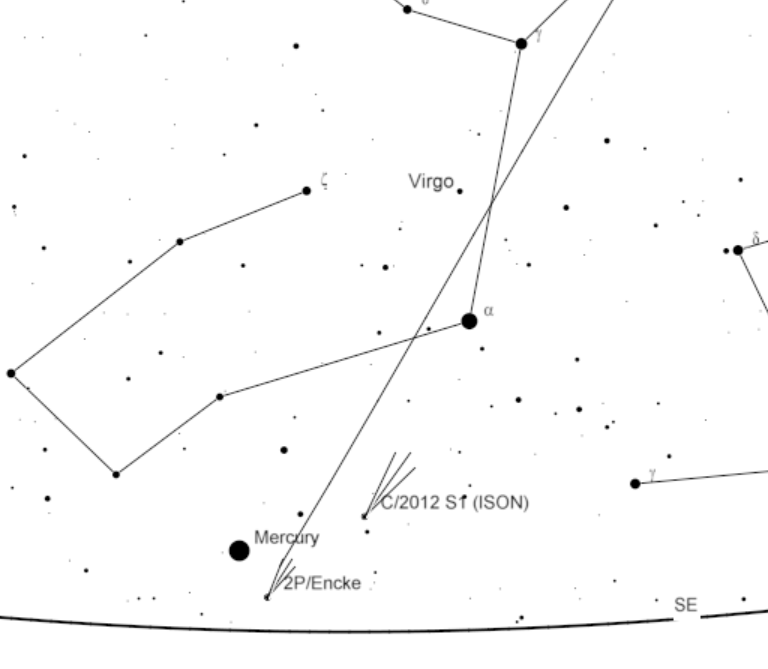
Chart for finding Comet ISON this morning (November 21, 2013 at 6:30 a.m.). Chart created using Cartes du Ciel.
Chart for finding Comet ISON tomorrow morning (November 22, 2013 at 6:30 a.m.). Chart created using Cartes du Ciel.

