Archive
12/06/2012 – Ephemeris – The constellation Taurus the bull
Ephemeris for Thursday, December 6th. The sun will rise at 8:05. It’ll be up for 8 hours and 57 minutes, setting at 5:02. The moon, at last quarter today, will rise at 1:10 tomorrow morning.
Low in the east southeast at 9 p.m. is the constellation of the giant hunter Orion. Above him is Taurus the bull. His face is a letter V shape of stars lying on its side, the star cluster Hyades, with the bright orange-red star Aldebaran at one tip of the V as its angry blood-shot eye, but actually about half way between us and the cluster. Jupiter is complicating this this year, appearing in Taurus. Orion is depicted in the sky facing, with club in one hand and a shield in the other, the approaching and in some depictions charging Taurus. The Pleiades star cluster is in his shoulder. Taurus in Greek mythology was the guise the god Zeus when he carried off the maiden Europa. Europa’s still with him as the intriguing satellite orbiting Zeus’ Roman equivalent the planet Jupiter.
Times are for the Traverse City/Interlochen area of Michigan. They may be different for your location.
Addendum
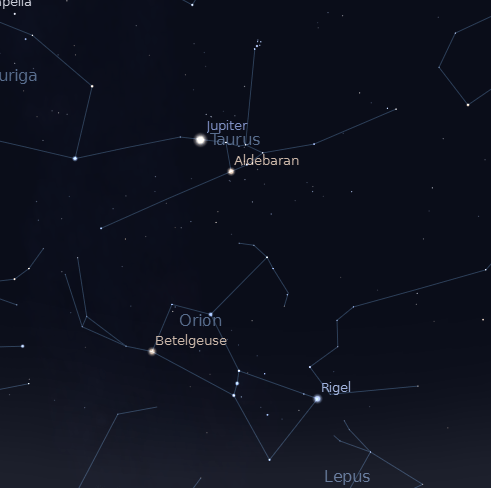
Taurus and Orion in the east at 9 p.m. December 6, 2012. Created using Stellarium.
12/05/2012 – Ephemeris – Where are all the bright planets this week?
Ephemeris for Wednesday, December 5th. The sun will rise at 8:04. It’ll be up for 8 hours and 58 minutes, setting at 5:02. The moon, 1 day before last quarter, will rise at 12:03 tomorrow morning.
Let’s check out the planets for this week. All 5 classical planets are visible now. Mars can be seen low in the southwest. Mars will set at 7:05. The planetary action will have already picked up on the other side of the sky. Jupiter is located in the constellation of Taurus on the southeast in the evening. It will transit or pass due south at 12:18 a.m, and will set at 7:51. Saturn will be the next planet to rise at 4:48 a.m. in the east southeast. Venus will rise at 5:44 and is below and left of Saturn. Mercury will rise at 6:16 a.m. Below and left of Venus. A half an hour later it should be high enough to spot . The three planets will appear in a straight line and nearly equally spaced. After about a week, Mercury will not be visible again until next spring.
Times are for the Traverse City/Interlochen area of Michigan. They may be different for your location.
Addendum
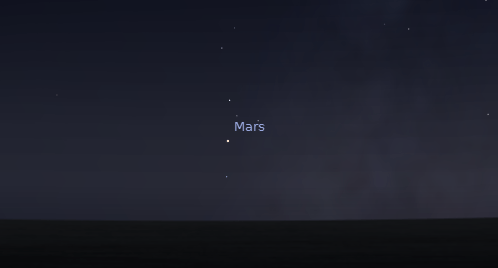
Mars low in the southwest at 6:15 p.m. on December 5, 2012. Created using Stellarium.
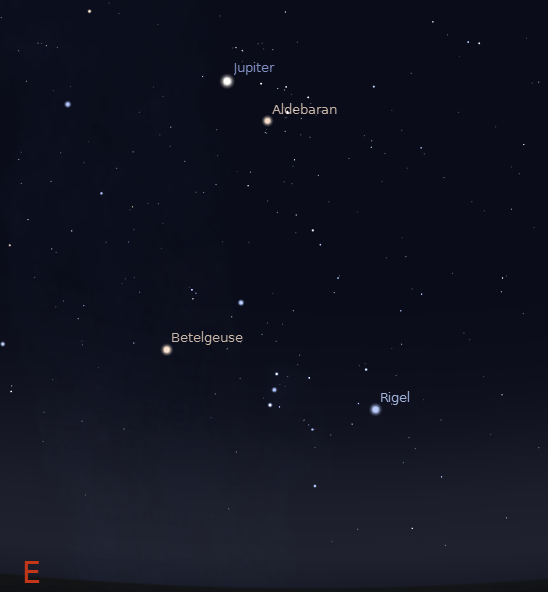
Jupiter and the winter stars at 9 p.m. on December 5, 2012. Created using Stellarium.
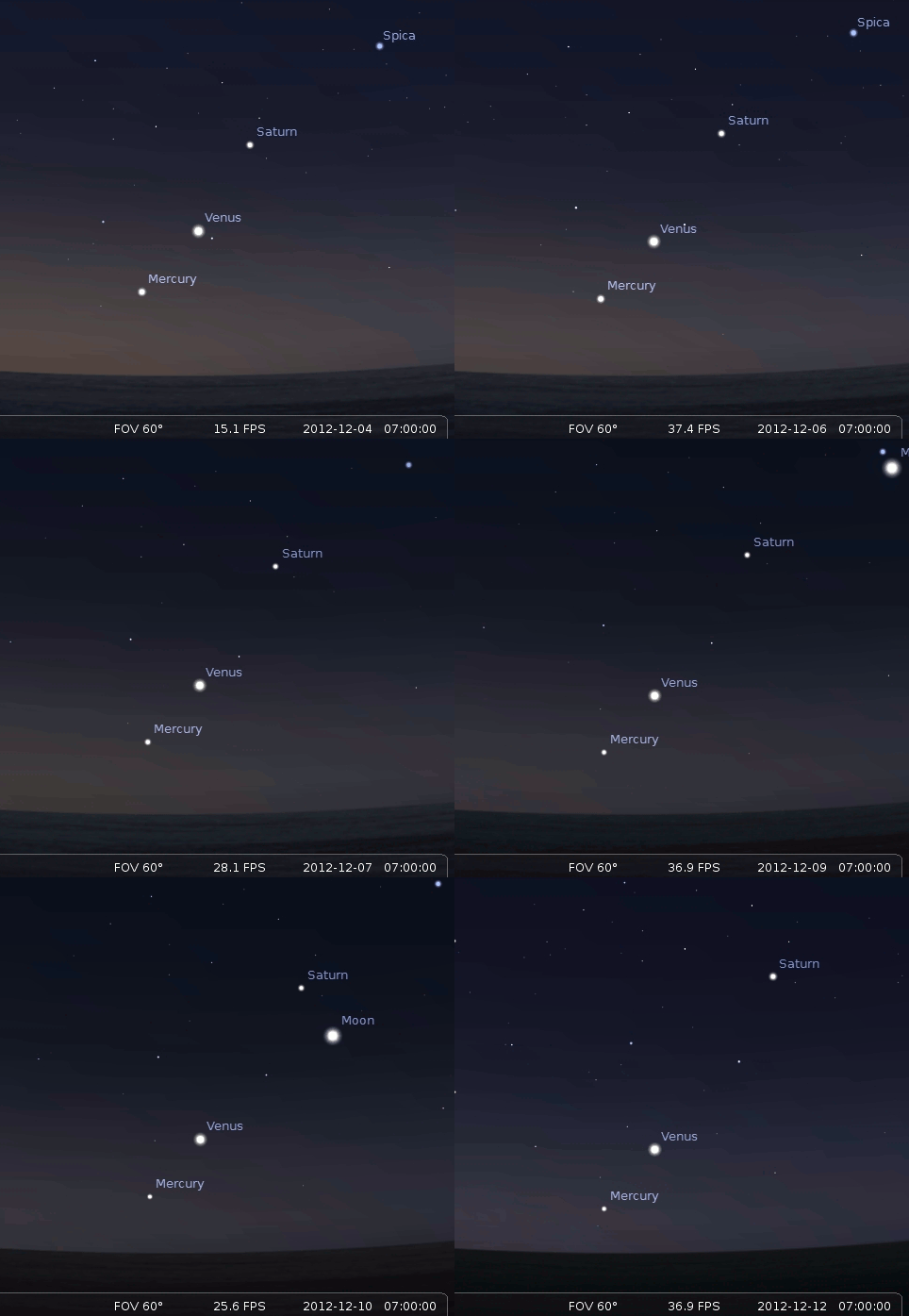
Mercury animation from December 4 to thru 12, 2012. Created using Stellarium
12/04/2012 – Ephemeris – Mercury in the morning
Ephemeris for Tuesday, December 4th. The sun will rise at 8:02. It’ll be up for 8 hours and 59 minutes, setting at 5:02. The moon, 2 days before last quarter, will rise at 10:59 this evening.
The planet Mercury has joined the morning planets for a week or so. Mercury can be best spotted low in the east southeast starting about 7 a.m. It will be below and slightly left of Venus, the brightest planet, about the same distance below as Saturn is above Venus. They’re just about in straight line. Binoculars will help in the search. Once found Mercury may be tracked past 7:30. Mercury will be visible for about a week as become somewhat brighter as it does. That’s because Mercury’s phase at its half illuminated today at its greatest elongation from the sun. It will be becoming more and more full as it moves around the sun mostly away from us now. Mercury is a prise, few people have ever seen it.
Times are for the Traverse City/Interlochen area of Michigan. They may be different for your location.
Addendum
Mercury animation starting December 4, 2012. Created using Stellarium
Note the passage of the moon on the mornings of the 10th and 11th. The moon will actually be a thin crescent.
12/03/2012 – Ephemeris – Orion rising
Ephemeris for Monday, December 3rd. The sun will rise at 8:01. It’ll be up for 9 hours and 1 minute, setting at 5:02. The moon, 3 days before last quarter, will rise at 9:56 this evening.
Off in the southeast at 9 in the evening the great constellation of Orion will be seen now. This is the most famous of all constellations world wide. We think the Big Dipper is a big deal. It’s not even a constellation, being the hind end of the great bear Ursa Major. However it’s invisible if one travels far enough south of the equator. Orion is now a rectangle of stars tilted to the left as he rises. With three stars in a straight line in the center. They are aligned nearly vertically. Orion is a giant hunter. The rectangle depict his shoulders and knees. Among its other bright stars Orion contains two of the brightest. The upper left star is the famous red giant star Betelgeuse. The lower left star is the blue=white super giant Rigel.
Times are for the Traverse City/Interlochen area of Michigan. They may be different for your location.
Addendum
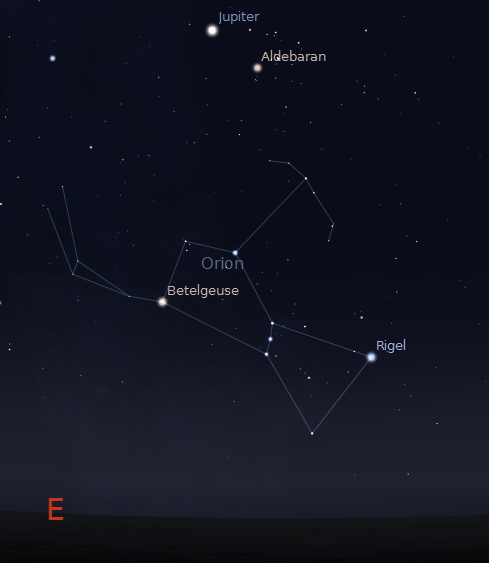
Orion rising at 9 p.m. December 3, 2012. Created using Stellarium.
11/30/2012 – Ephemeris – Previewing December skies
Ephemeris for Friday, November 30th. The sun will rise at 7:58. It’ll be up for 9 hours and 5 minutes, setting at 5:03. The moon, 2 days past full, will rise at 6:58 this evening.
Let’s look at the month of December which starts tomorrow. The hours of daylight will change little except to be darker in the morning and lighter in the evenings. In the Traverse City/Interlochen area sunset will be from 5:03 today, down to 5:02 and then advancing to 5:12 at the end of the month. The earliest sunset will be around the 10th. There is more movement in the sunrise times which will advance from 7:59 this morning to 8:19 on the 31st.Dec 1. Winter will officially arrive at the winter solstice on the 21st at 6:12 a.m. The noontime sun will dip from 23 ½ degrees to a bit less than 22 degrees above the southern horizon on that day. Daylight hours will drop from 9 hours 3 minutes tomorrow to 8:48 on the solstice.
Times are for the Traverse City/Interlochen area of Michigan. They may be different for your location.
11/29/2012 – Ephemeris – Sunita Williams, Astronaut
Ephemeris for Thursday, November 29th. The sun will rise at 7:57. It’ll be up for 9 hours and 6 minutes, setting at 5:04. The moon, 1 day past full, will rise at 6:06 this evening.
NASA astronaut Sunita Williams, Yury Malenchenko and Japanese astronaut Aki Hoshide landed last week Sunday in Kazakhstan with their Soyuz capsule after 125 days on the International Space Station. Williams and Hoshide went on three space walks to make repairs. This makes Sunny, as she likes to be called a total of 50 hours and 40 minutes of space walk time during seven EVAs, the most for any female. In her two space missions, she’s spent a total of 322 days in space, tops for a US woman. Perhaps the funniest incident that occurred to her was on her first trip to the space station. She requested a tube of wasabi sauce to spice up her food, she’s Indian American, The tube sprayed all over in the stations low air pressure and made quite a mess.
Times are for the Traverse City/Interlochen area of Michigan. They may be different for your location.
Addendum

Sunita Williams in a Russian Sokol space suit prior to the Soyuz launch.
She was a flight engineer for Expedition 32, and station commander for Expedition 33, the second female station commander.

Sunny Williams doing the running leg of a triathlon aboard the ISS.

Astronaut Sunita Williams and her crew mates Russian cosmonaut Yury Malenchenko and Japanese astronaut Aki Hoshide
11/28/2012 – Ephemeris – Where are the bright planets this week?
Ephemeris for Wednesday, November 28th. The sun will rise at 7:56. It’ll be up for 9 hours and 8 minutes, setting at 5:04. The moon, at full today, will rise at 5:18 this evening.
Let’s check out the planets for this week. First there will be a penumbral eclipse of the moon this morning which we will not be able see. Penumbral eclipses are not very noticeable. At 6:15 p.m. Mars can be seen low in the southwest. Mars will set at 7:07. The planetary action will have already picked up on the other side of the sky. Jupiter, will rise at 5:16 p.m. in the east northeast. It is located in the constellation of Taurus. Tonight it will appear right above the moon. It will transit or pass due south at 12:49 a.m. Jupiter will reach opposition from the sun this Saturday December 1st, and will officially be part of the evening sky. Saturn will be the next planet to rise at 5:15 a.m. in the east southeast. Venus will rise at 5:23 and is almost directly below Saturn. Mercury will rise at 6:13 and will be seen below and left of Venus.
Times are for the Traverse City/Interlochen area of Michigan. They may be different for your location.
Addendum
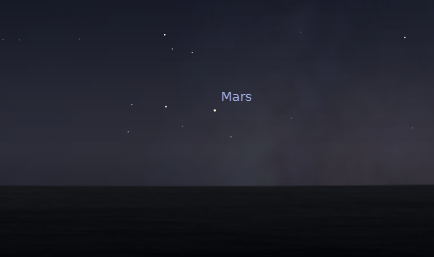
Mars low in the southwest at 6:15 p.m. on November 28, 2012. Created using Stellarium.
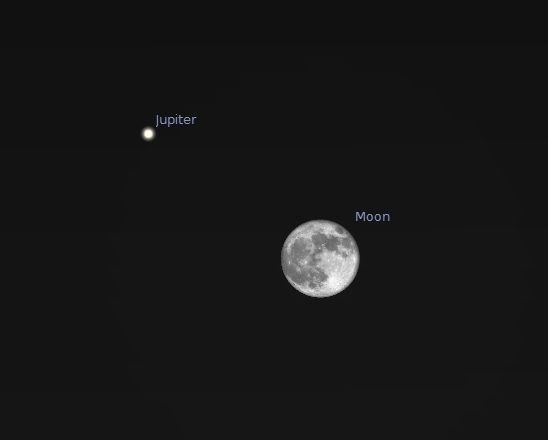
Jupiter and the Moon at 6:15 p.m. low in the east northeast on November 28, 2012. Created using Stellarium.
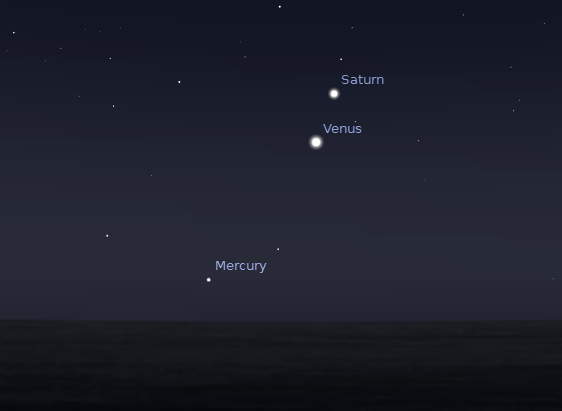
Saturn, Venus and Mercury low in the east southeast at 6:30 a.m. November 29, 2012. Created using Stellarium.
11/27/2012 – Ephemeris – What’s Curiosity’s big secret?
Ephemeris for Tuesday, November 27th. The sun will rise at 7:55. It’ll be up for 9 hours and 10 minutes, setting at 5:05. The moon, 1 day before full, will set at 7:53 tomorrow morning.
Last Tuesday NPR’s Joe Palca revealed that John Grotzinger the Principal Investigator for the Curiosity Rover mission on Mars had let slip that they may soon announce an earth shaking discovery. The Jet Propulsion Laboratory and NASA have been backpedaling ever since. The announcement may come next week Monday. The discovery may have been made with the SAM instrument, the most complex chemical lab sent into space. SAM is an acronym for Sample Analysis at Mars. It is hoped that SAM might detect organic compounds. Maybe it has. The Viking missions in 1976 failed to detect organics. It’s thought for organics to survive they would have to be below the surface shielded from the sun’s x-rays that get in through Mars’ thin atmosphere.
Times are for the Traverse City/Interlochen area of Michigan. They may be different for your location.
Addendum
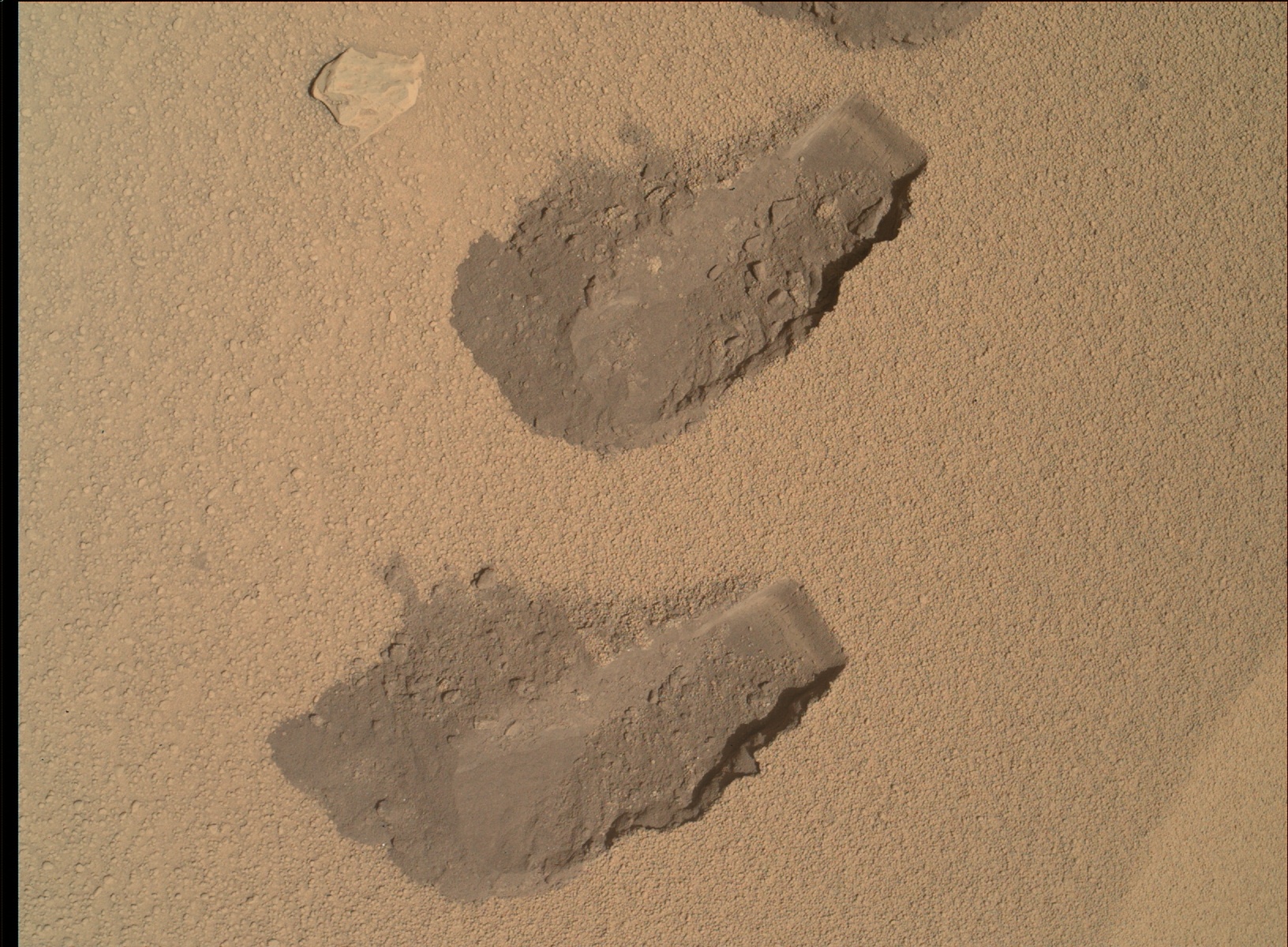
Scoop marks at RockNest. Image credit: NASA/JPL-Caltech/Malin Space Science Systems. Did the sample in question come from there?
When the Bad Astronomer Phil Plait posted his take on this last week. I responded that I thought it was a discarded Earth Bar wrapper. Think about it.
11/26/2012 – Ephemeris – Saturn and Venus pass in the morning twilight
Ephemeris for Monday, November 26th. The sun will rise at 7:53. It’ll be up for 9 hours and 11 minutes, setting at 5:05. The moon, 2 days before full, will set at 6:58 tomorrow morning.
This morning the planet Saturn will appear to the left of the much brighter Venus. By tomorrow morning Venus will be below Saturn. Both are moving eastward against the stars, but Venus being closer is moving faster. Venus is moving around and behind the sun from our vantage point. On March 28th next year it will pass behind the sun and will enter the evening sky. Saturn will increase its apparent distance from the sun and will be visible in the evening in late spring. Saturn is perhaps everyone’s favorite planets due to its spectacular rings that can be spotted in just about any telescope. This and next year the rings will be open to nearly their widest extent. Still orbiting Saturn the Cassini spacecraft is going strong.
Times are for the Traverse City/Interlochen area of Michigan. They may be different for your location.
Addendum
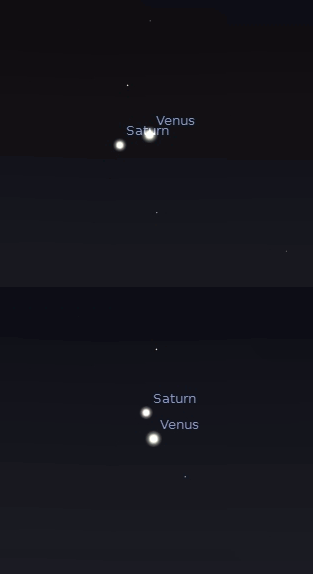
Venus and Saturn on the mornings of November 26 & 27, 2012 at 6:30 a.m. Created using Stellarium.
The long pause is on the 27th.
11/23/2012 – Emphemeris – Think Tatooine is special? How about a planet in a 4 star system.
Ephemeris for Friday, November 23rd. The sun will rise at 7:50. It’ll be up for 9 hours and 17 minutes, setting at 5:07. The moon, 3 days past first quarter, will set at 3:59 tomorrow morning.
The satellite named Kepler, which is attempting to detect planets around other stars has been up there for over 3 years and has received a mission extension. It is looking at a single patch of the sky in the constellation Cygnus. The count of confirmed and unconfirmed planets has risen to 23 hundred. Confirmations have to be done by ground based telescopes, so it will take a while to investigate all the finds for planets. The public can help sift through the Kepler data at www.planethunters.org. In fact the first planet hunters discovery was announced last month: A planet orbiting a pair of stars in the 4 star system. That’s a real feat considering they all look like a single point of light to Kepler.
Times are for the Traverse City/Interlochen area of Michigan. They may be different for your location.
Addendum
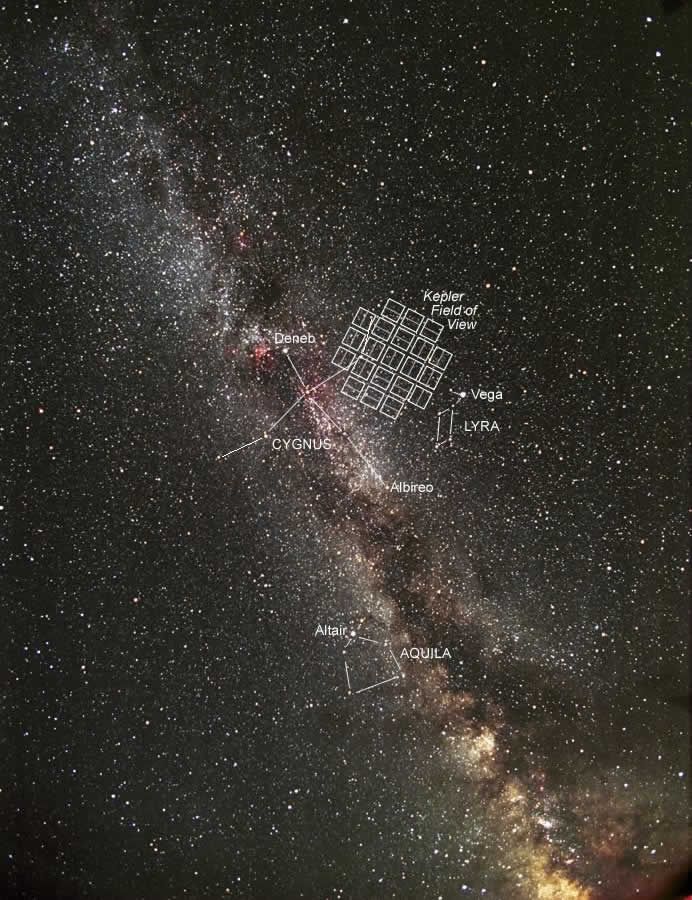
Kepler field of view. Credit C. Roberts, NASA.
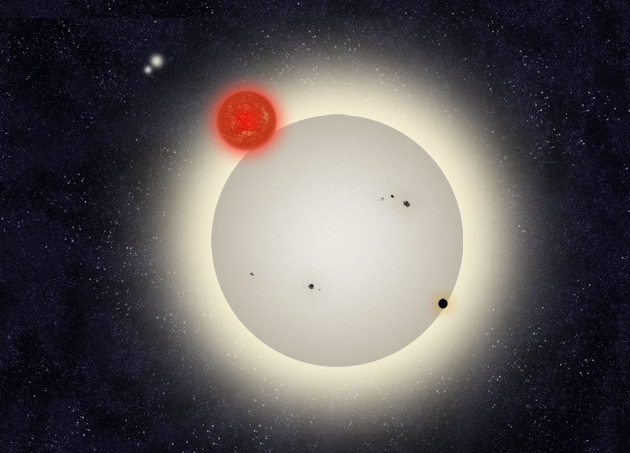
Artist’s rendition of PH1 (Planet Hunters 1) a planet in a 4 star system. Image credit: Haven Giguere/Yale.
Here’s the post from the Planet Hunters blog.

