Archive
11/22/2012 – Ephemeris – Celestial navigation in the days of the Pilgrims
Ephemeris for Thanksgiving Day, Thursday, November 22nd. The sun will rise at 7:48. It’ll be up for 9 hours and 19 minutes, setting at 5:08. The moon, 2 days past first quarter, will set at 2:58 tomorrow morning.
Back in the days of the Pilgrims navigation was much less certain than it is today. At the mercy of the winds and weather, sailing took a lot of courage. Celestial navigation took the form of measuring the altitude of the pole star Polaris at night and the sun at noon. That and tossing a log overboard attached to a rope with knots at regular interval to gauge their speed and progress. That’s where we get the term knots as a measure of speed for nautical and aviation use. Today we have GPS to tell us where we are. However that is based on the position of not stars, but quasars, bright nuclei of distant galaxies, whose motions are currently too small to measure. Have a happy Thanksgiving.
Times are for the Traverse City/Interlochen area of Michigan. They may be different for your location.
Addendum
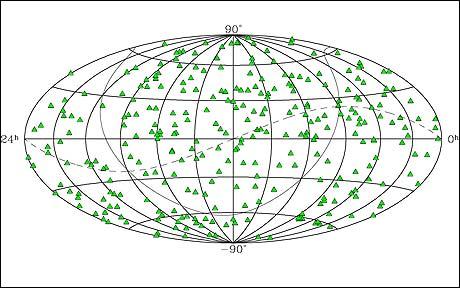
All sky map of quasar locations used as the celestial markers for the GPS system. Chart by David Bobolz, US Naval Observatory.
The chart above is from an article in the Telegraph.
11/21/2012 – Ephemeris – Where are the bright planets this week?
Ephemeris for Wednesday, November 21st. The sun will rise at 7:47. It’ll be up for 9 hours and 21 minutes, setting at 5:09. The moon, 1 day past first quarter, will set at 1:55 tomorrow morning.
Let’s check out the planets for this week. At 6:15 p.m. Mars can be seen low in the southwest. Mars, being the nearest planet outside the earth’s orbit takes its own sweet time leaving the evening sky. Mars will set at 7:10. The planetary action will have already picked up on the other side of the sky. Jupiter, will rise at 5:47 p.m. in the east northeast. It is located in the constellation of Taurus. It will transit or pass due south at 1:25 a.m. The morning planet Venus is the next planet to rise at 5:08 a.m. also in the east. Venus is now near the bright star Spica in the constellation of Virgo. Saturn can now be seen after it rises in the east southeast at 5:35 a.m. as twilight brightens. It’s approaching Venus from the lower left.
Times are for the Traverse City/Interlochen area of Michigan. They may be different for your location.
Addendum
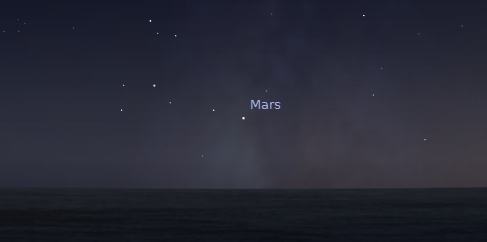
Mars low in the southwest at 6:15 p.m. November 21, 2012. Created using Stellarium.
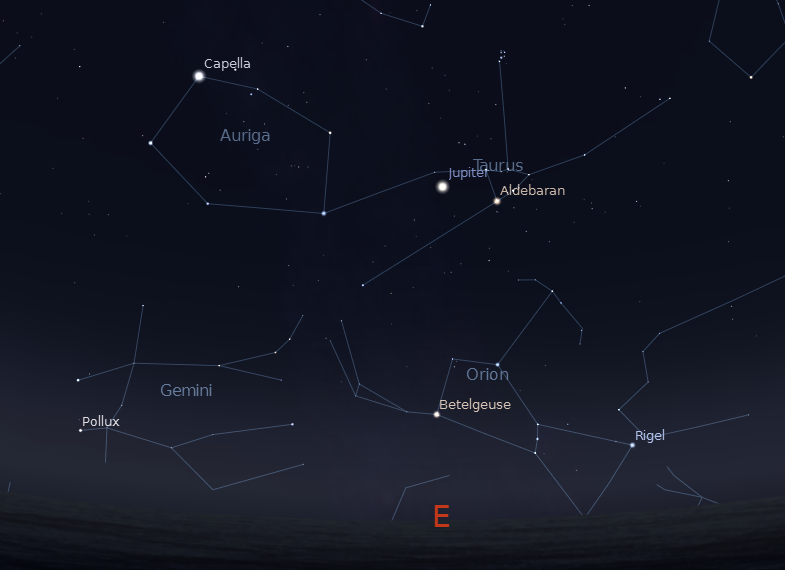
Jupiter with the rising winter constellation is the east at 9 p.m. November 21, 2012. Created using Stellarium.
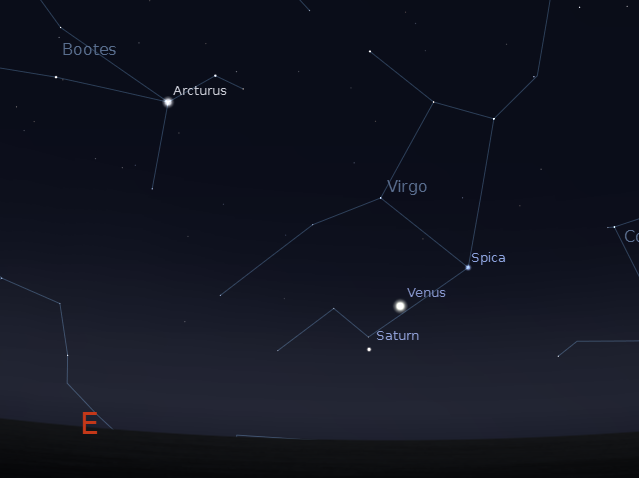
Venus and Saturn low in the east southeast at 6:30 a.m. November 22, 2012. Created using Stellarium.
11/19/2012 – Ephemeris – A Leonid meteor peak at 1 a/m/ EST tomorrow morning.
Ephemeris for Monday, November 19th. The sun will rise at 7:45. It’ll be up for 9 hours and 25 minutes, setting at 5:10. The moon, 1 day before first quarter, will set at 11:43 this evening.
There is expected to be a peak of the Leonid meteor shower at around 1 tomorrow morning. By then the radiant of the meteor shower will have risen in the east in the head of Leo the lion in the curve of the backwards question mark that denotes the front end of the beast. The Leonids do not have the same numbers every year. Great meteor storms occur, on average every 33 years because they are associated with a comet of the same period, Comet Tempel-Tuttle. It last came through the inner solar system in 1998, so this is not a great year for them. However astronomers are getting better at predicting where the debris streams are that were liberated by the comet in its passes of the sun, giving observers a heads up on the best times to look.
Times are for the Traverse City/Interlochen area of Michigan. They may be different for your location.
Addendum
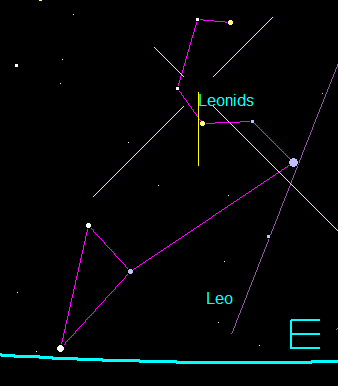
Leo rising at around 2 a.m. on the morning of November 20. Note the radiant in the sickle asterism of Leo. Created using Looking Up, my own program.
At 1 a.m. the triangle of stars at his haunches will not have risen yet. The maximum number of meteors per hour will be 10-20. However this is if the radiant is overhead. The numbers are expected to be lower. This will not be as visible west to here (Michigan).
11/15/2012 – Ephemeris – Fomalhaut the lonely star has a companion planet
Ephemeris for Thursday, November 15th. The sun will rise at 7:39. It’ll be up for 9 hours and 34 minutes, setting at 5:14. The moon, 2 days past new, will set at 7:03 this evening.
The lonely bright star low in the south at 8 p.m. these evenings is Fomalhaut the harbinger of autumn in my book. Fomalhaut means fishes mouth and is located at the head of Piscis Austrinus, a very dim constellation. Fomalhaut is a young white star only 400 million years old with a disk of dust surrounding it. In an outer dust ring, 10 years ago the Hubble Space Telescope discovered a spot. Four years later astronomers discovered that the spot moved along the dust lane and announced the first direct discovery of an exoplanet. There’s been some controversy ever since, about is it really a planet or just a clump of material. It seems at this time that there is a planet there but it is shrouded by a cloud of dust, so that the planet cannot be detected.
Times are for the Traverse City/Interlochen area of Michigan. They may be different for your location.
Addendum
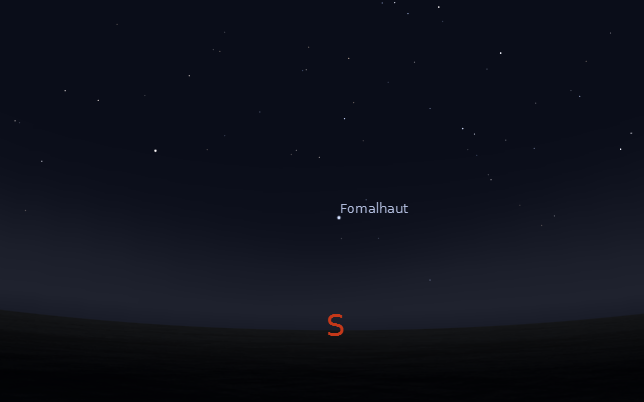
Fomalhaut in the south at 8 p.m. on November 15, 2012. Created using Stellarium.
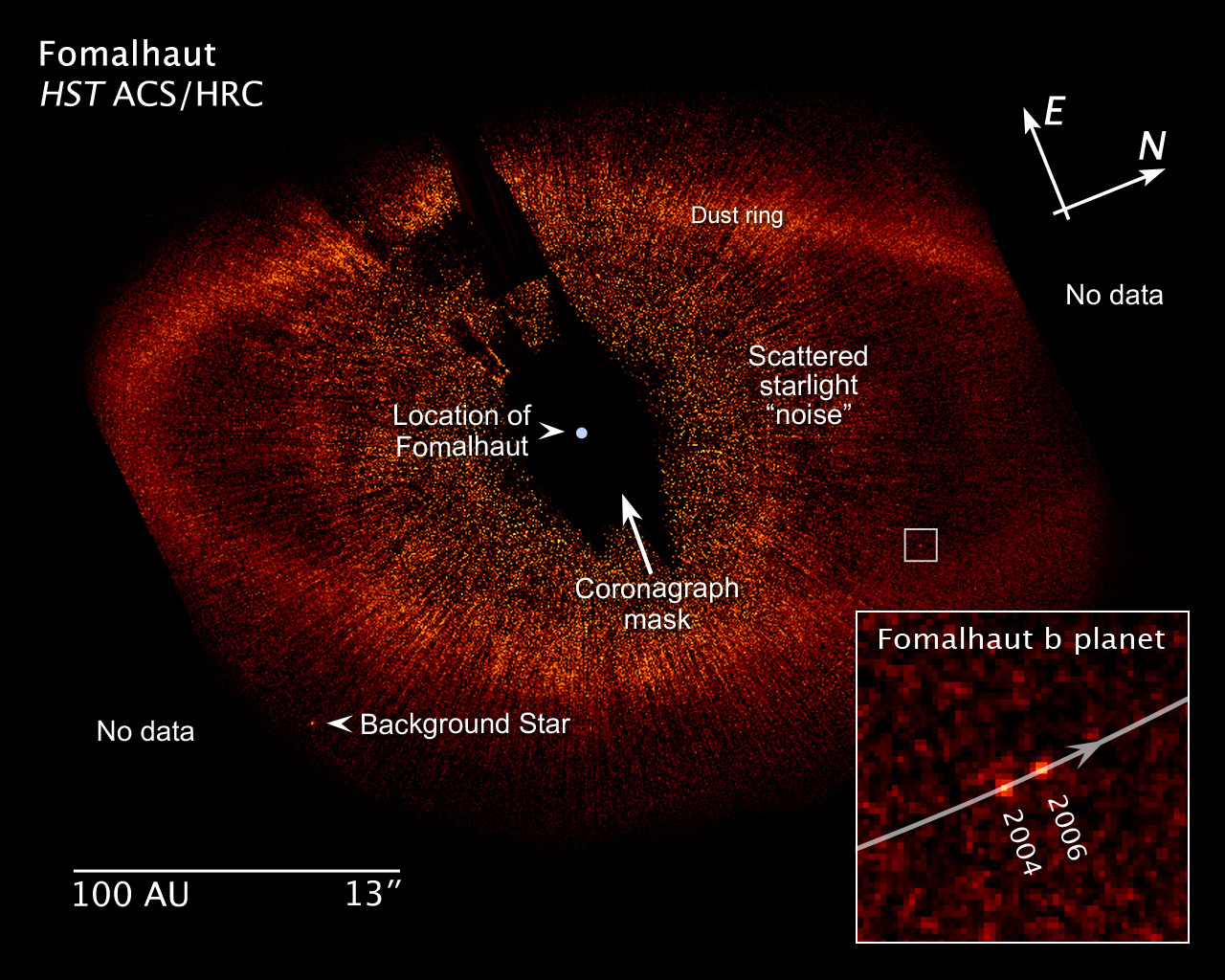
Fomalhaut and possible planet via the Hubble Space Telescope. Courtesy NASA
Click on above image to enlarge.
11/14/2012 – Ephemeris – Where are he bright planets this week.
Ephemeris for Wednesday, November 14th. The sun will rise at 7:38. It’ll be up for 9 hours and 36 minutes, setting at 5:15. The moon, 1 day past new, will set at 6:01 this evening.
Let’s check out the planets for this week. At 6:15 p.m. Mars can be seen low in the southwest. Mars, being the nearest planet outside the earth’s orbit takes its own sweet time leaving the evening sky. Mars will set at 7:14. The planetary action will have already picked up on the other side of the sky. Jupiter, will rise at 6:18 p.m. in the east northeast. It is located in the constellation of Taurus. It will transit or pass due south at 1:52 a.m. The morning planet Venus is the next planet to rise at 4:50 a.m. also in the east. Venus is now near the bright star Spica in the constellation of Virgo. Saturn can now be seen after it rises in the east south east at 5:58 a.m. as twilight brightens. It will be easier to spot next week.
Times are for the Traverse City/Interlochen area of Michigan. They may be different for your location.
Addendum
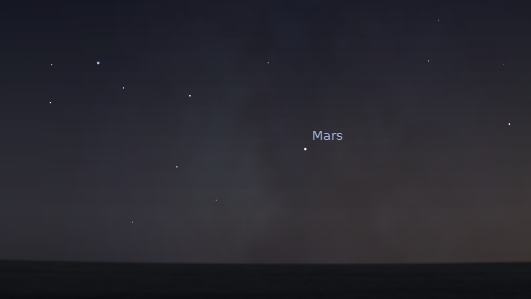
Mars low in the southwest at 6:15 p.m. on November 14, 2012. Created using Stellarium.
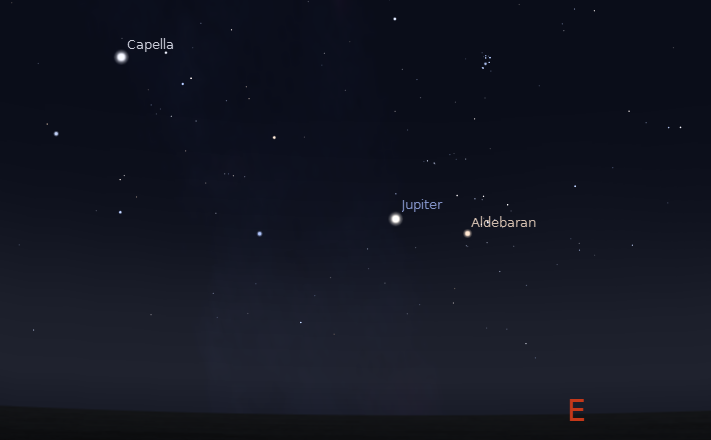
Jupiter low in the east at 8 p.m. on November 14, 2012. Created using Stellarium.
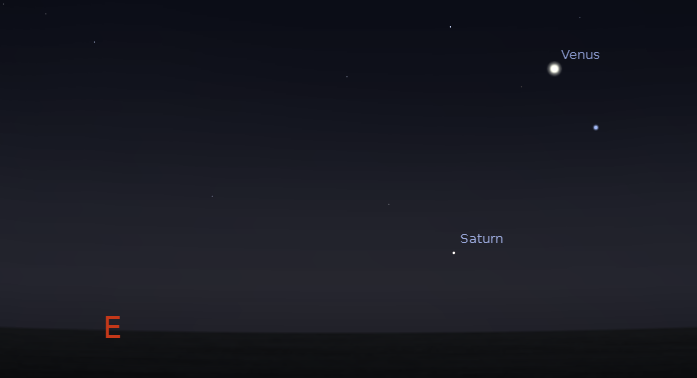
Venus and Saturn at 6:30 a.m. on November 15, 2012. Created using Stellarium.
11/13/2012 – Ephemeris – Total Solar Eclipse in the South Pacific
Ephemeris for Tuesday, November 13th. The sun will rise at 7:37. It’ll be up for 9 hours and 39 minutes, setting at 5:16. The moon is new today, and won’t be visible.
There will be a total solar eclipse today for the South Pacific Ocean. The path of totality crosses almost no land except in the two northernmost tips of Australia. Australia, New Guinea, New Zealand parts of Antarctica, Chile and Argentina will get a partial eclipse. The moon’s shadow crosses the earth from west to east, so in crossing the International Date Line it will start at sunrise on November 14th local time and end at sunset November 13th local time. The solar eclipse we’re waiting for is the total solar eclipse of August 21st 2017, now less than 5 years away. This will be at least partial for the contiguous 48 states with the path of totality crossing the central United States. Being in the path of totality that day is high on my bucket list.
Times are for the Traverse City/Interlochen area of Michigan. They may be different for your location.
Addendum
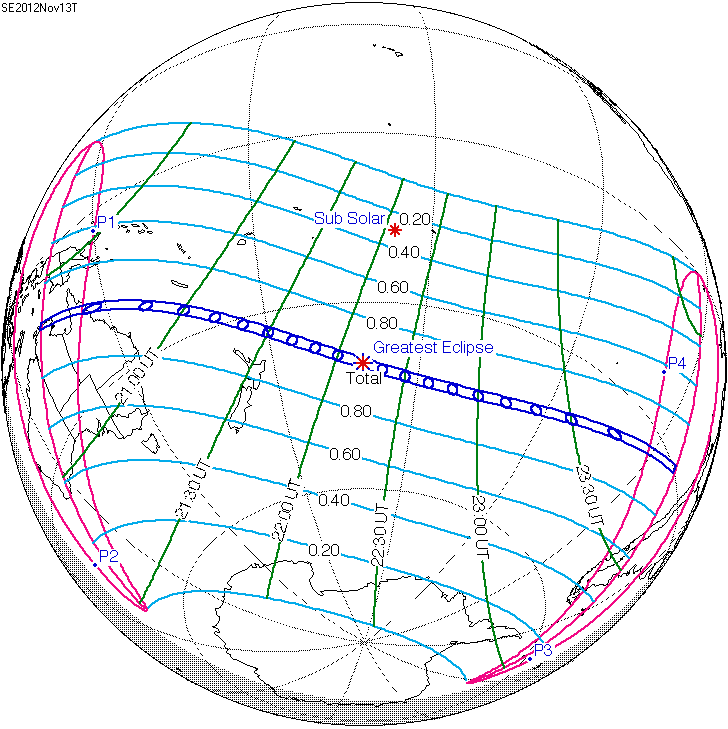
Diagram of the coverage of the November 13-14 total Solar Eclipse. Courtesy Fred Espanek, NASA.
Here’s an animation that brings the above chart to life.
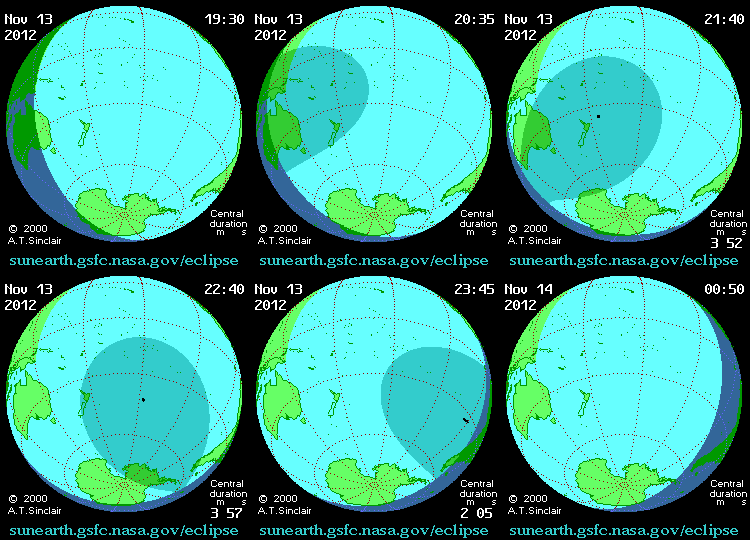
November 13-14 total solar eclipse animation. Courtesy NASA, A. T. Sinclair.
11/12/2012 – Ephemeris – The North Taurid Meteor Dhower
Ephemeris for Monday, November 12th. The sun will rise at 7:35. It’ll be up for 9 hours and 41 minutes, setting at 5:17. The moon, 1 day before new, will rise at 7:15 tomorrow morning.
This is the date of the peak of the Northern Taurid Meteor Shower. This shower has a long duration, from late October to early December. Taurus is up all night, so the meteors will be seen all night, but more numerous in the morning. There won’t be many of them, maybe 5 an hour, but they are very slow moving, only 29 kilometers per second or 18 miles per second, about half the speed of other meteors. It has more than its share of very bright meteors. These meteors are thought to have their origin with Comet Encke. Encke is the comet with the shortest period known, only 3.3 years. The peak will last several days, and there’s even an expectation of a swarm, a higher number or meteors, that might be visible during this period.
Times are for the Traverse City/Interlochen area of Michigan. They may be different for your location.
Addendum
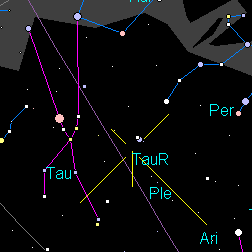
The Taurid Radiant.
11/09/2012 – Ephemeris – The constellations of the triangle and the ram
Ephemeris for Friday, November 9th. The sun will rise at 7:31. It’ll be up for 9 hours and 48 minutes, setting at 5:20. The moon, 3 days past last quarter, will rise at 3:29 tomorrow morning.
High in the south at 9 p.m. can be seen the Great Square of Pegasus. From the top left star of the square diverge two curved lines of stars that is Andromeda the chained princess. Just below and left of Andromeda is a slender triangle of stars, none particularly bright. It has a name you can easily see in the stars, Triangulum, the triangle. It has been known from antiquity, and early Christians saw it as the Mitre of Saint Peter or the Trinity. Another small constellation seen below Triangulum is the much better known constellation Aries the ram. It is the first constellation of the Zodiac, where the sun used to to enter on the first day of spring. Aries is a small hockey stick constellation, not that hard to spot.
Times are for the Traverse City/Interlochen area of Michigan. They may be different for your location.
Addendum
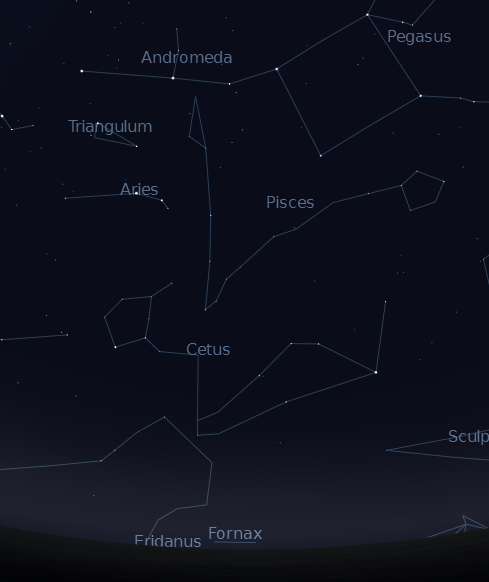
Cetus, Triangulum, Aries and surrounding constellations on November 8, 2012 at 9 p.m. Created using Stellarium.
11/08/2012 – Ephemeris – Is the constellation Cetus a whale of a sea monster?
Ephemeris for Thursday, November 8th. The sun will rise at 7:30. It’ll be up for 9 hours and 51 minutes, setting at 5:21. The moon, 2 days past last quarter, will rise at 2:18 tomorrow morning.
The identity of the constellation Cetus is a bit mixed up. Officially it is a whale, but in the story of the constellations above it, (Cassiopeia, Pegasus, Andromeda, Perseus and Cepheus) it is the monster sent to ravage the Ethiopian coast, and to whom the sacrifice of Andromeda was to stop. Either can be seen in the stars in the southeast at 9 p.m. It is a large constellation of dim stars below and left of the Great Square of Pegasus and Pisces. The whale can be seen diving, its tail of 5 stars in a squished pentagon, is seen to the upper left. If you see the stars differently and put the head of the of the sea monster where the tail of whale is the dreaded Cetus of the story appears. One of its stars is variable and may not be visible. It’s Mira, the wonderful.
Times are for the Traverse City/Interlochen area of Michigan. They may be different for your location.
Addendum
Cetus, Triangulum, Aries and surrounding constellations on November 8, 2012 at 9 p.m. Created using Stellarium.
11/07/2012 – Ephemeris – Where are the bright planets this week?
Ephemeris for Wednesday, November 7th. The sun will rise at 7:28. It’ll be up for 9 hours and 53 minutes, setting at 5:22. The moon, 1 day past last quarter, will rise at 1:11 tomorrow morning.
Let’s check out the planets for this week. At 6:15 p.m. Mars can be seen low in the southwest. Mars, being the nearest planet outside the earth’s orbit takes its own sweet time leaving the evening sky. Mars will set at 7:19. The planetary action will have already picked up on the other side of the sky. Jupiter, will rise at 6:48 p.m. in the east northeast. It is located in the constellation of Taurus. It will transit or pass due south at 2:23 a.m. The last bright planet of the night is the morning star Venus which will rise at 4:33 a.m. also in the east. Venus is now below the hind end of Leo, and actually in the constellation of Virgo. The planets Venus and Jupiter and the winter constellations are a great sight for early risers.
Times are for the Traverse City/Interlochen area of Michigan. They may be different for your location.
Addendum
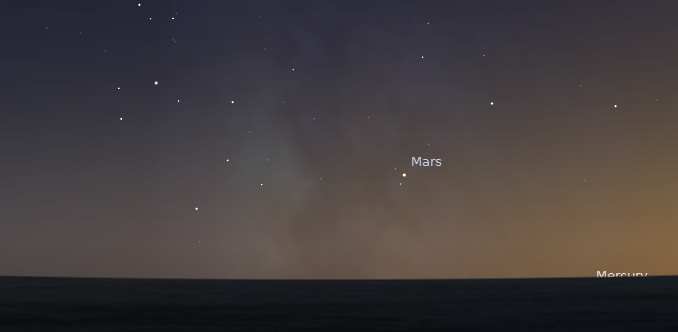
Mars low in the southwest at 6:15 p.m. on November 7, 2012. Created using Stellarium.
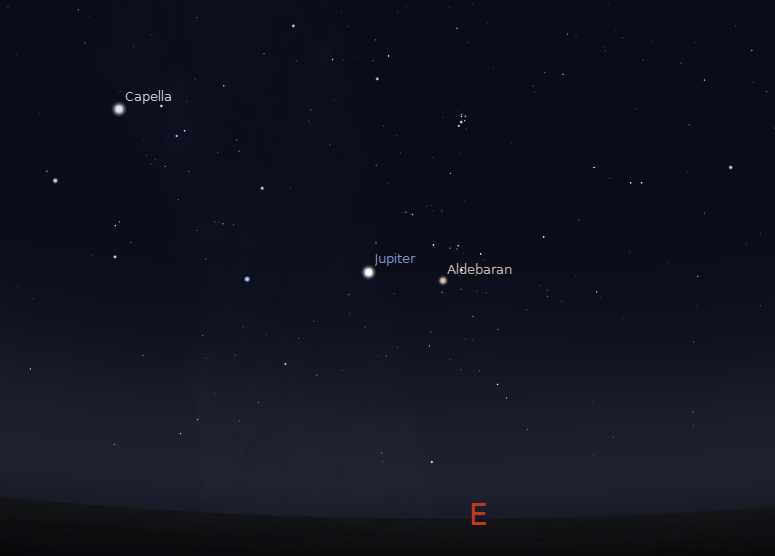
Jupiter rising at 9 p.m. on November 7, 2012. Created using Stellarium.
In the morning.
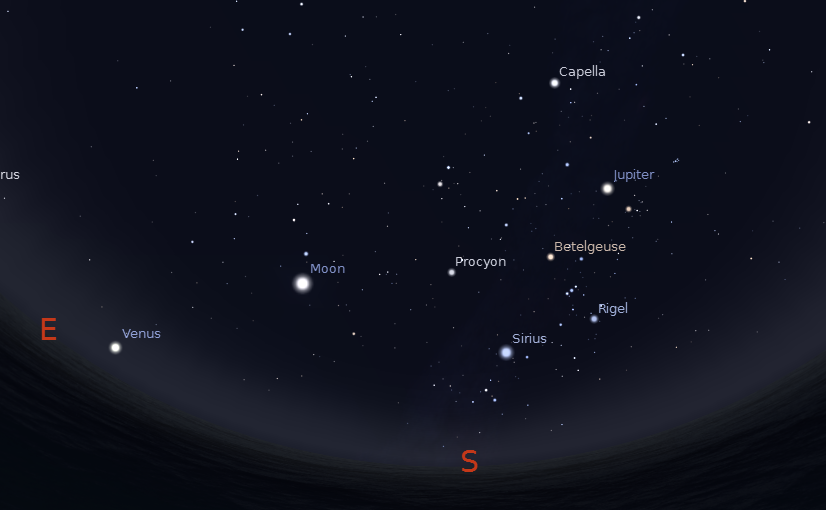
Jupiter and Venus with the winter stars at 5 a.m. November 8, 2012. Created using Stellarium.
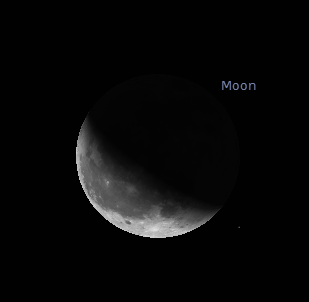
The waning crescent moon on November 8, 2012 at 5 a.m. Created using Stellarium.

