Archive
10/10/11 – Ephemeris – What happened with the Draconids last Saturday?
Columbus Day (observed), Monday, October 10th. The sun will rise at 7:51. It’ll be up for 11 hours and 16 minutes, setting at 7:07. The moon, 1 day before full, will set at 7:31 tomorrow morning.
Last Saturday nights International Observe the Moon Night coincided with the Draconid meteor shower. The Draconids are a periodic shower, not good most years, and when they do appear the shower, or rather meteor storm doesn’t last very long. The bright moon didn’t help, and the peak was predicted to occur in the afternoon our time. The meteors did appears, and right on time, too early for us to have seen it. The best way to detect them with a bright moon is with radio. And using that technique the estimated the peak of Draconid meteors was over 200 per hour. The responsible comet, Giacobini-Zinner, will pass our orbit next February, and may give us a chance to spot the Draconids in darker skies next year.
* Times are for the Traverse City/Interlochen area of Michigan. They may be different for your location.
10/07/11 – Ephemeris – International Observe the Moon Night
Friday, October 7th. The sun will rise at 7:47. It’ll be up for 11 hours and 25 minutes, setting at 7:12. The moon, half way from first quarter to full, will set at 4:28 tomorrow morning. | Tomorrow night is International Observe the Moon Night the Grand Traverse Astronomical Society will be out, if it’s clear, on the north side of Front Street in Traverse City, near the Martinek Clock. The moon will be bright and a fat gibbous phase. Later on in the evening Jupiter will appear to the east, and will provide even more moons to view. Also that night the Draconid meteor shower will be active, if we happen to pass through a cloud of comet debris from past passages of the Comet Giacobini-Zinner near this part of earth’s orbit. The Draconids have been spectacular at rare occasions in the past. We don’t expect a super shower this time, but it may be more active than it usually is. The bright moon will only allow the brightest to be seen.
* Times are for the Traverse City/Interlochen area of Michigan. They may be different for your location.
10/06/11 – Ephemeris – The Draconid meteor shower
Thursday, October 6th. The sun will rise at 7:46. It’ll be up for 11 hours and 28 minutes, setting at 7:14. The moon, 3 days past first quarter, will set at 3:26 tomorrow morning.
This weekend astronomers expect the meteor shower called the Draconids. This is a periodic shower which is active about once every six years. That is because it is related to a short period comet called Giacobini-Zinner. It was discovered in 1900 by the two named astronomers. Its orbit stretches from the earth’s orbit to somewhat past Jupiter’s. When the comet passes near the earth’s orbit we pass through a cloud of its debris when we get to that same spot. Giacobini-Zinner will do so next February. The comet’s nucleus is estimated to be a bit more than a mile in diameter. The Draconid meteors will appear to come from north of the bright star Vega, which is a bit west of overhead at 9 in the evening.
* Times are for the Traverse City/Interlochen area of Michigan. They may be different for your location.
Addendum
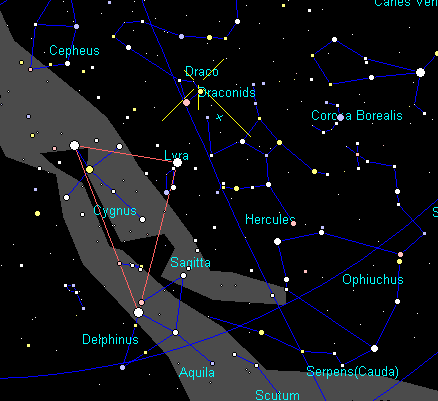
Draconid Meteor Shower Radiant
10/05/11 – Ephemeris – The bright planets visible this week
Wednesday, October 5th. The sun will rise at 7:44. It’ll be up for 11 hours and 31 minutes, setting at 7:16. The moon, 2 days past first quarter, will set at 2:21 tomorrow morning.
It’s Wednesday and time again to take a look at the whereabouts of the bright planets. The planet Venus is rather close to the sun in the evening setting 34 minutes after the sun and not really visible. The ringed planet Saturn also hidden in the bright twilight is setting 29 minutes after the sun. Jupiter is now the prominent planet of the evening sky after it rises at 8:15 p.m. in the east northeast and is seen against the stars of the constellation Aries. In a telescope it will be accompanied by its 4 brightest moons, and as the planet rises higher Jupiter’s image becomes sharper, and its cloud bands will become visible. Mars will rise at 2:14 a.m also in the east northeast and is entering the constellation of Cancer.
* Times are for the Traverse City/Interlochen area of Michigan. They may be different for your location.
10/04/11 – Ephemeris – Good news on the NEO front
Tuesday, October 4th. The sun will rise at 7:43. It’ll be up for 11 hours and 34 minutes, setting at 7:18. The moon, 1 day past first quarter, will set at 1:16 tomorrow morning.
In the last couple of years the WISE satellite, an infrared survey satellite, has been primarily mapping targets for the James Webb Space Telescope proposed to be launched later this decade. As a bonus was the discovery of a great number of asteroids including Near Earth Objects or NEOs. The survey concluded that there are most likely fewer threatening asteroids of all sizes that had been estimated before. That’s definitely good news. However the numbers of asteroids less than 300 meters in diameter is still pretty much unknown. That’s the size of the Apothis asteroid that will pass under the geostationary satellite orbits in 2029. Asteroids that size are still killers, such as the rock that made the crater in Arizona, and another the Tunguska event in Siberia.
* Times are for the Traverse City/Interlochen area of Michigan. They may be different for your location.
10/03/11 – Ephemeris – More celestial events for this month
Monday, October 3rd. The sun will rise at 7:42. It’ll be up for 11 hours and 37 minutes, setting at 7:19. The moon, at first quarter today, will set at 12:10 tomorrow morning.
We have more celestial happenings this month than I could enumerate last Friday. Later on Saturday evening, if it’s clear the Grand Traverse Astronomical Society will join with astronomy groups, planetariums and observatories with International Observe the Moon Night with telescopes positioned on the 200 block east Front Street in Traverse City, near the Martinek clock. Going on that same evening will be the return of the Draconid meteor shower. Its a favorable return of a periodic shower but interferes with by the bright moon. However some bright meteors will be seen. I’ll have more information and background Thursday. Another meteor shower later this month will be the Orionids a morning shower related to Halley’s Comet.
* Times are for the Traverse City/Interlochen area of Michigan. They may be different for your location.
09/30/11 – Ephemeris – Previewing October skies
Friday, September 30th. The sun will rise at 7:38. It’ll be up for 11 hours and 46 minutes, setting at 7:25. The moon, half way from new to first quarter, will set at 9:14 this evening.
Let’s look at the skies for the month of October which starts tomorrow. The sun will still be moving south rapidly. Daylight hours in the Interlochen/Traverse City area will drop from 11 hours and 43 minutes tomorrow to 10 hours 14 minutes on the 31st. The altitude of the sun above the southern horizon at local noon will be 42 degrees tomorrow, and will descend to 31degrees on Halloween, also in the Interlochen area. The Straits area will have the sun a degree lower. Local noon, when the sun is due south will be about 1:30 p.m. in Interlochen. The planet Jupiter will move higher in the southeast in the evening next month. I’m hoping with the sun’s activity increasing we’ll get a shot at seeing some northern lights next month.
* Times are for the Traverse City/Interlochen area of Michigan. They may be different for your location.
09/29/11 – Ephemeris – Deneb at the zenith
Thursday, September 29th. The sun will rise at 7:37. It’ll be up for 11 hours and 49 minutes, setting at 7:27. The moon, 2 days past new, will set at 8:28 this evening.
At 10 p.m. tonight the first magnitude star Deneb will be overhead, that is very near the zenith. Deneb is the northern most and dimmest of the three stars of the Summer Triangle. It is at the head of the Northern Cross, which extends to the south. This is an asterism, which is what astronomers call a informal constellation. The Big and Little Dippers are also examples of asterisms. You won’t find them in the list of the 88 official constellations. The actual constellation that Deneb belongs to is Cygnus the swan. In the swan Deneb is the tail. That’s actually what Deneb means. The swan is flying southwestward along the Milky Way with its wings outstretched. Stars can be followed around the wings to make out a very realistic flying swan.
* Times are for the Traverse City/Interlochen area of Michigan. They may be different for your location.
Addendum
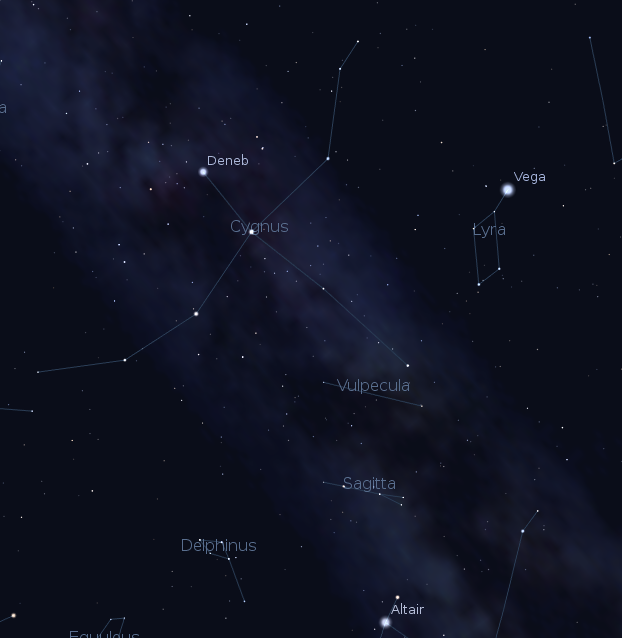
Deneb at the Zenith. Looking overhead while facing south. Created using Stellarium.
The Summer Triangle of bright stars Deneb, Vega and Altair are in this view.
09/28/11 – Ephemeris – Where are the bright planets this week?
Wednesday, September 28th. The sun will rise at 7:36. It’ll be up for 11 hours and 52 minutes, setting at 7:29. The moon, 1 day past new, will set at 7:50 this evening.
It’s Wednesday and time again to take a look at the whereabouts of the bright planets. The planet Venus is rather close to the sun in the evening setting 29 minutes after the sun and not really visible. The ringed planet Saturn also hidden in the bright twilight is setting 38 minutes after the sun. Jupiter is now the prominent planet of the evening sky after it rises at 8:44 p.m. in the east northeast and is seen against the stars of the constellation Aries now. In a telescope it will be accompanied by its 4 brightest moons, and as the planet rises higher Jupiter’s image becomes sharper, and its cloud bands will become visible. Mars will rise at 2:20 a.m also in the east northeast and is now entering the constellation of Cancer.
* Times are for the Traverse City/Interlochen area of Michigan. They may be different for your location.
09/27/11 – Ephemeris – The constellation of Capricornus
Tuesday, September 27th. The sun will rise at 7:35. It’ll be up for 11 hours and 55 minutes, setting at 7:30. The moon is new today, and won’t be visible.
As the Teapot of the constellation Sagittarius tilts and pours celestial tea on the southwestern horizon, it is followed in the south by the faint constellation of Capricornus the sea goat. I’m not sure you’ll see a half goat with a fish’s tail here unless you’ve started Oktoberfest a bit early. To me, it looks like a big sagging triangle with the point down. Capricornus is a constellation of the zodiac, and its claim to fame is a latitude line on the globe at 23 and a half degrees south, called the Tropic of Capricorn. Back a couple of thousand years ago the sun entered Capricornus on the first day of winter, the winter solstice. Thus the latitude where the sun is overhead at that instant was called the Tropic of Capricorn. Due to the wobble of the earth’s axis, the line should be called the Tropic of Sagittarius.
* Times are for the Traverse City/Interlochen area of Michigan. They may be different for your location.
Addendum
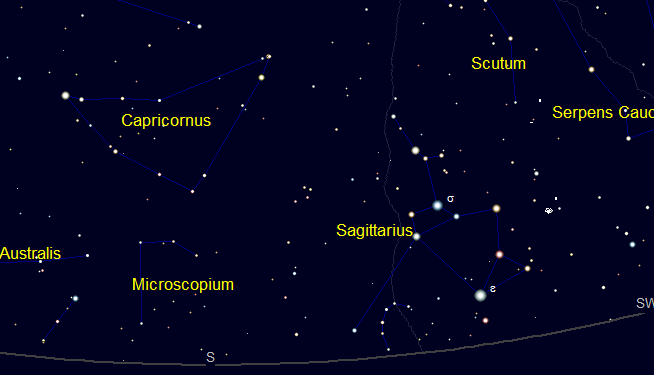
Capricornus as represented in Cartes du Ciel
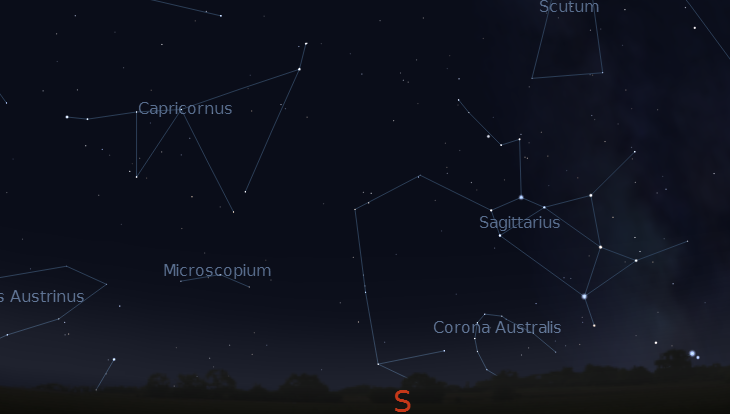
Capricornus as represented in Stellarium

