Archive
03/28/11 – Ephemeris – The bright star Regulus
Monday, March 28th. The sun will rise at 7:31. It’ll be up for 12 hours and 33 minutes, setting at 8:04. The moon, 2 days past last quarter, will rise at 5:05 tomorrow morning.
Regulus is the brightest star in the constellation of Leo the lion. Leo is high in the southeast at 10 p.m. It can be found by imagining a leak in the bottom of the Big Dipper. The water would fall on Leo’s back. Regulus is the star lower right corner of the constellation. Alluding to the lion’s status in the animal kingdom, Regulus is the little king star. It is dead last in order of brightness of the 21 first magnitude stars, 1/13th the brightness of Sirius the brightest star low in the southwest at the same time. To the Babylonians it was the king, the 15th of their constellations that marked the passage of the sun. Regulus is about 77 light years away, and 150 times the brightness of the sun. [It is a rapidly spinning ellipsoid 3 and a half times the sun’s mass.]
* Times are for the Traverse City/Interlochen area of Michigan. They may be different for your location. Text in brackets was omitted from the recorded program due to time constraints.
Addendum
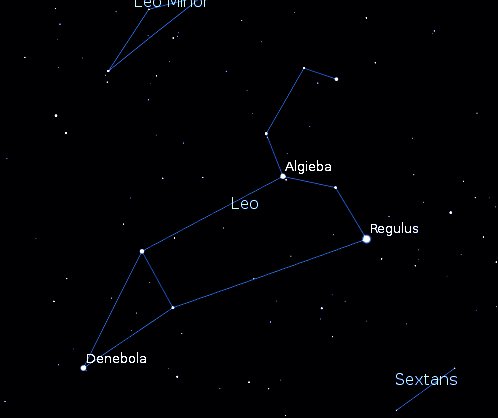
Leo in the southeast. Created using Stellarium.
03/25/11 – Ephemeris – The stars Castor and Pollux
Friday, March 25th. The sun will rise at 7:36. It’ll be up for 12 hours and 24 minutes, setting at 8:00. The moon, 1 day before last quarter, will rise at 3:20 tomorrow morning
Castor and Pollux are the two brightest stars in the constellation Gemini, at the heads of their namesakes. They are high in the south at 10 p.m. Castor, the horseman is on top. It is actually 6 stars orbiting about a common center of gravity in pairs. The two brightest unresolved pairs, named Castor A and Castor B are discernible in telescopes. They all lie 45 light years away. Pollux the pugilist is a single star, slightly brighter than Castor, and somewhat closer to us at 33.7 light years. In his 1603 atlas of the heavens Johannes Bayer gave Castor the alpha designation to Pollux’s beta, even though Pollux is slightly brighter. I once took a photograph of Pollux during the daytime under special circumstances: it happened to be near the totally eclipsed sun.
* Times are for the Traverse City/Interlochen area of Michigan. They may be different for your location.
Addendum
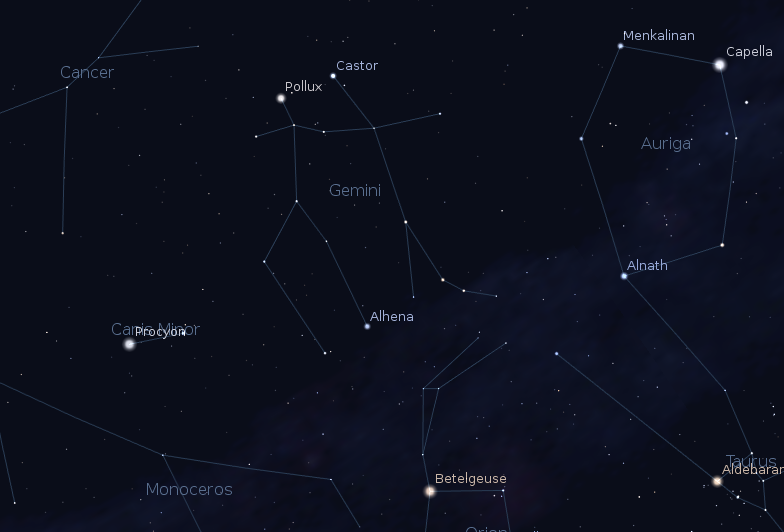
Gemini with the stars Castor and Pollux. Created using Stellarium.
Click to enlarge.
03/24/11 – Ephemeris – The constellation Leo
Thursday, March 24th. The sun will rise at 7:38. It’ll be up for 12 hours and 20 minutes, setting at 7:59. The moon, 2 days before last quarter, will rise at 2:29 tomorrow morning
Besides the advancing sunset times and warming temperatures, there’s another sign that spring is here. That’s the appearance of the constellation Leo the lion high in the southeast in the evening. The front of this beast is a backward question mark of stars with the bright star Regulus as the dot at the bottom. That’s his head, mane and chest. His haunches are a triangle of stars to the left, ending with the bright star Denebola. A way to find Leo is to remember that cat’s aren’t supposed to like water. Find the Big Dipper high in the northeast and imagine drilling a hole in the bottom of the bowl. The water will fall on Leo’s back. Also you’ll notice the stars of spring to the east are more sparse than those of winter to the west.
* Times are for the Traverse City/Interlochen area of Michigan. They may be different for your location.
Addendum
This is Tuesday’s image, showing how to locate Leo.
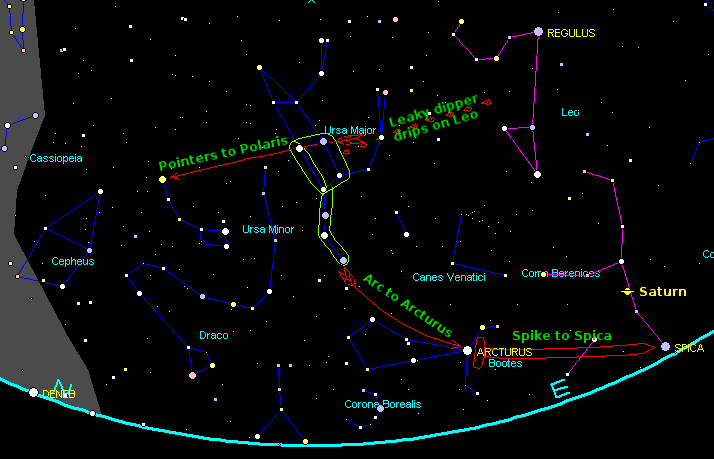
The Big Dipper points to other stars and constellations. Created using my own LookingUp program.
03/23/11 – Ephemeris – The bright planets this week
Wednesday, March 23rd. The sun will rise at 7:40. It’ll be up for 12 hours and 17 minutes, setting at 7:58. The moon, 3 days before last quarter, will rise at 1:28 tomorrow morning.
It’s Wednesday and time again to take a look at the whereabouts of the bright planets for this week. We are losing Jupiter low in the twilight It will set at 8:48 p.m. Now Mercury is actually easier to spot. Higher than Jupiter, it will be visible in twilight and will set at 9:39. My usual rule of thumb about spotting Mercury is that it will be easiest to spot about 45 minutes after sunset, which will be about 8:40 p.m.. The ringed planet Saturn will rise at 8:47 p.m. in the east southeast and will move due south at 2:36 a.m. In telescopes Saturn shows its rings which are a year and a half along their seven and a half year opening. Venus is brilliant in the morning sky and will rise at 6:22 a.m. in the east southeast. It is really a beautiful sight in the morning twilight.
* Times are for the Traverse City/Interlochen area of Michigan. They may be different for your location.
* Times are for the Traverse City/Interlochen area of Michigan. They may be different for your location.
03/22/11 – Ephemeris – The Big Dipper
Tuesday, March 22nd. The sun will rise at 7:42. It’ll be up for 12 hours and 14 minutes, setting at 7:57. The moon, 3 days past full, will rise at 12:17 tomorrow morning
We are a few days into spring. And while the winter constellation of Orion and its cohorts hold forth in the southwestern sky the Big Dipper is sneaking up in the northeast. At 9 p.m. the Big Dipper is standing on the tip of its handle in the northeastern sky. The stars at the front of the bowl are at the top of Big Dipper now. An imaginary line through them to the lower left will point to Polaris the North Star. The Big Dipper never sets for us, in the north country. It scrapes the northern horizon on autumn evenings, climbs the northeastern sky in the winter, is overhead, in spring, and descends in the northwest in summer. The Big Dipper points to, well it leaks on Leo the Lion. The bright star Arcturus, now rising in the east is found by following the curve of the handle.
* Times are for the Traverse City/Interlochen area of Michigan. They may be different for your location.
Addendum
The Big Dipper points to other stars and constellations. Created using my own LookingUp program. Click on the image to enlarge.
03/21/11 – Ephemeris – The constallation of Hydra
Monday, March 21st. The sun will rise at 7:44. It’ll be up for 12 hours and 11 minutes, setting at 7:55. The moon, 2 days past full, will rise at 11:00 this evening.
In the south and southeastern sky at 10 p.m. can be found the constellation of Hydra the water snake. Unlike the monster of the same name this Hydra has but one head, which is its most distinctive part. At 10 p.m. look to the south. The head of Hydra is located below a line from the constellation Leo the Lion in the southeast and Gemini high in the south. Hydra’s head is a small but distinctive group of 6 stars that make a drooping loop to the right. The rest of Hydra wends its way to the southeastern horizon, and eventually ends near the spring and summer transitional constellation of Libra the scales. Over the next few months Hydra will slither across the southern skies.
* Times are for the Traverse City/Interlochen area of Michigan. They may be different for your location.
Addendum
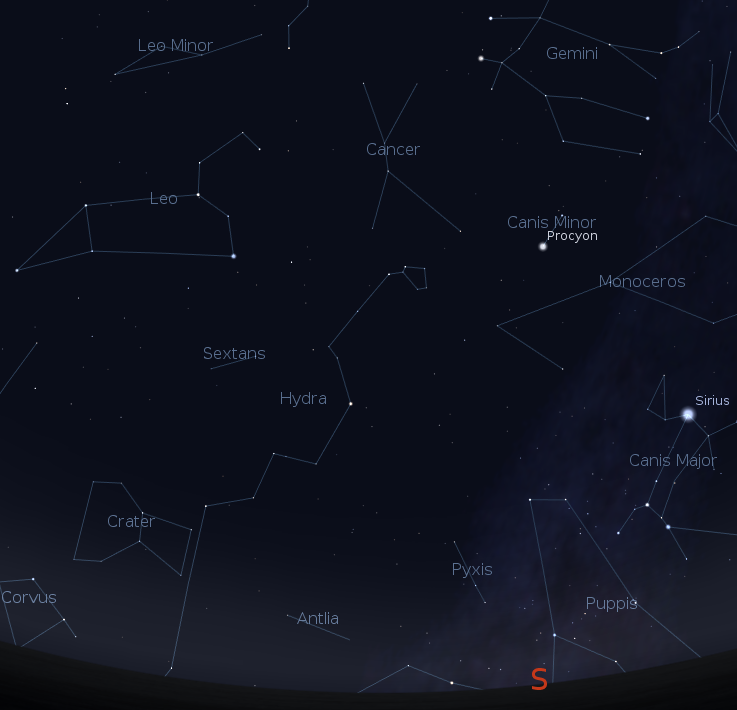
Hydra Rising. Created using Stellarium a free planetarium program.
03/18/11 – Ephemeris – Spring is almost here
Ephemeris for Friday, March 18th. The sun will rise at 7:49. It’ll be up for 12 hours and 2 minutes, setting at 7:52. The moon, 1 day before full, will set at 7:16 tomorrow morning.
We are now two days and some hours from the beginning of spring. Spring will arrive at 7:21 p.m. Sunday evening. At that instant the sun will appear to cross the celestial equator, the projection of the earth’s equator on the sky, heading northward. This will give us six months of over 12 hours daylight, culminating on June 21st with over 15 and a half hours of daylight for our listening area. This is the spring or vernal equinox, or to be hemisphericaly correct, the March equinox, because those folks south of the equator will begin autumn. Earth’s seasons are due to the tilt of its axis by 23 and a half degrees. The earth’s axis is nearly fixed in space, but changes its orientation with respect to the sun during our yearly orbit.
* Times are for the Traverse City/Interlochen area of Michigan. They may be different for your location.
03/17/11 – Ephemeris – MESSENGER spacecraft arrives at Mercury tonight
Ephemeris for St. Patrick’s Day, Thursday, March 17th. The sun will rise at 7:51. It’ll be up for 11 hours and 59 minutes, setting at 7:50. The moon, 2 days before full, will set at 6:48 tomorrow morning.
This evening the MESSENGER Spacecraft will fire its main engine for 15 minutes to put itself in orbit of the planet Mercury. The rocket firing will be at 8:45 this evening. Due to light time delays caused by Mercury being 97 million miles away, we won’t know if the rocket fired until 8:54. While its high gain antenna won’t be pointed at earth, we should get a signal from its omni- directional antenna. We did get a signal from Cassini with its orbital insertion of Saturn in 2004, and that was nearly a billion miles away. I don’t know if NASA TV’s covering the insertion live, but Johns Hopkins Applied Physics Laboratory is having a live webcast. Google “messenger mercury live orbital insertion” It was the first hit. I’ll have the address on the blog. http://messenger.jhuapl.edu/mer_orbit.html
* Times are for the Traverse City/Interlochen area of Michigan. They may be different for your location.
03/16/11 – Ephemeris – The bright planets this week
Ephemeris for Wednesday, March 16th. The sun will rise at 7:53. It’ll be up for 11 hours and 56 minutes, setting at 7:49. The moon, 3 days before full, will set at 6:19 tomorrow morning.
It’s Wednesday and time again to take a look at the whereabouts of the bright planets for this week. If the weather cooperates tonight we might get a glimpse of Mercury just above Jupiter low in the west shortly after sunset. Jupiter is the brighter of the two and will set first at 9:07, with Mercury following at 9:18. The best time to view them will be about 8:30 or so. The ringed planet Saturn will rise at 9:17 p.m. in the east southeast and will move due south at 3:05 a.m. In telescopes Saturn shows its rings which are a year and a half along their seven and a half year opening. Venus is brilliant in the morning sky and will rise at 6:27 a.m. in the east southeast. It is really a beautiful sight in the morning twilight.
* Times are for the Traverse City/Interlochen area of Michigan. They may be different for your location.
Addendum
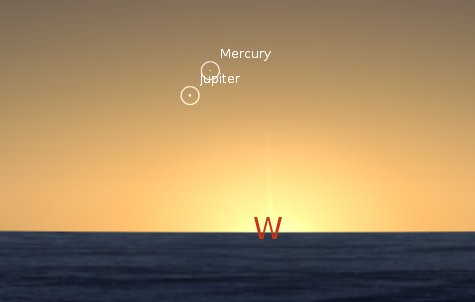
Jupiter-Mercury Conjunction March 16, 2011. Created using Stellaruim.
03/15/11 – Ephemeris – The Lunar Highlands
Ephemeris for Tuesday, March 15th. The sun will rise at 7:55. It’ll be up for 11 hours and 52 minutes, setting at 7:48. The moon, half way from first quarter to full, will set at 5:48 tomorrow morning.
The south part of the moon that can be seen tonight appears brighter than the darker areas that we call seas, that make up the face of the man in the moon. These and other bright areas are called the lunar highlands, and are the most primitive surface of the moon. Here the landscape is saturated with craters. In binoculars the crater Tycho with its rays are just beginning to become prominent. These rays, are thought to be small craterlets caused by the ejecta from the creation of Tycho which occurred perhaps less than 1.1 billion years ago. This makes Tycho a relatively fresh crater in the moon’s nearly 4.5 billion year history. A telescope will reveal more, including the large crater Clavius with its arc of smaller craters within.
* Times are for the Traverse City/Interlochen area of Michigan. They may be different for your location.

