Archive
Ephemeris: 10/09/2024 – Where are the naked-eye planets this week?
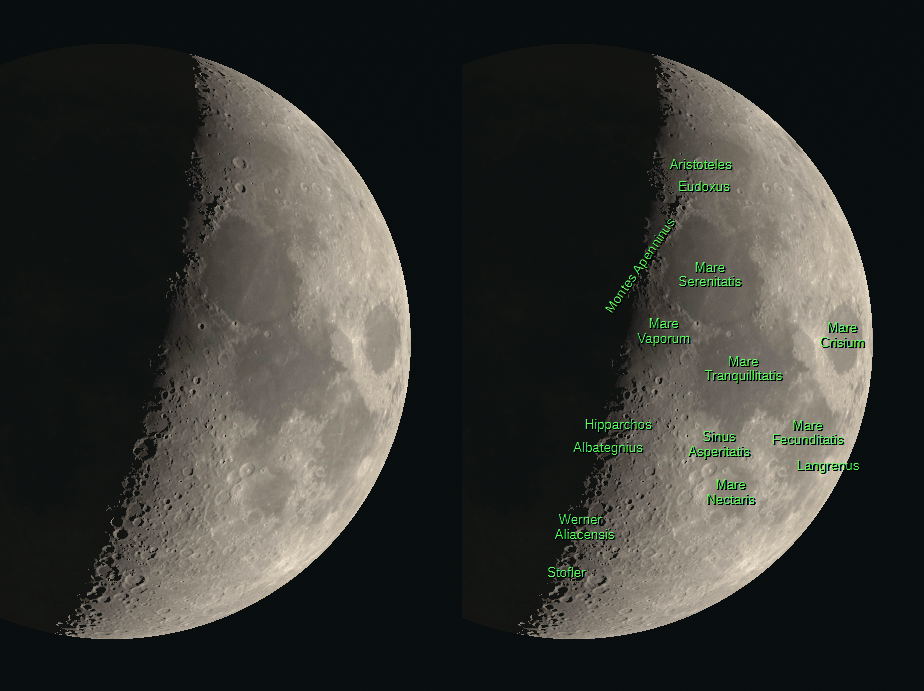
This is Ephemeris for Wednesday, October 9th. Today the Sun will be up for 11 hours and 16 minutes, setting at 7:07, and it will rise tomorrow at 7:52. The Moon, 1 day before first quarter, will set at 10:57 this evening.
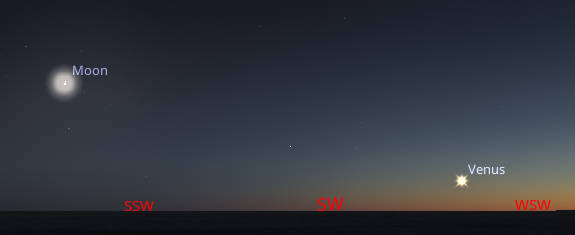
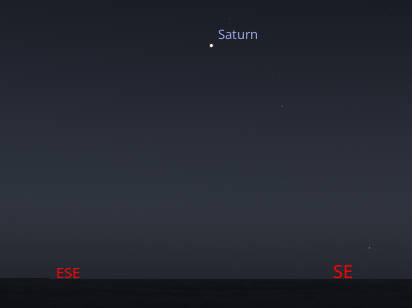
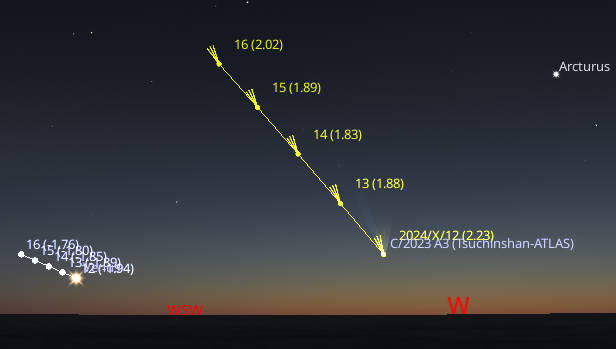
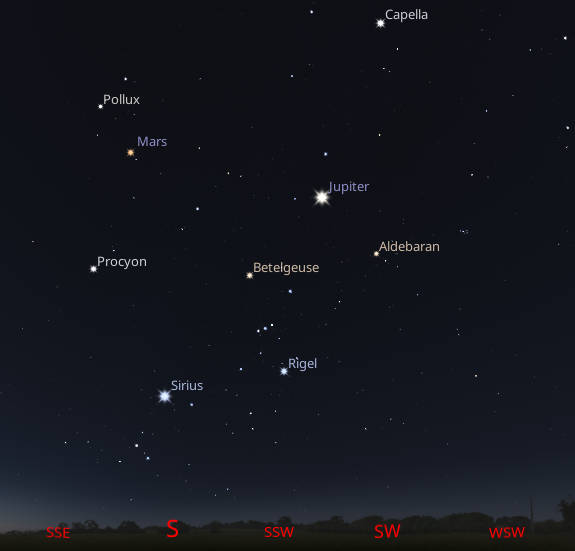
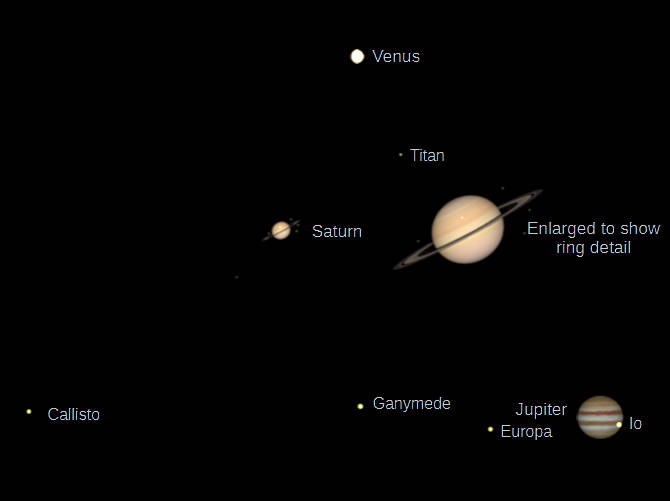
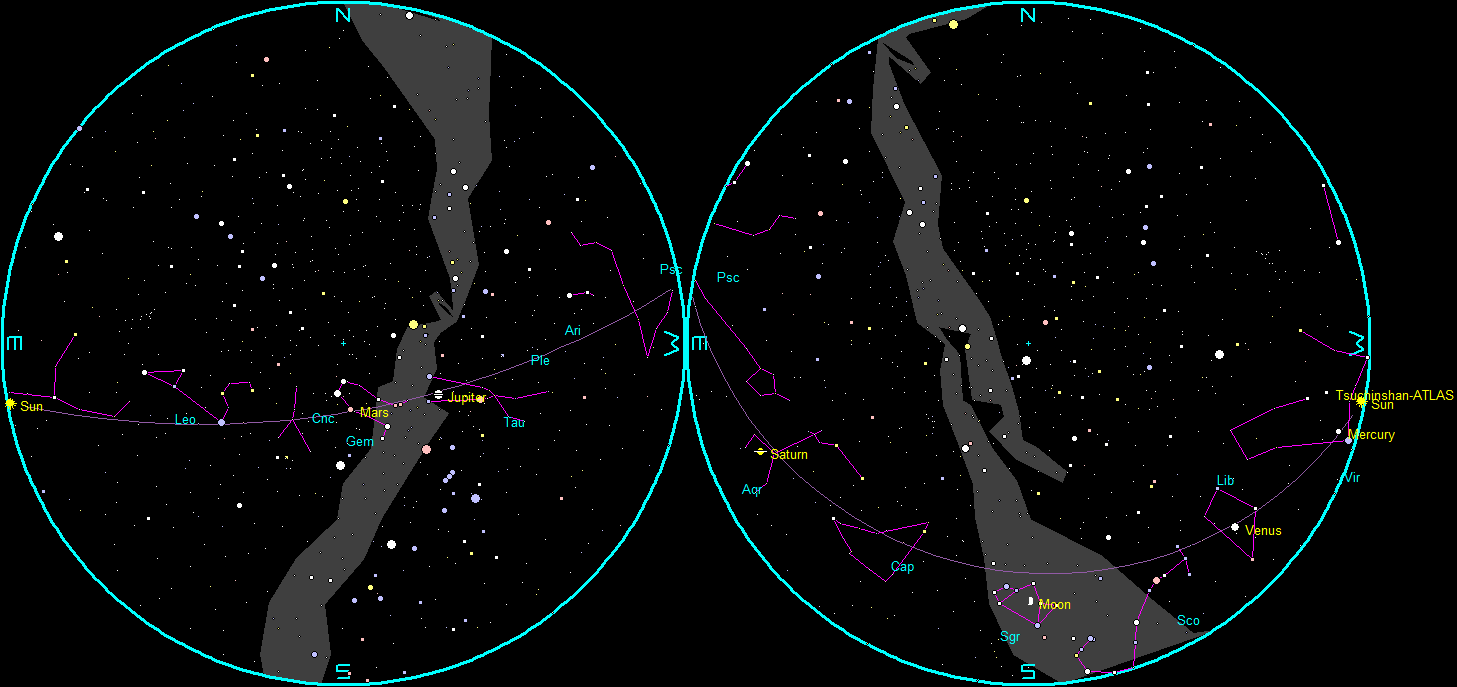
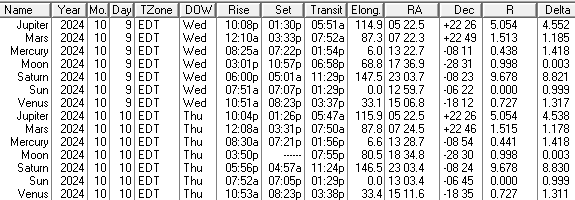
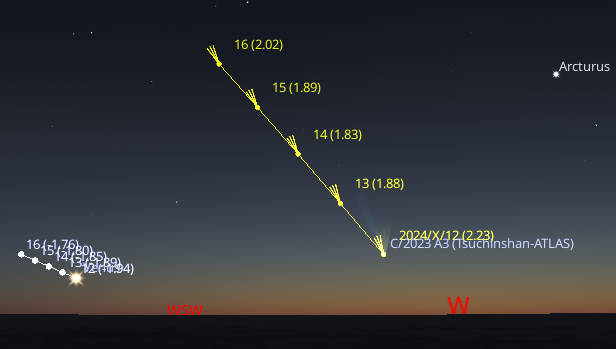
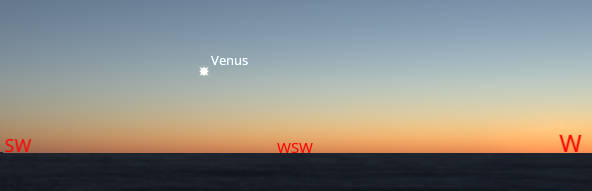
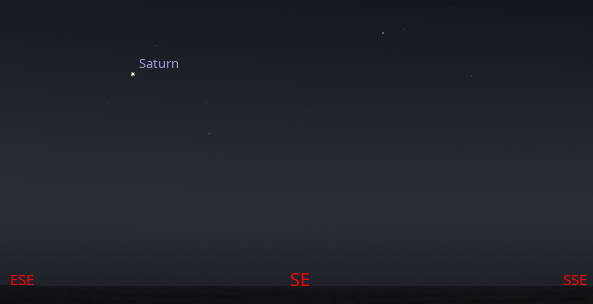
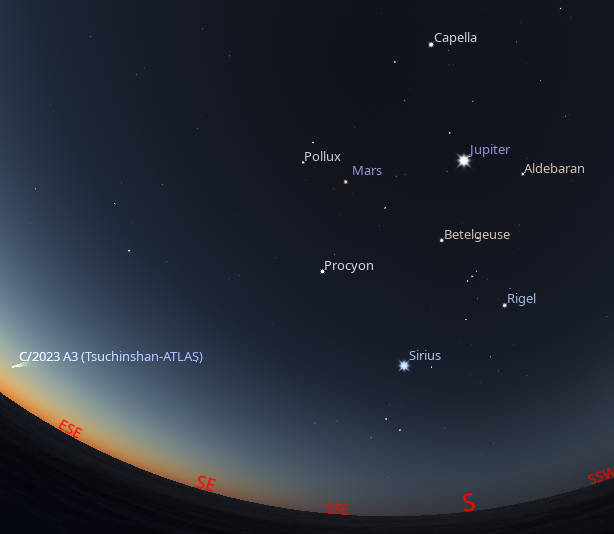
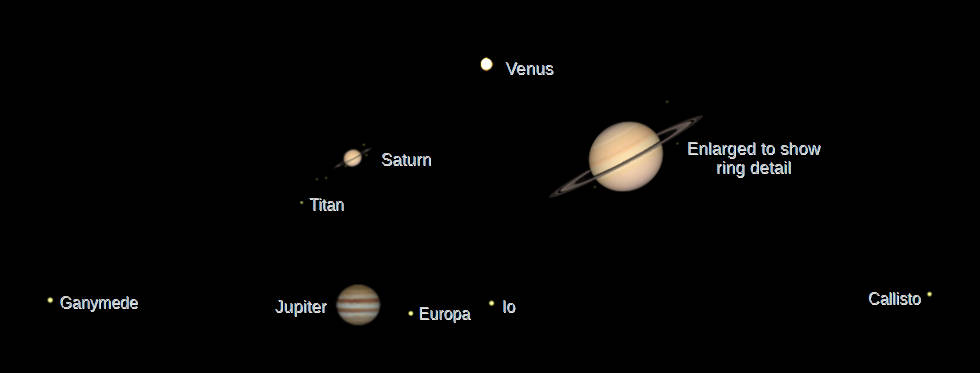
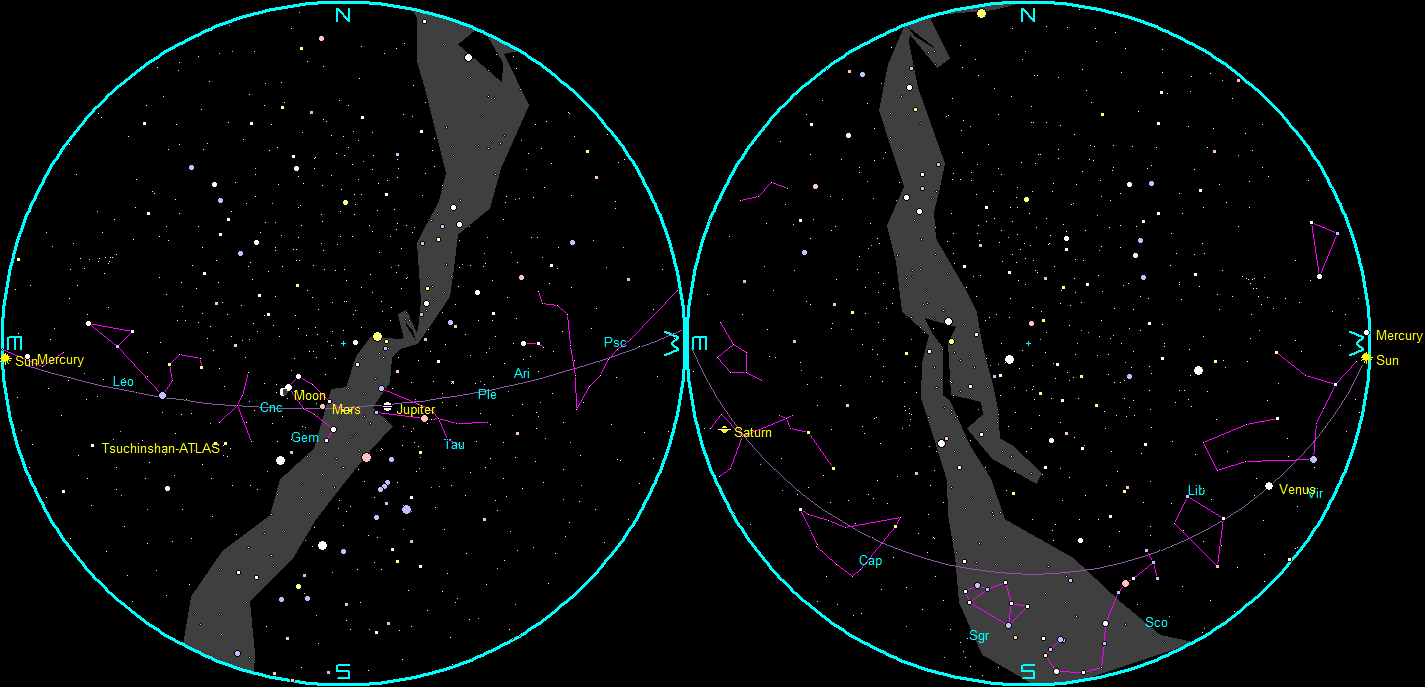
Let’s take our weekly look at the whereabouts of the naked-eye planets. Venus might be spotted in the West southwest only 7° above the horizon at 8 PM, 55 minutes after sunset. It will set at 8:23. Saturn will be in the southeast at that time. Saturn may look disappointing in telescopes this year since its rings are nearly edge on and appearing as a line through the planet like it’s stapled onto the sky. Jupiter and Mars will be up in the morning sky, with Jupiter rising about 10:08 PM in the east-northeast. By 7 AM tomorrow, Jupiter will be brighter than any of the winter stars high in the south. Mars, with its reddish hue, will be to the left of Jupiter. Comet Tsuchinshan-ATLAS will be in the western evening sky starting this weekend. It is expected to be quite bright, I’m betting with a broad tail.
The astronomical event times given are for the Traverse City/Interlochen area of Michigan (EDT, UT – 4 hours). Times will be different for other locations.
Addendum
Ephemeris: 10/08/2024 – Comet Tsuchinshan-ATLAS may be brighter than expected
This is Ephemeris for Tuesday, October 8th. Today the Sun will be up for 11 hours and 19 minutes, setting at 7:09, and it will rise tomorrow at 7:51. The Moon, 2 days before first quarter, will set at 10:00 this evening.
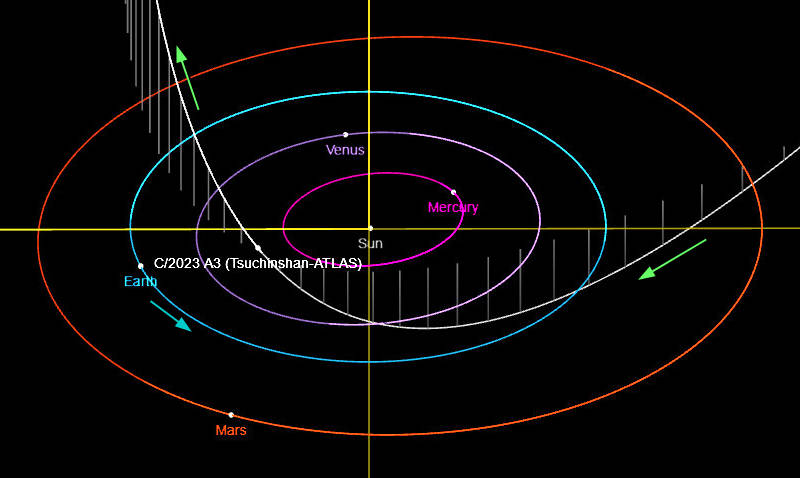
You are going to hear a lot about a bright comet visible in the evening starting this weekend. The comet with a long name Tsuchinshan-ATLAS will begin to be visible in the evening sky, and it will be very bright. It will be the brightest comet we’ve had in some time visible in the Northern Hemisphere since Comet Hale-Bopp in 1997. The reason for this comet’s great brightness is that the comet is passing between the Earth and the Sun. This comet is very dusty with an extensive dust tail. Since the comet is passing between the Earth and Sun the dust scatters sunlight in a forward direction like seeing sunbeams through holes in the clouds near sunset. This is making the comet brighter than originally predicted.
The astronomical event times given are for the Traverse City/Interlochen area of Michigan (EDT, UT – 4 hours). Times will be different for other locations.
Addendum
Ephemeris: 10/04/2024 – GTAS meeting & star party tonight
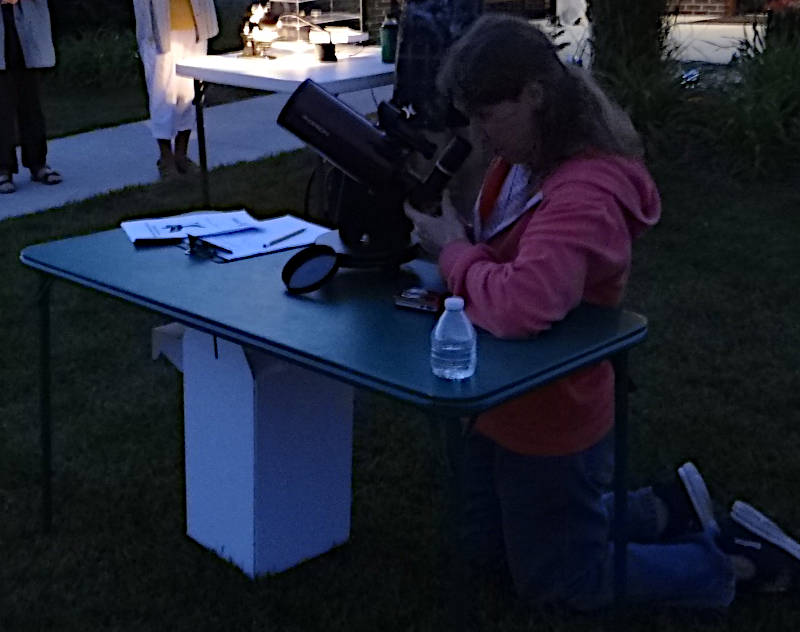
This is Bob Moler with Ephemeris for Friday, October 4th. Today the Sun will be up for 11 hours and 31 minutes, setting at 7:16, and it will rise tomorrow at 7:46. The Moon, 2 days past new, will set at 7:51 this evening. | The Grand Traverse Astronomical Society will host its October meeting tonight at 8:00 PM at Northwestern Michigan College’s Joseph H Rogers Observatory, featuring the society’s Library Telescope program. For over five years now the society has given small telescopes to a number of local libraries and branches to lend out. It has been quite successful. After the meeting, about 9 PM if it’s clear, there will be viewing of the heavens through the observatory’s telescopes, featuring Saturn and the wonders of the Milky Way, including nebulae, open and globular star clusters, containing hundreds to hundreds of thousands of stars. The observatory is located on Birmley Rd. South of Traverse City between Garfield and Keystone roads.
The astronomical event times given are for the Traverse City/Interlochen area of Michigan (EDT, UT – 4 hours). Times will be different for other locations.
Addendum
Ephemeris: 10/03/2024 – Capella rising
This is Ephemeris for Thursday, October 3rd. Today the Sun will be up for 11 hours and 34 minutes, setting at 7:18, and it will rise tomorrow at 7:45. The Moon, 1 day past new, will set at 7:33 this evening.
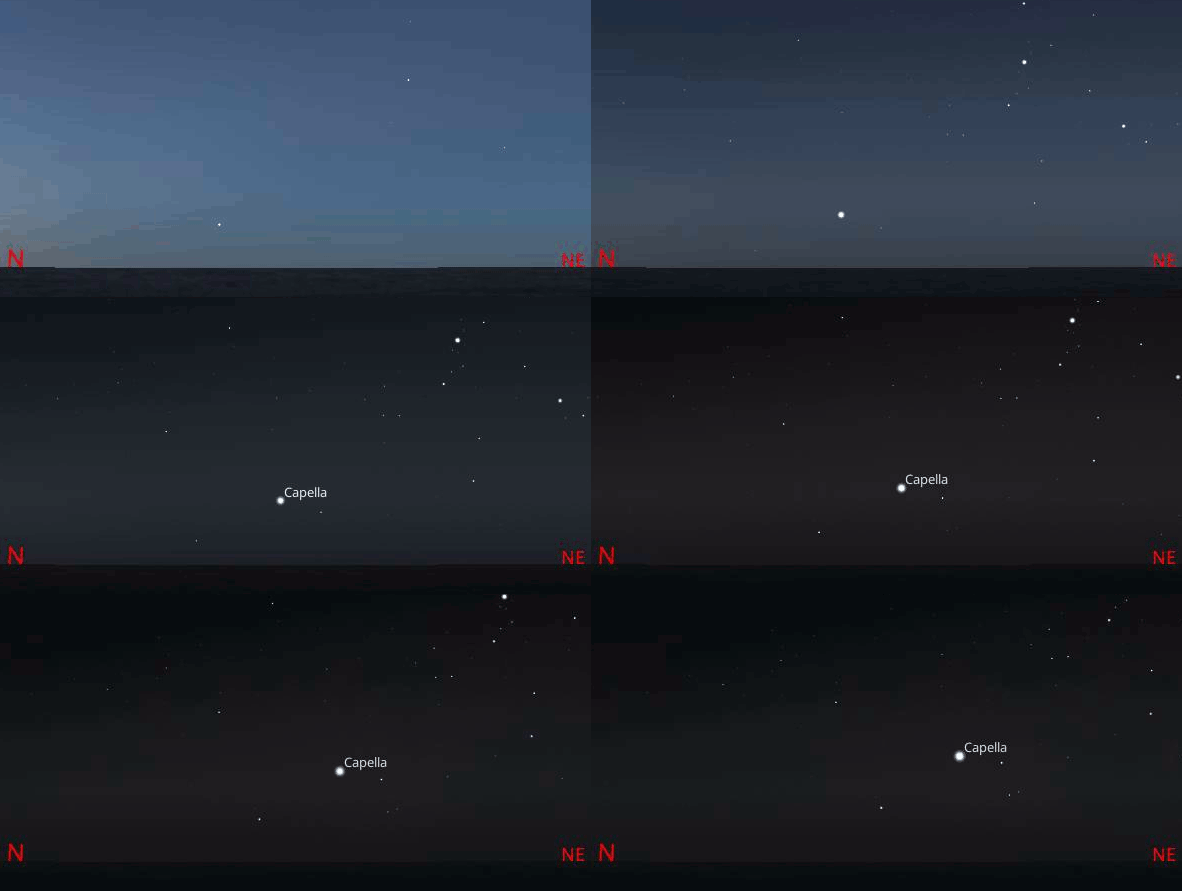
There is a bright star low in the northeast these evenings. It doesn’t seem to be rising very much over the course of the evening. This star is Capella, whose name means “little goat” and is part of the constellation Auriga the charioteer, which won’t completely rise for until about 11 PM. Capella is a circumpolar star meaning it appears to go around the North Pole of the sky, in a circle, as the Earth rotates but never sets. This is true for the Interlochen/Traverse City area and for latitudes north of the city of Ludington. Capella is slowly rising from the bottom of its circumpolar circle in the north, so it’s moving more horizontally than it is rising up. This motion was suspicious to one person who called me, who wondered what it was.
The astronomical event times given are for the Traverse City/Interlochen area of Michigan (EDT, UT – 4 hours). Times will be different for other locations.
Addendum
Ephemeris: 10/02/2024 – Taking our weekly look at where the naked-eye planets are
This is Ephemeris for Wednesday, October 2nd. Today the Sun will be up for 11 hours and 37 minutes, setting at 7:20, and it will rise tomorrow at 7:43. The Moon is new today, and won’t be visible.
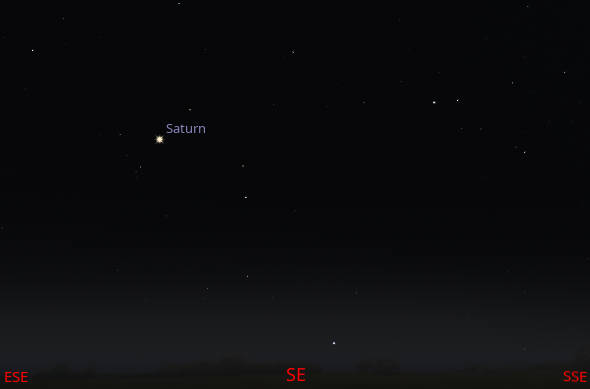
Let’s take our weekly look at the whereabouts of the naked-eye planets. Venus might be spotted in the West southwest only 7° above the horizon at 7:45 PM, 35 minutes after sunset. It will set at 8:30. Saturn will be low in the east-southeast at that time, but you might have to wait another half hour for it to appear. Saturn may look disappointing in telescopes this year since its rings are nearly edge on and appearing as a line through the planet like it’s stapled onto the sky. Jupiter and Mars will be up in the morning sky, with Jupiter rising about 10:30 PM now in the east-northeast and by 7 AM tomorrow, Jupiter will be brighter than the winter stars high in the south. Mars will be left of Jupiter. Comet Tsuchinshan-ATLAS is very low in the east at that hour, but probably too faint to spot.
The astronomical event times given are for the Traverse City/Interlochen area of Michigan (EDT, UT – 4 hours). Times will be different for other locations.
Addendum
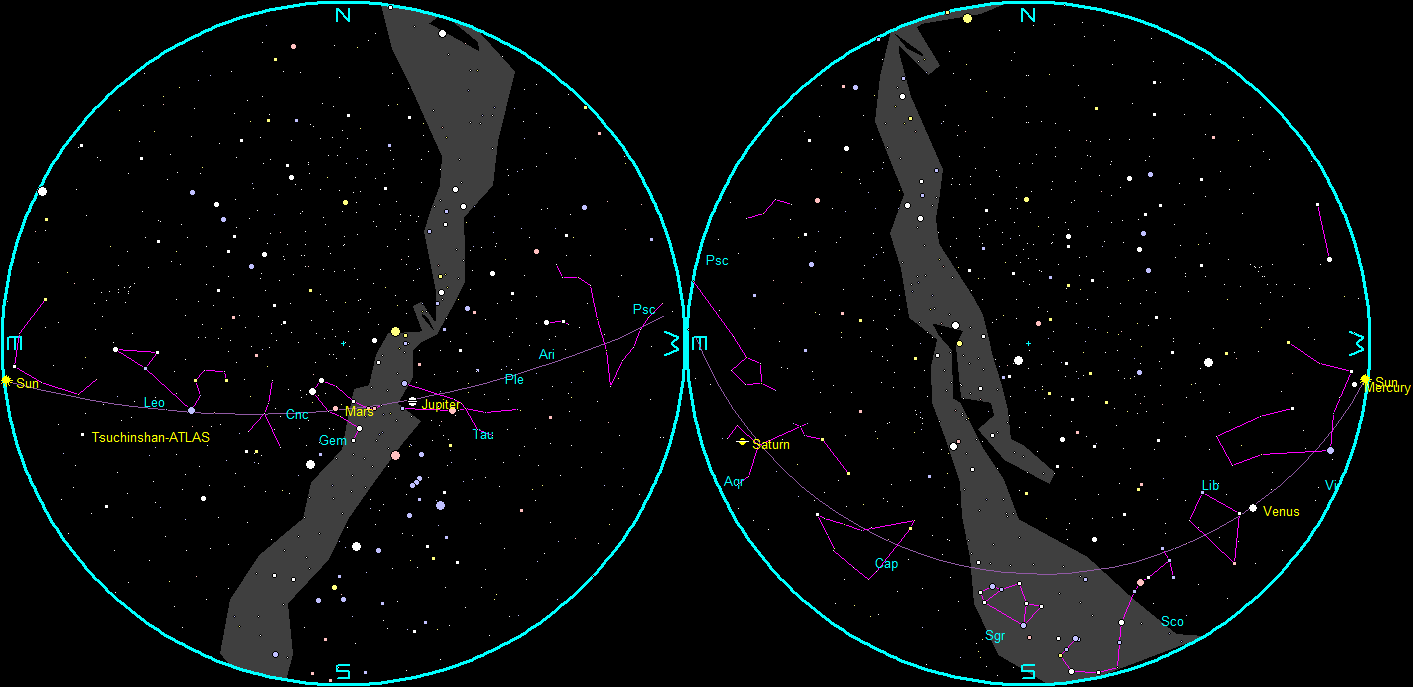
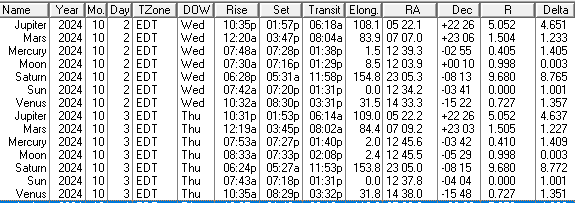
Ephemeris: 10/01/2024 – Previewing the skies of October
This is Ephemeris for Tuesday, October 1st. Today the Sun will be up for 11 hours and 40 minutes, setting at 7:22, and it will rise tomorrow at 7:42. The Moon, 1 day before new, will rise at 7:30 tomorrow morning.
Let’s look at the skies for the month of October. The Sun will still be moving south rapidly. Daylight hours in the Interlochen/Traverse City area and will drop from 11 hours and 40 minutes today to 10 hours, 11 minutes at month’s end. The altitude of the Sun above the southern horizon at local noon will be 42 degrees today, and will descend to 31 degrees on Halloween, also in the Interlochen area. Sunrise times will increase from 7:41 today all the way to 8:20 a.m. in Interlochen and Traverse City on the 31st. Sunset times will decrease from 7:22 p.m. today to 6:32 on Halloween.
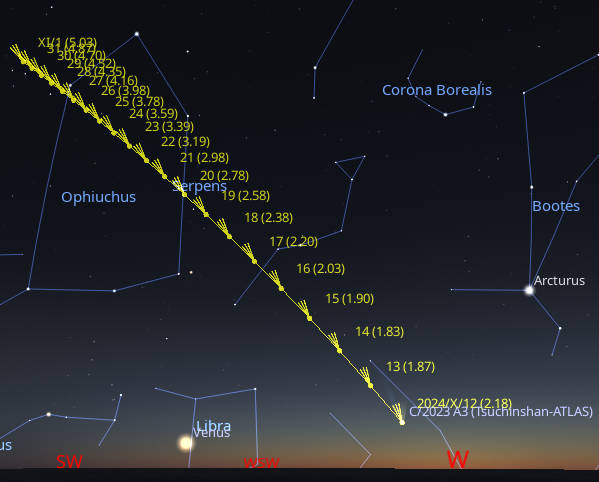
The big event of October will be the appearance of Comet Tsuchinshan-ATLAS in the evening sky which may become quite bright, but being a comet, all bets are off until you actually see it. It will become visible in the evening sky starting October 12th.
The astronomical event times given are for the Traverse City/Interlochen area of Michigan (EDT, UT – 4 hours). Times will be different for other locations.
Addendum
October path of Comet Tsuchinshan-ATLAS
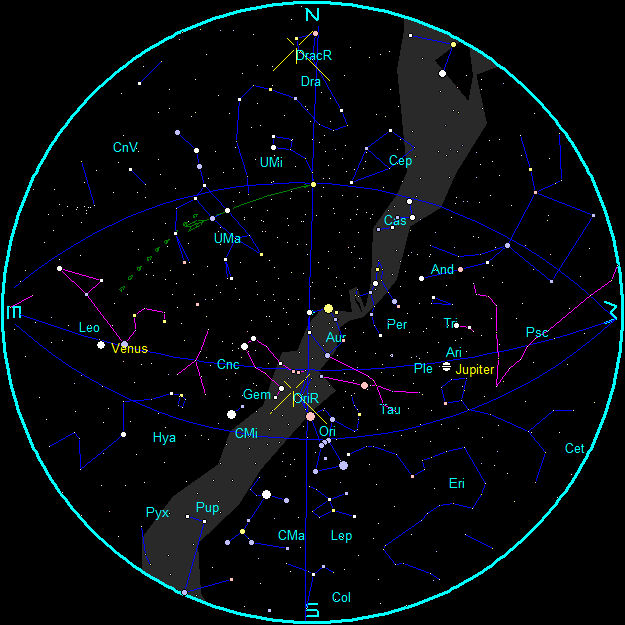
October Evening Star Chart
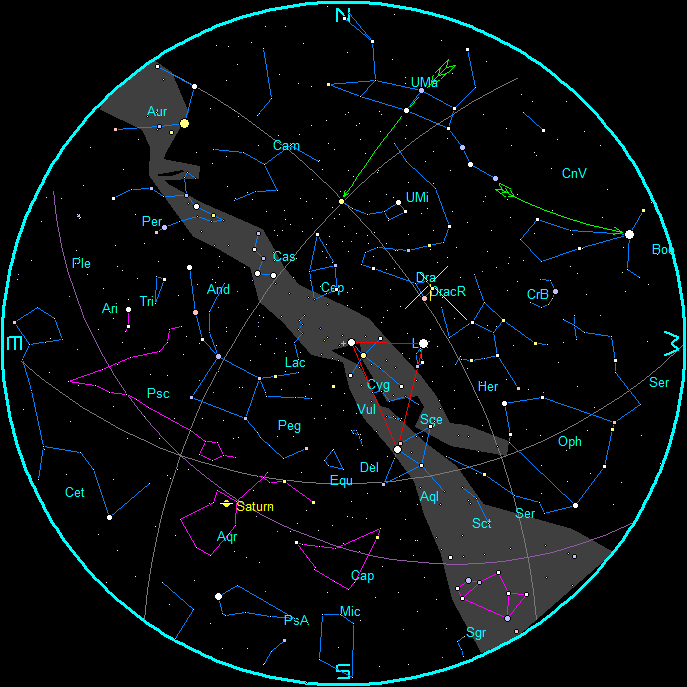
The planets and stars are plotted for the 15th at 9 p.m. EDT in the evening and 6 a.m. for the morning chart. These are the chart times. Note that Traverse City is located approximately 45 minutes behind our time meridian, West 75° longitude. (An hour 45 minutes behind our daylight saving time meridian during EDT). To duplicate the star positions on a planisphere you may have to set it to 1 hour 45 minutes earlier than the current time.
October Morning Star Chart
or a list of constellation names to go with the abbreviations, click here.
- Pointer stars at the front of the bowl of the Big Dipper point to Polaris, the North Star.
- Leaky dipper drips on Leo.
- Follow the arc of the handle of the Big Dipper to the star Arcturus.
- The Summer Triangle is in red.
- DracR – Draconid Radiant – Peaks the 8th – Zenithal Hourly Rate < 10 with rare outbursts of a thousand an hour. It’s hindered this year by the full moon.
- OriR – Orionid Radiant – Peak 21st – Zenithal Hourly Rate = 20
Twilight Limits, Nautical and Astronomical
| EDT | |||||||
| Morning | Twilight | Evening | Twilight | Dark | Night | Moon | |
| Date | Astro. | Nautical | Nautical | Astro. | Start | End | Illum. |
| 2024-10-01 | 6h06m | 6h40m | 20h28m | 21h03m | 21h03m | 6h06m | 0.00 |
| 2024-10-02 | 6h07m | 6h41m | 20h27m | 21h01m | 21h01m | 6h07m | 0.00 |
| 2024-10-03 | 6h08m | 6h42m | 20h25m | 20h59m | 20h59m | 6h08m | 0.02 |
| 2024-10-04 | 6h09m | 6h43m | 20h23m | 20h57m | 20h57m | 6h09m | 0.05 |
| 2024-10-05 | 6h11m | 6h45m | 20h21m | 20h55m | 20h55m | 6h11m | 0.10 |
| 2024-10-06 | 6h12m | 6h46m | 20h19m | 20h53m | 20h53m | 6h12m | 0.17 |
| 2024-10-07 | 6h13m | 6h47m | 20h17m | 20h51m | 21h15m | 6h13m | 0.25 |
| 2024-10-08 | 6h14m | 6h48m | 20h16m | 20h50m | 22h01m | 6h14m | 0.34 |
| 2024-10-09 | 6h16m | 6h50m | 20h14m | 20h48m | 22h58m | 6h16m | 0.44 |
| 2024-10-10 | 6h17m | 6h51m | 20h12m | 20h46m | – | 6h17m | 0.55 |
| 2024-10-11 | 6h18m | 6h52m | 20h10m | 20h44m | 0h06m | 6h18m | 0.65 |
| 2024-10-12 | 6h19m | 6h53m | 20h09m | 20h43m | 1h22m | 6h19m | 0.76 |
| 2024-10-13 | 6h21m | 6h54m | 20h07m | 20h41m | 2h42m | 6h21m | 0.85 |
| 2024-10-14 | 6h22m | 6h56m | 20h05m | 20h39m | 4h03m | 6h22m | 0.92 |
| 2024-10-15 | 6h23m | 6h57m | 20h04m | 20h37m | 5h25m | 6h23m | 0.98 |
| 2024-10-16 | 6h24m | 6h58m | 20h02m | 20h36m | – | – | 1.00 |
| 2024-10-17 | 6h26m | 6h59m | 20h00m | 20h34m | – | – | 0.99 |
| 2024-10-18 | 6h27m | 7h01m | 19h55m | 20h33m | – | – | 0.96 |
| 2024-10-19 | 6h28m | 7h02m | 19h53m | 20h31m | – | – | 0.89 |
| 2024-10-20 | 6h29m | 7h03m | 19h52m | 20h29m | 20h29m | 20h40m | 0.81 |
| 2024-10-21 | 6h31m | 7h04m | 19h50m | 20h28m | 20h28m | 21h36m | 0.72 |
| 2024-10-22 | 6h32m | 7h05m | 19h49m | 20h26m | 20h26m | 22h41m | 0.62 |
| 2024-10-23 | 6h33m | 7h07m | 19h47m | 20h25m | 20h25m | 23h51m | 0.51 |
| 2024-10-24 | 6h34m | 7h08m | 19h46m | 20h23m | 20h23m | – | 0.41 |
| 2024-10-25 | 6h35m | 7h09m | 19h44m | 20h22m | 20h22m | 1h01m | 0.32 |
| 2024-10-26 | 6h37m | 7h10m | 19h43m | 20h21m | 20h21m | 2h10m | 0.23 |
| 2024-10-27 | 6h38m | 7h12m | 19h42m | 20h19m | 20h19m | 3h16m | 0.16 |
| 2024-10-28 | 6h39m | 7h13m | 19h40m | 20h18m | 20h18m | 4h19m | 0.10 |
| 2024-10-29 | 6h40m | 7h14m | 19h39m | 20h17m | 20h17m | 5h22m | 0.05 |
| 2024-10-30 | 6h41m | 7h15m | 19h37m | 20h15m | 20h15m | 6h25m | 0.02 |
| 2024-10-31 | 6h43m | 7h16m | 19h36m | 20h14m | 20h14m | 6h43m | 0.00 |
Twilight calendar was generated using Cartes du Ciel (Sky Charts).
See my blog post: Twilight Zone for the definitions of the different periods of twilight here: https://bobmoler.wordpress.com/2018/09/27/.
NASA Calendar of Planetary Events
Date          Time    Event
Oct  1  Tu            Venus: 31.4° E
     2  We   7:52 am  Moon Descending Node
     2  We   2:46 pm  Annular Solar Eclipse
     2  We   2:49 pm  New Moon
     2  We   3:40 pm  Moon Apogee: 406500 km
     5  Sa   4:26 pm  Moon-Venus: 3.3° N
     7  Mo   2:48 pm  Moon-Antares:  .2° N
     9  We   7:53 am  Moon South Dec.: 28.7° S
    10  Th   2:55 pm  First Quarter
    14  Mo   2:05 pm  Moon-Saturn:  .1° S
    16  We   3:05 am  Moon Ascending Node
    16  We   8:46 pm  Moon Perigee: 357200 km
    17  Th   7:26 am  Full Moon
    18  Fr   7:50 pm  Mars-Pollux: 5.7° S
    19  Sa   3:59 pm  Moon-Pleiades:  .1° S
    21  Mo   1:58 am  Orionid Shower: ZHR = 20
    21  Mo   8:50 pm  Moon North Dec.: 28.7° N
    23  We   1:16 pm  Moon-Pollux: 1.8° N
    23  We   3:55 pm  Moon-Mars: 4.2° S
    24  Th   4:03 am  Last Quarter
    24  Th   1:35 pm  Moon-Beehive: 3.3° S
    25  Fr   7:43 pm  Venus-Antares: 3.1° N
    29  Tu  12:44 pm  Moon Descending Node
    29  Tu   5:50 pm  Moon Apogee: 406200 km
Nov  1  Fr            Venus: 38.2° E
All event times are given for UTC-4 hr: Eastern Daylight Saving Time.
Sky Events Calendar by Fred Espenak and Sumit Dutta (NASA’s GSFC),
http://eclipse.gsfc.nasa.gov/SKYCAL/SKYCAL.html.
If you go to the above site, you can print out a list like the above for the entire year or calendar pages for your time zone.
Sun and Moon Rising and Setting Times
     LU                  Ephemeris of Sky Events for Interlochen/TC
October, 2024    Local time zone: EDT
+-----------------------------------------------------------------------+
| DATE |  SUN     SUN  DAYLIGHT|   TWILIGHT*    |MOON  RISE OR    ILLUM |
|      |  RISE    SET    HOURS |  END    START  |PHASE SET** TIME FRACTN|
+=======================================================================+
|Tue  1| 07:41a  07:22p  11:40 | 08:25p  06:38a |      Rise 07:30a    1%|
|Wed  2| 07:42a  07:20p  11:37 | 08:23p  06:39a |New   Set  07:16p    0%|
|Thu  3| 07:43a  07:18p  11:34 | 08:21p  06:40a |      Set  07:33p    1%|
|Fri  4| 07:45a  07:16p  11:31 | 08:19p  06:42a |      Set  07:51p    4%|
|Sat  5| 07:46a  07:14p  11:28 | 08:17p  06:43a |      Set  08:13p    9%|
+------+-----------------------+----------------+-----------------------+
|Sun  6| 07:47a  07:13p  11:25 | 08:15p  06:44a |      Set  08:40p   15%|
|Mon  7| 07:48a  07:11p  11:22 | 08:14p  06:45a |      Set  09:15p   23%|
|Tue  8| 07:50a  07:09p  11:19 | 08:12p  06:47a |      Set  10:00p   32%|
|Wed  9| 07:51a  07:07p  11:16 | 08:10p  06:48a |      Set  10:57p   42%|
|Thu 10| 07:52a  07:05p  11:13 | 08:08p  06:49a |F Qtr Set  12:05a   52%|
|Fri 11| 07:53a  07:04p  11:10 | 08:07p  06:50a |      Set  01:22a   63%|
|Sat 12| 07:55a  07:02p  11:07 | 08:05p  06:51a |      Set  02:41a   73%|
+------+-----------------------+----------------+-----------------------+
|Sun 13| 07:56a  07:00p  11:04 | 08:03p  06:53a |      Set  04:03a   83%|
|Mon 14| 07:57a  06:58p  11:01 | 08:02p  06:54a |      Set  05:24a   91%|
|Tue 15| 07:58a  06:57p  10:58 | 08:00p  06:55a |      Set  06:47a   97%|
|Wed 16| 08:00a  06:55p  10:55 | 07:58p  06:56a |      Set  08:11a  100%|
|Thu 17| 08:01a  06:53p  10:52 | 07:57p  06:58a |Full  Rise 06:53p  100%|
|Fri 18| 08:02a  06:52p  10:49 | 07:55p  06:59a |      Rise 07:21p   96%|
|Sat 19| 08:04a  06:50p  10:46 | 07:54p  07:00a |      Rise 07:55p   91%|
+------+-----------------------+----------------+-----------------------+
|Sun 20| 08:05a  06:48p  10:43 | 07:52p  07:01a |      Rise 08:40p   83%|
|Mon 21| 08:06a  06:47p  10:40 | 07:50p  07:02a |      Rise 09:35p   74%|
|Tue 22| 08:08a  06:45p  10:37 | 07:49p  07:04a |      Rise 10:40p   64%|
|Wed 23| 08:09a  06:44p  10:34 | 07:47p  07:05a |      Rise 11:50p   53%|
|Thu 24| 08:10a  06:42p  10:31 | 07:46p  07:06a |L Qtr Rise 01:01a   43%|
|Fri 25| 08:12a  06:40p  10:28 | 07:45p  07:07a |      Rise 02:09a   34%|
|Sat 26| 08:13a  06:39p  10:25 | 07:43p  07:09a |      Rise 03:15a   25%|
+------+-----------------------+----------------+-----------------------+
|Sun 27| 08:14a  06:37p  10:23 | 07:42p  07:10a |      Rise 04:19a   17%|
|Mon 28| 08:16a  06:36p  10:20 | 07:40p  07:11a |      Rise 05:22a   11%|
|Tue 29| 08:17a  06:34p  10:17 | 07:39p  07:12a |      Rise 06:24a    6%|
|Wed 30| 08:18a  06:33p  10:14 | 07:38p  07:14a |      Rise 07:28a    2%|
|Thu 31| 08:20a  06:32p  10:11 | 07:36p  07:15a |      Rise 08:34a    0%|
+-----------------------------------------------------------------------+
* Nautical Twilight
** Moonrise or moonset, whichever occurs between sunset and sunrise
Generated using my LookingUp for DOS program.
Ephemeris: 09/27/2024 – Finding Andromeda
This is Ephemeris for Friday, September 27th. Today the Sun will be up for 11 hours and 53 minutes, setting at 7:29, and it will rise tomorrow at 7:37. The Moon, 3 days past last quarter, will rise at 3:11 tomorrow morning.
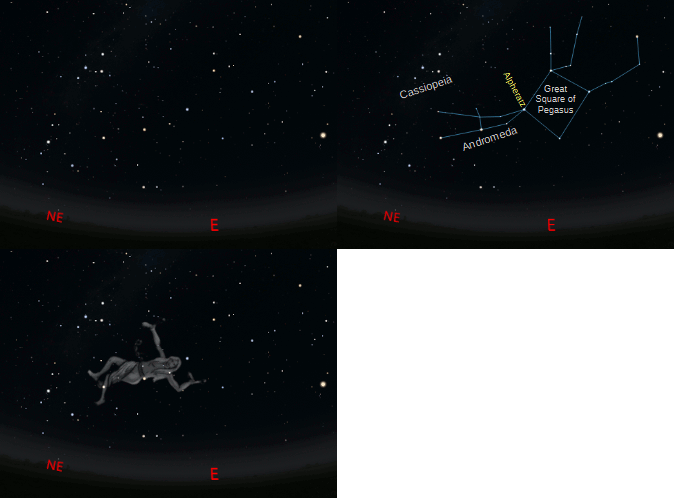
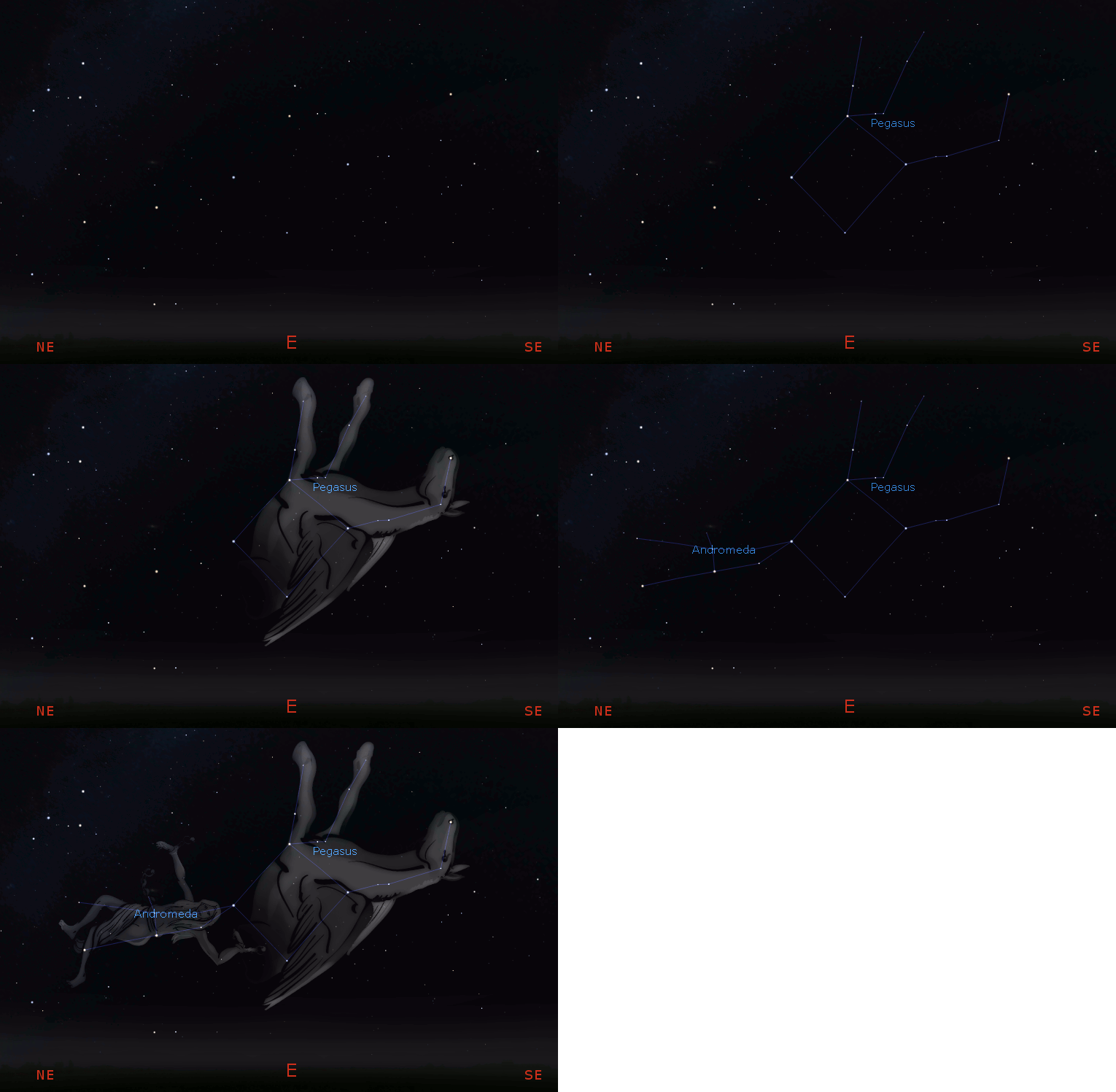
The constellation of Andromeda is famous mainly for the galaxy visible to the naked eye that is contained within it, called the Great Andromeda Galaxy, which is actually visible to the naked eye. Andromeda is found in the east northeast these evenings connected to the Great Square of Pegasus, the square of stars standing on one corner in the east. It shares a star with that square called Alpheratz, the leftmost star, and from that star two curved lines of stars are seen to the left that is the body of Andromeda. She was a Princess and daughter of Queen Cassiopeia, and was fated to be devoured by the monster Cetus. She was saved by the hero Perseus who flew in on his flying horse Pegasus.
The astronomical event times given are for the Traverse City/Interlochen area of Michigan (EDT, UT – 4 hours). Times will be different for other locations.
Addendum
Ephemeris: 09/26/2024 – Finding Cassiopeia the queen
This Ephemeris for Thursday, September 26th. Today the Sun will be up for 11 hours and 56 minutes, setting at 7:31, and it will rise tomorrow at 7:36. The Moon, 2 days past last quarter, will rise at 2:02 tomorrow morning.
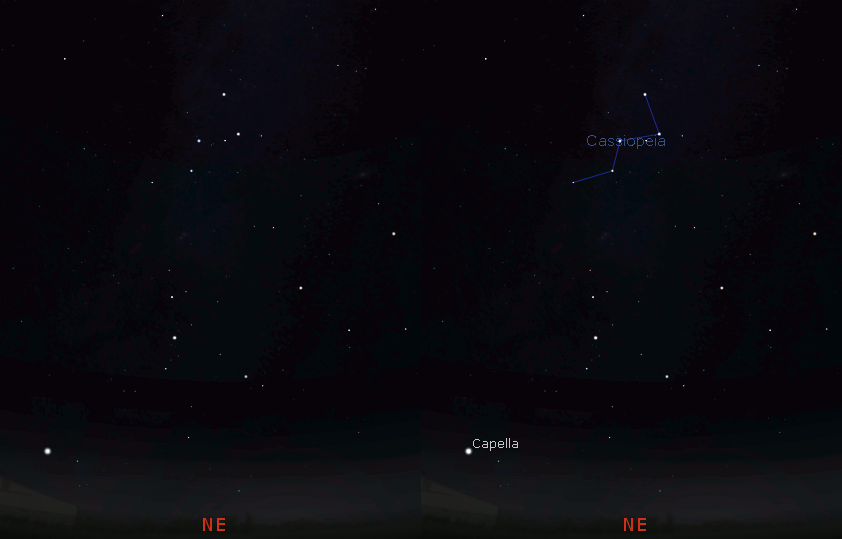
High in the northeast sky at 9:00 PM can be found the constellation of Cassiopeia the queen. Its stars make a letter W in the sky. It is circumpolar, meaning that it never sets, as it appears to move around the North Pole of the sky. In the summer it is a W low in the north. It becomes kind of an open and angular number 3 in the autumn. In the winter it is overhead and looks like an M. In springtime it looks like the Greek capital letter Sigma in the northwest. I will visit Cassiopeia later this autumn and relate her story and other autumn constellations including her daughter Andromeda, husband King Cepheus, future son-in-law Perseus and his horse Pegasus, and the sea monster, Cetus.
The astronomical event times given are for the Traverse City/Interlochen area of Michigan (EDT, UT – 4 hours). Times will be different for other locations.
Addendum
Ephemeris: 09/25/2024 – Looking for the naked-eye planets for this week
This is Ephemeris for Wednesday, September 25th. Today the Sun will be up for 11 hours and 59 minutes, setting at 7:33, and it will rise tomorrow at 7:35. The Moon, 1 day past last quarter, will rise at 12:53 tomorrow morning.
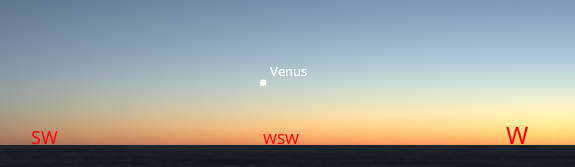
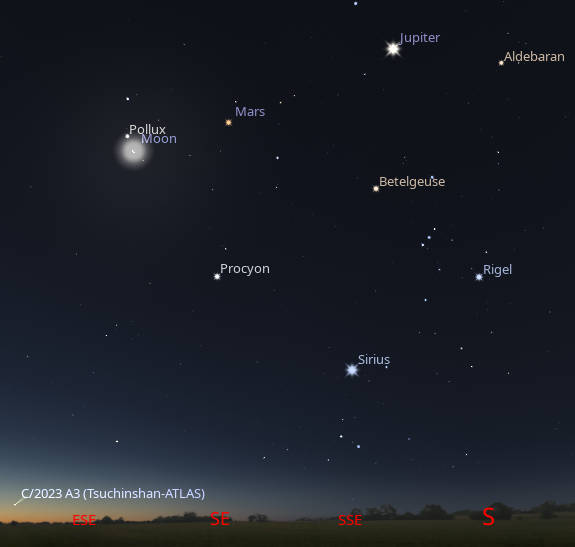
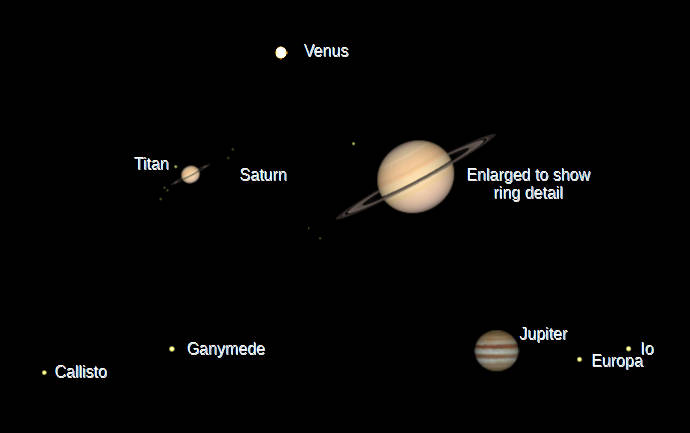
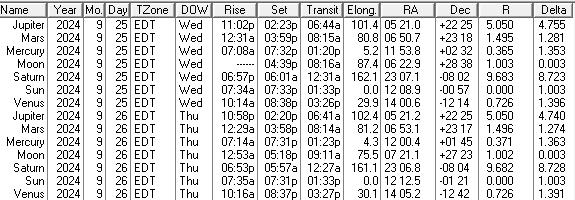
Let’s take our weekly look at the whereabouts of the naked-eye planets. Venus might be spotted in the West southwest only 6° above the horizon at 8 PM, 30 minutes after sunset. It will set at 8:38. Saturn will be low in the east-southeast at that time, but you might have to wait another half hour for it to appear. Saturn may look disappointing in telescopes this year since its rings are nearly edge on and appearing as a line through the planet like it’s stapled onto the sky. Jupiter and Mars will be up in the morning sky, with Jupiter rising about 11 PM now and by 6:30 AM tomorrow, Jupiter will be brighter than the winter stars in the south-southeast. Mars and the Moon will be left and below Jupiter.
The astronomical event times given are for the Traverse City/Interlochen area of Michigan (EDT, UT – 4 hours). Times will be different for other locations.
Addendum
Ephemeris: 09/24/2024 – Pegasus is rising on autumn evenings
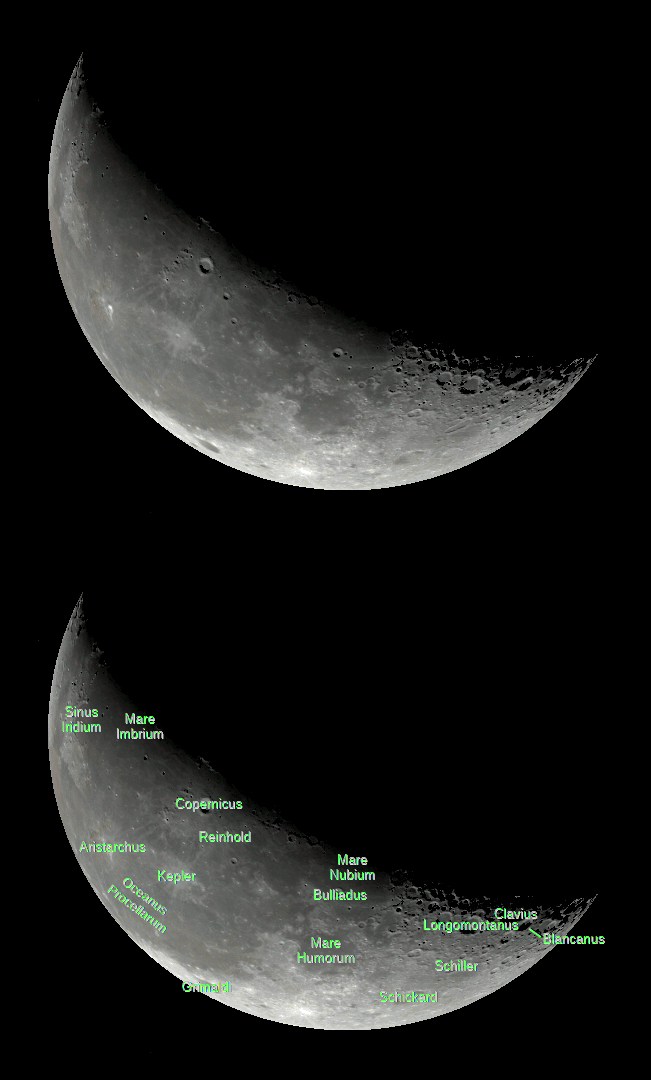
This is Ephemeris for Tuesday, September 24th. Today the Sun will be up for 12 hours and 2 minutes, setting at 7:35, and it will rise tomorrow at 7:34. The Moon, at last quarter today, will rise at 11:47 this evening.
While we’ve been watching the stars and constellations of summer and the Milky Way, the constellations of autumn have been sneaking up on us from the east. About halfway up the sky in the east at 9 PM is one of the greatest constellations of autumn, Pegasus the flying horse. Her body or at least the front part of it is a large square of stars called the Great Square of Pegasus. It is an almost perfect rectangle. However, as she’s rising, it’s standing on one corner. From the upper star are her front legs, from the rightmost star her neck and head extend in the stars. And from the left star of the square are what might look like her hind legs but aren’t. Only half of her body is in the stars. It’s another constellation, Andromeda, which we’ll talk about later.
The astronomical event times given are for the Traverse City/Interlochen area of Michigan (EDT, UT – 4 hours). Times will be different for other locations.
Addendum
 Bob Moler's Ephemeris Blog