Archive
08/05/2016 – Ephemeris – Star party at NMC’s Rogers Observatory tonight
Ephemeris for Friday, August 5th. The Sun rises at 6:34. It’ll be up for 14 hours and 28 minutes, setting at 9:02. The Moon, 3 days past new, will set at 10:31 this evening.
There will be a star party this evening at Northwestern Michigan College’s Rogers Observatory hosted by the Grand Traverse Astronomical Society and the NMC Astronomy Club starting at 9 p.m. On tap, if it’s clear, will be Jupiter and the Moon early, then Mars and Saturn. Mars will appear quite small. As it gets darker the stars will appear. Some will show companion stars, while between the stars, what we call deep sky objects will be seen. Clusters of stars, and nebulae which can be either the birthplaces of stars or markers of dying stars. While other galaxies can be spotted our eyes are dazzled by our galaxy, the Milky Way spanning the sky from northeast to the south, in which these other objects dwell. The months of August and September are the months when the heart of the Milky Way is best seen.
Times are for the Traverse City/Interlochen area of Michigan. They may be different for your location.
Addendum
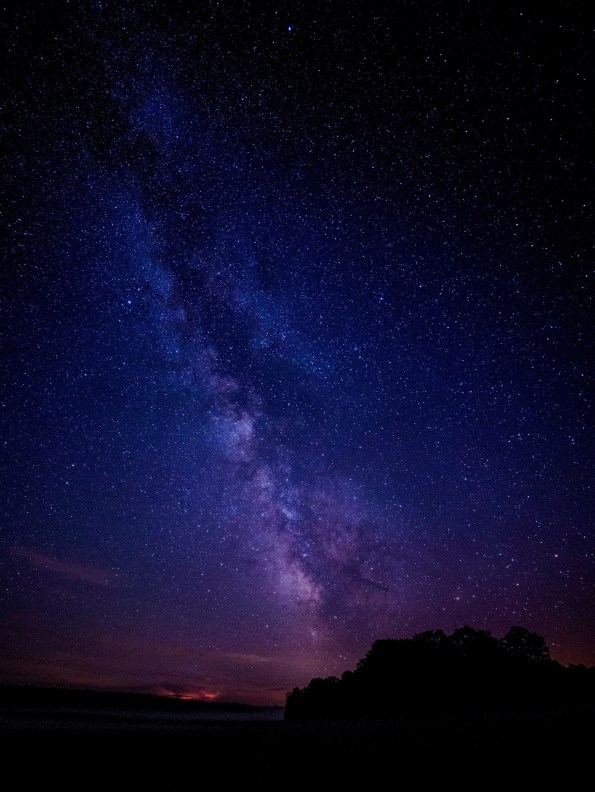
The Milky Way from the Sleeping Bear Dunes last August by Mark Stewart.
This year Saturn and Mars will be in the picture. In this picture Saturn is low and to the right.
08/13/2015 – Ephemeris – The constellation Sagittarius, toward the heart of the Milky Way
Thursday, August 13th. The Sun rises at 6:42. It’ll be up for 14 hours and 9 minutes, setting at 8:52. The Moon, 1 day before new, will rise at 6:48 tomorrow morning.
The Milky Way runs from north to south through the heavens at 11 p.m. You’ll notice that the Milky Way is brighter and broader just above the horizon in the south. In that glow in the south is a star pattern that looks like the stout little teapot of the children’s song, with a the Milky way like steam rising from the spout, which faces the west. This pattern of stars is the major part of the constellation called Sagittarius. According to Greek mythology Sagittarius is a centaur with a bow and arrow poised to shoot Scorpius the scorpion to the right. This centaur is called Chiron, the most learned of the breed, centaurs usually being a rowdy bunch. The center of the pin wheel of our galaxy lies hidden beyond the stars above the spout of the teapot.
Times are for the Traverse City/Interlochen area of Michigan. They may be different for your location.
Addendum
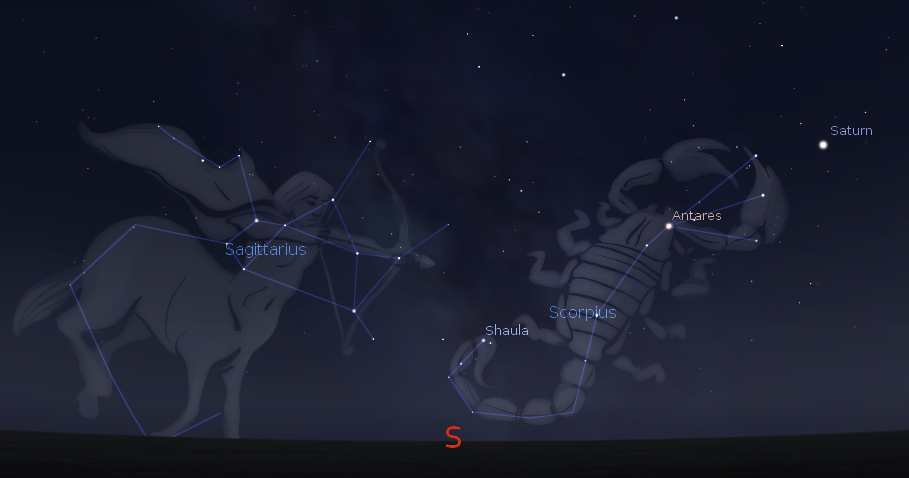
Sagittarius and Scorpius mythological view 10 p.m. August 13, 2015. Created using Stellarium.
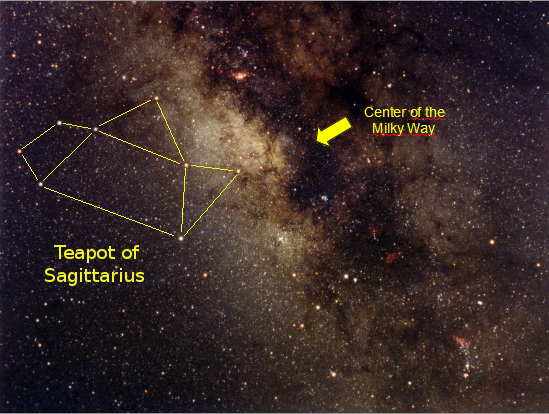
Location of the center of the Milky Way and the Teapot of Sagittarius.
07/03/2015 – Ephemeris – Astronomy in the Grand Traverse Region tonight
Ephemeris for Friday, July 3rd. Today the Sun will be up for 15 hours and 29 minutes, setting at 9:31. The Moon, 2 days past full, will rise at 10:33 this evening and tomorrow the Sun will rise at 6:02.
Dr. David Penney will investigate the structure of the Milky Way at this evening’s meeting of the Grand Traverse Astronomical Society at 8 p.m. at Northwestern Michigan College’s Rogers Observatory. The Milky Way is the band of light we see in the sky especially on summer and winter evenings. But it is more than a band of dim stars, it is what we can see of the huge disk of maybe 200 billion stars with an embedded pin wheel structure. Everyone is welcome. Also at 9 p.m. there will be a star party at the observatory. The astronomical objects of the evening will be the planets Venus, Jupiter and Saturn and the Moon later in the evening. The observatory is located south of Traverse City on Birmley Road.
Times are for the Traverse City/Interlochen area of Michigan. They may be different for your location.
Addendum
Dr. Penney has a Ph.D. in Physiology and Biochemistry, and is pretty much retired spending his time between Michigan in the summer and northern Florida in the winter, where he is a member of several astronomy clubs. He gives many talks there also.
05/08/2015 – Ephemeris – May’s missing Milky Way
Ephemeris for Friday, May 8th. Today the Sun will be up for 14 hours and 32 minutes, setting at 8:55. The Moon, 3 days before last quarter, will rise at 1:08 tomorrow morning. Tomorrow the Sun will rise at 6:22.
In May we look up to the sky and notice that the Milky Way is missing. Will not really it’s as if the sky has pattern baldness with the Milky Way as a fringe on the horizon around the north half of the sky. Overhead, where none should be is a galactic star cluster, a star cluster that should normally be in the Milky band. That cluster is the constellation of Coma Berenices. Its is a sparse star cluster of about 50 stars only 288 light years away. If we were a thousand light years from it, it would appear in the Milky band. One notes too that the stars of spring are also fewer, not the riot of stars we see in the winter or late summer. The Milky Way galaxy is a thin disk, and in spring we are looking out the thin side.
Times are for the Traverse City/Interlochen area of Michigan. They may be different for your location.
Addendum
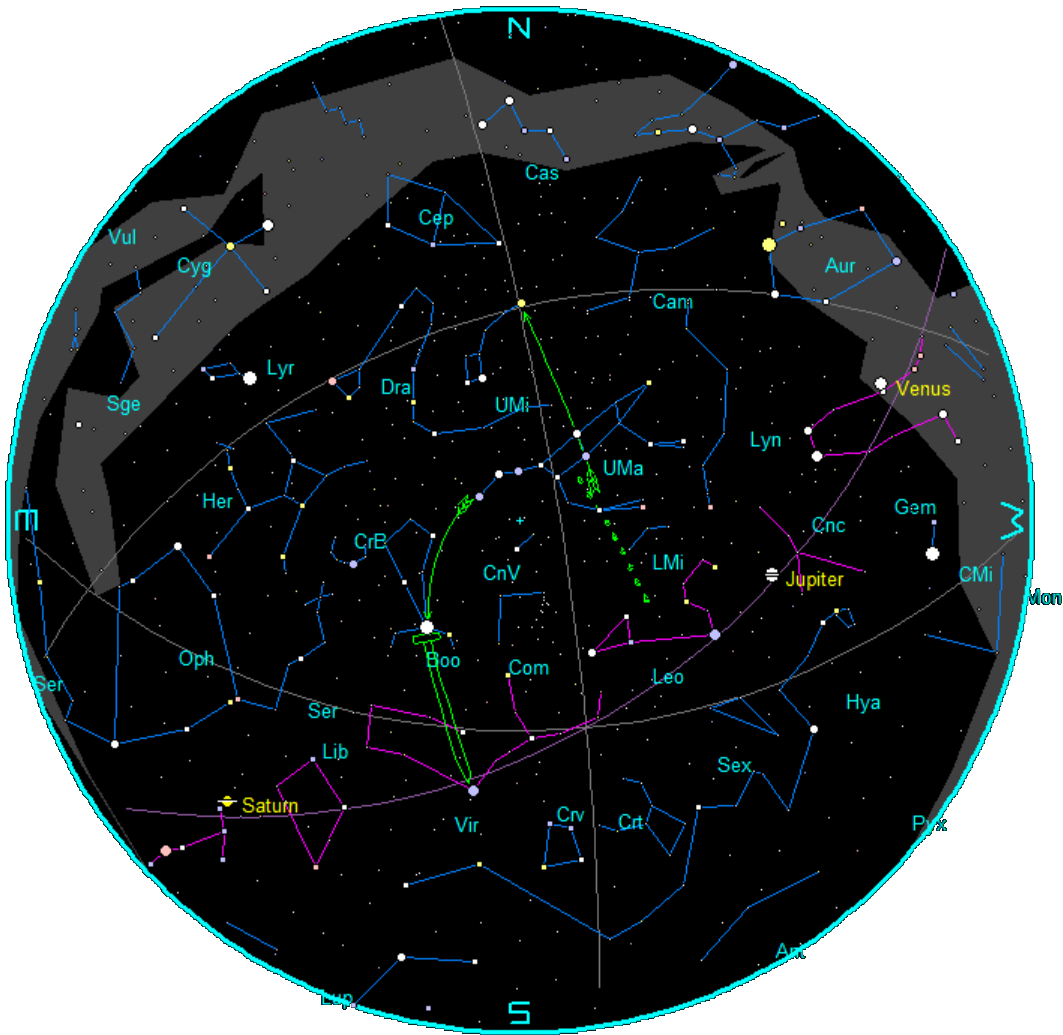
Star Chart for May 2015. Note the Milky way in the north. The Coma Berenices cluster is located between the labels CnV and Com. Created using my LookingUp program.
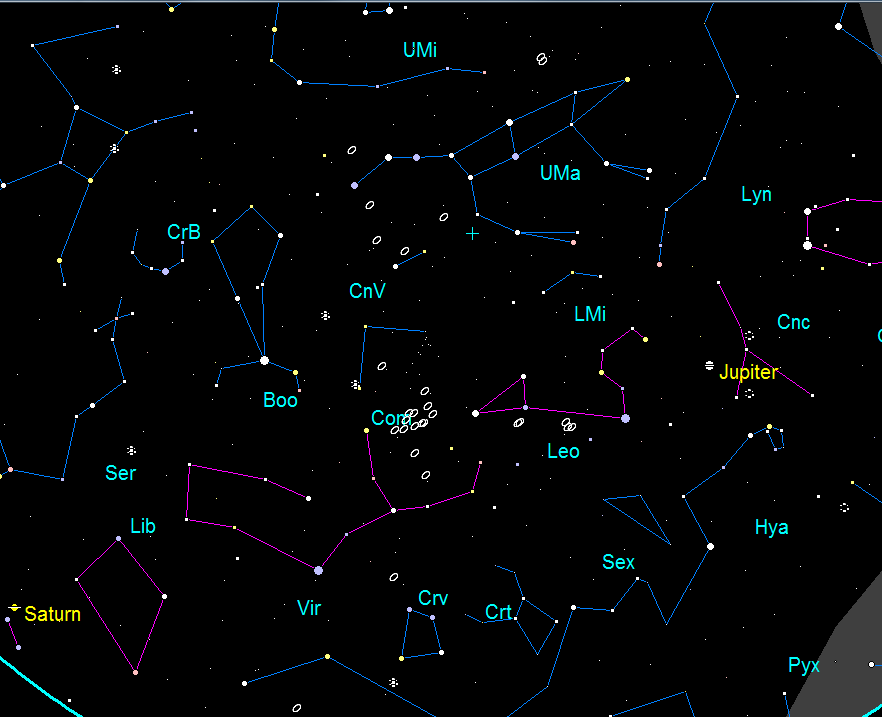
Messier objects, mostly galaxies (ovals) in the spring sky. Created using my LookingUp program.
Most of the galaxies in the above chart belong to the Virgo Cluster a cluster of several thousand galaxies about 53 million light years away. Charles Messier was a comet hunter active in the period around the time of the American Revolution at the Paris Observatory. He made a catalog of fuzzy objects he ran into that didn’t move and thus were not comets. The Messier catalog, which ran to 110 galaxies, star clusters and nebulae, some added posthumously, became a must-see list of some of the best sights for the telescope.
08/26/2014 – Ephemeris – The Great Rift
Ephemeris for Tuesday, August 26th. The sun rises at 6:57. It’ll be up for 13 hours and 31 minutes, setting at 8:29. The moon, 1 day past new, will set at 8:45 this evening.
High overhead the Milky Way is seen passing through the Summer Triangle of three bright stars. Here we find the Milky Way split into two sections. The split starts in the constellation of Cygnus the Swan or Northern Cross very high in the east. The western part of the Milky Way ends southwest of the Aquila the eagle. This dark dividing feature is called the Great Rift. Despite the lack of stars seen there, it doesn’t mean that there are fewer stars there than in the brighter patches of the Milky Way. The rift is a great dark cloud that obscures the light of the stars behind it. Sometimes binoculars can be used to find the edges of the clouds of the rift, as stars numbers drop off suddenly. This is especially easy to see in Aquila.
Times are for the Traverse City/Interlochen area of Michigan. They may be different for your location.
Addendum
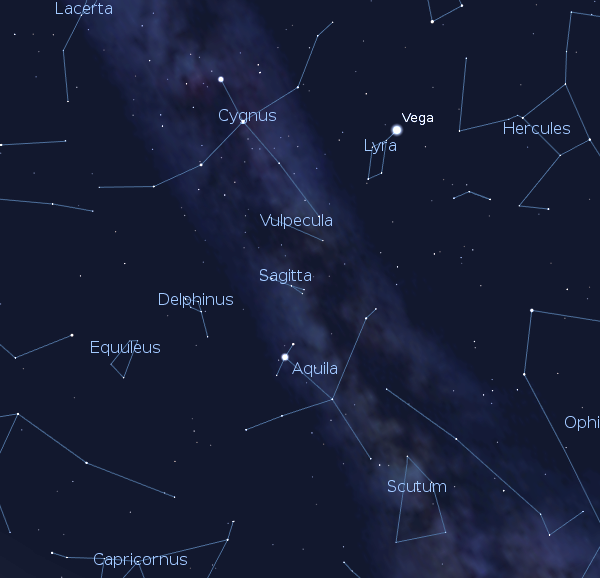
The Great Rift in the Milky Way. Created using Stellarium.
08/14/2014 – Ephemeris – The Milky Way now spans the sky in the evening
Ephemeris for Thursday, August 14th. The sun rises at 6:43. It’ll be up for 14 hours and 5 minutes, setting at 8:49. The moon, 3 days before last quarter, will rise at 10:58 this evening.
We’ll get a bit of darkness tonight, but it will be the start of about two weeks of the best sky viewing of the year. Now is the time the summer Milky Way is displayed to its fullest to the southern horizon. City folk come to our area and are sometimes fooled by the brightness and expanse of the Milky Way and think it’s clouding up. Yes those are clouds indeed, but they are star clouds. Binoculars will begin to show them to be millions of stars, each too faint to be seen by themselves to the unaided eye, but whose combined glow give the impression of a luminous cloud. Binoculars are the ideal tool to begin to explore the Milky Way. Objects still too fuzzy can be checked out with a telescope to reveal their true nature.
Times are for the Traverse City/Interlochen area of Michigan. They may be different for your location.
Addendum
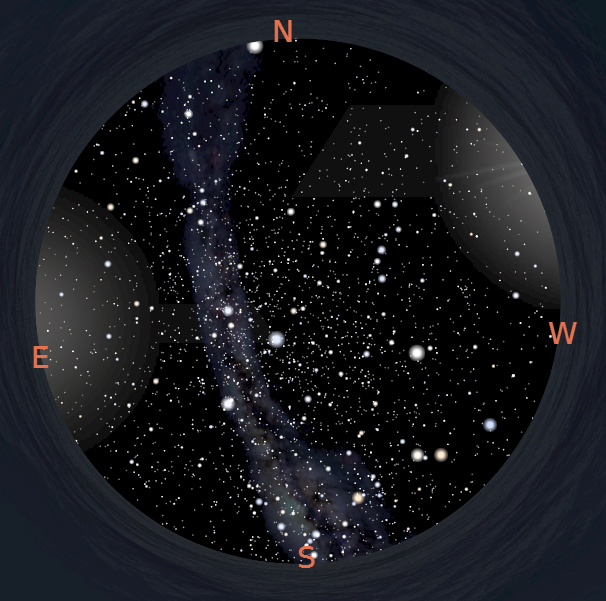
The Milky Way at 10 p.m. on August 14, 2014. Residual glow in the west is from the Sun, to the east is for the Soon to rise Moon. There is also an odd artifact connected to the solar glow. Created using Stellarium.
09/26/2013 – Ephemeris – The Milky Way is crossing overhead
Ephemeris for Thursday, September 26th. The sun will rise at 7:34. It’ll be up for 11 hours and 57 minutes, setting at 7:31. The moon, at last quarter today, will rise at 12:17 tomorrow morning. | At 10 this evening the Milky Way will pass directly overhead. The bright star Deneb of the Summer Triangle and at the head of the Northern Cross is directly overhead at that time. Deneb is incidentally the tail of Cygnus the swan. The Milky Way stretches from the northeast to the southwest where the Teapot of Sagittarius is tipping, pouring out its tea on the horizon. The Milky Way can be enjoyed with the naked eye, binoculars or telescope. With the naked eye, we see it as the pre-scientific cultures did. The Milky way was a pathway of milk, the path that the American Indian warriors journeyed to the hereafter, the stars their camp fires shining in the night. In reality it is what we can see of our galaxy.
Times are for the Traverse City/Interlochen area of Michigan. They may be different for your location.
Addendum
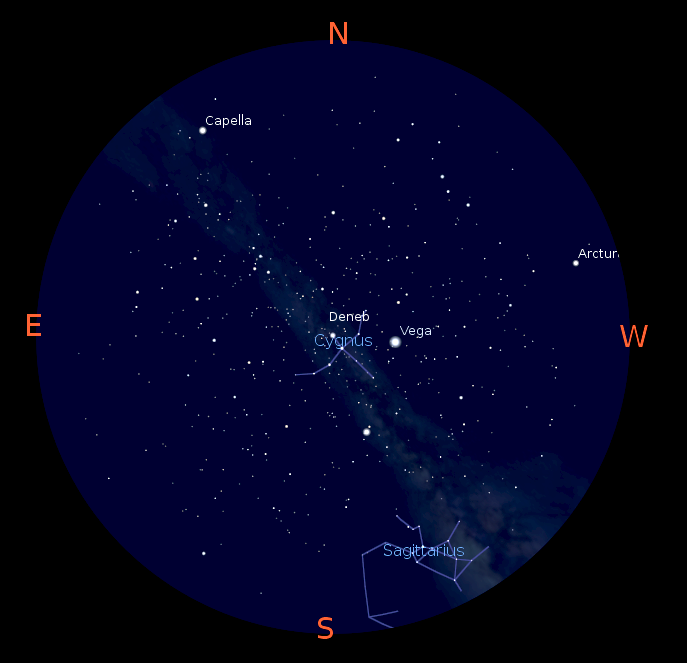
The Milky Way crosses the sky overhead at 10 p.m., September 26, 2013. Horizon to horizon view. Created using Stellarium.
09/02/2013 – Ephemeris – The Milky Way’s Great Rift
Ephemeris for Labor Day, Monday, September 2nd. The sun will rise at 7:06. It’ll be up for 13 hours and 10 minutes, setting at 8:16. The moon, 3 days before new, will rise at 5:19 tomorrow morning.
High overhead the Milky Way is seen passing through the Summer Triangle of three bright stars. Here we find the Milky Way split into two sections. The split starts in the constellation of Cygnus the Swan or Northern Cross very high in the east. The western branch of the Milky Way ends in the south. The dark dividing feature is called the Great Rift. Despite the lack of stars seen there, it doesn’t mean that there are fewer stars there than in the brighter patches of the Milky Way. The rift is a number of overlapping clouds of dust and gas about 300 light years away that obscure the light of the stars behind them. Sometimes binoculars can be used to find the edges of the clouds of the rift, as stars numbers drop off suddenly. This is especially easily seen in the constellation of Aquila.
Times are for the Traverse City/Interlochen area of Michigan. They may be different for your location.
Addendum
The Great Rift in the Milky Way. Created using Stellarium.
08/08/2013 – Ephemeris – The wonders located in Scutum the shield
Ephemeris for Thursday, August 8th. The sun rises at 6:37. It’ll be up for 14 hours and 20 minutes, setting at 8:58. The moon, 2 days past new, will set at 9:28 this evening.
The teapot pattern of stars that is the constellation of Sagittarius lies at the southern end of the Milky Way this evening. It appears that the Milky Way is steam rising from the spout. The area above Sagittarius in the brightest part of the Milky Way is the dim constellation of Scutum the shield. Don’t bother looking for the stars that make up the constellation; what’s important is the star clouds of the Milky Way. Scan this area with binoculars or small telescope for star clusters and nebulae or clouds of gas. In binoculars both clusters and nebulae will appear fuzzy, but a small telescope will tell most of them apart. Even if you’ve never been able to find anything in your telescope, put on the lowest power eyepiece you have and scan back and forth for these wonders.
Times are for the Traverse City/Interlochen area of Michigan. They may be different for your location.
Addendum
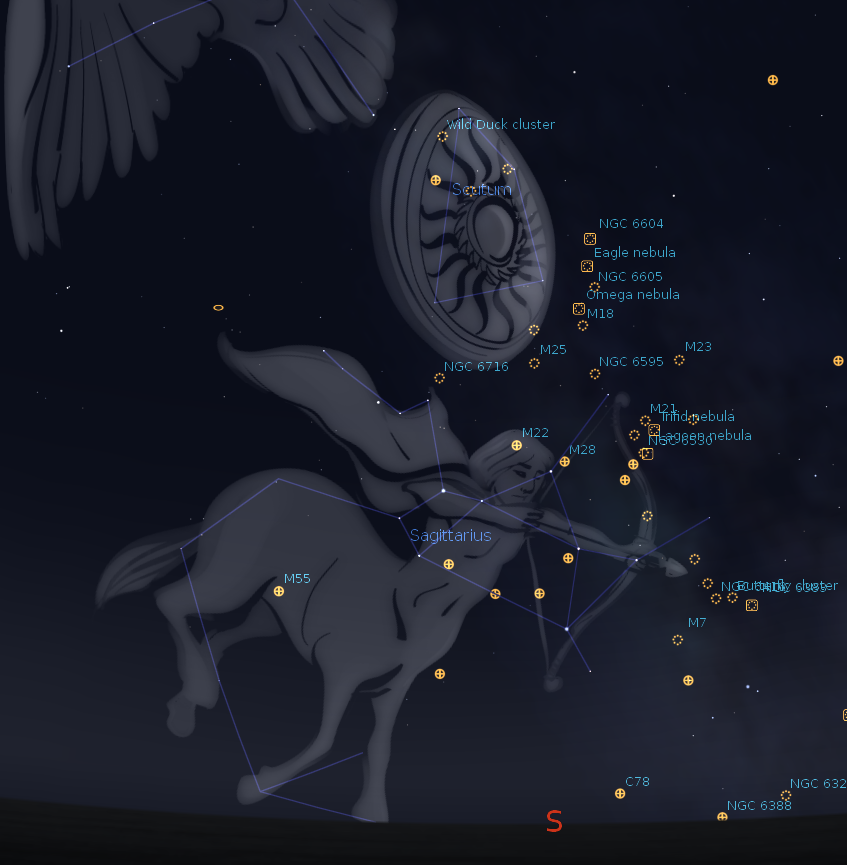
Binocular and telescope deep sky objects in Scutum and Sagittarius. Created using Stellarium.
The symbols mean:
Circle with embedded cross – Globular star cluster (Very old compact star cluster)
Open dotted circle – Open or galactic star cluster (Young loose star cluster)
Square – Nebula (Here emission nebulae. In many cases with associated open clusters)
Ellipse – Galaxy
06/11/2013 – Ephemeris – The Milky Way rising
Ephemeris for Tuesday, June 11th. Today the sun will be up for 15 hours and 30 minutes, setting at 9:27. The moon, 3 days past new, will set at 11:24 this evening. Tomorrow the sun will rise at 5:56.
Last Saturday night at the Sleeping Bear Dunes star party, at the end of the official star party after 11 we were looking to the east. The only blemish to the dark skies was the light pollution dome of Traverse City to the east. Rising out of that yellowish haze and barely visible was the Milky Way. In the spring skies the Milky way almost rings the horizon. The only portion visible is low in the north, too close to the horizon to be really visible. Now that spring is almost over , we are transitioning at the end of twilight to the summer stars and the brilliant Milky Way of summer is rising in the east. By August it will run across the sky from northeast to the south, revealing in the south the bulge of the galactic center.
Times are for the Traverse City/Interlochen area of Michigan. They may be different for your location.
Addendum
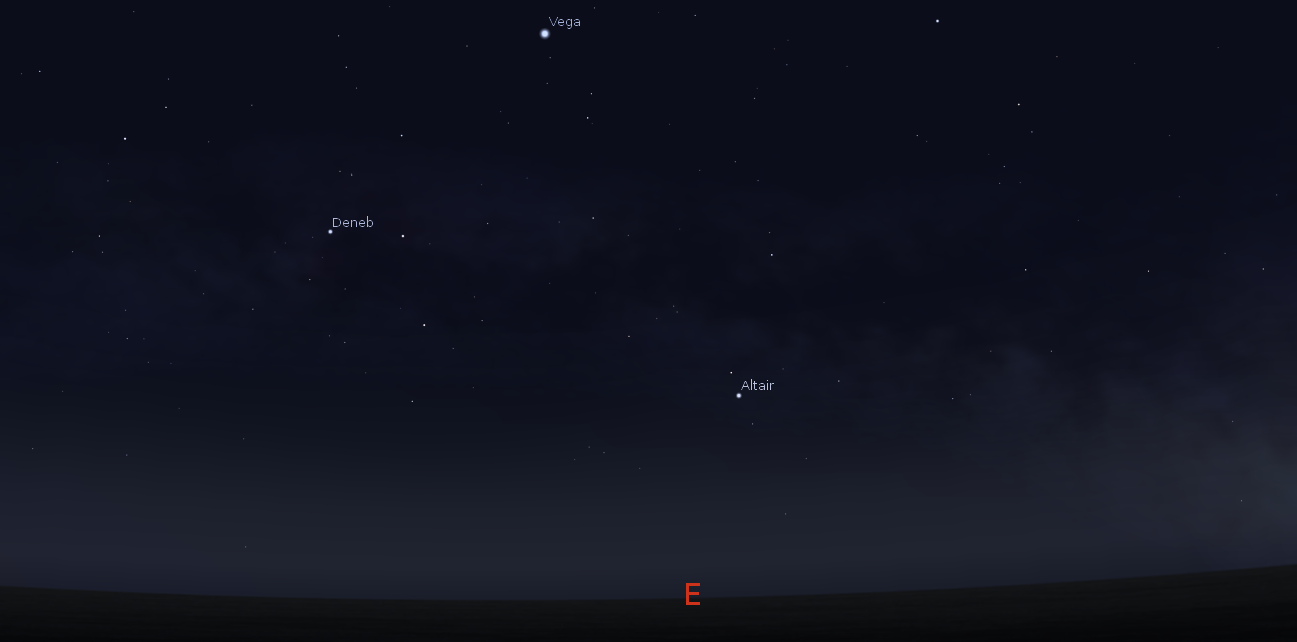
The Milky Way Rising at 11:15 p.m. on June 11, 2013. Created using Stellarium.
The three named stars are those of the Summer Triangle.
 Bob Moler's Ephemeris Blog