Archive
08/22/11 – Ephemeris – The constellation Sagittarius
Monday, August 22nd. The sun rises at 6:52. It’ll be up for 13 hours and 44 minutes, setting at 8:36. The moon, 1 day past last quarter, will rise at 12:50 tomorrow morning.
The Milky Way runs from north to south through the heavens at 11 p.m. You’ll notice that the Milky Way is brighter and broader just above the horizon in the south. In that glow in the south is a star pattern that looks like a stout little teapot, with a the Milky way like steam rising from the spout, which faces the west. This pattern of stars is the major part of the constellation called Sagittarius. According to Greek mythology Sagittarius is a centaur with a bow and arrow poised to shoot Scorpius the scorpion to the right. This centaur is called Chiron, the most learned of the breed, centaurs usually being a rowdy bunch. The center of the pinwheel of our galaxy lies hidden beyond the stars above the spout of the teapot.
* Times are for the Traverse City/Interlochen area of Michigan. They may be different for your location.
Addendum
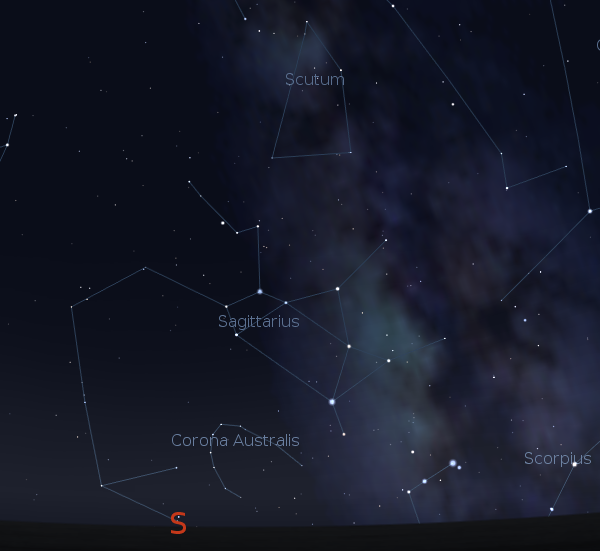
The constellations Sagittarius and Scutum. Created using Stellarium.
07/26/11 – Ephemeris – The Milky Way
Tuesday, July 26th. The sun rises at 6:22. It’ll be up for 14 hours and 53 minutes, setting at 9:15. The moon, 3 days past last quarter, will rise at 3:01 tomorrow morning.
The Milky Way, which is rising to pass overhead later in the evening is what we see of a huge structure of stars of which we are a part. We call it the Milky Way galaxy. It’s a spiral galaxy with a straight bar of stars through the center, a barred spiral galaxy about a hundred thousand light years across. It’s part of a small cluster of galaxies called the Local Group. Besides these three dozen galaxies, the Milky Way has small satellite galaxies orbiting it. The largest of these are the two Magellanic clouds seen from the southern hemisphere of earth. Even now a tiny galaxy is colliding with our galaxy. We can penetrate to the center of our own galaxy in infrared light, but not visible light from our location 26,000 light years away.
* Times are for the Traverse City/Interlochen area of Michigan. They may be different for your location.
Addendum

The Milky Way 360 degrees - Wikipedia
This is a mosaic of photographs showing the Milky Way as seen from the earth. The summer Milky Way we see is from just right of center to the left edge.

