Archive
03/24/11 – Ephemeris – The constellation Leo
Thursday, March 24th. The sun will rise at 7:38. It’ll be up for 12 hours and 20 minutes, setting at 7:59. The moon, 2 days before last quarter, will rise at 2:29 tomorrow morning
Besides the advancing sunset times and warming temperatures, there’s another sign that spring is here. That’s the appearance of the constellation Leo the lion high in the southeast in the evening. The front of this beast is a backward question mark of stars with the bright star Regulus as the dot at the bottom. That’s his head, mane and chest. His haunches are a triangle of stars to the left, ending with the bright star Denebola. A way to find Leo is to remember that cat’s aren’t supposed to like water. Find the Big Dipper high in the northeast and imagine drilling a hole in the bottom of the bowl. The water will fall on Leo’s back. Also you’ll notice the stars of spring to the east are more sparse than those of winter to the west.
* Times are for the Traverse City/Interlochen area of Michigan. They may be different for your location.
Addendum
This is Tuesday’s image, showing how to locate Leo.
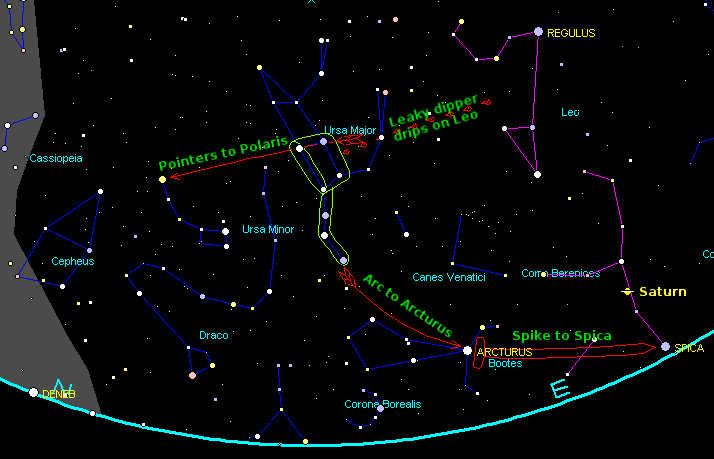
The Big Dipper points to other stars and constellations. Created using my own LookingUp program.
03/23/11 – Ephemeris – The bright planets this week
Wednesday, March 23rd. The sun will rise at 7:40. It’ll be up for 12 hours and 17 minutes, setting at 7:58. The moon, 3 days before last quarter, will rise at 1:28 tomorrow morning.
It’s Wednesday and time again to take a look at the whereabouts of the bright planets for this week. We are losing Jupiter low in the twilight It will set at 8:48 p.m. Now Mercury is actually easier to spot. Higher than Jupiter, it will be visible in twilight and will set at 9:39. My usual rule of thumb about spotting Mercury is that it will be easiest to spot about 45 minutes after sunset, which will be about 8:40 p.m.. The ringed planet Saturn will rise at 8:47 p.m. in the east southeast and will move due south at 2:36 a.m. In telescopes Saturn shows its rings which are a year and a half along their seven and a half year opening. Venus is brilliant in the morning sky and will rise at 6:22 a.m. in the east southeast. It is really a beautiful sight in the morning twilight.
* Times are for the Traverse City/Interlochen area of Michigan. They may be different for your location.
* Times are for the Traverse City/Interlochen area of Michigan. They may be different for your location.
03/22/11 – Ephemeris – The Big Dipper
Tuesday, March 22nd. The sun will rise at 7:42. It’ll be up for 12 hours and 14 minutes, setting at 7:57. The moon, 3 days past full, will rise at 12:17 tomorrow morning
We are a few days into spring. And while the winter constellation of Orion and its cohorts hold forth in the southwestern sky the Big Dipper is sneaking up in the northeast. At 9 p.m. the Big Dipper is standing on the tip of its handle in the northeastern sky. The stars at the front of the bowl are at the top of Big Dipper now. An imaginary line through them to the lower left will point to Polaris the North Star. The Big Dipper never sets for us, in the north country. It scrapes the northern horizon on autumn evenings, climbs the northeastern sky in the winter, is overhead, in spring, and descends in the northwest in summer. The Big Dipper points to, well it leaks on Leo the Lion. The bright star Arcturus, now rising in the east is found by following the curve of the handle.
* Times are for the Traverse City/Interlochen area of Michigan. They may be different for your location.
Addendum
The Big Dipper points to other stars and constellations. Created using my own LookingUp program. Click on the image to enlarge.
03/21/11 – Ephemeris – The constallation of Hydra
Monday, March 21st. The sun will rise at 7:44. It’ll be up for 12 hours and 11 minutes, setting at 7:55. The moon, 2 days past full, will rise at 11:00 this evening.
In the south and southeastern sky at 10 p.m. can be found the constellation of Hydra the water snake. Unlike the monster of the same name this Hydra has but one head, which is its most distinctive part. At 10 p.m. look to the south. The head of Hydra is located below a line from the constellation Leo the Lion in the southeast and Gemini high in the south. Hydra’s head is a small but distinctive group of 6 stars that make a drooping loop to the right. The rest of Hydra wends its way to the southeastern horizon, and eventually ends near the spring and summer transitional constellation of Libra the scales. Over the next few months Hydra will slither across the southern skies.
* Times are for the Traverse City/Interlochen area of Michigan. They may be different for your location.
Addendum
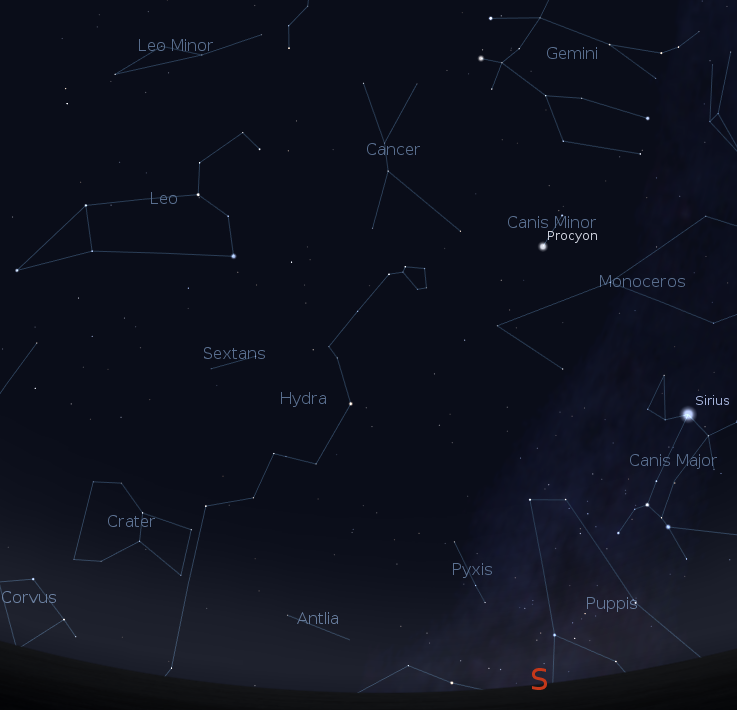
Hydra Rising. Created using Stellarium a free planetarium program.
03/16/11 – Ephemeris – The bright planets this week
Ephemeris for Wednesday, March 16th. The sun will rise at 7:53. It’ll be up for 11 hours and 56 minutes, setting at 7:49. The moon, 3 days before full, will set at 6:19 tomorrow morning.
It’s Wednesday and time again to take a look at the whereabouts of the bright planets for this week. If the weather cooperates tonight we might get a glimpse of Mercury just above Jupiter low in the west shortly after sunset. Jupiter is the brighter of the two and will set first at 9:07, with Mercury following at 9:18. The best time to view them will be about 8:30 or so. The ringed planet Saturn will rise at 9:17 p.m. in the east southeast and will move due south at 3:05 a.m. In telescopes Saturn shows its rings which are a year and a half along their seven and a half year opening. Venus is brilliant in the morning sky and will rise at 6:27 a.m. in the east southeast. It is really a beautiful sight in the morning twilight.
* Times are for the Traverse City/Interlochen area of Michigan. They may be different for your location.
Addendum
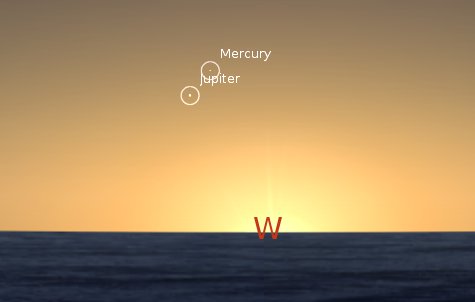
Jupiter-Mercury Conjunction March 16, 2011. Created using Stellaruim.
03/15/11 – Ephemeris – The Lunar Highlands
Ephemeris for Tuesday, March 15th. The sun will rise at 7:55. It’ll be up for 11 hours and 52 minutes, setting at 7:48. The moon, half way from first quarter to full, will set at 5:48 tomorrow morning.
The south part of the moon that can be seen tonight appears brighter than the darker areas that we call seas, that make up the face of the man in the moon. These and other bright areas are called the lunar highlands, and are the most primitive surface of the moon. Here the landscape is saturated with craters. In binoculars the crater Tycho with its rays are just beginning to become prominent. These rays, are thought to be small craterlets caused by the ejecta from the creation of Tycho which occurred perhaps less than 1.1 billion years ago. This makes Tycho a relatively fresh crater in the moon’s nearly 4.5 billion year history. A telescope will reveal more, including the large crater Clavius with its arc of smaller craters within.
* Times are for the Traverse City/Interlochen area of Michigan. They may be different for your location.
03/14/11 – Ephemeris – The Lunar Jura Mountains
Ephemeris for Monday, March 14th. The sun will rise at 7:57. It’ll be up for 11 hours and 49 minutes, setting at 7:46. The moon, 3 days past first quarter, will set at 5:13 tomorrow morning.
On the moon tonight the gibbous phase and the terminator on the left side of the moon is revealing a large semi circular mountain range called the Jura Mountains that encloses a flat lava plain that looks like a bay in the margin of the Sea of Showers or Mare Imbrium. It is easily visible in binoculars this evening when the sunrise line is crossing the bay. The Jura Mountains will appear as a hook out of the upper left edge of the moon. That’s about the coolest sight that’s visible on the moon that can be seen with binoculars. It’s especially striking if seen in a small telescope. I’ve added these programs to my web log or blog and I can add images to illustrate what I’m talking about, as I did today. The blog’s address is bobmoler.wordpress.com.
* Times are for the Traverse City/Interlochen area of Michigan. They may be different for your location.
Addendum
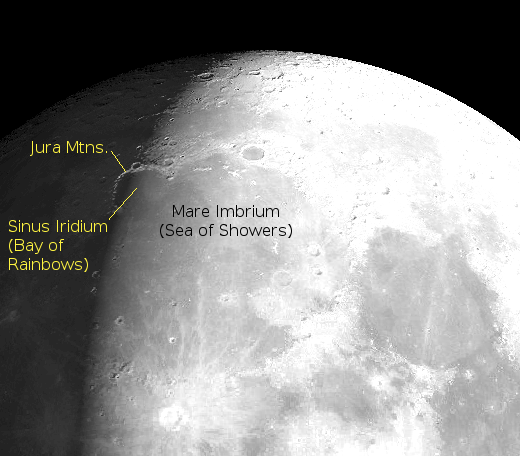
The Jura Mountains sticking up into morning daylight. Created from the Virtual Moon Atlas.
03/10/11 – Ephemeris – The moon will appear near the Pleiades tonight
Thursday, March 10th. The sun will rise at 7:04. It’ll be up for 11 hours and 37 minutes, setting at 6:41. The moon, 2 days before first quarter, will set at 12:54 tomorrow morning.
The fat crescent moon tonight will be near the Pleiades or Seven Sisters star cluster. The Pleiades can be seen above the moon. They will make a very beautiful sight in binoculars. They will be closest together near 2 in the morning. Some years the moon will even pass in front of the stars of the Pleiades. On the moon itself tonight, in binoculars, we can see the dark lunar seas of Crises, Fertility, Nectar, and Tranquility. With a telescope the crater Theophilus is visible near the terminator, the sunrise line a bit below center of the moon. It is a perfect circular crater with a central peak. The best crater visible now. That will change as the moons phase becomes fuller. It will appear washed out and indistinct. The moon needs shadows to delineate its features.
* Times are for the Traverse City/Interlochen area of Michigan. They may be different for your location.
Blog addendum:
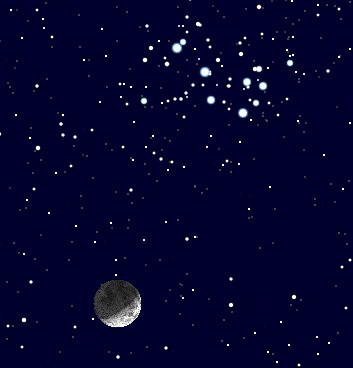
Pleiades and the moon 03/10/11, created using Cartes du Ciel.
Here’s a closer look at the moon courtesy of Virtual Moon Atlas.
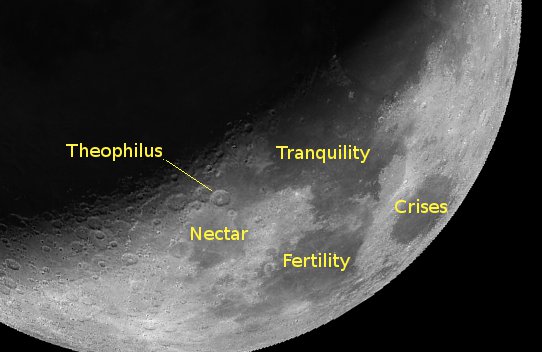
Young moon with the crater Theophilus and four seas. From Virtual Moon Atlas
03/08/11 – Ephemeris – The lunar sea of Crises
Fat Tuesday, March 8th. The sun will rise at 7:08. It’ll be up for 11 hours and 31 minutes, setting at 6:39. The moon, half way from new to first quarter, will set at 10:51 this evening.
The one feature that is prominent on the crescent moon tonight will be the dark sea Mare Crisium or sea of Crises. It appears easily in binoculars. It, as all the lunar seas, are really a large crater that was created about 3.85 billion years ago by an asteroid strike. It appears foreshortened because it’s near the moon’s limb. If you watched the proximity of Mare Crisium to the edge of the moon over time, you’d notice that sometimes it’s closer to the edge than at other times. The moon has a constant rotation, but its orbit isn’t circular, so the moon appears to rock back and forth slowly, and nods a bit too. The effect is called libration, and allows us to see 60% of the moon from earth.
* Times are for the Traverse City/Interlochen area of Michigan. They may be different for your location.
Blog Addendum:
Below is an image from Virtual Moon Atlas pointing out Mare Crisium, the Sea of Crises. VMA is a free program. See the links for free programs on this blog.
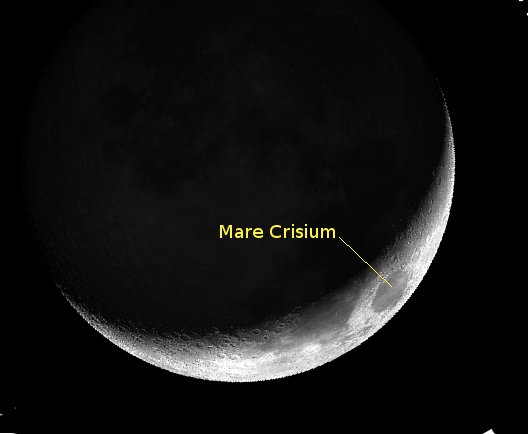
Mare Crisium via Virtual Moon Atlas
02/22/11 – Ephemeris – The star Sirius and the star cluster M41
Tuesday, February 22nd. The sun will rise at 7:32. It’ll be up for 10 hours and 48 minutes, setting at 6:20. The moon, 2 days before last quarter, will rise at 12:24 tomorrow morning.
The brightest night time star Sirius is just about due south at 9 p.m. Otherwise Sirius can be found by following the three bright stars of Orion’s belt higher in the south southwest down to Sirius. In binoculars Sirius is a dazzling blue-white diamond. While officially pure white, Sirius has an arc light blue tinge. After checking out Sirius in binoculars shift your view one binocular field down and you will come to a beautiful field of faint stars. This is M41, number 41 on comet hunter Charles Messier’s list of fuzzy objects that weren’t comets. Binoculars may see up to 25 stars, telescopes even more. You might even be able to spot it with the unaided eye. It’s a whopping 2,300 light years away.
* Times are for the Traverse City/Interlochen area of Michigan. They may be different for your location.

