Archive
05/18/11 – Ephemeris – The bright planets visible this week
Wednesday, May 18th. Today the sun will be up for 14 hours and 55 minutes, setting at 9:06. The moon, 1 day past full, will rise at 10:54 this evening. Tomorrow the sun will rise at 6:10.
It’s Wednesday and time again to take a look at the whereabouts of the bright planets. The ringed planet Saturn will be visible in the south southeast as it gets dark. It’s near the bright star Spica to its lower left. Spica has a blue tinge, while Saturn is yellowish. It will cross the meridian due south at 10:42 p.m. and will set at 4:36 a.m. The morning planet traffic jam is breaking up. Rising first will be Jupiter at 4:52 on the east. Mars will rise at 5:13 followed by Venus 3 minutes later. Mercury will rise at 5:24. Unless we have very clear skies and you have a very flat eastern horizon, you’d have to wait until maybe 5:45 to try to spot them. It will take binoculars to first locate Venus and Jupiter. Good luck finding the others.
* Times are for the Traverse City/Interlochen area of Michigan. They may be different for your location.
05/12/11 – Ephemeris – Lunar telescopic wonders: Bay of Rainbows and the crater Copernicus
Thursday, May 12th. Today the sun will be up for 14 hours and 41 minutes, setting at 8:59. The moon, 2 days past first quarter, will set at 3:40 tomorrow morning. Tomorrow the sun will rise at 6:17.
Tonight the moon will again show a hook out into the darkness at the upper left edge of the moon for observers using binoculars or a telescope. That’s the Jura mountains cupping the Bay of Rainbows, a rather gray lava expanse on the edge of the Sea of Showers. At the other edge of the that sea is the great crater Copernicus, center left on the moon. Its halo of rays will show up better when the moon is full, but now the crater itself can be appreciated. In a telescope its is quite a sight. It has a complex triple central peak, and terraced walls. The small asteroid that hit it less than a billion years ago, struck the moon, gouging out the 56 mile diameter crater we see today. Rebound created the central peaks.
* Times are for the Traverse City/Interlochen area of Michigan. They may be different for your location.
Addendum
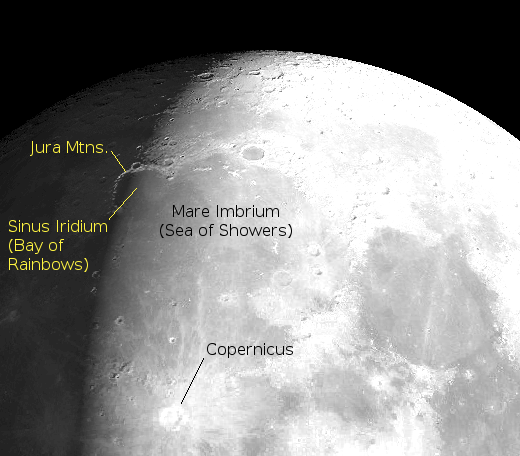
Bay of Rainbows and the crater Copernicus. Created using Virtual Moon Atlas.
I have more on Sinus Iridium and the Jura Mountains back in March.
05/05/11 – Ephmeris – The Eta Aquarid meteor shower
Thursday, May 5th. The sun rises at 6:27. It’ll be up for 14 hours and 24 minutes, setting at 8:51. The moon, 2 days past new, will set at 11:35 this evening.
The Eta Aquarid meteor shower is ramping up. The Eta Aquarids are caused by bits of Halley’s Comet, passing the earth’s orbit heading out from the sun. The Orionids of late October are debris of Halley’s comet passing the earth’s orbit heading in toward the sun. It’s the only comet I recollect caused two meteor showers. The Eta Aquarids are named for the star nearest the radiant of the meteor shower. The constellation of Aquarius has many shower radiants, which is why the shower is named for a star in Aquarius. The radiant rises shortly before 3:30 and astronomical twilight begins an hour later. There’s perhaps another half hour of visibility after that. The peak will occur tomorrow morning where up to 20 meteors per hour might be seen.
* Times are for the Traverse City/Interlochen area of Michigan. They may be different for your location.
Addendum
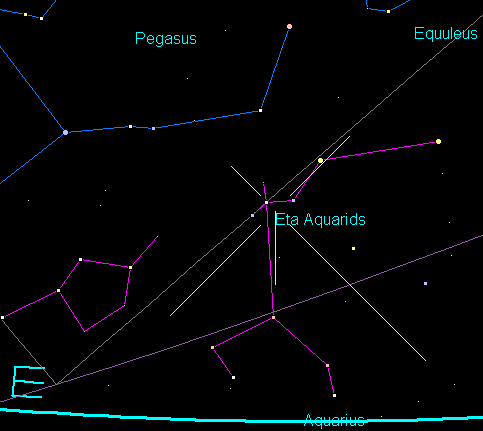
Eta Aquarid radiant
04/20/11 – Ephemeris – The bright planets visible this week
Wednesday, April 20th. The sun rises at 6:50. It’ll be up for 13 hours and 42 minutes, setting at 8:33. The moon, 3 days past full, will rise at 12:13 tomorrow morning.
It’s Wednesday and time again to take a look at the whereabouts of the bright planets for this week. The ringed planet Saturn is rising before sunset and will be visible in the southeast as it gets dark. It’s near the bright star Spica to its lower left. Spica has a blue tinge, while Saturn is yellowish. It will cross the meridian due south at 12:38 a.m. and will set at 6:30 a.m. In telescopes Saturn shows its rings which are a year and a half along their seven and a half year period of opening along with at least one satellite, the large moon Titan. Venus is brilliant in the morning sky and will rise at 5:51 a.m. in the east.. It is really a beautiful sight in the morning twilight, though disappointingly small in a telescope. Jupiter, Mars and Mercury are all too close to the direction of the sun to be visible.
* Times are for the Traverse City/Interlochen area of Michigan. They may be different for your location.
04/14/11 – Ephemeris – The gibbous moon
Thursday, April 14th. The sun will rise at 7:00. It’ll be up for 13 hours and 25 minutes, setting at 8:25. The moon, half way from first quarter to full, will set at 5:13 tomorrow morning.
The moon tonight is in its gibbous phase. The word gibbous means hump backed. At this phase the moon is severely interfering with the dimmer stars. So looking at the moon with a telescope becomes a good option. The moon will be bright and ruin any dark adaption your eye had before looking at it. Remember the sun shines on the moon with the same strength that it does on the earth, since it’s at roughly the same distance from the sun as the earth. The brightest spot on the earth facing side of the moon will be emerging into the lunar morning light this evening. It will be showing that brightness in a few days, but now it is the crater at the upper left edge of the moon, just coming into light. It is the crater Aristarchus.
* Times are for the Traverse City/Interlochen area of Michigan. They may be different for your location.
Addendum
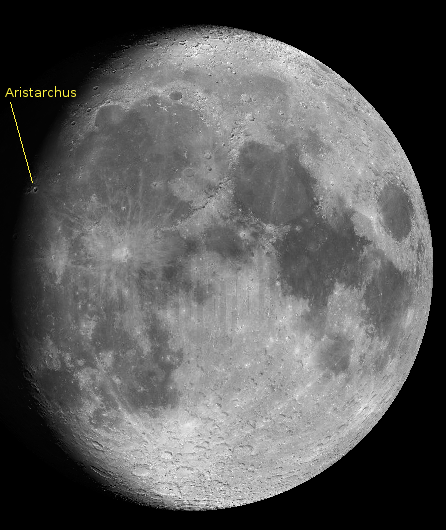
The gibbous moon for April 14, 2011. Created using Virtual Moon Atlas.
The crater Aristarchus is moving into the morning lunar daylight.
04/13/11 – Ephemeris – The Bright planets this week
Wednesday, April 13th. The sun will rise at 7:02. It’ll be up for 13 hours and 22 minutes, setting at 8:24. The moon, 2 days past first quarter, will set at 4:45 tomorrow morning.
It’s Wednesday and time again to take a look at the whereabouts of the bright planets for this week. The ringed planet Saturn is rising before sunset and will be visible low in the southeast as it gets dark. It will cross the meridian due south at 1:07 a.m. and will set at 7:12 a.m. In telescopes Saturn shows its rings which are a year and a half along their seven and a half year period of opening along with at least one satellite, the large moon Titan. Venus is brilliant in the morning sky and will rise at 6:00 a.m. in the east.. It is really a beautiful sight in the morning twilight, though disappointingly small in a telescope. Jupiter, Mars and Mercury are all too close to the direction of the sun to be visible.
* Times are for the Traverse City/Interlochen area of Michigan. They may be different for your location.
04/12/11 – Ephemeris – Saturn and its moon Titan
Tuesday, April 12th. The sun will rise at 7:04. It’ll be up for 13 hours and 19 minutes, setting at 8:23. The moon, 1 day past first quarter, will set at 4:16 tomorrow morning.
The planet Saturn, now rising up in the southeastern sky is always the most wonderful sight in a small telescope. The rings are slowly opening to the sun, however for us on the earth, whose orbit is tilted by about 2 and a half degrees to the Saturn’s orbit of the sun, the rings appear to be closing just a bit right now. After June they will open up again. Tonight a small telescope will also reveal Saturn’s largest satellite or moon which will be off the edge of the longest extent of the rings to the east of Saturn. Titan is the second largest moon in the solar system, after Jupiter’s Ganymede. It is larger than the planet Mercury and the only moon with a substantial atmosphere. Titan’s surface atmospheric pressure is slightly greater than the earth’s.
* Times are for the Traverse City/Interlochen area of Michigan. They may be different for your location.
Addendum
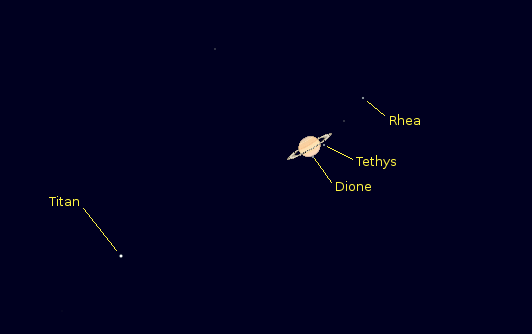
Saturn and some of its bright moons for April 12, 2011. Created using Cartes du Ciel
Titan is the easiest moon to see. Rhea is more difficult. The others being close to Saturn tonight may be impossible to spot. The free programs Cartes du Ciel and Stellarium will show the positions of Saturn’s satellites. See the Free Astronomical Software links in the right. Stellarium does have a problem getting the satellite brightness right, they’re too bright.
04/08/11 – Ephemeris – Looking out the thin side of the Milky Way
Friday, April 8th. The sun will rise at 7:11. It’ll be up for 13 hours and 7 minutes, setting at 8:18. The moon, 3 days before first quarter, will set at 1:39 tomorrow morning.
In winter and summer we see the Milky Way crossing the sky from north to south. In the autumn we see it cross nearly overhead from east to west. In the spring, especially next month the Milky way is barely visible low in the north. The Milky Way circles the sky as a great circle. It is what we see of our own galaxy. It is a spiral galaxy 100,000 light years in diameter and less than 5,000 light years thick where we are. So in the spring we look out the thin side of our galaxy. The stars are sparser than in other parts of the sky, the constellations generally are larger. The really cool part is that in telescopes we can see other galaxies, other Milky Ways beyond. In the spring we have a huge cluster of thousands of galaxies out there about 50 million light years away.
* Times are for the Traverse City/Interlochen area of Michigan. They may be different for your location.
Addendum
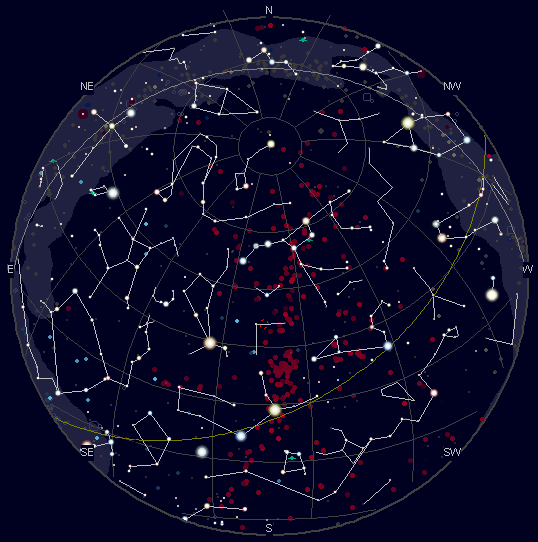
Looking out the thin side of the Milky Way. Created using Cartes duCiel
This is the entire dome of the sky on May 15th at 11 p.m. Note the Milky Way ringing the horizon. The red dots are galaxies, the blue and gray dots are star clusters in our galaxy, the green ones are nebulae, also in our galaxy.
04/05/11 – Ephemeris – Zodiacal Light
Tuesday, April 5th. The sun will rise at 7:16. It’ll be up for 12 hours and 58 minutes, setting at 8:14. The moon, 2 days past new, will set at 10:45 this evening.
After you spot the moon tonight, hang around outside at the end of astronomical twilight, about 9:37 p.m. look to the west at Taurus the bull and Gemini. Then broaden your gaze. There will be a very faint triangular glow with broad base at the horizon leaning a bit to the left, with its apex near the V of the face of Taurus the bull and the bright star Aldebaran to the right of Orion. This glow is called Zodiacal Light, caused by the reflected sunlight off a cloud of dust located in the plane of the solar system. Most of the large bodies of the solar system orbit the sun close to a single plane. The exceptions to this are comets, which orbit at all angles to the sun and Kuiper belt objects. Zodiacal Light is best seen on spring evenings and autumn mornings.
* Times are for the Traverse City/Interlochen area of Michigan. They may be different for your location.
Addendum
Back in 1997 I caught the zodiacal light when I photographed Comet Hale-Bopp. This was taken later in April when the apex of the zodiacal glow extended almost to Gemini. Click on the image to enlarge.
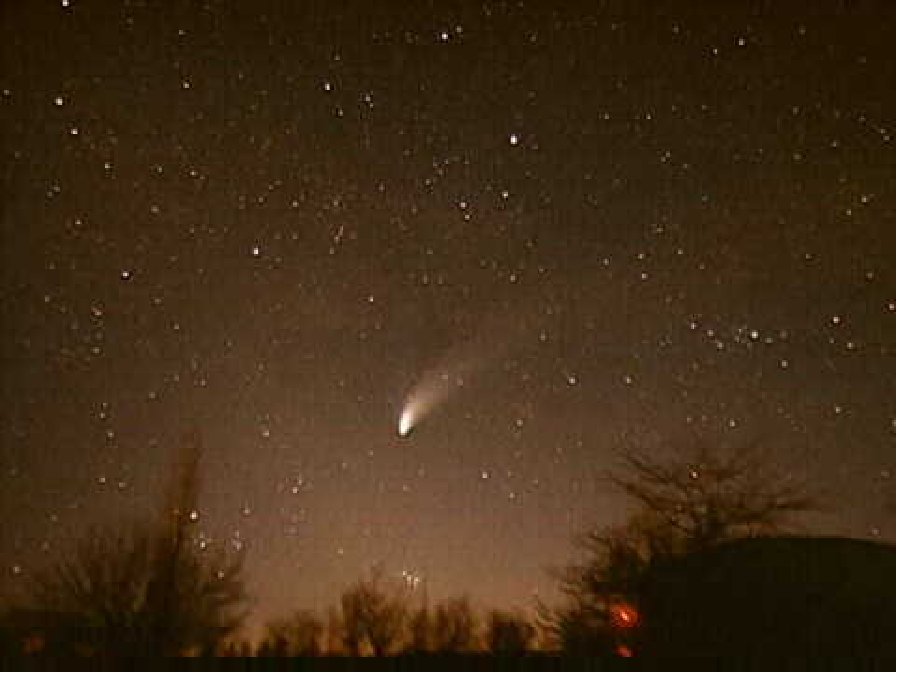 I
IZodiacal Light and Comet Hale-Bopp April 1997. My image.
Here is an enhanced image in black and white.
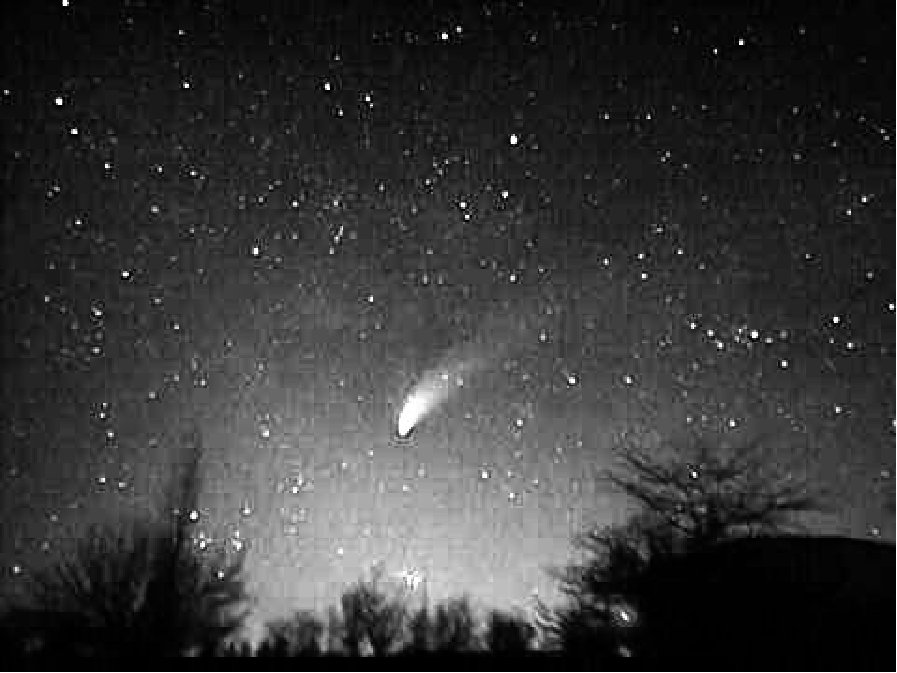
Zodiacal Light and Comet Hale-Bopp April 1997. Enhanced contrast.
04/06/11 – Ephemeris – The bright planets for this week
Wednesday, April 6th. The sun will rise at 7:14. It’ll be up for 13 hours and 1 minute, setting at 8:15. The moon, 3 days past new, will set at 11:46 this evening.
It’s Wednesday and time again to take a look at the whereabouts of the bright planets for this week. Jupiter is in conjunction with the sun today and will enter the morning sky. It’ll be more than a month before it’s easily spotted in the morning twilight. The ringed planet Saturn is rising before sunset and will be visible low in the southeast as it gets dark. It will cross the meridian due south at 1:37 a.m. and will set at 7:27 a.m. In telescopes Saturn shows its rings which are a year and a half along their seven and a half year opening along with at least one satellite, the large moon Titan. Venus is brilliant in the morning sky and will rise at 6:09 a.m. in the east southeast. It is really a beautiful sight in the morning twilight, though disappointingly small in a telescope.
* Times are for the Traverse City/Interlochen area of Michigan. They may be different for your location.

