Archive
02/22/11 – Ephemeris – The star Sirius and the star cluster M41
Tuesday, February 22nd. The sun will rise at 7:32. It’ll be up for 10 hours and 48 minutes, setting at 6:20. The moon, 2 days before last quarter, will rise at 12:24 tomorrow morning.
The brightest night time star Sirius is just about due south at 9 p.m. Otherwise Sirius can be found by following the three bright stars of Orion’s belt higher in the south southwest down to Sirius. In binoculars Sirius is a dazzling blue-white diamond. While officially pure white, Sirius has an arc light blue tinge. After checking out Sirius in binoculars shift your view one binocular field down and you will come to a beautiful field of faint stars. This is M41, number 41 on comet hunter Charles Messier’s list of fuzzy objects that weren’t comets. Binoculars may see up to 25 stars, telescopes even more. You might even be able to spot it with the unaided eye. It’s a whopping 2,300 light years away.
* Times are for the Traverse City/Interlochen area of Michigan. They may be different for your location.
02/18/11 – Ephemeris – Jupiter is getting its belt back
Friday, February 18th. The sun will rise at 7:38. It’ll be up for 10 hours and 36 minutes, setting at 6:14. The moon, at full today, will rise at 7:10 this evening.
Ever since Jupiter appeared in the morning sky, after passing behind the sun, 9 months ago it had lost its dark southern equatorial belt. Now there are visual and infrared signs that the belt is coming back. Belts are lower clouds than the bright clouds. They appear bright in the infrared. While Jupiter’s cloud tops are 200 degrees below zero, the interior of Jupiter is incredibly hot. In fact it radiates twice as much heat as it gets from the sun. Where the southern equatorial belt should be there is a crack appearing in the high cloud deck where the interior heat is showing up. We are getting to the point where Jupiter is going to pass behind the sun and out of view. April 6th is that date. I wonder if we are going to be able to see the complete restoration of the belt.
* Times are for the Traverse City/Interlochen area of Michigan. They may be different for your location.
02/16/11 – Ephemeris – The bright planets this week
Wednesday, February 16th. The sun will rise at 7:41. It’ll be up for 10 hours and 30 minutes, setting at 6:12. The moon, 2 days before full, will set at 6:54 tomorrow morning.
Time again to take a look at the whereabouts of the bright planets for this week. The planet Jupiter is up in the west southwestern sky in the early evening. It is a spectacular sight in a telescope with its four satellites, shifting their positions from night to night, and the cloud bands running in the directions of the satellites. Jupiter is the brightest star-like object in the evening before it sets. It’s located left the Circlet in Pisces now and will set at 9:23 p.m. The ringed planet Saturn will rise at 10:16 p.m. in the east southeast and will move due south at 4:01 a.m. Venus is brilliant in the morning sky and will rise at 5:24 a.m. in the east southeast. Mercury is now too close to the direction of the sun to be seen, as is Mars which is now in the morning sky.
* Times are for the Traverse City/Interlochen area of Michigan. They may be different for your location.
02/11/11 – Ephemeris – The moon will appear near the Pleiades tonight
Friday, February 11th. The sun will rise at 7:48. It’ll be up for 10 hours and 16 minutes, setting at 6:05. The moon, at first quarter today, will set at 3:05 tomorrow morning.
Today the moon will pass below the Pleiades or Seven Sisters star cluster. It does this once a month, but maybe tonight the moon won’t be too bright to completely drown them out. The Pleiades is a relatively nearby star cluster about 440 light years away. It is easily visible to the unaided eye, but not with the bright moon nearby. Binoculars will help bring out the cluster, which may show many more stars. On the moon two of the great features for small telescopes are visible, the wide flat floored crater Plato and the Straight Wall. Plato is visible at the upper part of the moon, while the Straight Wall is below center on the moon as a thin black line. It’s hard to spot for the first time. It is nearly a sheer fault 67 miles long and 900 feet high with a slope of 30 to 40 degrees.
* Times are for the Traverse City/Interlochen area of Michigan. They may be different for your location.
Extra
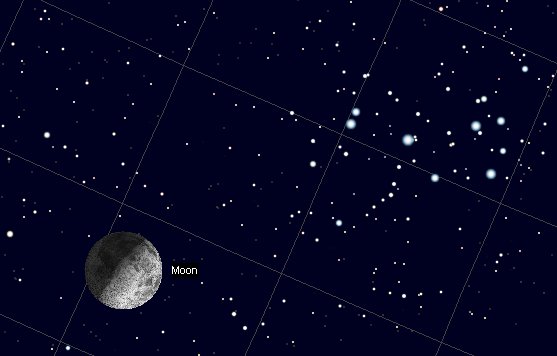
The Moon near the Pleiades, February 11, 2011 9 p.m. EST. Created using Cartes du Ciel (Sky Charts)
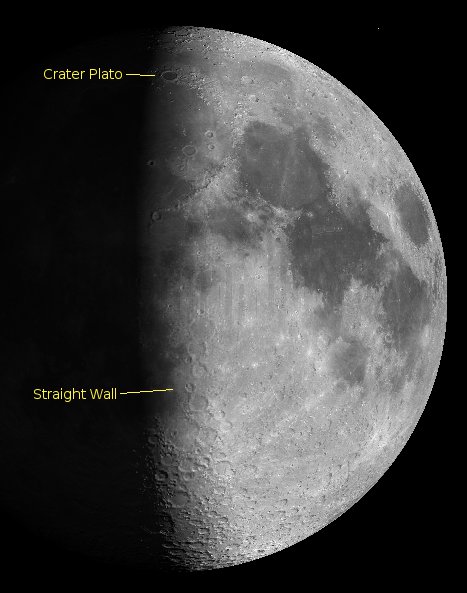
Lunar crater Plato and the fault Straight Wall
This is not a photograph! Image created using Virtual Moon Atlas by Christian Legrand and Patrick Chevalley. A free program. http://www.ap-i.net/avl/en/start.
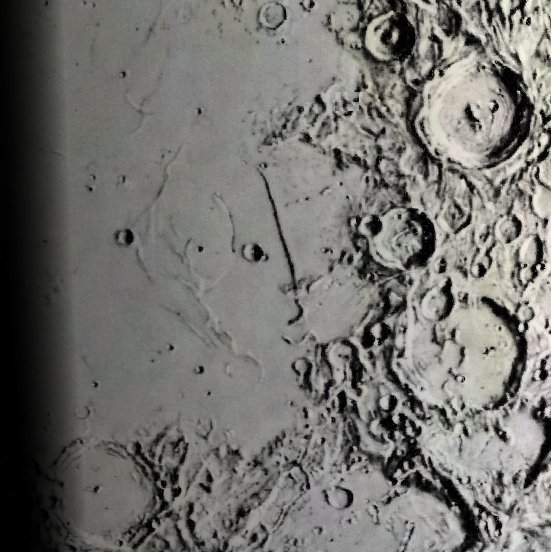
Closeup of the Straight Wall
Image also created using Virtual Moon Atlas.
02/10/11 – Ephemeris – The moon near first quarter
Thursday, February 10th. The sun will rise at 7:50. It’ll be up for 10 hours and 13 minutes, setting at 6:03. The moon, 1 day before first quarter, will set at 2:04 tomorrow morning.
The moon is just about first quarter. When it’s out tonight it will be less than 6 hours from the actual moment of first quarter, that is when the moon is at a 90 degree angle from the sun. In a small telescope a neat straight feature will be visible. It is near the northern part of the moon, which is up to the unaided eye or binoculars and usually on the lower part of the moon when viewed in an astronomical telescope. The straight feature is the Alpine Valley which cuts through the lunar Alps. Mountain ranges on the moon are named for earthly mountains, though lunar mountains are usually the rims of lunar seas, which are really large craters. The Alpine valley is 79 miles long and 7 miles wide. It appears to be a fault line.
* Times are for the Traverse City/Interlochen area of Michigan. They may be different for your location.
Extra
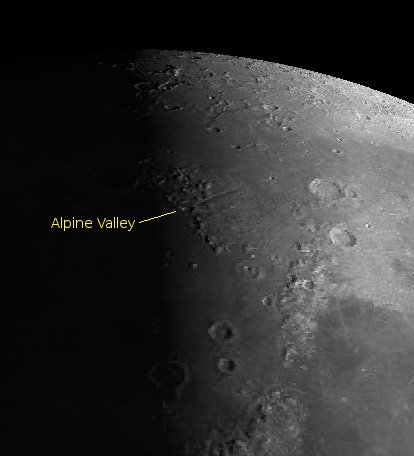
Alpine Valley on the moon
This is not a photograph! Image created using Virtual Moon Atlas by Christian Legrand and Patrick Chevalley. A free program. http://www.ap-i.net/avl/en/start.
02/08/11 – Ephemeris – The lunar crater Theophilus
Tuesday, February 8th. The sun will rise at 7:52. It’ll be up for 10 hours and 8 minutes, setting at 6:00. The moon, 3 days before first quarter, will set at 11:58 this evening.
The 5 day old crescent moon reveals to a small telescope, a trio of large craters on the edge of the moon’s terminator or sunrise line. The best of these is on top Theophilus, a perfectly circular 61 mile diameter crater with a prominent central peak. It’s a little late for it tonight but sometimes when the terminator is crossing the crater, the floor is dark and the central peak catches the morning sunlight. Theophilus is a couple of hundred miles south of the Apollo 11 landing site in the Sea of Tranquility, That sea will be completely in sunlight tomorrow night. The moon is a great celestial object to view with that new telescope. It’d big and bright, and relatively easy to find in the telescope. When trying to find an object in the sky always use the lowest power.
* Times are for the Traverse City/Interlochen area of Michigan. They may be different for your location.
01/21/11 – Ephemeris – The Winter Circle
Friday, January 21st. The sun will rise at 8:12. It’ll be up for 9 hours and 23 minutes, setting at 5:35. The moon, 2 days past full, will rise at 8:19 this evening.
The winter skies are blessed with more first magnitude stars than any other season. With the bright moon out these stars will stand out even more, as dimmer stars are suppressed. Six of these stars lie in a large circle centered on the seventh. This circle is up at 9 p.m. Starting high in the east is Capella in Auriga the charioteer. Moving down clockwise is Aldebaran in the face of Taurus the Bull. Then down to Orion’s knee we find Rigel. Down and left is the brightest star of all Sirius the Dog Star in Canis Major, lowest of these stars in the southeast. Moving up and left is Procyon in Canis Minor, Above Procyon is Pollux in Gemini the twins. All these are centered on Betelgeuse the bright red star in Orion’s shoulder.
* Times are for the Traverse City/Interlochen area of Michigan. They may be different for your location.
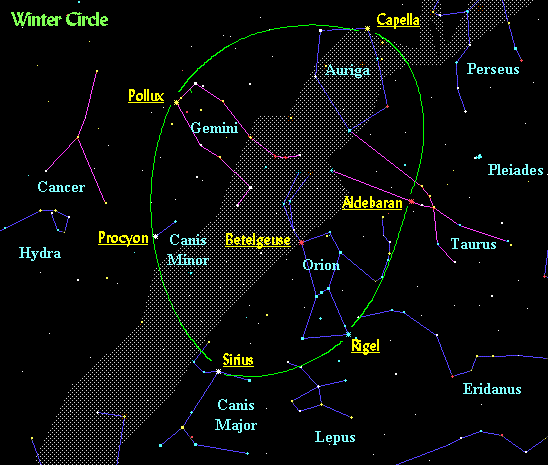
The Winter Circle of 1st magnitude stars
01/20/11 – Ephemeris – The bright star Capella
Thursday, January 20th. The sun will rise at 8:12. It’ll be up for 9 hours and 21 minutes, setting at 5:34. The moon, 1 day past full, will rise at 7:00 this evening.
A bright star called Capella is now nearly overhead in the east. Capella is the highest of winter’s seven brilliant first magnitude stars. Capella never quite sets for anyone north of Ludington. Due to its brightness, and being the closest first magnitude star to the pole, Capella appears to move slowly as the earth rotates, and spends summer and autumn evenings close to the northern horizon, and has in years past elicited a few phone calls and other queries about that ‘bright object in the northeast’. Capella belongs to the pentagonal constellation of Auriga the Charioteer. Capella represents a mother goat he is holding. Three stars in a thin triangle nearby are her kids. The star at the top of the triangle is an eclipsing binary star with a 27 year period.
* Times are for the Traverse City/Interlochen area of Michigan. They may be different for your location.
01/10/11 – Ephemeris – Venus and Mercury at greatest western elongation
Monday, January 10th. The sun will rise at 8:18. It’ll be up for 9 hours and 3 minutes, setting at 5:22. The moon, 2 days before first quarter, will set at 12:07 tomorrow morning.
Over the weekend Venus and Mercury both reached their greatest western elongation from the sun, That is their greatest separation from the sun, Venus at 47 degrees, and Mercury at 23 degrees. Venus is easy to spot in the southeast in the morning now. Mercury rises this morning at 6:40. By possibly 7:30 there will be a time between the growing twilight and the rising of Mercury to be high enough to be spotted. Mercury will be close to the horizon off to the lower left of Venus. Don’t be confused with the star below Venus, that is the red giant star Antares. Binoculars are a great help is spotting Mercury low in the brightening twilight. The visibility of Mercury will continue for the rest of the week.
* Times are for the Traverse City/Interlochen area of Michigan. They may be different for your location.
Extra
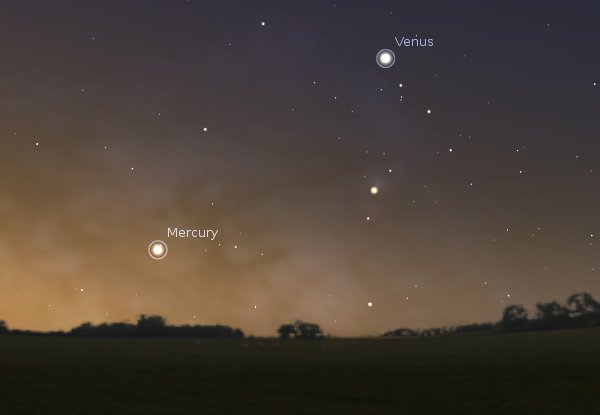
Venus and Mercury at 7:30 a.m. the week of January 10, 2011
This illustration is created using Stellarium. The sky will be brighter and Mercury fainter than shown here.
01/07/11 – Ephemeris – Local astronomical events this weekend
Friday, January 7th. The sun will rise at 8:18. It’ll be up for 8 hours and 59 minutes, setting at 5:18. The moon, 3 days past new, will set at 9:03 this evening.
Previewing astronomy and space events for 2011 will be the topic at this evening’s meeting of the Grand Traverse Astronomical Society at Northwestern Michigan College’s Rogers Observatory starting at 8 p.m. Yours truly will be giving the presentation highlighting the events of the new year which encompass a cometary flyby, and the orbiting of the planet Mercury and the asteroid Vesta. Plus viewing opportunities for us on the ground. Also tomorrow even there will be a viewing night at the observatory featuring the moon, Jupiter and the Great Orion Nebula. That also starts at 8 p.m. If it’s cloudy there will be some hands on activities lead by the NMC Astronomy Club. The observatory’s located south of Traverse City on Birmley Road.
* Times are for the Traverse City/Interlochen area of Michigan. They may be different for your location.

