Archive
01/03/11 – Ephemeris – The earth at perihelion and the Quadrantid meteor shower
Monday, January 3rd. The sun will rise at 8:19. It’ll be up for 8 hours and 55 minutes, setting at 5:14. The moon, 1 day before first quarter, will rise at 8:26 tomorrow morning.
We have two celestial events today. Around 2:30 this afternoon the earth with be at its closest point to the sun called perihelion, only 91.4 million miles. We’re a little too far north to need the extra sun screen. What really happens is the earth travels faster in its orbit making winter the shortest season. Tonight will see the peak of the Quadrantid meteor shower. These meteors seem to come from the defunct constellation of the Quadrangle near the tip of the handle of the Big Dipper. It can be as productive as the meteors of August. Up to 100 an hour may be seen toward dawn when the radiant point is high in the sky. Early in the evening the radiant will be low in the north giving us fewer but longer meteor trails in the sky.
* Times are for the Traverse City/Interlochen area of Michigan. They may be different for your location.
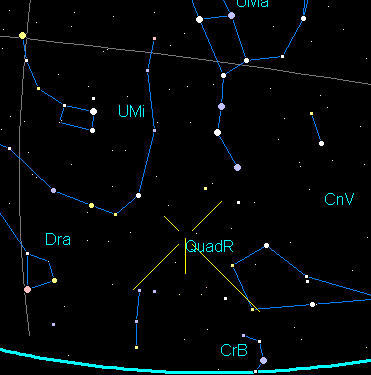
Quadrantid meteor shower radiant at 1:30 a.m. Looking northeast.
12/22/10 – Ephemeris – The bright planets visible this week
Wednesday, December 22nd. The sun will rise at 8:16. It’ll be up for 8 hours and 48 minutes, setting at 5:05. The moon, 1 day past full, will rise at 6:49 this evening.
Lets take a look at the bright planets for Christmas week. Mars is very low and lost in the evening twilight. The planet Jupiter is up in the southwestern sky in the early evening. It is a spectacular sight in a telescope with its four satellites, shifting their positions from night to night, and the cloud bands running in the directions of the satellites. Jupiter is the brightest starlight object in the evening, becoming our Christmas Star this year . It’s located below the Circlet in Pisces now and will set at 12:13 a.m. The ringed planet Saturn will rise at 1:53 a.m. in the east southeast. It’s located in the constellation Virgo this year. It’s rings are opening nicely for telescopic observers. Venus is brilliant in the morning sky and will rise at 4:23 a.m. in the east southeast.
* Times are for the Traverse City/Interlochen area of Michigan. They may be different for your location.
12/20/10 – 12/21/10 Live eclipse blogging
9:47 p.m. EST: It started out clear, but by 9:30 p.m. we’re getting some light cloud. I’m staying home for this one near Traverse City, Michigan. Below is my 9:30 p.m. picture:
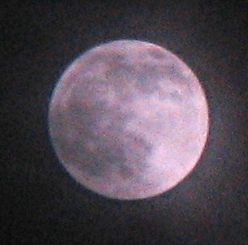
The full moon 12/20/10 9:30 p.m. EST through light clouds
My equipment is simple. I’m using my Canon A570 IS camera with 2X telephoto in manual mode.
11:23 p.m. EST: It’s hazing over. The moon looks better than this photograph taken at 11:10 p.m. The color balance is off. I don’t know whay, though it is intensified by adjusting the levels of the image.
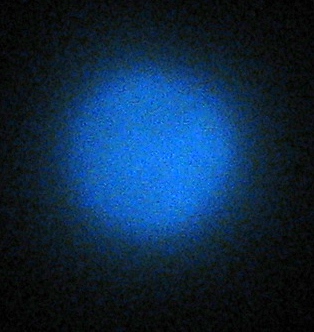
The moon at 11:14 p.m. EST
According to http://www.wunderground.com (Weather Underground) at this time we’re in the middle of a relatively thin cloud band that may pass over before the eclipse starts. Here’s hoping.
12:27 a.m. EST: The penumbral part of the eclipse is starting now. The moon is entering the moon’s outer shadow. Nothing will be visibly different about the moon until about 1 a.m. when the left part of the moon will begin to appear a bit dusky. It’s still hazy out but not as bad as an hour ago. The map on Weather Underground shows the cloud dissipating and moving to the east. Looks like the clouds are coming from the southwest. However now we’re getting a radar image of precipitation now moving near Manistee, about 6o miles southwest of us. It’s gong to be a race to see if we can see the start of the partial eclipse before the clouds and snow get us. The weather service says that there will be snow after 1 a.m. I’d hate for them to be right for a change.
1:11 a.m. EST: When I took the shot below it was much clearer than a half hour ago. I underexposed the photo but it does show the duskiness on the left edge of being deep in the penumbral shadow. It really wasn’t apparent to the eye. Sunglasses help is seeing it.
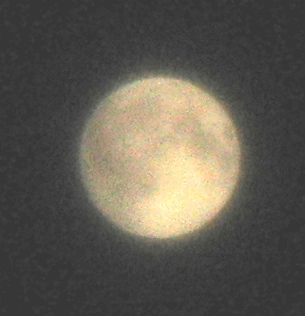
Under exposed moon about half way into the earth's penumbral shadow at 1:03 a.m.
1:17 a.m. EST: The Weather Underground maps show the snow either dissipating or moving east rather the northeast. We might get this eclipse in after all.
1:38 a.m. EST: We are in the partial phase now: The image below was taken at 1:33, just 2 minutes into the eclipse.
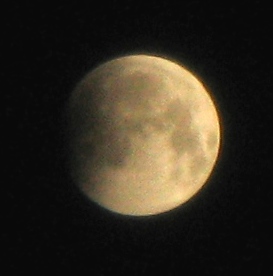
The moon 2 minutes into the partial phase of the eclipse at 1:33 a.m.
It is clearer that at any time since the first photograph. I did spot some heavier clouds to the southwest, but they weren’t very big. The Weather Underground map still looks promising.
1:57 a.m. EST: High clouds are affecting the moon’s image again making it fuzzy. It looks clearer visually than in photographs. At this point in the eclipse I try to get an idea of the brightness and color of the umbra. The haze has so far prevented me.
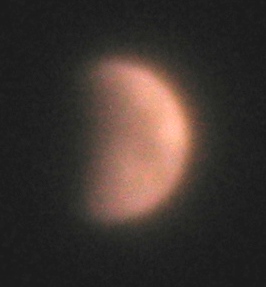
The partially eclipsed moon at 1:53 a.m.
2:15 a.m. EST: It’s getting hazier, so I didn’t attempt a photograph. With binoculars I was able to ascertain that the umbral shadow appears to be the red of a normal eclipse. I heard one prediction on the radio yesterday that the shadow may be darker than usual due to volcanic ash high in the atmosphere. Whomever didn’t quote a source. Bu it looks like a normal red colored moon in totality.
2:42 a.m. EST: We’re in totality. I can hardly see the moon through the thickening clouds. I can see the the moon in binoculars, so this isn’t a particularly dark eclipse. I’m hanging it up now. I have to go to work this morning.
Update 3:40 p.m. EST: It never did clear up after my last post, so I got nearly 3 hours sleep. I’m really dragging about now. There’s lots of good eclipse images posted on space.com, spaceweather.com and even the Huntington post.
12/20/10 – Ephemeris – Total lunar eclipse tomorrow morning
Monday, December 20th. The sun will rise at 8:15. It’ll be up for 8 hours and 48 minutes, setting at 5:04. The moon, 1 day before full, will set at 8:33 tomorrow morning.
The winter solstice occurs tomorrow, coincidentally there will be a total lunar eclipse after midnight tonight. The eclipse will start at 1:32 a.m. when the moon will begin to slip into the earth’s inner shadow. The moon will be completely inside the shadow at 2:40 a.m. beginning totality. The moon should still be visible but be a dim red color. The color and brightness of the eclipsed moon depends on the transparency of the earth’s atmosphere because it is illuminated by light being bent into the earth’s shadow by the earth’s atmosphere. Mid eclipse occurs at 3:17 a.m.. Totality will end at 3:53 a.m. when the moon peeks into sunlight again. The partial phase will end at 5:01 a.m. Our next lunar eclipse won’t be until December next year.
* Times are for the Traverse City/Interlochen area of Michigan. They may be different for your location.
12/13/10 – Ephemeris – Geminid meteors peak tomorrow morning
Monday, December 13th. The sun will rise at 8:10. It’ll be up for 8 hours and 51 minutes, setting at 5:02. The moon, at first quarter today, will set at 1:19 tomorrow morning.
Tomorrow morning will see the peak of the Geminid meteor shower. This is one of the most active showers of the year. Some say it’s even more active than the Perseid meteor shower of August with up to 100 meteors or shooting stars visible an hour. They will seem to come from near the star Castor in the constellation Gemini which is rising high towards midnight. The moon will interfere until it sets at 1:19 a.m. After that until dawn is the best time to view them. All you’ll need then is clear skies. If it does clear up, make sure you dress warmly. It will take up to 10 minutes or even more for your eyes to get accustomed to the darkness to be able to see the meteors. This is Michigan, you never know when it will clear up.
* Times are for the Traverse City/Interlochen area of Michigan. They may be different for your location.
12/09/10 – Ephemeris – Geminid meteor preview
Thursday, December 9th. The sun will rise at 8:07. It’ll be up for 8 hours and 54 minutes, setting at 5:02, the earliest sunset of the year. The moon, half way from new to first quarter, will set at 9:11 this evening.
On Tuesday morning we will have the chance to see the peak of the Geminid meteor shower. Some of its members can be seen tonight, but the meteors will be most numerous on the morning of Tuesday the 14th. This shower rivals the Perseid meteor shower of August. The problem for us in viewing this fabulous shower is the cold temperatures and usually cloudy skies. Another problem this year is the moon which will be at first quarter and will set at 1:19 a.m. Tuesday morning. I’ll have more on Monday. The source of the Geminids was discovered in 1983. It is a burnt out comet with the asteroid designation 3200 and given the name Phaethon which swoops down to only 13 million miles of the sun.
* Times are for the Traverse City/Interlochen area of Michigan. They may be different for your location.
11/26/10 – The constellation Taurus
Friday, November 26th. The sun will rise at 7:53. It’ll be up for 9 hours and 12 minutes, setting at 5:06. The moon, 2 days before last quarter, will rise at 10:18 this evening.
Low in the east southeast at 9 p.m. is the constellation of the giant hunter Orion. Above him is Taurus the bull. His face is a letter V shape of stars lying on its side, the star cluster Hyades, with the bright orange-red star Aldebaran at one tip of the V as its angry blood-shot eye, but actually about half way between us and the cluster. Orion is depicted in the sky facing, with club in one hand and a shield in the other, the approaching and in some depictions charging Taurus. The Pleiades star cluster is in his shoulder. Taurus in Greek mythology was the guise the god Zeus when he carried off the maiden Europa. Europa’s still with him as the intriguing satellite orbiting Zeus’ Roman equivalent the planet Jupiter.
* Times, as always are for the Traverse City/Interlochen area of Michigan.
11/25/10 – Ephemeris – The constellation Andromeda
Thanksgiving Day (US), Thursday, November 25th. The sun will rise at 7:52. It’ll be up for 9 hours and 14 minutes, setting at 5:06. The moon, 3 days before last quarter, will rise at 9:04 this evening.
In the south at 9 this evening can be found a large square of stars, the Great Square of Pegasus the flying horse, flying upside down to the right. What look like its hind legs stretching to the left from the upper left corner star is another constellation, Andromeda the chained maiden. She is seen in the sky as two diverging curved strings of stars that curve upward. She was rescued by the hero Perseus, a nearby constellation, riding his steed Pegasus. Andromeda’s claim to astronomical fame is the large galaxy seen with the unaided eye just above the upper line of stars. The Great Andromeda Galaxy is 2.5 million light years away. To the unaided eye the galaxy appears as a small smudge of light. In binoculars the galaxy is a delicate spindle of light.
* Times, as always are for the Traverse City/Interlochen area of Michigan.
11/24/10 – Ephemeris – This week’s bright planets
Wednesday, November 24th. The sun will rise at 7:50. It’ll be up for 9 hours and 16 minutes, setting at 5:07. The moon, 3 days past full, will rise at 7:52 this evening.
Lets take a look at the bright planets for this week. Mars is very low and lost in the evening twilight as is Mercury. The planet Jupiter is up in the southern sky in the early evening. It is a spectacular sight in a telescope with its four satellites, shifting their positions, and the cloud bands running in the directions of the satellites. Jupiter will move due south at 8:05 p.m.. It is the brightest starlight object in the sky. It’s located in Pisces this year and will set at 1:52 a.m. The ringed planet Saturn will rise at 3:32 a.m. in the east southeast. It’s located in the constellation Virgo this year. It’s rings are opening nicely for telescopic observers. Venus is in the morning sky and will rise at 4:51 a.m. in the east southeast.
* Times, as always are for the Traverse City/Interlochen area of Michigan.
10/22/10 – Ephemeris – The Full Hunter’s Moon
Friday, October 22nd. The sun will rise at 8:06. It’ll be up for 10 hours and 39 minutes, setting at 6:46. The moon, is the full Hunter’s Moon, and will rise at 6:12 this evening.
The full moon is blinding in telescopes and binoculars. Well it is daylight there, and the moon is essentially the same distance from the sun as the earth. The face of the man in the moon is at its best visibility now. In binoculars or low power in telescopes the best feature to view is the ray system radiating out of the bright southern crater Tycho which is relatively fresh. Fresh on the moon is less than a billion years old, how much less is not known. Maybe the Lunar Reconnaissance Orbiter can help pinpoint the age or a visit by astronauts in the future. My general feeling is that the only good full moon is an eclipsed one. On the second full moon from now, on the morning of December 21st we will be able to witness total lunar eclipse, if it’s clear.

