Archive
10/21/10 – Ephemeris – The Orionid meteors
Thursday, October 21st. The sun will rise at 8:05. It’ll be up for 10 hours and 42 minutes, setting at 6:48. The moon, 1 day before full, will set at 7:47 tomorrow morning.
We are now at the best time to see the Orionid meteor shower, but unfortunately the moon is near full and out all night.. However the brightest of the meteors will be visible. Like most meteor showers, this is best seen just before dawn. As the name suggests the so-called shooting stars will seem to come from the constellation Orion the hunter. Actually they will appear to come from above the rectangular torso of the giant. These meteors actually have nothing to do with Orion, but they are the light flashes from bits of rock that were once part of Halley’s comet, as they burn up in the earth’s atmosphere. In Halley’s many passes close to the sun, much of its solid material has been liberated by the evaporating gases, leaving a trail of litter in its orbit.
10/20/10 – Ephemeris – The planets and Comet hartley 2 for this week
Wednesday, October 20th. The sun will rise at 8:04. It’ll be up for 10 hours and 45 minutes, setting at 6:49. The moon, 2 days before full, will set at 6:44 tomorrow morning.
Lets take a look at the bright planets for this week. Venus and Mars are very low and lost in the evening twilight. Venus has a bit more than a week to be officially in the evening sky before it passes between the earth and the sun. It will then enter the morning sky where it appear quite suddenly a couple of weeks later. The planet Jupiter is up at sunset appearing in the southeastern sky in the early evening. It will move due south at 11:28 p.m.. It is the brightest starlight object in the sky. It’s located in Pisces this year and will set at 5:16 a.m. Comet Hartley 2 may be just visible in binoculars as a fuzzy spot in the pentagonal constellation of Auriga, below and right of the bright star Capella in the northeastern sky.
10/18/10 – Ephemeris – The moon’s orientation in a telescope
Monday, October 18th. The sun will rise at 8:01. It’ll be up for 10 hours and 51 minutes, setting at 6:52. The moon, half way from first quarter to full, will set at 4:41 tomorrow morning.
This evening the moon will be inviting to the telescope. Depending on your optical arrangement, you will see the moon in different orientations. When I describe the moon is describe it as seen in binoculars, right side up. The Feature that looks like an arc of mountains called the Jura mountains that contain the Bay of Rainbows or Sinus Iridium will appear to the upper left of the moon. In a Newtonian reflecting telescope the moon appears upside down so Sinus Iridium appears to the lower right. A printed moon map may only have to be turned upside down to match what you see. In a telescope with a diagonal mirror by the eyepiece gives a mirror image. Whether it is upside down or not depends on the orientation of the eyepiece.
Astronomy Cruise – Day 0
Late last year I was privileged enough to be asked by Captain Dave owner of the tall ship Manitou and the Traverse Tall Ship Company, based in Traverse City, to be the astronomer on their annual astronomy cruise. After the three times a day two hour cruises of the summer months they have three or four day “Windjammer” cruises after Labor Day. The astronomy cruise was scheduled for October 1-4 this year, and happened to be the last cruise of the season.
The Manitou is a 114 foot replica of a 19th century cargo schooner like those that sailed the lakes back then. It can accommodate 24 passengers on multi-day cruises, 62 on short day cruises.
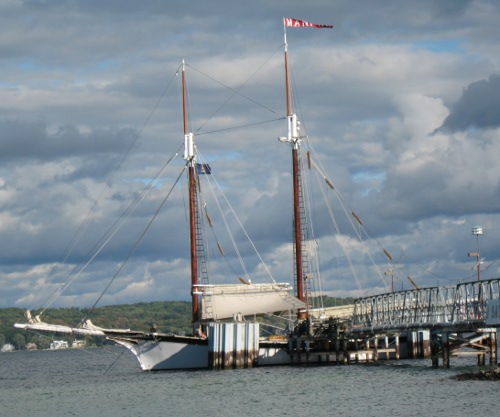
The schooner Manitou at its dock in Traverse City
Boarding was on the afternoon before to get things stowed, and I had a lot to stow: 8″ Celestron SCT telescope, tripod, other telescope parts, christened “bag of bricks” by the crew, 2 battery packs, a Questar telescope on loan from the Leelanau School, and my traveling bag. I had a cabin to myself, so the tripod slept in the upper bunk.
After heading ashore with another passenger to get some takeout burgers and having a quick supper I set up my telescope, because the sky was clear.
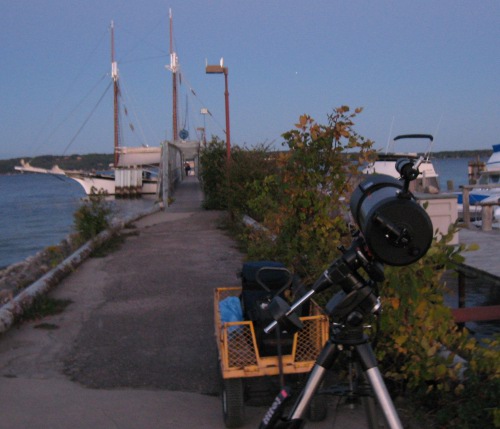
My telescope aimed at the rising Jupiter, just visible.
Only tonight and Sunday night were forecast to be clear, so I wasn’t going to waste even this first night in port to observe the sky. Among other things I did spot comet Hartley 2. The south was affected by an unshielded sodium light on a dock south of us. Overhead and to the north were good and dark.
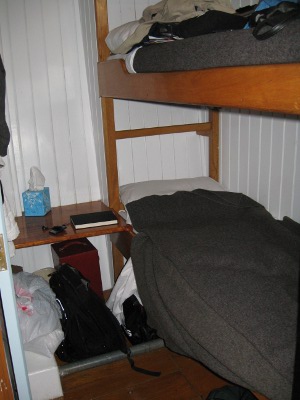
The bunk in my quarters (Not the first night)
After tearing down the telescope, I settled in to my cabin and a very comfortable, but narrow bed for a fitful sleep. I always have trouble sleeping the first night in a new place. The rest of the nights I went to sleep right away and slept soundly. My MP3 player and ear buds silenced the fellow snoring on the other side of the wall. The bed being unmade in the photo is my fault. I didn’t keep my cabin exactly ship shape.
Tomorrow is going to be a big day as we head out into the Grand Traverse Bay.
10/07/10 – Ephemeris – The star Fomalhaut
Thursday, October 7th. The sun will rise at 7:47. It’ll be up for 11 hours and 24 minutes, setting at 7:12. The moon is new today, and won’t be visible.
There’s a bright star that appears for only seven and a half hours a night on autumn evenings. It’s appearance, low in the south, is a clear indication of the autumn season. At 9 p.m. tonight it’s low in the southeast. The star’s name is Fomalhaut, which means fish’s mouth. That fits because it’s in the constellation of Piscis Austrinus, the southern fish. At our latitude it’s the fish that got away, because Fomalhaut appears to be quite alone. The dimness of the constellation’s other stars and location close to the horizon make the fainter stars hard to spot. They would be overhead in Australia. The earth’s thick atmosphere near the horizon reduces the stars brightness by a factor of two or more, so Fomalhaut appears to keep a lonely vigil in the south.
Times are for the Grand Traverse Area of Northern Michigan, USA.
10/05/10 – Ephemeris – The constellation Capricornus
Tuesday, October 5th. The sun will rise at 7:45. It’ll be up for 11 hours and 30 minutes, setting at 7:15. The moon, 2 days before new, will rise at 6:22 tomorrow morning.
2000 years ago the southernmost of the constellations of the zodiac was Capricornus the water goat. That’s why the latitude on the earth where the sun is overhead on the winter solstice is called the Tropic of Capricorn. Not any more, Sagittarius, one constellation west, has that honor today. Actually Capricornus does need the press. It’s large, but made up of dim stars. To me it looks like a 45 degree isosceles triangle, long side up, but which all the sides are sagging. The constellation is found low in the south at 10 p.m. and tilted a bit from the upper right to the lower left. The image that is supposed to be represented by the stars is that of a goat whose hind quarters are replaced by a fish’s tail, not a mermaid but a mer-goat.
*Times are for the Grand Traverse Area of Northern Michigan, USA.
10/04/10 – Ephemeris – Comet Hartley 2
Monday, October 4th. The sun will rise at 7:43. It’ll be up for 11 hours and 33 minutes, setting at 7:17. The moon, 3 days before new, will rise at 5:02 tomorrow morning.
Comet 103P/Hartley 2 is visible all night, but it’s visible only in binoculars or a small telescope It’s cruising past the W shaped constellation of Cassiopeia in the northeast in the evening. Looking at the W in the evening it’s standing on one end, and looks like the number 3. The comet is moving down just to the right of it. Since it is seen against the Milky Way there are some other fuzzy spots to confuse you. The comet will stay fuzzy in a telescope. Discovered in 1986 by Malcolm Hartley in Australia, the comet has a 6 and a half year orbit of the sun. It will be closest to the earth on October 20th. The Deep Impact spacecraft renamed EPOXI will pass close to the half mile diameter nucleus on November 4th.
Times are for the Grand Traverse Area of Northern Michigan, USA.
09/30/10 – Ephemeris – October Preview
Thursday, September 30th.* The sun will rise at 7:39. It’ll be up for 11 hours and 45 minutes, setting at 7:24. The moon, at last quarter today, will rise at 11:59 this evening.
Let’s look at the skies for the month of October. The sun will still moving south rapidly. Daylight hours in the Interlochen/Traverse City area and will drop from 11 hours and 42 minutes tomorrow to 10 hours, 14 minutes at months end.. The altitude of the sun above the southern horizon at local noon will be 42 degrees tomorrow, and will descend to 31 degrees on Halloween, also in the Interlochen area. The Straits area will have the sun a degree lower. Local noon, when the sun is due south will be about 1:30 p.m. in Interlochen. Sunrise times will increase all the way to 8:18 a.m. in Interlochen on the 31st. Sunset times will decrease from 7:23 p.m. tomorrow to 6:32 when the trick or treaters haunt our neighborhoods.
Times are for the Grand Traverse Area of Northern Michigan, USA.
09/29/10 – Ephemeris – Planets this week
Wednesday, September 29th. The sun will rise at 7:37. It’ll be up for 11 hours and 48 minutes, setting at 7:26. The moon, 1 day before last quarter, will rise at 10:55 this evening.
Lets take a look at the bright planets for this week. Venus and Mars are very low in the twilight. Venus is the brightest. It’s 36 million miles away and slowly approaching, and appears as a thin crescent. It will set at 8:09 p.m. Mars is above, left of Venus, and much dimmer. I doubt if you could spot it. The planet Jupiter is up at sunset and will move due south at 2:59 a.m.. It’s located in Pisces this year and will set at 6:51 a.m. Mercury is difficult to spot low in the east before sunrise. It will rise tomorrow morning at 6:30 a.m. Mercury is visible in the morning twilight in the east. 6:45 to 7:10 a.m. is the best time to spot it. Comet Hartley 2 may be just visible in binoculars as a fuzzy spot just right of the W shape of the constellation Cassiopeia in the evening now.
Times are for the Grand Traverse Area of Northern Michigan, USA.
9/28/10 – Ephemeris – Venus
Tuesday, September 28th. The sun will rise at 7:36. It’ll be up for 11 hours and 51 minutes, setting at 7:28. The moon, 2 days before last quarter, will rise at 10:00 this evening.
Venus, if you can catch it before it sets at 8:13 p.m. is a very thin crescent. Venus is visible as a crescent even in binoculars now. A very tiny and thin one. Though the planet Venus is very close to the earth now, it is difficult to see. It is low in the sky, setting very soon after the sun. Being low in the sky, telescopes cannot see good detail on its surface, if we could see it at all, which we can’t. Venus is cloud covered. Its dense atmosphere of mostly carbon dioxide is covered by layers of sulfuric acid clouds. Two decades ago the Magellan spacecraft orbited the planet with radar and mapped the hellish surface. In roughly the same period the Soviets landed probes on its surface to see its barren landscape lit by a dim reddish sun.
Times are for the Grand Traverse Area of Northern Michigan, USA.

