Archive
Ephemeris: 10/21/2025 – Finding Andromeda
This is Ephemeris for Tuesday, October 21st. Today the Sun will be up for 10 hours and 41 minutes, setting at 6:47, and it will rise tomorrow at 8:07. The Moon is new today, and won’t be visible.
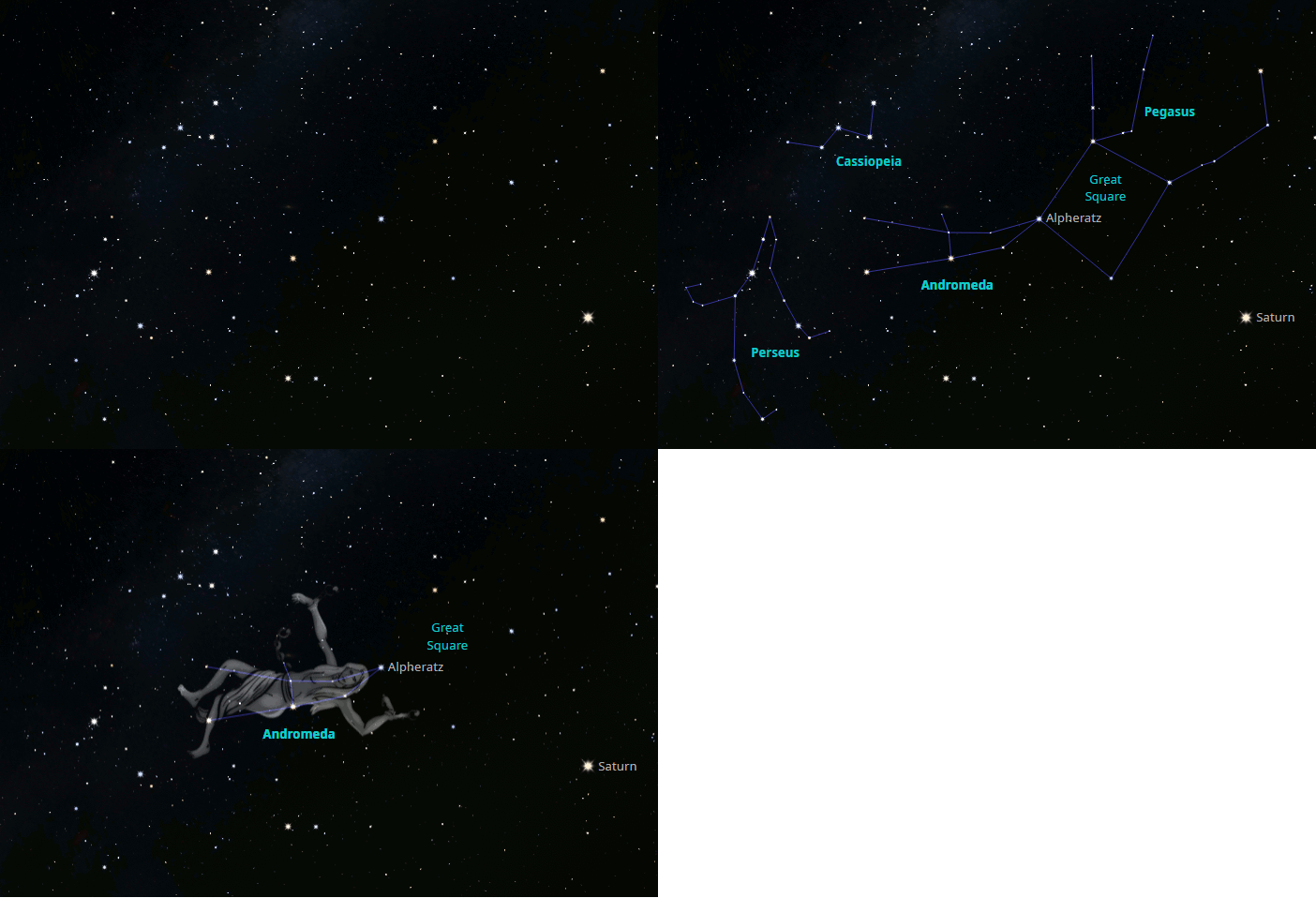
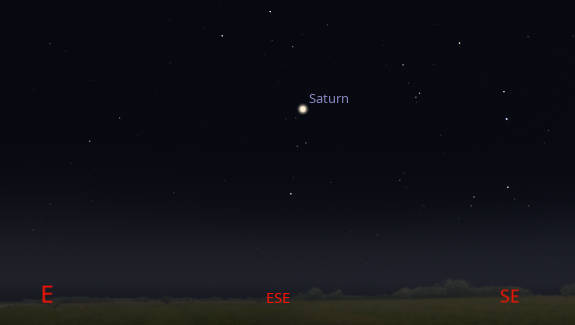
Tonight at 9:00 PM Saturn is in the southeast, with the Great Square of Pegasus above and to the left. Off the leftmost star of the Great Square, called Alpheratz, are two curved lines of stars to the left and a bit below, and slightly diverging. They might be mistaken for the hind legs of the horse, which is flying upside down. It’s another constellation, that of Andromeda the Princess, daughter of Cassiopeia, the W shaped constellation to the upper left. Andromeda was rescued by hero Perseus which is another constellation left of her, which we’ll get to later on this week. Andromeda’s claim to scientific fame is the large galaxy located there, the Great Andromeda Galaxy, probably the farthest thing one can spot with the naked eye.
The astronomical event times given in this blog are for the Traverse City/Interlochen area of Michigan (Lat 44.7° N, Long 85.7° W; EDT, UT – 4 hours) unless stated otherwise. Times will be different for other locations.
Addendum
Andromeda is part of the Great Star Story of Autumn. My take on it is linked Here.
Ephemeris: 10/20/2025 – The Fisher paints the autumn colors
This is Ephemeris for Monday, October 20th. Today the Sun will be up for 10 hours and 44 minutes, setting at 6:49, and it will rise tomorrow at 8:06. The Moon, 1 day before new, will rise at 8:19 tomorrow morning.
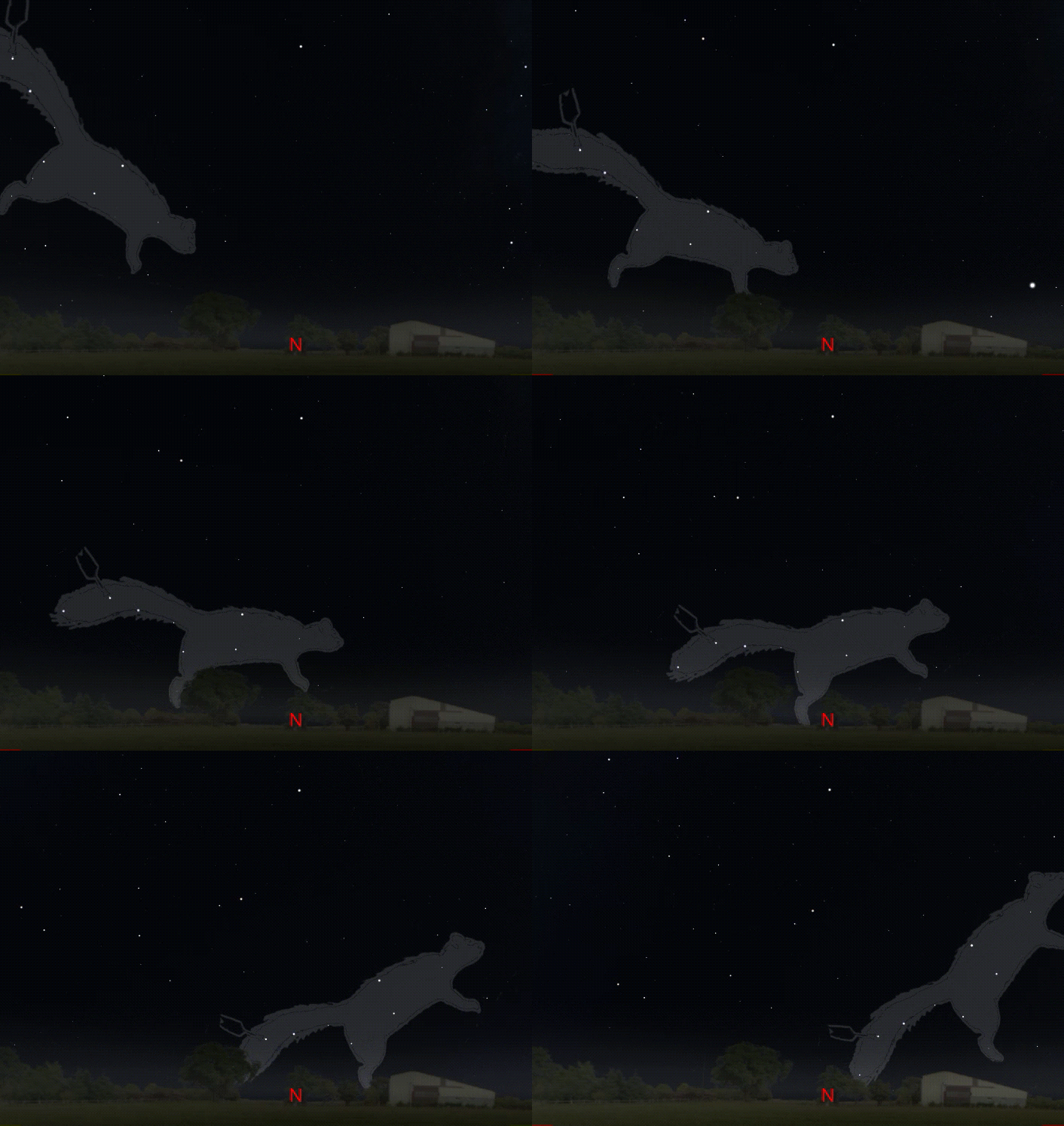
The leaves on the trees are beginning to turn to reds and yellows as we advance through autumn. The native Anishinaabe peoples, whose homeland we share, have a story about how that came to be. Of how a magical weasel-like creature called the Fisher or, in their native language, Ojiig Anung (Fisher Star), brought summer to the Earth from Skyland. For his trouble, he was shot with an arrow in his only vulnerable spot, the tip of his tail. As he fell to Earth Gichi Manitou, the Great Spirit, caught him and placed him in the sky where we see the Great Bear and the Big Dipper. Every late autumn night we see his tail, the handle of the dipper, slowly swooping down to the horizon in the north, where his bloody tail paints the trees with their autumn colors.
The astronomical event times given in this blog are for the Traverse City/Interlochen area of Michigan (Lat 44.7° N, Long 85.7° W; EDT, UT – 4 hours) unless stated otherwise. Times will be different for other locations.
Addendum
For my take on the story of how the Fisher brought summer to the Earth, click here.
Ephemeris: 10/16/2025 – The Anishinaabe saw a Moose where Pegasus is
This is Ephemeris for Thursday, October 16th. Today the Sun will be up for 10 hours and 55 minutes, setting at 6:55, and it will rise tomorrow at 8:01. The Moon, 3 days past last quarter, will rise at 3:57 tomorrow morning.
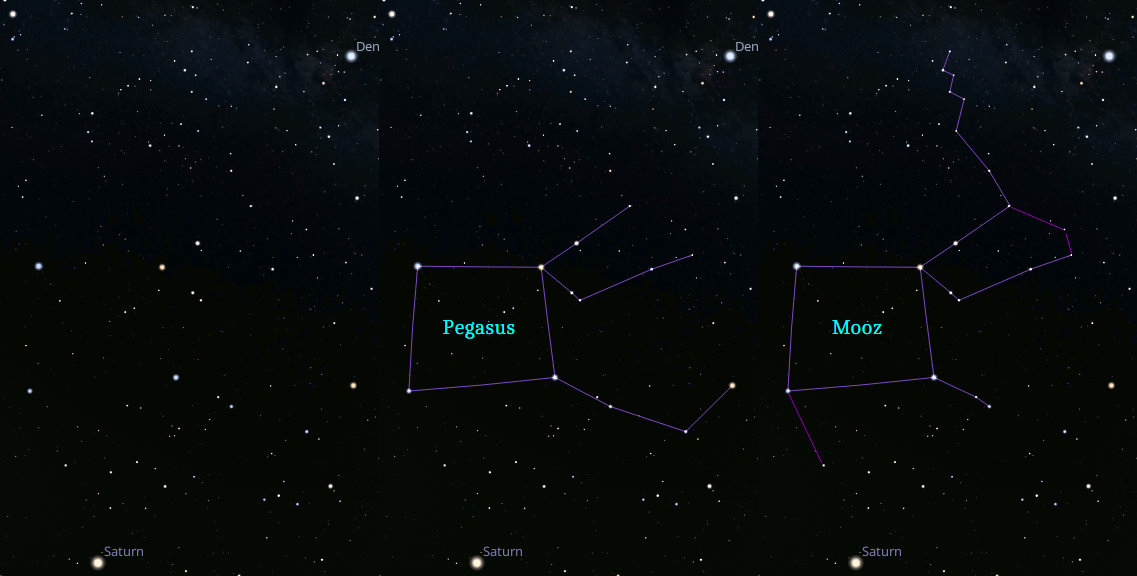
High in the southeast at 10 PM is the constellation officially called Pegasus the flying horse. The front part of his body is a pattern of stars we call the Great Square of Pegasus, and he’s flying upside down, quite an aerobatic horse. His wings are not seen in the stars, however his neck and head, up to his nose is, along with his front legs. The Anishinaabe peoples of this area call it Mooz, from which we get our word moose. He’s right side up, facing the west. His head is where we see the front legs of Pegasus, and his antlers are above it where there is another official constellation made of faint stars called Lacerta, which is a lizard. Not everyone sees the same figure in the stars.
The astronomical event times given in this blog are for the Traverse City/Interlochen area of Michigan (Lat 44.7° N, Long 85.7° W; EDT, UT – 4 hours) unless stated otherwise. Times will be different for other locations.
Addendum
Ephemeris: 10/15/2025 – Taking our weekly look at the whereabouts of the naked-eye planets
This is Ephemeris for Wednesday, October 15th. Today the Sun will be up for 10 hours and 58 minutes, setting at 6:57, and it will rise tomorrow at 7:59. The Moon, 2 days past last quarter, will rise at 2:47 tomorrow morning.
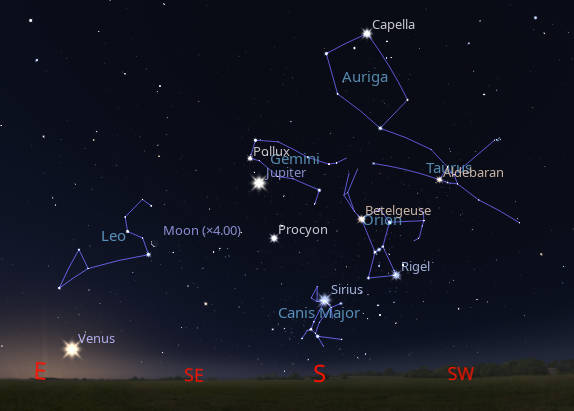
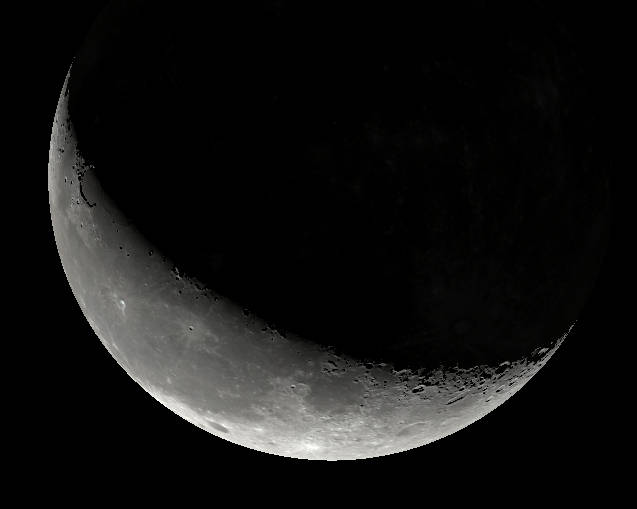
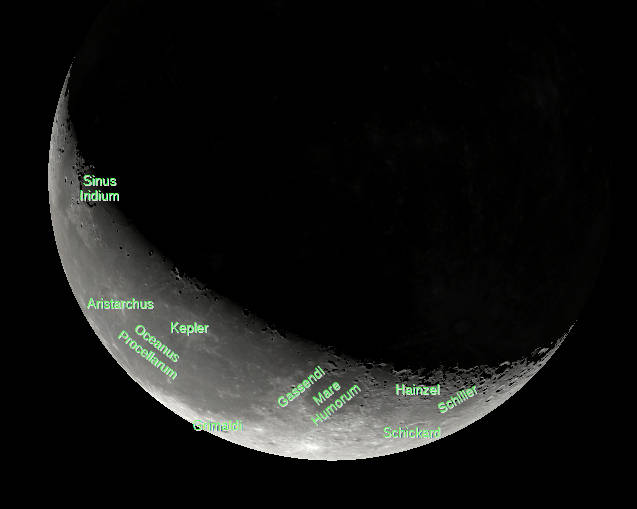
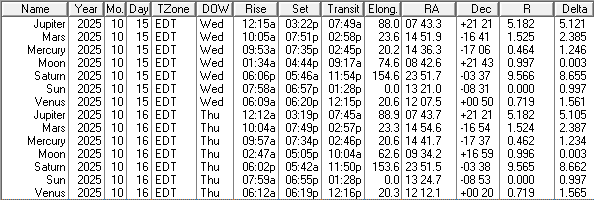
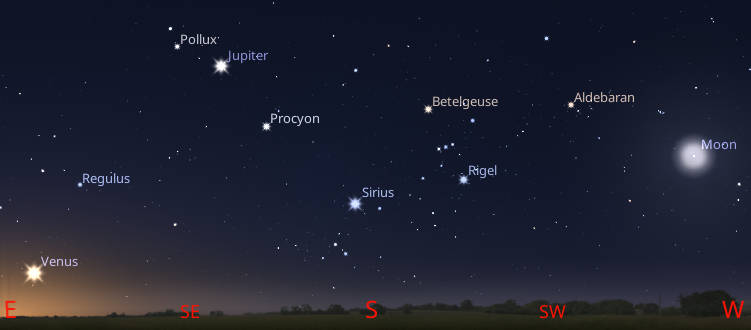
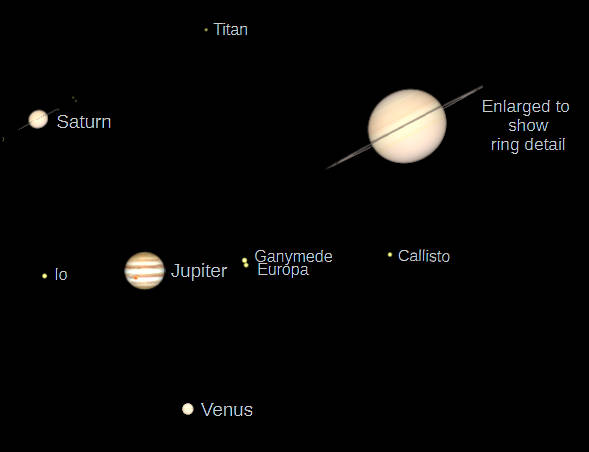
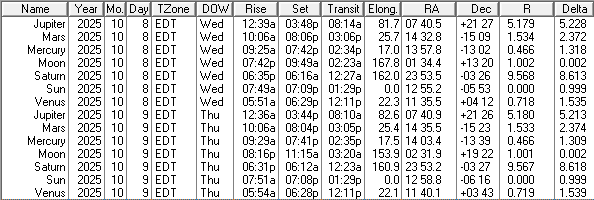
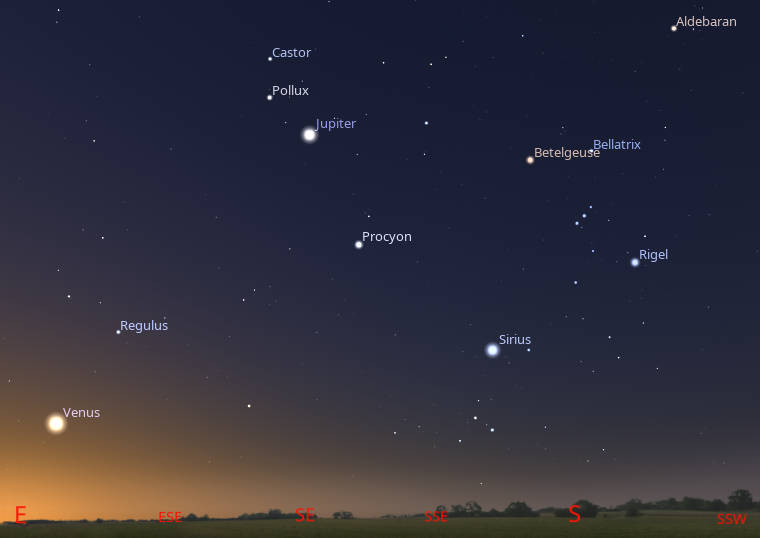
Let’s take our weekly look at the whereabouts of the naked-eye planets. Saturn is the brightest star like object in the east southeastern sky at 8 PM. In a telescope Saturn sports a very thin ring, 1° from being edge on in telescopes. Many times I’ve been asked whether they can see Saturn’s rings in their telescope. Normally I’d say yes. Currently, the rings appear very thin and can be difficult to pick up. Jupiter will rise at 12:11 AM. By 7 AM, it will appear high in the south-southeast, below the stars of Gemini, with Orion and the other bright stars of Winter in the south. Brilliant Venus, which will rise at 6:12 AM will be low in the east at 7 AM. Tomorrow morning the waning crescent of the Moon will appear between the two planets.
The astronomical event times given in this blog are for the Traverse City/Interlochen area of Michigan (Lat 44.7° N, Long 85.7° W; EDT, UT – 4 hours) unless stated otherwise. Times will be different for other locations.
Addendum
Ephemeris: 10/09/2025 – Eclipses and occultations of Jupiter’s satellites by each other
This is Ephemeris for Thursday, October 9th. Today the Sun will be up for 11 hours and 17 minutes, setting at 7:08, and it will rise tomorrow at 7:52. The Moon, 3 days past full, will rise at 8:16 this evening.
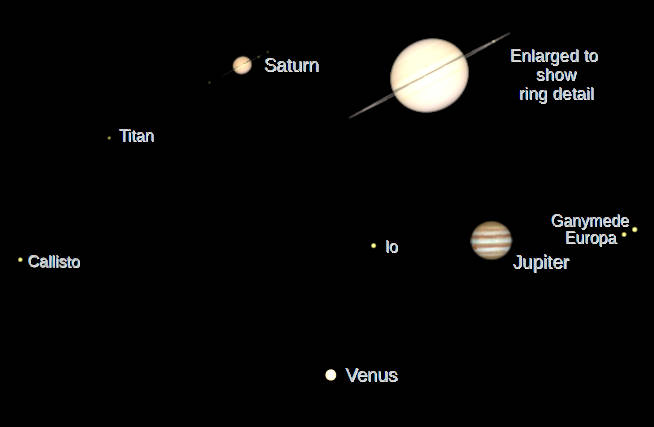
To astronomers the word occult doesn’t mean what you think it means. It’s not a mysterious thing, but the word occult simply means hidden, when one body hides behind another. For example, a solar eclipse isn’t really an eclipse by astronomical standards it is an occultation: the Sun hides behind the Moon. But, a lunar eclipse is really an eclipse where the Moon enters the Earth’s shadow. There is a period for the next 2½ years when Jupiter’s satellites will be both occulting and eclipsing each other. This can easily be seen in a small telescope or even binoculars. Satellites will slowly seem to merge in occultations and disappear, for some minutes, being eclipsed in another satellite’s shadow. The main show starts in May next year and ends in August 2028.
The astronomical event times given in this blog are for the Traverse City/Interlochen area of Michigan (Lat 44.7° N, Long 85.7° W; EDT, UT – 4 hours) unless stated otherwise. Times will be different for other locations.
Addendum


IOTA’s website is occultations.org. Occult is free software. Besides occultations, it can be used to investigate historical and future solar and lunar eclipses, and transits of Mercury and Venus across the face of the Sun. And more.
Ephemeris: 10/08/2025 – Weekly look at the whereabouts of the naked-eye planets
This is Ephemeris for Wednesday, October 8th. Today the Sun will be up for 11 hours and 20 minutes, setting at 7:09, and it will rise tomorrow at 7:51. The Moon, 2 days past full, will rise at 7:42 this evening.
Let’s take our weekly look at the whereabouts of the naked-eye planets. Saturn rises before sunset in the east. It is the brightest star like object in the east southeastern sky at 8 PM not long after the Moon rises. In a telescope Saturn sports a very thin ring, 1.2° from being edge on in telescopes. Saturn has an axial tilt of about 27°, so it has seasons like the Earth and since its rings are over its equator, when they go edge on to the Sun, it is an equinox for it, which happened this past May. Earth, being close to the Sun, sees nearly the same thing. Now the ring angle for us will decrease to about a third of a degree by November 23rd before increasing. By 7 AM, Jupiter will appear high in the southeast, under the stars of Gemini. With brighter Venus low in the east.
The astronomical event times given in this blog are for the Traverse City/Interlochen area of Michigan (Lat 44.7° N, Long 85.7° W; EDT, UT – 4 hours) unless stated otherwise. Times will be different for other locations.
Addendum
Ephemeris: 10/06/2025 – Tonight’s full moon is the Harvest Moon!
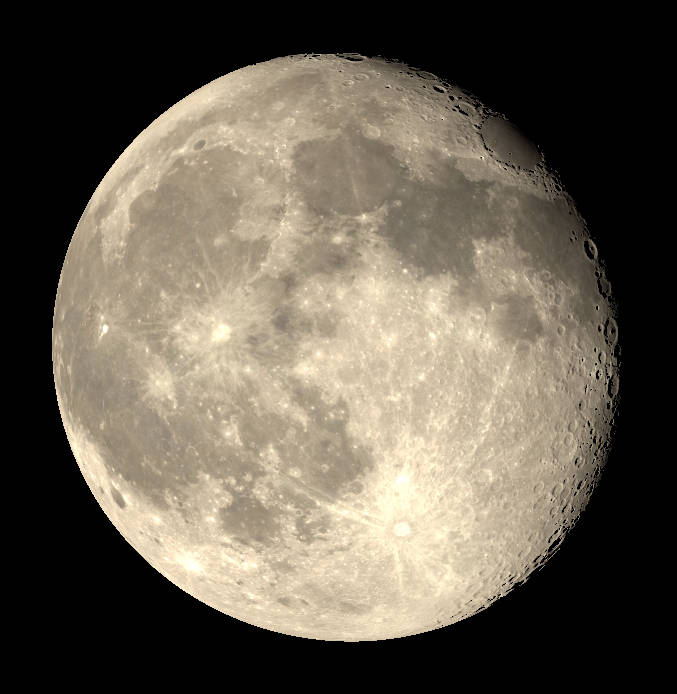
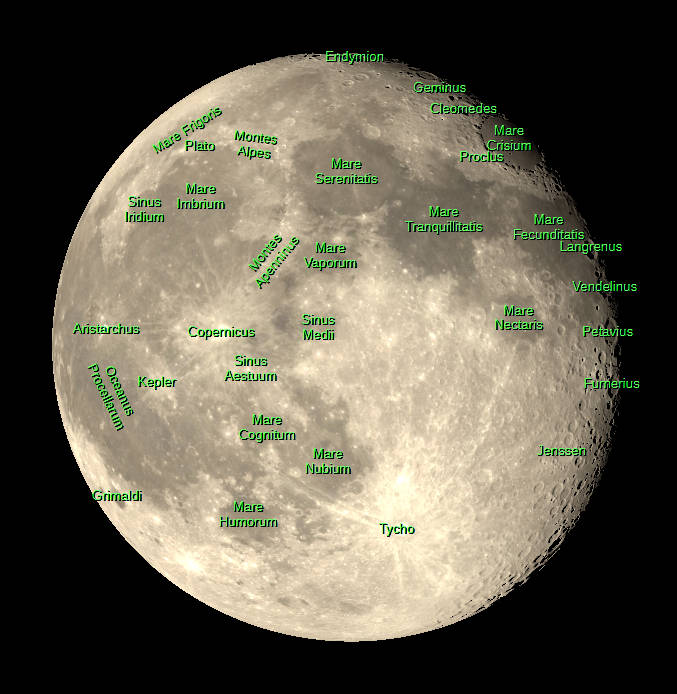
This is Ephemeris for Monday, October 6th. Today the Sun will be up for 11 hours and 26 minutes, setting at 7:13, and it will rise tomorrow at 7:48. The Moon, at full today, will rise at 6:53 this evening.
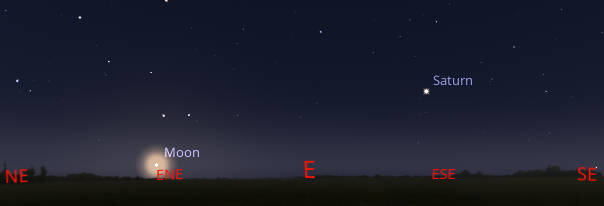
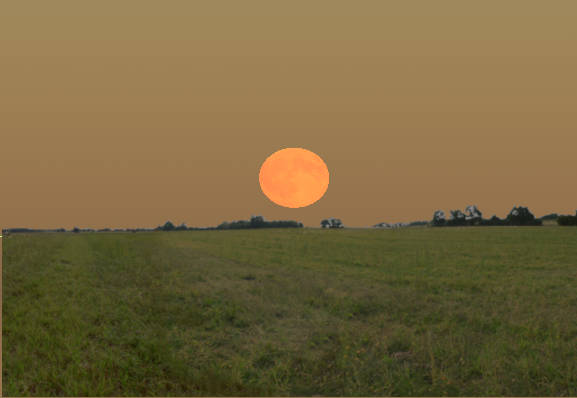
Today’s full moon is the nearest full moon to the autumnal equinox which makes it the Harvest Moon. Normally, October’s full moon is called the Hunter’s Moon, so it can be both at the same time. The indigenous peoples of our area, the Anishinaabe, call it the Falling Leaves Moon and indeed this month the leaves will fall from deciduous trees, after giving us a couple of weeks of spectacular color. The exact time that the moon will be full will be 11:48 PM this evening. Therefore, the Moon is going to rise very close to sunset. As a matter of fact, it will rise 20 minutes before sunset, so it should be a very spectacular rising of an orangish moon which, this time of year, will remind one of a pumpkin.
The astronomical event times given in this blog are for the Traverse City/Interlochen area of Michigan (Lat 44.7° N, Long 85.7° W; EDT, UT – 4 hours) unless stated otherwise. Times will be different for other locations.
Addendum
Ephemeris: 10/01/2025 – Our weekly look at the whereabouts of the naked-eye planets
This is Ephemeris for Wednesday, October 1st. Today the Sun will be up for 11 hours and 41 minutes, setting at 7:22, and it will rise tomorrow at 7:42. The Moon, 2 days past first quarter, will set at 1:55 tomorrow morning.
Let’s take our weekly look at the whereabouts of the naked-eye planets. Saturn rises before sunset in the east. It is the brightest star like object in the eastern to southeastern sky in the evening. In a telescope Saturn sports a very thin ring, 1.5° from being edge on. Saturn has an axial tilt of about 27°, so it has seasons like the Earth and since its rings are over its equator, when they go edge on to the Sun, it is an equinox for it, which happened this past May. Earth, being close to the Sun, sees nearly the same thing. Now the ring angle for us will decrease to about a third of a degree by November 23rd before increasing. By 7 AM, Jupiter will appear high in the southeast, under the stars of Gemini. With brighter Venus low in the east.
The astronomical event times given in this blog are for the Traverse City/Interlochen area of Michigan (Lat 44.7° N, Long 85.7° W; EDT, UT – 4 hours) unless stated otherwise. Times will be different for other locations.
Addendum
Ephemeris: 09/30/2025 – Previewing October skies
This is Ephemeris for Tuesday, September 30th. Today the Sun will be up for 11 hours and 44 minutes, setting at 7:24, and it will rise tomorrow at 7:41. The Moon, 1 day past first quarter, will set at 12:44 tomorrow morning.
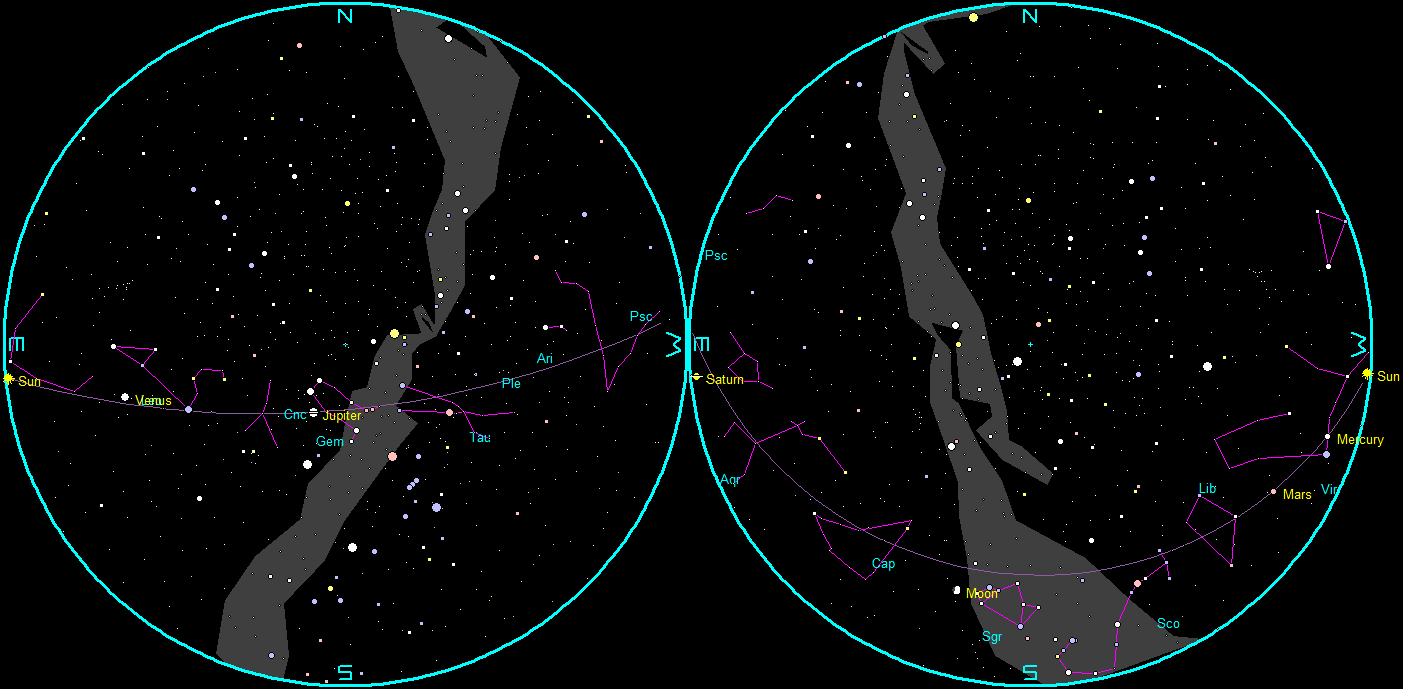
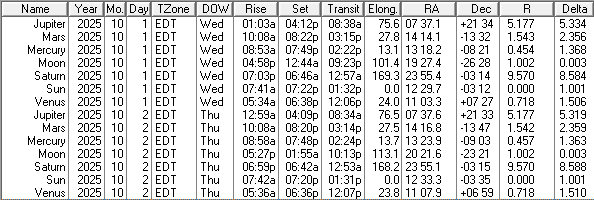
Let’s look at the skies for this month of October. The Sun will still be moving south rapidly. Daylight hours in the Interlochen/Traverse City area will drop from 11 hours and 41 minutes tomorrow to 10 hours 12 minutes on the 31st. The altitude of the sun above the southern horizon at local noon will be 42 degrees tomorrow, and will descend to 31 degrees on Halloween, also in the Interlochen/Traverse City area. The Straits area will have the sun a degree lower. Local noon, when the Sun is due south, will be about 1:30 pm in Interlochen and Traverse City. Bits of Halley’s comet will return later in the month as the Orionid meteor shower. Dark skies will prevail this year for the Orionids
The astronomical event times given in this blog are for the Traverse City/Interlochen area of Michigan (Lat 44.7° N, Long 85.7° W; EDT, UT – 4 hours) unless stated otherwise. Times will be different for other locations.
Addendum
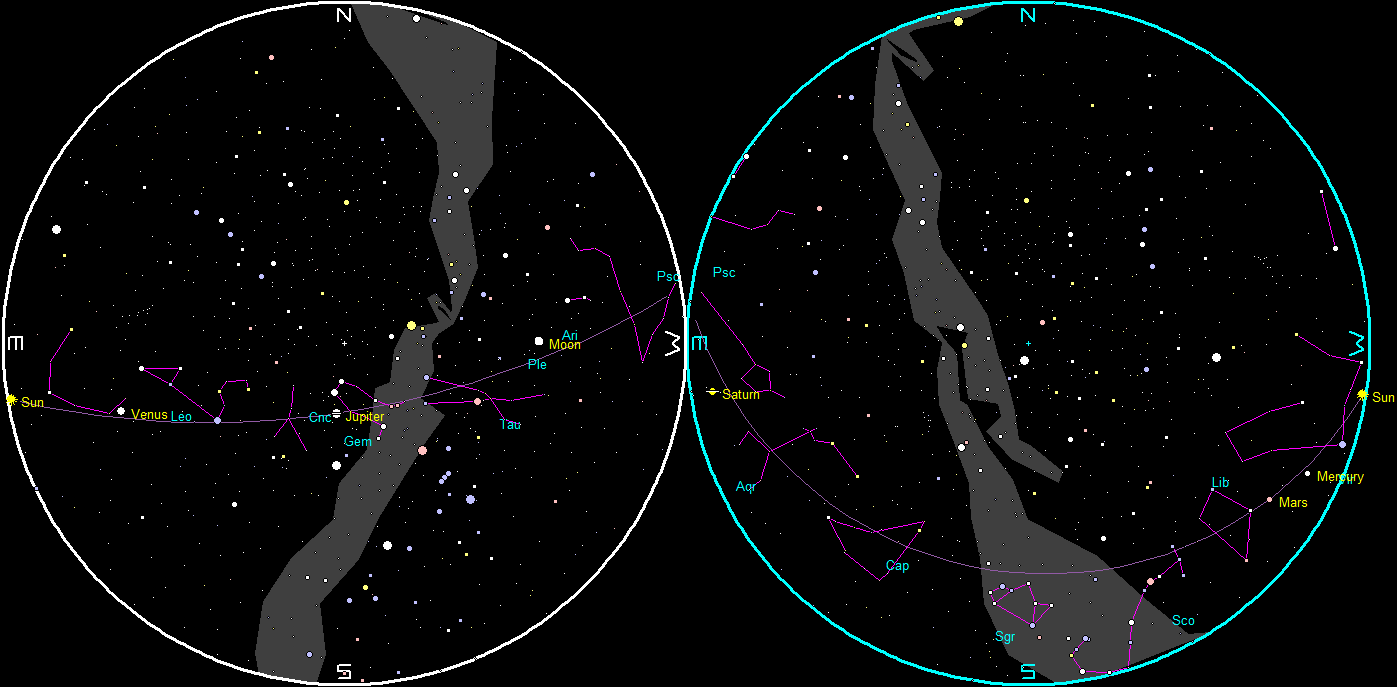
October Evening Star Chart
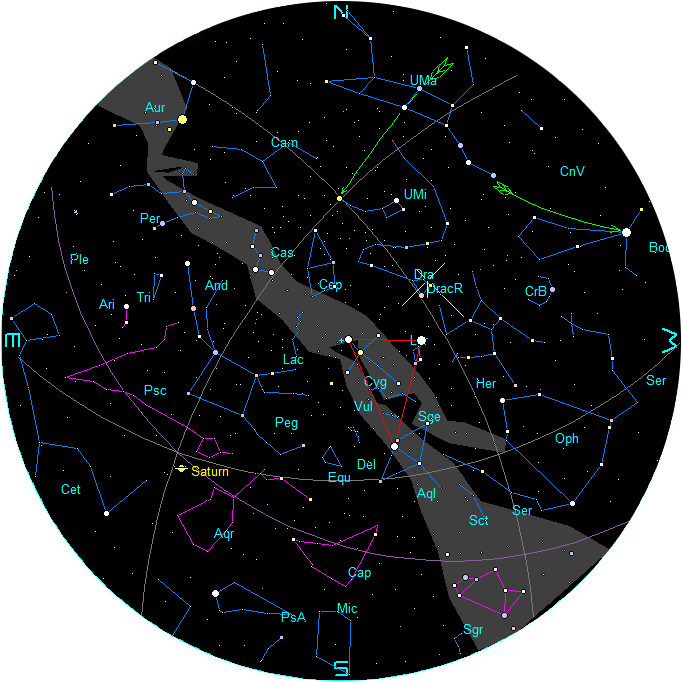
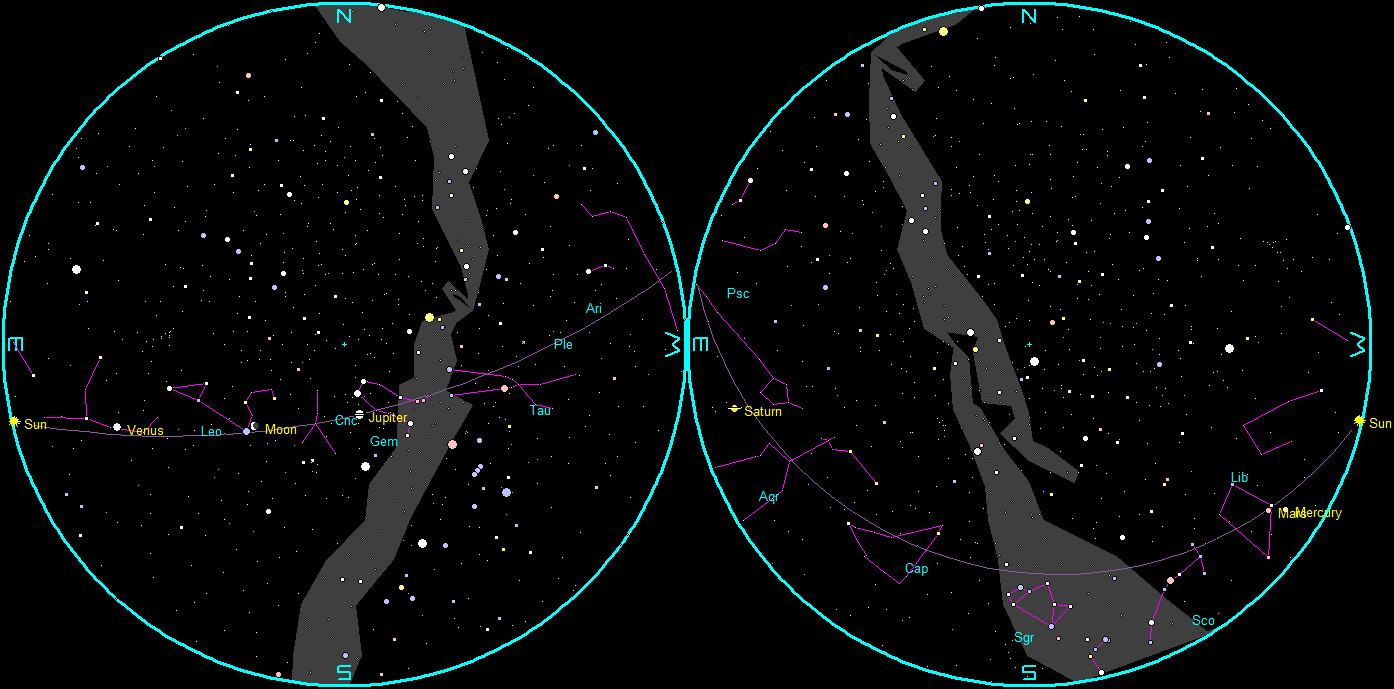
The planets and stars are plotted for the 15th at 9 PM EDT in the evening and 6 AM on the 16th for the morning chart. These are the chart times. Note that Traverse City is located approximately 45 minutes behind our time meridian, West 75° longitude. (An hour 45 minutes behind our daylight saving time meridian during EDT). To duplicate the star positions on a planisphere you may have to set it to 1 hour 45 minutes earlier than the current time.
October Morning Star Chart
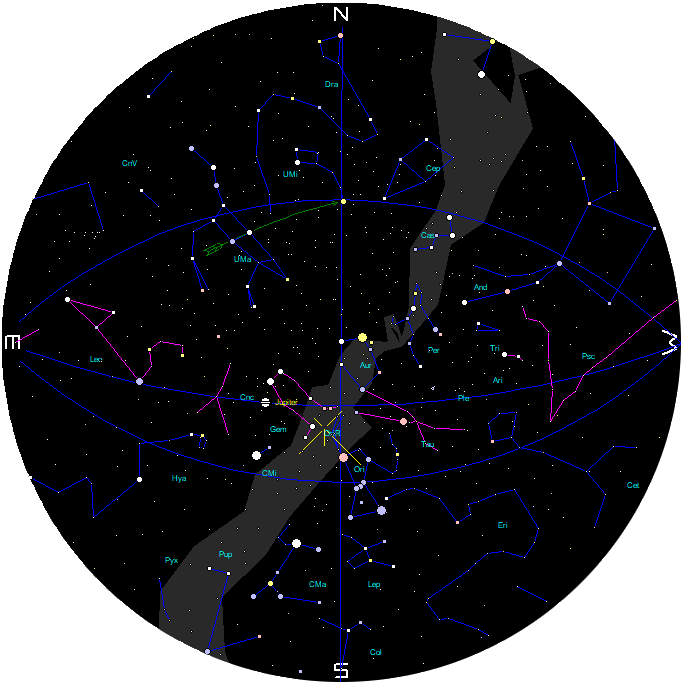
For a list of constellation names to go with the abbreviations, click here.
- Pointer stars at the front of the bowl of the Big Dipper point to Polaris, the North Star.
- Leaky dipper drips on Leo.
- Follow the arc of the handle of the Big Dipper to the star Arcturus.
- The Summer Triangle is in red.
- DracR – Draconid Radiant – Peaks the 8th – Zenithal Hourly Rate < 10 with rare outbursts of a thousand an hour, though not expected this year. It’s hindered this year by the bright moon.
- OriR – Orionid Radiant – Peak 21st – Zenithal Hourly Rate = 20
Twilight Limits, Nautical and Astronomical
| EDT | |||||||
| Morning | Twilight | Evening | Twilight | Dark | Night | Moon | |
| Date | Astro. | Nautical | Nautical | Astro. | Start | End | Illum. |
| 2025-10-01 | 6h05m | 6h40m | 20h29m | 21h03m | 0h44m | 6h05m | 0.72 |
| 2025-10-02 | 6h07m | 6h41m | 20h27m | 21h01m | 1h56m | 6h07m | 0.81 |
| 2025-10-03 | 6h08m | 6h42m | 20h25m | 20h59m | 3h11m | 6h08m | 0.88 |
| 2025-10-04 | 6h09m | 6h43m | 20h23m | 20h57m | 4h27m | 6h09m | 0.95 |
| 2025-10-05 | 6h10m | 6h44m | 20h22m | 20h56m | 5h44m | 6h10m | 0.99 |
| 2025-10-06 | 6h12m | 6h46m | 20h20m | 20h54m | – | – | 1.00 |
| 2025-10-07 | 6h13m | 6h47m | 20h18m | 20h52m | – | – | 0.98 |
| 2025-10-08 | 6h14m | 6h48m | 20h16m | 20h50m | – | – | 0.94 |
| 2025-10-09 | 6h15m | 6h49m | 20h14m | 20h48m | – | – | 0.87 |
| 2025-10-10 | 6h17m | 6h51m | 20h13m | 20h46m | 20h46m | 21h01m | 0.78 |
| 2025-10-11 | 6h18m | 6h52m | 20h11m | 20h45m | 20h45m | 21h57m | 0.67 |
| 2025-10-12 | 6h19m | 6h53m | 20h09m | 20h43m | 20h43m | 23h05m | 0.56 |
| 2025-10-13 | 6h20m | 6h54m | 20h07m | 20h41m | 20h41m | – | 0.45 |
| 2025-10-14 | 6h22m | 6h55m | 20h06m | 20h40m | 20h40m | 0h19m | 0.35 |
| 2025-10-15 | 6h23m | 6h57m | 20h04m | 20h38m | 20h38m | 1h35m | 0.25 |
| 2025-10-16 | 6h24m | 6h58m | 20h02m | 20h36m | 20h36m | 2h48m | 0.17 |
| 2025-10-17 | 6h25m | 6h59m | 20h01m | 20h35m | 20h35m | 3h57m | 0.10 |
| 2025-10-18 | 6h27m | 7h00m | 19h55m | 20h33m | 20h33m | 5h04m | 0.05 |
| 2025-10-19 | 6h28m | 7h01m | 19h54m | 20h31m | 20h31m | 6h10m | 0.02 |
| 2025-10-20 | 6h29m | 7h03m | 19h52m | 20h30m | 20h30m | 6h29m | 0.00 |
| 2025-10-21 | 6h30m | 7h04m | 19h51m | 20h28m | 20h28m | 6h30m | 0.00 |
| 2025-10-22 | 6h31m | 7h05m | 19h49m | 20h27m | 20h27m | 6h31m | 0.03 |
| 2025-10-23 | 6h33m | 7h06m | 19h48m | 20h25m | 20h25m | 6h33m | 0.06 |
| 2025-10-24 | 6h34m | 7h08m | 19h46m | 20h24m | 20h24m | 6h34m | 0.12 |
| 2025-10-25 | 6h35m | 7h09m | 19h45m | 20h22m | 20h38m | 6h35m | 0.19 |
| 2025-10-26 | 6h36m | 7h10m | 19h43m | 20h21m | 21h30m | 6h36m | 0.27 |
| 2025-10-27 | 6h38m | 7h11m | 19h42m | 20h20m | 22h31m | 6h38m | 0.36 |
| 2025-10-28 | 6h39m | 7h13m | 19h40m | 20h18m | 23h39m | 6h39m | 0.45 |
| 2025-10-29 | 6h40m | 7h14m | 19h39m | 20h17m | – | 6h40m | 0.55 |
| 2025-10-30 | 6h41m | 7h15m | 19h38m | 20h16m | 0h50m | 6h41m | 0.66 |
| 2025-10-31 | 6h42m | 7h16m | 19h37m | 20h14m | 2h03m | 6h42m | 0.76 |
Twilight calendar was generated using Cartes du Ciel (Sky Charts).
See my blog post: Twilight Zone for the definitions of the different periods of twilight here: https://bobmoler.wordpress.com/2018/09/27/.
NASA Calendar of Planetary Events
Date          Time    Event
Oct  1  We            Venus: 23.9° W
     5  Su   5:20 AM  Moon Ascending Node
     5  Su  10:46 PM  Moon-Saturn: 3.8° S
     6  Mo  11:48 PM  Full Moon
     8  We   8:36 AM  Moon Perigee: 359800 km
     8  We   5:08 PM  Jupiter-Pollux: 6.7° S
    10  Fr   1:20 AM  Moon-Pleiades: 0.9° S
    11  Sa  11:30 PM  Moon North Dec.: 28.5° N
    13  Mo   2:13 PM  Last Quarter
    13  Mo   6:31 PM  Moon-Jupiter: 4.4° S
    13  Mo   7:30 PM  Moon-Pollux: 2.6° N
    14  Tu   6:53 PM  Moon-Beehive: 2° S
    16  Th  12:56 PM  Moon-Regulus: 1.4° S
    18  Sa  12:34 AM  Moon Descending Node
    19  Su   4:25 PM  Mercury-Mars: 2° N
    19  Su   5:37 PM  Moon-Venus: 4° N
    21  Tu   8:07 AM  Orionid Shower: ZHR = 20
    21  Tu   8:25 AM  New Moon
    23  Th  12:15 PM  Moon-Mercury: 2.5° N
    23  Th   7:31 PM  Moon Apogee: 406400 km
    24  Fr   8:15 PM  Moon-Antares: 0.6° N
    26  Su   7:50 AM  Moon South Dec.: 28.5° S
    29  We  11:21 AM  First Quarter
    29  We   4:59 PM  Mercury Elongation: 23.9° E
All event times are given for UTC-4 hr: Eastern Daylight Saving Time.
Sky Events Calendar by Fred Espenak and Sumit Dutta (NASA’s GSFC),
http://eclipse.gsfc.nasa.gov/SKYCAL/SKYCAL.html.
If you go to the above site, you can print out a list like the above for the entire year or calendar pages for your time zone.
Sun and Moon Rising and Setting Times
LU               Ephemeris of Sky Events for Interlochen/TC
October, 2025    Local time zone: EDT
+-----------------------------------------------------------------------+
| DATE |  SUN     SUN  DAYLIGHT|   TWILIGHT*    |MOON  RISE OR    ILLUM |
|      |  RISE    SET    HOURS |  END    START  |PHASE SET** TIME FRACTN|
+=======================================================================+
|Wed  1| 07:41a  07:22p  11:41 | 08:25p  06:38a |      Set  01:55a   70%|
|Thu  2| 07:42a  07:20p  11:38 | 08:23p  06:39a |      Set  03:10a   79%|
|Fri  3| 07:43a  07:19p  11:35 | 08:21p  06:40a |      Set  04:26a   87%|
|Sat  4| 07:44a  07:17p  11:32 | 08:20p  06:41a |      Set  05:44a   94%|
+------+-----------------------+----------------+-----------------------+
|Sun  5| 07:46a  07:15p  11:29 | 08:18p  06:43a |      Set  07:03a   98%|
|Mon  6| 07:47a  07:13p  11:26 | 08:16p  06:44a |Full  Rise 06:53p  100%|
|Tue  7| 07:48a  07:11p  11:23 | 08:14p  06:45a |      Rise 07:15p   99%|
|Wed  8| 07:49a  07:09p  11:20 | 08:12p  06:46a |      Rise 07:42p   95%|
|Thu  9| 07:51a  07:08p  11:17 | 08:11p  06:47a |      Rise 08:16p   88%|
|Fri 10| 07:52a  07:06p  11:14 | 08:09p  06:49a |      Rise 09:00p   80%|
|Sat 11| 07:53a  07:04p  11:10 | 08:07p  06:50a |      Rise 09:57p   69%|
+------+-----------------------+----------------+-----------------------+
|Sun 12| 07:54a  07:02p  11:07 | 08:05p  06:51a |      Rise 11:05p   58%|
|Mon 13| 07:56a  07:01p  11:04 | 08:04p  06:52a |L Qtr Rise 12:19a   47%|
|Tue 14| 07:57a  06:59p  11:01 | 08:02p  06:54a |      Rise 01:34a   37%|
|Wed 15| 07:58a  06:57p  10:58 | 08:00p  06:55a |      Rise 02:47a   27%|
|Thu 16| 07:59a  06:55p  10:55 | 07:59p  06:56a |      Rise 03:57a   18%|
|Fri 17| 08:01a  06:54p  10:52 | 07:57p  06:57a |      Rise 05:04a   11%|
|Sat 18| 08:02a  06:52p  10:49 | 07:55p  06:59a |      Rise 06:09a    6%|
+------+-----------------------+----------------+-----------------------+
|Sun 19| 08:03a  06:50p  10:47 | 07:54p  07:00a |      Rise 07:14a    2%|
|Mon 20| 08:05a  06:49p  10:44 | 07:52p  07:01a |      Rise 08:19a    0%|
|Tue 21| 08:06a  06:47p  10:41 | 07:51p  07:02a |New   Set  06:32p    0%|
|Wed 22| 08:07a  06:45p  10:38 | 07:49p  07:03a |      Set  06:54p    2%|
|Thu 23| 08:09a  06:44p  10:35 | 07:48p  07:05a |      Set  07:21p    6%|
|Fri 24| 08:10a  06:42p  10:32 | 07:46p  07:06a |      Set  07:55p   11%|
|Sat 25| 08:11a  06:41p  10:29 | 07:45p  07:07a |      Set  08:38p   17%|
+------+-----------------------+----------------+-----------------------+
|Sun 26| 08:13a  06:39p  10:26 | 07:43p  07:08a |      Set  09:30p   25%|
|Mon 27| 08:14a  06:38p  10:23 | 07:42p  07:10a |      Set  10:31p   34%|
|Tue 28| 08:15a  06:36p  10:20 | 07:41p  07:11a |      Set  11:38p   43%|
|Wed 29| 08:17a  06:35p  10:18 | 07:39p  07:12a |F Qtr Set  12:50a   53%|
|Thu 30| 08:18a  06:33p  10:15 | 07:38p  07:13a |      Set  02:03a   63%|
|Fri 31| 08:19a  06:32p  10:12 | 07:37p  07:14a |      Set  03:17a   73%|
+-----------------------------------------------------------------------+
* Nautical Twilight
** Moonrise or moonset, whichever occurs between sunset and sunrise
Generated using my LookingUp for DOS app.
Ephemeris: 09/26/2025 – Pegasus rising
This is Ephemeris for Friday, September 26th. Today the Sun will be up for 11 hours and 56 minutes, setting at 7:32, and it will rise tomorrow at 7:36. The Moon, 3 days before first quarter, will set at 9:19 this evening.
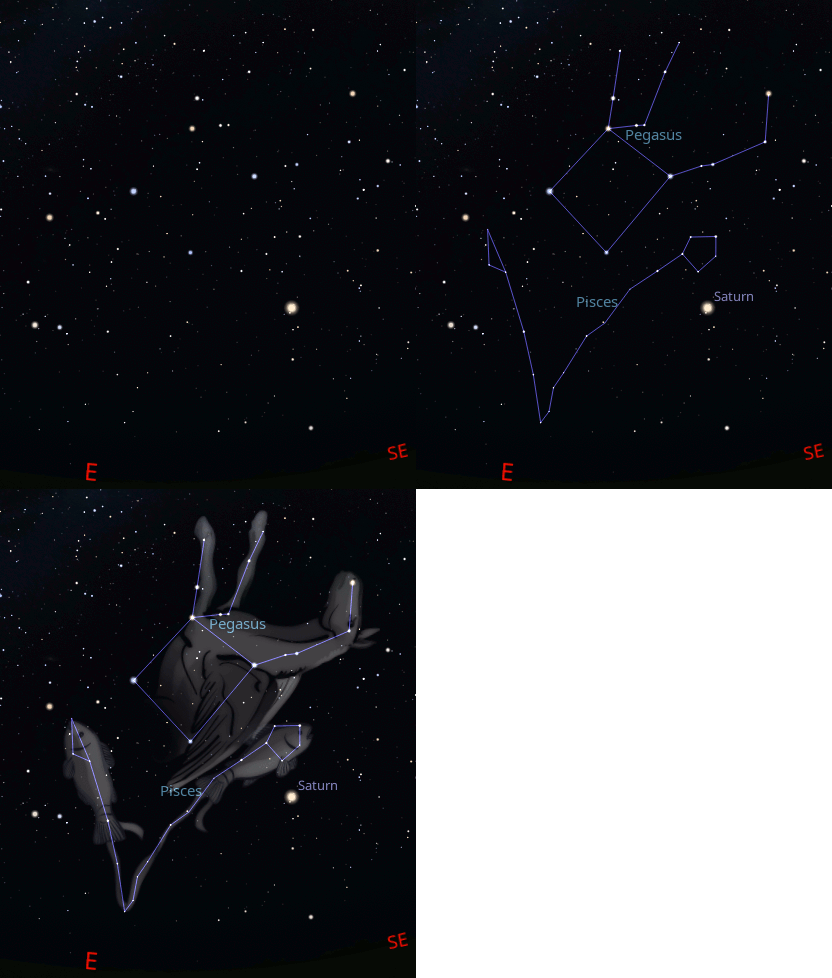
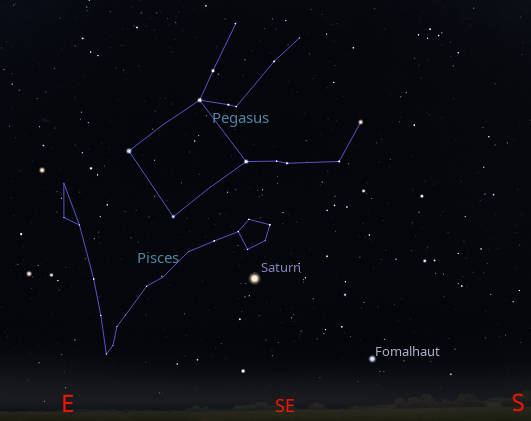
Saturn is well up in the east southeastern sky at 10 PM. This is the brightest “star” in that direction. Below it, at about the 4 o’clock position from it is Fomalhaut, which I sometimes call the loneliest star in the sky, because without Saturn or another planet in that direction it seems pretty much alone low in the south. Above and a bit to the left of Saturn is the Great Square of Pegasus A four star group standing on one corner which is the body of Pegasus the flying horse. Between Saturn and the Great Square is a faint and small circle of five or six stars called the Circlet, an asterism, which is a loop around one of the fish of Pisces the fish. Pisces is two fish held together by a long rope.
The astronomical event times given in this blog are for the Traverse City/Interlochen area of Michigan (Lat 44.7° N, Long 85.7° W; EDT, UT – 4 hours) unless stated otherwise. Times will be different for other locations.
Addendum