Archive

Archive for the ‘Observing’ Category

Ephemeris: 12/03/2024 – Jupiter begins to dominate the evening sky

December 3, 2024 Comments off

This is Ephemeris for Tuesday, December 3rd. Today the Sun will be up for 9 hours even, setting at 5:02, and it will rise tomorrow at 8:03. The Moon, 2 days past new, will set at 6:48 this evening.

The bright star that’s in the east early in the evenings isn’t a star at all, but the planet Jupiter. This giant planet is moving to be in opposition to the Sun this Saturday, which means that the Earth is directly between Jupiter and the Sun, so it’s the time that it’s closest to us. And so it’s at its largest appearing and brightest. Jupiter is the largest of the planets being about 11 times the Earth’s diameter, its volume would be 11 cubed or about 1,300 times the Earth’s volume. It is the second-brightest planet after Venus. It is also the largest appearing planet in telescopes except for a couple of months around the time when Venus is closest to the Earth. Binoculars will show that Jupiter is not quite star-like, and some of its large satellites can be also seen.

The astronomical event times given are for the Traverse City/Interlochen area of Michigan (EST, UT – 5 hours). Times will be different for other locations.

Addendum
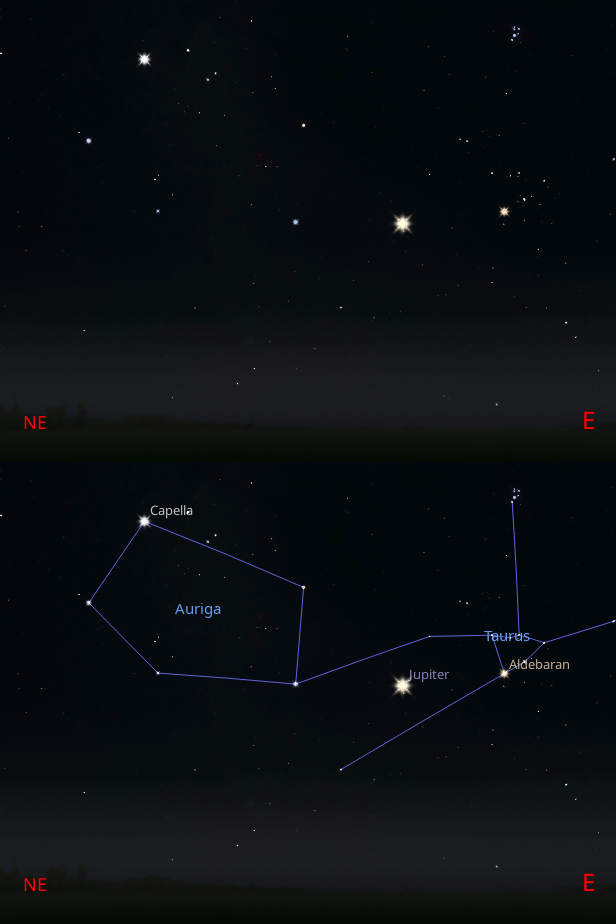
Jupiter is now seen low in the east in the early evening.
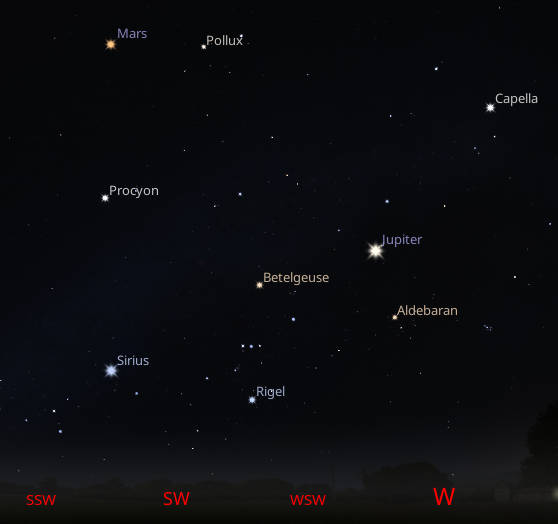
Jupiter is now seen low in the east in the early evening. It is currently located between the horns of Taurus the bull and it will stay wandering in there through the rest of its appearance until spring when it moves towards the horn tips as it sets in the west in the evening twilight. The next time we’ll see it late next year it will be in the constellation of Gemini. Created using Stellarium and GIMP.
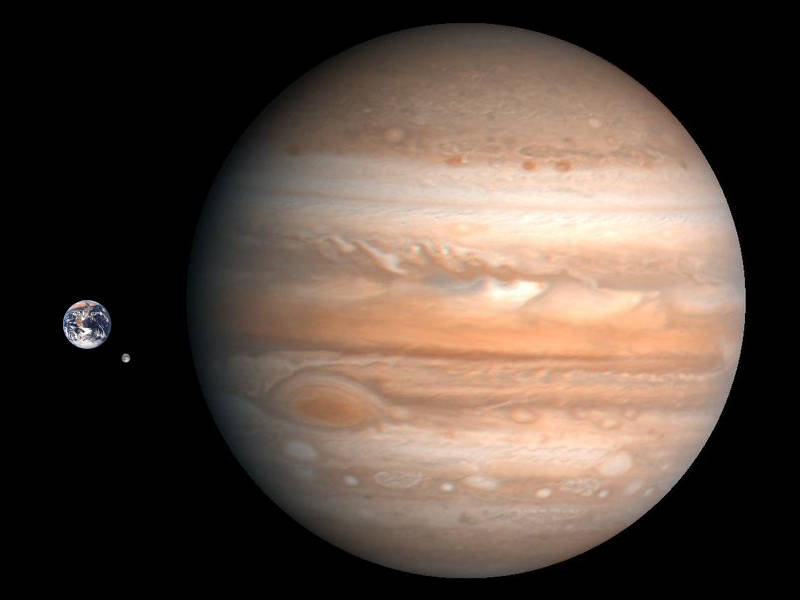
A size comparison between Jupiter, the Earth and Moon
A size comparison between Jupiter the Earth and Moon. Feel insignificant yet? Credit: NASA.

Ephemeris: 12/02/2024 – Orion is rising in the evening

December 2, 2024 Comments off

This is Ephemeris for Monday, December 2nd. Today the Sun will be up for 9 hours and 1 minute, setting at 5:03, and it will rise tomorrow at 8:02. The Moon, 1 day past new, will set at 5:47 this evening.

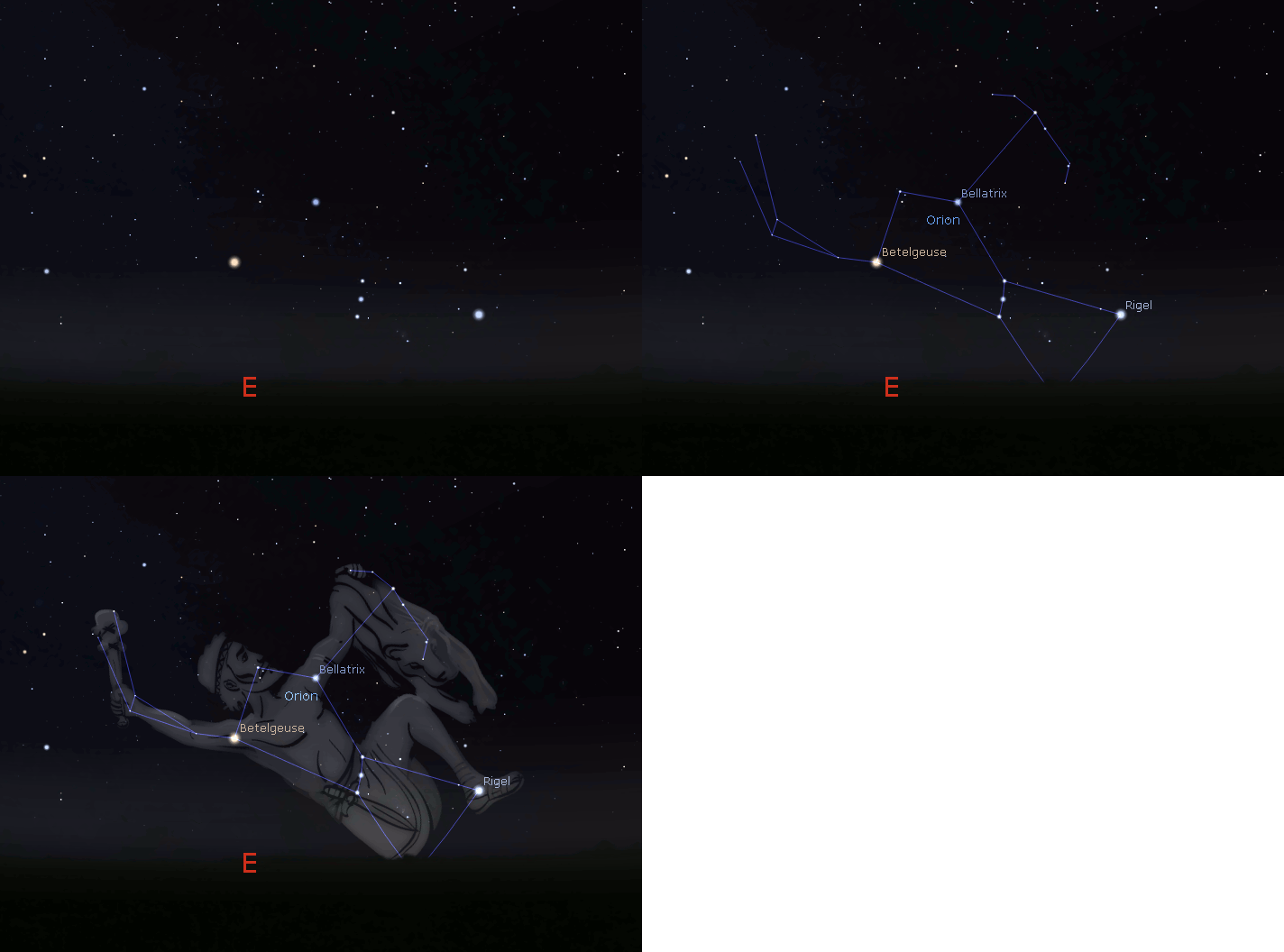
In the east, the central winter constellation Orion the hunter throws a leg over the horizon between 8 and 9 p.m. as Robert Frost told in his poem Star-Splitter. The upright rectangle that is his body on December evenings is tilted to the left as he rises, with a bright red star Betelgeuse at the top left of the rectangle, his shoulder. At the opposite corner is blue-white Rigel, a knee. In the center of the rectangle is a line of three stars nearly vertically aligned as he rises, which represents his belt. The stars of Orion’s belt are how many folks can find him. The Anishinaabek native peoples of this area call him the Wintermaker whose arms are held wide to encompass the winter stars. His rising in the evening heralds the coming of winter.

The astronomical event times given are for the Traverse City/Interlochen area of Michigan (EST, UT – 5 hours). Times will be different for other locations.

Addendum
Orion rising
Finder chart for the rising Orion at 9 PM around the beginning of December. Created using Stellarium and GIMP.

Ephemeris: 11/27/2024 – Checking up on the naked-eye planets this week

November 27, 2024 Comments off

This is Ephemeris for Wednesday, November 27th. Today the Sun will be up for 9 hours and 9 minutes, setting at 5:05, and it will rise tomorrow at 7:57. The Moon, 4 days before new, will rise at 5:23 tomorrow morning.

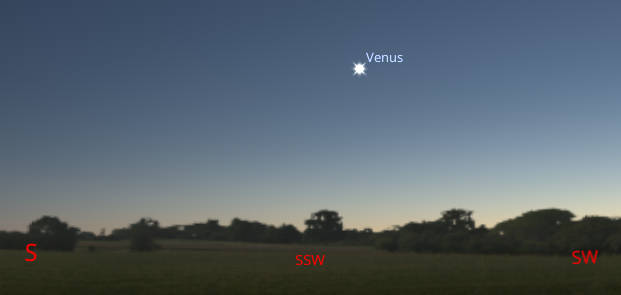
Let’s take our weekly look at the whereabouts of the naked-eye planets. Venus can be spotted low in the south-southwestern sky by 5:30 PM, about 25 minutes after sunset. It will set at 7:52. Saturn will be in the south-southeast at 6 PM. Jupiter will rise at 5:45 PM in the east northeast, and be a good object for the small telescope about an hour later. Mars, rises tonight near 9:16, Both Mars and Jupiter are considered morning planets, since they are still up at sunrise. By 6 AM tomorrow Jupiter will be in the west, above and right of Orion, while reddish Mars will be high in the southwest. Jupiter and Saturn are good planets to view with a small telescope, Mars will appear only a quarter the diameter of Jupiter.

The astronomical event times given are for the Traverse City/Interlochen area of Michigan (EST, UT – 5 hours). Times will be different for other locations.

Addendum
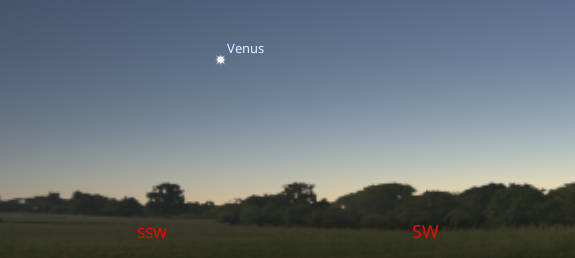
This is where Venus will appear in the south-southwest at about 5:30 PM or about 25 minutes after sunset
This is where Venus will appear in the south-southwest at about 5:30 PM or about 25 minutes after sunset. Venus is now in the part of the ecliptic where the planets travel northward as it moves eastward. So It will be seeing it higher in the sky when it’s first spotted in the evening. Created using Stellarium.
Saturn and Jupiter at 8 PM tonight, November 27, 2024. Off to the right beyond the image, Venus setting in the southwest. Click or tap on the image to enlarge it. Created using Stellarium.
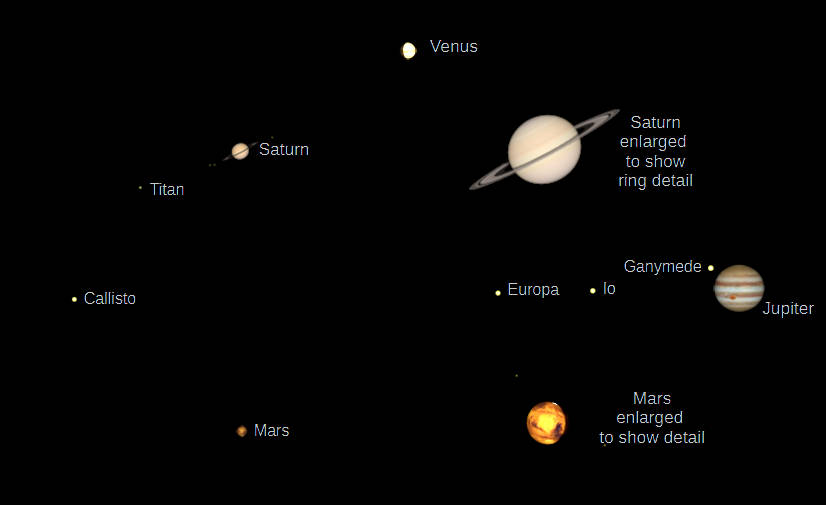
Telescopic Venus, Saturn, Jupiter and Mars (north up) as they would be seen in a small telescope with the same magnification
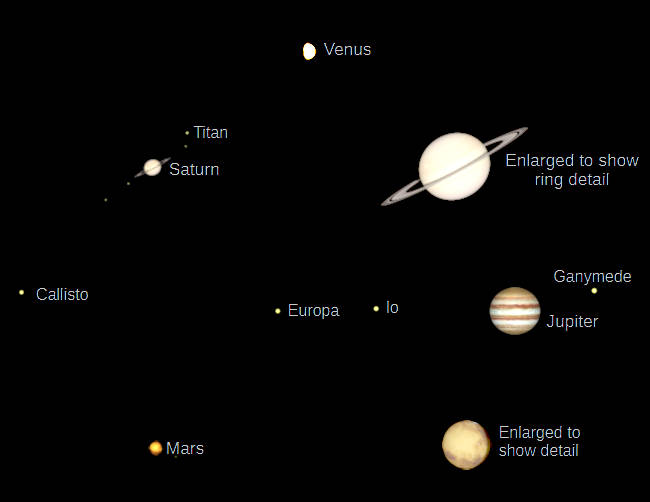
Telescopic Venus, Saturn, Jupiter and Mars (north up) as they would be seen in a small telescope with the same magnification. All the planets are shown for tonight, Jupiter specifically for 8 PM, November 27, 2024. Apparent diameters: Venus 16.8″, 68.8% illuminated; Saturn 17.5″, its rings 40.9″, 5.2 degrees from edge on (closing again); Jupiter 48.1″; Mars, 11.4″, 92.1% illuminated. Saturn’s rings are actually much brighter than depicted here. Planetary surface detail is more subtle than shown here. The ” means seconds of arc, or 1/3600th of a degree. Click or tap on the image to enlarge it. Created using Cartes du Ciel (Sky Charts).
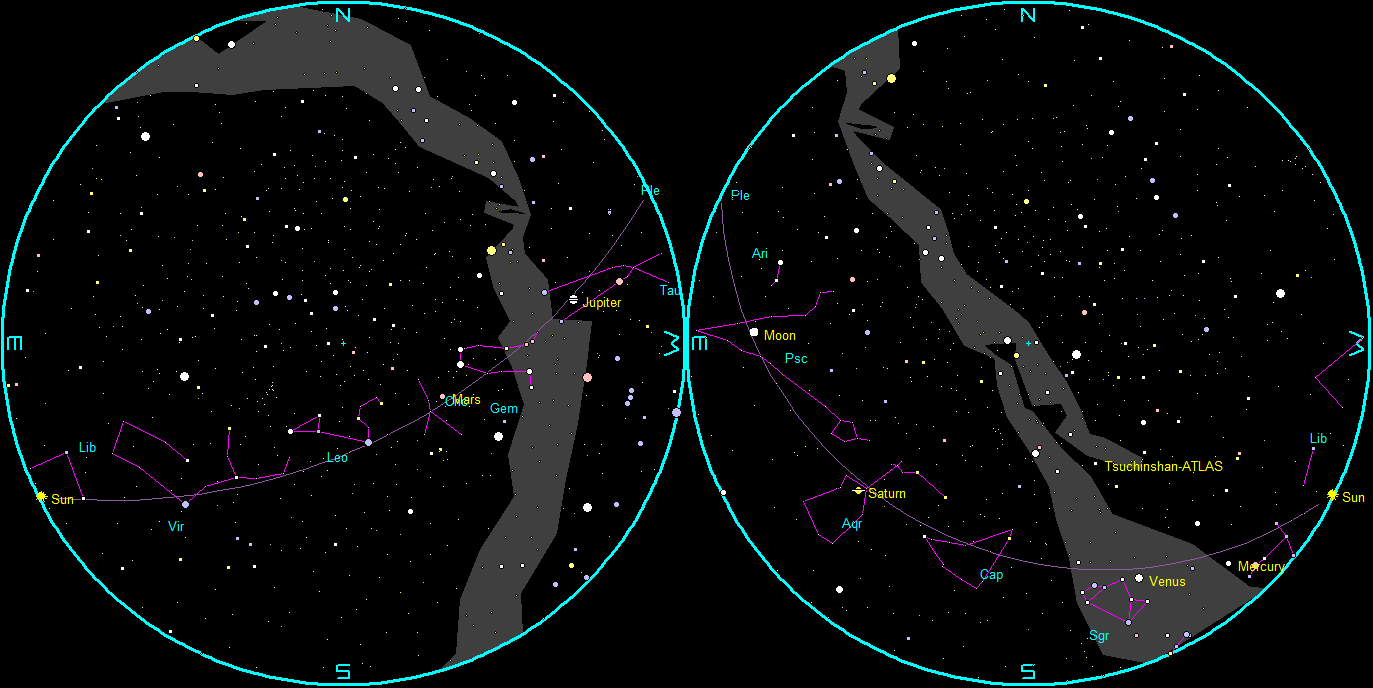
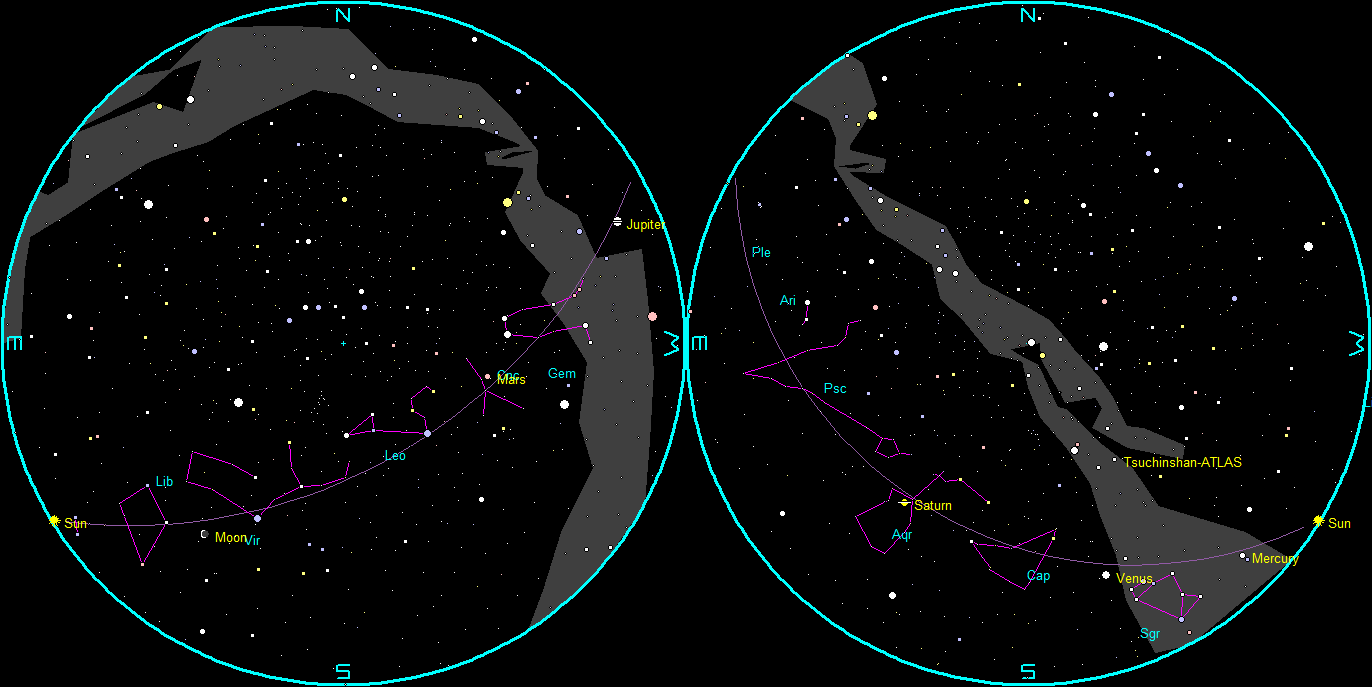
The naked-eye planets and the Moon at sunset and sunrise on a single night
The naked-eye planets and the Moon at sunset and sunrise on a single night, starting with sunset on the right on November 27, 2024. The night ends on the left with sunrise on the 28th. Click or tap on the image to enlarge it. Created using my LookingUp app and GIMP.
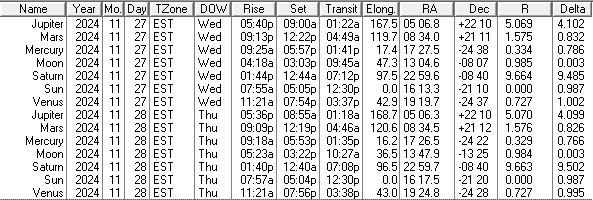
Low precision ephemeris of the Sun Moon and naked eye planet positions
This is a low precision ephemeris of the Sun Moon and naked eye planet positions for today and tomorrow, November 27 and 28, 2024. Some of the columns are self-explanatory, others not. The transit column is the time that the body crosses the meridian and is due south. Elong, for elongation, is the angle between the Sun and that body. RA is right ascension, which is the object’s east-west position on the celestial sphere in hours and minutes. Dec is declination which is the north-south position of the object on the celestial sphere in degrees and minutes. R is the distance of that object from the Sun in astronomical units. An astronomical unit is about 93 million miles or 150 million kilometers. And Delta is the distance of that object from the Earth, also in astronomical units. I omit the ‘m’ in am and pm for compactness. The data was generated using my LookingUp for DOS app and displayed as a table by my Ephemeris Helper app.

Ephemeris: 11/26/2024 – Finding the celestial charioteer and his goats

November 26, 2024 Comments off

This is Ephemeris for Tuesday, November 26th. Today the Sun will be up for 9 hours and 11 minutes, setting at 5:05, and it will rise tomorrow at 7:55. The Moon, 4 days past last quarter, will rise at 4:18 tomorrow morning.

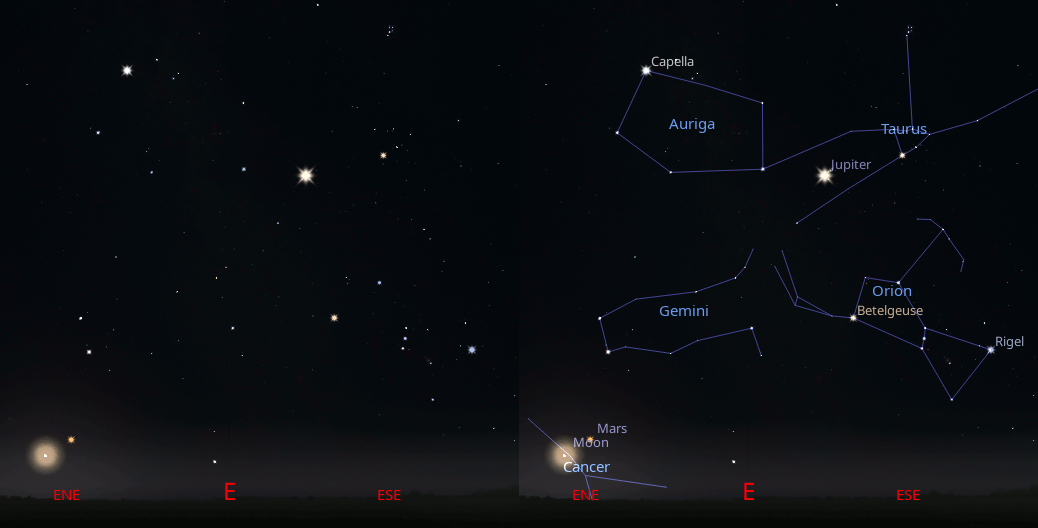
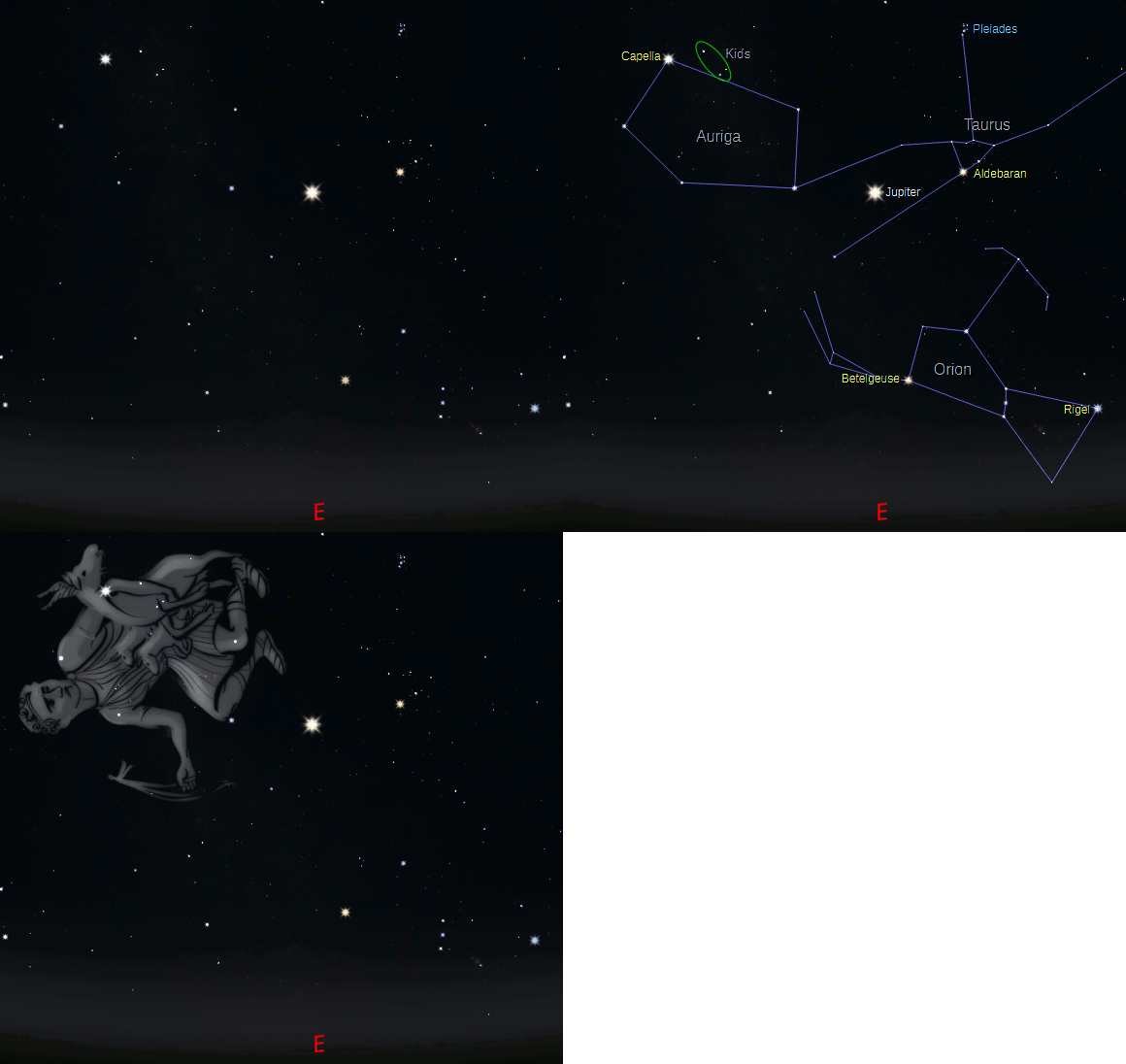
The constellation Auriga the charioteer is halfway up the sky in the east northeast at 9 p.m. It is a pentagon of stars, with the brilliant star Capella at the upper left of its corners. Capella represents a mama goat he’s carrying. A narrow triangle of stars just right of Capella are her kids, that is her baby goats. The Kids is an informal constellation or asterism. The Milky Way runs through Auriga, but it’s not very bright here. We are looking away from the center of the Milky Way to the more sparse outer parts of our galaxy. Within and near that pentagon, one can sweep with binoculars and low power telescopes to find several star clusters, groups of hundreds of stars born in the clump we still see them in. These star clusters will appear as fuzzy spots in binoculars.
The astronomical event times given are for the Traverse City/Interlochen area of Michigan (EST, UT – 5 hours). Times will be different for other locations.

Addendum
An animated Finder chart for Auriga the charioteer in three frames
An animated Finder chart for Auriga the charioteer in three frames. 1st is the sky looking East as you would see it. 2nd frame shows constellation lines and labels for stars and planets. 3rd is Stellarium’s constellation art for the charoiteer and the goats he’s carrying. This is for 9:00 PM on November 26, 2024. Created using Stellarium, LibreOffice Draw, and GIMP.

Ephemeris: 11/25/2024 – How to find Taurus the bull

November 25, 2024 Comments off

This is Ephemeris for Monday, November 25th. Today the Sun will be up for 9 hours and 12 minutes, setting at 5:06, and it will rise tomorrow at 7:54. The Moon, 3 days past last quarter, will rise at 3:15 tomorrow morning.

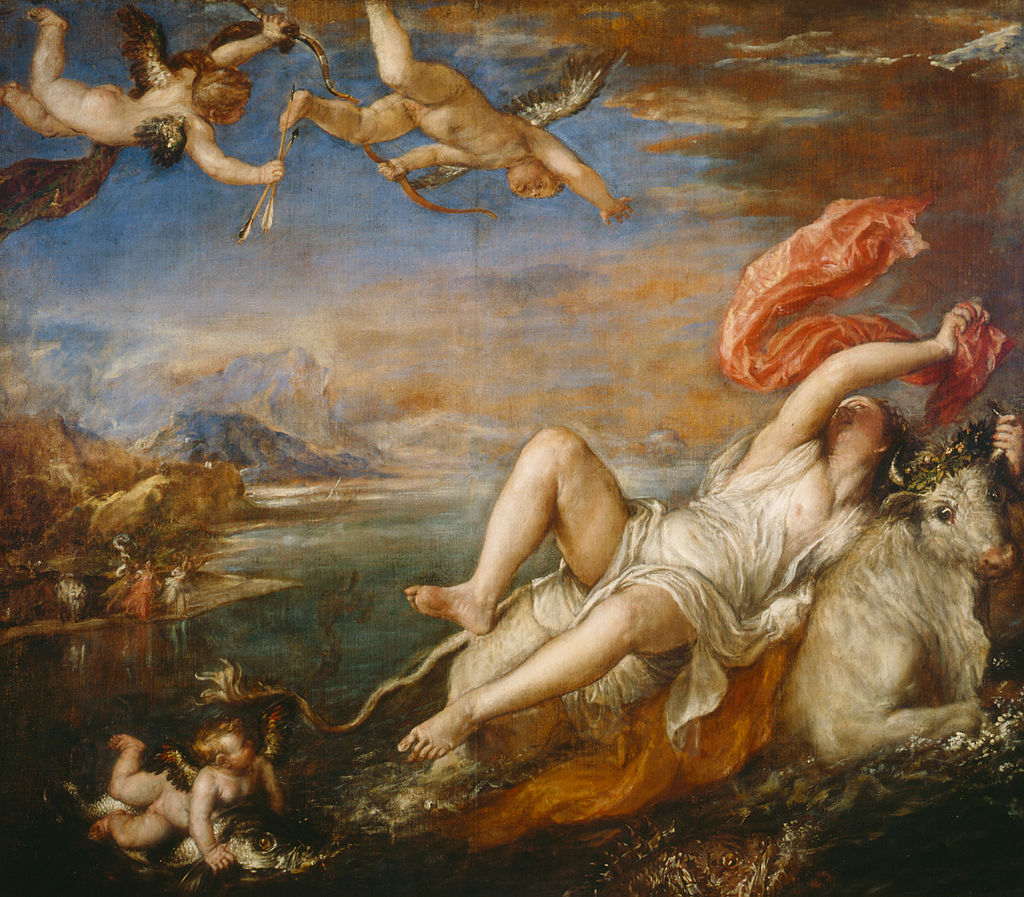
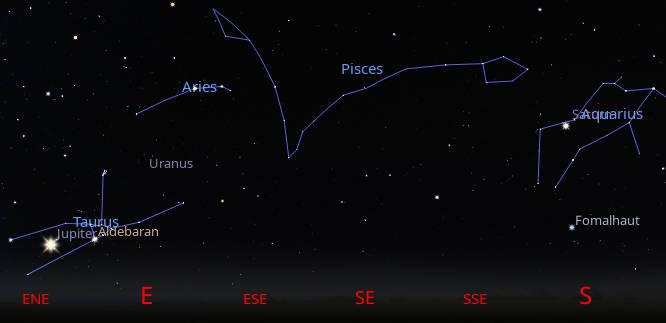
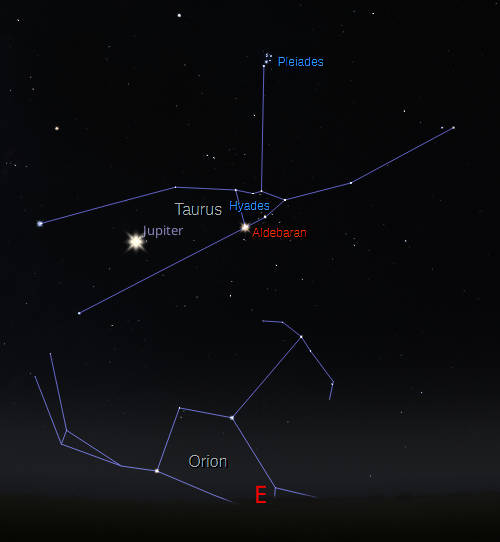
Low in the east at 8 this evening and below the beautiful Pleiades star cluster is Taurus the bull. His face is a letter V shape of stars lying on its side, the star cluster Hyades, with the bright orange-red star Aldebaran at one tip of the V as its angry bloodshot eye. Aldebaran is actually about halfway between us and the cluster. Tonight it is to the right of the brilliant planet Jupiter. The Pleiades star cluster is in his shoulder. Taurus is seen charging downward at that hour, the rising constellation of Orion. Taurus in Greek mythology was the form the god Zeus assumed when he carried off the maiden Europa. Europa’s still with him as a moon orbiting Zeus’ Roman equivalent, the planet Jupiter.

The astronomical event times given are for the Traverse City/Interlochen area of Michigan (EST, UT – 5 hours). Times will be different for other locations.

Addendum
Finding Taurus the bull tonight, November 25 2024, is easy
Finding Taurus the bull tonight, November 25 2024, is easy. Just look for Jupiter in the east. It lies between the long horns of Taurus. The Pleiades star cluster is in his shoulder, and the Hyades star cluster this is face, with Aldebaran as his angry bloodshot eye. He is charging Orion, just rising. Created using Stellarium LibreOffice draw, and GIMP.
Rape of Europa
The Rape of Europa by Titian. According to the story Zeus as a bull abducted Europa and swam to Crete, where she became the first queen of that island, and bore him three sons. Other paintings of this subject are by Rembrandt and de Troy. This painting belongs to the Isabella Stewart Gardener Museum in Boston, MA.

Ephemeris: 11/22/2024 – Finding Aquarius

November 22, 2024 Comments off

This is Ephemeris for Friday, November 22nd. Today the Sun will be up for 9 hours and 18 minutes, setting at 5:08, and it will rise tomorrow at 7:50. The Moon, at last quarter today, will rise at 12:04 tomorrow morning.

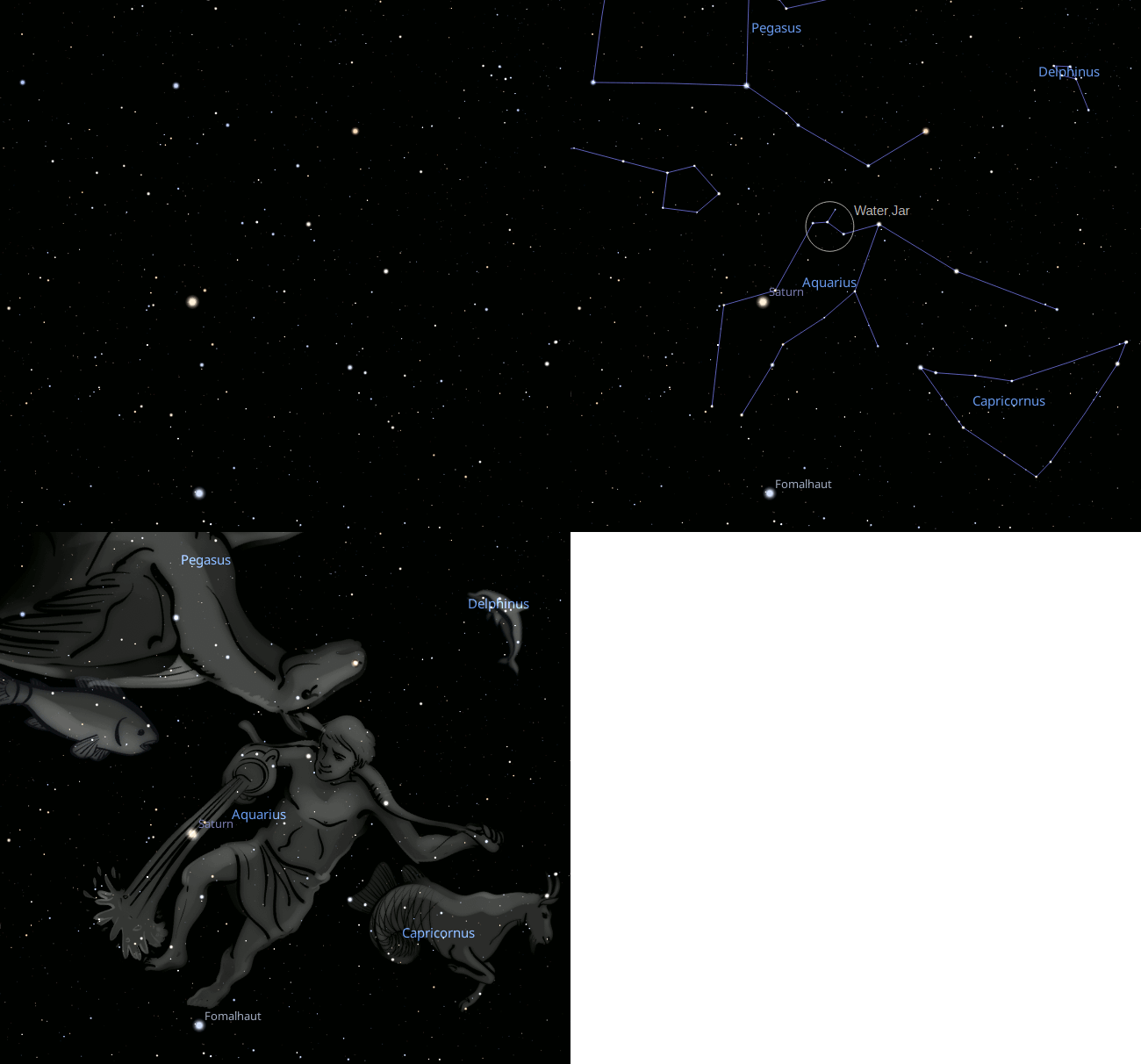
One of the constellations of the zodiac is in the southern sky at 8 in the evening, where Saturn is located this year. It’s the constellation of Aquarius, the water bearer. The image that is supposed to be depicted in the stars is that of a fellow carrying a stone jar of water. Aquarius is fairly hard to spot because it is made of faint stars. One part of him, though, is easier to spot. That is the Water Jar, an asterism or informal constellation. It is a distinctive small nearly equilateral triangle of stars with another star in the center. Aquarius is not a very good water bearer because he’s spilling the water out of his jar. The Water jar is above and to the right of Saturn this year and the water is flowing down a line of stars to the lower left.

The astronomical event times given are for the Traverse City/Interlochen area of Michigan (EST, UT – 5 hours). Times will be different for other locations.

Addendum
An animated finder chart for the constellation Aquarius
An animated finder chart for the constellation Aquarius. This year the planet Saturn is a good pointer to the constellation. In other years it can be found sandwiched between the head of Pegasus the flying horse above and the star Fomalhaut to the south. Aquarius’ stars are mostly rather faint, but the one pattern that does stand out is the asterism called the Water Jar which is circled in the animation. Created using Stellarium, LibreOffice Draw, and GIMP.

Ephemeris: 11/20/2024 – Our weekly look at the naked-eye planets

November 20, 2024 Comments off

This is Ephemeris for Wednesday, November 20th. Today the Sun will be up for 9 hours and 22 minutes, setting at 5:09, and it will rise tomorrow at 7:48. The Moon, 2 days before last quarter, will rise at 9:45 this evening.

Let’s take our weekly look at the whereabouts of the naked-eye planets. Venus can be spotted low in the southwestern sky by 5:30 PM, about 20 minutes after sunset. It will set at 7:41. Saturn will be in the south-southeast at 6 PM. Jupiter will rise at 6:11 PM in the east northeast, and be a good object for the small telescope about an hour later. Mars, rises tonight near 9:36, just ahead of the Moon and will be leading it through the night skies tonight. By 6:00 AM tomorrow Jupiter will be in the west, above and right of Orion, while reddish Mars will be high in the southwest to the right of the waning gibbous Moon. Jupiter and Saturn are good planets to view with a small telescope, Mars will appear only a quarter the diameter of Jupiter.

The astronomical event times given are for the Traverse City/Interlochen area of Michigan (EST, UT – 5 hours). Times will be different for other locations.

Addendum
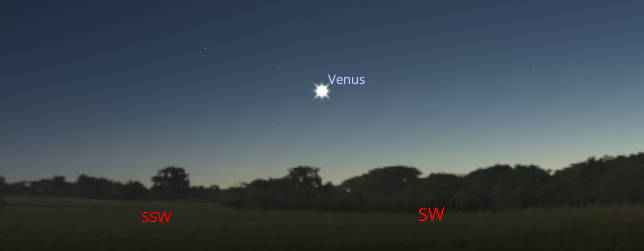
Venus will appear in the south-southwest at about 5:30 PM or about 20 minutes after sunset
This is where Venus will appear in the south-southwest at about 5:30 PM or about 20 minutes after sunset. Venus is now in the part of the ecliptic where the planets travel northward as it moves eastward. So It will be seeing it higher in the sky when it’s first spotted in the evening. Created using Stellarium.
Saturn finder animation
Saturn and the star Fomalhaut as they would appear at 8 PM this evening in the south. This is a chart from yesterday’s post. There is no real change from then. Created using Stellarium and GIMP.
A finder animation for Jupiter, Mars and the Moon
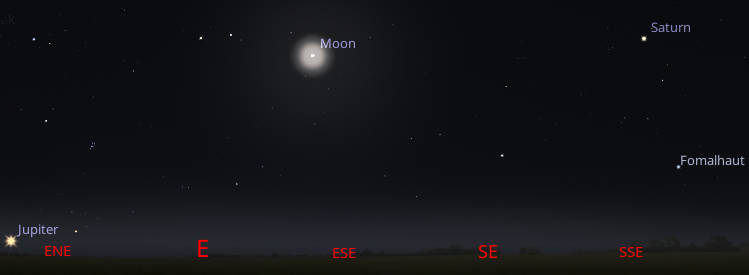
A finder animation for Jupiter, Mars and the Moon for 10:30 PM this evening, November 20, 2024. They’re located among the winter constellations that are rising in the late evening. We are a month and a day from the beginning of winter. Created using Stellarium and GIMP.
The Moon as it might appear through a small telescope tonight
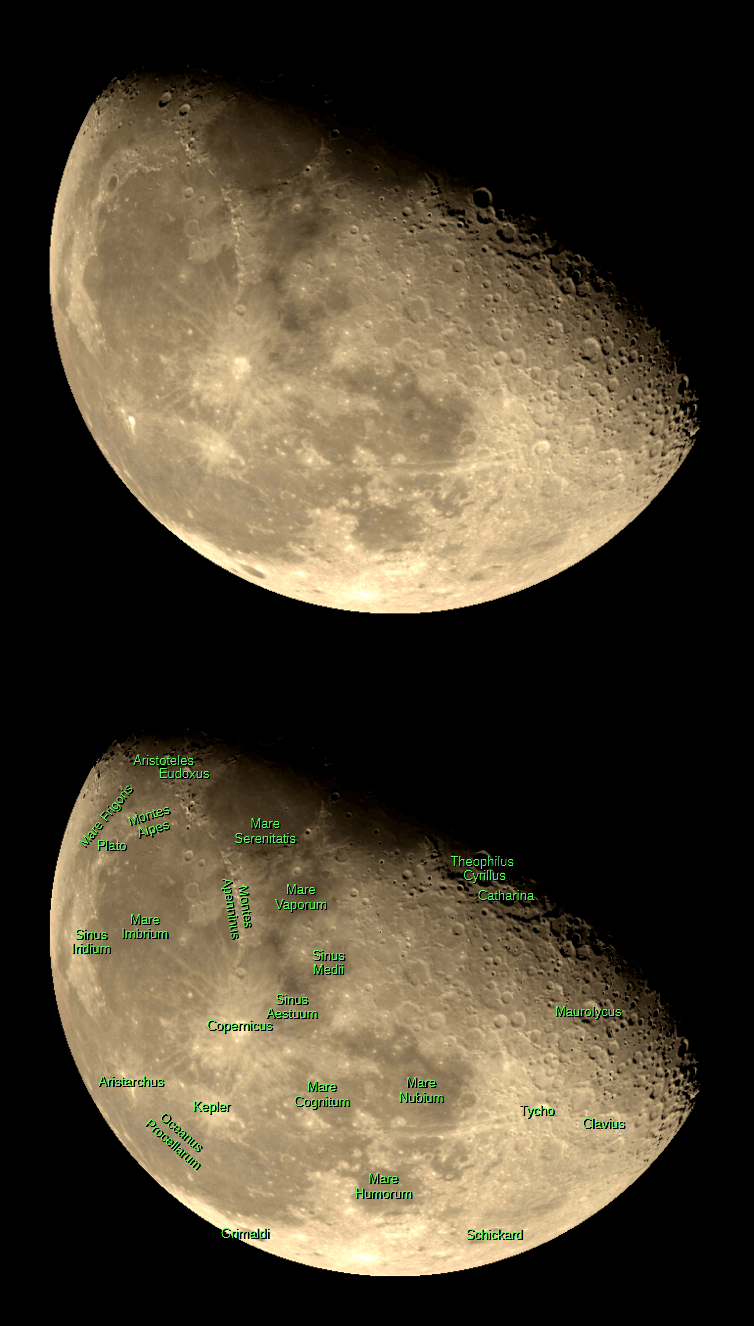
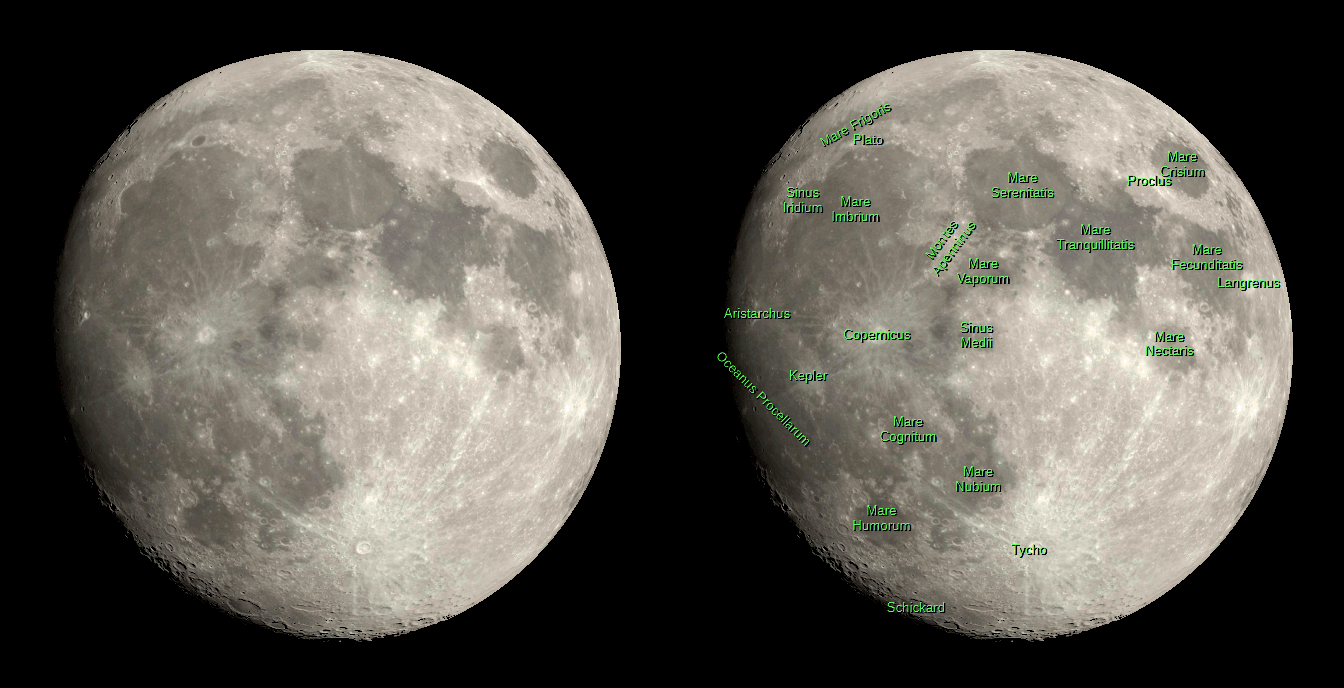
The Moon as it might appear through a small telescope tonight, November 20, 2024. Selected features are labeled. Created using Stellarium, LibreOffice draw, and GIMP.
Telescopic Venus, Saturn, Jupiter and Mars
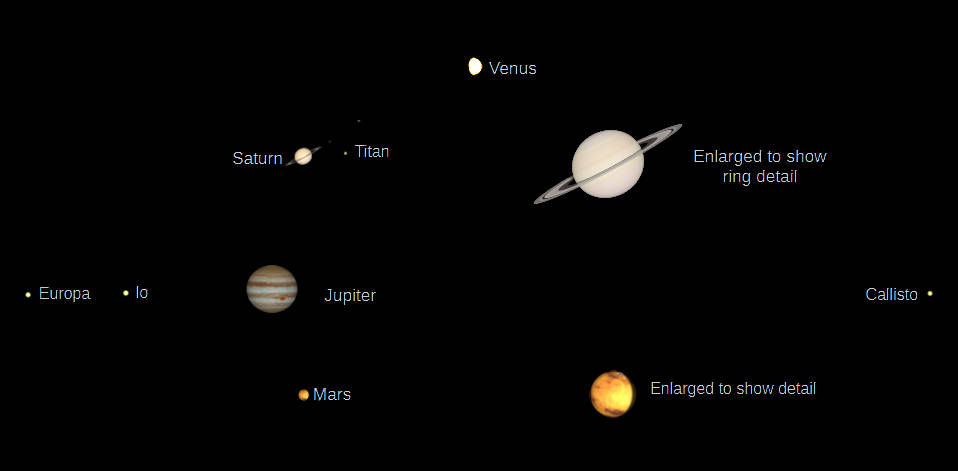
Telescopic Venus, Saturn, Jupiter and Mars (north up) as they would be seen in a small telescope with the same magnification. All the planets are shown for tonight, November 20, 2024 at 11 PM EST. Apparent diameters: Venus 16.0″, 71.1% illuminated; Saturn 17.8″, its rings 41.3″, 5.2 degrees from edge on (starting to close again); Jupiter 47.8″; Mars, 10.7″, 91.0% illuminated. Saturn’s rings are actually much brighter than depicted here. Planetary surface detail is more subtle than shown here. Jupiter’s moon Ganymede is behind the planet, but will appear on the Io and Eurolpa side of the planet at 11:16 PM. The ” symbol means seconds of arc, or 1/3600th of a degree. Click or tap on the image to enlarge it. Created using Cartes du Ciel (Sky Charts).
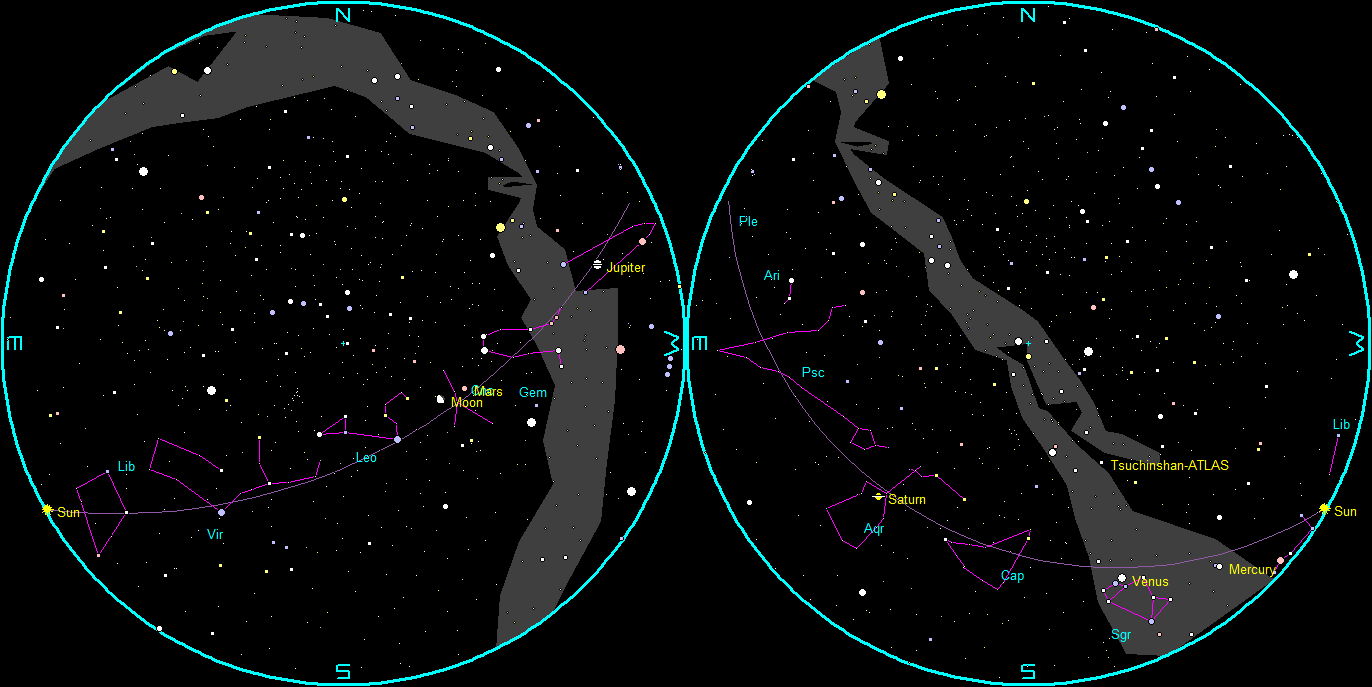
The naked-eye planets and the Moon at sunset and sunrise on a single night, starting with sunset on the right on November 20, 2024. The night ends on the left with sunrise on the 21st. Click or tap on the image to enlarge it. Created using my LookingUp app and GIMP.
Low precision ephemeris of the Sun Moon and naked eye planet positions for today and tomorrow
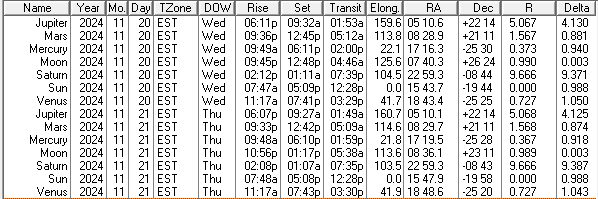
This is a low precision ephemeris of the Sun Moon and naked eye planet positions for today and tomorrow, November 20 and 21, 2024. Some of the columns are self-explanatory, others not. The transit column is the time that the body crosses the meridian and is due south. Elong, for elongation, is the angle between the Sun and that body. RA is right ascension, which is the object’s east-west position on the celestial sphere in hours and minutes. Dec is declination which is the north-south position of the object on the celestial sphere in degrees and minutes. R is the distance of that object from the Sun in astronomical units. An astronomical unit is about 93 million miles or 150 million kilometers. And Delta is the distance of that object from the Earth, also in astronomical units. I omit the ‘m’ in am and pm for compactness. The data was generated using my LookingUp for DOS app and displayed as a table by my Ephemeris Helper app.

Ephemeris: 11/19/2024 – The loneliest star in the sky

November 19, 2024 Comments off

This is Bob Moler with Ephemeris for Tuesday, November 19th. Today the Sun will be up for 9 hours and 24 minutes, setting at 5:10, and it will rise tomorrow at 7:47. The Moon, 3 days before last quarter, will rise at 8:32 this evening.

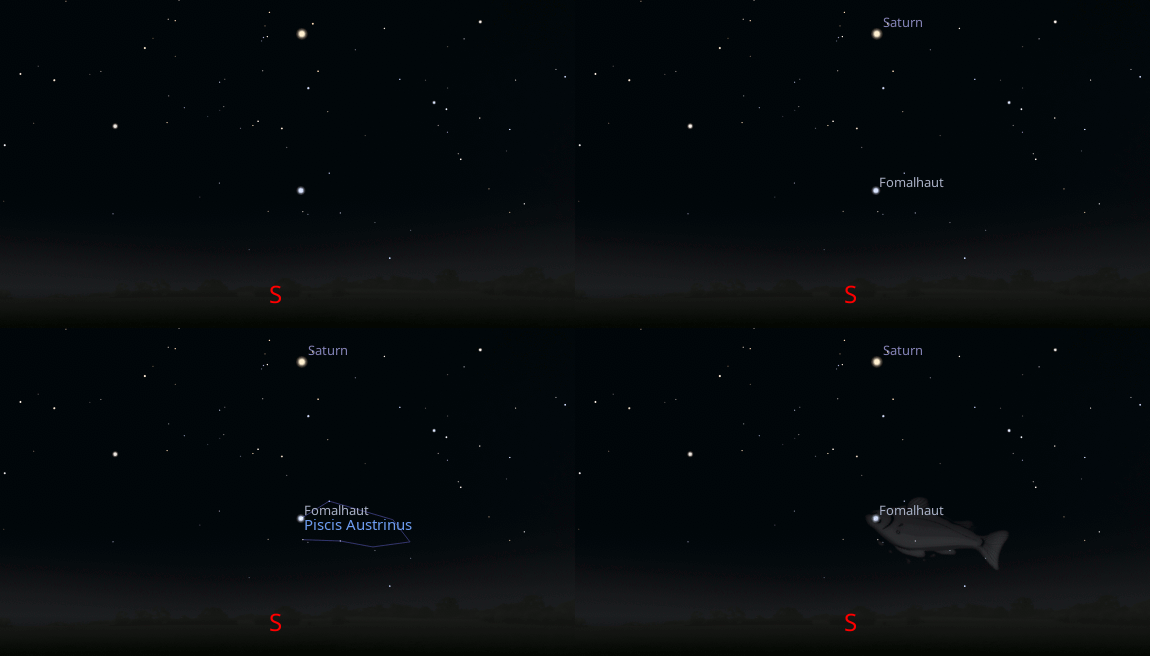
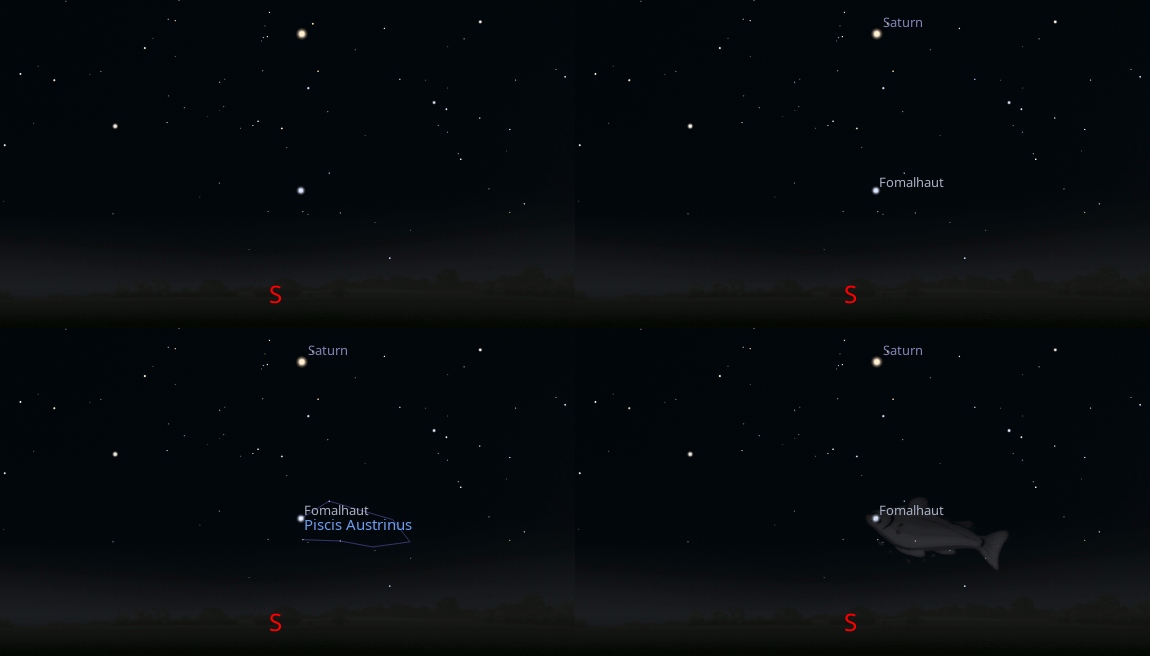
There’s a bright star that appears for only seven and a half hours on autumn evenings. Its appearance, low in the south-southeast at 8 p.m., is a clear sign that autumn is here. It is currently far below the much brighter Saturn. The star’s name is Fomalhaut, which means fish’s mouth. That’s fitting because it’s in the constellation of Piscis Austrinus, the southern fish. At our latitude it’s kind of the fish that got away, because usually Fomalhaut appears to be quite alone low in the sky. For the last few years Jupiter and then Saturn have kept it company. In a couple of years Saturn will have moved on leaving Fomalhaut to its lonely vigil in the south.

The astronomical event times given are for the Traverse City/Interlochen area of Michigan (EST, UT – 5 hours). Times will be different for other locations.

Addendum
A Fomalhaut finder chart in four frames
A Fomalhaut finder chart in four frames, showing just the stars and the planet Saturn; Saturn and Fomalhaut labeled; the constellation outlined and labeled; and lastly, the fish as imagined by the Stellarium artist.. For 8 PM this evening, November 19 2024. Created using Stellarium and GIMP.

Ephemeris: 11/13/2024 – Looking for the naked-eye planets this week

November 13, 2024 Comments off

This is Ephemeris for Wednesday, November 13th. Today the Sun will be up for 9 hours and 38 minutes, setting at 5:16, and it will rise tomorrow at 7:39. The Moon, 2 days before full, will set at 6:03 tomorrow morning.

Let’s take our weekly look at the whereabouts of the naked-eye planets. Venus can be spotted low in the southwestern sky by 6 PM, about 45 minutes after sunset. It will set at 7:30. Saturn will be in the south-southeast at 7 PM. Jupiter will rise at 6:42 PM in the east northeast, and be a good object for the small telescope about an hour later. By 6:00 AM tomorrow Jupiter will be high in the west, above and right of Orion, while reddish Mars, which rises tonight near 9:56, will be high in the south-southwest. Jupiter and Saturn are good planets to view with a small telescope, while Venus and Mars will appear very small and featureless. These last two will improve next year when they move closer to us.

The astronomical event times given are for the Traverse City/Interlochen area of Michigan (EST, UT – 5 hours). Times will be different for other locations.

Addendum
Venus as it might appear tonight at 6 PM, about 45 minutes after sunset, low in the southwest. Venus is now as far South in the sky as it will get and will now begin to move northward. From now until the end of the year it will rise higher and higher in the sky in the evening. Its greatest eastern separation, or elongation, from the Sun will occur on January 2nd. Created using Stellarium.
Saturn, the Moon with Jupiter rising at 7 PM. Off to the right beyond the image, Venus setting in the southwest. Click or tap on the image to enlarge it. Created using Stellarium.
The Moon as it might appear through a small telescope tonight, November 13, 2024. Selected features are labeled. Created using stellarium, LibreOffice draw, and GIMP.
Jupiter and Mars among the stars of winter seen in the southwestern sky at 6 AM, or about an hour and a half before sunrise, tomorrow morning November 14, 2024. Created using Stellarium.
Telescopic Venus, Saturn, Jupiter and Mars (north up) as they would be seen in a small telescope with the same magnification. All the planets except Mars are shown for tonight, November 13, 2024, Mars for tomorrow morning the 14th. Apparent diameters: Venus 15.3″, 73.3% illuminated; Saturn 18.0″, its rings 41.9″, 5.3 degrees from edge on (starting to close again); Jupiter 47.4″; Mars, 10.2″, 90.1% illuminated. Saturn’s rings are actually much brighter than depicted here. Plan etary surface detail is more subtle than shown here. The ” means seconds of arc, or 1/3600th of a degree. Click or tap on the image to enlarge it. Created using Cartes du Ciel (Sky Charts).
The naked-eye planets and the Moon at sunset and sunrise on a single night, starting with sunset on the right on November 13, 2024. The night ends on the left with sunrise on the 14th. Click or tap on the image to enlarge it. Created using my LookingUp app and GIMP.
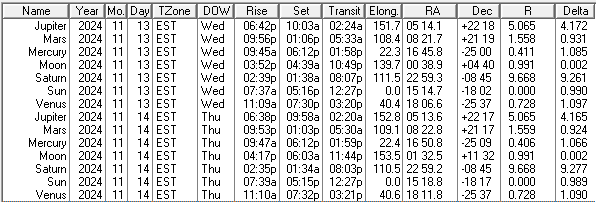
This is a low precision ephemeris of the Sun Moon and naked eye planet positions for today and tomorrow, November 13 and 14, 2024. Some of the columns are self-explanatory, others not. The transit column is the time that the body crosses the meridian and is due south. Elong, for elongation, is the angle between the Sun and that body. RA is right ascension, which is the object’s east-west position on the celestial sphere in hours and minutes. Dec is declination which is the north-south position of the object on the celestial sphere in degrees and minutes. R is the distance of that object from the Sun in astronomical units. An astronomical unit is about 93 million miles or 150 million kilometers. And Delta is the distance of that object from the Earth, also in astronomical units. I omit the ‘m’ in am and pm for compactness. The data was generated using my LookingUp for DOS app and displayed as a table by my Ephemeris Helper app.

Ephemeris: 11/11/2024 – Still waiting for the promised nova

November 11, 2024 Comments off

This is Ephemeris for Veterans Day, Monday, November 11th. Today the Sun will be up for 9 hours and 43 minutes, setting at 5:18, and it will rise tomorrow at 7:36. The Moon, 2 days past first quarter, will set at 3:19 tomorrow morning.

We’ve been waiting all year so far for the appearance of a nova or Blaze Star, as they called it, in the constellation of Corona Borealis. The astronomical name For it is T Coronae Borealis or T CrB for short. It last erupted in 1946 and the time before that it was 1866 an interval of 80 years. This year would be 78 years since 1946 so we could be waiting another two years. Observations of the star, which is still visible, though faint, between eruptions, were not as comprehensive in the prior 80 years, as they are today. It’s possible that observations of pre-nova activity were missed during war years preceding the 1946 outburst.

The astronomical event times given are for the Traverse City/Interlochen area of Michigan (EST, UT – 5 hours). Times will be different for other locations.

Addendum
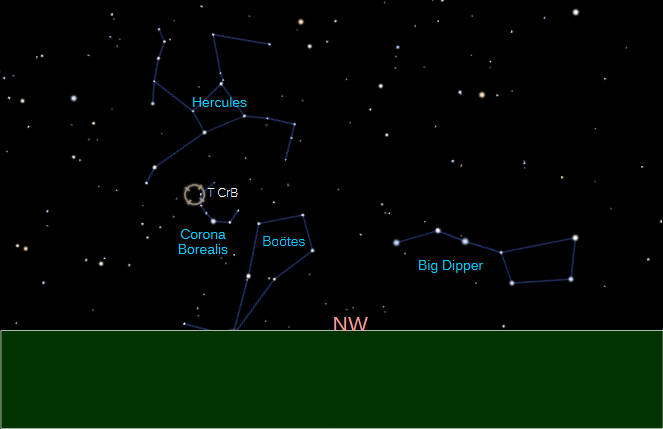
A Finder for the location of the nova, or Blaze Star, T Coronae Borealis or T CrB (when it happens), for the early evening now
A Finder for the location of the nova, or Blaze Star, T Coronae Borealis or T CrB (when it happens), for the early evening now. Corona Borealis is a small horseshoe shaped constellation whose brightest star Alphecca is just above the “n” in Corona. It is a second magnitude star about the same brightness as the nova will get at its peak. After late November the best time to see the nova, if it occurs then, will be in the morning sky just before sunrise. Though the nova is not circumpolar, meaning it rises and sets, it is up in the sky for 16 of the 24 hours of the day, so we will never completely lose it to daylight. When the Nova explosion occurs it will be visible to the naked eye for about a week so it’s easy to miss in time and also, in Northern Michigan due to the winter weather, we could miss it because of clouds. But as I mentioned in the program script above we are currently about two years away from the nominal time between between explosions, so we still have a couple of years to go before 80 years are up. Created using Stellarium, and LibreOffice Draw.