Archive
Ephemeris: 01/22/2025 – Let’s take our weekly look at the whereabouts of the naked-eye planets
This is Ephemeris for Wednesday, January 22nd. Today the Sun will be up for 9 hours and 26 minutes, setting at 5:38, and it will rise tomorrow at 8:10. The Moon, 1 day past last quarter, will rise at 3:07 tomorrow morning.
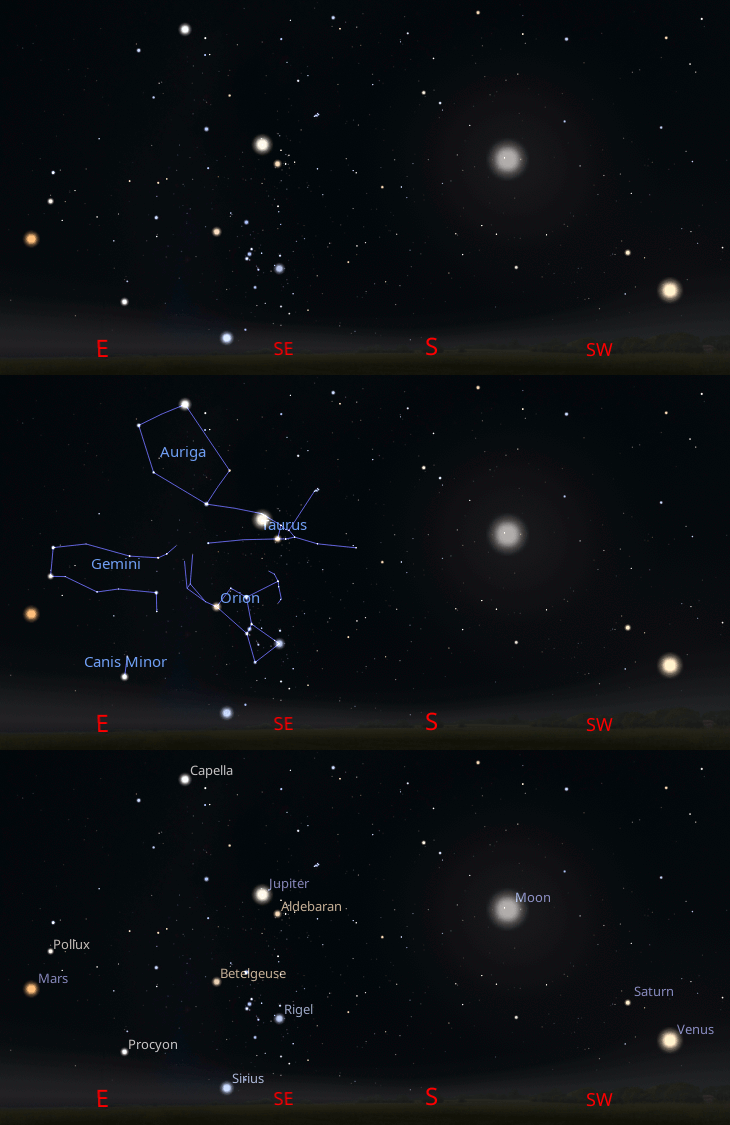
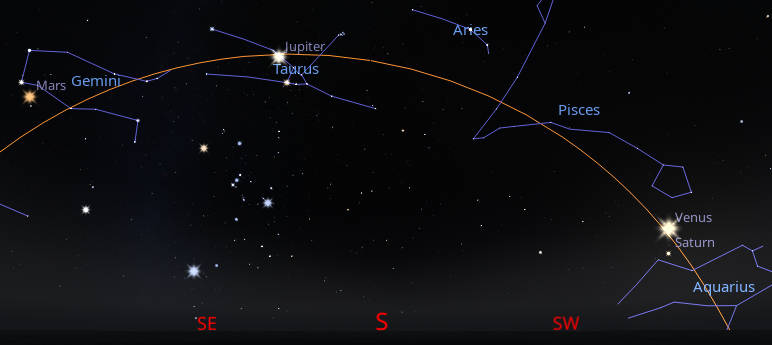
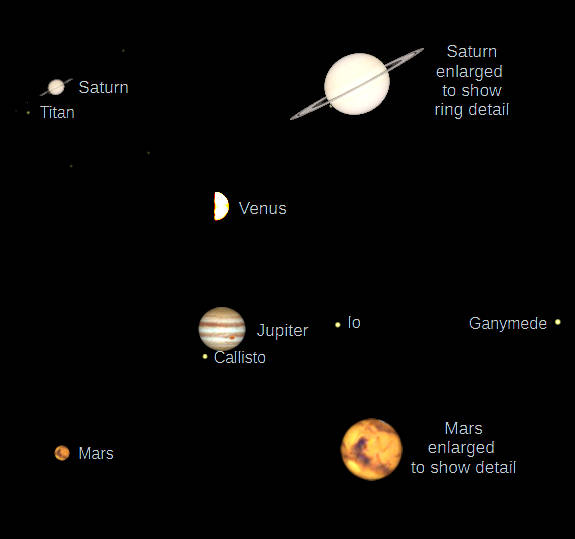
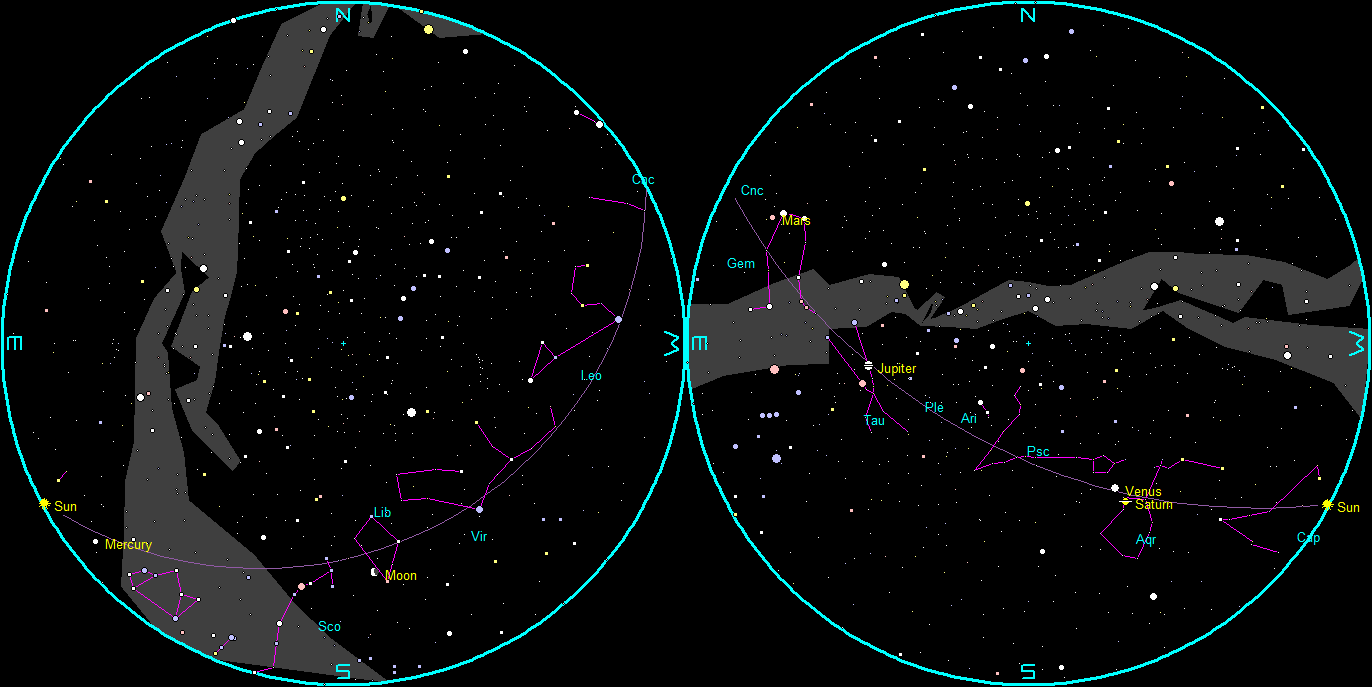
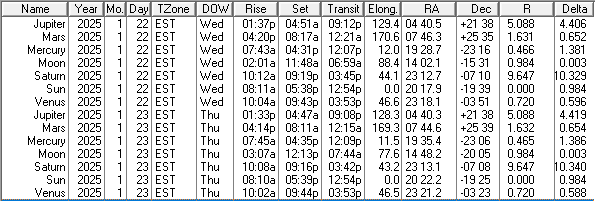
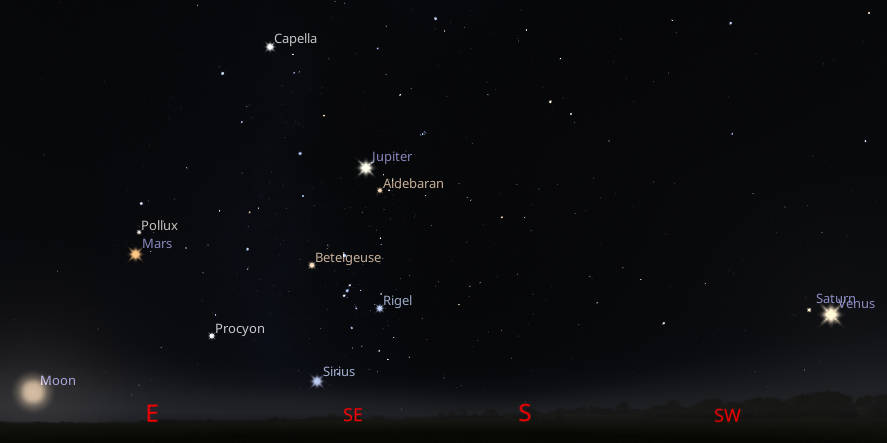
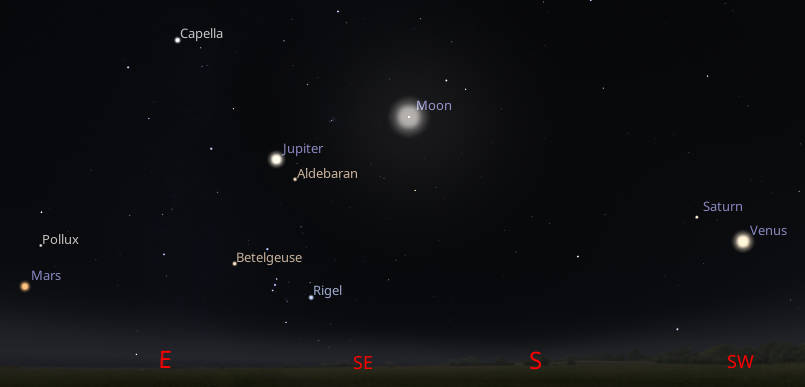
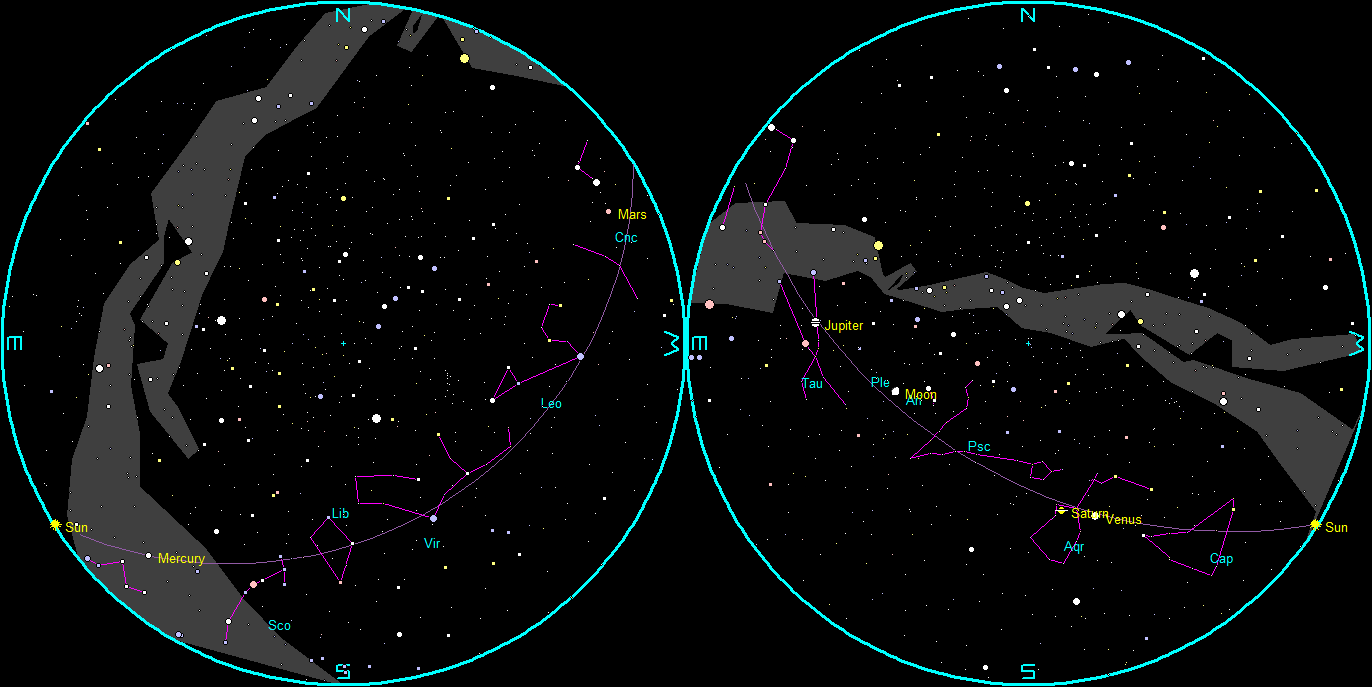
Let’s take our weekly look at the whereabouts of the naked-eye planets. At 8 PM this evening four of the five naked eye planets will be out. Starting from the West we have Venus the brightest of all low in the west southwest. Directly below it will be the much dimmer Saturn. Jupiter, the second-brightest planet will be high in the southeast. Below and right of it is the letter V shape of stars that is the head of Taurus the bull. Farther below is the spectacular constellation of Orion the hunter. The 4th planet out is Mars, the third brightest planet now, with its distinctive reddish hue, near the star Pollux in Gemini. The fifth naked eye planet, Mercury, is too close to the Sun in the morning to be visible.
The astronomical event times given are for the Traverse City/Interlochen area of Michigan (EST, UT – 5 hours). Times will be different for other locations.
Addendum
Ephemeris: 01/21/2025 – How to find the Great Orion Nebula
This is Ephemeris for Tuesday, January 21st. Today the Sun will be up for 9 hours and 24 minutes, setting at 5:36, and it will rise tomorrow at 8:11. The Moon, at last quarter today, will rise at 2:01 tomorrow morning.
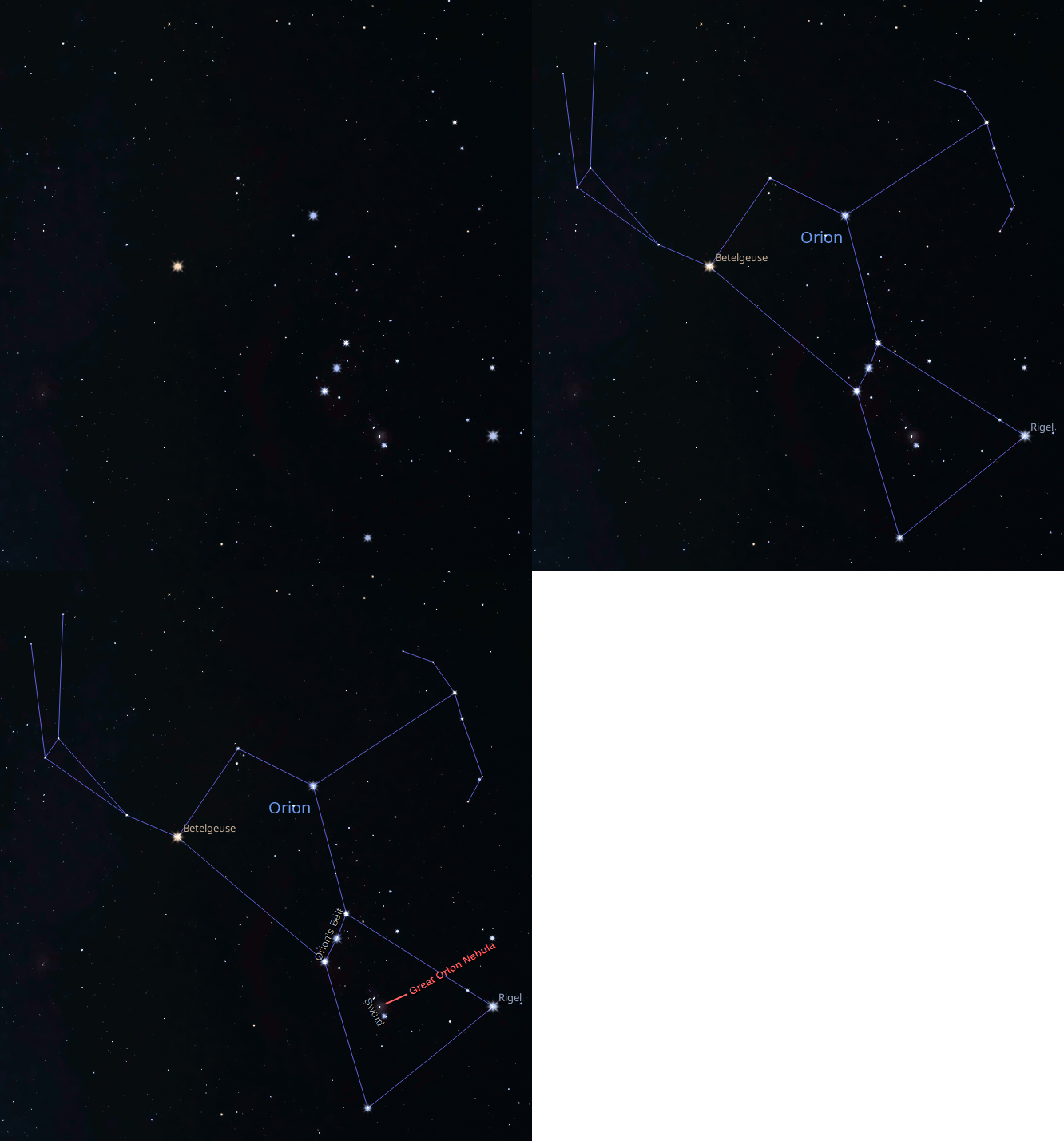
The constellation Orion the hunter is in the southeast at 8 PM. Its rectangle of four stars lean to the left and frame his belt of three stars in a straight line in the center of the rectangle. Below the belt is what appear to the unaided eye as three more stars arranged in a shorter straight line, his sword. Binoculars aimed at the middle stars of the sword will find a glowing haze around those stars. That is the Great Orion Nebula, also known as Messier 42 or M 42. It is the birthplace of stars, illuminated by a clutch of four hot young stars. Besides stars and protostars being born in the nebula, there are also many double planets not belonging to stars discovered by the James Webb Space Telescope. The planets are only detectable in the infrared, Webb’s specialty.
The astronomical event times given are for the Traverse City/Interlochen area of Michigan (EST, UT – 5 hours). Times will be different for other locations.
Addendum
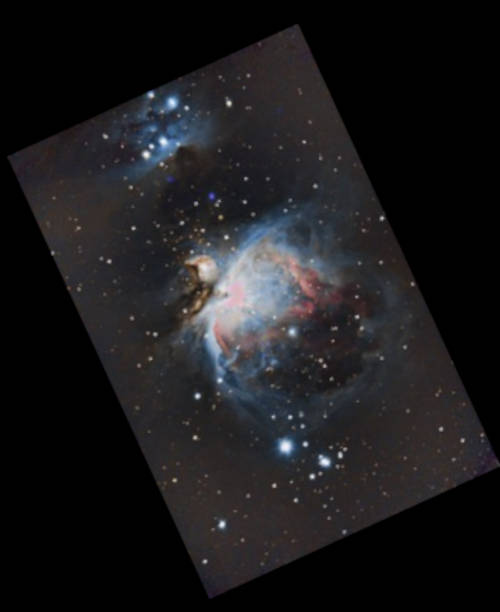
The blog’s archive has many other posts about the Great Orion Nebula and other nebulae in Orion.
Ephemeris: 01/20/2025 – The planets augment the Winter Hexagon
This is Ephemeris for Martin Luther King Jr. Day, Monday, January 20th. Today the Sun will be up for 9 hours and 22 minutes, setting at 5:35, and it will rise tomorrow at 8:12. The Moon, 1 day before last quarter, will rise at 12:56 tomorrow morning.
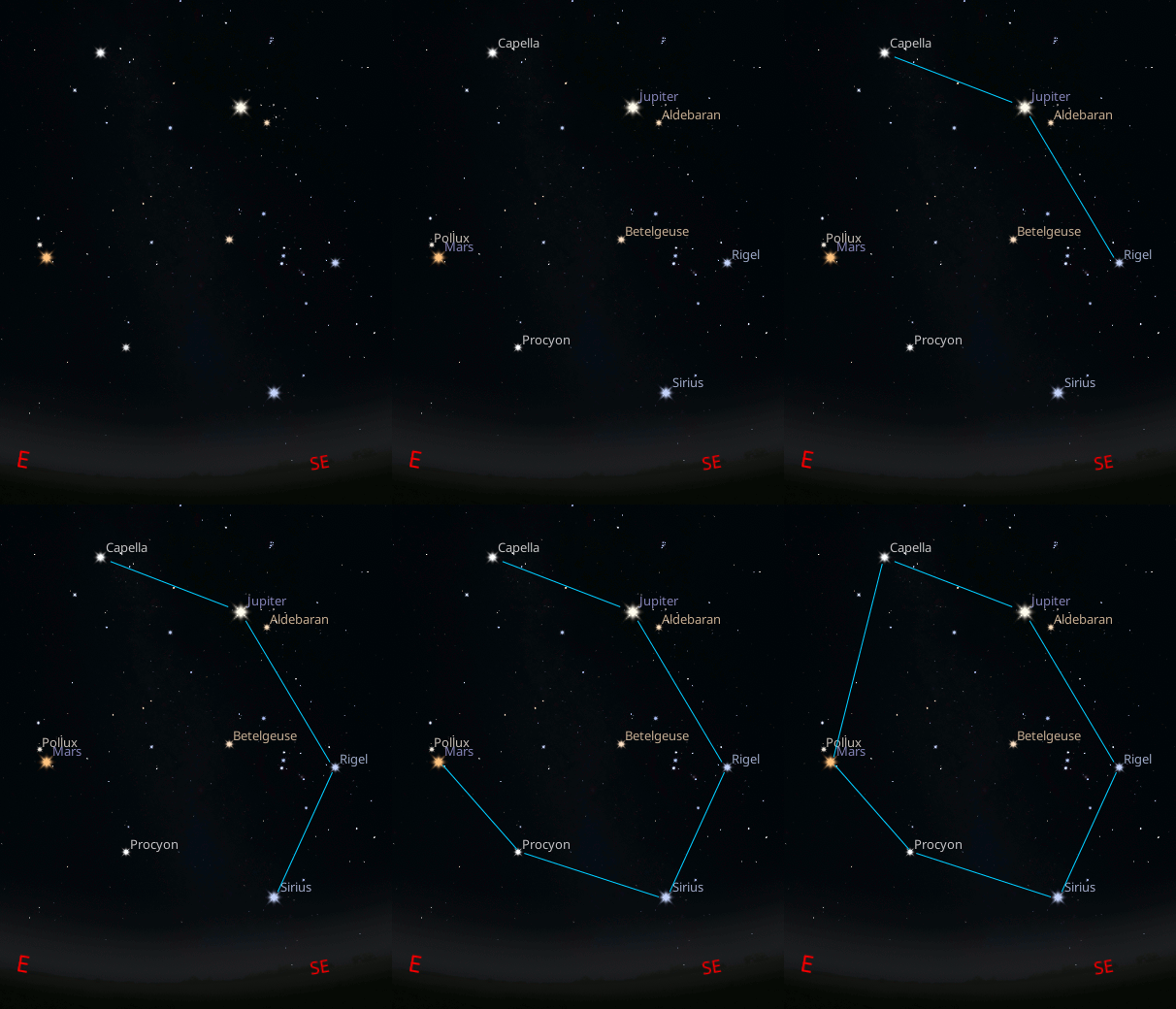
The winter circle or more properly hexagon, seen in the winter sky this evening, has the addition of two planets, and they’re in the proper location so that they don’t spoil the hexagon. We start at the top with the star Capella high in the east. We move clockwise downward to Jupiter and below it the star Aldebaran. We drop lower to Orion’s knee and the star Rigel, then down to Sirius, low in the southeast, the brightest nighttime star, but doesn’t hold a candle to Jupiter. Then we go above left to Procyon and upwards and left to Mars, which is near Pollux, and finally back up to Capella. That’s that is our winter hexagon right now, so take it in while you can, before Jupiter and Mars move off and mess it up.
The astronomical event times given are for the Traverse City/Interlochen area of Michigan (EST, UT – 5 hours). Times will be different for other locations.
Addendum
As for events happening on Earth: Resist!
Ephemeris: 01/17/2025 – Venus passes Saturn in conjunction tomorrow
We end this week of planetary events with this post:
This is Ephemeris for Friday, January 17th. Today the Sun will be up for 9 hours and 16 minutes, setting at 5:31, and it will rise tomorrow at 8:14. The Moon, halfway from full to last quarter, will rise at 9:44 this evening.
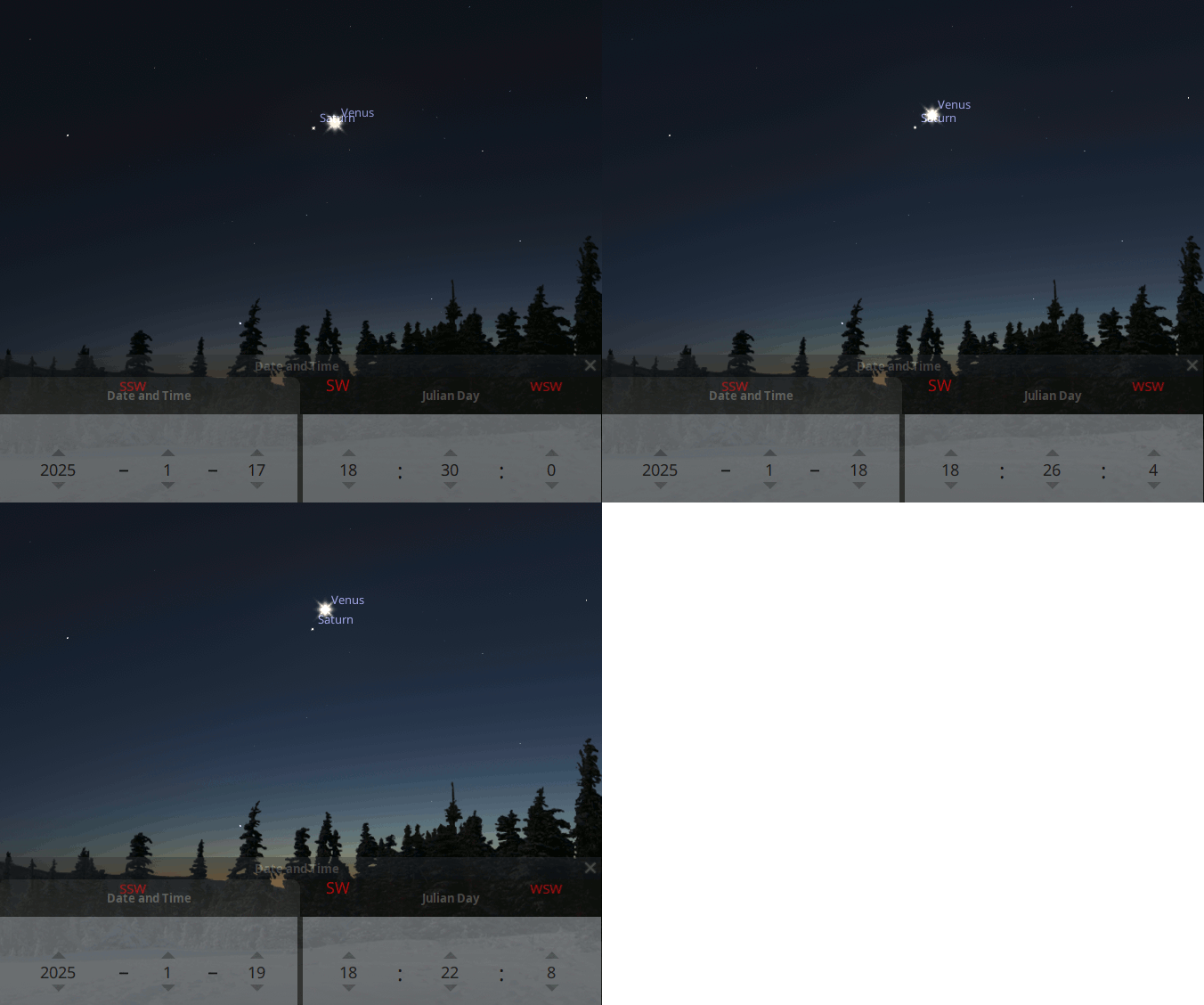
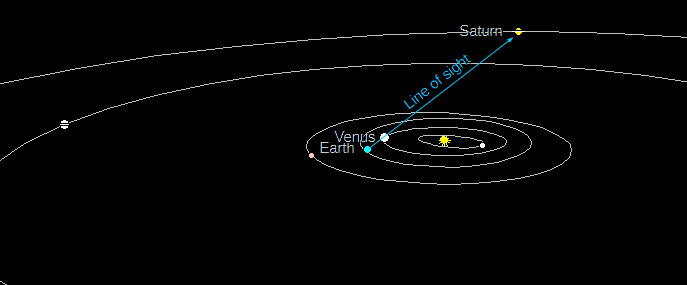
Venus will pass the slower moving Saturn at about 11:00 tomorrow morning, so tonight and Saturday night are your best times to see these two planets at their closest. They will probably be slightly closer tomorrow night than tonight. This apparent meeting of two planets is called a conjunction. The two planets are not anywhere close to each other, in fact Venus is closer than the Sun right now, and Saturn is 10 times farther away than the Sun. They just happen to be near the same line of sight. From there both will lose their battle with evening twilight. Saturn will make it back to conjunction with the Sun first, ten days before Venus. Before that Mercury will pass in conjunction with Venus.
The astronomical event times given are for the Traverse City/Interlochen area of Michigan (EST, UT – 5 hours). Times will be different for other locations.
Addendum
Ephemeris: 01/16/2025 – Mars has the second most eccentric orbit of all the planets
This is Ephemeris for Thursday, January 16th. Today the Sun will be up for 9 hours and 14 minutes, setting at 5:30, and it will rise tomorrow at 8:15. The Moon, 3 days past full, will rise at 8:37 this evening.
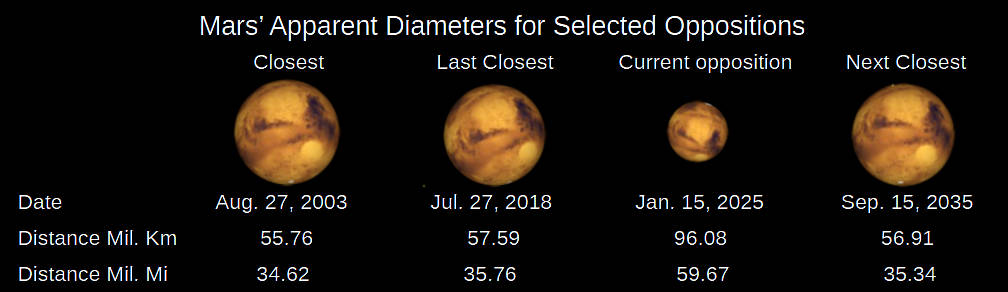
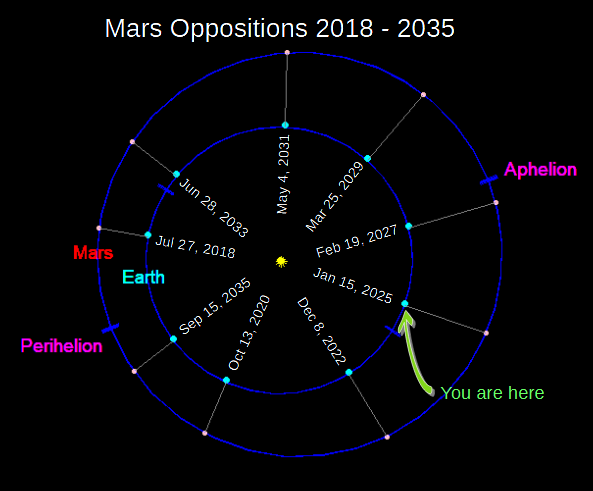
The planet Mars has the second most eccentric orbit of all the planets, after Mercury. But with yesterday’s opposition of Mars it only came down to 59.7 million miles away. At its absolute closest to us, which occurred in 2003, Mars got down to 34.6 million miles away. Since Mars orbits the Sun in little less than two earth years we catch up to it a little farther down in its orbit every time. Mars closest approaches occur every 15 or 17 years. The last close approach was in 2018. The next closest approach will occur in 2035 a span of 17 years. The closest approach before 2018 occurred in 2003 the span between those two was 15 years. Even at closest approach Martian detail is hard to see with a small telescope.
The astronomical event times given are for the Traverse City/Interlochen area of Michigan (EST, UT – 5 hours). Times will be different for other locations.
Addendum
Ephemeris: 01/15/2025 – Our weekly look at the whereabouts of the naked-eye planets
This is Ephemeris for Wednesday, January 15th. Today the Sun will be up for 9 hours and 12 minutes, setting at 5:28, and it will rise tomorrow at 8:15. The Moon, 2 days past full, will rise at 7:27 this evening.
Let’s take our weekly look at the whereabouts of the naked-eye planets. At 8 PM this evening four of the five naked eye planets will be out. Starting from the West we have Venus the brightest of all low in the west southwest. Left and a bit above it is Saturn. They will appear at their closest Friday and Saturday nights. Jupiter, the second-brightest planet will be high in the southeast. The 4th planet out is Mars, which is at opposition from the Sun tonight. Mars will not get this close to the Earth again until 2031. It shines with its reddish hue a third as bright as Jupiter in the eastern sky. On unusually close approaches, Mars can actually outshine Jupiter. The fifth naked eye planet, Mercury, is too close to the Sun on the morning side to be visible.
The astronomical event times given are for the Traverse City/Interlochen area of Michigan (EST, UT – 5 hours). Times will be different for other locations.
Addendum
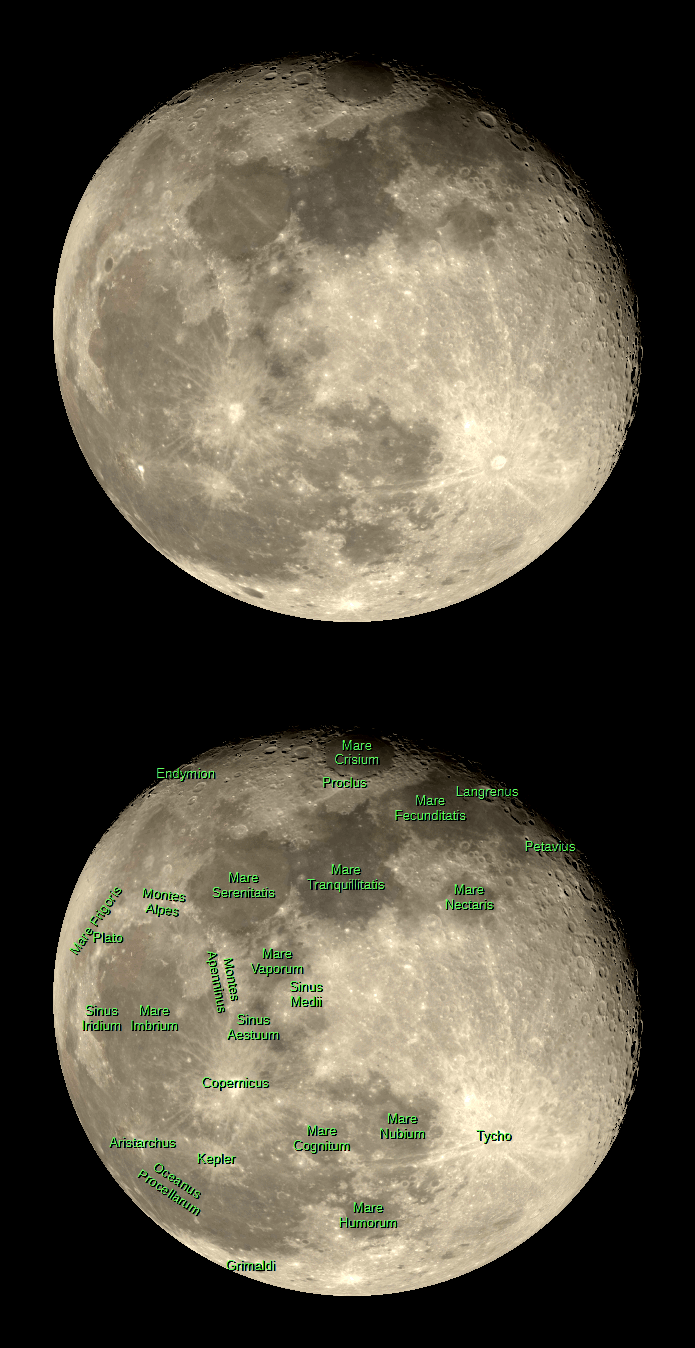
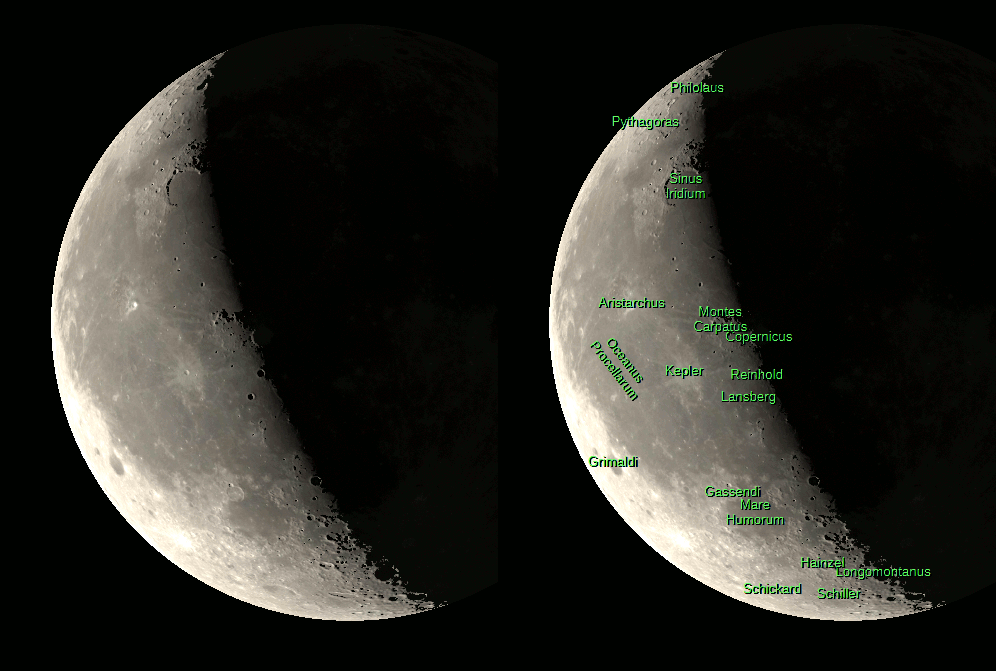
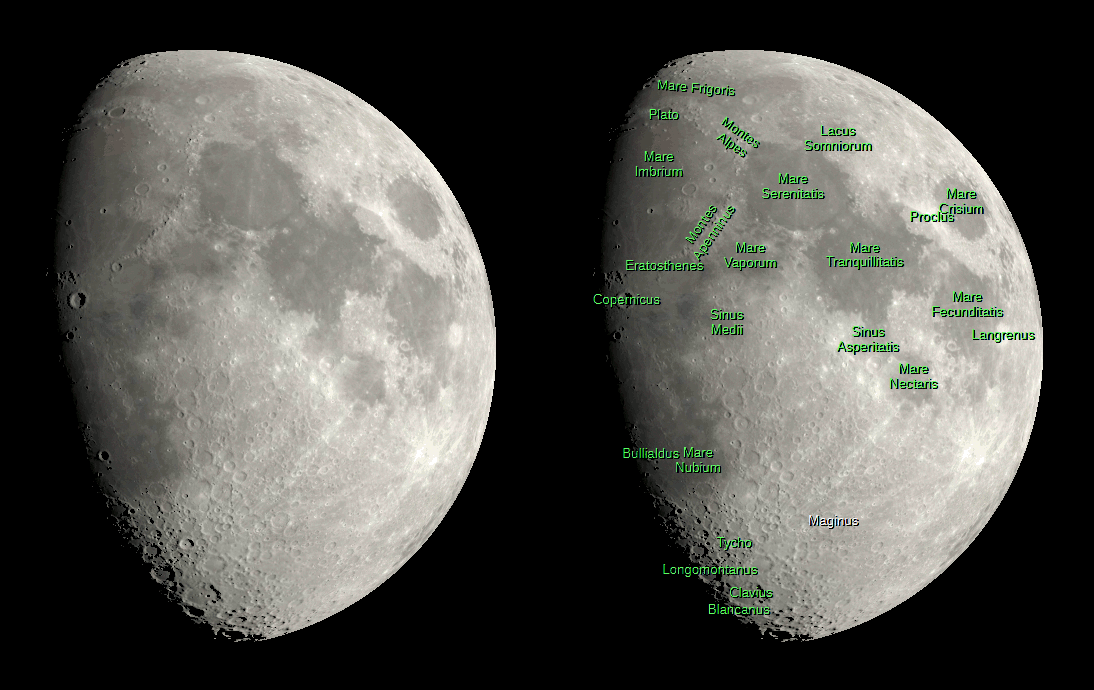
Translations of some lunar feature names according to Virtual Moon Atlas
Mare Cognitum – Sea of Knowledge
Mare Crisium – Sea of Crises
Mare Fecunditatis – Sea of Fruitfulness
Mare Frigoris – Sea of Cold
Mare Humorum – Sea of Moisture
Mare Imbrium – Sea of Showers
Mare Nectaris – Sea of Nectar
Mare Nubium – Sea of Clouds
Mare Serenitatis – Sea of Serenity
Mare Tranquillitatis – Sea of Tranquility
Mare Vaporum – Sea of Vapors
Montes Alpes – Alps Mountains
Montes Apenninus – Apennines Mountains
Oceanus Procellarum – Ocean of Storms
Sinus Iridium – Bay of Rainbows
Sinus Medii – Central Bay
Mare is pronounced Mar-e. Craters are named for persons, real or otherwise.
Ephemeris: 01/14/2025 – Mars reaches opposition tomorrow – What that means
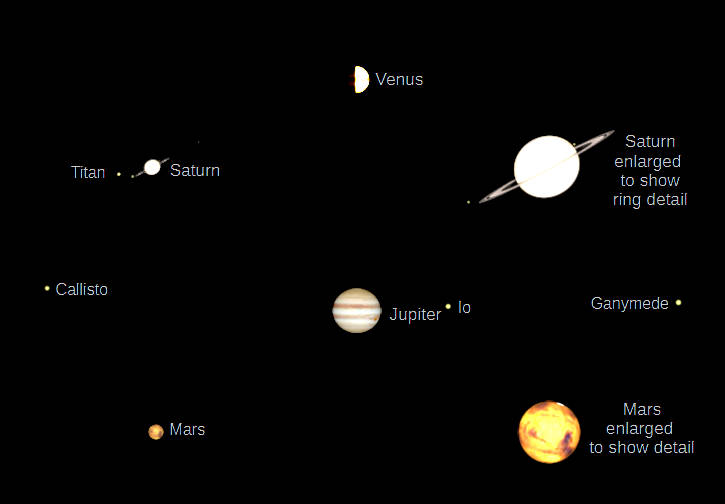
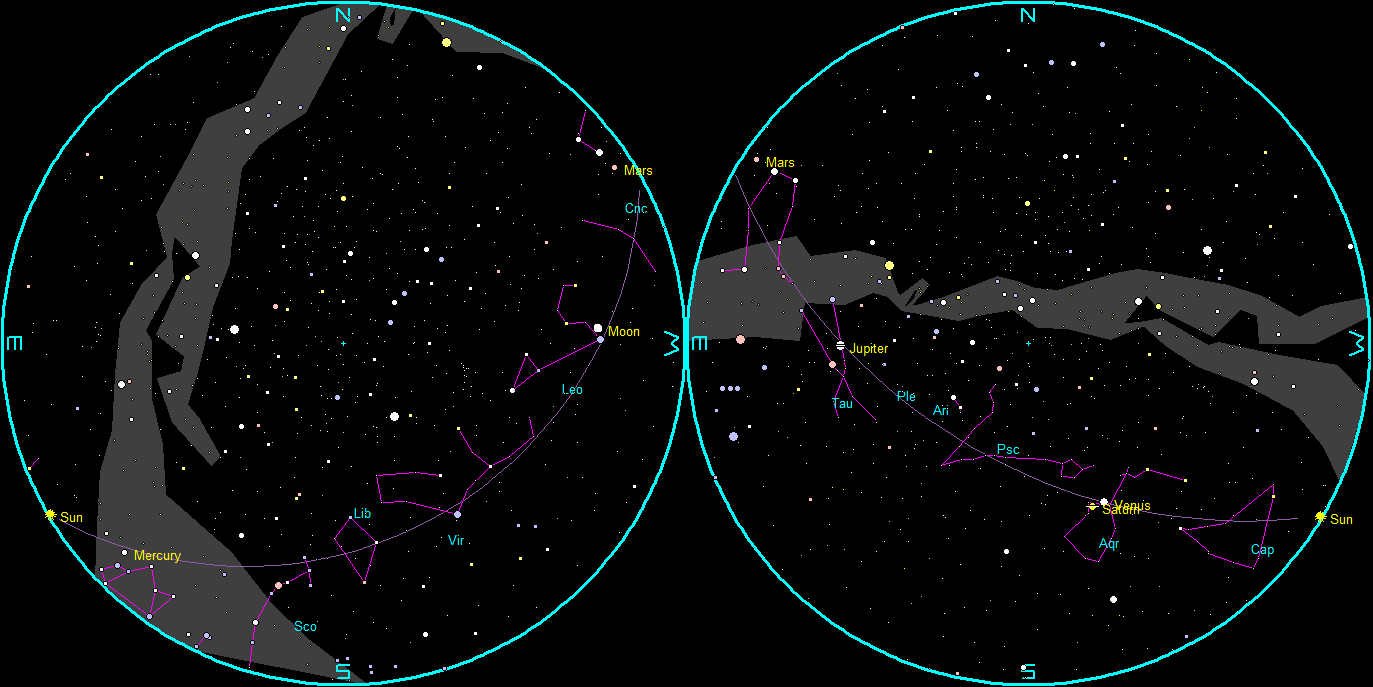
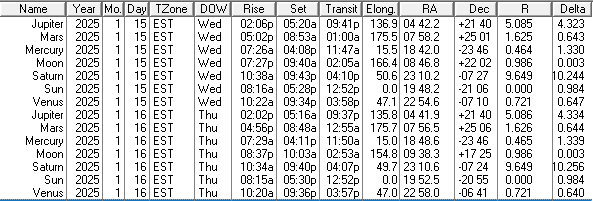
This is Ephemeris for Tuesday, January 14th. Today the Sun will be up for 9 hours and 10 minutes, setting at 5:27, and it will rise tomorrow at 8:16. The Moon, 1 day past full, will rise at 6:14 this evening. | Tomorrow the planet Mars will be in opposition to the Sun. That means it will rise at sunset and set at sunrise. This is the time we are closest to Mars or near closest to Mars of its current pass. Mars comes in opposition from the Sun about every 26 months on average. Currently, Mars is farther from the Sun than average. It has a large swing in distances from the Sun and so at this time moves slower than average. The time between oppositions is only 25 months currently. The various space agencies know that opposition time is the best time to launch spacecraft to Mars. However, they launch several months ahead of opposition for the spacecraft to arrive several months after opposition for the least amount of energy needed for the journey.
The astronomical event times given are for the Traverse City/Interlochen area of Michigan (EST, UT – 5 hours). Times will be different for other locations.
Addendum
Ephemeris: 01/13/2025 – The Moon will pass in front of Mars tonight
This is Ephemeris for Monday, January 13th. Today the Sun will be up for 9 hours and 8 minutes, setting at 5:26, and it will rise tomorrow at 8:16. The Moon, at full today, will rise at 5:00 this evening.
Tonight we will be able to witness, if it’s clear of course, an event between the Moon and the planet Mars. The Moon will pass in front of the planet Mars this evening. The event is called an occultation. If you think of tonight’s full moon as being a clock face, Mars will disappear at about the 8 o’clock position of the Moon’s edge at 9:13 PM and will reappear near the 1 o’clock position at 10:20 PM. These times should be within a minute or two depending on where you are in the listening area. However, because the full moon is so bright it will be best to view this with binoculars, starting earlier in the evening so you can find Mars against the brightness of the Moon, while it’s still far away from the Moon’s edge. Good luck, and clear skies!
The astronomical event times given are for the Traverse City/Interlochen area of Michigan (EST, UT – 5 hours). Times will be different for other locations.
Addendum
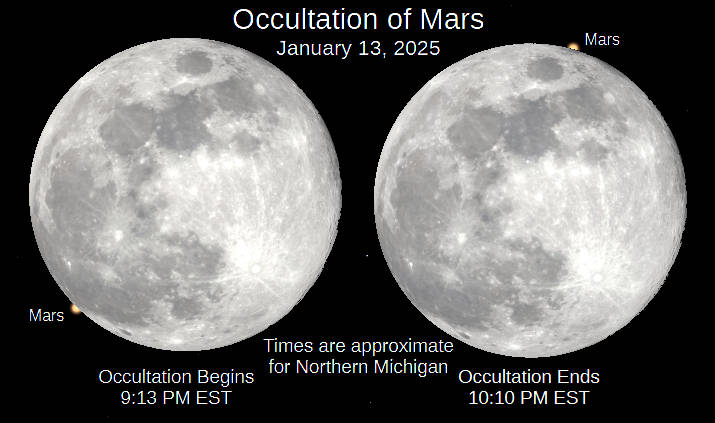
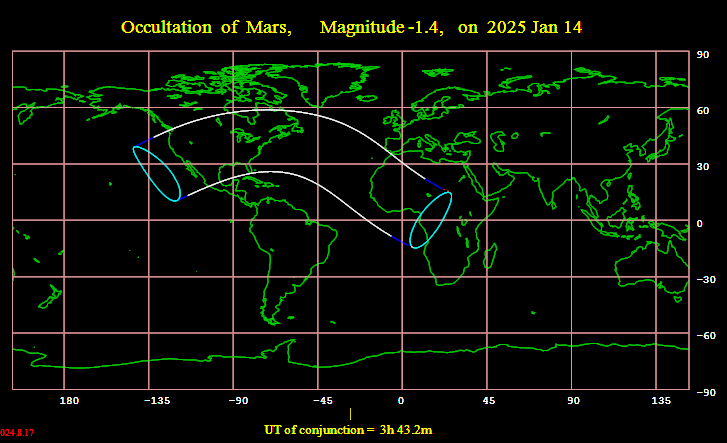
If you are not in Northern Michigan the use of a program such as Stellarium will allow you to preview the occultation to derive the times of the ingress and egress times and positions for your location.
Ephemeris: 01/08/2025 – A weekly look at the whereabouts of the naked-eye planets
This is Ephemeris for Wednesday, January 8th. Today the Sun will be up for 9 hours and 1 minute, setting at 5:20, and it will rise tomorrow at 8:18. The Moon, 2 days past first quarter, will set at 4:05 tomorrow morning.
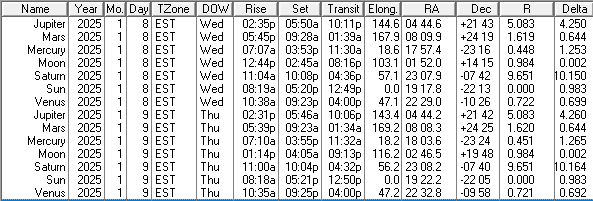
Let’s take our weekly look at the whereabouts of the naked-eye planets. At 8:00 PM this evening four of the five naked eye planets will be out. Starting from the West we have Venus the brightest of all low in the west southwest. Above and left of that is Saturn. The waxing gibbous moon is high in the South at that time. Jupiter, the second-brightest planet will be high in the southeast. The 4th planet out is Mars which is low in the east northeast with its reddish hue giving it away. Next Monday the Moon will pass directly over the planet Mars in our evening sky. The fifth naked eye planet, Mercury, is too close to the Sun on it morning side to be visible.
The astronomical event times given are for the Traverse City/Interlochen area of Michigan (EST, UT – 5 hours). Times will be different for other locations.
Addendum
Ephemeris: 01/06/2025 – Things that go blink in the night
This is Ephemeris for Monday, January 6th. Today the Sun will be up for 8 hours and 58 minutes, setting at 5:18, and it will rise tomorrow at 8:19. The Moon, at first quarter today, will set at 1:26 tomorrow morning.
Lately there’s been a lot of reported observations of drones or various things in the sky at night, especially, for some reason, in New Jersey. If it’s something that’s moving in the sky other than satellites, meteors and aurorae, they’re out of my wheelhouse. I generally concern myself with the sidereal universe, the universe beyond the atmosphere. Things that don’t seem to move that rapidly. There are a lot of bright lights in the sky, that are things that I can and do talk about this time of year and this particular year. We have a lot of bright lights in the sky now, foremost Venus in the southwest in the early evening, and Jupiter in the east and the south. Mars is also up, but it’s not in competition with Jupiter this year. These plus the bright winter stars.
The astronomical event times given are for the Traverse City/Interlochen area of Michigan (EST, UT – 5 hours). Times will be different for other locations.
Addendum