Archive
Ephemeris: 06/04/2026 – Finding Lyra the harp
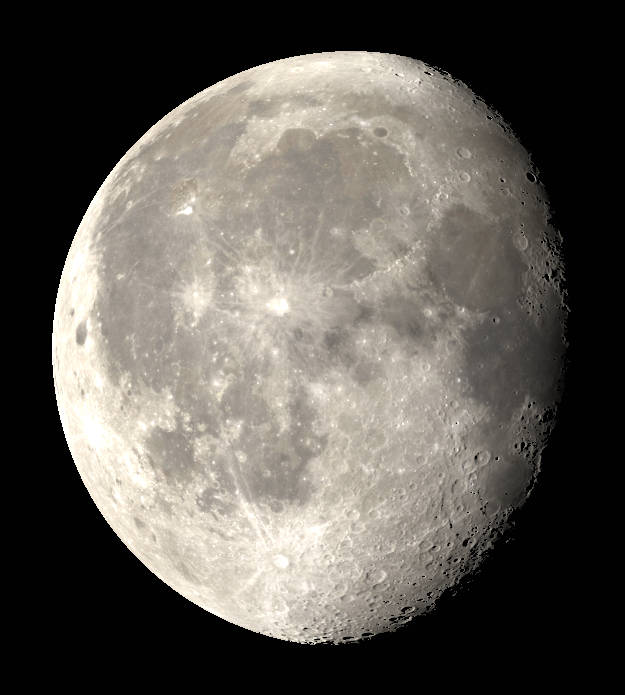
This is Bob Moler with Ephemeris for Thursday, June 4th. Today the Sun will be up for 15 hours and 24 minutes, setting at 9:23, and it will rise tomorrow at 5:58. The Moon, halfway from full to last quarter, will rise at 12:57 tomorrow morning.
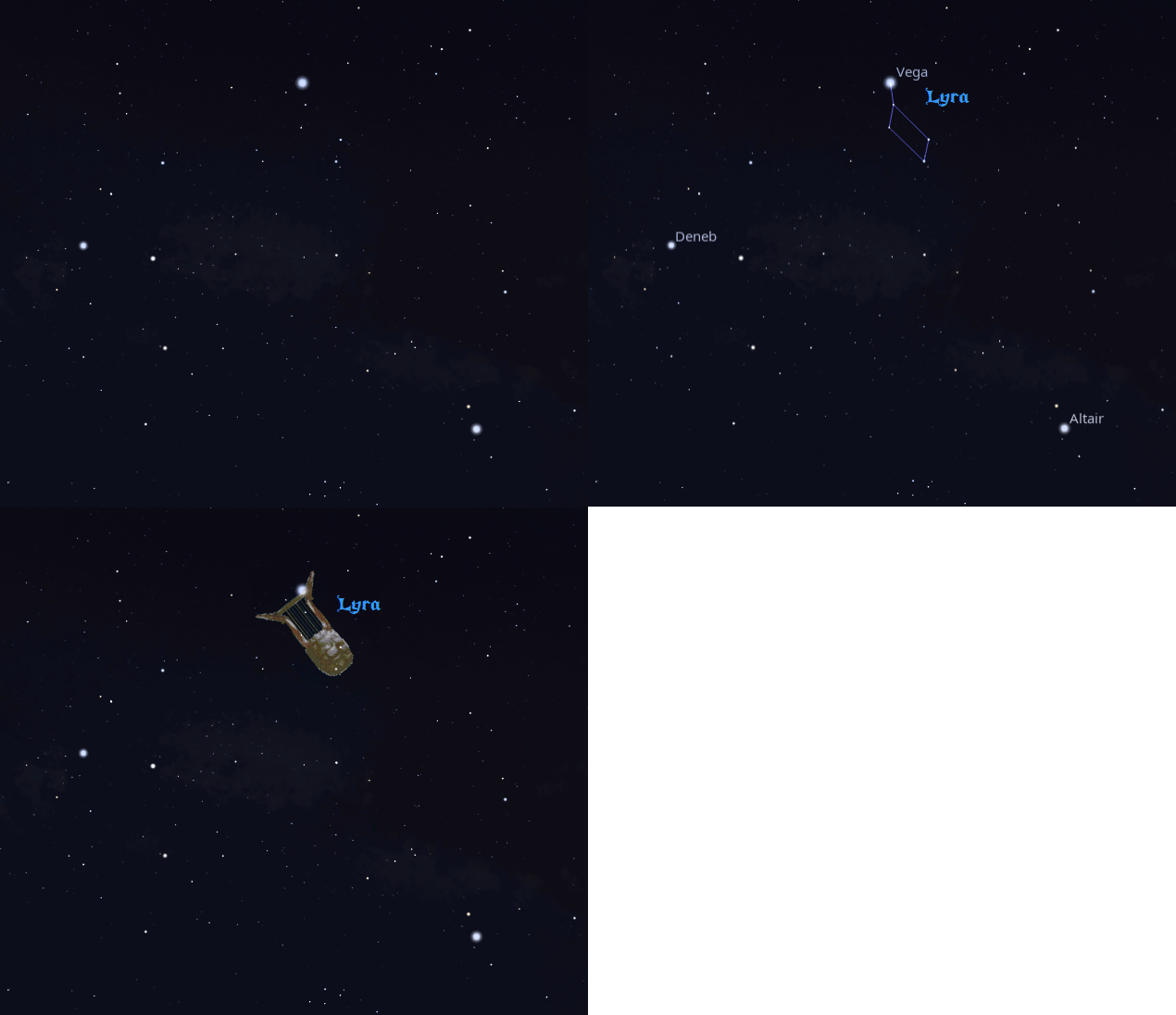
Halfway up the sky in the east at 11 PM, one can find a bright star just above a small, narrow, but very distinctive parallelogram of stars. They are the stars of the constellation Lyra the harp. The bright star is Vega, the 5th brightest nighttime star. To the Romans, the star Vega represented a falling eagle or vulture. Apparently they never made the distinction between the two species. It is a pure white star and serves as a calibration star for color and brightness. In the evening, it is the top-most star of the Summer Triangle. The harp, according to Greek mythology, was invented by the god Hermes. The form of the harp, in the sky, is as he had invented it: by stretching strings across a tortoise shell. Hermes gave it to his half-brother Apollo, who in turn gave it to the legendary musician Orpheus.
The astronomical event times given in this blog are for the Traverse City/Interlochen area of Michigan (Lat 44.7° N, Long 85.7° W; EDT, UT – 4 hours) unless stated otherwise. Times will be different for other locations.
Addendum
Ephemeris: 06/03/2026 – Where are the naked-eye planets this week?
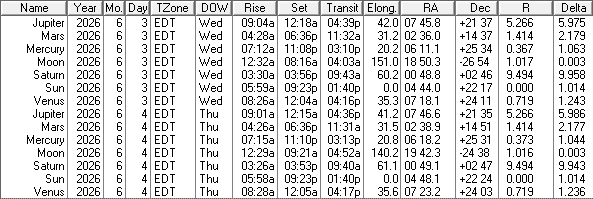
This is Ephemeris for Wednesday, June 3rd. Today the Sun will be up for 15 hours and 23 minutes, setting at 9:23, and it will rise tomorrow at 5:58. The Moon, 3 days past full, will rise at 12:29 tomorrow morning.
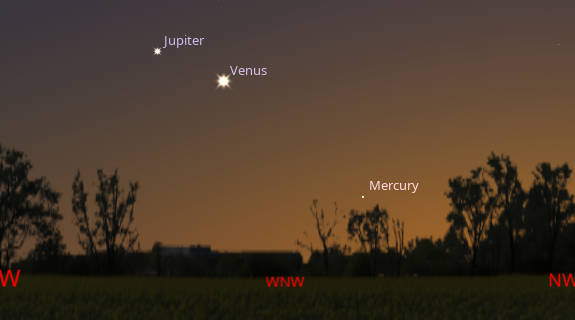
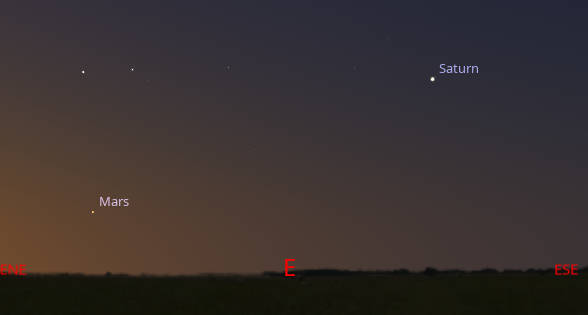
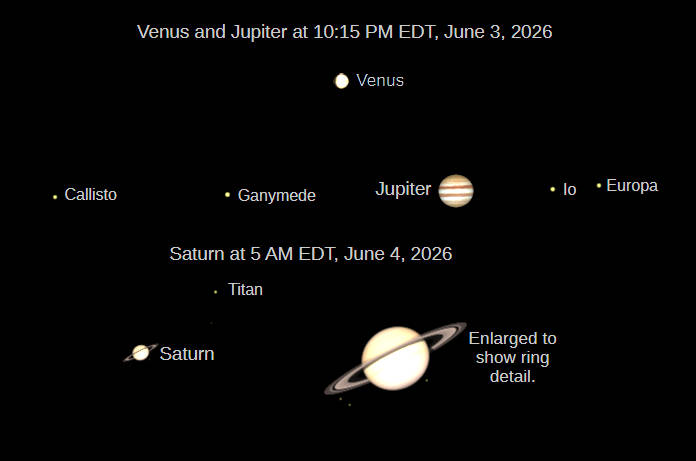
Let’s take our weekly look at the whereabouts of the naked-eye planets. By 10:15 PM tonight, nearly an hour after sunset, Venus and Jupiter may be seen in the western sky. A telescope will show a very tiny disc on Venus, because it is still pretty much beyond the Sun, 115 million miles (186 million kilometers) away from us. Over the next 4½ months it will be moving closer to us and becoming much larger. Jupiter is to the upper left of Venus, and the second-brightest star-like object in the sky. Venus will set at 12:05 AM, while Jupiter will hold out ten minutes longer. Venus will pass Jupiter on the afternoon of the 9th. Saturn rises into the eastern sky at 3:27 AM, followed by dimmer Mars an hour later.
The astronomical event times given in this blog are for the Traverse City/Interlochen area of Michigan (Lat 44.7° N, Long 85.7° W; EDT, UT – 4 hours) unless stated otherwise. Times will be different for other locations.
Addendum
Ephemeris: 06/01/2026 – Previewing June skies
This is Ephemeris’ 51st anniversary program, and starting orbit 52 for Monday, June 1st. Today the Sun will be up for 15 hours and 21 minutes, setting at 9:21, and it will rise tomorrow at 5:59. The Moon, 1 day past full, will rise at 11:11 this evening.
Let’s preview June skies. There will be a lot of sun in June and very little night. The daylight hours will increase a bit from 15 hours and 21 minutes Today to 15 hours and 34 minutes on the 21st, retreating back to 15 hours 31 minutes at month’s end. The altitude of the Sun above the southern horizon at local noon will hover around 68 to 69 degrees. Local noon, when the Sun is actually due south, will occur at about 1:43 PM Summer begins on the 21st at 4:25 am, when the Sun reaches its farthest north. The actual amount of nighttime will be quite short, mostly due to the length of daylight, but also because twilight lasts much longer than average because the Sun sets at a shallow angle. On the 21st, there’s theoretically only 3 ½ hours of total darkness if the Moon wasn’t up.
The astronomical event times given in this blog are for the Traverse City/Interlochen area of Michigan (Lat 44.7° N, Long 85.7° W; EDT, UT – 4 hours) unless stated otherwise. Times will be different for other locations.
Addendum
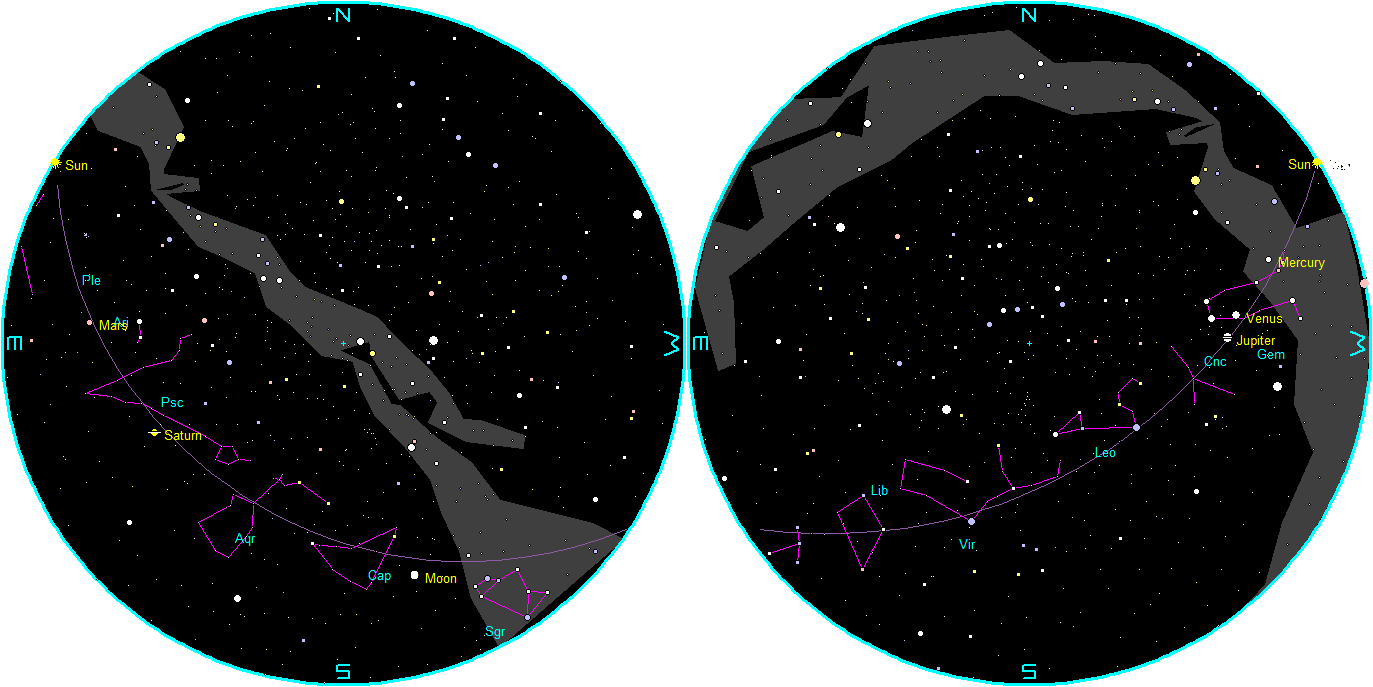
June Evening Star Chart
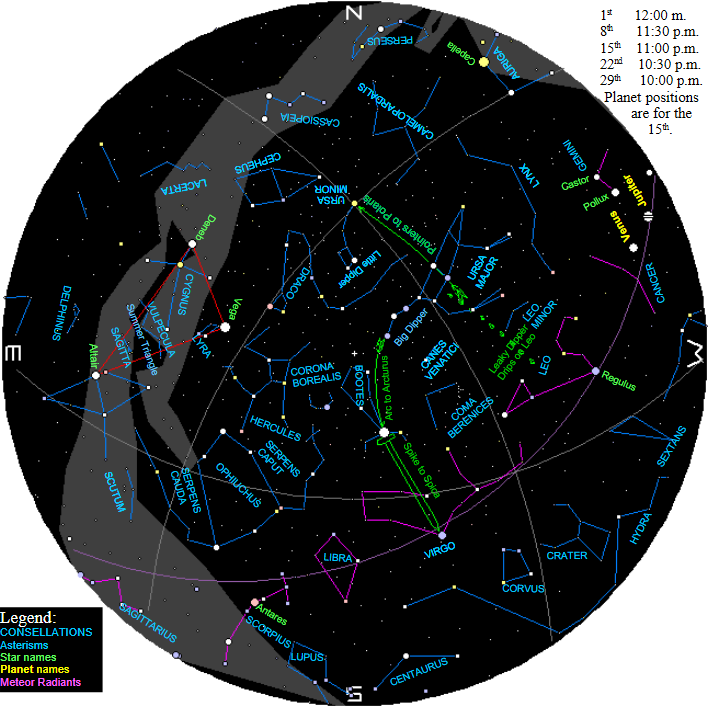
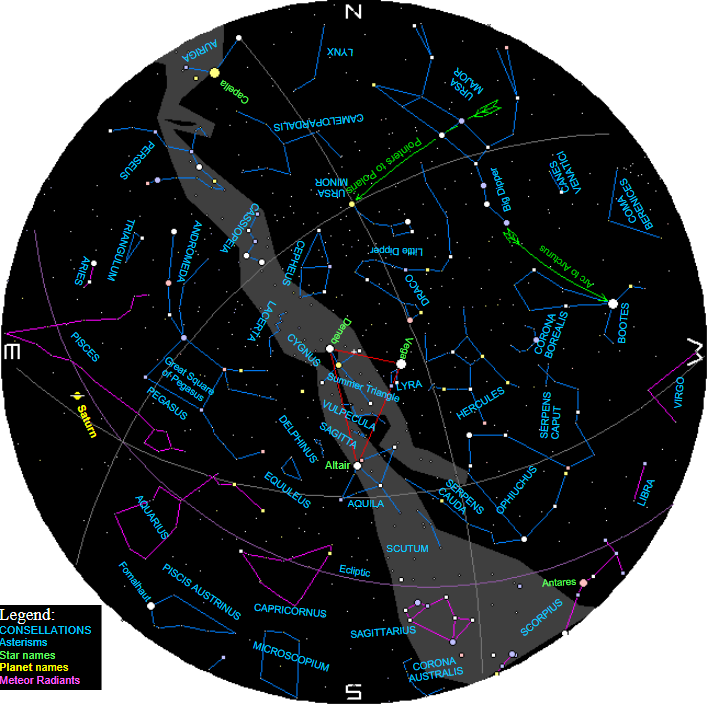
The planets and stars are plotted for the 15th at 11 PM EDT in the evening and 4 AM. on the 15th.on the morning chart. These are the chart times. Note that Interlochen/Traverse City is located approximately 45 minutes behind our time meridian, West 75° longitude. (An hour 45 minutes behind our daylight saving time meridian during EDT). To duplicate the star positions on a planisphere you may have to set it to 1 hour 45 minutes earlier than the current time.
Note, the chart times of 11 PM and 4 AM are for the 15th & 16th. For each week before the 15th, add ½ hour (28 minutes if you’re picky). For each week after the 15th, subtract ½ hour, or 28 minutes. The planet positions are updated each Wednesday on this blog. For planet positions on dates other than the 15th, check the Wednesday planet posts on this blog for weekly positions.
June Morning Star Chart
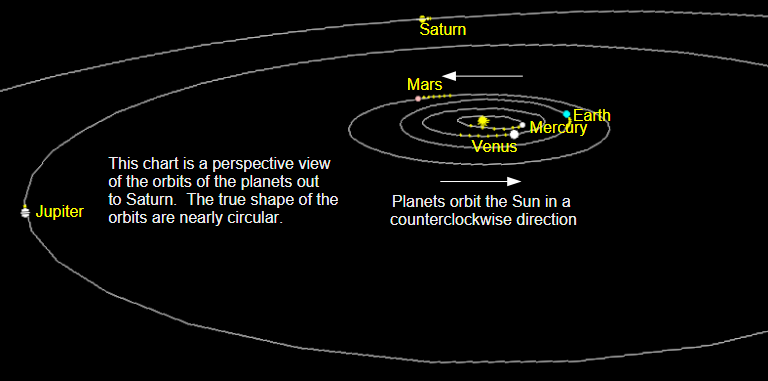
Orbits of the naked-eye planets for seven 5-day intervals starting June 1, 2026.
NASA Calendar of Planetary Events
Jun  1  Mo            Venus: 35° E
     1  Mo  12:32 AM  Moon Apogee: 406400 km
     1  Mo  12:59 PM  Moon South Dec.: 28° S
     7  Su   2:19 AM  Moon Ascending Node
     7  Su  12:15 PM  Venus-Pollux: 4.7° S
     8  Mo   6:00 AM  Last Quarter
     9  Tu   4:11 PM  Venus-Jupiter: 1.6° N
    13  Sa   9:15 AM  Moon-Pleiades: 0.9° S
    14  Su   7:18 PM  Moon Perigee: 357200 km
    14  Su  10:54 PM  New Moon
    15  Mo   1:29 AM  Moon North Dec.: 28° N
    15  Mo   3:59 PM  Mercury Elongation: 24.5° E
    16  Tu   3:32 PM  Moon-Mercury: 2.6° S
    17  We   2:54 AM  Moon-Jupiter: 2.5° S
    17  We   4:21 PM  Moon-Venus: 0.3° S
    17  We   7:40 PM  Moon-Beehive: 0.6° S
    18  Th  10:59 AM  Mercury-Pollux: 6.4° S
    19  Fr  10:31 AM  Moon-Regulus: 0.3° N
    19  Fr  11:44 AM  Venus-Beehive: 0.4° N
    19  Fr   1:57 PM  Moon Descending Node
    21  Su   4:25 AM  Summer Solstice
    21  Su   5:55 PM  First Quarter
    23  Tu   4:11 PM  Moon-Spica: 2.3° N
    25  Th   7:54 AM  Mercury-Jupiter: 3.8° N
    27  Sa  10:32 AM  Moon-Antares: 0.5° N
    28  Su   3:11 AM  Moon Apogee: 406300 km
    28  Su   2:30 PM  Mars-Pleiades: 4.4° S
    28  Su   6:06 PM  Moon South Dec.: 28° S
    29  Mo   7:57 PM  Full Moon
Jul  1  We            Venus: 41.1° E
Sky Events Calendar by Fred Espenak and Sumit Dutta (NASA’s GSFC),
http://eclipse.gsfc.nasa.gov/SKYCAL/SKYCAL.html.
Sun and Moon Rising and Setting Events
LU              Ephemeris of Sky Events for Interlochen/TC
June, 2026    Local time zone: EDT
+-----------------------------------------------------------------------+
| DATE |  SUN     SUN  DAYLIGHT|   TWILIGHT*    |MOON  RISE OR    ILLUM |
|      |  RISE    SET    HOURS |  END    START  |PHASE SET** TIME FRACTN|
+=======================================================================+
|Mon  1| 06:00a  09:21p  15:21 | 10:44p  04:37a |      Rise 11:11p   97%|
|Tue  2| 05:59a  09:22p  15:22 | 10:45p  04:36a |      Rise 11:54p   94%|
|Wed  3| 05:59a  09:23p  15:23 | 10:46p  04:35a |      Rise 12:29a   88%|
|Thu  4| 05:58a  09:23p  15:24 | 10:47p  04:35a |      Rise 12:57a   82%|
|Fri  5| 05:58a  09:24p  15:26 | 10:48p  04:34a |      Rise 01:21a   74%|
|Sat  6| 05:58a  09:25p  15:27 | 10:49p  04:33a |      Rise 01:41a   64%|
+------+-----------------------+----------------+-----------------------+
|Sun  7| 05:57a  09:25p  15:28 | 10:50p  04:33a |      Rise 02:00a   54%|
|Mon  8| 05:57a  09:26p  15:29 | 10:51p  04:32a |L Qtr Rise 02:18a   44%|
|Tue  9| 05:57a  09:27p  15:29 | 10:52p  04:32a |      Rise 02:38a   33%|
|Wed 10| 05:57a  09:27p  15:30 | 10:53p  04:31a |      Rise 03:00a   23%|
|Thu 11| 05:56a  09:28p  15:31 | 10:53p  04:31a |      Rise 03:28a   14%|
|Fri 12| 05:56a  09:28p  15:32 | 10:54p  04:31a |      Rise 04:04a    7%|
|Sat 13| 05:56a  09:29p  15:32 | 10:55p  04:30a |      Rise 04:52a    2%|
+------+-----------------------+----------------+-----------------------+
|Sun 14| 05:56a  09:29p  15:33 | 10:55p  04:30a |New   Set  09:44p    0%|
|Mon 15| 05:56a  09:30p  15:33 | 10:56p  04:30a |      Set  10:47p    1%|
|Tue 16| 05:56a  09:30p  15:34 | 10:56p  04:30a |      Set  11:34p    5%|
|Wed 17| 05:56a  09:31p  15:34 | 10:57p  04:30a |      Set  12:09a   12%|
|Thu 18| 05:56a  09:31p  15:34 | 10:57p  04:30a |      Set  12:36a   20%|
|Fri 19| 05:56a  09:31p  15:34 | 10:57p  04:30a |      Set  12:58a   30%|
|Sat 20| 05:57a  09:31p  15:34 | 10:58p  04:30a |      Set  01:17a   40%|
+------+-----------------------+----------------+-----------------------+
|Sun 21| 05:57a  09:32p  15:34 | 10:58p  04:30a |F Qtr Set  01:35a   51%|
|Mon 22| 05:57a  09:32p  15:34 | 10:58p  04:31a |      Set  01:53a   61%|
|Tue 23| 05:57a  09:32p  15:34 | 10:58p  04:31a |      Set  02:13a   70%|
|Wed 24| 05:58a  09:32p  15:34 | 10:58p  04:31a |      Set  02:36a   79%|
|Thu 25| 05:58a  09:32p  15:34 | 10:58p  04:32a |      Set  03:03a   86%|
|Fri 26| 05:58a  09:32p  15:33 | 10:58p  04:32a |      Set  03:37a   92%|
|Sat 27| 05:59a  09:32p  15:33 | 10:58p  04:33a |      Set  04:19a   96%|
+------+-----------------------+----------------+-----------------------+
|Sun 28| 05:59a  09:32p  15:32 | 10:58p  04:33a |      Set  05:10a   99%|
|Mon 29| 06:00a  09:32p  15:32 | 10:58p  04:34a |Full  Rise 09:53p  100%|
|Tue 30| 06:00a  09:32p  15:31 | 10:57p  04:34a |      Rise 10:31p   99%|
+-----------------------------------------------------------------------+
* Nautical Twilight
** Moonrise or moonset, whichever occurs between sunset and sunrise
Generated using my LookingUp for DOS app.
Ephemeris: 05/27/2026 – Taking our weekly look at the whereabouts of the naked-eye planets
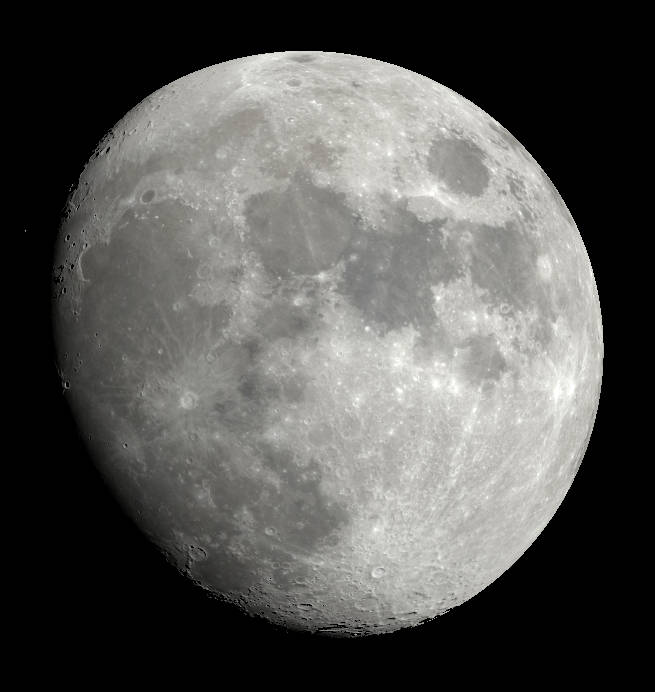
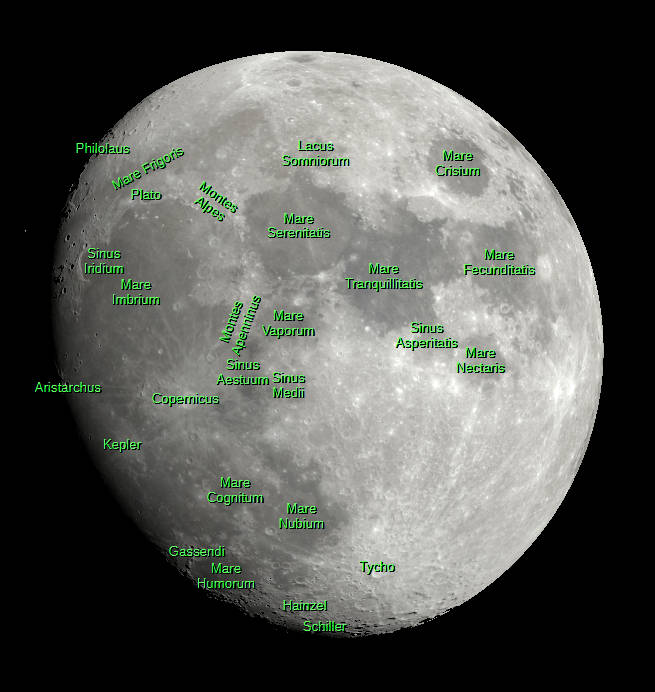
This is Bob Moler with Ephemeris for Wednesday, May 27th. Today the Sun will be up for 15 hours and 13 minutes, setting at 9:17, and it will rise tomorrow at 6:02. The Moon, halfway from first quarter to full, will set at 4:08 tomorrow morning.
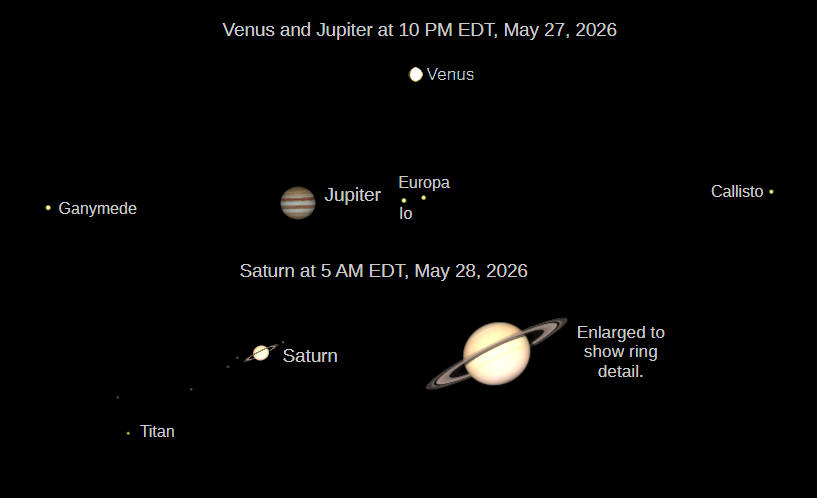
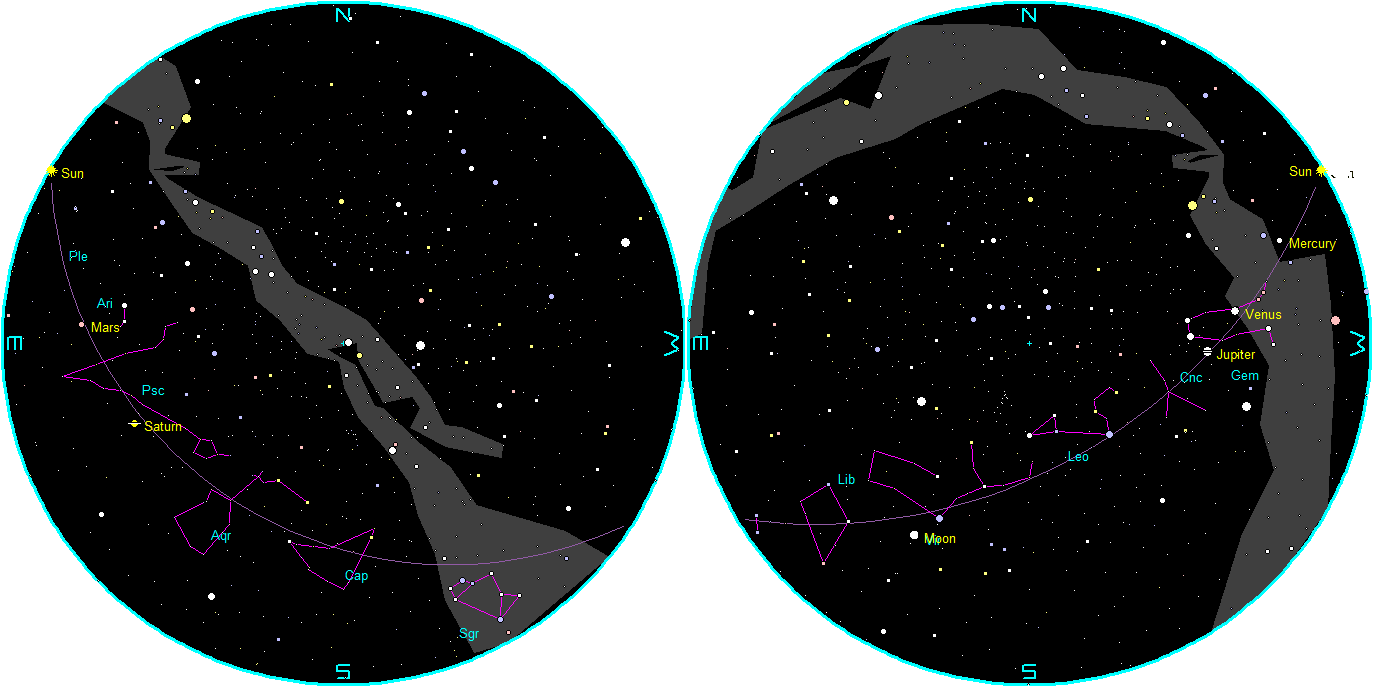
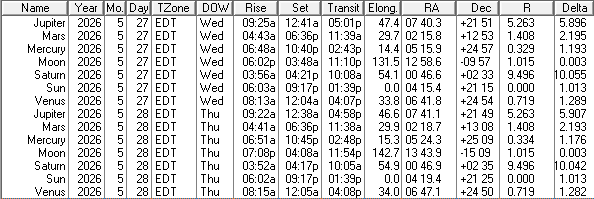
Let’s take our weekly look at the whereabouts of the naked-eye planets. By 10 PM tonight, about 40 minutes after sunset, Venus may be seen in the western sky. A telescope will show a very tiny disc on Venus, because it is still pretty much beyond the Sun, 120 million miles (193 million km) away from us. Over the next 5 months it will be moving closer to us and becoming much larger. Jupiter is the second-brightest star-like object in the western sky seen before 10 PM. It is above and left of Venus tonight. Venus will set at 12:04 AM, while Jupiter will hold out until 12:41 AM. Saturn rises in the east at 3:52 AM, followed by dimmer Mars at 4:42 AM.
The astronomical event times given in this blog are for the Traverse City/Interlochen area of Michigan (Lat 44.7° N, Long 85.7° W; EDT, UT – 4 hours) unless stated otherwise. Times will be different for other locations.
Addendum
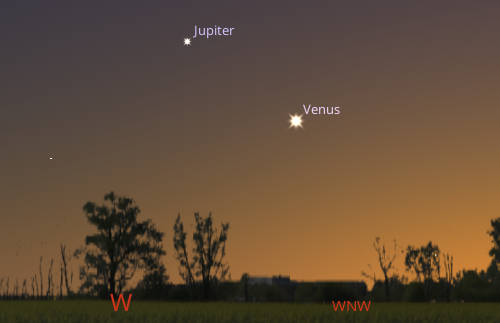
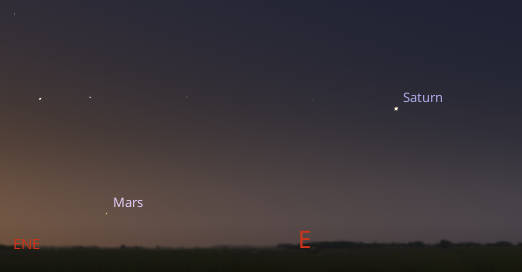
Ephemeris: 05/20/2026 – Taking our weekly look at the whereabouts of the naked-eye planets
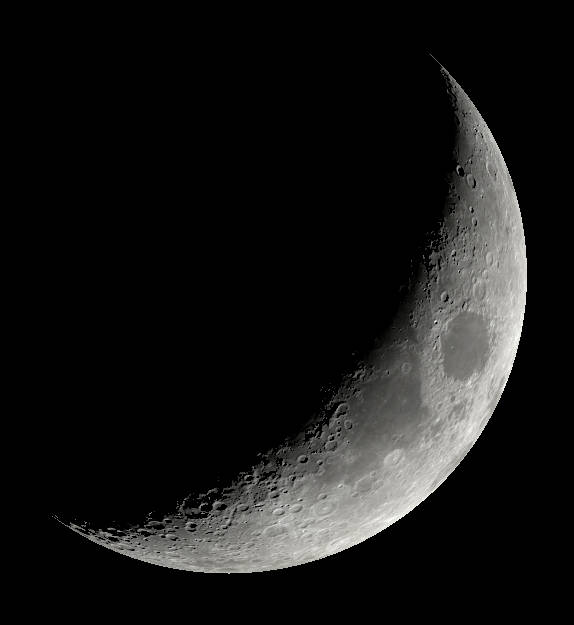
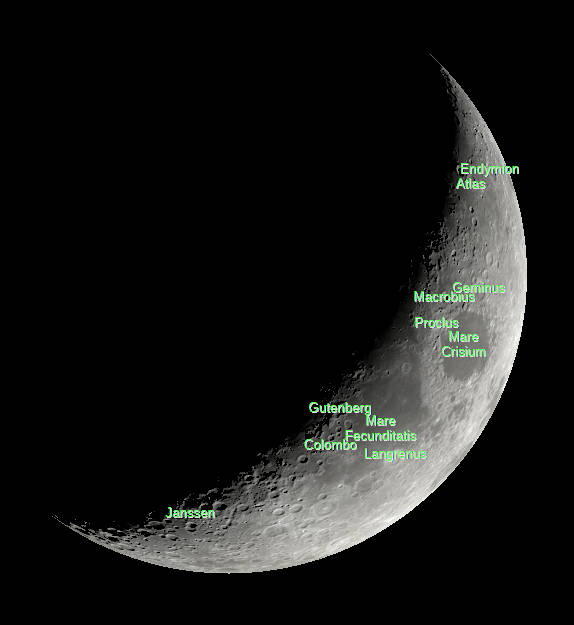
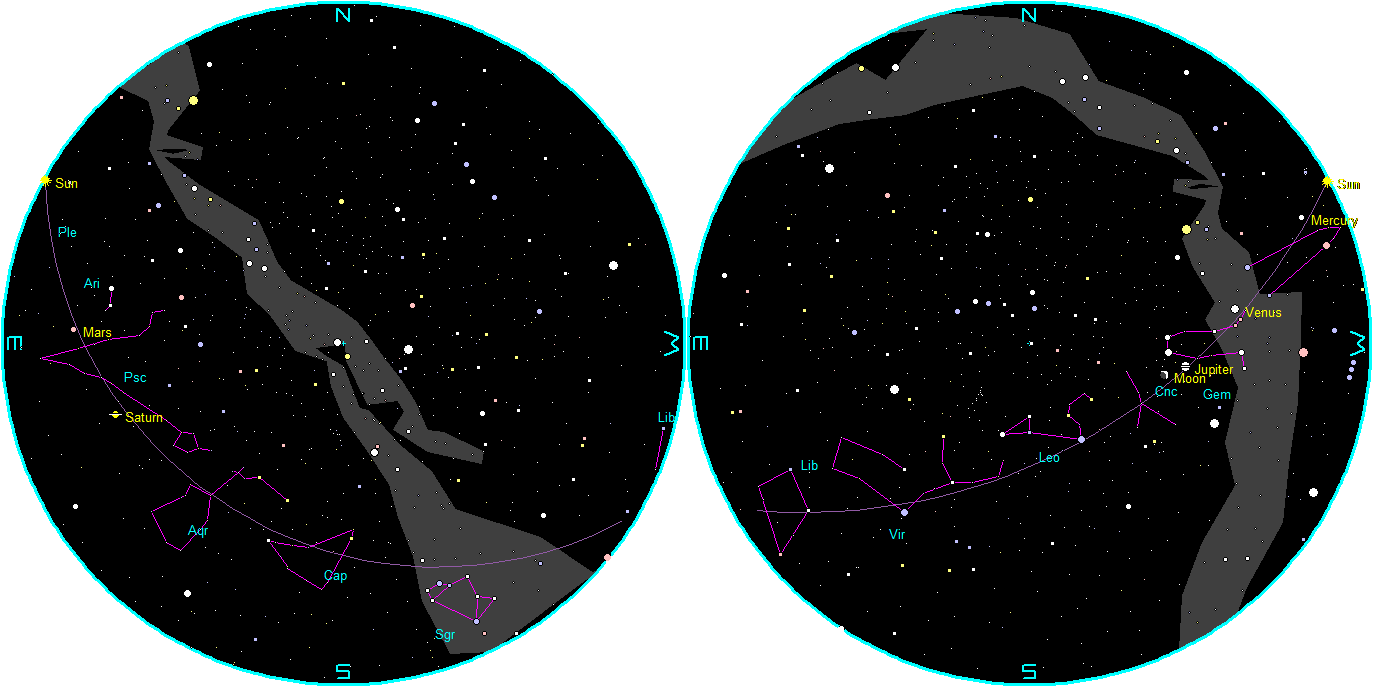
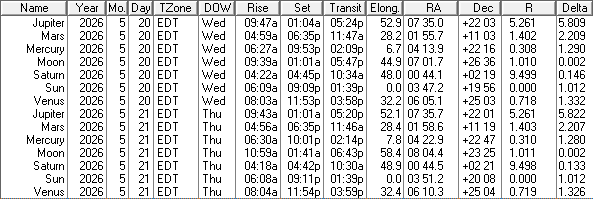
This is Ephemeris for Wednesday, May 20th. Today the Sun will be up for 15 hours exactly, setting at 9:09, and it will rise tomorrow at 6:08. The Moon, 3 days before first quarter, will set at 1:41 tomorrow morning.
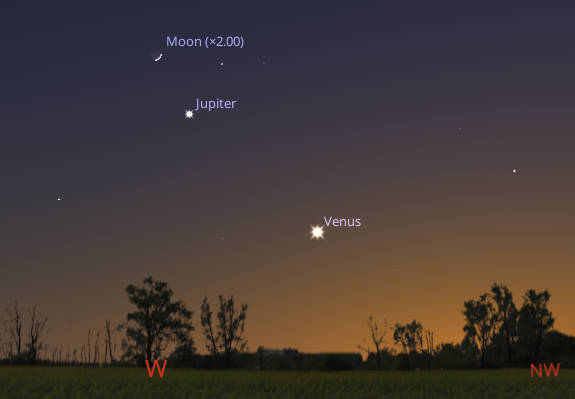
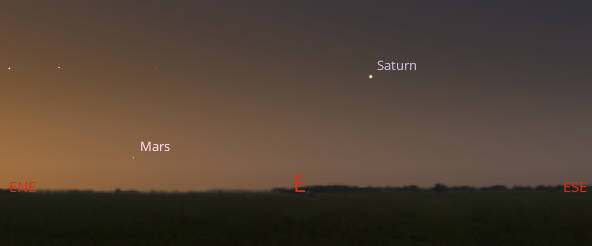
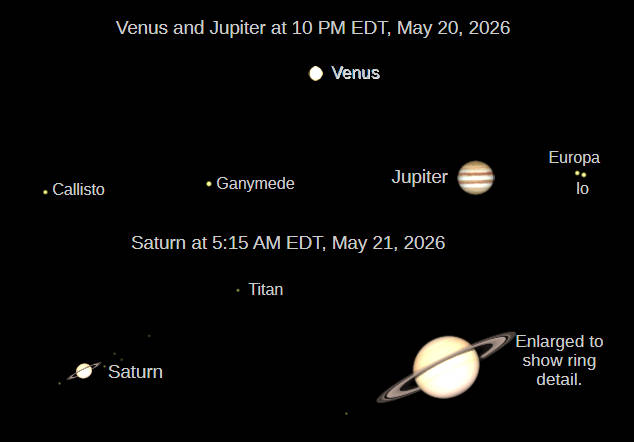
Let’s take our weekly look at the whereabouts of the naked-eye planets. By 9:30 PM tonight, about 20 minutes after sunset, Venus may be seen in the western sky. A telescope will show a very tiny disc on Venus, because it is still pretty much beyond the Sun, 124 million miles (199 million kilometers) away from us. Over the next 5 months it will be moving closer to us and becoming much larger. Jupiter is the second-brightest star-like object in the western sky seen before 10 PM. It is below and right of the Moon tonight. Venus will set at 11:53 PM, while Jupiter will hold out until 1:01 AM. Saturn may be first glimpsed just after it rises in the east at 4:18 AM, before morning twilight overwhelms it later on.
The astronomical event times given in this blog are for the Traverse City/Interlochen area of Michigan (Lat 44.7° N, Long 85.7° W; EDT, UT – 4 hours) unless stated otherwise. Times will be different for other locations.
Addendum
Ephemeris: 05/15/2026 – Orion flees the evening sky as Scorpius rises
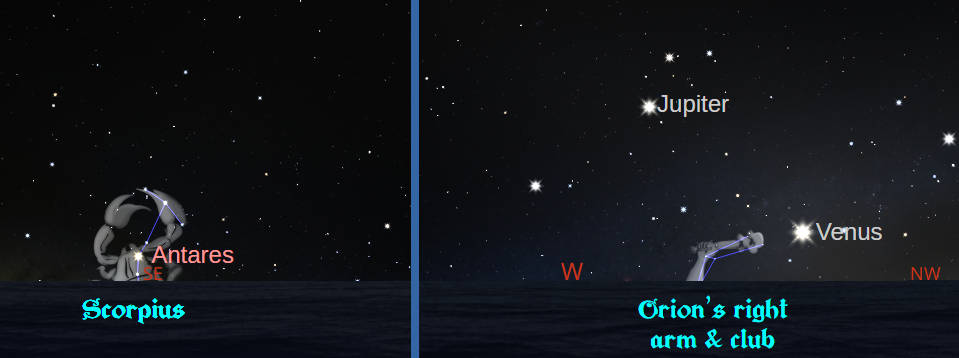
This is Ephemeris for Friday, May 15th. Today the Sun will be up for 14 hours and 49 minutes, setting at 9:04, and it will rise tomorrow at 6:13. The Moon, 1 day before new, will rise at 5:34 tomorrow morning.
Orion the winter constellation is just about gone from our spring skies. Only the top part of his club is left in the west as evening twilight fades. Rising in the southeast at the same time is his nemesis the constellation Scorpius the scorpion. According to Greek mythology, Orion was killed by a giant scorpion. And that scorpion of course was Scorpius. It was sent by the goddess of the earth Gaia. Orion, the mighty hunter, had boasted that he could kill any creature. So this was his final comeuppance. In that battle he was killed by the sting of that scorpion. And that is why Scorpius and Orion can never be in the sky at the same time. Orion won’t venture into the evening sky until Scorpius is long gone in late autumn.
The astronomical event times given in this blog are for the Traverse City/Interlochen area of Michigan (Lat 44.7° N, Long 85.7° W; EDT, UT – 4 hours) unless stated otherwise. Times will be different for other locations.
Addendum

Ephemeris: 05/14/2026 – Looking at the bluest first magnitude star: Spica
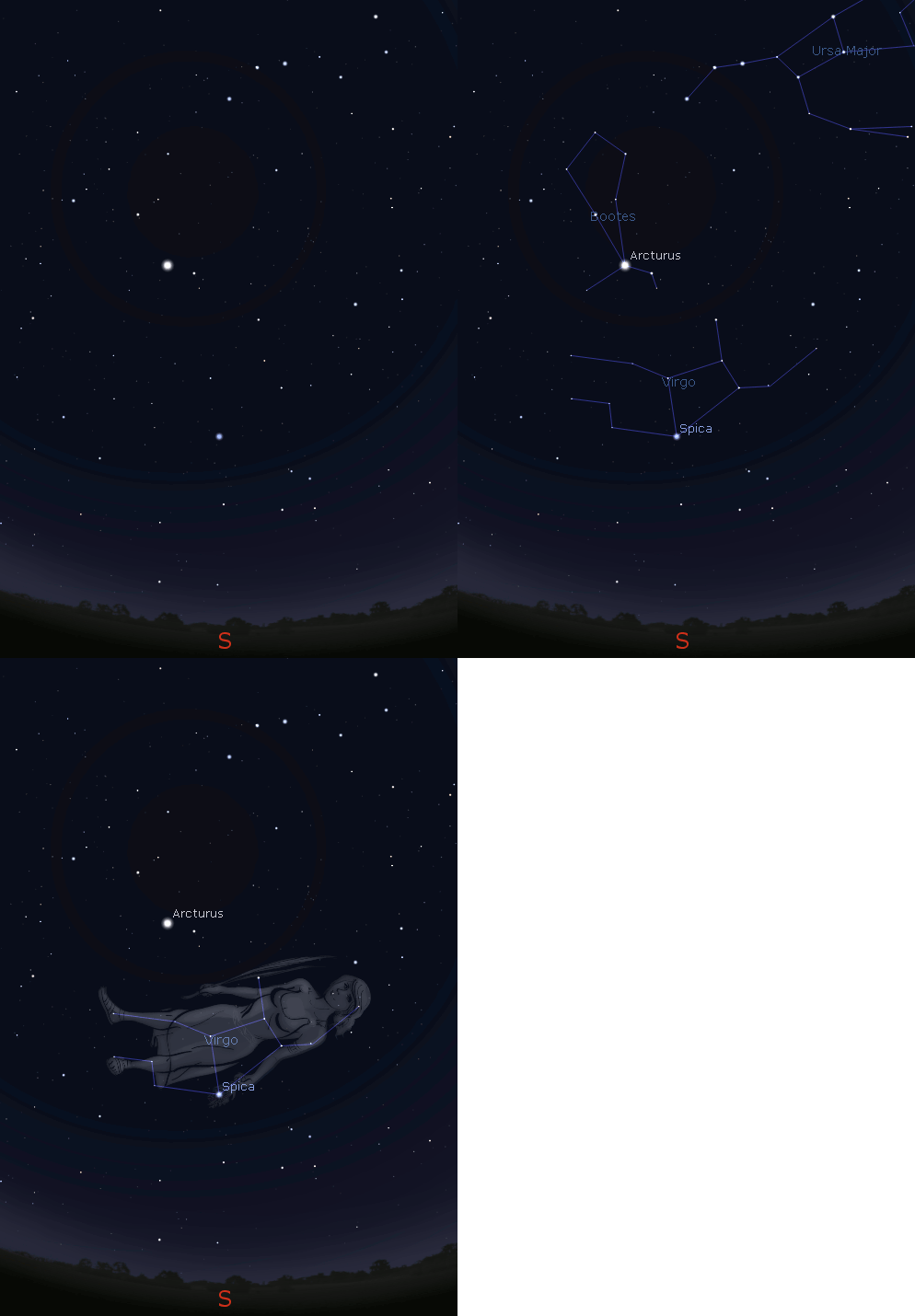
This is Bob Moler with Ephemeris for Thursday, May 14th. Today the Sun will be up for 14 hours and 47 minutes, setting at 9:03, and it will rise tomorrow at 6:14. The Moon, 2 days before new, will rise at 5:02 tomorrow morning.
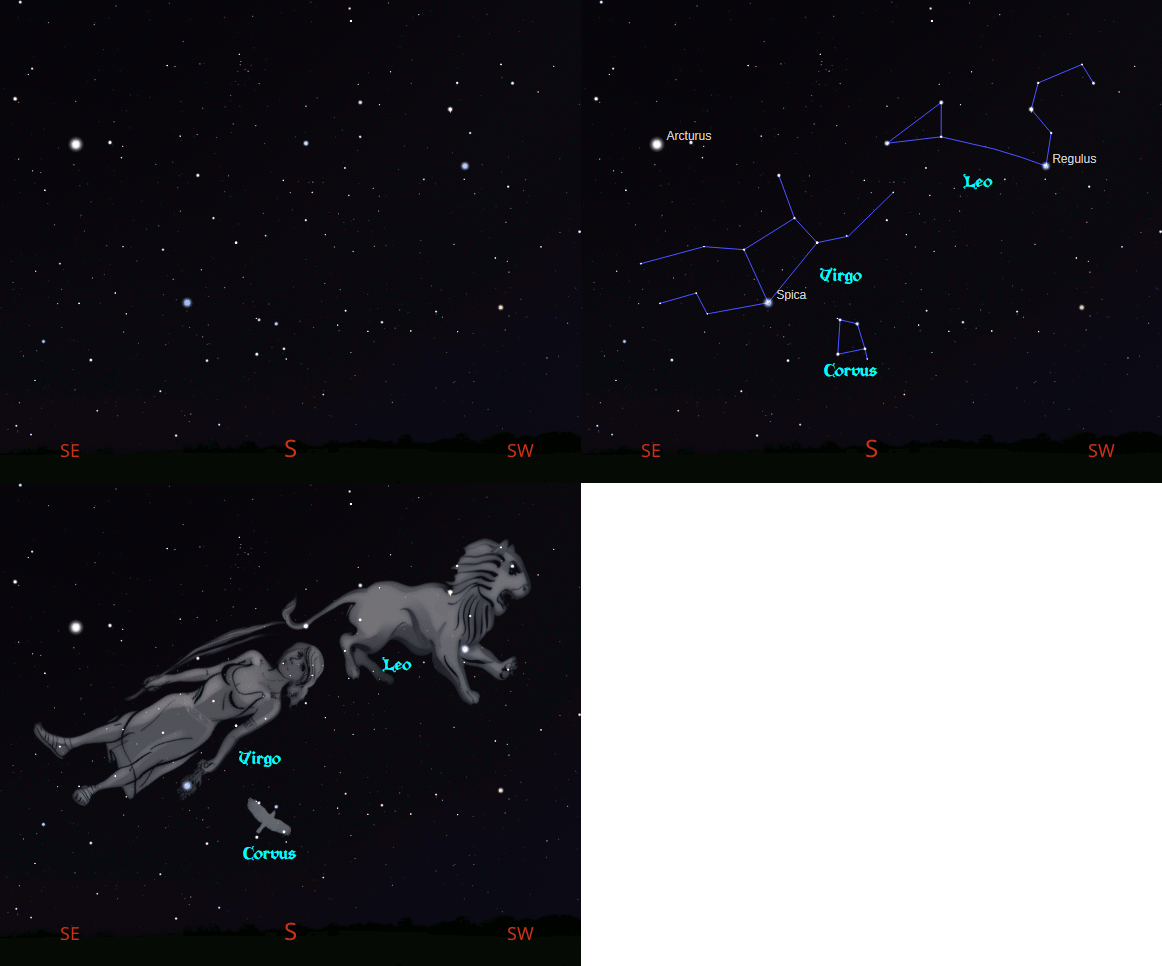
In the south at 11 PM is the bright star Spica in Virgo the virgin. Arcturus, high in the southeast, is much brighter than Spica and has an orange tint to Spica’s bluish hue. In fact, Spica is the 15th brightest and the bluest of the 21 first magnitude stars. That means that it has a really hot surface temperature. I found that out once photographing a lunar eclipse near Spica, The star came out very blue, much bluer than seen visually. Spica is actually two stars in a tight 4-day orbit of each other. They are both reasonably matched in mass and brightness. The twin stars of Spica are 250 light years away. I’m glad the stars are young now. They will have a very interesting future as they age and interact in the next few million years.
The astronomical event times given in this blog are for the Traverse City/Interlochen area of Michigan (Lat 44.7° N, Long 85.7° W; EDT, UT – 4 hours) unless stated otherwise. Times will be different for other locations.
Addendum
Ephemeris: 05/13/2026 – Where are the naked-eye planets this week?
This is Ephemeris for Wednesday, May 13th. Today the Sun will be up for 14 hours and 45 minutes, setting at 9:02, and it will rise tomorrow at 6:15. The Moon, 3 days before new, will rise at 4:37 tomorrow morning.
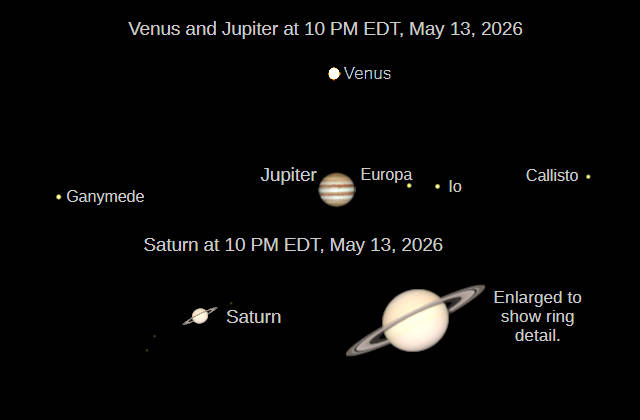
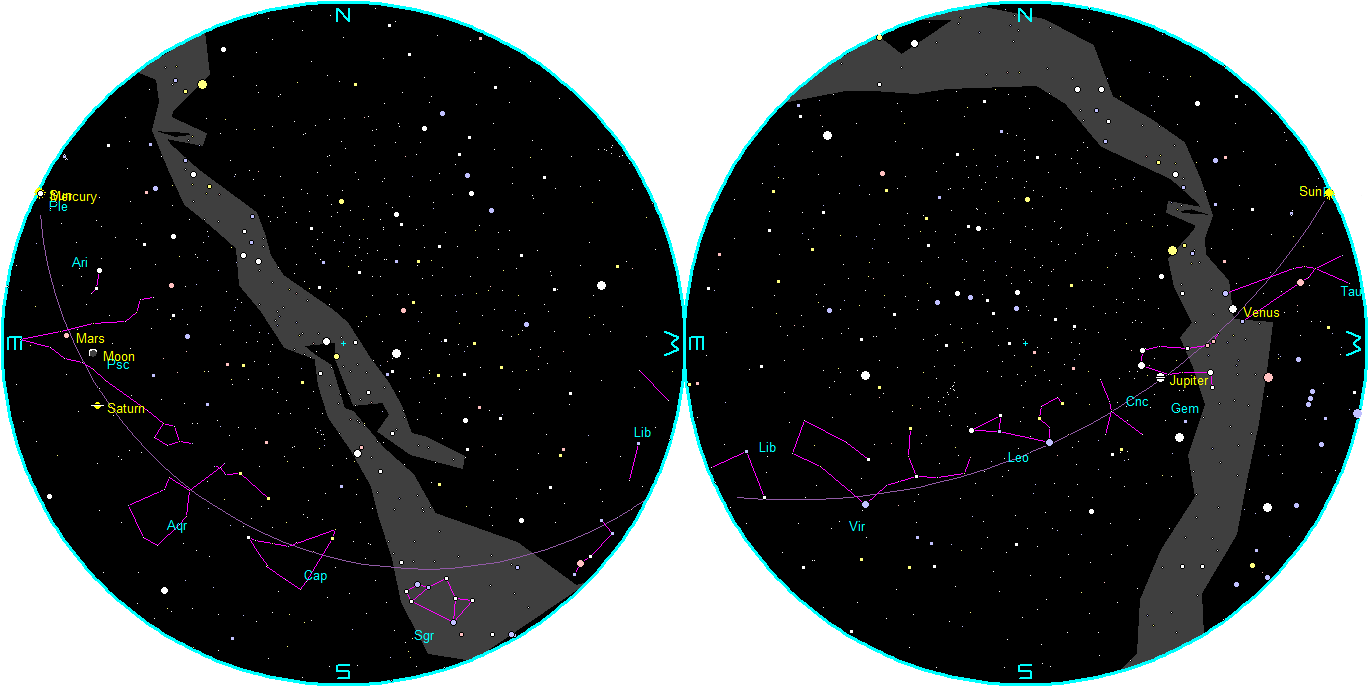
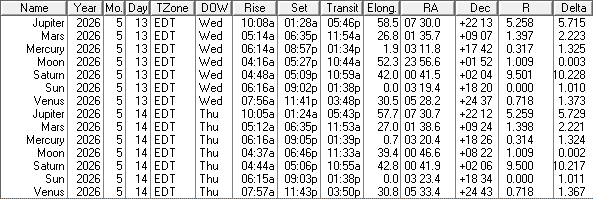
Let’s take our weekly look at the whereabouts of the naked-eye planets. By 9:30 PM tonight, about a half hour after sunset, Venus may be seen in the western sky. A telescope will show a very tiny disc on Venus, because it is still pretty much beyond the Sun, 128 million miles (205 million kilometers) away from us. Over the next 5 months it will be moving closer to us and becoming much larger. Jupiter is the second-brightest star-like object in the western sky seen before 10 PM. It is above and left of the brighter Venus. Venus will set at 11:38 PM, while Jupiter will hold out until 1:21 AM. Saturn may be glimpsed just after it rises in the east at 4:48 AM, before morning twilight overwhelms it sometime later.
The astronomical event times given in this blog are for the Traverse City/Interlochen area of Michigan (Lat 44.7° N, Long 85.7° W; EDT, UT – 4 hours) unless stated otherwise. Times will be different for other locations.
Addendum
Ephemeris: 05/12/2026 – Finding the constellations of Virgo and Libra
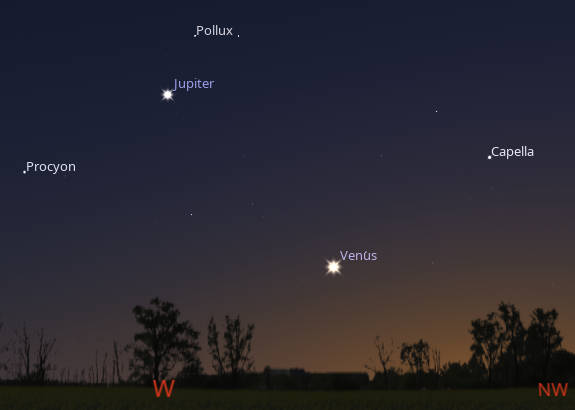
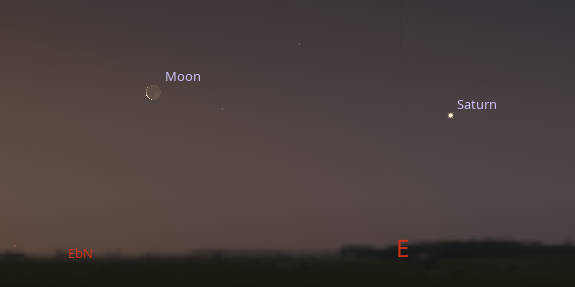
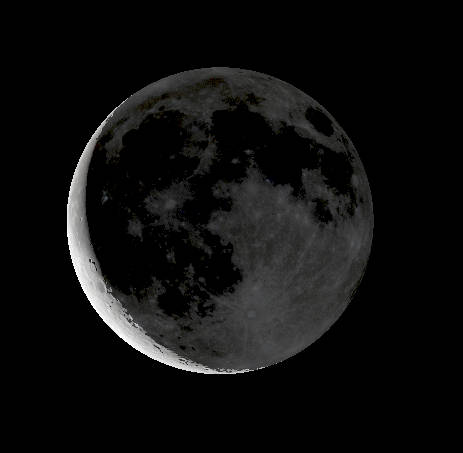
This is Ephemeris for Tuesday, May 12th. Today the Sun will be up for 14 hours and 43 minutes, setting at 9:01, and it will rise tomorrow at 6:16. The Moon, 3 days past last quarter, will rise at 4:16 tomorrow morning.
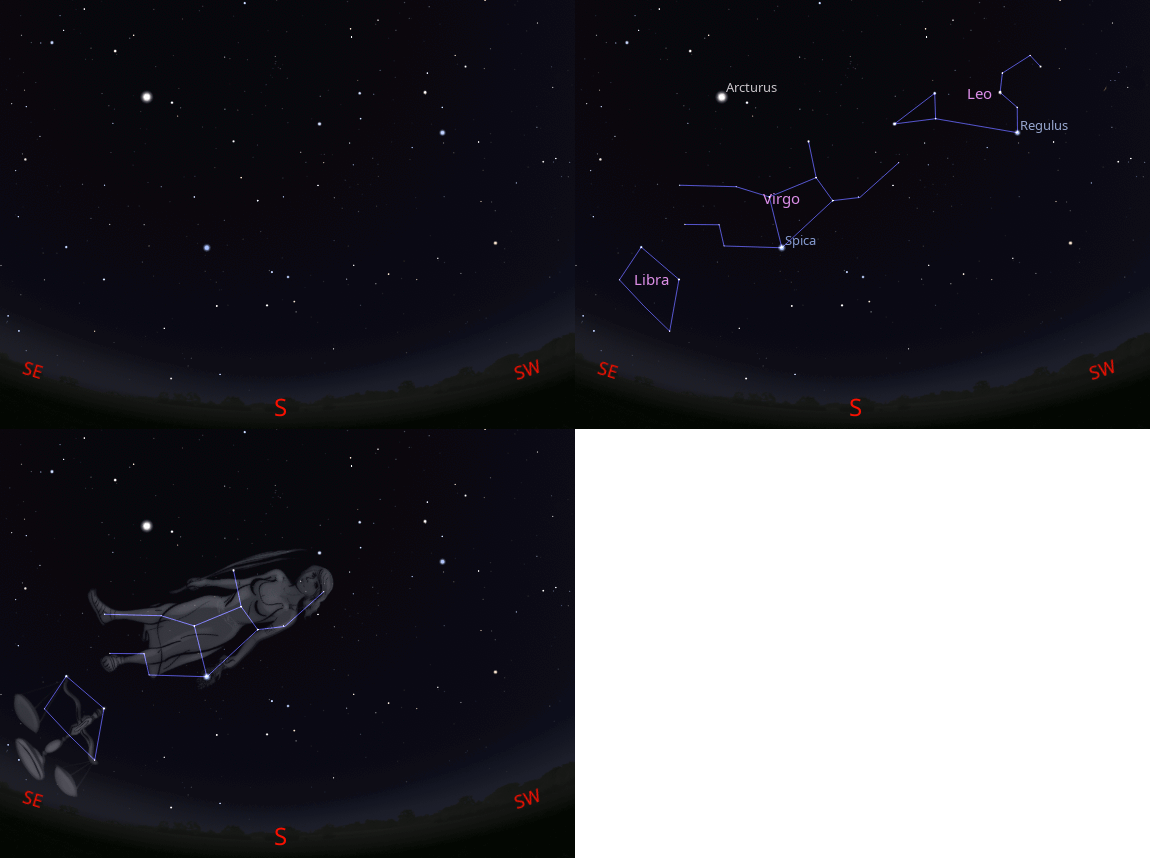
As skies darken look to the south, below the bright star Arcturus, high in the southeast, and left and below Leo the lion, in the southwest, to the constellation of Virgo the virgin with its bright star Spica in the south. Other than Spica, Virgo contains only dim stars. It’s quite large, extending to the upper right, and to the left of Spica. Virgo represents two goddesses. The Greek harvest goddess Persephone, whose Roman name is Ceres, which is the root of our word cereal, is one. The bright star Spica is the ear of wheat that she’s holding in her hand. Some see her standing at an odd angle, I see her reclining. Virgo also represents Astraea the goddess of Justice, with her scales, the constellation Libra, at her feet low in the southeast.
The astronomical event times given in this blog are for the Traverse City/Interlochen area of Michigan (Lat 44.7° N, Long 85.7° W; EDT, UT – 4 hours) unless stated otherwise. Times will be different for other locations.
Addendum
Ephemeris: 05/11/2026 – Finding the tiny but distinctive constellation of Corvus the crow
This is Ephemeris for Monday, May 11th. Today the Sun will be up for 14 hours and 40 minutes, setting at 8:59, and it will rise tomorrow at 6:17. The Moon, 2 days past last quarter, will rise at 3:57 tomorrow morning.
The small constellation of Corvus the crow is located low in the south at 10:30 this evening. It’s made of 6 dim stars, but the pattern is a distinctive but distorted box with two stars at the upper left marking that corner, and another two marking the lower right corner. I usually don’t notice the extra star at these corners, which denote the wings of this crow in flight to the upper right. To me the box is distinctive enough. It’s pretty much alone below Virgo and its bright star Spica, left an above it. I don’t see a crow here, but the box is distinctive in that no two sides are parallel. In the US we call the shape a trapezium, the British call it a trapezoid. Anyway it is a very memorable shape, at least to me.
The astronomical event times given in this blog are for the Traverse City/Interlochen area of Michigan (Lat 44.7° N, Long 85.7° W; EDT, UT – 4 hours) unless stated otherwise. Times will be different for other locations.
Addendum