Archive
09/15/2021 – Ephemeris – Let’s search for the naked-eye planets for this week
This is Ephemeris for Wednesday, September 15th. Today the Sun will be up for 12 hours and 30 minutes, setting at 7:52, and it will rise tomorrow at 7:23. The Moon, 2 days past first quarter, will set at 1:59 tomorrow morning.
Let’s search for the naked-eye planets for this week. Venus should be visible in the western evening twilight before 8:15 tonight. It will set at 9:19 pm. By 8:30 pm, Jupiter and Saturn will be seen low in the southeastern sky. The brighter Jupiter will be easy to spot at that hour. Saturn will be dimmer, but a bit higher and to its right. Both these planets will be to the left of the bright gibbous Moon. They will be visible for most of the night, with Saturn setting first at 3:24 am, with Jupiter setting at 4:50 tomorrow morning. Saturn’s rings can be seen in a spotting scope of about 20 power magnification. Though at that power, the rings won’t appear separated from the planet, so Saturn will look like an elliptical spot. Most of Jupiter’s 4 brightest moons can even be spotted in binoculars.
The astronomical event times given are for the Traverse City/Interlochen area of Michigan (EDT, UT – 4 hr). They may be different for your location.
Addendum
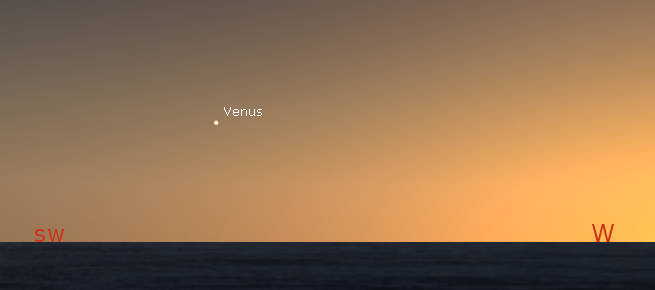
Venus in evening twilight at 8:15 tonight, about 20 minutes after sunset, September 15, 2021. Created using Stellarium.
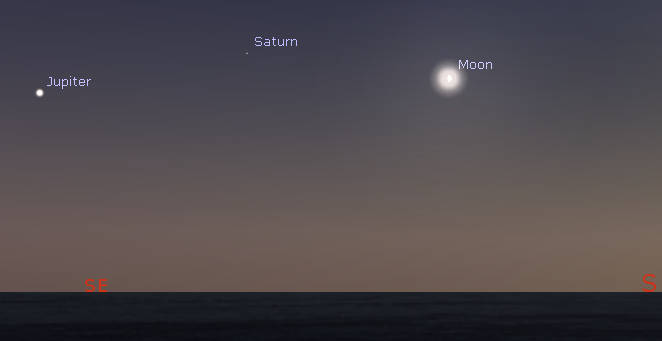
Jupiter Saturn and the Moon at 8:30 tonight, about 40 minutes after sunset, September 15, 2021. Created using Stellarium.
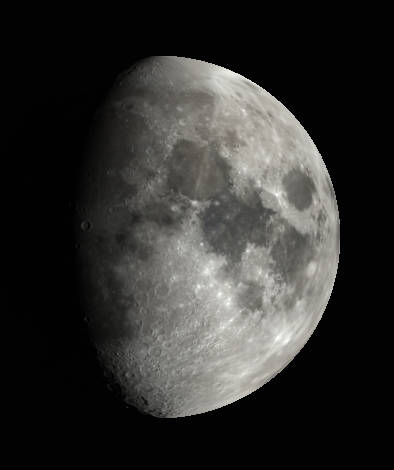
Low magnification view of the Moon tonight. The large crater Clavius is seen at the south (bottom) of the Moon. The crater Copernicus is seen near the left edge of the Moon, the sunrise terminator. Created using Stellarium.
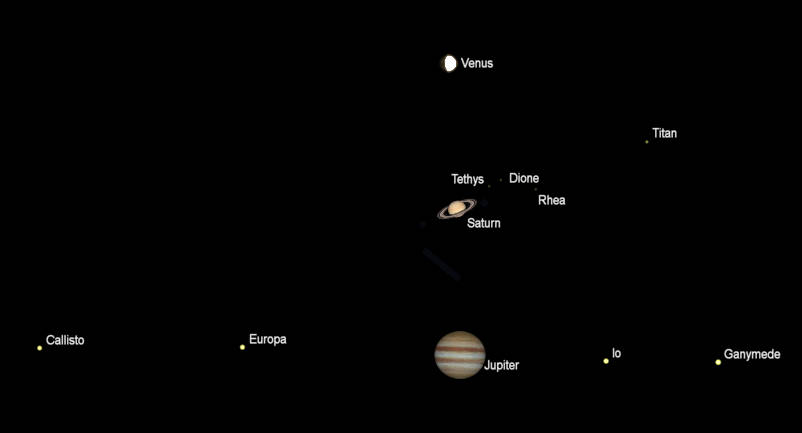
Telescopic view of the bright planets (north up) as they would be seen in a small telescope, with the same magnification, this evening. Venus at 8:30 pm, September 15, 2021. Apparent diameters: Venus, 16.70″ 68% illuminated; Saturn 18.03″, its rings 42.00″; Jupiter, 47.88″. The ” symbol means seconds of arc (1/3600th of a degree.) Created using Cartes du Ciel (Sky Charts).
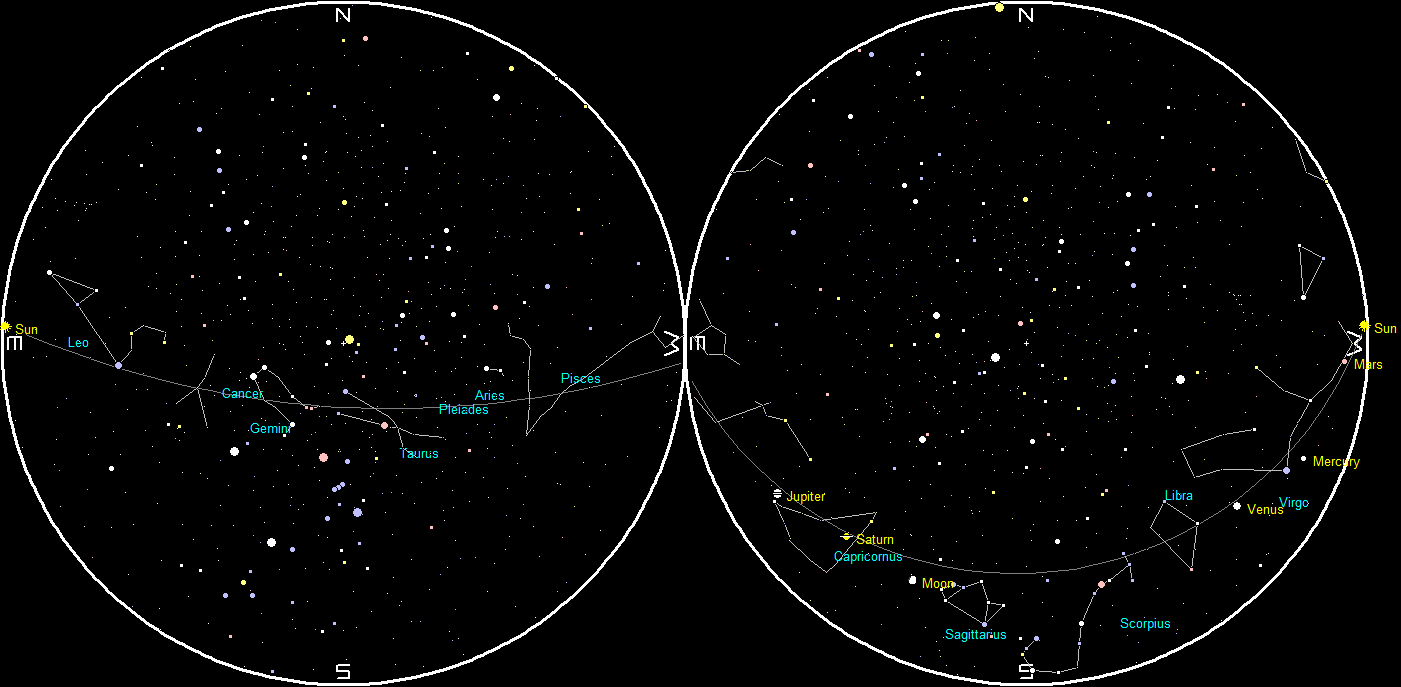
Planets and the Moon at sunset and sunrise of a single night, starting with sunset on the right on September 15, 2021. The night ends on the left with sunrise on the 16th. Click on the image to enlarge. Created using my LookingUp program.
09/09/2021 – Ephemeris – The constellation of Cassiopeia the Queen
This is Ephemeris for Thursday, September 9th. Today the Sun will be up for 12 hours and 49 minutes, setting at 8:04, and it will rise tomorrow at 7:16. The Moon, 3 days past new, will set at 9:40 this evening.
Tonight, check out the crescent Moon, with Venus below left of it. Cassiopeia is a constellation shaped like the letter W seen in the northeast these evenings. In Greek mythology, she was the queen of Ethiopia. She was very beautiful and very boastful of that fact. She even compared her beauty with that of the sea nymphs, daughters of the sea god Poseidon. Papa was not amused. So Cassiopeia’s daughter, the Princess Andromeda, was made to suffer for it. Poseidon sent a sea monster, Cetus, to ravage the coastal cities of the country. The only way to stop it was to sacrifice Andromeda to the monster. Andromeda and Cetus are constellations we’ll meet in the coming weeks. We’ve already met Pegasus, the flying horse, rising in the east. And we are yet to meet the hero, Perseus.
The astronomical event times given are for the Traverse City/Interlochen area of Michigan (EDT, UT – 4 hr). They may be different for your location.
Addendum
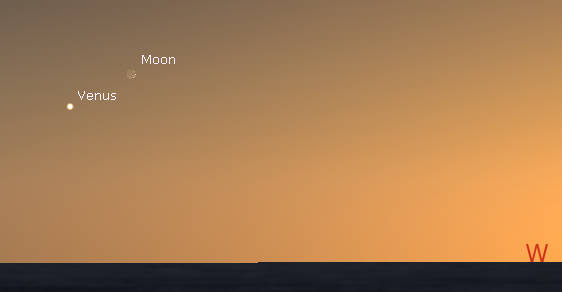
Venus and the Moon in evening twilight, about a half hour after sunset tonight, September 9, 2021. Created using Stellarium.
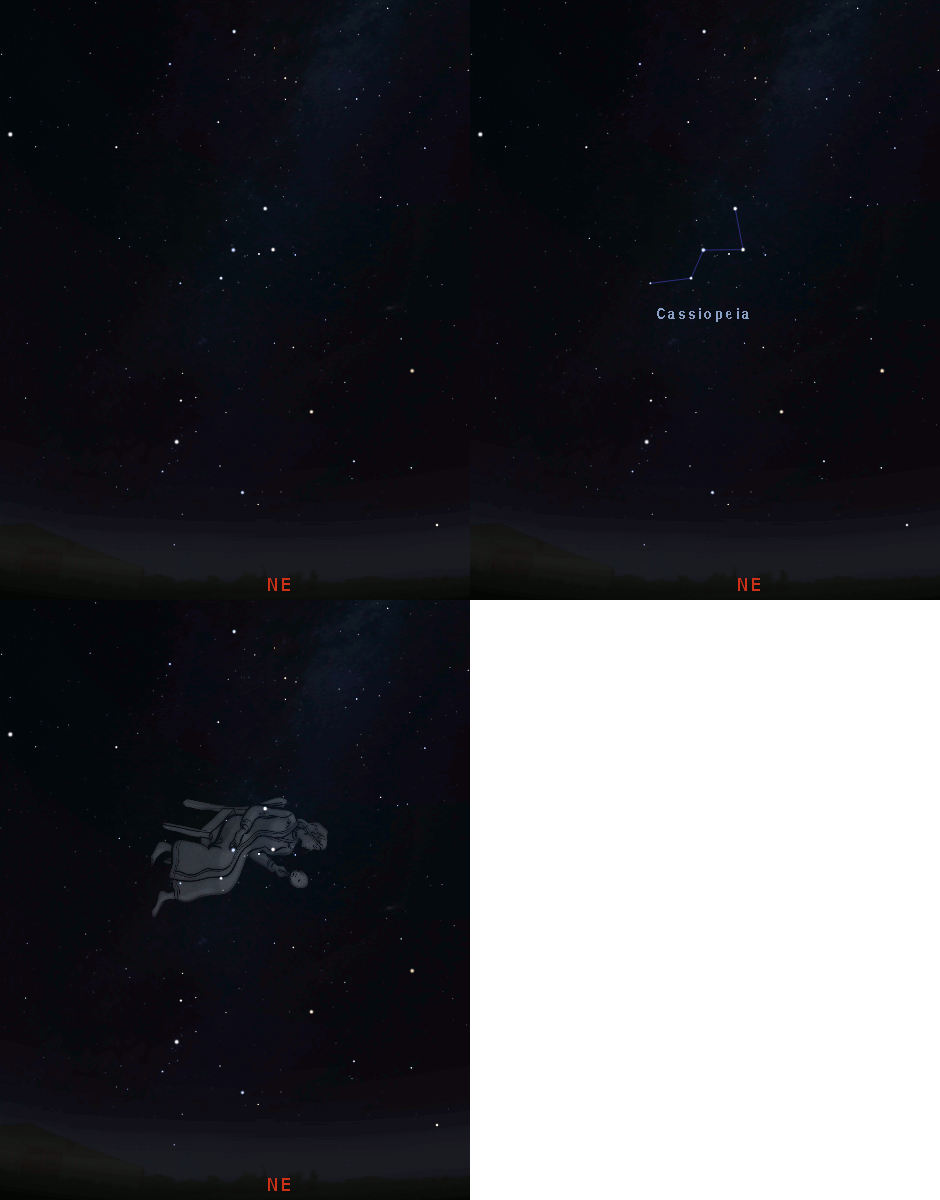
Cassiopeia finder animation looking northeast in mid-September, an hour and a half after sunset. Created using Stellarium.
09/02/2021 – Ephemeris – Finding the Little Dipper
This is Bob Moler with Ephemeris for Thursday, September 2nd. Today the Sun will be up for 13 hours and 10 minutes, setting at 8:17, and it will rise tomorrow at 7:07. The Moon, 3 days past last quarter, will rise at 2:55 tomorrow morning.
10 p.m. is the best time now to spot the Little Dipper. It is difficult to spot, being much smaller and dimmer than the Big Dipper. However, it is the Big Dipper that points to it, by the two stars at the front of the bowl which point to the North Star, Polaris, the star that doesn’t appear to move. That star is the tip of the handle of the Little Dipper. The handle is seen as a curve of stars upward and to the left to a small box of stars that is its bowl. The two brighter stars at the front of the bowl are called the Guard Stars because in the past they were thought to be guardians of the pole. The Little Dipper is not an official constellation, but is Ursa Minor the lesser bear. To the Anishinaabe native peoples of this area, it represents Maang the loon.
The astronomical event times given are for the Traverse City/Interlochen area of Michigan (EDT, UT – 4 hr). They may be different for your location.
Addendum
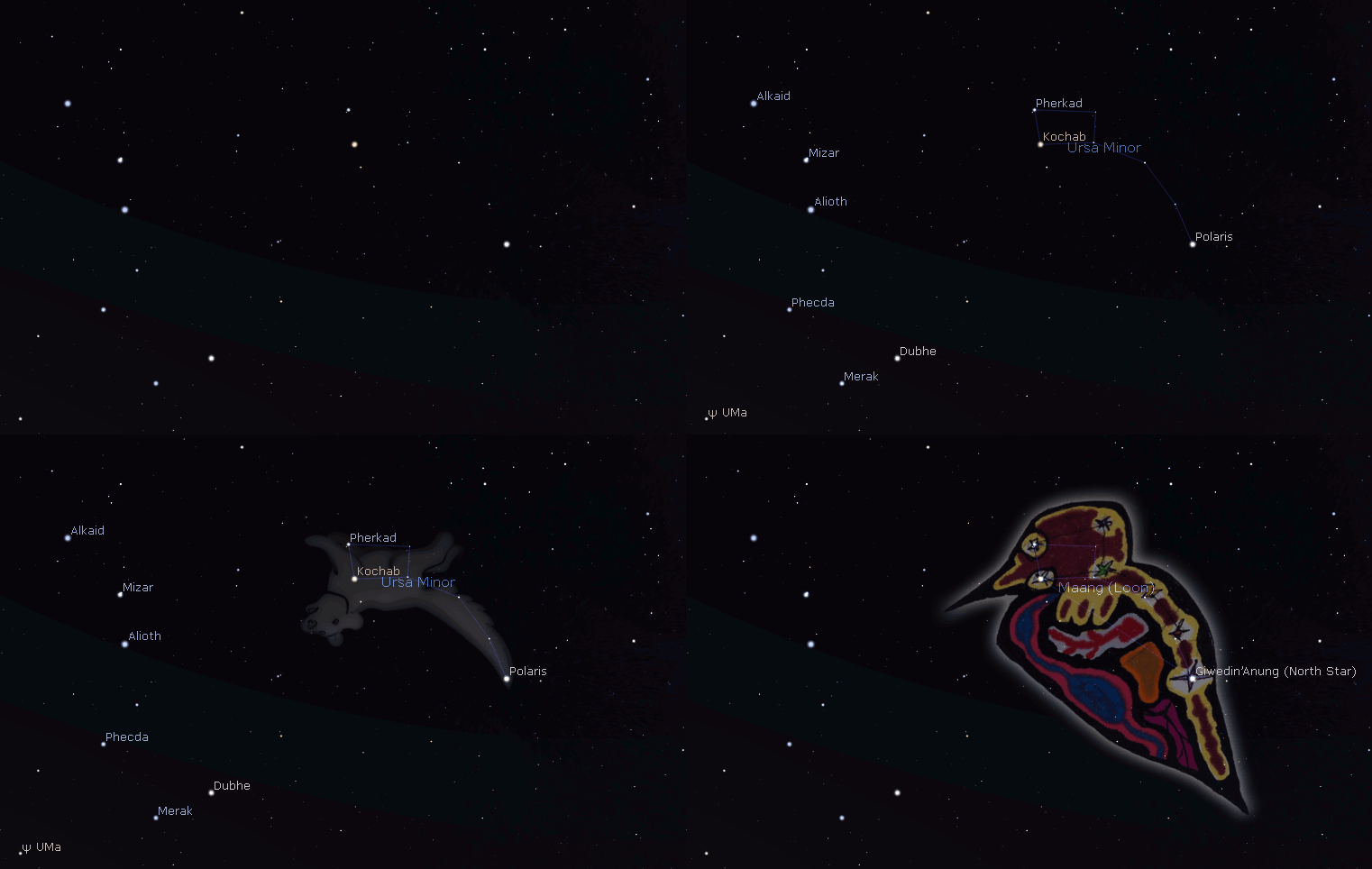
Little Dipper finder animation. The Little Dipper is also Ursa Major and the Loon. Polaris is the Pole Star and North Star. The Guard Stars are Kochab and Pherkad. Except for the named stars, the Little Dipper stars are quite faint and require moonless skies away from the city to spot. Created using Stellarium and GIMP.
08/30/2021 – Ephemeris – “W”
This is Bob Moler with Ephemeris for Monday, August 30th. Today the Sun will be up for 13 hours and 19 minutes, setting at 8:22, and it will rise tomorrow at 7:04. The Moon, at last quarter today, will rise at 12:26 tomorrow morning.
Rising higher each evening in the northeastern sky is a group of stars that make the pattern of the letter W. It is the constellation of Cassiopeia the queen. It is one of the more recognizable star patterns. From our latitude here in Northern Michigan, it is circumpolar, meaning that it never sets. Though, the best time to see it is in the autumn and winter, when it’s highest in the sky. It is opposite the Big Dipper from Polaris, the north star. In fact, a line drawn from any of the handle stars of the Big Dipper through Polaris will reach Cassiopeia. So as the Big Dipper descends in the northwestern sky now, Cassiopeia ascends in the northeast. They change places in winter and spring as the Big Dipper ascends in the northeast.
The astronomical event times given are for the Traverse City/Interlochen area of Michigan (EDT, UT – 4 hr). They may be different for your location.
Addendum
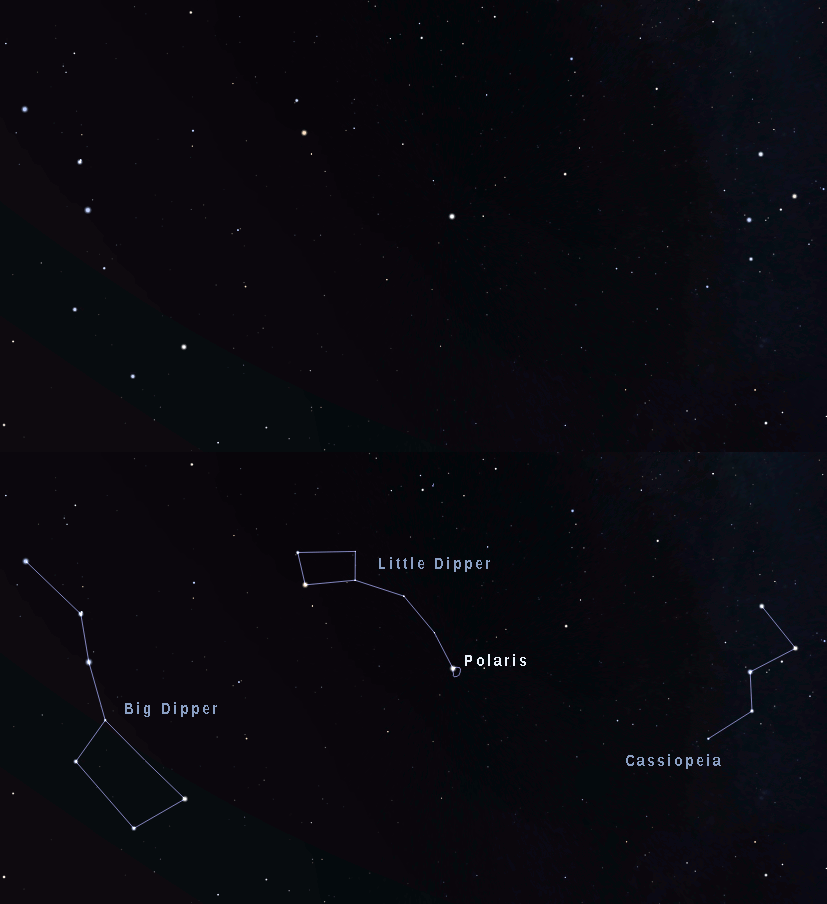
Animation showing the juxtaposition of Cassiopeia and the Big Dipper from Polaris, the North Star. Click on the image to enlarge it. Created using Stellarium and GIMP.
08/27/2021 – Ephemeris – As Labor Day approaches, so do the autumn constellations
This is Bob Moler with Ephemeris for Friday, August 27th. Today the Sun will be up for 13 hours and 28 minutes, setting at 8:27, and it will rise tomorrow at 7:00. The Moon, 3 days before last quarter, will rise at 11:01 this evening.
Rising in the east at as it gets dark around 9:30 p.m. we can preview one of the great autumn constellations: Pegasus the flying horse of Greek myth. Its most visible feature is a large square of four stars, now standing on one corner. This feature, called the Great Square of Pegasus, represents the front part of the horse’s body. The horse is quite aerobatic because it is seen flying upside down. Remembering that fact, the neck and head is a bent line of stars extending from the right corner star of the square. Its front legs can be seen in a gallop extending to the upper right from the top star of the square. From the left star extend, not hind legs but the constellation of Andromeda, an important constellation in its own right. The Anishinaabe peoples native to this region saw a right side up Moose (Mooz) in the stars here.
The astronomical event times given are for the Traverse City/Interlochen area of Michigan (EDT, UT – 4 hr). They may be different for your location.
Addendum
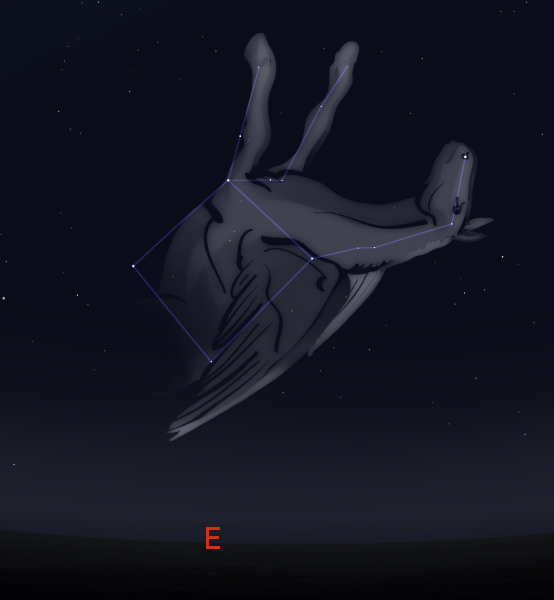
Pegasus image in the stars at 10 pm. Created using Stellarium. Drawing by Johan Meuris.
08/26/2021 – Ephemeris – Two tiny summer constellations
This is Ephemeris for Thursday, August 26th. Today the Sun will be up for 13 hours and 31 minutes, setting at 8:29, and it will rise tomorrow at 6:59. The Moon, half-way from full to last quarter, will rise at 10:40 this evening. | Located below the eastern edge of the Summer Triangle of three of the brightest stars in the sky, which is nearly overhead in our sky at 10 p.m., is the tiny constellation of Delphinus the dolphin. Delphinus’ 6 stars, in a small parallelogram with a tail, really does look like a dolphin leaping out of the water. The parallelogram itself has the name Job’s Coffin. The origin of this asterism or informal constellation is unknown. Of the dolphin itself: the ancient Greeks appreciated this aquatic mammal as we do, and told stories of dolphins rescuing shipwrecked sailors. There’s another tiny constellation to the right of Delphinus, Sagitta the arrow a small thin group of 5 stars, which represents Cupid’s dart.
The astronomical event times given are for the Traverse City/Interlochen area of Michigan (EDT, UT – 4 hr). They may be different for your location.
Addendum
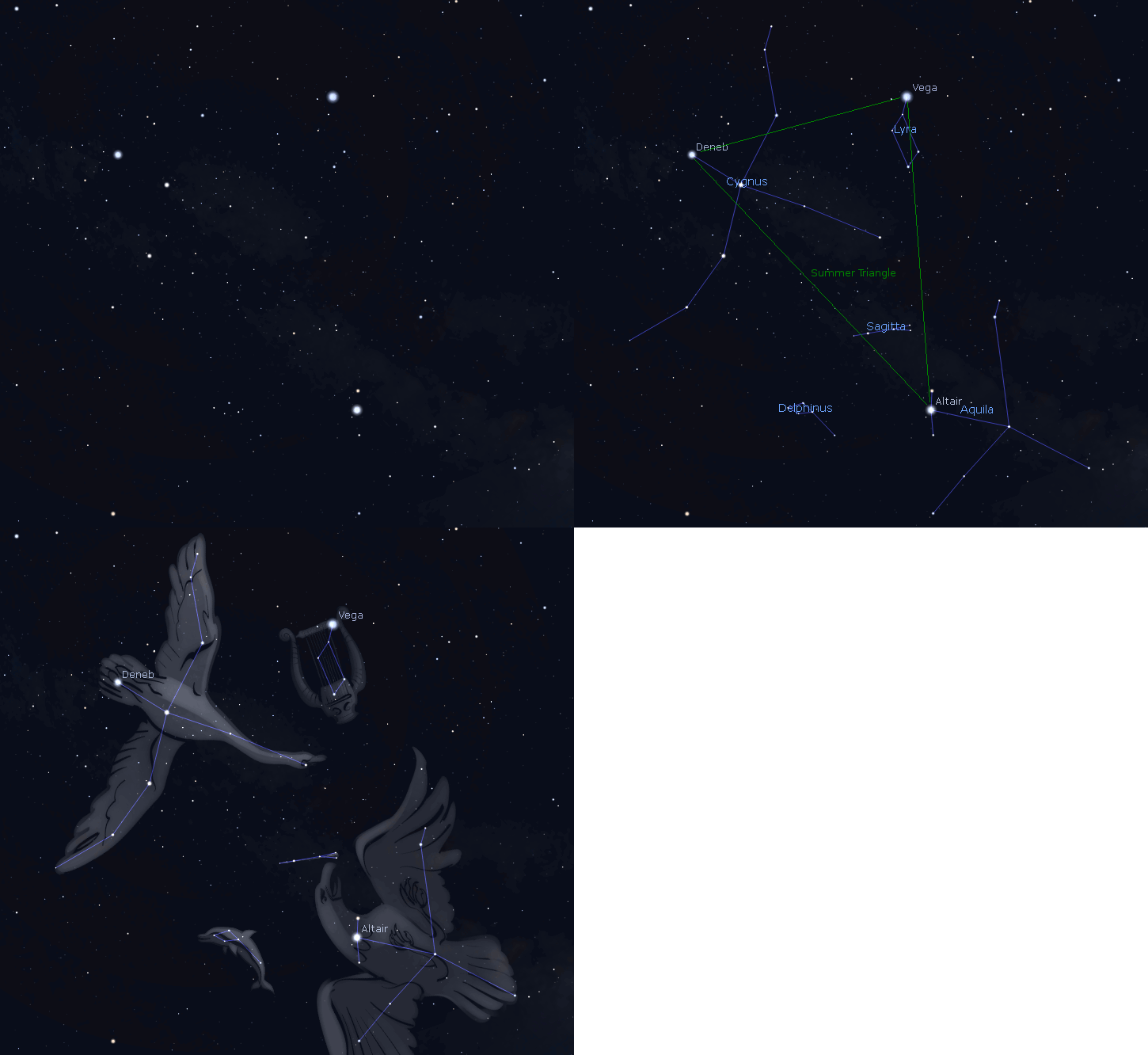
Delphinus and Sagitta finder animation. Created using Stellarium and GIMP.
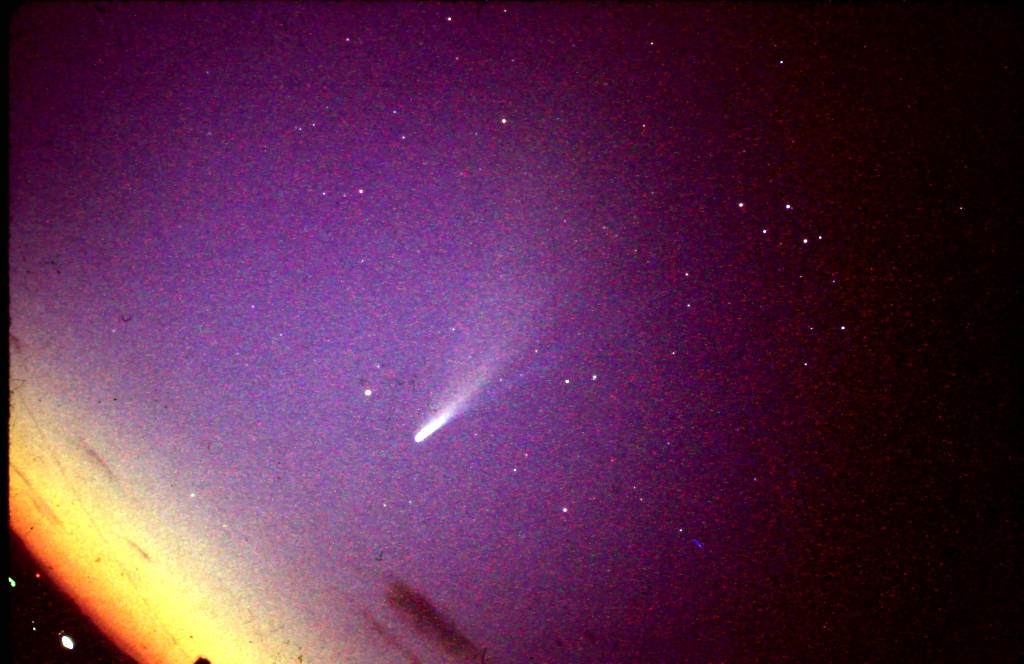
Comet West, C/1975 V1, as photographed by me at about 6 am, March 8, 1976. The wide, curved dust tail is most prominent, with the narrow blue ion tail streaming more directly away from the rising Sun. The small summer constellation of Delphinus the dolphin is to the upper right. The diamond shape of stars at the front of the dolphin’s body is an asterism called Job’s Coffin.
08/19/2021 – Ephemeris – Jupiter is at opposition today!
This is Ephemeris for Thursday, August 19th. Today the Sun will be up for 13 hours and 51 minutes, setting at 8:41, and it will rise tomorrow at 6:51. The Moon, 3 days before full, will set at 4:11 tomorrow morning.
Tonight, Jupiter will be at opposition. That’s a shortcut term for Jupiter being opposite the Sun in our sky. At that time, Jupiter rises at sunset and sets at sunrise. It is also at its closest to us. It also officially becomes an evening planet, available in the evening for those of us with daytime jobs. In even small telescopes, Jupiter shows two dark bands. There’s more, but those two are the most prominent. Its four largest moons will be visible before 9:50 pm tonight, after that the innermost of the four, Io, will start to cross the face of Jupiter. It will leave Ganymede on Jupiter’s east side. On the west side will be the moon Europa, and farther out, Callisto. At 12:08 am, Io will reappear on the west side of Jupiter, joining Europa and Callisto. The moons do put on a show.
The astronomical event times given are for the Traverse City/Interlochen area of Michigan (EDT, UT – 4 hr). They may be different for your location.
Addendum
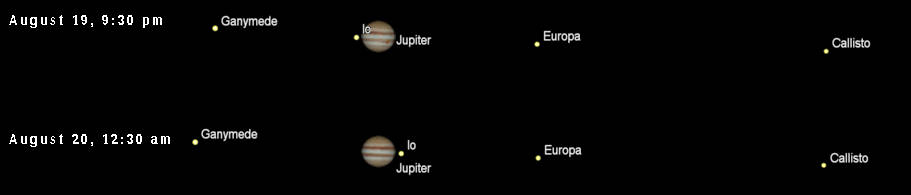
Jupiter’s Galilean moons at two times tonight, August 19th at 9:30 pm (01:30 on the 20th, UT) and 12:30 am (04:30 UT). From 9:50 pm to 12:08 am (01:50 – 04:08 UT), Io will pass in front of Jupiter and be practically invisible. Click on the image to enlarge it. Created using Cartes du Ciel (Sky Charts).
08/17/2021 – Ephemeris – Jupiter is big and bright in the evening
This is Bob Moler with Ephemeris for Tuesday, August 17th. Today the Sun will be up for 13 hours and 56 minutes, setting at 8:44, and it will rise tomorrow at 6:49. The Moon, 2 days past first quarter, will set at 2:02 tomorrow morning.
The brilliant planet we see rising in the east-southeast in the evening is not Venus, which is low in the west, ensnared in evening twilight. It’s Jupiter, the second-brightest planet and the largest by far. Jupiter would be the brightest planet except that the strength of sunlight falling on it is only 1/25th of what we get on the Earth and less than 1/50th of what Venus gets. Plus, it’s a lot farther away. Even in binoculars, Jupiter appears as not quite star-like. Most of the time, Jupiter is the largest appearing planet in telescopes. It is only beaten by Venus for a couple of months when it is nearest to us. When I was a kid, just learning about the planets, Jupiter had 12 moons. Astronomers by now have discovered 68 more.
The astronomical event times given are for the Traverse City/Interlochen area of Michigan (EDT, UT – 4 hr). They may be different for your location.
Addendum
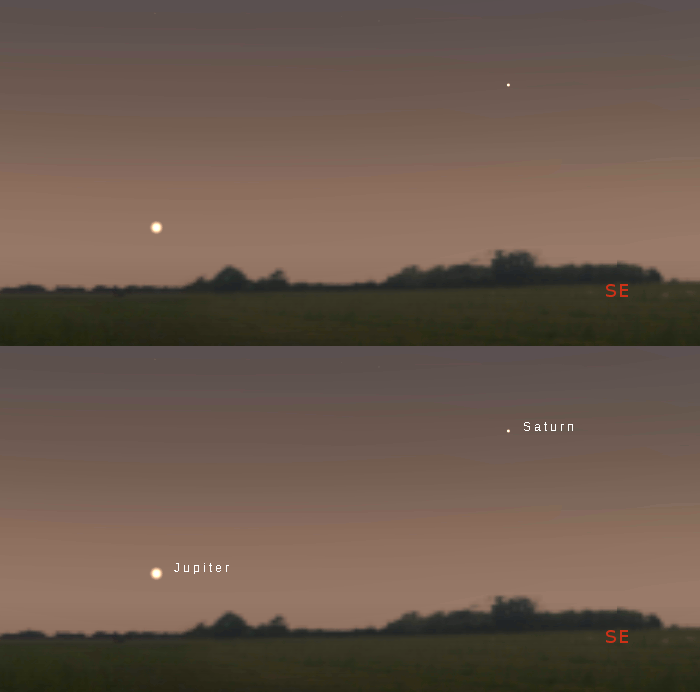
Jupiter finder animation for tonight, August 17, 2021, at 9:15 pm. Venus i is in the west, which is brighter but suffering in bright twilight. Saturn may not be as easily visible as it is shown here until later. Credit: Stellarium and GIMP.
08/12/2021 – Ephemeris – It’s not too late to see the Perseids
This is Ephemeris for Thursday, August 12th. Today the Sun will be up for 14 hours and 10 minutes, setting at 8:52, and it will rise tomorrow at 6:43. The Moon, 3 days before first quarter, will set at 11:13 this evening.
It’s not too late to see the Perseid meteors. The projected peak of the shower is expected to be between 3 and 6 this afternoon. So the meteor shower should still be quite active. It has been my experience that the numbers of meteors decline more rapidly than they increase before the peak. NASA can determine their orbits using all sky cameras placed at different locations to get their paths by triangulation. The cameras have shutters the interrupt the meteor track at a specific interval, which allow them to determine the meteor’s speed and are able to calculate the particle’s orbit of the Sun. An animation of these orbital tracks can be found on the International Meteor Organization website imo.net.
The astronomical event times given are for the Traverse City/Interlochen area of Michigan (EDT, UT – 4 hr). They may be different for your location.
Addendum
I’ve been talking about the Perseid meteor shower all week, so far. Click on the calendar dates to the upper right to review those posts.
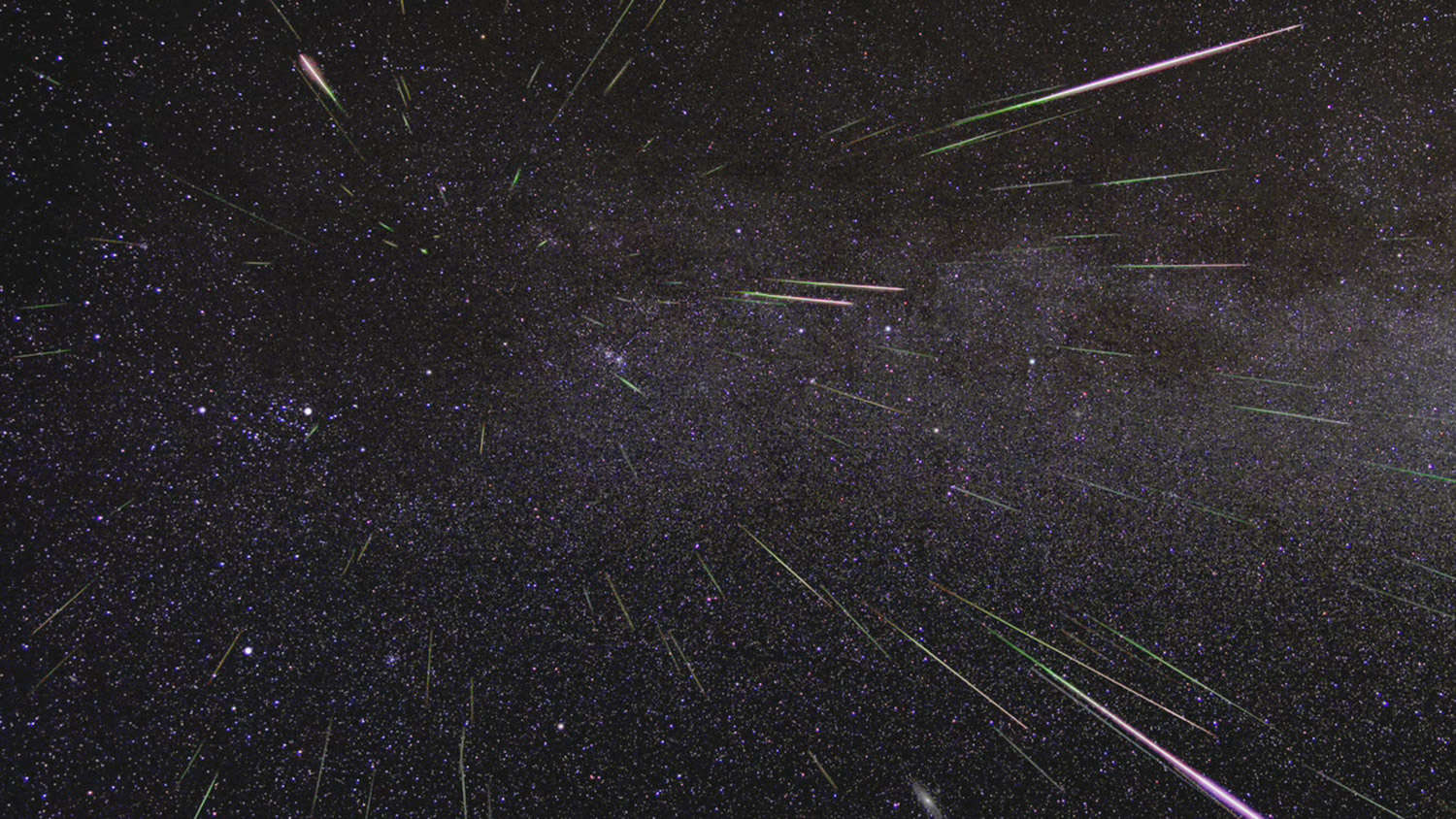
A Perseid outburst from 2009. Credit NASA/JPL via Phil Plait’s Bad Astronomy.
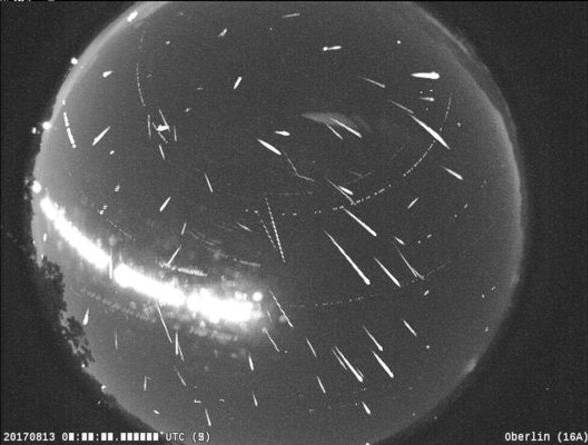
Perseid fireballs in one of NASA’s all sky cameras during the morning hours of August 13, 2017. This is a long time exposure. The bright swath in the image is the Moon that morning. Since it is a time exposure, the radiant is also moving with the earth’s rotation, so the meteors only seem to come from the northeastern sky. North is at the top, and East is to the left. Credit NASA.
08/11/2021 – Ephemeris – Let’s search for the naked-eye planets for this week, and meteors tonight
This is Bob Moler with Ephemeris for Wednesday, August 11th. Today the Sun will be up for 14 hours and 13 minutes, setting at 8:54, and it will rise tomorrow at 6:42. The Moon will be 3 days past new tonight.
Let’s search for the naked-eye planets for this week. Venus and the Moon will be close together tonight, with Venus below and right of the waxing crescent Moon by 9:30 tonight. Venus will set at 10:18 pm. With the Moon following at 10:50. By 10 pm, Jupiter and Saturn will be seen low in the southeastern sky. The brighter Jupiter will be easy to spot at that hour. Saturn will be dimmer, but a bit higher and to its right. Tonight and especially in the morning hours tomorrow, the Perseid meteors will be at their peak. These bits of Comet Swift-Tuttle, liberated by the comet’s prior passes in through the warmth of the inner solar system, will flash into incandescence as they enter the Earth’s atmosphere at interplanetary speeds.
The astronomical event times given are for the Traverse City/Interlochen area of Michigan (EDT, UT – 4 hr). They may be different for your location.
Addendum
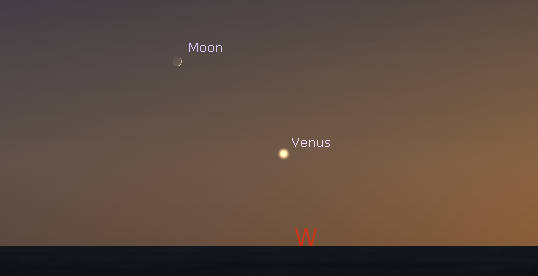
Venus and the 3-day-old Moon ion evening twilight at 9:45 tonight, August 11, 2021. Created using Stellarium.
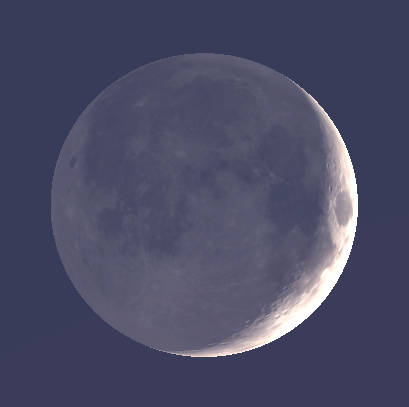
The Moon as it might appear in binoculars tonight, August 11, 2021, with earth shine on its night side, illuminated by the bright Earth in its sky.
Created using Stellarium.
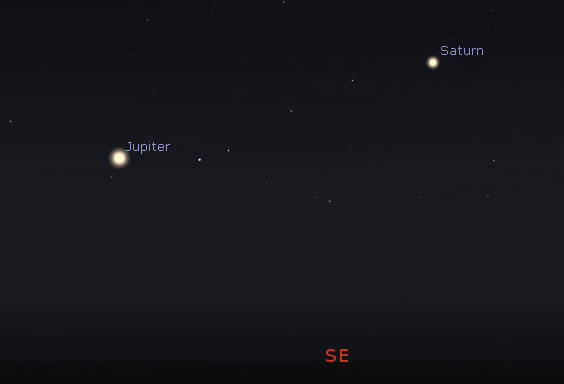
Jupiter and Saturn in the southeastern sky at 10:30 in the evening tonight, August 11, 2021. Created using Stellarium.
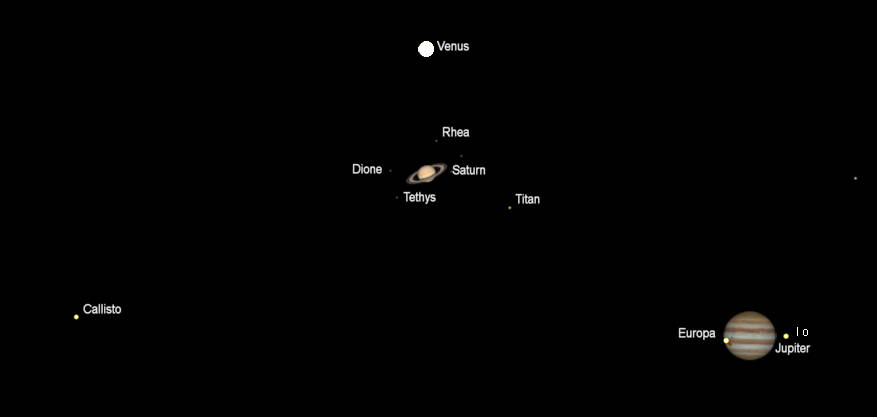
Telescopic view of the bright planets (north up) as they would be seen in a small telescope, with the same magnification, this evening, at 10 pm August 11, 2021. Apparent diameters: Venus, 13.40″; Saturn 18.57″, its rings 43.26″; Jupiter, 49.00″. Jupiter’s moon have a cluster of events in the evening. See below. The ” symbol means seconds of arc (1/3600th of a degree.) Click on the image to enlarge it. Created using Cartes du Ciel (Sky Charts).
                Jupiter's Satellite events
Moon      Event            EDT (pm-11th, am-12th) UT (12th)
Europa    Shadow enters    10:00 pm               02:00
Europa    Transit starts   10:25 pm               02:25
Io        Eclipse starts   10:41 pm               02:41
Europa    Shadow exits     12:51 am               04:51
Ganymede  Occultation ends  1:06 am               05:06
Io        Occultation ends  1:11 am               05:11
Europa    Transit ends      1:12 am               05:12
The above times were determined using Stellarium, and may be off by several minutes.
Shadow events are when a satellite’s shadow is cast onto the face of the planet
Transit events are when the satellite passes in front of the planet
Eclipse events are when a satellite passes through the planet’s shadow
Occultation events are when the satellite passes behind the planet
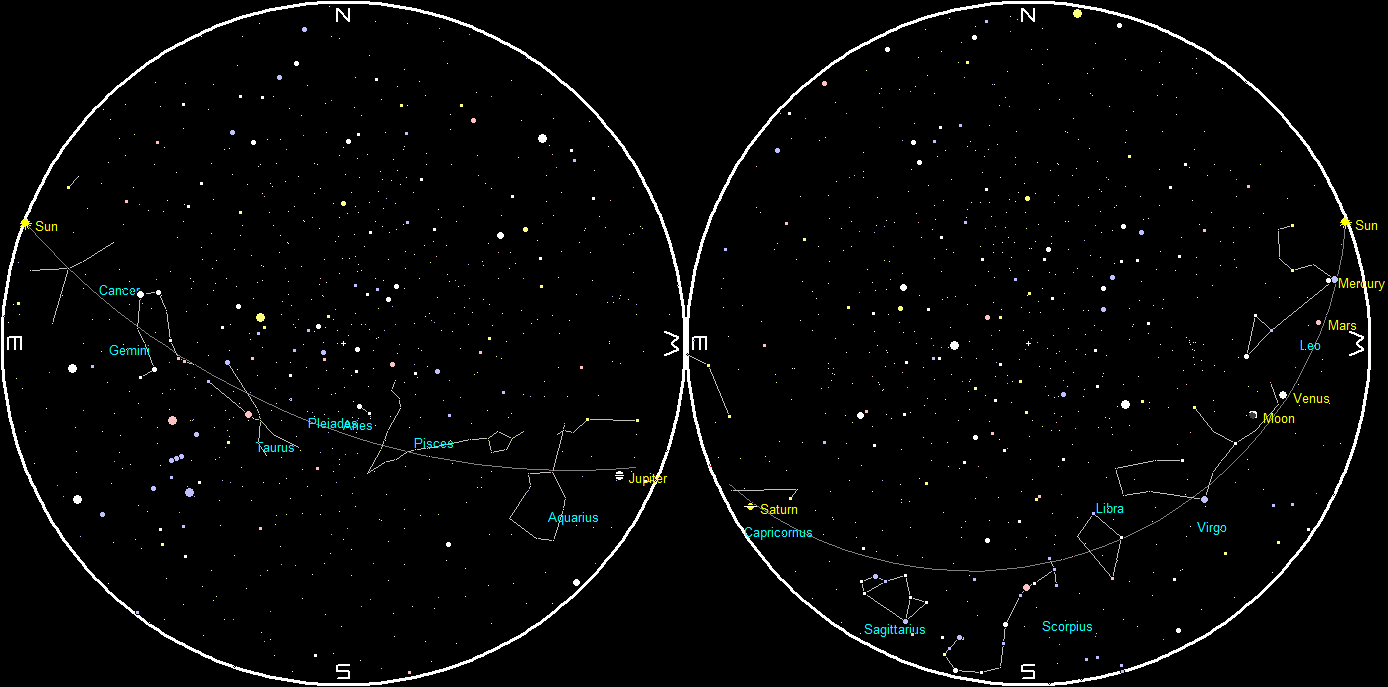
Planets and the Moon at sunset and sunrise of a single night, starting with sunset on the right on August 11, 2021. The night ends on the left with sunrise on the 12th. Click on the image to enlarge. Created using my LookingUp program.
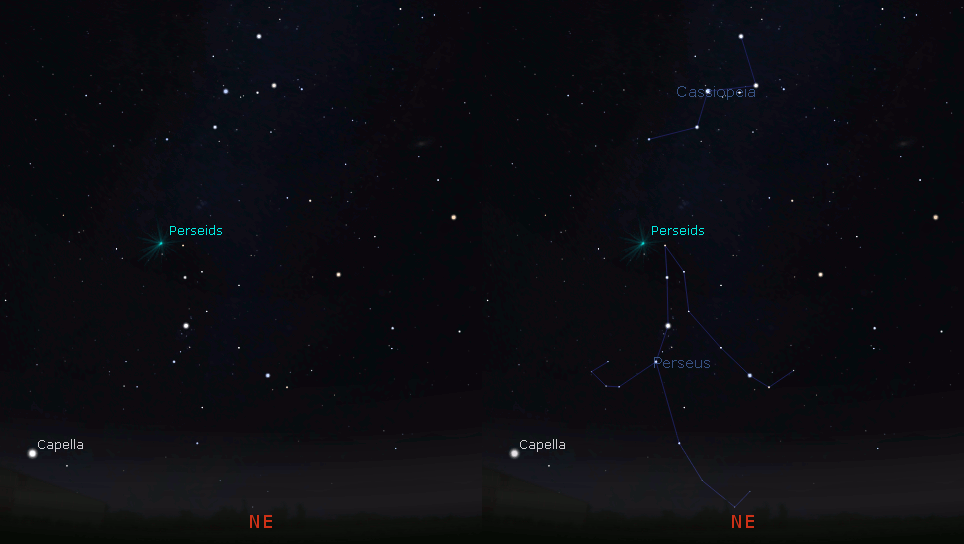
Perseid Radiant finder automation for midnight, August 11th. Created using Stellarium and GIMP.
More on the Perseids on Monday and Tuesday’s posts.

