Archive
11/02/2021 – Ephemeris – Finding the Pleiades or Seven Sisters
This is Ephemeris for Election Day for some, Tuesday, November 2nd. The Sun will rise at 8:22. It’ll be up for 10 hours and 7 minutes, setting at 6:29. The Moon, 2 days before new, will rise at 6:35 tomorrow morning.
A marvelous sight in the autumn skies can be found low in the east after 8 in the evening. It is the famous star cluster called the Pleiades or the Seven Sisters. I might also add the “Tiny Dipper”. Many people can spot a tiny dipper shape in its six or seven stars, and mistake it for the Little Dipper. However, with binoculars, one can see over a hundred stars appear along with the dipper shape of the brightest. In photographs, the Pleiades actually contain wisps of the dust they are passing through. They are a young star cluster, whose age is estimated to be one hundred million years. In Greek mythology, the sisters were daughters of the god Atlas. I’ll be revisiting the Pleiades several times this autumn, and winter, starting on Thursday.
The astronomical event times given are for the Traverse City/Interlochen area of Michigan (EDT, UT – 4 hours). They may be different for your location.
Addendum
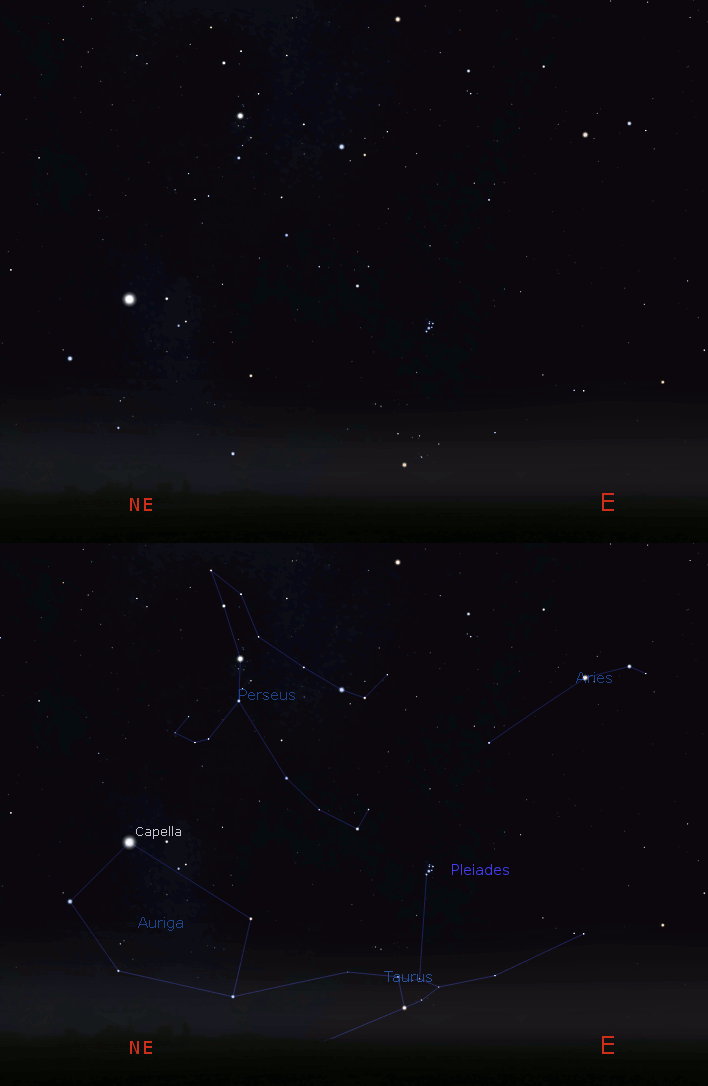
Finding the Pleiades animation for 9 p.m. in late October/early November. Created using Stellarium and GIMP.
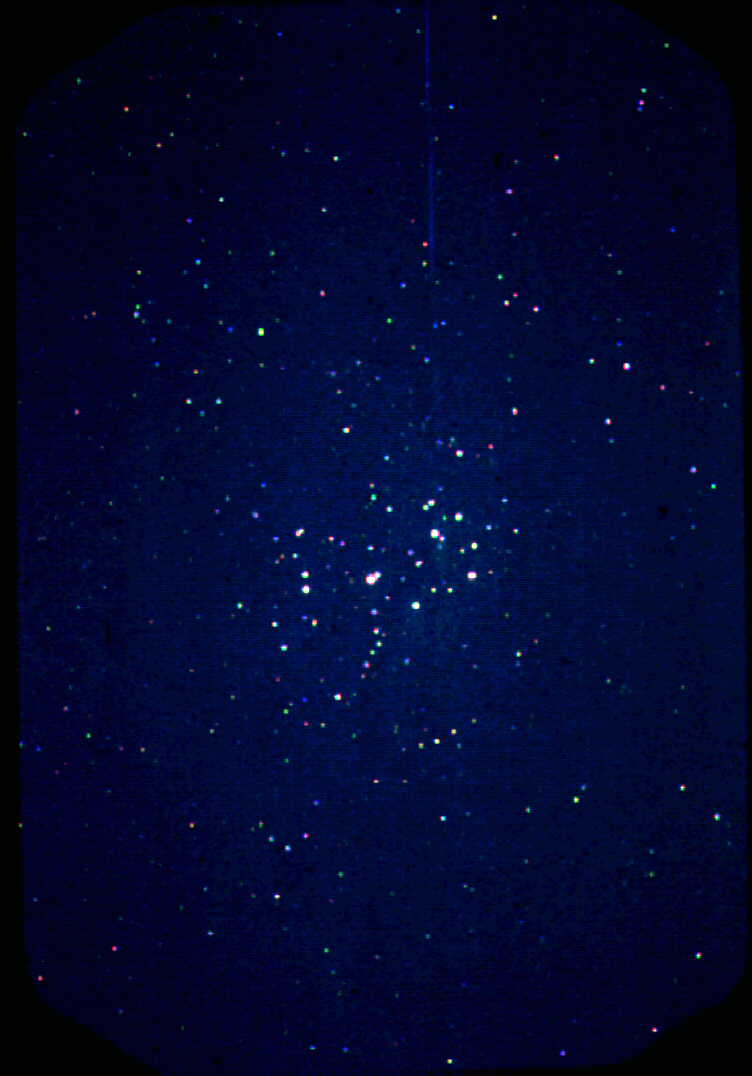
The Pleiades, about what you’d see in binoculars.
10/29/2021 – Ephemeris – Venus is at its greatest separation east from the Sun today
This is Ephemeris for Friday, October 29th. Today the Sun will be up for 10 hours and 18 minutes, setting at 6:35, and it will rise tomorrow at 8:18. The Moon, 1 day past last quarter, will rise at 1:39 tomorrow morning.
Tonight, Venus will be at its greatest separation east of the Sun of 47 angular degrees. Having an orbit inside the Earth’s orbit, Venus never strays more than a 47-degree angle from the Sun. It has been moving away from around behind the Sun to its present position since March 26th. That’s 217 days. And now it will take only 72 days to head back to pass between the Earth and the Sun in inferior conjunction and leave the evening sky on January 9th. For this next 70 or so days, Venus will look great in telescopes. It will get larger as it approaches us and become a dazzling crescent in telescopes. Toward the latter half of December, the tiny crescent can even be made out in binoculars. It is the very best time to view Venus in a telescope.
The astronomical event times given are for the Traverse City/Interlochen area of Michigan (EDT, UT – 4 hours). They may be different for your location.
Addendum
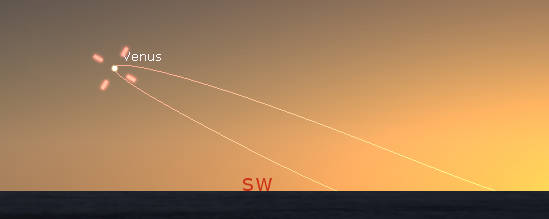
Venus at greatest elongation, seen at 7 pm tonight, October 29, 2021. Note how shallow the orbit is compared with Mercury’s orbit was on Monday’s (10/25/2021) post of Mercury’s greatest western elongation as seen in the morning. Created using Stellarium.
10/26/2021 – Ephemeris – The bright star Capella is slowly ascending in the northeastern sky
This is Ephemeris for Tuesday, October 26th. Today the Sun will be up for 10 hours and 26 minutes, setting at 6:39, and it will rise tomorrow at 8:14. The Moon, 2 days before last quarter, will rise at 10:29 this evening.
The bright star that’s been hanging out fairly low in the northeastern sky in the evening lately is Capella, sometimes called the Goat Star. It’s at the top of a rather oddly shaped pentagon of stars that make up the constellation Auriga, the charioteer. A small, thin triangle of stars to Capella’s right is called the Kids*. Her kids. I’m not sure what a fellow is doing holding 4 goats while driving a chariot. Maybe that’s how he ended up in the sky. Capella itself consists of two yellow giant stars, about the same temperature as the Sun, but much larger. Capella is circumpolar for most of northern Michigan, meaning it never sets. It gets pretty low in the north on summer evenings.
The astronomical event times given are for the Traverse City/Interlochen area of Michigan (EDT, UT – 4 hours). They may be different for your location.
* I’ve always known them as the Kids. Stellarium calls them the Goatlings.
Addendum
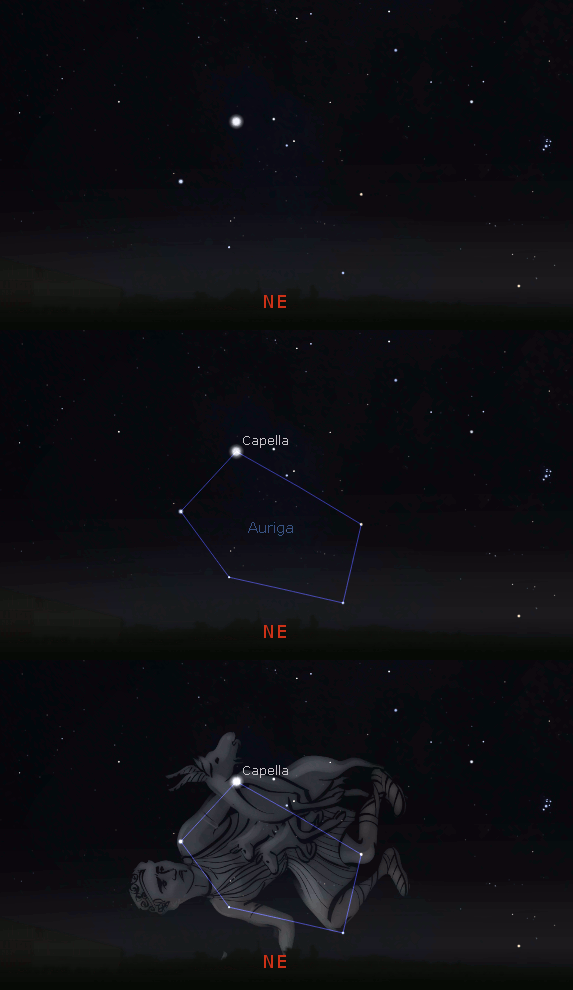
Capella and Auriga, low in the northeastern sky. I left the Kids unannotated, but they are easy to find near Capella. An animation created using Stellarium and GIMP.
10/25/2021 – Ephemeris – Mercury is at its greatest separation west of the Sun of the season
This is Bob Moler with Ephemeris for Monday, October 25th. Today the Sun will be up for 10 hours and 29 minutes, setting at 6:41, and it will rise tomorrow at 8:13. The Moon, 3 days before last quarter, will rise at 9:38 this evening.
This morning at 12:59 am, the planet Mercury reached its greatest western elongation from the Sun. It reached an angle of 18.4 degrees west of the Sun. It will be visible for most of the 7 am hour low in the east southeastern sky. Mercury will be visible to the naked-eye for the next week or 10 days. The planet has quite an elliptical orbit. And it happens that in our favorable appearances of Mercury on fall mornings and spring evenings, we are seeing Mercury in the same part of its orbit. Which is near its perihelion, the closest part of its orbit of the Sun. Observers in the Southern Hemisphere see Mercury’s favorable elongations near aphelion, its farthest from the Sun, of around 28 degrees separation from Earth’s viewpoint.
The astronomical event times given are for the Traverse City/Interlochen area of Michigan (EDT, UT-4 hours). They may be different for your location.
Addendum
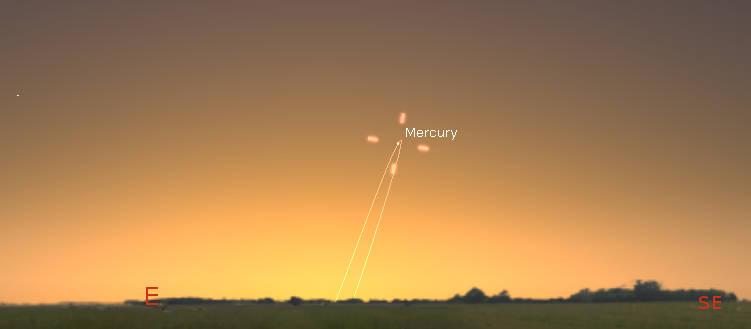
Mercury, a day after greatest western elongation at 7:54 am, or 20 minutes before sunrise tomorrow morning, October 26, 2021. Also shown is its orbit, if we could see it. Mercury is virtually in the same position this morning. Created using Stellarium.
10/07/2021 – Ephemeris – The loneliest star in the sky
This is Bob Moler with Ephemeris for Thursday, October 7th. Today the Sun will be up for 11 hours and 23 minutes, setting at 7:11, and it will rise tomorrow at 7:49. The Moon, 1 day past new, will set at 8:06 this evening.
There’s a bright star that appears for only seven and a half hours on autumn nights. It’s appearance, low in the south-southeast at 9 p.m., is a clear indication of the autumn season. The star’s name is Fomalhaut, which means fish’s mouth. That’s fitting because it’s in the constellation of Piscis Austrinus, the southern fish. At our latitude it’s kind of the fish that got away, because Fomalhaut appears to be quite alone low in the sky. The dimness of the constellation’s other stars and location close to the horizon make the other stars hard to spot. The Earth’s thick atmosphere near the horizon reduces their brightness by a factor of two or more, so Fomalhaut, one of the brightest stars in the sky, keeps a lonely vigil in the south.
The astronomical event times given are for the Traverse City/Interlochen area of Michigan (EDT, UT-4 hours). They may be different for your location.
Addendum
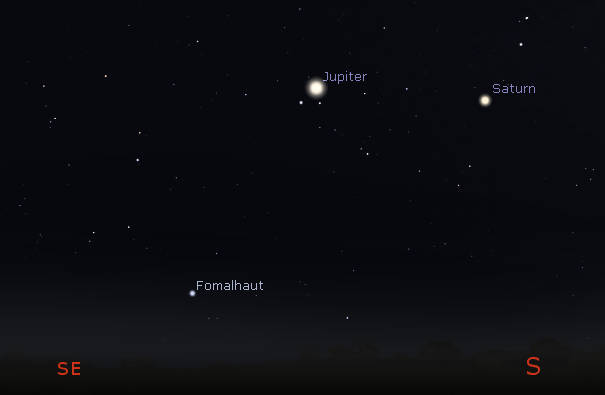
Fomalhaut at 9 pm, October 7, 2021. This year it has two bright planets relatively nearby, By they’re just passing through, albeit slowly. Normally the closest first magnitude star to Fomalhaut is Altair, the southernmost of the Summer Triangle stars. Created using Stellarium.
10/06/2021 – Ephemeris – Let’s search for the naked-eye planets for this week
This is Ephemeris for Wednesday, October 6th. Today the Sun will be up for 11 hours and 26 minutes, setting at 7:13, and it will rise tomorrow at 7:48. The Moon is new today, and won’t be visible.
Let’s search for the naked-eye planets for this week. Venus should be visible in the southwestern evening twilight by 7:45 tonight. It will set at 8:52 pm. By 8 pm, Jupiter will be spotted in the south-southeastern sky. The Jupiter should be easy to spot at that hour. Saturn will be dimmer, but a bit higher and to its right. They will be visible into the morning hours, with Saturn setting first at 1:58 am, and Jupiter following at 3:20. Saturn’s rings can be seen in a spotting scope of about 20 power magnification. Though at that power the rings won’t appear separated from the planet, so Saturn will look like an elliptical disk. Jupiter’s 4 brightest moons are spread out, three on one side, and one on the other. They might all be visible in binoculars tonight.
The astronomical event times given are for the Traverse City/Interlochen area of Michigan (EDT, UT-4 hours). They may be different for your location.
Addendum
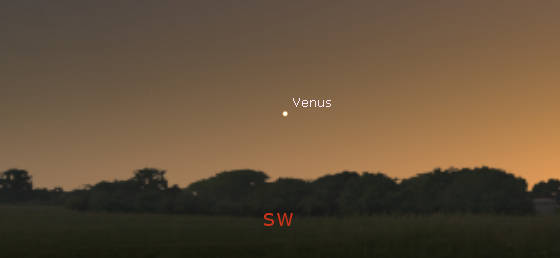
Venus in evening twilight at 7:45 pm, about a half hour after sunset. Created using Stellarium.
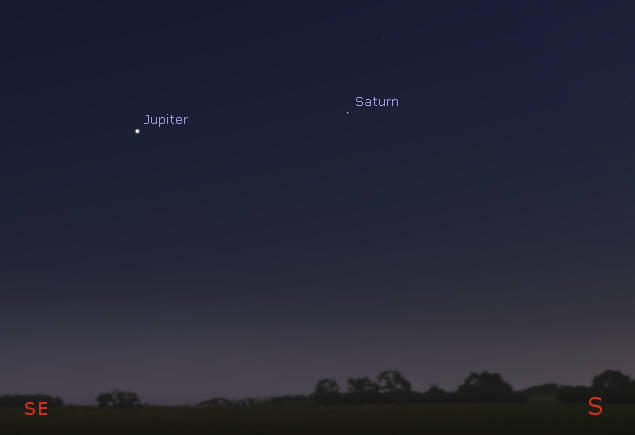
Jupiter and Saturn at 8 pm, about 45 minutes after sunset tonight, October 6, 2021. Created using Stellarium.
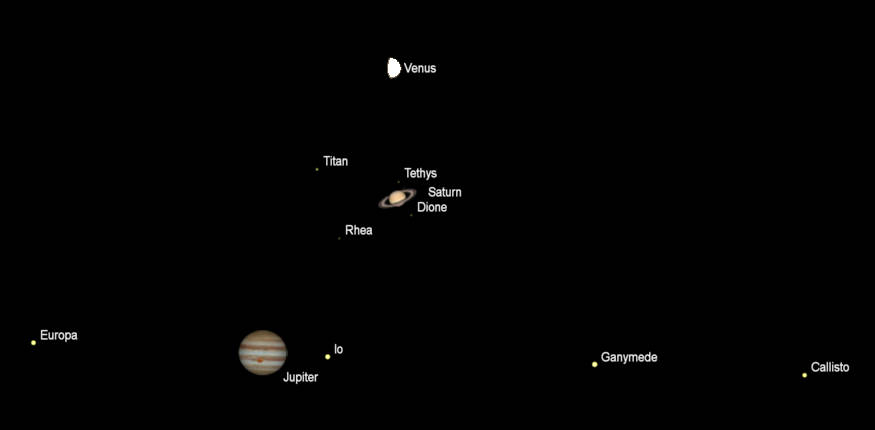
Telescopic views of the bright planets (north up) as they would be seen in a small telescope, with the same magnification, this evening at 8 pm, October 6, 2021. Apparent diameters: Venus, 19.81″, 59.8% illuminated; Saturn 17.48″, its rings 40.73″; Jupiter, 45.55″. The ” symbol means seconds of arc (1/3600th of a degree.) Click on the image to enlarge it. Created using Cartes du Ciel (Sky Charts).
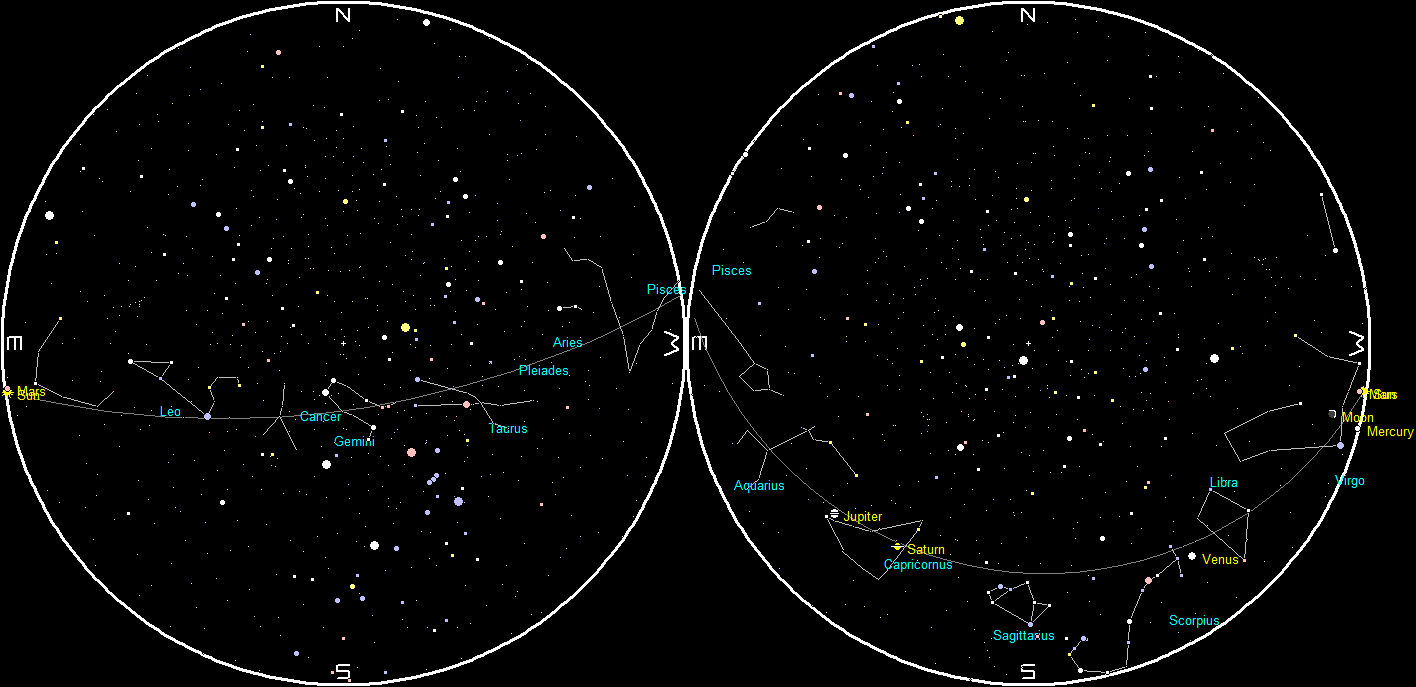
The naked-eye planets and the Moon at sunset and sunrise on a single night, starting with sunset on the right on October 6, 2021. The night ends on the left with sunrise on the 7th. Click on the image to enlarge it. Created using my LookingUp program.
09/29/2021 – Ephemeris – Let’s search for the naked-eye planets for this week
This is Ephemeris for Wednesday, September 29th. Today the Sun will be up for 11 hours and 47 minutes, setting at 7:26, and it will rise tomorrow at 7:39. The Moon, 1 day past last quarter, will rise at 12:40 tomorrow morning.
Let’s search for the naked-eye planets for this week. Venus should be visible in the southwestern evening twilight by 7:45 tonight. It will set at 8:59 pm. By 8 pm, Jupiter will be spotted in the southeastern sky. The Jupiter should be easy to spot at that hour. Saturn will be dimmer, but a bit higher and to its right. They will be visible into the morning hours, with Saturn setting first at 2:26 am, with Jupiter following at 3:49. Saturn’s rings can be seen in a spotting scope of about 20 power magnification. Though at that power the rings won’t appear separated from the planet, so Saturn will look like an elliptical disk. Jupiter’s four brightest moons are spread out, two on each side. They all might be visible in binoculars tonight.
The astronomical event times given are for the Traverse City/Interlochen area of Michigan (EDT, UT-4 hours). They may be different for your location.
Addendum
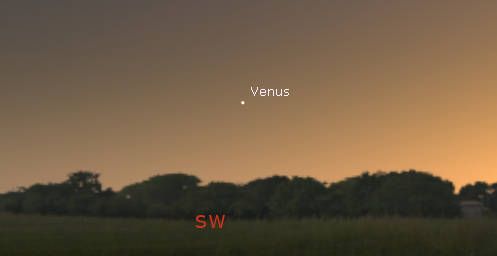
Venus in evening twilight at 7:45 pm, about a half hour after sunset tonight, September 29, 2021. Created using Stellarium.
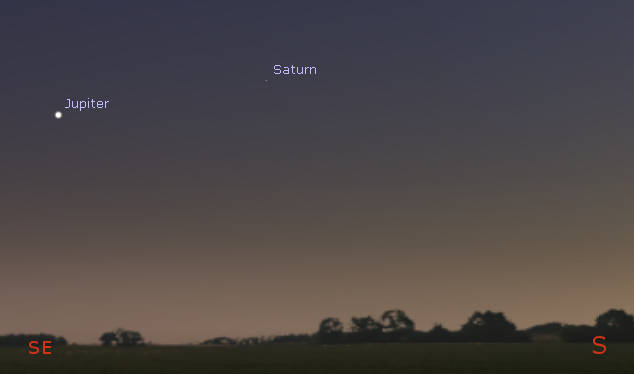
Jupiter and Saturn in the southeast at 8 pm. Created using Stellarium.
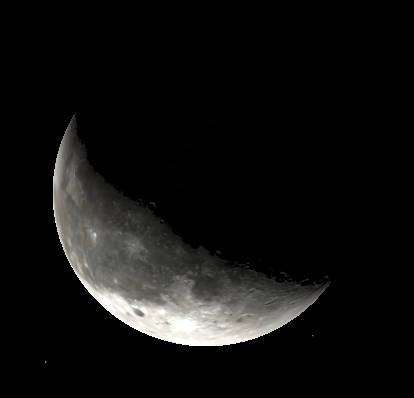
Low magnification view of the waxing crescent Moon as it would appear at 6:30 am tomorrow, September 30, 2021. Created using Stellarium.
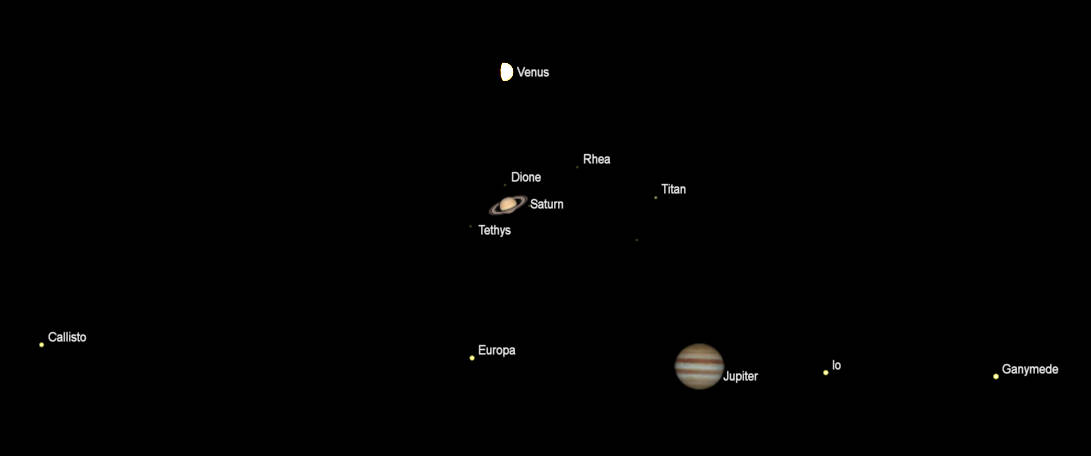
Telescopic views of the bright planets (north up) as they would be seen in a small telescope, with the same magnification, this evening at 8 pm, September 29, 2021. Apparent diameters: Venus, 18.65″, 62.6% illuminated; Saturn 17.68″, its rings 41.18″; Jupiter, 46.41″. The ” symbol means seconds of arc (1/3600th of a degree.) Click on the image to enlarge it. Created using Cartes du Ciel (Sky Charts).
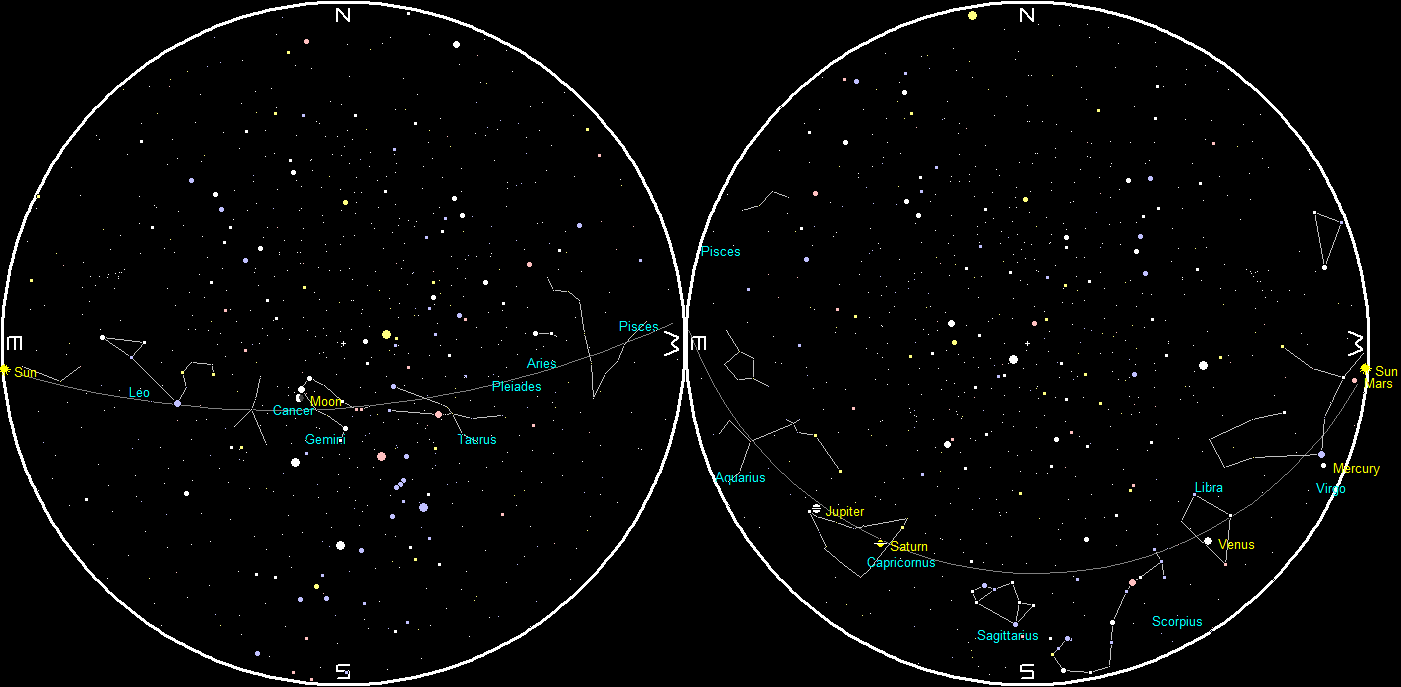
The naked-eye planets and the Moon at sunset and sunrise on a single night, starting with sunset on the right on September 29, 2021. The night ends on the left with sunrise on the 30th. Click on the image to enlarge it. Created using my LookingUp program.
09/28/2021 – Ephemeris – Andromeda, a damsel in distress
This is Bob Moler with Ephemeris for Tuesday, September 28th. Today the Sun will be up for 11 hours and 50 minutes, setting at 7:28, and it will rise tomorrow at 7:38. The Moon, at last quarter today, will rise at 11:46 this evening.
In the east at 9 this evening can be found a large square of stars, the Great Square of Pegasus the flying horse. The square is standing on one corner. What looks like its hind legs stretching to the left from the left corner star is another constellation, Andromeda the chained princess. She is seen in the sky as two diverging curved strings of stars that curve upward. She was doomed due to her mother, Queen Cassiopeia’s boasting, which angered the god Poseidon. She was rescued by the hero Perseus, a nearby constellation, riding his steed Pegasus. Andromeda’s claim to astronomical fame is the large galaxy seen with the naked-eye just above the upper line of stars. The Great Andromeda Galaxy is two and a half million light years away.
The astronomical event times given are for the Traverse City/Interlochen area of Michigan (EDT, UT-4 hours). They may be different for your location.
Addendum
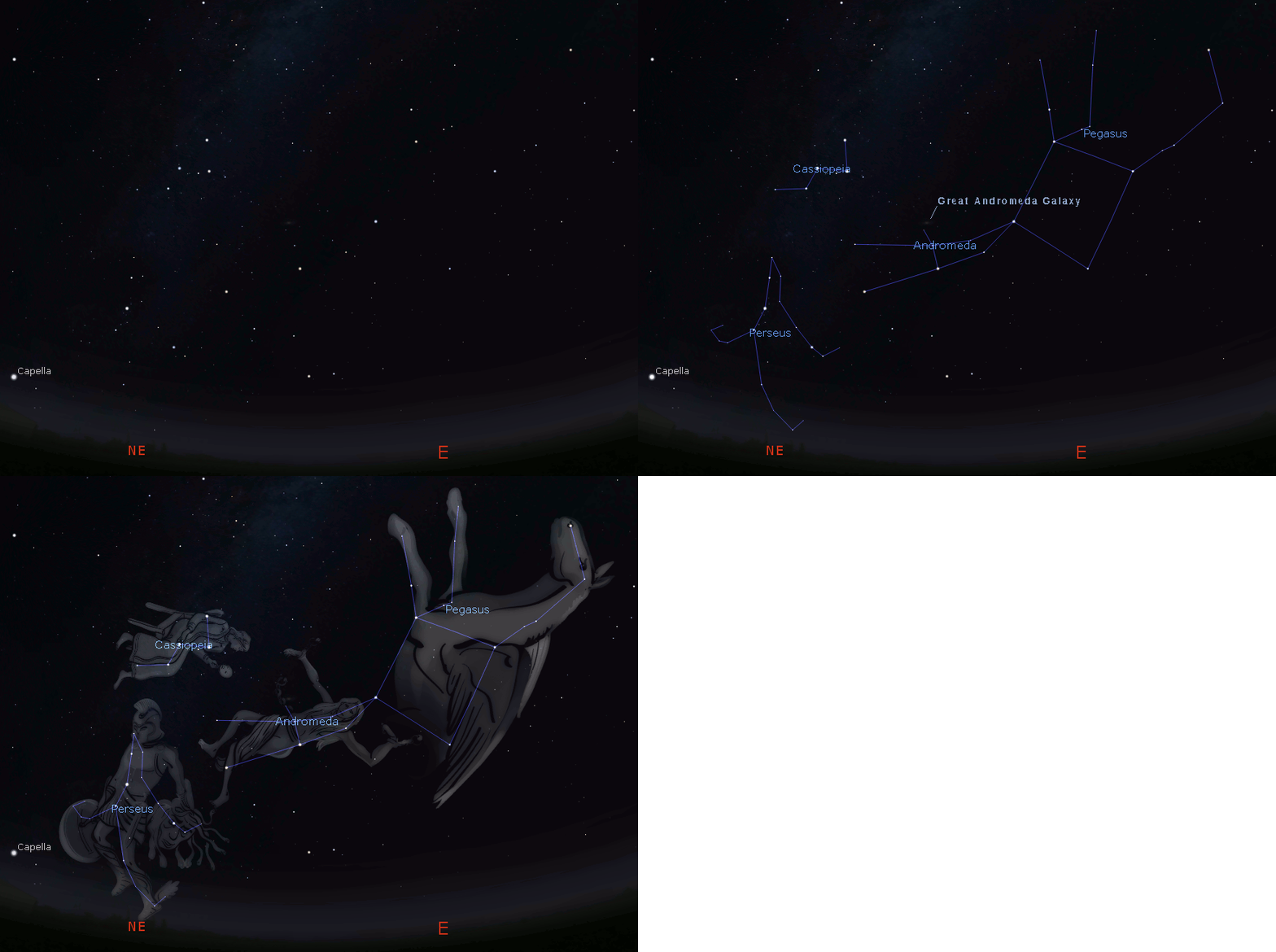
Andromeda finder animation surrounded by the other constellations in her story, except the monster, which will rise later. Click on the image to enlarge it. Created using Stellarium and GIMP.
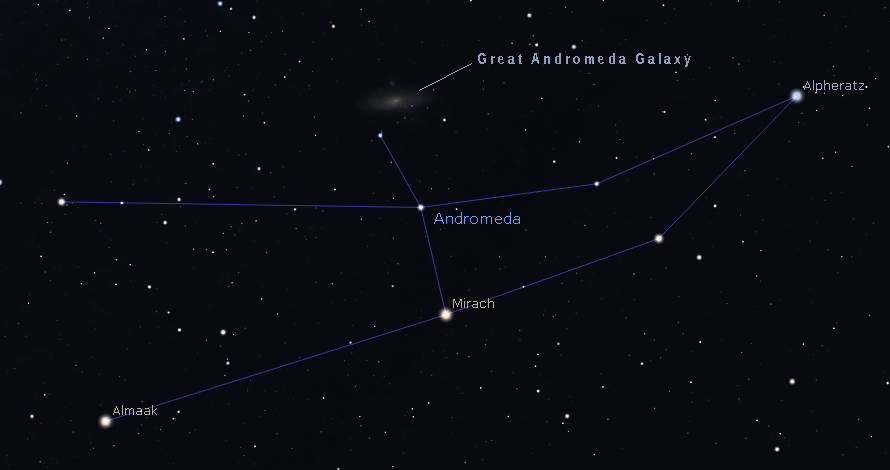
Great Andromeda Galaxy finder chart. This image shows the galaxy almost to its fullest extent. In the finder animation above, the galaxy looks pretty much as it would to the naked eye. Click on the image to enlarge it. Created using Stellarium.
Astronomers often refer to this galaxy as M 31 for short. It was the 31st entry in Charles Messier’s catalog of objects that could be confused as being comets by comet hunters like himself. It was added in 1764. He didn’t care what these fuzzy objects were, just that they didn’t move against the background stars. Actually, M 31 is in the background. The stars are in the foreground, in our Milky Way Galaxy.
09/27/2021 – Ephemeris – The native peoples constellations of the Crane and the Moose
This is Ephemeris for Monday, September 27th. Today the Sun will be up for 11 hours and 53 minutes, setting at 7:30, and it will rise tomorrow at 7:37. The Moon, 1 day before last quarter, will rise at 11:00 this evening.
The evening sky hosts two more of the constellations of the Anishinaabe native peoples of our area. Overhead, where the official constellation Cygnus the Swan is, or the Northern Cross is Ajijaak, the Sand Hill Crane flying northward through the Milky Way, wings outstretched, with its long legs trailing behind. In the eastern sky where the official constellation of Pegasus the flying horse is climbing the sky upside down is. His body is the Great Square, an informal constellation. To the Anishinaabe, it is the Mooz (Moose), who is upright. His magnificent antlers take up the dim official constellation of Lacerta the lizard between Pegasus and Cygnus. Also in the sky is Ojiig the Fisher, our Big Dipper, whose bloody tail will soon swoop down and paint the trees with their fall colors. (You can search for “Fisher” above right for his story, and his relevant appearances in autumn and late winter.)
The astronomical event times given are for the Traverse City/Interlochen area of Michigan (EDT, UT-4 hours). They may be different for your location.
Addendum
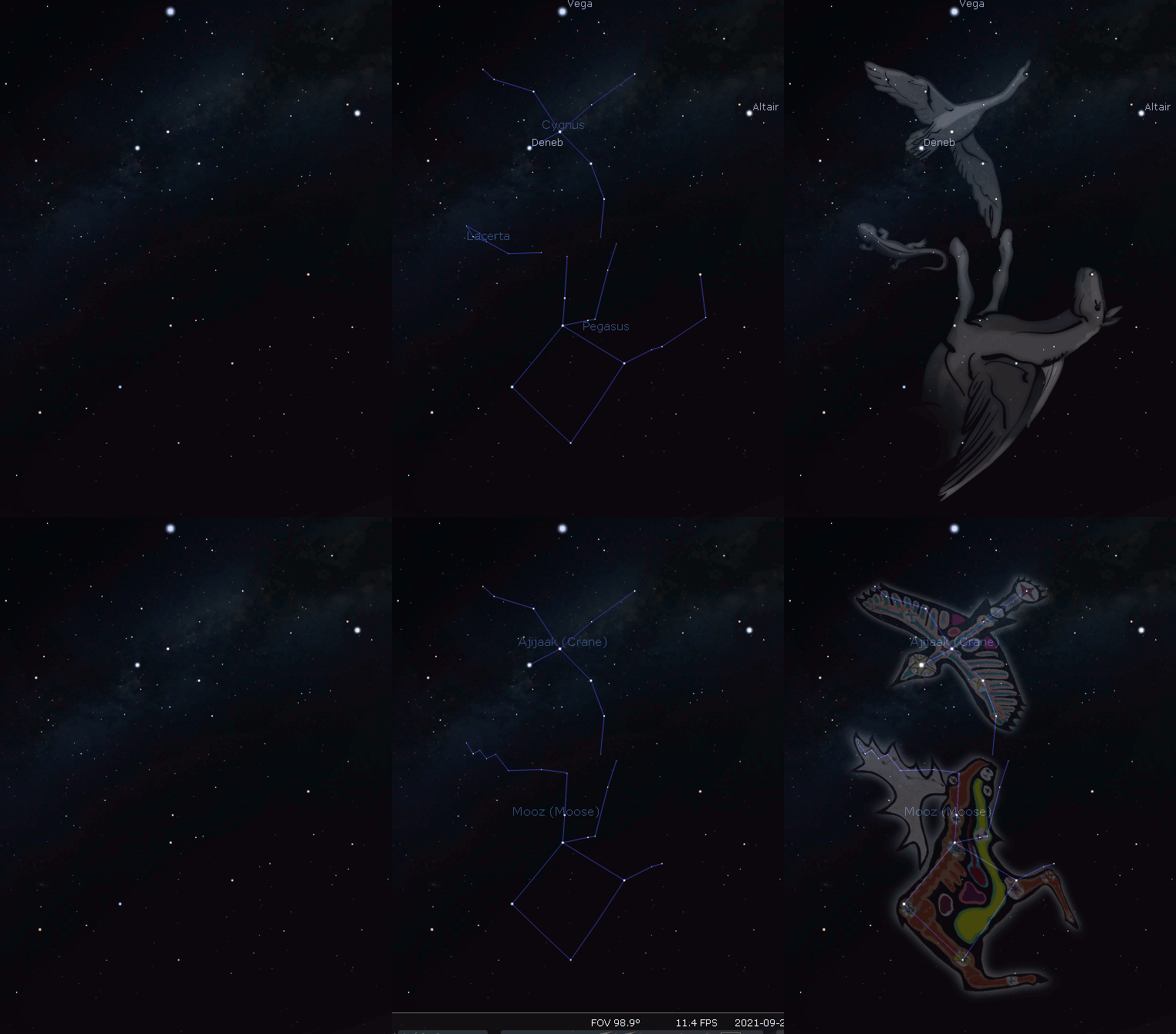
The Anishinaabe constellations of Ajijaak, the Crane and Mooz (Moose) compared to the official International Astronomical Union (IAU) constellations. Created using Stellarium and GIMP.
The Ojibwe constellation art is part of the latest versions of Stellarium. Ojibwe (Anishinaabe) constellation art by Annette S Lee and William Wilson from Ojibwe Sky Star Map Constellation Guide, ISBN 978-0-615-98678-4.
09/20/2021 – Ephemeris – The Harvest Moon rises tonight
This is Ephemeris for Monday, September 20th. Today the Sun will be up for 12 hours and 15 minutes, setting at 7:43, and it will rise tomorrow at 7:29. The Moon, at full today, will rise at 8:03 this evening.
Tonight’s full moon is the Harvest Moon. It is the most famous of the named full moons, and was very useful in the days before electric lights. The reason is that the Moon, around the time it is full now, doesn’t advance its rising time very much from night to night, effectively extending the light of twilight to allow more time to gather in crops. This is because the Moon is moving north as well as eastward. The farther north it is, the longer it stays up and retards the advance in rise times. On average, the Moon rises 50 minutes later each night. This week, the interval is down near 20 minutes advance in moonrise times per day, extending twilight and the time each day to harvest the crops for a few more days.
The astronomical event times given are for the Traverse City/Interlochen area of Michigan (EDT, UT-4 hr). They may be different for your location.
Addendum
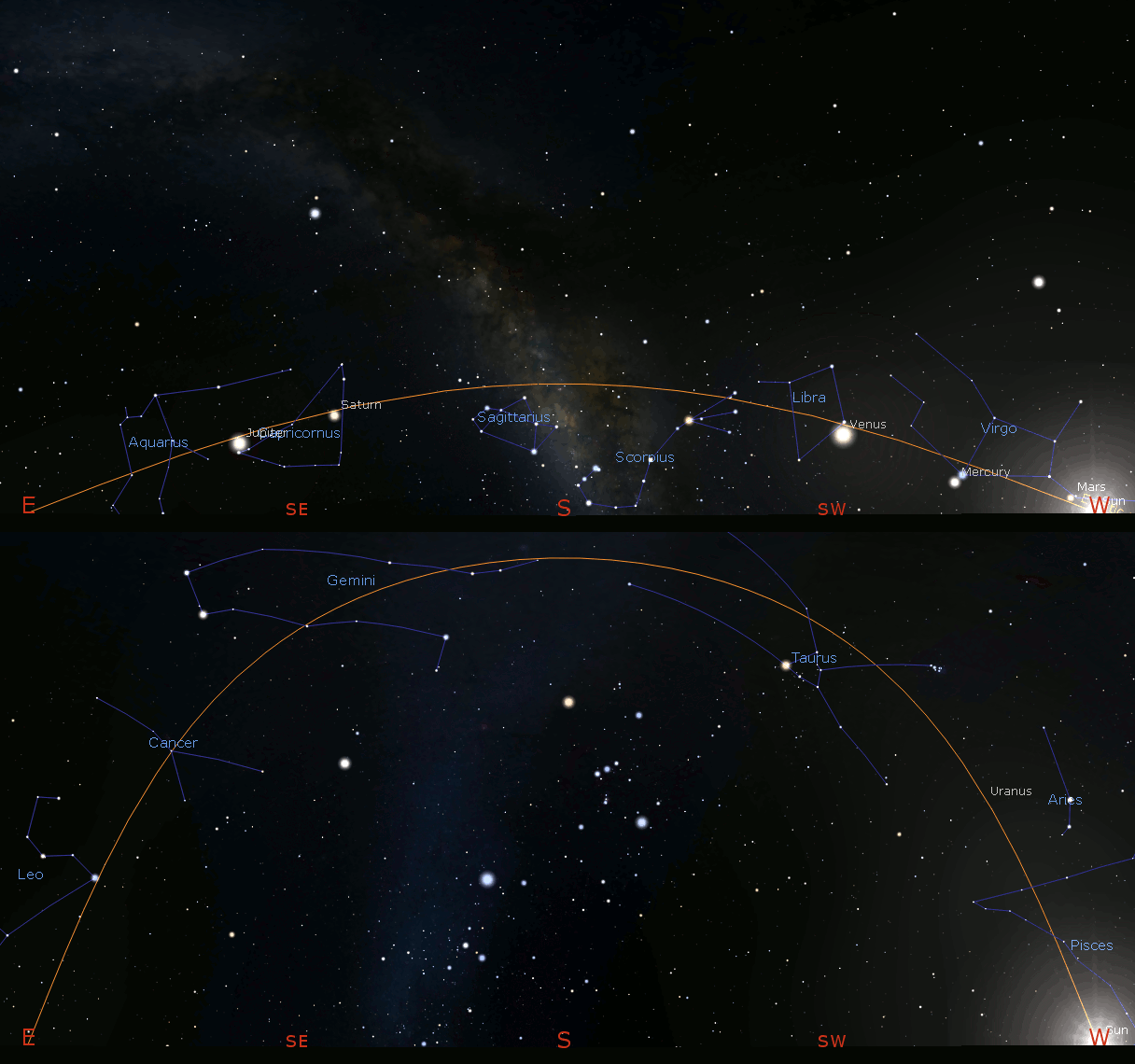
The autumn vs spring sunset ecliptic. I’m using the autumnal equinox 2021, with the tip of the spout of the Sagittarius Teapot at due south, and vernal equinox 2022, with the red star Betelgeuse in Orion at due south as examples. Click on the image to enlarge it. Created using Stellarium and GIMP.
The ecliptic for the autumnal equinox runs low in the south, a preview of the Sun’s apparent travel for the next six months of fall and winter. Besides the planets, the Moon at sticks close to that line, as do the planets. The full moon rising in the east as the Sun sets does so at a shallow angle, so for a week or so around the full moon, its advance in rise times can be as little as 20 minutes per night. In spring, it can be much longer than an hour.

