Archive
05/17/2017 – Ephemeris – Let’s look at the bright planets for this week
Ephemeris for Wednesday, May 17th. Today the Sun will be up for 14 hours and 54 minutes, setting at 9:06, and it will rise tomorrow at 6:11. The Moon, 1 day before last quarter, will rise at 2:20 tomorrow morning.
Let’s take our weekly look at the bright planets. Mars is still in the west-northwest after sunset and fading. It appears under the left edge of the constellation Auriga. It will set at 10:54 p.m. Dominating the evening sky now is Jupiter in the south-southeast. The bright blue-white star Spica is seen below and left of it. In even the smallest telescopes Jupiter’s four largest moons can be seen. They shift positions night from to night and sometimes even as you watch. Jupiter will set at 4:42 a.m. At 5:30 a.m. both Saturn and Venus will be in the morning twilight. Saturn will be low in the south-southwest. It will rise in the east-southeast at 11:14 p.m. Brilliant Venus will be low in the east tomorrow morning after rising at 4:27 a.m.
For us Mercury, at greatest western elongation of 25.8°will be on the horizon at 5:30, but those south of the equator it will be well placed for viewing in the morning.
The times given are for the Traverse City/Interlochen area of Michigan. They may be different for your location.
Addendum
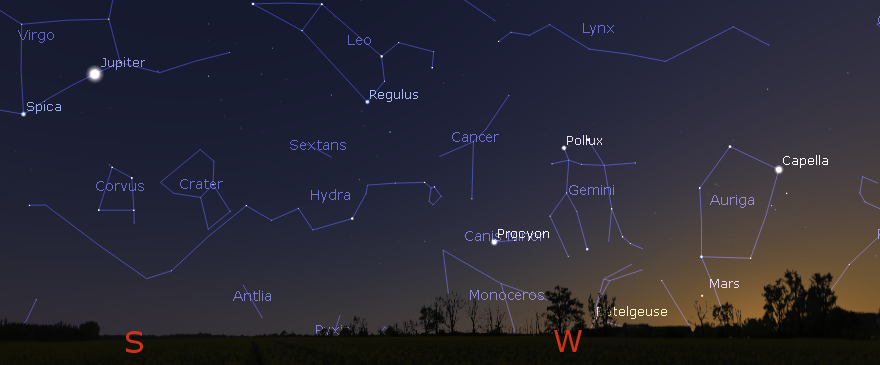
Mars and Jupiter with the spring constellations in the fading twilight at 10 p.m., May 17, 2017. Created using Stellarium.
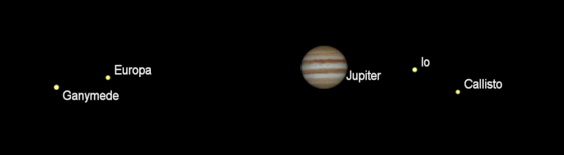
Jupiter and its four Galilean moons as they might be seen in a telescope at 10 p.,. May 17, 2017. Created using Cartes du Ciel (Sky Charts).
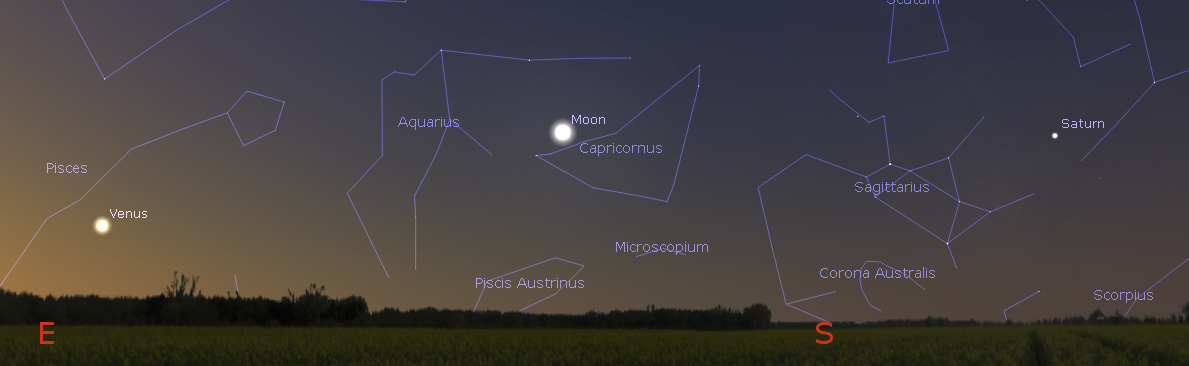
Venus, Saturn and the Moon at 5:30 a.m. May 18, 2017. Created using Stellarium. Click on the image to expand.
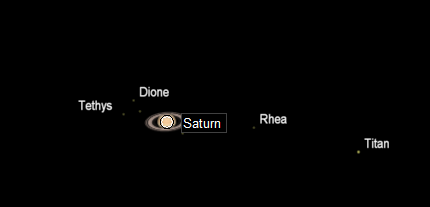
Saturn and its brightest moons at 5:30 a.m. May 18, 2017. This is displayed at the same scale/magnification as the Jupiter image above. Created using Cartes du Ciel (Sky Charts).
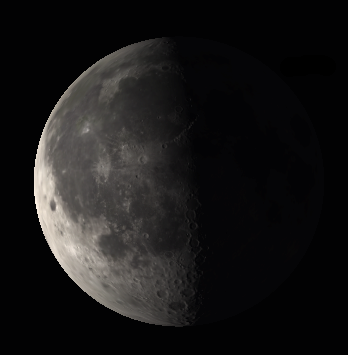
The Moon as it might be seen in binoculars at 5:30 a.m., May 18, 2017. Created using Stellarium.
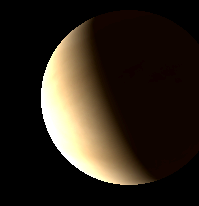
Venus as seen through a telescope at 5:30 a.m. May 18, 2017. This is displayed at a larger scale/magnification than the Jupiter and Saturn images above. Created using Stellarium.
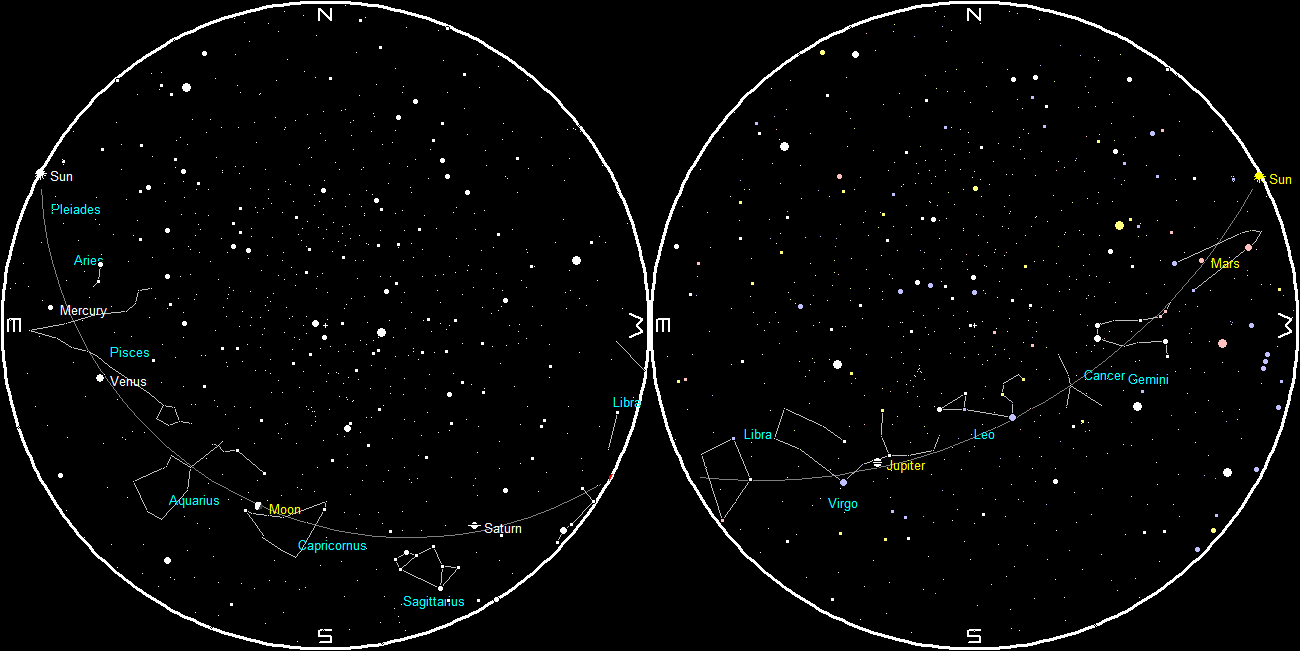
Planets and the Moon at sunset and sunrise of a single night starting with sunset on the right on May 17, 2017. The night ends on the left with sunrise on May 18. Click on the image to enlarge. Created using my LookingUp program.
05/10/2017 – Ephemeris – Our weekly look at the bright planets
Wednesday, May 10th. The Sun rises at 6:20. It’ll be up for 14 hours and 38 minutes, setting at 8:58. The Moon, at full today, will rise at 8:44 this evening.
Let’s take our weekly look at the bright planets. Mars is still in the west after sunset and fading. It appears above the brighter star Aldebaran in Taurus now. It will set at 10:58 p.m. Not quite dominating the evening sky now due to the Moon is Jupiter in the south-southeast. The bright blue-white star Spica is seen below and left of it. In even the smallest telescopes Jupiter’s four largest moons can be seen. They shift positions night from to night and even as you watch. Jupiter will set at 5:11 a.m. At 6 a.m. both Saturn and Venus will be in the morning twilight. Saturn will appear to be a bit to the west of south compass point. It will rise in the east-southeast at 11:44 p.m. Venus will be low in the east at 6 a.m. tomorrow morning after rising at 4:41.
The times given are for the Traverse City/Interlochen area of Michigan. They may be different for your location.
Addendum
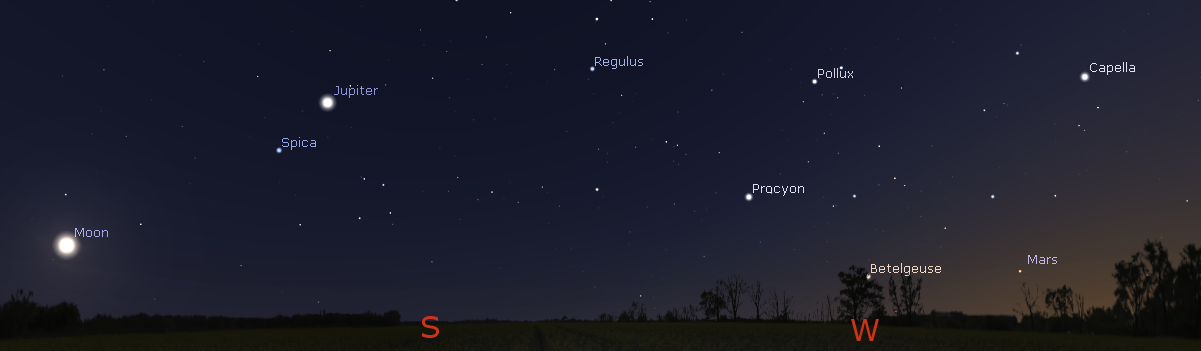
Mars, Jupiter and the full Moon with the brighter stars at 10 p.m., May 10, 2017. Created using Stellarium. Click on the image to enlarge.
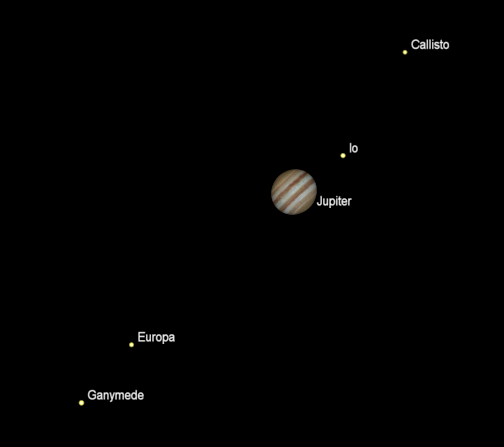
Jupiter and its four Galilean moons as they might be seen in a telescope at 10 p.,. May 10, 2017. Created using Cartes du Ciel (Sky Charts).
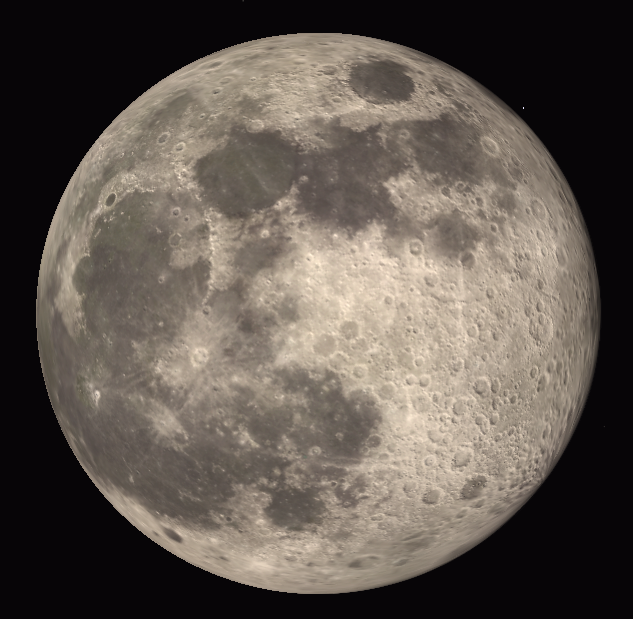
The Full Moon at 10 p.m., May 10, 2017. Created using Stellarium.
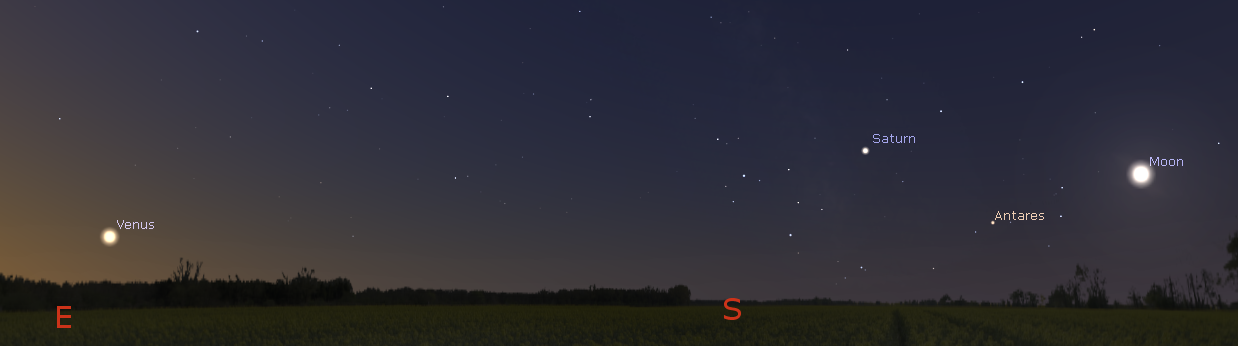
Venus, Saturn and the Moon at 5:30 a.m. May 11, 2017. Created using Stellarium. Click on the image to expand.
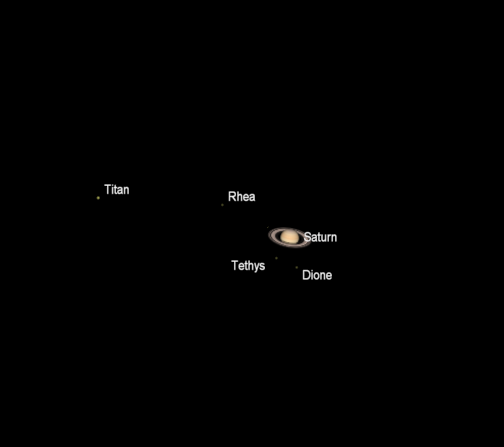
Saturn and its brightest 4 moons at 5:30 a.m. May 11, 2017. This is displayed at the same scale/magnification as the Jupiter image above. Created using Cartes du Ciel (Sky Charts).
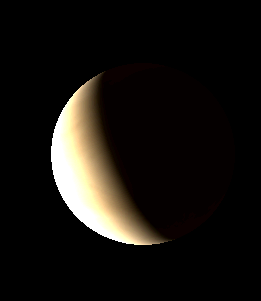
Venus as seen through a telescope at 5:30 a.m. May 11, 2017. This is displayed at a larger scale/magnification than the Jupiter and Saturn images above. Created using Stellarium.
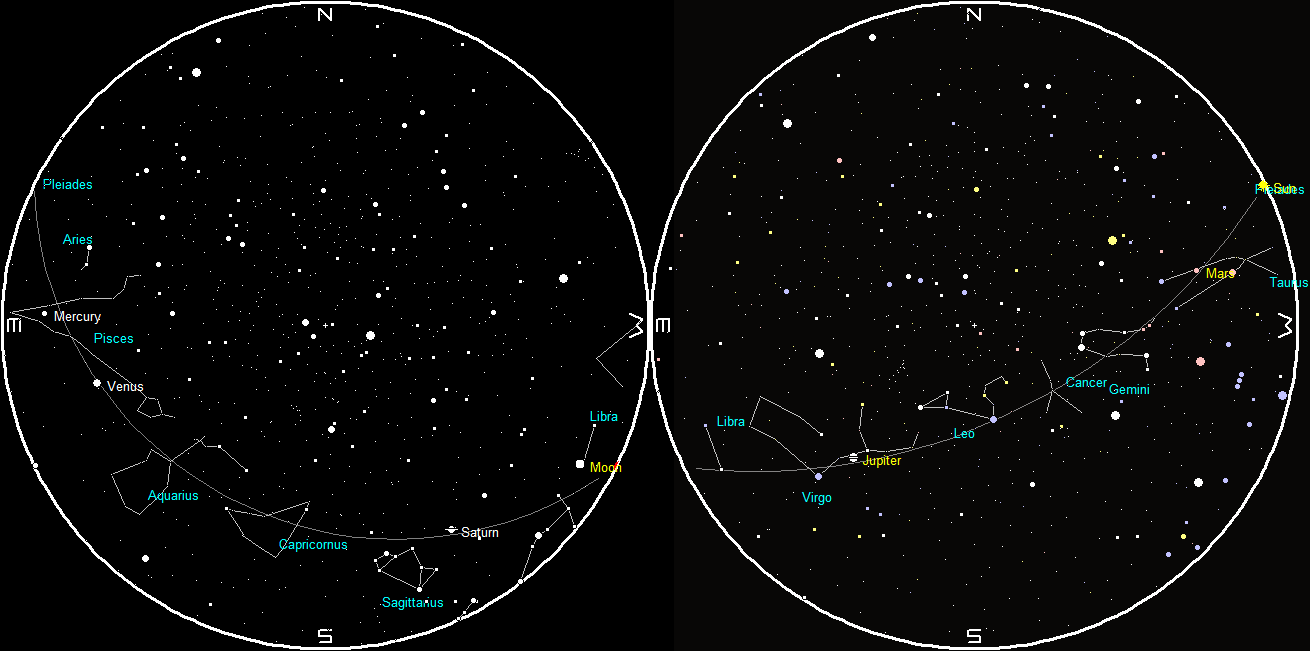
Planets and the Moon at sunset and sunrise of a single night starting with sunset on the right on May 10, 2017. The night ends on the left with sunrise on May 11. Click on the image to enlarge. Created using my LookingUp program.
05/09/2017 – Ephemeris – Looking at Jupiter through a telescope
Ephemeris for Tuesday, May 9th. The Sun rises at 6:21. It’ll be up for 14 hours and 35 minutes, setting at 8:57. The Moon, 1 day before full, will set at 6:36 tomorrow morning.
The first thing one sees by turning a telescope to the planet Jupiter are it’s moons, that change position night to night. A closer look at the planet itself will reveal that it is not exactly circular, but a bit squashed, making Jupiter fatter in the direction of the line of moons. Jupiter has only a 3 degree axial tilt, and its four large moons orbit over Jupiter’s equator, so even though they have nearly circular orbits, appear to move back and forth in a straight line. On the face of the planet itself appear parallel cloud bands of cream and reddish-brown. The parallel cloud bands and the squashed appearance of the planet have the same cause. Jupiter, though over a thousand times the Earth’s volume rotates, that is has a day, of a bit less than 10 hours.
The times given are for the Traverse City/Interlochen area of Michigan. They may be different for your location.
Addendum
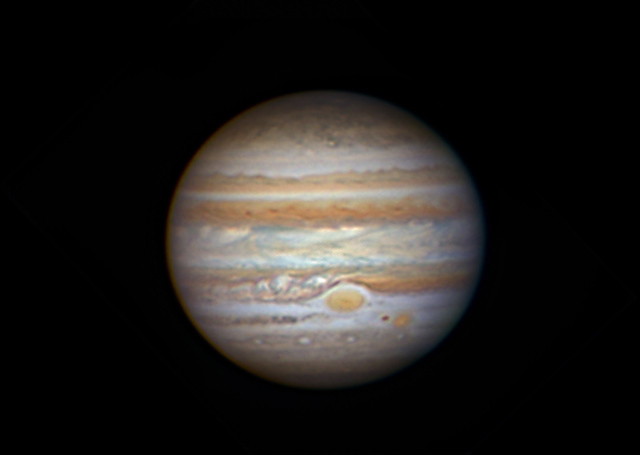
A slightly squished Jupiter with its Great Red Spot November 18, 2012 by Scott Anttila.
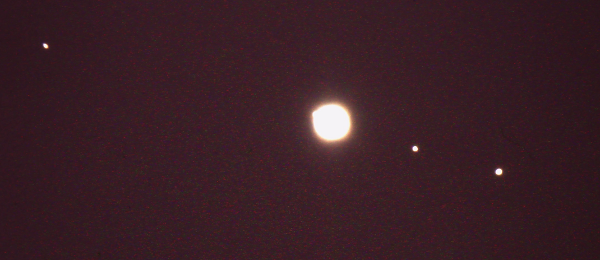
Overexposed Jupiter and its moons. Note the moon that looks like a bump on the left edge of the planet. My archival image.
05/04/2017 – Ephemeris – Bits of Halley’s Comet will fill our skies for the next few mornings
Ephemeris for Thursday, May 4th. The Sun rises at 6:28. It’ll be up for 14 hours and 23 minutes, setting at 8:51. The Moon, 2 days past first quarter, will set at 4:15 tomorrow morning.
Look out for the Eta Aquariids meteors in the early morning sky for the next few days. This is like 5 a.m. These are sand grain sized debris from “Hawley’s” Comet. That’s the same guy we pronounce “Hayley” or “Hal-ley”. The authority on the pronunciation is a contemporary of his, Samuel Pepys, who spelled his name H-a-w-l-e-y. Anyway, this is one of two meteor showers every year that are attributed to Halley’s Comet, where the Earth crosses the debris stream. The other, the Orionids of late October see the debris stream entering the inner solar system, while the Eta Aquariids, which seem to come from the southeast are the debris stream leaving the inner solar system, and heading back out toward Neptune’s orbit.
The times given are for the Traverse City/Interlochen area of Michigan. They may be different for your location.
Addendum
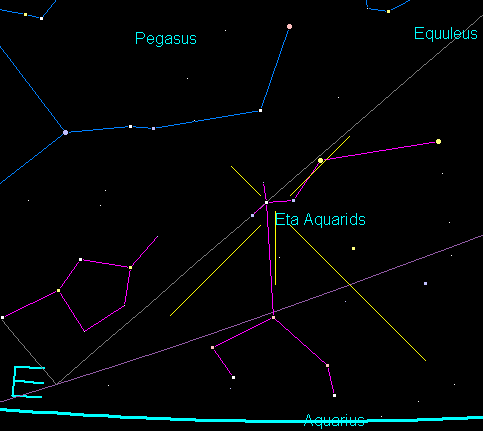
The Eta Aquariid radiant at the peak of the shower. The radiant moves slowly to the east with time. Credit: Bob Moler’s LookingUp program.
04/21/2017 – Ephemeris – Mars is passing south of the Pleiades today
Ephemeris for Friday, April 21st. The Sun rises at 6:47. It’ll be up for 13 hours and 47 minutes, setting at 8:35. The Moon, 2 days past last quarter, will rise at 4:54 tomorrow morning.
Mars in its ever eastward trek through the constellations of the Zodiac is now just south of the Pleiades or Seven Sisters star cluster in the western evening twilight. By 10 p.m. Mars will be 10 degrees above the western horizon. That’s the width of a fist held at arm’s length. Because of our location on the Earth, the setting sky is tilted, so Mars being south of the Pleiades is to the lower left of it. The bright star Aldebaran, now brighter than Mars is to the left of it with the V-shaped star cluster called the Hyades, in mythology, half sisters of the Pleiades, filling out the face of Taurus the bull. Mars will finally be overtaken by the Sun on July 26th. After that it will spend more than a year to come closer to us than at any time since August 2003.
First star party of the year at the Sleeping Bear Dunes National Lakeshore
Tomorrow night the Rangers of the Sleeping Bear Dunes National Lakeshore and the Grand Traverse Astronomical Society will host a Star Party at the Dune Climb featuring the planet Jupiter, and the stars of spring. It starts at 9 p.m.
The times given are for the Traverse City/Interlochen area of Michigan. They may be different for your location.
Addendum
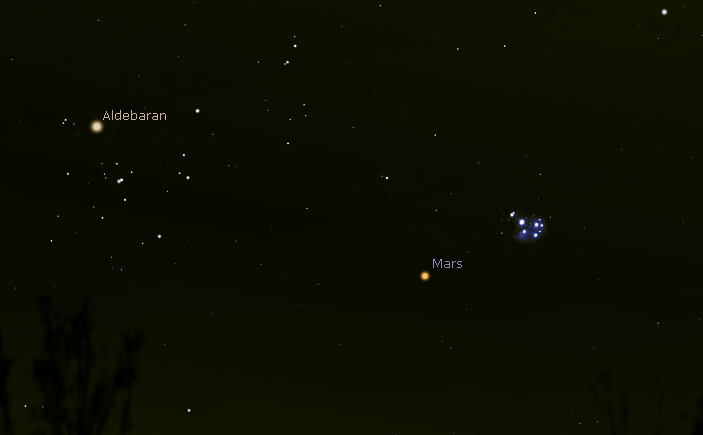
Mars and the Pleiades at 10 p.m. April 21, 2017. Aldebaran and the Hyades which is the face of Taurus the bull is to the left of them. Created using Stellarium.
Note that the nebulosity in the Pleiades exists, but is not visible to the naked eye.
04/20/2017 – Ephemeris – The Lyrid meteors are reaching their peak now
Ephemeris for Thursday, April 20th. The Sun rises at 6:49. It’ll be up for 13 hours and 44 minutes, setting at 8:33. The Moon, 1 day past last quarter, will rise at 4:20 tomorrow morning.
We are in a period where the Lyrid meteors appear. This capricious shower peaks at various times and with a variety of peak numbers from 14 to 90 per hour. The expected peak will be April 22nd at 8 a.m. The radiant point, from where the meteors seem to come, lies between the constellation Lyra and its bright star Vega and Hercules to the west of it. The radiant point starts the evening low in the northeast and moves nearly overhead when the Moon finally rises. The meteors, sometimes called falling stars will appear all over the sky, but can be traced back to that radiant point. The best time to see these or any meteor shower is when the radiant point is highest in the sky. That will be Saturday morning.
The times given are for the Traverse City/Interlochen area of Michigan. They may be different for your location.
Addendum
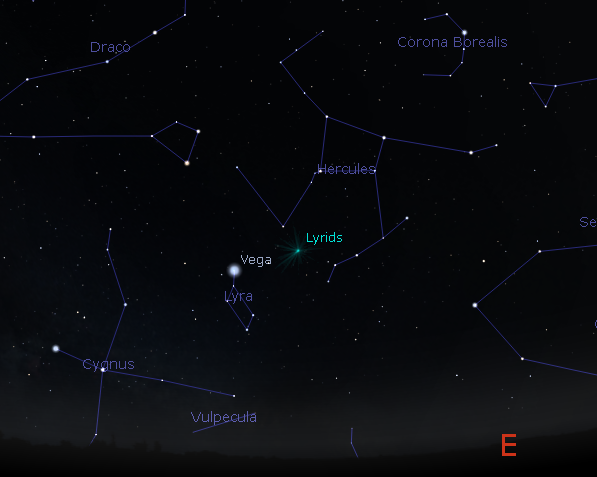
Location of the Lyrid meteor radiant at midnight. Note that the radiant point is a spot that the meteors can be back tracked to. The meteors will appear all over the sky. If they appear near the radiant they will appear to move the slowest, since their actual motion is mostly toward the observer. Created using Stellarium.
The display of meteor shower radiants is a plug-in in the latest versions of Stellarium.
04/17/2017 – Ephemeris – How to find the stars Arcturus and Spica from the Big Dipper
Ephemeris for Monday, April 17th. The Sun rises at 6:54. It’ll be up for 13 hours and 35 minutes, setting at 8:30. The Moon, 2 days before last quarter, will rise at 2:21 tomorrow morning.
The Big Dipper, now nearing the zenith at 10 p.m. points to several stars and constellations. It’s handle points to two bright stars. First we follow the arc of the handle to the bright orange star Arcturus, the 4th brightest night-time star. The reason I say night-time is that the sun is a star also but by definition is not out at night. The arc to Arcturus is a how to find Arcturus and a clue to its name. Arcturus, midway up the sky in the east, lies at the base point of the kite shaped constellation of Boötes the herdsman. From Arcturus, straighten out the arc to a spike and one soon arrives at Spica a blue-white star in Virgo the virgin, now low in the southeast. It is below Jupiter this year. Spica is also sometimes pronounced ‘Speeka’.
The times given are for the Traverse City/Interlochen area of Michigan. They may be different for your location.
Addendum
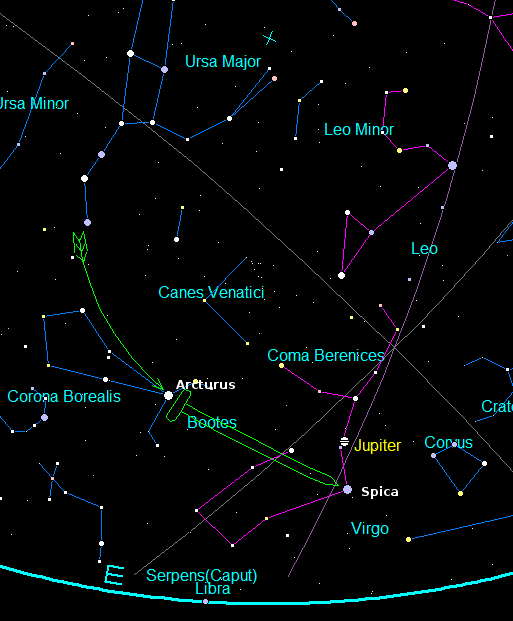
How to find the stars Arcturus and Spica from the Big Dipper in April 2017. Created using my LookingUp program.
04/10/2017 – Ephemeris – Jupiter takes over as king of the evening sky
Ephemeris for Monday, April 10th. The Sun will rise at 7:06. It’ll be up for 13 hours and 14 minutes, setting at 8:21. The Moon, 1 day before full, will set at 7:36 tomorrow morning.
By the time we see the Moon tonight it will be about 5 hours from officially being full. However bright planet Jupiter should be easily visible about 5 moon diameters to the right and a bit above the Moon. In a small telescope it is easy to see the disk of Jupiter, and possible see the cloud bands in the atmosphere, due to the planet’s rapid rotation, of less than 10 hours. Jupiter’s mass is over 300 times the Earth’s, while one could squeeze over a thousand Earth’s into its volume. Jupiter has something like 67 satellites, but only for are visible in small to medium telescopes. Tonight they will be strung out all on one side of Jupiter, tomorrow night two will be on the other side of the planet, and another will be playing peek-a-boo in front of Jupiter.
The times given are for the Traverse City/Interlochen area of Michigan. They may be different for your location.
Addendum
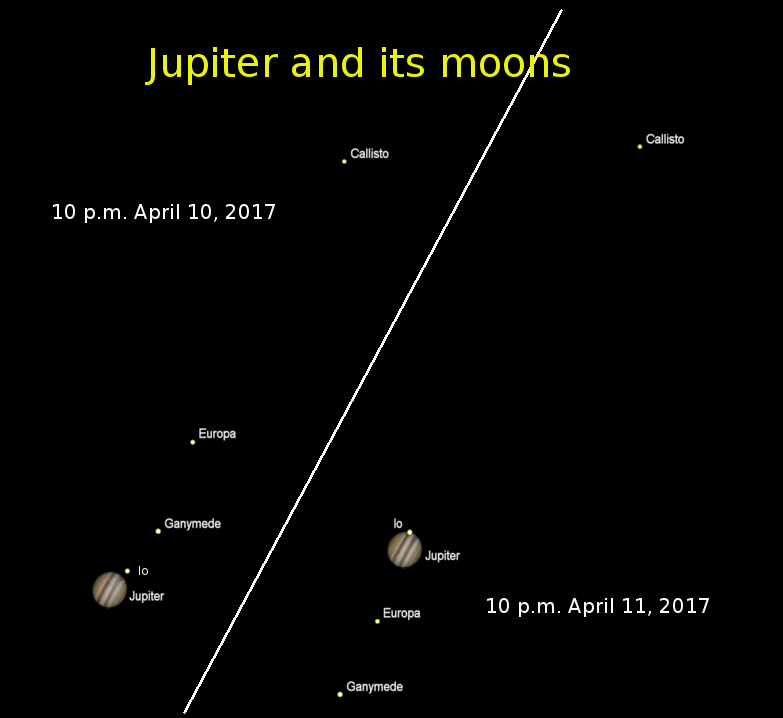
Jupiter and its moons in a telescope at 10 p.m. both April 10th & 11th, 2017. Created using Cartes du Ciel (Sky Charts).
| Event | Date & Time EDT | Date & Time UT |
| Io Occultation Start | 10 April 2017 10:31 p.m. | 11 April 2017 2:31 |
| Io Eclipse ends | 11 April 2017 12:28 a.m. | 11 April 2017 4:46 |
| Ganymede Occultation start | 11 April 2017 4:28 a.m. | 11 April 2017 8:28 |
| Ganymede Eclipse end | Not visible | 11 April 2017 11:02 |
| Europa Occultation start | Not visible | 11 April 2017 18:44 |
| Europa Eclipse ends | Not visible | 11 April 2017 21:19 |
| Io Transit starts | Not visible | 11 April 2017 23:48 |
| Io Shadow ingress | Not visible | 11 April 2017 23:54 |
| Io Transit ends | 11 April 2017 8:58 p.m. | 12 April 2017 1:58 |
| Io Shadow egress | 11 April 2017 10:05 p.m. | 12 April 2017 2:05 |
Where times EDT show as not visible, Jupiter is below the horizon. Date and time UT are for observers in other locations. UT is Universal Time, or Greenwich Mean Time.
Occultation = moon passes behind Jupiter
Eclipse = moon in Jupiter’s shadow
Transit = moon passes in front of Jupiter
Shadow = moon’s shadow is cast on the face of Jupiter
03/30/2017 – Ephemeris – Have you ever seen zodiacal light?
Ephemeris for Thursday, March 30th. The Sun will rise at 7:26. It’ll be up for 12 hours and 41 minutes, setting at 8:07. The Moon, 3 days past new, will set at 11:23 this evening.
After you spot the moon tonight, hang around outside at the end of astronomical twilight, about 9:50 p.m. look to the west at Taurus the bull and Gemini, trying to block out the Moon. Then broaden your gaze. There will be a very faint triangular glow with broad base at the horizon leaning a bit to the left, with its apex near the V of the face of Taurus the bull and the bright star Aldebaran to the right of Orion. This glow is called Zodiacal Light, caused by the reflected sunlight off a cloud of dust located in the plane of the solar system. Most of the large bodies of the solar system orbit the sun close to a single plane. Zodiacal Light is best seen on spring evenings and autumn mornings where it tilts to the right.
Times are for the Traverse City/Interlochen area of Michigan. They may be different for your location.
Addendum
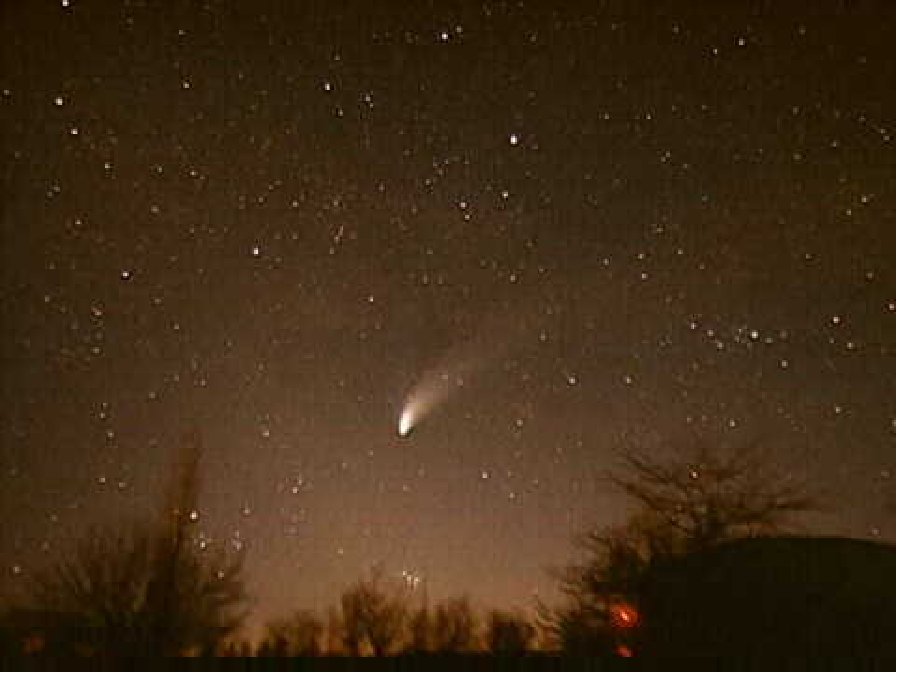
Zodiacal Light and Comet Hale-Bopp April 1997. My image.
03/19/2017 – Ephemeris Extra – Comet 41P/Tuttle-Giacobini-Kresak is within reach of binoculars and small telescopes
UT
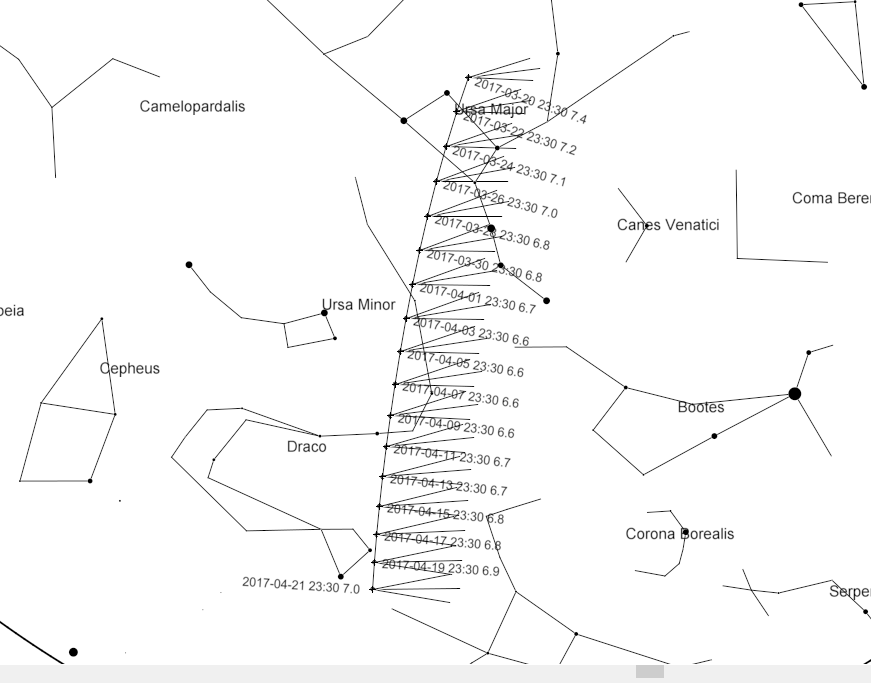
Comet 41P finder chart for the next month, March 20 to April 19. It is expected to be brightest at magnitude 6.6 in early April. Comet positions and orientation in the northeast are for 11:30 p.m. on the date specified or 3:30 UT on the next date. Created using Cartes du Ciel (Sky Charts). Click on the chart to enlarge.
Note above: The tail symbol points to the direction of a tail. However none of the photographs I’ve seen show a tail, so none will be visible visually.
This comet is known to have frequent outbursts where its brightness increases by many times. If an outburst occurs in early April, the comet could become visible to the naked eye. Original source material for this post comes from Seiichi Yoshida’s Weekly Information about Bright Comets web page. The comet will pass less than 14 million miles (22 million km) from Earth on April 5th, only 8 days before it’s closest approach to the Sun, called perihelion. From the finder chart one can see the comet will pass to the north of the Earth.
According to Gary Kronk’s Cometography.com web site the comet was discovered and lost three times. It was first discovered in 1858 by Horace Tuttle, whose name was attached to at two well known comets that produce meteor showers. It was unobserved for the next eight returns, which were expected every 5.42 years. Michel Giacobini rediscovered it again in 1907. Giacobini was the discoverer of Comet Giacobini-Zinner, another famous meteor shower producing comet. It was lost again until Lubos Kresák rediscovered it in 1951 after seven more missed returns.

