Archive
11/14/2013 – Comet ISON has an outburst
Last night Comet ISON suddenly brightened and may be bright enough to be visible to the naked eye.. The comet is now within the orbit of Venus and falling with increasing velocity toward the sun for its November 28th perihelion.
Here’s a link to Universe Today‘s post with lots of photos.
EarthSky also has an entry for it: with a finder chart for naked eye viewing of the comet in twilight.
Here’s SpaceWeather.com‘s entry for today.
This may bode well for the comet’s brightness after perihelion, if the comet’s nucleus holds together or stays in big enough pieces. The next week may tell.
11/12/2013 – Ephemeris – Not one but four comets grace the morning sky now
Ephemeris for Tuesday, November 12th. The sun will rise at 7:35. It’ll be up for 9 hours and 42 minutes, setting at 5:17. The moon, 2 days past first quarter, will set at 3:19 tomorrow morning.
Comet ISON has competition in the morning sky now. There are actually three other comets within range of telescopes gracing our morning sky now. Comet ISON is still not brightening as predicted. It is still 2 to 3 times dimmer than predicted. Comet Encke is still brighter, Comet C/2013 R1 (Lovejoy) discovered two months ago is almost as bright as ISON. It’s moving between Cancer and Leo now. C/2012 X1 (LINEAR) is the faintest of the four and a tough one to spot. It will appear to pass the bright star Arcturus a week from now. I’ll have finder charts for all these comets at bobmoler.wordpress.com with today’s transcript. Apparently the nucleus of ISON is still holding together.
Times are for the Traverse City/Interlochen area of Michigan. They may be different for your location.
Addendum
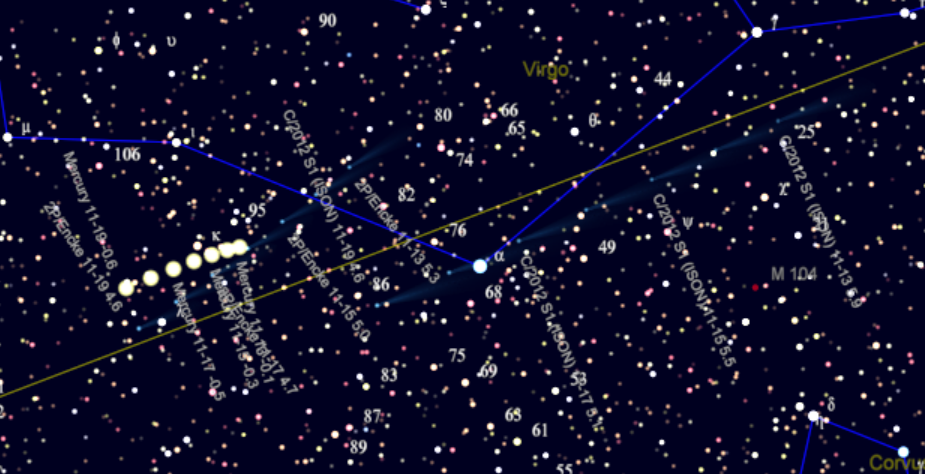
This is a busy chart with Comets ISON and Encke and Mercury for the period November 13th through 19th of November 2013 at 6 a.m. Created using Carts du Ciel.
Note that the star designated α is Spica, Alpha Virginis.
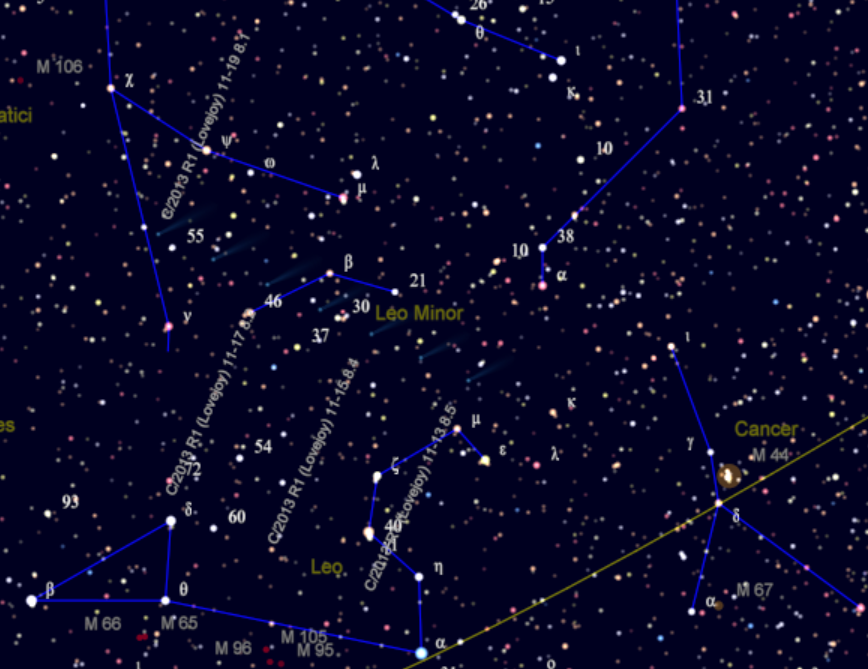
Comet Lovejoy and the constellation Leo for November 13th through 19th, 2013 at 6 a.m. Created using Cartes du Ciel.
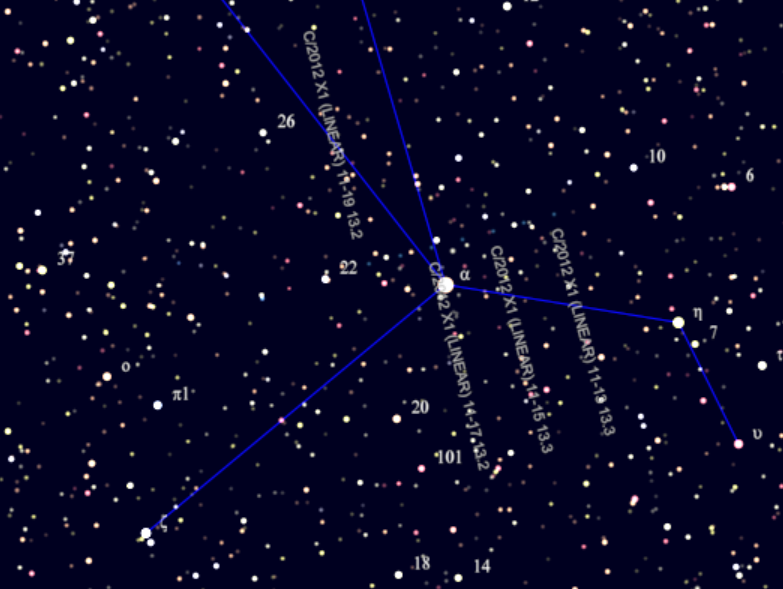
Comet LINEAR track for November 13th through 19th 2013. Created using Cartes du Ciel.
The star designated α is Arcturus or Alpha Boötis. The brightest star is Boötes. Remember follow the arc of the Big Dipper handle to Arcturus.
The following are the latest magnitudes (brightnesses) recorded for these comets:
Comet               Magnitude
C/2012 S1 (ISON)    8  (1 magnitude dimmer than predicted)
P2 (Encke)          8
C/2013 R1 (Lovejoy) 6  (2.5 magnitudes brighter than predicted)
C/2012 X1 (LINEAR)  8  (5 magnitudes* brighter than predicted)
* 5 magnitudes brighter = 100 times brighter!
Source is http://www.icq.eps.harvard.edu/CometMags.html.  Search page using the C/???? ?? instead of name.  Comets Lovejoy and LINEAR have multiple entries.
10/18/2013 – Ephemeris – Penumbral lunar eclipse tonight
Ephemeris for Friday, October 18th. The sun will rise at 8:01. It’ll be up for 10 hours and 50 minutes, setting at 6:52. The Moon, at full today is the full Hunters Moon, will rise at 6:41 this evening.
There will be a penumbral eclipse of the moon tonight as the moon rises. This is a special case of a partial eclipse, in that the moon dips only into the earth outer shadow, where sunlight to it is only partially blocked by the earth. To the casual observer nothing appears to be happening, but near mid eclipse the bottom right part of the moon will appear to have a dusky appearance, a 5 o’clock shadow, so to speak, which is best seen wearing sun glasses to cut the bright glare of the full moon. That mid eclipse point will occur at 7:50 this evening. The moon will be in eclipse as it rises, and the eclipse will officially end at 9:52 p.m., though the shadow effect will be long gone by that time.
Times are for the Traverse City/Interlochen area of Michigan. They may be different for your location.
Addendum
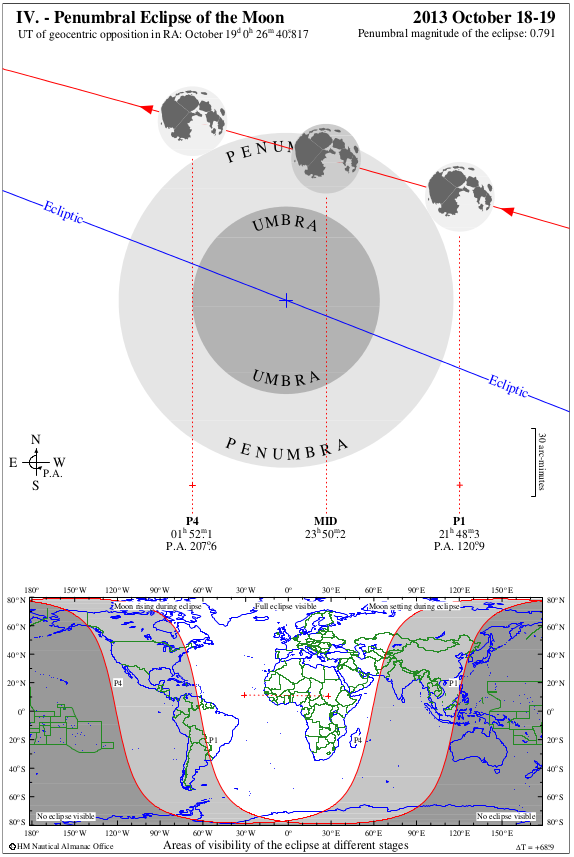
Penumbral Eclipse of October 18-19. Times on this chart are Universal Time. The times in the post above are Eastern Daylight Time. Credit: H M Nautical Almanac Office, UK.
Note: The moon has to dip into the Umbra for the eclipse to be a partial or total eclipse. In the world map above Michigan is in the partially shaded part of the diagram, where the eclipse starts before the moon rises. The darker shaded portions of the earth cannot see the eclipse at all.
10/10/2013 – Ephemeris – Comet ISON is becoming visible in binoculars
Ephemeris for Thursday, October 10th. The sun will rise at 7:51. It’ll be up for 11 hours and 14 minutes, setting at 7:06. The moon, 1 day before first quarter, will set at 11:34 this evening.
Comet ISON is finally bright enough to possibly spot in binoculars. It seems to be between 10th and 11th magnitude, at the very limit of a pair of binoculars. Since it’s physically close to Mars, it’s close to Mars in our sky. Tomorrow morning it will be less than a binocular’s field of view to the upper left of Mars. Also don’t confuse Mars with the brighter star Regulus below Mars. In color photographs Comet ISON is showing a green coma or head a sign that the nucleus is spewing, among other things, cyanogen, a poison gas and/or diatomic carbon. Don’t worry, Comet ISON will not get anywhere close to the earth. The last comet I saw with a green head was Comet Hyakutake which came within 10 million miles of the earth in 1996. The comet’s head is pretty much a vacuum. We’ve flown spacecraft through them before. It’s the dust grains we worry about.
Times are for the Traverse City/Interlochen area of Michigan. They may be different for your location.
Addendum
Tuesday morning (Oct 8) I went out to try to spot Comet ISON with my 10X50 binoculars at 5:30 a.m. and was unsuccessful. I think I had two problems. First I am located 5 miles southwest of Traverse City, and though I had a good view to the east, I was hampered by the lights of the city. Also there may have been some zodiacal light. It’s the prime time for zodiacal light in the morning and the inbound comet is following close to the ecliptic line where the zodiac constellations reside. Wednesday morning I’m setting up my 11″ Dobsonian reflector. Let’s see what I can see.
Wednesday morning (Oct 9) I had my 11 inch Dobsonian trained on the comet’s location. But the light from Traverse City south was overpowering. Let’s see plan C is to go south to outflank Traverse City. We have a member of the Grand Traverse Astronomical Society who lives about 9 miles south of me. The only town he has to the east, in the direction of the comet is 9 1/2 miles, the little town of Kingsley. So that’s where I’m going tomorrow morning if it stays clear. It’s expected to be.
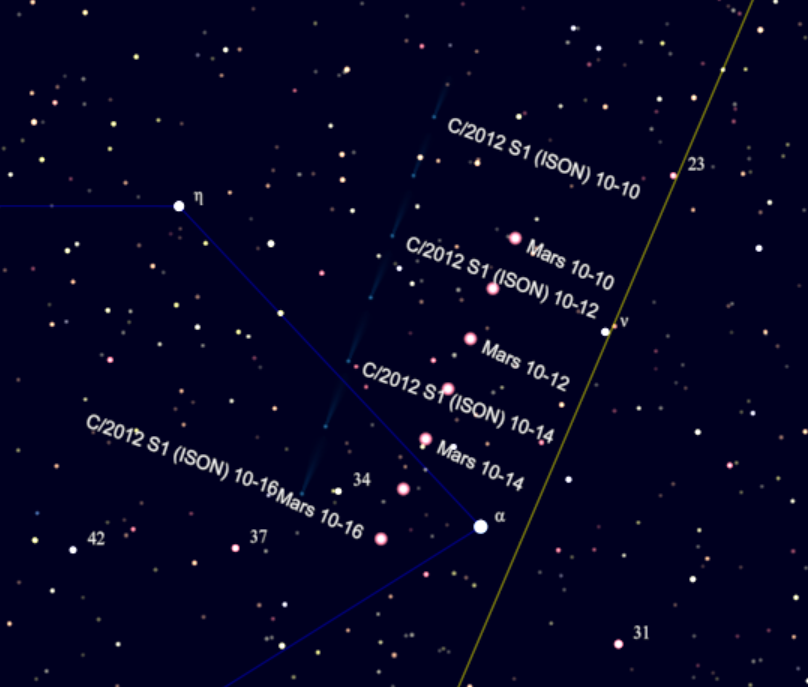
Comet ISON and Mars at 6 a.m. for 7 days starting October 10, 2013. Created using SkyCharts (Cartes du Ciel).
Don’t expect a tail. The head if Comet ISON will be hard enough to see. The yellow line is the ecliptic, the projection of the earth’s orbit on the sky. Most planet orbital planes lie close to the earth’s orbital plane, so are usually seen near it. The star marked α is Regulus the brightest star in the constellation of Leo, and about the brightness of Mars.
Spaceweather.com has images of the comet.
The Draconid meteor shower peaks tonight
The Draconid meteor shower is lackluster most years with a handful of meteors an hour, and this is one of those. However every once and a while all heaven breaks loose. It’s related to Comet Giacobini-Zinner, a short period comet. The radiant is overhead in the early evening, so this is a rare meteor shower best seen in the evening rather than the morning sky.
Here’s a link to my post a couple of years ago (2011) about it including a finder chart: https://bobmoler.wordpress.com/2011/10/06/100611-ephemer…-meteor-shower/
For this year check out the site EarthSky.org and their take on the Draconids.
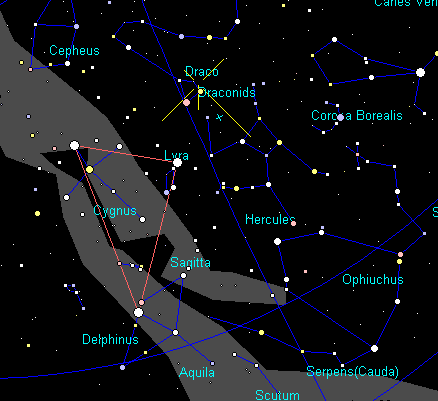
Draconid Meteor Shower Radiant
The red triangle delineates the Summer Triangle.
Links to other sites for Comet ISON information as it approaches perihelion
C/2012 S1 (ISON) is the official designation for Comet ISON, which will pass close to Mars on its inbound leg of its orbit of the sun.
Universe Today has two links on what to expect as Comet ISON nears the sun.
The Comet ISON, a Viewing Guide From Now to Perihelion: http://www.universetoday.com/104818/comet-ison-a-viewing-guide-from-now-to-perihelion/
The comet’s coma (head) is turning green as it approaches. That’s a good thing: http://www.universetoday.com/105087/comet-ison-goes-green/
Here’s another site: The NASA Comet ISON Observing Campaign: http://www.isoncampaign.org/ which answers some of your questions and details some of the world-wide and solar system wide attempts to observe Comet ISON as it makes its mad dash to and from the sun.
As Comet ISON approaches the Sun it is doing so close to the ecliptic plane (plane of the earth’s orbit). Situated in the morning sky, it will follow fairly close to the ecliptic, passing Mars and Saturn on the way in from our point of view. It will physically pass close to Mars this week. Expect photos of the comet from Mars by the end of the week. What Martians are taking the photos? Why we are. NASA and the Europeans have assets on and around Mars who will, in their robotic way photograph and possibly analyze the comet as it passes by. The apparent passage by Saturn is apparent from our point of view from the earth. It is far in the background. Comet Encke, the shortest of the periodic comets with a 3.3 year orbit will be in some of the photographs from earth.
Around the end of October Comet ISON will cross the earth’s orbit heading to perihelion on November 28th. Comet will stay a morning comet after leaving the sun heading northward from the earth’s point of view. We expect the comet be at its brightest, but rapidly fade in December. But who knows. I will be reporting what I know and see about the time the comet becomes visible in binoculars or a small telescope. Stay tuned.
09/16/2013 – Ephemeris – The brightest spot on the moon
Ephemeris for Monday, September 16th. The sun will rise at 7:22. It’ll be up for 12 hours and 27 minutes, setting at 7:50. The moon, 3 days before full, will set at 5:15 tomorrow morning.
The moon is very bright tonight and almost painful to view through a telescope. Remember that’s the full strength of the sun shining on it. Be thankful that it reflects only about 11 percent of the sunlight that hits it. Just thing how much brighter it would be if it was covered by Lake Michigan beach sand. There is a bright spot on the moon now visible. It just became visible today. It’s a crater at the upper left of the moon that’s called Aristarchus after the ancient Greek Philosopher who came up with the sun centered solar system in the 3rd century BC. Unfortunately all his writings have been lost. We only have the comments from others of what he wrote. The crater is the brightest spot on the moon.
Times are for the Traverse City/Interlochen area of Michigan. They may be different for your location.
Addendum
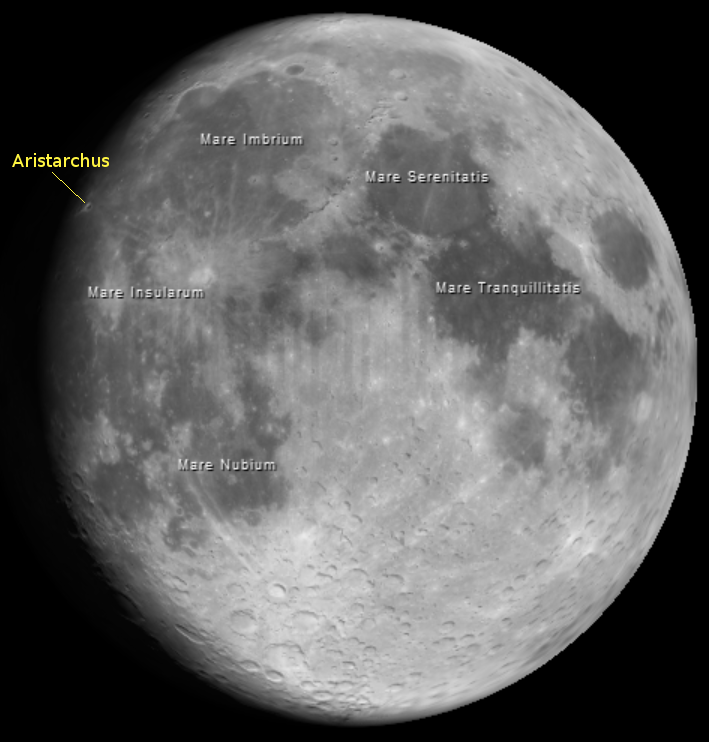
The location of Aristarchus on the moon at 9 p.m. September 16, 2013. Created using Virtual Moon Atlas.
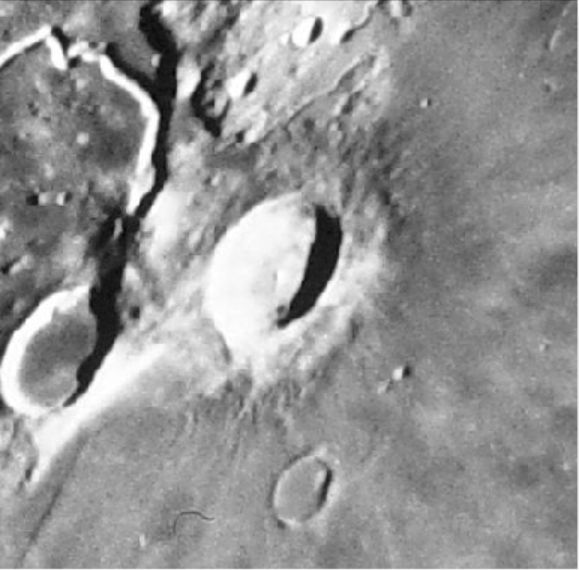
The crater Aristarchus. Credit: Lunar and Planetary Institute.
09/09/2012 – Ephemeris – The planets and the Moon in the evening
Ephemeris for Monday, September 9th. The sun will rise at 7:14. It’ll be up for 12 hours and 49 minutes, setting at 8:03. The moon, 3 days before first quarter, will set at 10:06 this evening.
The Moon will pass Saturn around noon today. By 9 p.m. the Moon will have scooted to the left of Saturn by 10 of its widths or half the width of your fist held at arm’s length. We are getting to the point that Saturn’s image is being seriously degraded in telescopes because the planet is so close to the horizon and we are looking at it through the very thick atmosphere. The Moon however is getting better each night and it moves higher each night. In binoculars the young Moon will reveal two dark seas. Above is the distinctive Sea of Crises, and below the Sea of Fertility. The Sea of Tranquility is partially illuminated, now cut by the Moon’s terminator or sunrise line. Telescopes will reveal interesting features near there.
Times are for the Traverse City/Interlochen area of Michigan. They may be different for your location.
Addendum
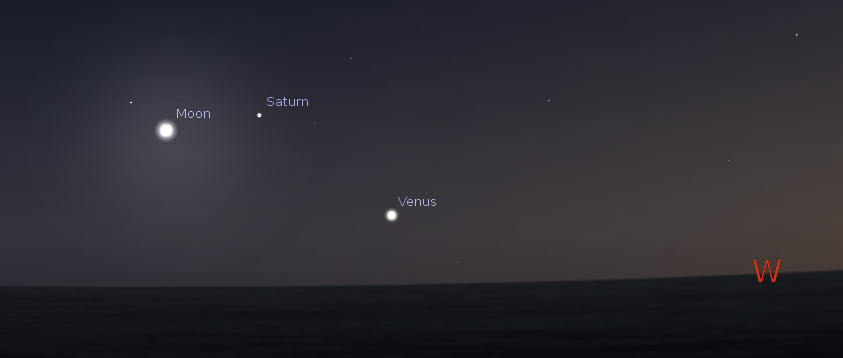
The Moon, Saturn and Venus at 9 p.m. on September 9, 2013. Created using Stellarium.
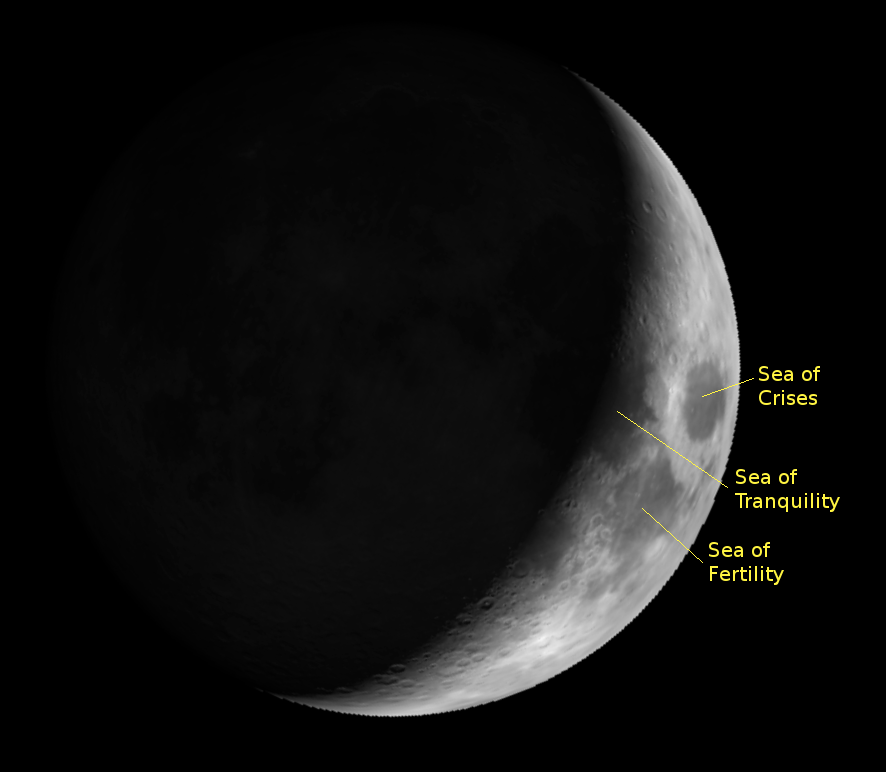
The Moon as seen at 9 p.m. September 9, 2013. Rotated the approximate extent for its appearance in the sky. Created using Virtual Moon Atlas.
09/02/2013 – Ephemeris – The Milky Way’s Great Rift
Ephemeris for Labor Day, Monday, September 2nd. The sun will rise at 7:06. It’ll be up for 13 hours and 10 minutes, setting at 8:16. The moon, 3 days before new, will rise at 5:19 tomorrow morning.
High overhead the Milky Way is seen passing through the Summer Triangle of three bright stars. Here we find the Milky Way split into two sections. The split starts in the constellation of Cygnus the Swan or Northern Cross very high in the east. The western branch of the Milky Way ends in the south. The dark dividing feature is called the Great Rift. Despite the lack of stars seen there, it doesn’t mean that there are fewer stars there than in the brighter patches of the Milky Way. The rift is a number of overlapping clouds of dust and gas about 300 light years away that obscure the light of the stars behind them. Sometimes binoculars can be used to find the edges of the clouds of the rift, as stars numbers drop off suddenly. This is especially easily seen in the constellation of Aquila.
Times are for the Traverse City/Interlochen area of Michigan. They may be different for your location.
Addendum
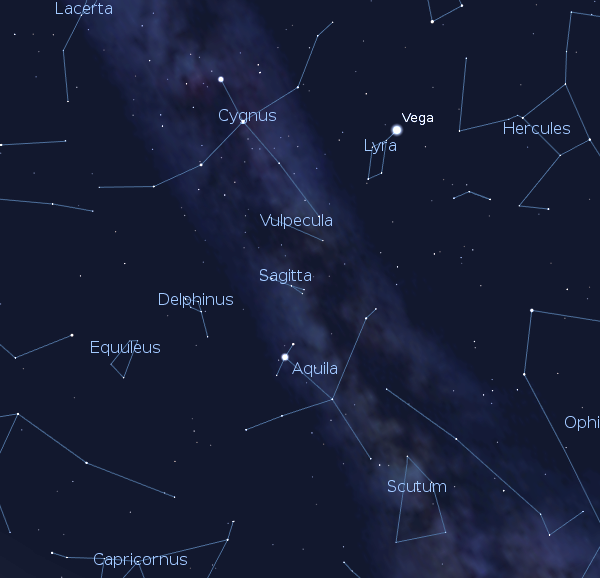
The Great Rift in the Milky Way. Created using Stellarium.
08/26/2013 – Ephemeris – The constellation of Delphinus the dolphin
Ephemeris for Monday, August 26th. The sun rises at 6:58. It’ll be up for 13 hours and 30 minutes, setting at 8:29. The moon, 2 days before last quarter, will rise at 11:22 this evening.
With Nova Delphinus in our skies let’s take a look at this celestial dolphin. Located below the eastern edge of the Summer Triangle of three of the brightest stars in the sky, which is overhead in our sky at 10 p.m., is the tiny constellation of Delphinus the dolphin. Delphinus’ 6 stars in a small parallelogram with a tail, really does look like a dolphin leaping out of the water. The parallelogram itself has the name Job’s Coffin. The origin of this asterism or informal constellation is unknown. Of the dolphin itself: the ancient Greeks appreciated this aquatic mammal as we do, and told stories of dolphins rescuing shipwrecked sailors. The nova can be spotted in binoculars using the chart at http://www.skyandtelescope.com or below.
Times are for the Traverse City/Interlochen area of Michigan. They may be different for your location.
Addendum
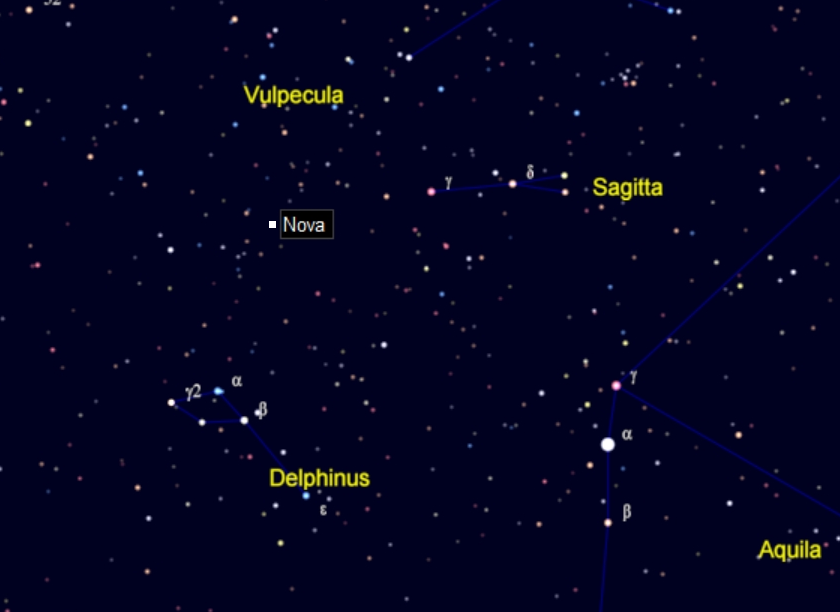
My finder chart for Nova Delphinus 2013. Created using Carte du Ceil (Sky Charts)
The dot for the Nova will show it brighter than it is. It should be fading now.

