Archive
01/27/2014 – Ephemeris – Mercury’s back in the evening sky now
Ephemeris for Monday, January 27th. The sun will rise at 8:06. It’ll be up for 9 hours and 37 minutes, setting at 5:44. The moon, half way from last quarter to new, will rise at 5:47 tomorrow morning.
Mercury is now making an appearance in the evening sky. It will have its greatest elongation or angular separation from the sun on Friday of 18.4 degrees. Mercury has a markedly elliptical orbit. Unfortunately both the best times to view Mercury from the northern hemisphere of earth, late summer and autumn mornings and late winter and spring evenings, Mercury is near perihelion or closest point in its orbit to the sun. The southern hemisphere, which has seasons opposite from ours, has the same viewing opportunities in late summer and autumn mornings and late winter and spring evenings. Only for them Mercury is near aphelion or its farthest from the sun, so this planet can be seen just outside of twilight, where we don’t have that luxury.
Times are for the Traverse City/Interlochen area of Michigan. They may be different for your location.
Addendum
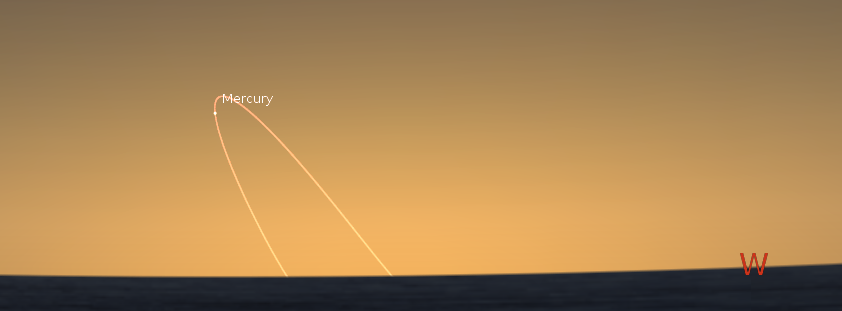
Mercury and its orbit as seen from Earth at 6:15 p.m. on January 27, 2014. Created using Stellarium.
Mercury will move to the top of the orbital loop Friday about 5 a.m. and descend to the right. The Mercury image will be posted Wednesday again.
01/17/2014 – Ephemeris – The Moon tonight
Ephemeris for Friday, January 17th. The sun will rise at 8:14. It’ll be up for 9 hours and 16 minutes, setting at 5:30. The moon, 2 days past full, will rise at 7:23 this evening. | Let’s take a look at the moon as it’s still dominates the evening sky. The terminator, now that it’s after full moon is the sunset line. It is just starting to encroach on the small distinctive sea at the moon’s upper right edge called the Sea of Crises or Mare Crisium. Where is is situated on the edge of the spherical moon it appears to be elongated north to south. However if you saw it from overhead it would actually be elongated somewhat east to west. On the terminator at the moon’s equator is a large crater called Langrenus with a central peak on the edge of the Sea of Fertility or Mare Fecunditatis, that should be an easy binocular and a great telescopic crater some 80 miles in diameter. The smallest ting you can see on the moon in a small telescope is 2 miles in diameter.
Times are for the Traverse City/Interlochen area of Michigan. They may be different for your location.
Addendum
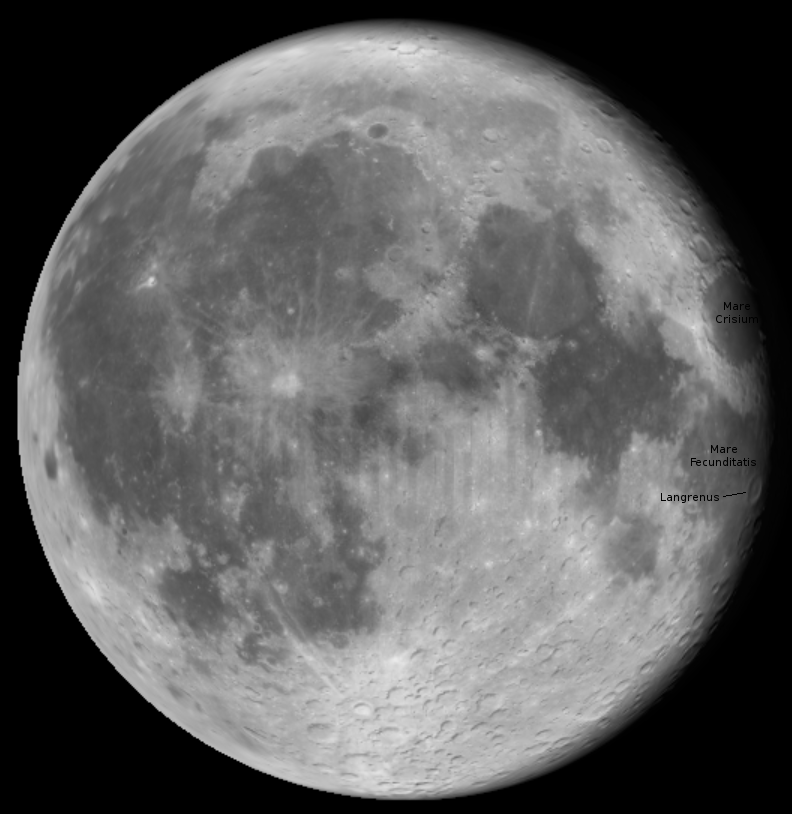
The Moon at 9 p.m., January 17, 2014. Created using Virtual Moon Atlas.
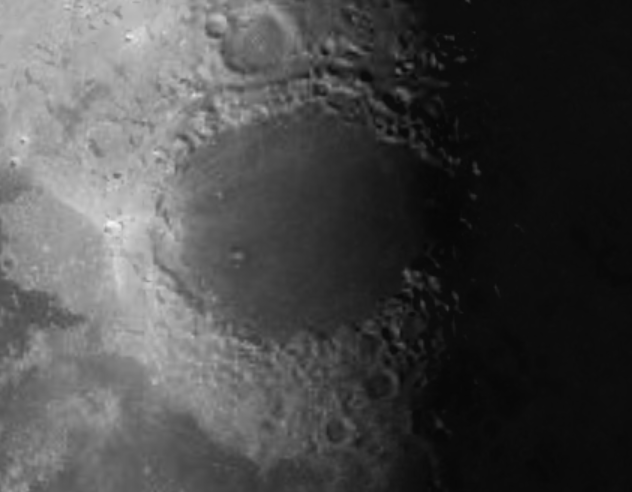
Mare Crisium as seen from overhead at 9 p.m., January 17, 2014. Created using Virtual Moon Atlas.
This last image cannot be seen without a spacecraft. The image was created using data from the Clementine spacecraft.
01/13/2014 – Ephemeris – Jupiter’s Great Red Spot
Ephemeris for Monday, January 13th. The sun will rise at 8:16. It’ll be up for 9 hours and 9 minutes, setting at 5:25. The moon, 2 days before full, will set at 6:49 tomorrow morning.
Jupiter is my youngest granddaughter’s favorite planet. She has books and pictures of Jupiter sporting its famous Great Red Spot. When I was a teenager in the 1950s, a bit older than she is now the Great Red Spot on Jupiter was indeed bright red. You couldn’t miss it in even the smallest telescopes. Since the early 1970s the spot has faded. At best it’s a pastel pink. The Great Red Spot appears to be a permanent feature of the Jovian atmosphere, an anti-cyclone that distorts the dark belts and bright zones of the planet. The dark belts are thought to be where air is sinking and the white zones are upwelling clouds. The Great Red Spot wanders east and west at about the same latitude within the atmosphere. I hope it gets really red soon.
Times are for the Traverse City/Interlochen area of Michigan. They may be different for your location.
Addendum
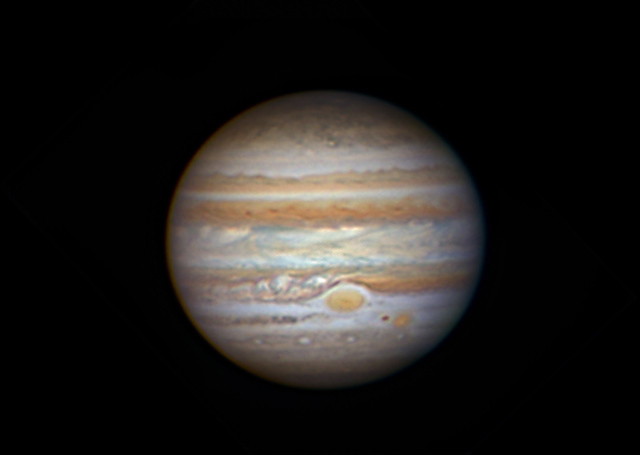
Jupiter with its Great Red Spot November 18, 2012 by Scott Anttila.
01/08/2014 – Ephemeris – Where are the bright planets this week?
Ephemeris for Wednesday, January 8th. The sun will rise at 8:18. It’ll be up for 9 hours and 2 minutes, setting at 5:20. The moon, 1 day past first quarter, will set at 2:18 tomorrow morning.
This is our weekly look at the planets. Venus is only three days from passing between the Earth and the Sun in what astronomers call inferior conjunction. Sharp eyed observers may be able to spot it in the bright twilight glow before it sets at 5:57 p.m. tonight. It will then pass into the morning sky. The giant planet Jupiter will be in the eastern sky as darkness falls tonight. It’s cruising against the stars of Gemini now. It will pass due south at 12:32 a.m., and will set at 8:13 a.m. Mars will rise at 12:39 a.m. in the east. Reddish Mars is in Virgo now and to the upper right of the bright star Spica by the width of your fist held at arm’s length. Saturn will rise at 3:47 a.m. in the east southeast. It’s seen against Libra the scales this year.
Times are for the Traverse City/Interlochen area of Michigan. They may be different for your location.
Addendum
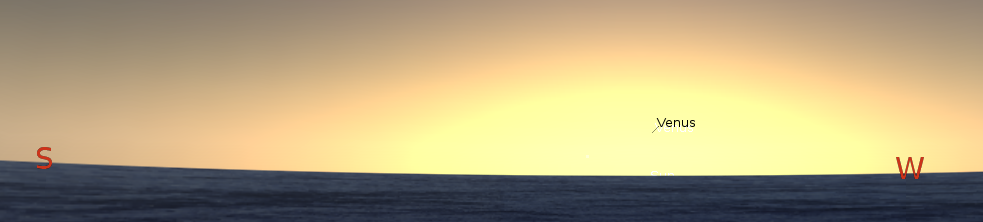
For diehards, Venus 15 minutes before it will set tonight January 8, 2014.
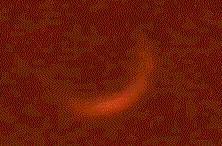
Venus at 3 days before inferior conjunction back in the late 1960’s. My photograph.
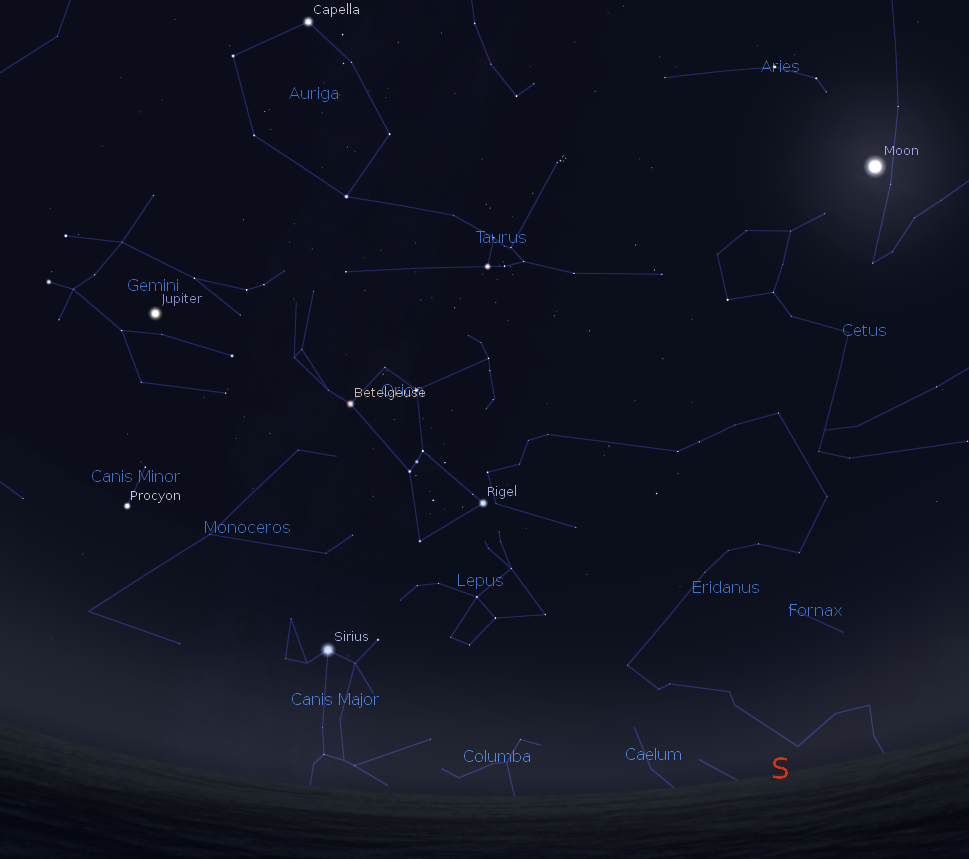
Jupiter, the Moon with the winter constellations at 9 p.m. on January 8, 2014. Created using Stellarium.
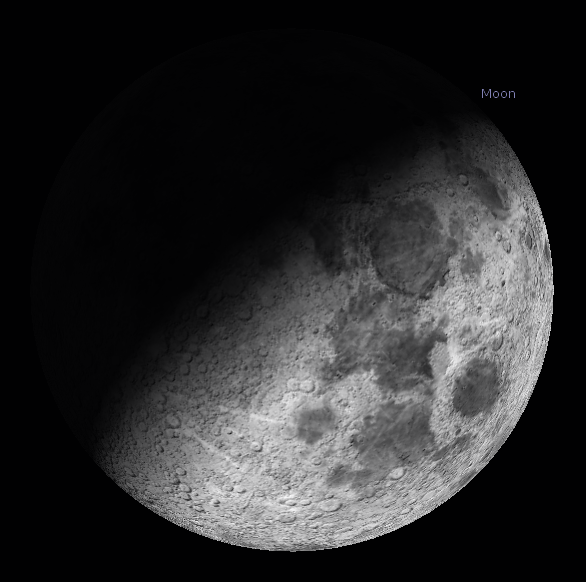
The telescopic moon at 9 p.m. January 8, 2014. Created using Stellarium.
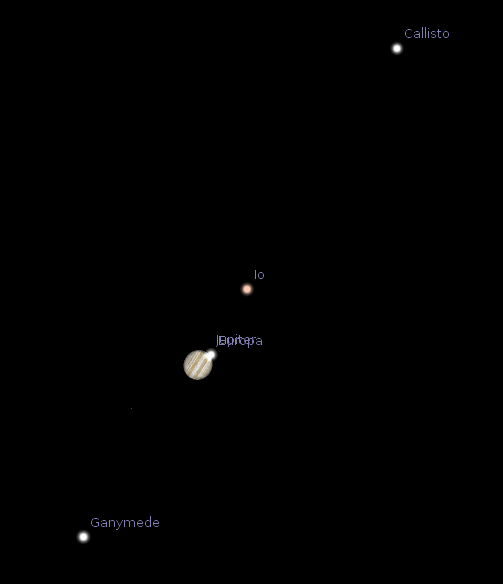
The telescopic Jupiter at 9 p.m. and January 8, 2014. The label for the moon Europa overlaps that of Jupiter. Created using Stellarium.
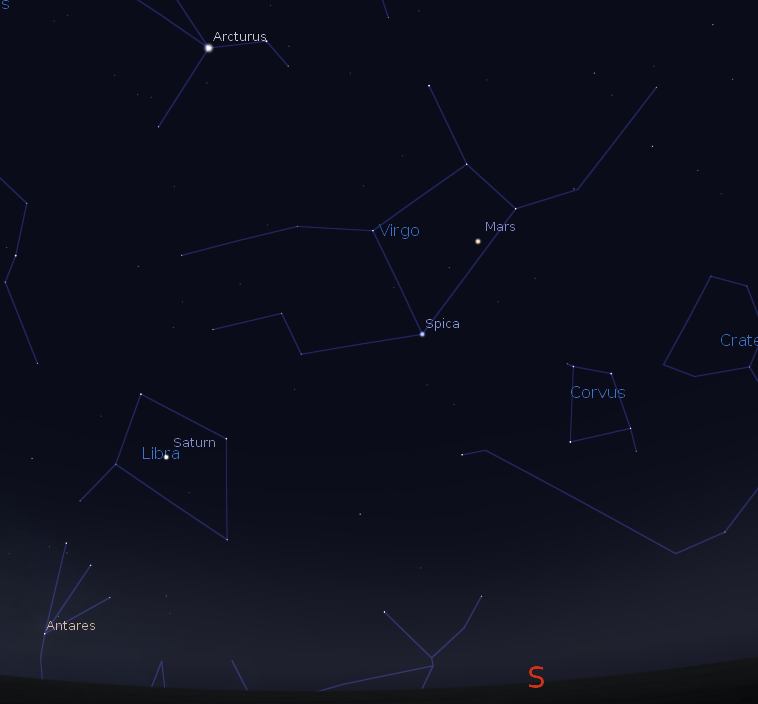
Mars and Saturn with the spring constellations at 6:30 a.m. on January 9, 2014. Created using Stellarium.
01/03/2014 – Ephemeris – Astronomy events in the Grand Traverse Region tonight.
Ephemeris for Friday, January 3rd. The sun will rise at 8:19. It’ll be up for 8 hours and 55 minutes, setting at 5:14. The moon, 2 days past new, will set at 8:32 this evening.
We have a big night ahead. At 1 a.m. the Earth will be closest to the Sun at perihelion. In the morning hours the Quadrantid meteor shower will reach peak. Before that the Grand Traverse Astronomical Society will hold its monthly meeting at Northwestern Michigan College’s Rogers observatory on Birmley Road south of Traverse City starting at 8 p.m. The program will be given by Richard Kuschell, who will talk about “Aristotle’s Big Mistake”. Afterward, starting at 9 p.m. there will be a star party. If its clear the winter wonders will be visible including the planet Jupiter and the Great Orion Nebula, the closest star nursery to us. The meeting is free to the public. There will be another program given during the star party.
Times are for the Traverse City/Interlochen area of Michigan. They may be different for your location.
Addendum
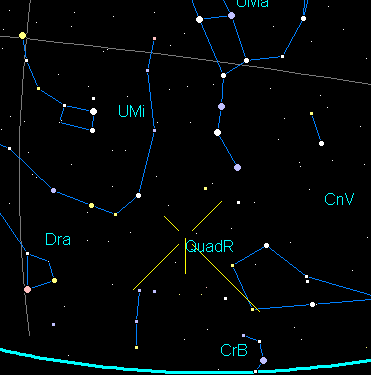
Quadrantid meteor shower radiant at 1:30 a.m.
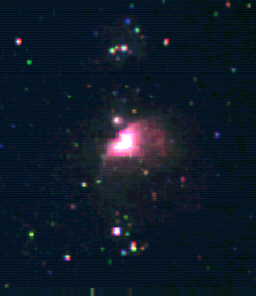
Great Orion Nebula in Orion’s sword. My old photograph. What you’ll see will actually be better than this except our eyes will not perceive the red color. It will look gray or greenish at best.
01/02/2014 – Ephemeris – Quadrantids and the Earth at Perihelion tomorrow night
Ephemeris for Thursday, January 2nd. The sun will rise at 8:19, the latest sunrise of the year. It’ll be up for 8 hours and 54 minutes, setting at 5:14. The moon, 1 day past new, will set at 7:16 this evening. | The Quadrantid meteor shower will be the best meteor shower of the year since the other showers will have to contend with the bright moon. The best time to see them will be between midnight and 6:30 in the morning Friday night through Saturday morning. They will seem to come from behind the Big Dipper’s handle. Weird though it seems. At 1 a.m. Saturday morning the Earth will be closest to the sun in it’s orbit. This is called perihelion. The earth at that instant will be 91.45 million miles away. On July 3rd it will be at its farthest, about 94 and a half million miles away. This slight distance variance doesn’t affect us much except to make winter shorter than summer by a few days. You probably won’t believe that either.
Times are for the Traverse City/Interlochen area of Michigan. They may be different for your location.
Addendum
Quadrantid meteor shower radiant low in the noirtheast at 1:30 a.m.
The Bad Astronomer’s take on perihelion is here.
Also for this and the rest of the year here is David Dickinson’s 101 Astronomical Events for 2014 on Universe Today.
12/16/2013 – Ephemeris – Orion’s bright blue-white star Rigel
Ephemeris for Monday, December 16th. The sun will rise at 8:13. It’ll be up for 8 hours and 49 minutes, setting at 5:03. The moon, 1 day before full, will set at 8:07 tomorrow morning.
Last week I talked about the star Betelgeuse the bright red star in the top left of Orion’s rectangle in the hunter’s shoulder. Orion is seen in the southeast at 9 in the evening. The blue-white star in Orion’s opposite corner is usually brighter. It is Rigel whose longer Arabic name of which Rigel is the first part means Left Leg of the Giant. Rigel is a giant itself, actually a super giant star, which is more a measure of its mass than its size, that of 17 solar masses. Its surface temperature is more than twice as hot as the sun. It is 130 thousand times as bright as the sun and 74 times its diameter. Its distance is around 860 light years. A telescope might reveal a close companion star to Rigel, off the edge of the bright arc light image of Rigel itself.
Times are for the Traverse City/Interlochen area of Michigan. They may be different for your location.
Addendum
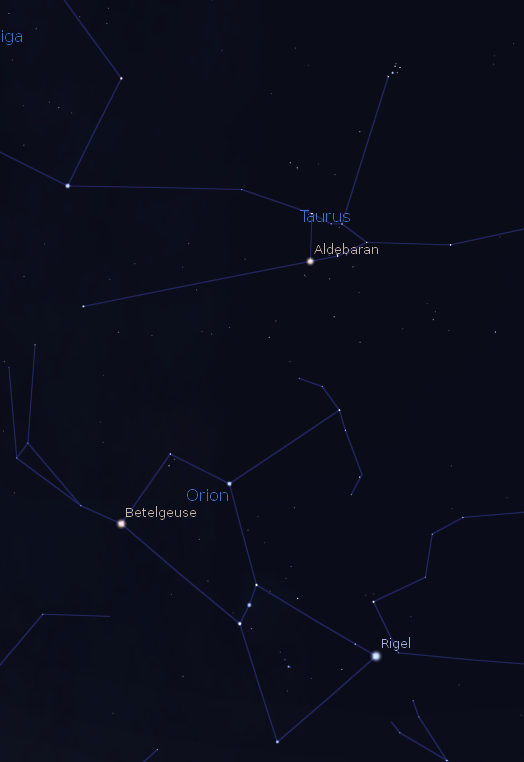
Taurus and Orion with Orion’s brightest stars named. Created using Stellarium.
12/13/2013 – Ephemeris – The Geminid meteor shower will peak overnight
Ephemeris for Friday, December 13th. The sun will rise at 8:11. It’ll be up for 8 hours and 51 minutes, setting at 5:02. The moon, half way from first quarter to full, will set at 5:27 tomorrow morning.
The Geminid meteor shower will reach maximum around 12:45 a.m. tomorrow morning. The big problem will be the bright moon, so only the brightest meteors will be visible before the moon sets tomorrow morning. The 5:27 moon-set time will give the Geminids about an hour of dark skies, plus maybe another half hour of unobjectionable morning twilight to see them at their best. The Geminids will appear to originate from near the star Castor at the head of the constellation Gemini, where Jupiter is currently located. It is said that the Geminids are year in and year our the most reliable shower. That may be true, because in 1983 the source of the meteor shower was found, a long dead comet hulk, that resembles an asteroid but with a comet’s orbit.
Times are for the Traverse City/Interlochen area of Michigan. They may be different for your location.
Addendum
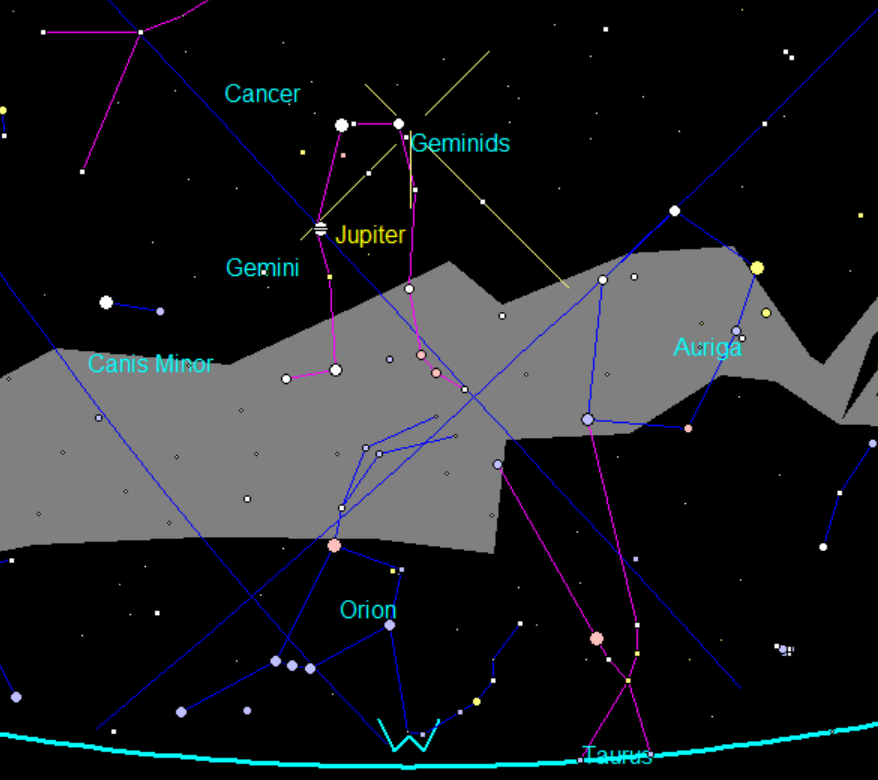
The Geminid radiant at 6 a.m. December 14, 2014 after moon set. Created using my LookingUp program for Windows
The brighter Geminids can be seen all night, but the darkest time will be just before dawn.
11/26/2013 – Ephemeris – Have a helping of comet with your turkey on Thursday
Ephemeris for Tuesday, November 26th. The sun will rise at 7:53. It’ll be up for 9 hours and 12 minutes, setting at 5:05. The moon, 1 day past last quarter, will rise at 1:42 tomorrow morning.
Comet ISON is now invisible from the earth, being too close to the direction of the sun to be seen. However it is and will be in view of NASA’s fleet of solar observation spacecraft at least until the end of the month. The comet is already in view of the STEREO Ahead spacecraft, looking back toward the Earth and Mercury. Later tonight of early tomorrow it will be in the view of the Solar and Heliospheric Observatory or SOHO parked a million miles sun-ward from the earth. It will appear on the LASCO C3 imager first. Thursday it will also be visible to the Solar Dynamics Observatory or SDO. On the Internet go to spaceweather.com at the page bottom click on STEREO, then click on Latest Images, or go to bobmoler.wordpress.com.
Times are for the Traverse City/Interlochen area of Michigan. They may be different for your location.
Addendum
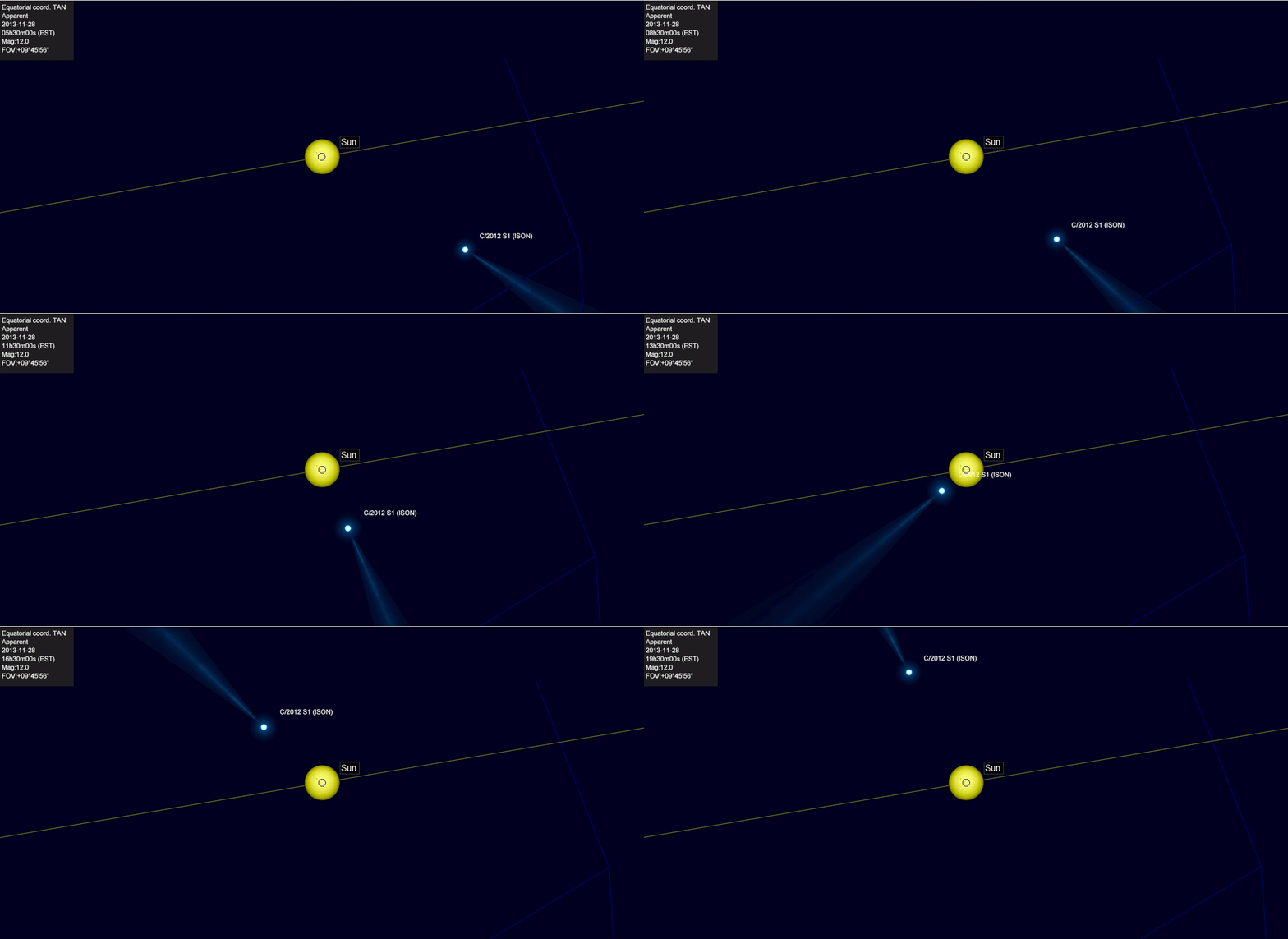
Animation of Comet ISON rounding the sun on Thanksgiving Day, November 28, 2013. Created using Cartes du Ciel (Sky Charts).
Click on the image to enlarge and animate.
11/22/2013 – Ephemeris – President Kennedy and the quest for the Moon plus Comet ISON finder charts
Ephemeris for Friday, November 22nd. The sun will rise at 7:48. It’ll be up for 9 hours and 19 minutes, setting at 5:08. The moon, 3 days before last quarter, will rise at 9:43 this evening.
Today marks the 50th anniversary of the assassination of President John F. Kennedy. Yes I remember where I was when I heard the news. Being a program about astronomy and space I’d like to think about the challenge he laid down “to send a man to the moon and return him safely to the Earth by the end of the decade”. This was in the midst of the Cold War in response to the Soviet’s triumph in sending Yuri Gagarin into orbit. It was made almost a sacred vow due to Kennedy’s assassination. No NASA program since was funded to the extent that the Gemini and Apollo programs were, so that on July 20, 1969 that promise was fulfilled. All of money spent in NASA’s 55 years is actually less than that of the recent bank bailout.
Times are for the Traverse City/Interlochen area of Michigan. They may be different for your location.
Comet ISON
Finder charts for Comet ISON for this morning, Saturday, Sunday and Monday mornings.
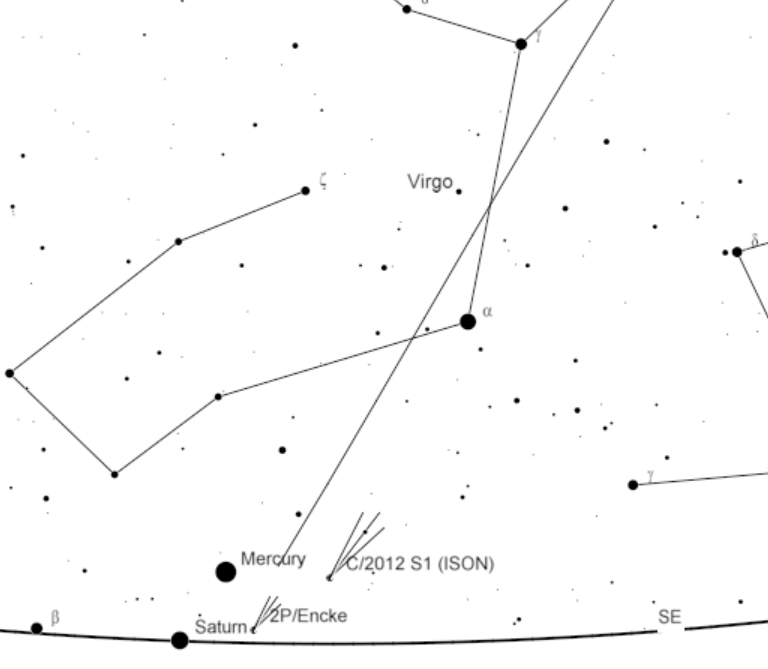
Chart for finding Comet ISON this morning (November 22, 2013 at 6:30 a.m.). Chart created using Cartes du Ciel.
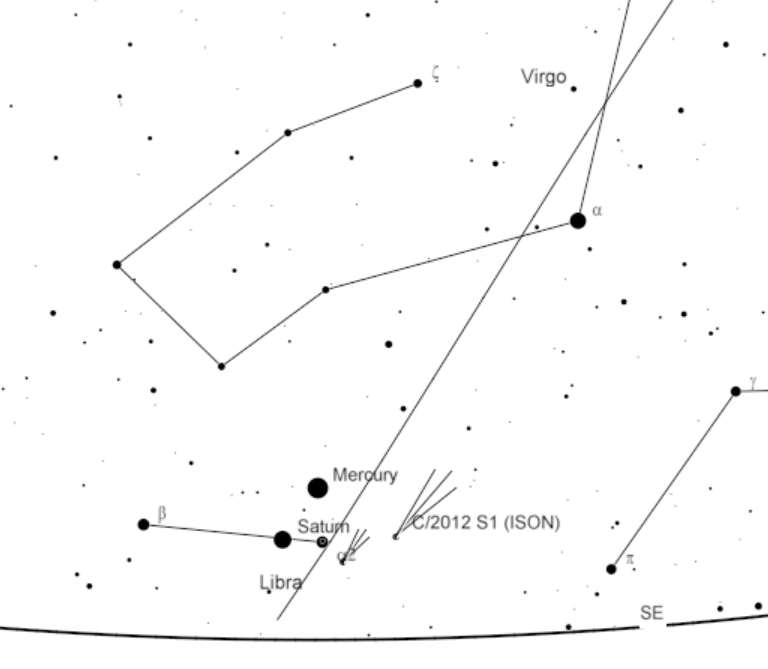
Chart for finding Comet ISON Saturday morning (November 23, 2013 at 7:00 a.m.). Chart created using Cartes du Ciel.
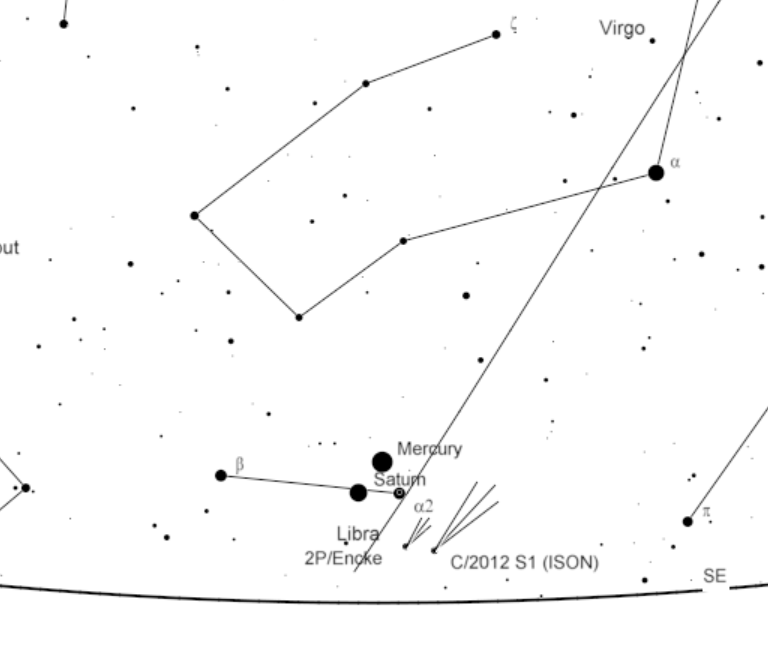
Chart for finding Comet ISON Sunday morning (November 24, 2013 at 7:00 a.m.). Chart created using Cartes du Ciel.
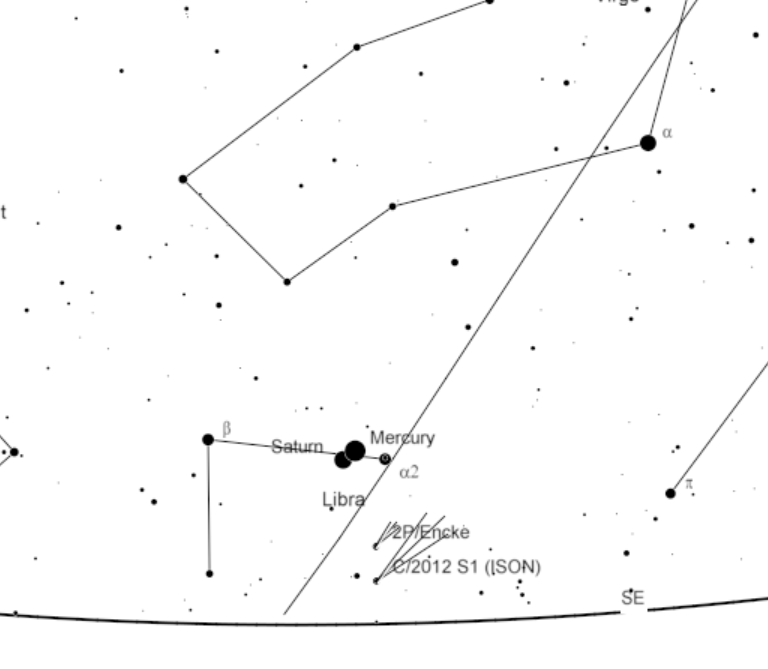
Chart for finding Comet ISON Monday morning (November 25, 2013 at 7:15 a.m.). Chart created using Cartes du Ciel.

