Archive
10/30/2018 – Ephemeris – Algol the spookiest star in the sky
Ephemeris for Tuesday, October 30th. The Sun will rise at 8:18. It’ll be up for 10 hours and 16 minutes, setting at 6:34. The Moon, 1 day before last quarter, will rise at 11:53 this evening.
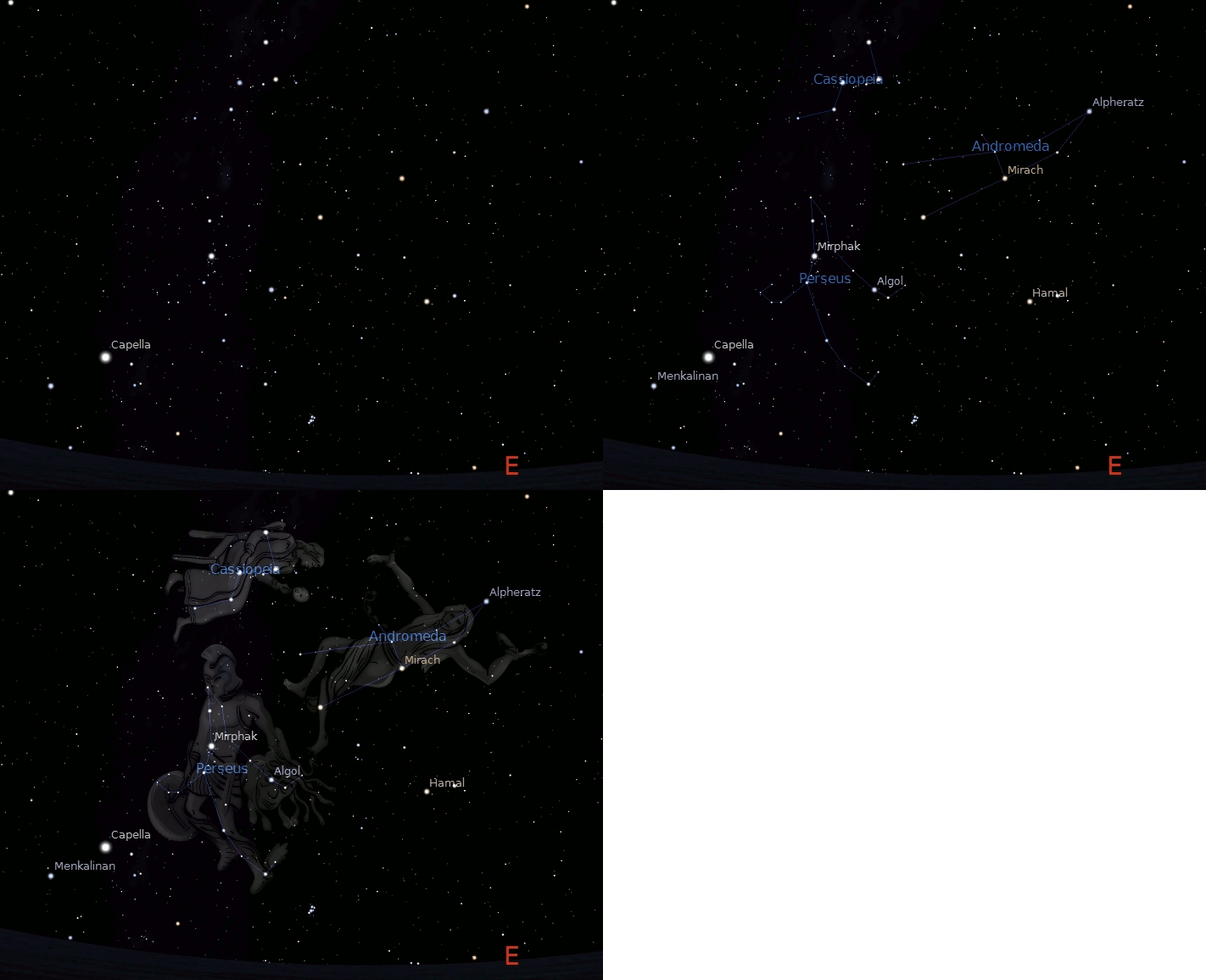
Not all the ghosts and goblins out tomorrow night will be children. One will be out every night because it’s a star. Its name is Algol, from the Arabic for Ghoul Star or Demon Star. The Chinese had a name for it that meant “piled up corpses”. It’s normally the second brightest star in the constellation Perseus the hero, visible in the northeast this evening. The star is located where artists have drawn the severed head of Medusa, whom he had slain. Medusa was so ugly that she turned all who gazed upon her to stone. Algol is her still glittering eye. The star got these names before astronomers found out what was wrong with it. They found out that it does a slow wink every two days, 21 hours. That’s because Algol is two stars that eclipse each other. Her next evening wink will be dimmest at 8:10 p.m. November 13th.
The times given are for the Traverse City/Interlochen area of Michigan. They may be different for your location.
Addendum
.

07/03/2018 – Ephemeris – Antares the sparkler star
Ephemeris for Tuesday, July 3rd. Today the Sun will be up for 15 hours and 29 minutes, setting at 9:31, and it will rise tomorrow at 6:02. The Moon, 3 days before last quarter, will rise at 12:47 tomorrow morning.
There’s going to be a lot of fireworks tomorrow night to celebrate Independence Day, and I may be watching some after the local Beach Bums baseball game. There’s at least one star that is a great sparkler any summer evening. That’s Antares in Scorpius the scorpion low in the south tonight. We in Michigan always see Antares low in the south. It’s a bright red giant star which twinkles mightily, and since it’s low in the sky spits and sputters all kinds of colors due to our atmosphere’s turbulence, and the fact that we’re looking through so much of it at Antares. The more magnification one uses with binoculars or a telescope the greater the sparkler effect. It is even called in sometimes as a UFO.
The times given are for the Traverse City/Interlochen area of Michigan. They may be different for your location.
Addendum
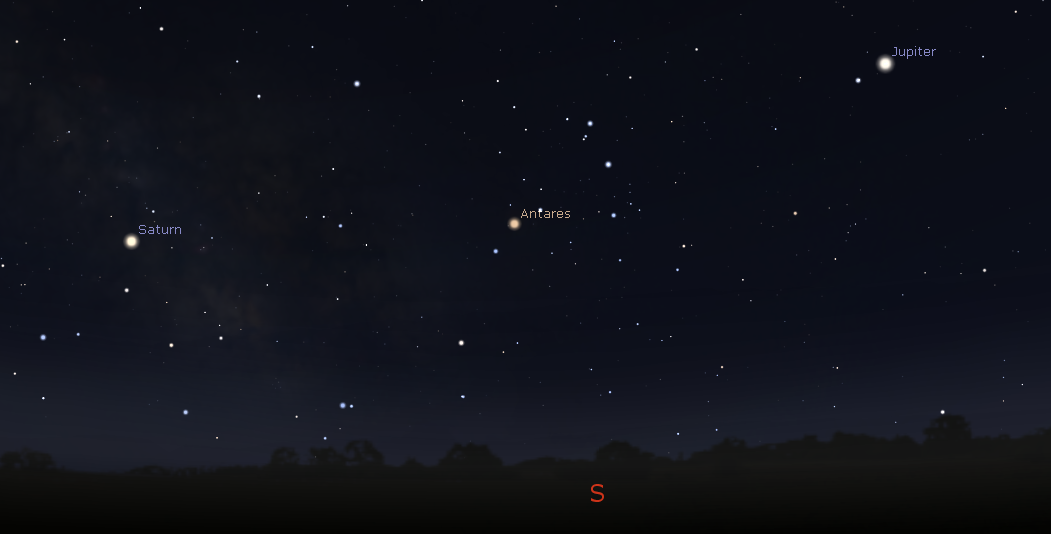
Antares finder chart for 11 p.m., July 3, 2018. Created using Stellarium.
07/02/2018 – Ephemeris – The starry triangle of summer
Ephemeris for Monday, July 2nd. Today the Sun will be up for 15 hours and 30 minutes, setting at 9:31, and it will rise tomorrow at 6:02. The Moon, half way from full to last quarter, will rise at 12:19 tomorrow morning.
Now that it’s summer it’s time to look for the Summer Triangle in the sky. It’s seen rising in the east as it gets dark. Highest of the three bright stars is Vega in the constellation Lyra the harp, whose body is seen in a narrow parallelogram nearby. The second star of the triangle is Deneb lower and left of Vega, It appears dimmer than Vega because it is by far the most distant of the three. The third star of the Summer Triangle is seen farther below and a right of Vega. It is Altair in Aquila the eagle, and the closest. Altair is 16.5 light years away, Vega is 27 light years while Deneb actually one of the brighter stars known, is 1500 or more light years away. It’s distance is not well known.
The times given are for the Traverse City/Interlochen area of Michigan. They may be different for your location.
Addendum
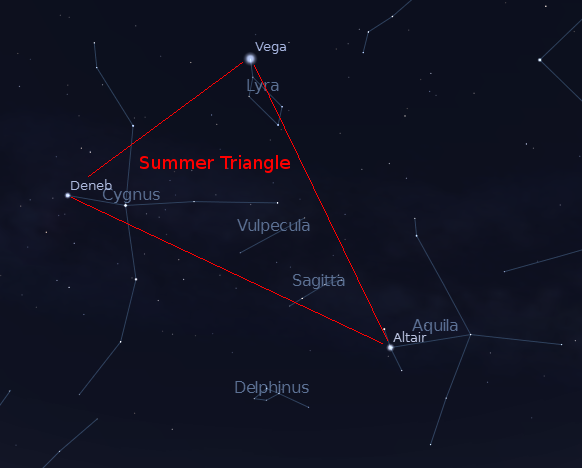
The Summer Triangle. Created using Stellarium.
06/11/2018 – Ephemeris – Jupiter and the claws of the scorpion
Ephemeris for Monday, June 11th. Today the Sun will be up for 15 hours and 31 minutes, setting at 9:28, and it will rise tomorrow at 5:56. The Moon, 2 days before new, will rise at 5:17 tomorrow morning.
Right now the bright planet Jupiter is seen in the south as it gets dark. There is a star visible below Jupiter now. The name of that star is my favorite star name: Zubenelgenubi. It roughly translates from the Arabic, and most star names are Arabic, as “Southern Claw”. This star, also known as Alpha Librae, is in the zodiacal constellation of Libra the scales or balance, a roughly square constellation standing on one corner. The name relates to Scorpius the scorpion to the east who in the Arab’s imagination extended farther to the west. The star farther to the upper left of Jupiter tonight is Zubeneschamali, you guessed it, the northern claw, also part of Libra. It’s the longest star name at 14 letters.
The times given are for the Traverse City/Interlochen area of Michigan. They may be different for your location.
Addendum
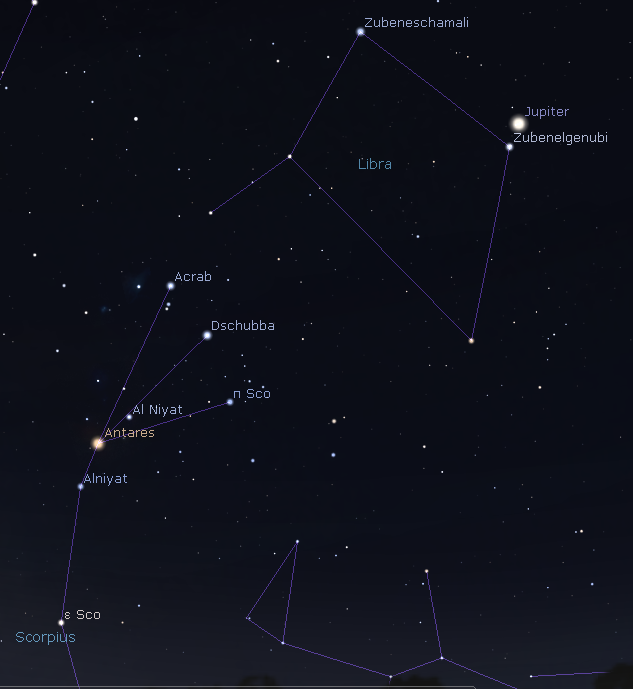
Jupiter with Zubenelgenubi, the South Claw and with nearby Zubeneschamali, the North Claw of Scorpius, still rising at 11 p.m. June 11, 2018. Created using Stellarium.
5/15/2018 – Ephemeris – Two thirds thru spring
Ephemeris for Tuesday, May 15th. Today the Sun will be up for 14 hours and 49 minutes, setting at 9:04, and it will rise tomorrow at 6:13. The Moon is new today, and won’t be visible.
Here we are at the middle of May, nearly two-thirds through spring and in the west only a few winter stars remain. Castor and Pollux of Gemini are horizontal in the west, Procyon the Little Dog Star is below and left of them, Capella in Auriga is in the northwest, but for most of the IPR listening area it will never quite set. At 10:30 Betelgeuse in Orion the hunter will be setting, chased from the skies by Scorpius the scorpion, which is rising in the southeast. In one story it is the sting of this scorpion that killed him. Already at that time two-thirds of the stars of the summer Triangle are up. Bright Vega in Lyra the harp, and Deneb in Cygnus the swan. The Big Dipper reigns overhead as spring is in full bloom.
The times given are for the Traverse City/Interlochen area of Michigan. They may be different for your location.
Addendum
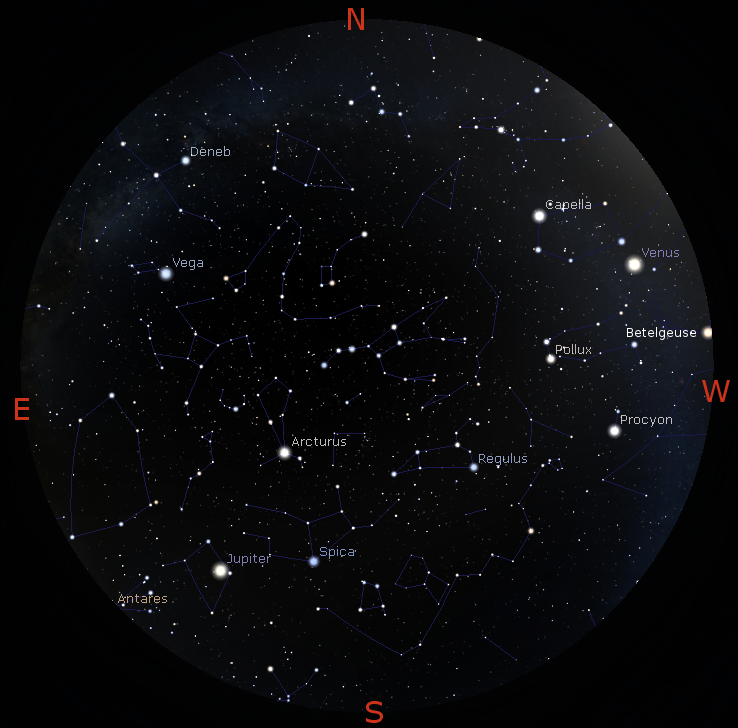
The sky dome for 10:30 p.m. May 15, 2018 showing the stars and constellations. It may not work for any latitude or time, but it works for our location, near 45 degrees north. Created using Stellarium.
05/14/2018 – Ephemeris – Big Dipper: Pointer to the Stars
Ephemeris for Monday, May 14th. Today the Sun will be up for 14 hours and 47 minutes, setting at 9:03, and it will rise tomorrow at 6:14. The Moon, 1 day before new, will rise at 6:45 tomorrow morning.
The Big Dipper points to other stars and constellations. Right now the Big Dipper is nearly overhead. The front bowl stars point to Polaris, the North Star which never seems to move in the sky. The handle can be used to find two stars. First follow the arc of the handle away from the bowl to find the fourth brightest night-time star Arcturus in the base of the kite shaped constellation of Boötes. Straighten the arc to a spike and continue to the south and you will come to the bright blue-white star Spica in Virgo the virgin. You can remember these stars with the phrase “Follow the arc of the handle to Arcturus and then spike to Spica” or if you prefer the alternate pronunciation of the latter star “Speak to Speeka”.
The times given are for the Traverse City/Interlochen area of Michigan. They may be different for your location.
Addendum
As can be seen below, there was one pointer function that didn’t make it into the program: A leaky dipper drips on Leo.
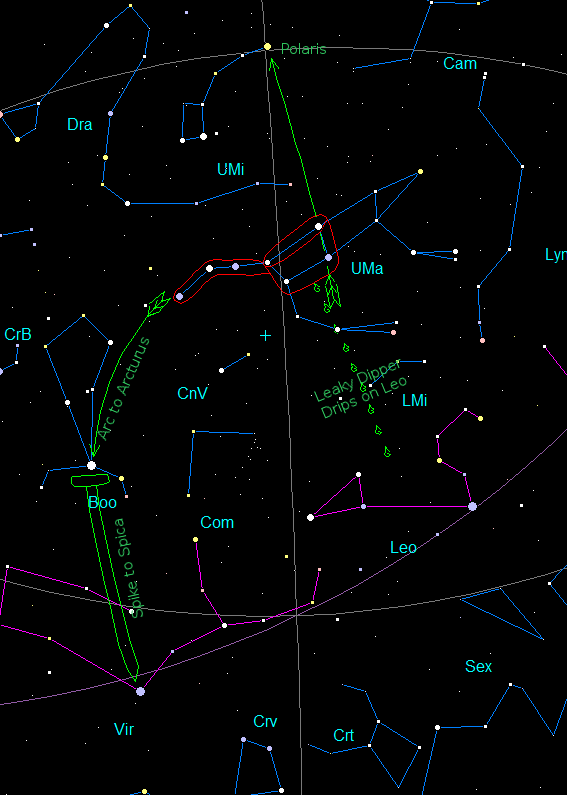
Using the Big Dipper as a pointer to other stars. The pointers to Polaris could be life saving, since it is always north. The view is southward. The cross displayed near the center is the zenith. One might want to lay down to take all this in. Created using my LookingUp program.
04/13/2018 – Ephemeris – Regulus, in Leo the lion, the “Little King” star.
Ephemeris for Friday, April 13th. The Sun will rise at 7:01. It’ll be up for 13 hours and 23 minutes, setting at 8:25. The Moon, 2 days before new, will rise at 6:42 tomorrow morning.
The brightest star in the constellation Leo, which is high in the south these evenings is Regulus, whose name means “Little King”. It is appropriate due to its position in the heart of the king of beasts Leo the lion. Regulus is dead last in brightness of the 21 first magnitude stars, the brightest night-time stars. Even so, it is much brighter than the Sun. It is 79 light years away. The Sun would require a telescope to be spotted at that distance. Regulus appears to be a quadruple star system. The bright star itself is really two stars with a bright star orbited by a much dimmer star every 40 days. There are two dimmer stars much further out that share Regulus’ motion through space. There are an infinite variety of star system arrangements in the galaxy and beyond.
The times given are for the Traverse City/Interlochen area of Michigan. They may be different for your location.
Addendum
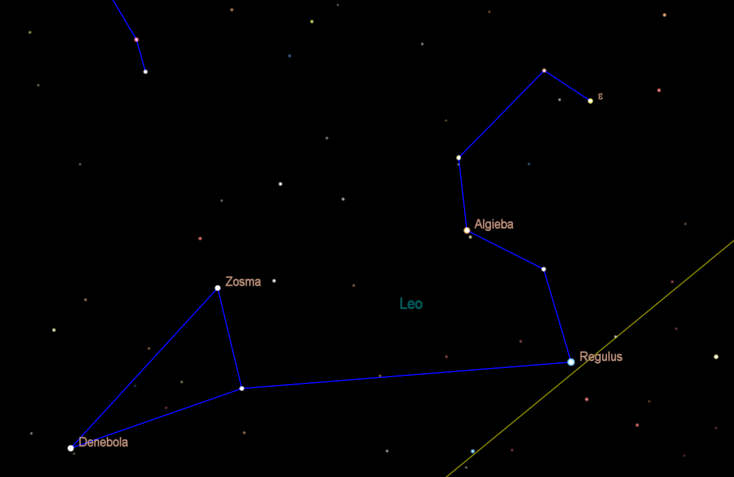
The naked eye stars of Leo, including Regulus at 10 p.m. April 13, 2018. Note that Algieba is a binary star that can be seen in small telescopes. The yellow line that passes Regulus is the ecliptic the apparent path of the Sun. The Moon and planets also hang out near that line. Created using Cartes du Ciel (Sky Charts).
Note: The original scheduled topic for today was the announcement of a star party at the Sleeping Bear Dunes National Lakeshore tomorrow, April 14th. It seems the weather gods have a different plan. There’s a winter storm watch from late Friday night (tonight) to noon Sunday with 3-6 inches of slushy snow.
04/09/2018 – Ephemeris – Follow the arc to Arcturus
Ephemeris for Monday, April 9th. The Sun will rise at 7:09. It’ll be up for 13 hours and 11 minutes, setting at 8:20. The Moon, 1 day past last quarter, will rise at 4:40 tomorrow morning.
The fourth brightest night-time star is now up in the east. It is Arcturus, a bright star with an orange hue. It can be found otherwise by finding the Big Dipper and tracing out and extending the curve of the handle and remembering the line “Follow the arc of the handle to Arcturus”. To remember the name of the star and how to find it. Arcturus is about 37 light years from us and is moving quite rapidly across the sky, compared to most stars, though one would not notice it to the naked eye in one’s lifetime. Arcturus is slightly more massive than our Sun, and about 7 billion years old, and is entering its red giant stage of life after using all the hydrogen fuel in its core. Our Sun, being slightly less massive will survive on hydrogen a bit longer.
The times given are for the Traverse City/Interlochen area of Michigan. They may be different for your location.
Addendum
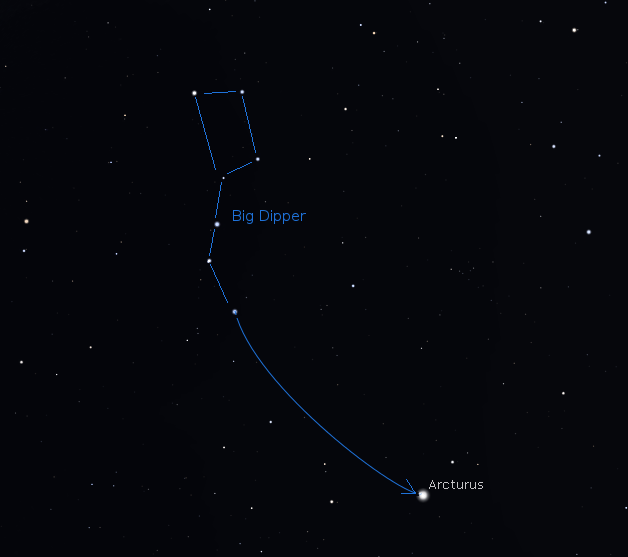
Look high in the east on a spring evening to follow the arc of the Big Dipper’s handle to Arcturus. Created using Stellarium ans GIMP.
02/13/2018 – Ephemeris – The Big Dipper as a pointer to other stars and constellations
Ephemeris for Tuesday, March 13th. The Sun will rise at 7:58. It’ll be up for 11 hours and 47 minutes, setting at 7:46. The Moon, 4 days before new, will rise at 6:42 tomorrow morning.
With the Big Dipper up in the northeastern sky it is a sign that spring is coming. At 9 p.m. The Big Dipper can be used to find other stars and constellations. The Big Dipper’s most famous function is in locating Polaris the North Star. It’s a good way of finding directions at night. The altitude of Polaris, that is angle above the horizon, will give one’s approximate latitude north of the equator. Another constellation that can be found is Leo the lion. It is rising in the east in the evening, but it can also be found from the Big Dipper by imagining that a hole were drilled in the bottom of the bowl to let the water leak out. It would fall on Leo’s back. The Big Dipper can be used to find two more stars, but they have not yet risen.
The times given are for the Traverse City/Interlochen area of Michigan. They may be different for your location.
Addendum
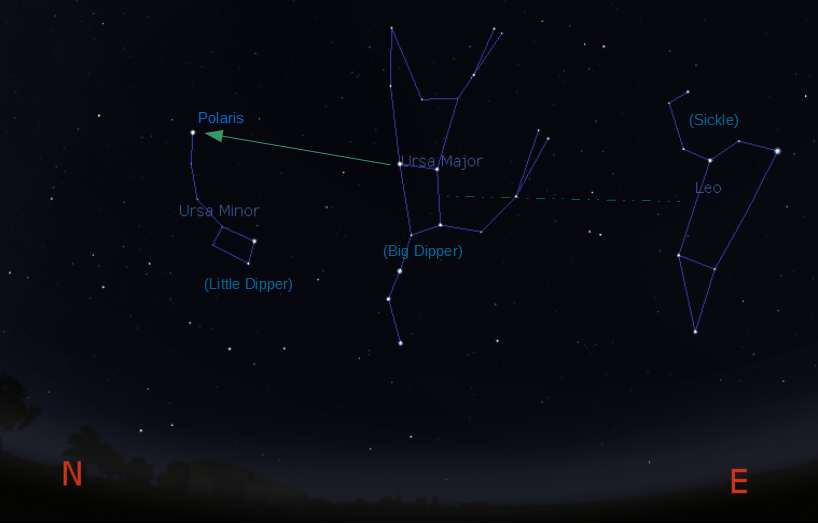
The Big Dipper points to Polaris, the, North Star, and to Leo the lion at 9 p.m., March 13th. In another hour the 4th brightest night-time star Arcturus will appear above the eastern horizon pointed to by the arc of the handle of the Big Dipper. We’ll revisit the Big Dipper next month when Arcturus and Spica will also be found by the use of the Big Dipper. Created using Stellarium and Libre Office.
02/23/2018 – Ephemeris – Meet the stars Castor and Pollux
Ephemeris for Friday, February 23rd. The Sun will rise at 7:30. It’ll be up for 10 hours and 52 minutes, setting at 6:22. The Moon, at first quarter today, will set at 2:54 tomorrow morning.
The star Pollux is at the head of the same named brother of Gemini the twins. Castor is the slightly dimmer star right above it. Pollux is about 34 light years away. It’s twice as massive as the Sun, and has run out of hydrogen in its core and is in the process of evolving into a red giant star. One planet, recently given the name Thestias, has been detected around it. Castor is at 51 light years away. There are 6 stars in its system. The brightest three are visible in telescopes. Each is a spectroscopic binary, meaning that the companion stars are detected by the Doppler shifts of the lines in their spectra as the stars orbit each other. The Doppler shift is just one of the many pieces of information revealed by the spectroscope.
The times given are for the Traverse City/Interlochen area of Michigan. They may be different for your location.
Addendum
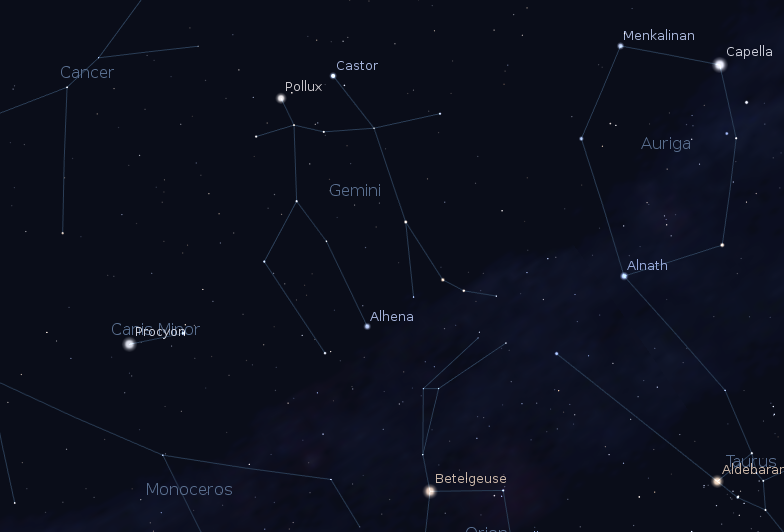
Gemini with the stars Castor and Pollux. Created using Stellarium.
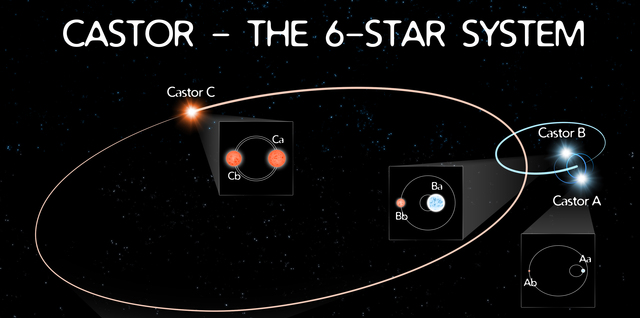
The Castor star system exploded in this JPL/NASA infographic.
 Bob Moler's Ephemeris Blog