Archive
12/18/2014 – Ephemeris – Capella’s kids
Ephemeris for Thursday, December 18th. The sun will rise at 8:14. It’ll be up for 8 hours and 49 minutes, setting at 5:03. The moon, 3 days before new, will rise at 5:23 tomorrow morning.
Tuesday I talked about the bright star Capella in the constellation Auriga the charioteer, the brightest star in the eastern sky until Jupiter rises around 9:30. I mentioned a slim triangle of stars called the Kids, offspring of the mama goat Capella. The star at the tip of that slim triangle is designated by the Greek letter epsilon and so in known as Epsilon Aurigae. It was discovered to be variable in brightness in 1821. It turns out to be an eclipsing binary, where stars eclipse each other. Only the period between eclipses is 27 years, and the eclipses last about 2 years. Typical eclipsing binary stars have periods of days and the eclipses last hours. The eclipsing star has a large debris ring around it that’s also eclipsing the other star.
Times are for the Traverse City/Interlochen area of Michigan. They may be different for your location.
Addendum
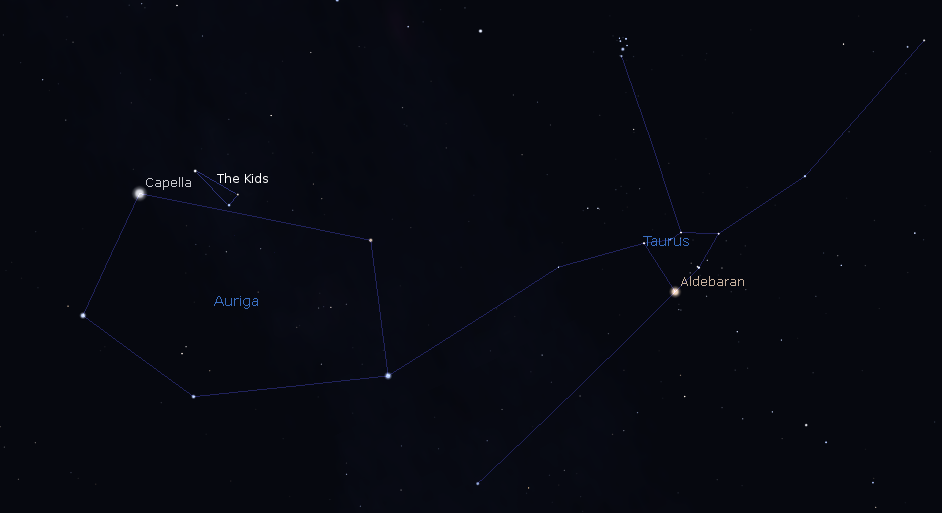
Capella and her kids. at 9 p.m. December 18, 2014. Created using Stellarium.
11/24/2014 – Ephemeris – The Summer Triangle is still with us
Ephemeris for Monday, November 24th. The sun will rise at 7:50. It’ll be up for 9 hours and 16 minutes, setting at 5:07. The moon, 2 days past new, will set at 7:29 this evening.
Well it’s almost Thanksgiving and about time that the Summer Triangle of bright summer stars finally set. Except it won’t go just yet. The stars Vega, Altair and Deneb are still hanging around in the west. The bright summer part of the Milky Way is gone. The constellations the three stars are in are Altair in Aquila the Eagle, now flying vertically up, Deneb in Cygnus the swan flying vertically down, and Vega in Lyre the harp, lying on its side. Altair the southernmost of these three will set first, later Vega will also set. What happens to Deneb depends on your location in the Interlochen Public Radio area. It you are north of Traverse City, Deneb will not actually set over Lake Michigan’s northern horizon.
Times are for the Traverse City/Interlochen area of Michigan. They may be different for your location.
Addendum
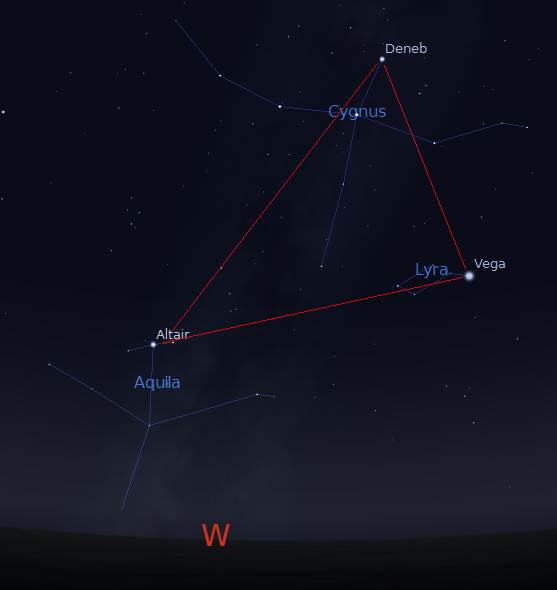
The Summer Triangle at 9 p.m. on November 24, 2014. Created using Stellarium.
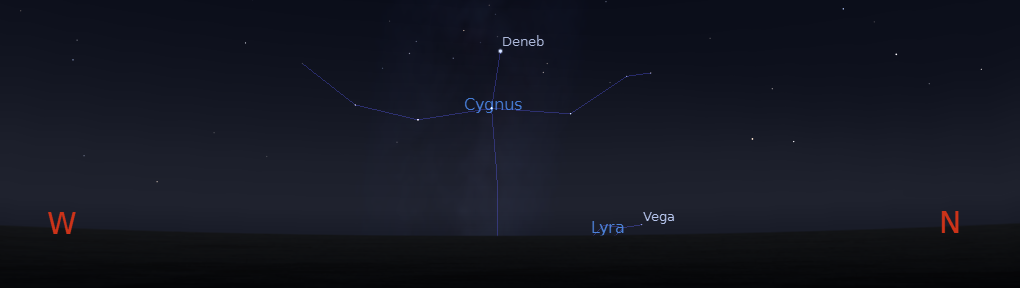
Vega near its setting point at 11:07 p.m. p.m. on November 24, 2014. Created using Stellarium.
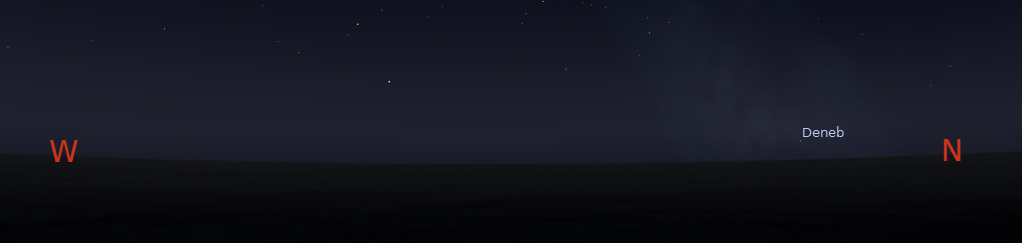
Deneb near its setting point at 5:05 a.m. p.m. on November 25, 2014. Created using Stellarium.
But will Deneb really set for Traverse City. Geometrically it will. However with a flat northern horizon looking northward over the bays to a clean Lake Michigan horizon, atmospheric refraction will bend the light from Deneb making it appear higher in the sky than it really is, so it won’t actually set. On the other side atmospheric extinction, the dimming of stars close to the horizon due to the filtering effect of looking through so much atmosphere would make Deneb impossible to see without a telescope. It might be an interesting challenge to spot.
10/31/2014 – Ephemeris – The spookiest star
Ephemeris for Halloween, Friday, October 31st. The sun will rise at 8:18. It’ll be up for 10 hours and 13 minutes, setting at 6:32. The moon, 1 day past first quarter, will set at 1:59 tomorrow morning.
Not all the ghosts and goblins out Sunday will be children. One will be out every night, because it’s a star. Its name is Algol, from the Arabic for Ghoul Star or Demon Star. The Chinese had a name for it that meant “piled up corpses”. It’s the second brightest star in the constellation Perseus the hero, rising in the northeast this evening. The star is located where artists have drawn the severed head of Medusa, whom he had slain. Medusa was so ugly that she turned all who gazed upon her to stone. Algol is her still glittering eye. Astronomers finally found out what was wrong with Algol. It does a slow 6 hour wink every two days 21 hours, because it is two stars that eclipse each other. Her next wink will be 10 p.m. Sunday night.
Times are for the Traverse City/Interlochen area of Michigan. They may be different for your location.
Addendum
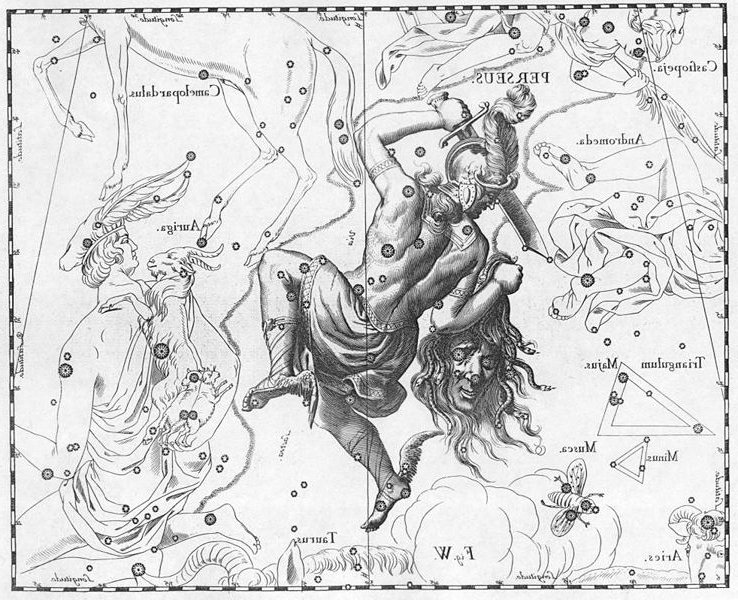
Perseus and the head of Medusa from the 1690 Uranographia by Johannes Hevelius. Image found with the article on Algol in Wikipedia.
Celestial globes of the day showed the celestial sphere from the outside, so the constellations appeared reversed. The star atlases of the day kept the trend. I reversed the image to correspond with the actual sky.
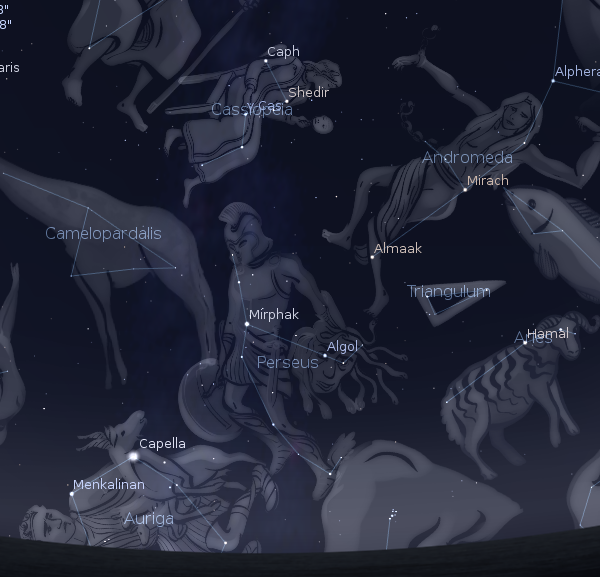
Algol at 7:30 p.m. on Halloween, in a modern portrayal. Created using Stellarium.
Update
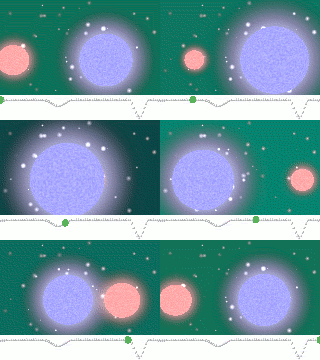
Animation of an eclipsing binary star like Algol. Credit: Wikimedia Commons. H/T EarthSky
Here’s a link to EarthSky’s post on Algol.
10/14/2014 – Ephemeris – The loneliest star
Ephemeris for Tuesday, October 14th. The sun will rise at 7:56. It’ll be up for 11 hours and 3 minutes, setting at 6:59. The moon, 1 day before last quarter, will rise at 11:57 this evening.
There’s a bright star that appears for only seven and a half hours a night on autumn evenings. It’s appearance, low in the south, is a clear indication of the autumn season. At 9 p.m. tonight it’s low in the southeast. The star’s name is Fomalhaut, which means fish’s mouth. That fits because it’s in the constellation of Piscis Austrinus, the southern fish. At our latitude it’s the fish that got away, because Fomalhaut appears to be the loneliest star in the sky. The dimness of the constellation’s other stars and location close to the horizon make the fainter stars hard to spot. They would be overhead in Australia. The earth’s thick atmosphere near the horizon reduces the stars brightness by a factor of two or more.
Times are for the Traverse City/Interlochen area of Michigan. They may be different for your location.
Addendum
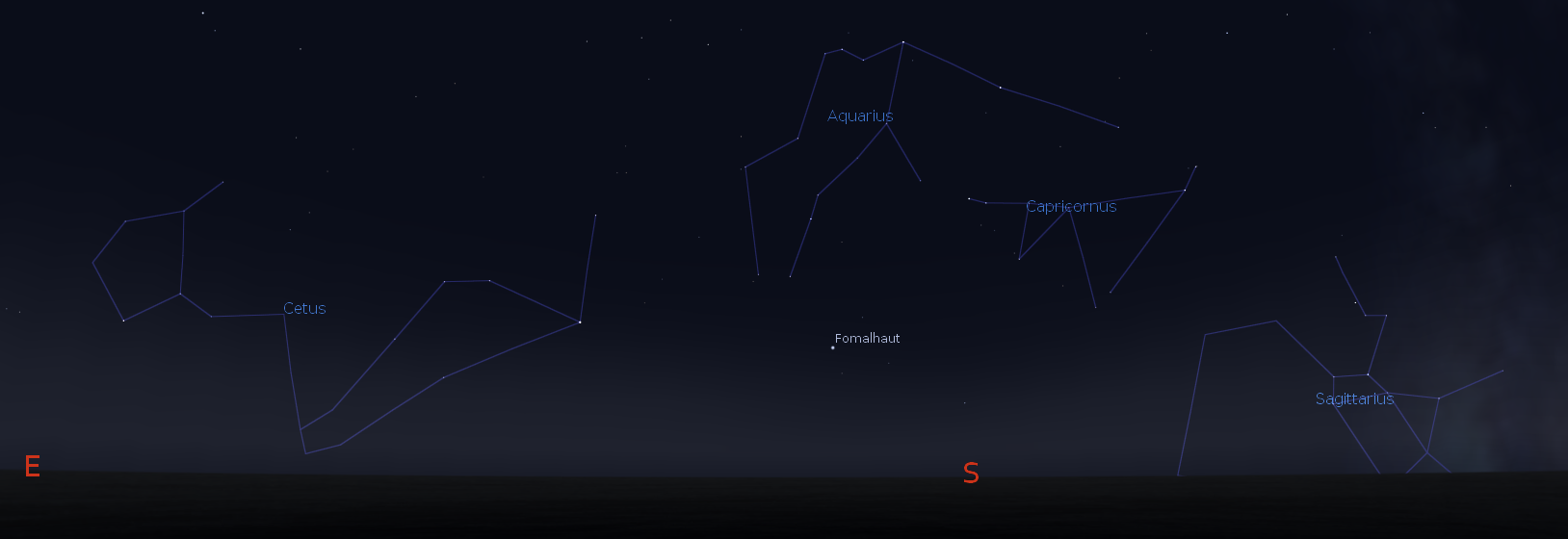
Fomalhaut appears quite alone in the south-southeast at 10 p.m. October 14, 2014. Created using Stellarium. Click on the image to enlarge.
09/29/2014 – Ephemeris – The Moon, Mars and Antares will line up tonight
Ephemeris for Monday, September 29th. The sun will rise at 7:37. It’ll be up for 11 hours and 48 minutes, setting at 7:26. The moon, 2 days before first quarter, will set at 10:49 this evening.
Tonight we’ll still have Mars hanging around the star Antares. However we’ll have the Moon joining the party. The three will nearly be in line at 9 p.m. with the fat crescent Moon on top, Mars below it and Antares below Mars. They will be in a straighter line but the Sun out makes them impossible to see. With binoculars or a small telescope the lunar seas visible, kind of in order from the Moon’s sunlit edge are Crises, Fertility, Nectar, Tranquility and half of Serenity. If you’re looking for the Man in the Moon, you’ll have to wait until the Moon is nearly full to completely discern his face. However most of the upside down rabbit is visible. The seas of Fertility and Nectar make up his ears, Tranquility, his head, and Serenity his body.
Times are for the Traverse City/Interlochen area of Michigan. They may be different for your location.
Addendum
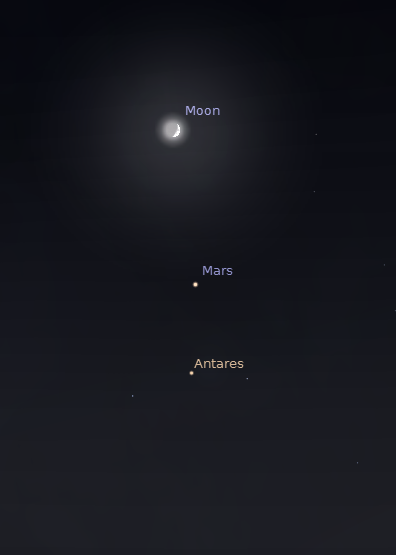
The Moon, Mars and the bright red star Antares line up on the evening of September 29, 2014. Created using Stellarium.
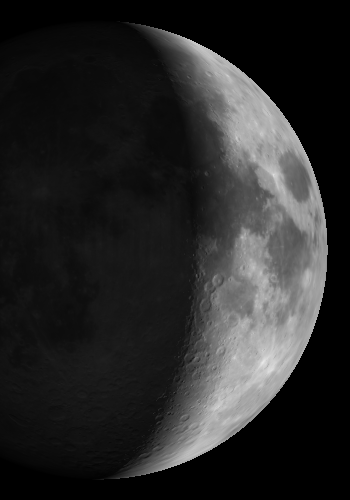
The moon tonight September 29, 2014. Created using Virtual Moon Atlas.
09/26/2014 – Ephemeris – Mars meets its rival
Ephemeris for Friday, September 26th. The sun will rise at 7:34. It’ll be up for 11 hours and 58 minutes, setting at 7:32. The moon, 2 days past new, will set at 8:45 this evening.
The planet Mars and the bright star Antares will appear at their closest tomorrow night. The name of the star Antares means “Rival of Mars”. “Ant” meaning anti, “Ares”, the Greek equivalent to the Roman god Mars. This is about a 26 month recurrence, give or take. Usually Mars is way brighter than Antares, or way dimmer. This time Mars and Antares are the same brightness. Both planet and star have the same color, kind of a faded orange color, made redder by being low in our sky which drains even more of the blue out. The reason Mars is red is that its surface is rusty. Antares is another matter. It is a cool red giant star. Well, cool on the outside by hotter than the sun’s interior on the inside where it’s changing helium into carbon and oxygen for power. Hint: Mars is always on top. Also tomorrow night the crescent Moon will be just to the right of Saturn.
Times are for the Traverse City/Interlochen area of Michigan. They may be different for your location.
Addenda
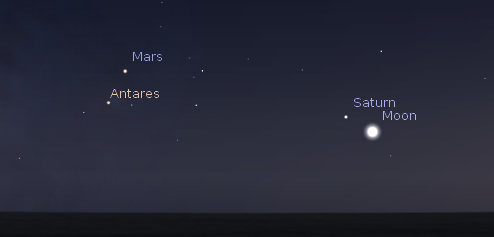
Mars appears its closest to Antares. Here seen low in the southwest at 8:30 p.m. on September 27, 2014. The Moon, near Saturn is too small to show a phase. Created using Stellarium.
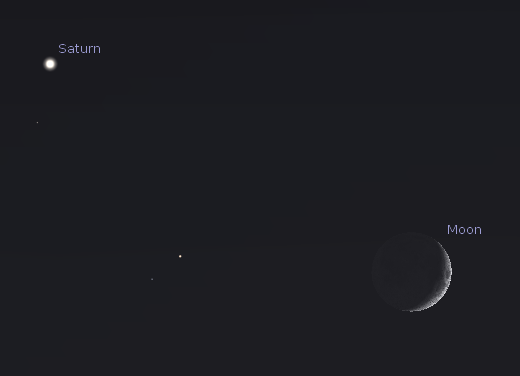
Saturn with the crescent moon. Earthshine may still be visible on the three day old Moon’s night side. Created using Stellarium.
Acme Fall Festival
The Grand Traverse Astronomical Society will be at the Acme Fall Festival at Flintfields Horse Park on Bates Rd, North of M72, which runs from 10 a.m. to 4 p.m. Saturday the 27th. The society will bring telescopes, including the 25 inch Dobsonian telescope and the Solar Telescope to view the Sun in white light and the light of the element hydrogen. There will also be exhibits and free stuff from NASA for the kids.
09/25/2014 – Ephemeris – Capella rising
Ephemeris for Thursday, September 25th. The sun will rise at 7:33. It’ll be up for 12 hours and 1 minute, setting at 7:34. The moon, 1 day past new, will set at 8:13 this evening.
A bright star called Capella has slowly been rising in the northeastern sky in the evenings for the past few months. At 9 p.m. now it is low in the north-northeast far below the letter “W” shaped constellation of Cassiopeia. This winter Capella will be overhead the highest of winter’s seven brilliant first magnitude stars. Capella never quite sets for anyone north of Ludington. It is what is called a circumpolar star. Due to its brightness, and being the closest first magnitude star to the north pole, Capella appears to move slowly as the earth rotates, and spends summer and autumn evenings close to the horizon, and has in years past elicited a few phone calls and other queries about that ‘bright object in the northeast’. When it’s higher the rest of its constellation Auriga the Charioteer will be visible.
Times are for the Traverse City/Interlochen area of Michigan. They may be different for your location.
Addendum
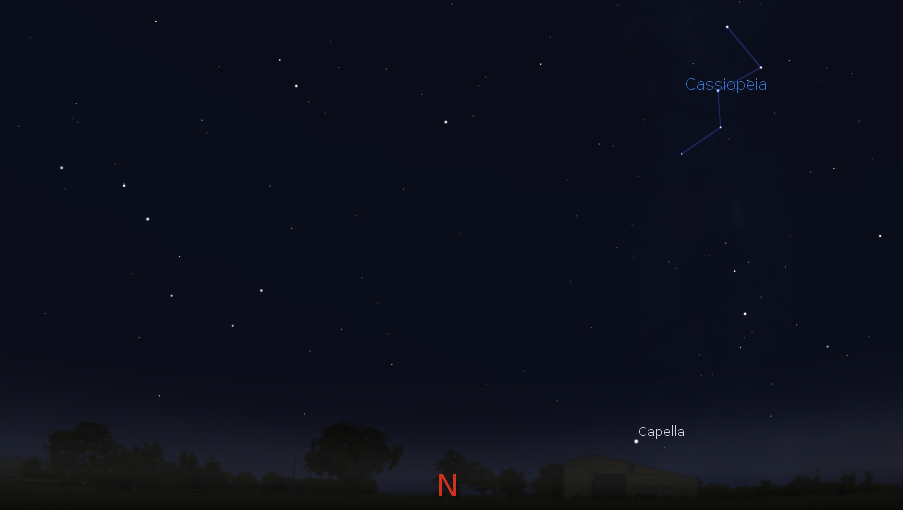
Capella cruising up from the north (thanks to the Earth’s rotation) on September 25 at 9 p.m. Created using Stellarium.
07/24/2014 – Ephemeris – A look at Altair the third star of the Summer Triangle
Ephemeris for Thursday, July 24th. The sun rises at 6:20. It’ll be up for 14 hours and 56 minutes, setting at 9:17. The moon, 2 days before new, will rise at 5:21 tomorrow morning.
The Summer Triangle Is high in the east to southeast sky in the evening. The southernmost star of the Summer Triangle is Altair, in the southeast. Altair is the closest of the three stars at a distance of 16.7 light years away. One light year is nearly 6 trillion miles, that’s 6 followed by 12 zeros. Altair is nearly 11 times the brightness of the sun. If seen at Altair’s distance, the sun would only be as bright as one of the two stars that flank it in our sky. What is rather different about Altair is its rapid rotation. While it’s almost twice the sun’s diameter, it rotates once in only 9 hours, and would show a decidedly squashed appearance if seen close up. Our sun’s a slow poke, taking nearly a month to rotate just once.
Times are for the Traverse City/Interlochen area of Michigan. They may be different for your location.
Addendum
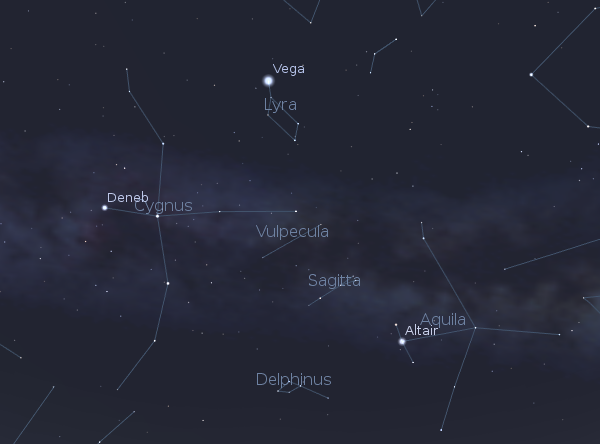
Deneb with the other stars and constellations in the Summer Triangle. Created using Stellarium.
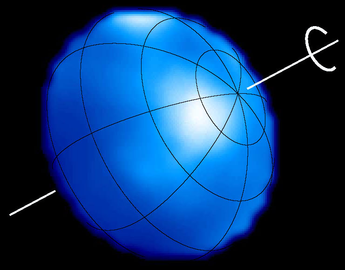
False-color image of the rapidly rotating star Altair, made with the MIRC imager on the CHARA array on Mt. Wilson. Credit: Ming Zhao, University of Michigan
07/18/2014 – Ephemeris – Deneb is the brightest star of the Summer Triangle… Really
Ephemeris for Friday, July 18th. Today the sun will be up for 15 hours and 8 minutes, setting at 9:22. The moon, at last quarter today, will rise at 12:58 tomorrow morning. Tomorrow the sun will rise at 6:15.
At 11 this evening the bright star Deneb in Cygnus the swan will be moderately high in the east northeast. Deneb is the dimmest star of the summer triangle. Of the other stars of the triangle, Vega is nearly overhead, and Altair to the southeast. While Deneb’s apparent magnitude, or brightness as seen from Earth, makes it the dimmest of the three bright stars, Deneb has a vast distance of possibly 1,550 light years. If brought as close as Vega, Deneb would be several times brighter than Venus. For all this it is only 13-20 times the mass of the sun. It will have an extremely short life and will explode, go supernova, in perhaps a few million years. Closer to home, check out the Sun at Kingsley Heritage Days This Saturday and Sunday.
Times are for the Traverse City/Interlochen area of Michigan. They may be different for your location.
Addendum
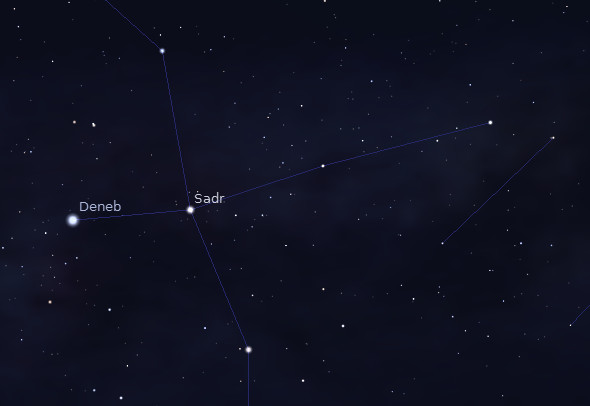
Deneb and the Northern Cross section of Cygnus the swan. Created using Stellarium.
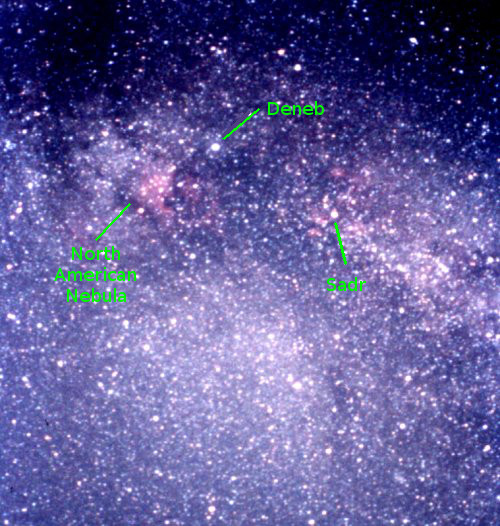
One of my old photographs of Deneb and the North American Nebula digitized from a slide.
The North American Nebula, visible as a faint smudge in binoculars or the naked eye may be ionized and illuminated by Deneb. It’s distance appears to be comparable to that of Deneb.
You may note that previous postings about Deneb over the years have given different distances of Deneb. That just denotes how difficult it is to pin down its distance.
07/04/2014 – Ephemeris – Find patriotic red, white and blue stars
Ephemeris for Independence Day, Friday, July 4th. Today the sun will be up for 15 hours and 27 minutes, setting at 9:30. The moon, 1 day before first quarter, will set at 1:03 tomorrow morning. Tomorrow the sun will rise at 6:03.
On this patriotic day let’s look for some red, white, and blue stars. Red is easy, the red star Antares is seen in the south at 11 p.m. Mars, the red planet, in the southwest, can be added even though it’s not technically a star. White is easy too, the official white calibration star Vega high in the east at 11 p.m. The blue star is really blue-white. The brightest of these out at 11 p.m. is Spica, low in the southwest. The color is best seen in binoculars. Star colors are quite subtle, and are an indicator of the temperature of their outer gaseous layers. The temperature of a stars outer layers, in order of their increasing temperatures, red, white and blue, is not related to the temperature in their cores. Of these three the coolest on the outside, Antares is really the hottest inside, using helium as fuel.
Times are for the Traverse City/Interlochen area of Michigan. They may be different for your location.
Addendum
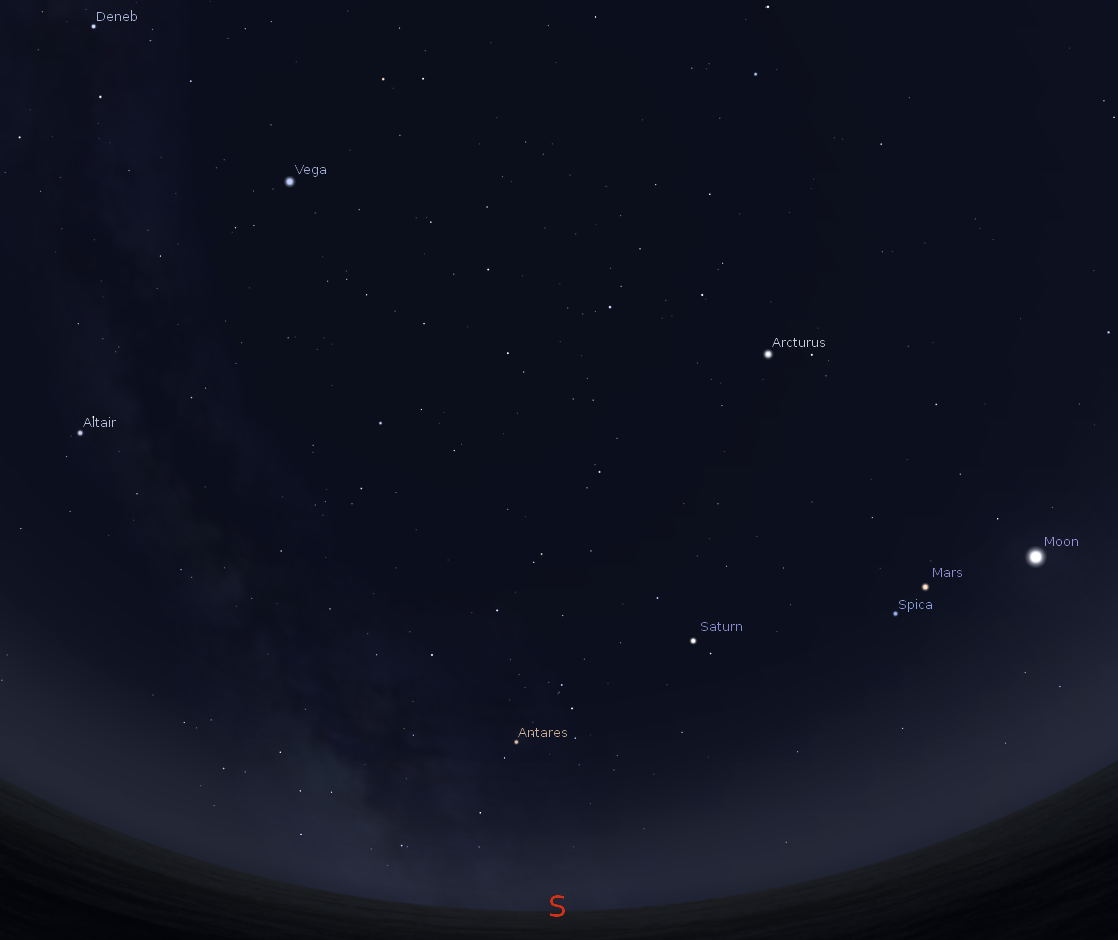
Red white and blue stars for Independence Day at 11 p.m. on July 4, 2014. Created using Stellarium.
 Bob Moler's Ephemeris Blog