Archive
07/04/2013 – Ephemeris – Patriotic Stars: Red, White and Blue
Ephemeris for Independence Day in the United States, Thursday, July 4th. Today the sun will be up for 15 hours and 27 minutes, setting at 9:30. The moon, half way from last quarter to new, will rise at 4:05 tomorrow morning. Tomorrow the sun will rise at 6:03.
Today is Independence Day so let’s look for some red, white, and blue stars. Red is easy, the red star Antares is seen in the south at 11 p.m. White is easy too, the official white calibration star Vega high in the east at 11 p.m. The blue star is really blue-white. The brightest of these out at 11 p.m. is Spica, low in the southwest to the right of the brighter Saturn. The color is best seen in binoculars. Star colors are quite subtle, and are an indicator of the temperature of their outer gaseous layers. The temperature of a stars outer layers, in order of their increasing temperatures are red, white and blue. Of these three the coolest on the outside, Antares is really the hottest inside, using helium as fuel.
Times are for the Traverse City/Interlochen area of Michigan. They may be different for your location.
Addendum
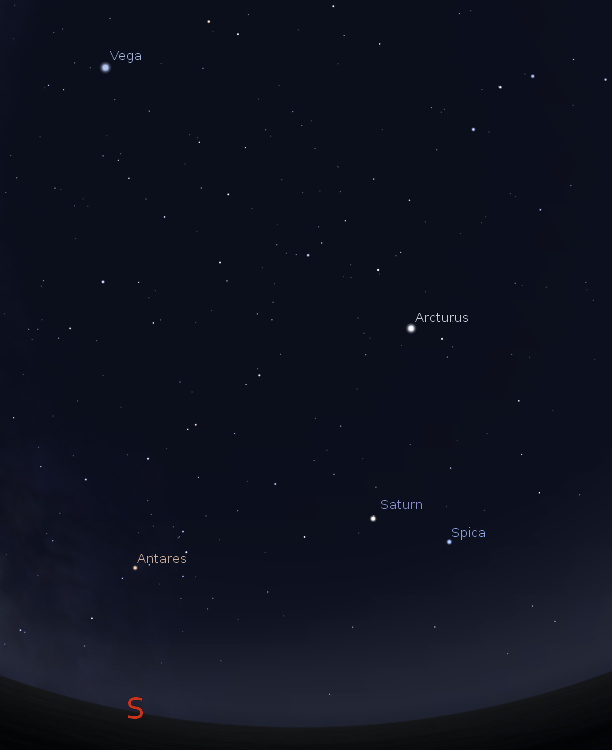
Red Antares, white Vega and blue Spica. Patriotic Stars this evening. Created using Stellarium.
06/06/2013 – Ephemeris – Star colors
Ephemeris for Thursday, June 6th. Today the sun will be up for 15 hours and 26 minutes, setting at 9:24. The moon, 2 days before new, will rise at 5:22 tomorrow morning. Tomorrow the sun will rise at 5:57.
Star and planets colors are quite subtle. This is partly due to the fact that we are color blind at very low light levels. Only the brightest stars show color at all. Telescopes however aid our color perception because it makes the stars brighter. The planet Saturn, now in the south at night has a distinct yellowish hue, caused by the color of its atmosphere. The star Spica to its right is the bluest of the bright first magnitude stars, and shows as a bright arc light. Arcturus, above both Saturn and Spica has a yellow to orange hue. Antares low in the southeast has a definite reddish hue. In a telescope it also looks like a sparkler due to our turbulent atmosphere. Red stars are the coolest stars (temperature wise) while blue-white stars are the hottest.
Times are for the Traverse City/Interlochen area of Michigan. They may be different for your location.
Addendum
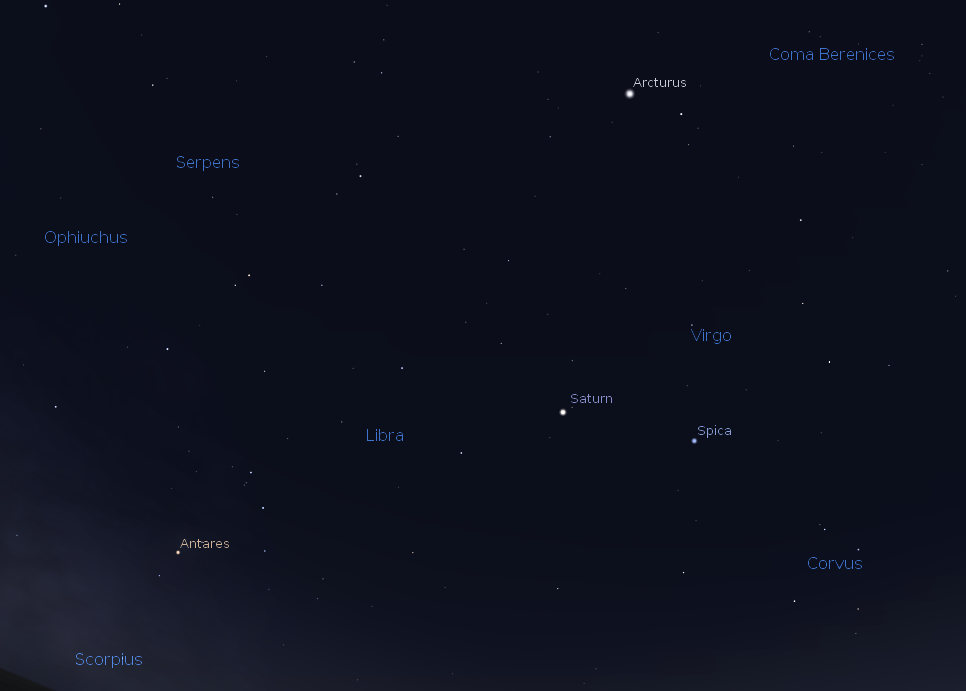
Stellarium does a pretty good job of showing the subtle colors of stars, which is also reflected in the color of the star labels. Click on the image to enlarge.
05/20/2013 – Ephemeris – Silicon rings around old stars in the Hyades
Ephemeris for Monday, May 20th. Today the sun will be up for 15 hours and 0 minutes, setting at 9:09. The moon, 2 days past first quarter, will set at 3:45 tomorrow morning. Tomorrow the sun will rise at 6:08. | I found this item at Universe Today, an astronomical news website, universetoday.com. The Hubble Space telescope has found evidence of rings of mainly silicon around two white dwarf stars in the Hyades star cluster. The Hyades is the V-shaped star cluster just below the setting Jupiter these nights. White dwarf stars are old stars in their last stage of life and usually don’t show the absorption of heavy elements in their spectrum. These two stars must have pulverized rings of silicon plus a little carbon orbiting them, suggesting the formation of earth-like planets. Astronomers usually don’t see this in cluster stars, which are generally young and too active to show planet forming material close to them.
Times are for the Traverse City/Interlochen area of Michigan. They may be different for your location.
05/14/2013 – Ephemeris – How to find two bright spring stars.
Ephemeris for Tuesday, May 14th. Today the sun will be up for 14 hours and 47 minutes, setting at 9:02. The moon, 4 days before first quarter, will set at 12:48 tomorrow morning. Tomorrow the sun will rise at 6:14.
The Big Dipper, now pretty much overhead points to several stars and constellations. It’s handle points to two bright stars. First we follow the arc of the handle to the bright orange star Arcturus, the 4th brightest night time star. The reason I say night time is that the sun is a star also but by definition is not out at night. The arc to Arcturus is a how to find Arcturus and a clue to its name. Arcturus, high in the east southeast, lies at the base point of the kite shaped constellation of Boötes the herdsman. From Arcturus, straighten out the arc to a spike and one soon arrives at Spica a blue-white star in Virgo the virgin, now low in the southeast. Saturn is to its left this year. Spica is also sometimes pronounced “Speeka”.
Times are for the Traverse City/Interlochen area of Michigan. They may be different for your location.
Addendum
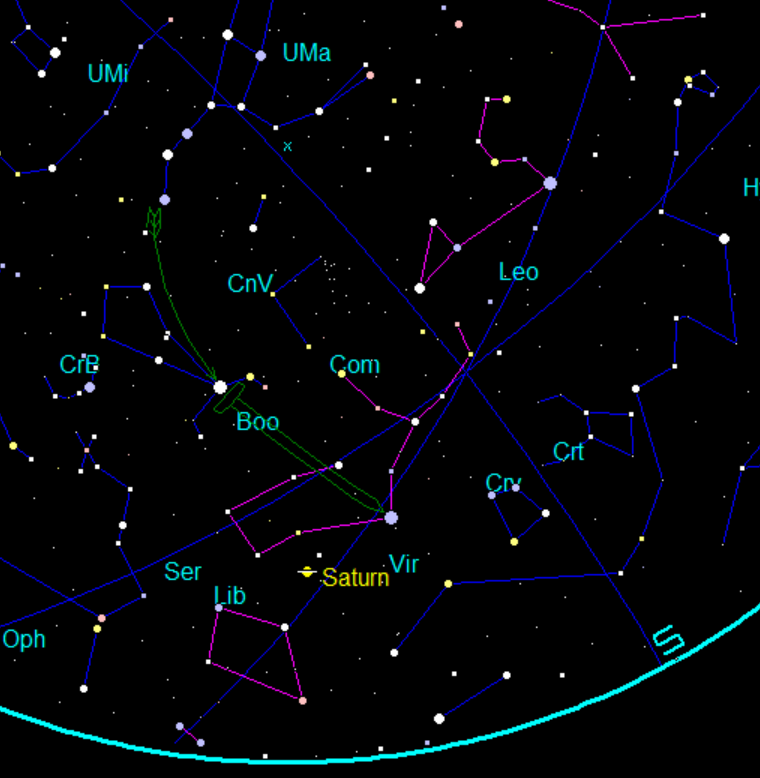
My program that shows the arc to Arcturus and spike to Spica.
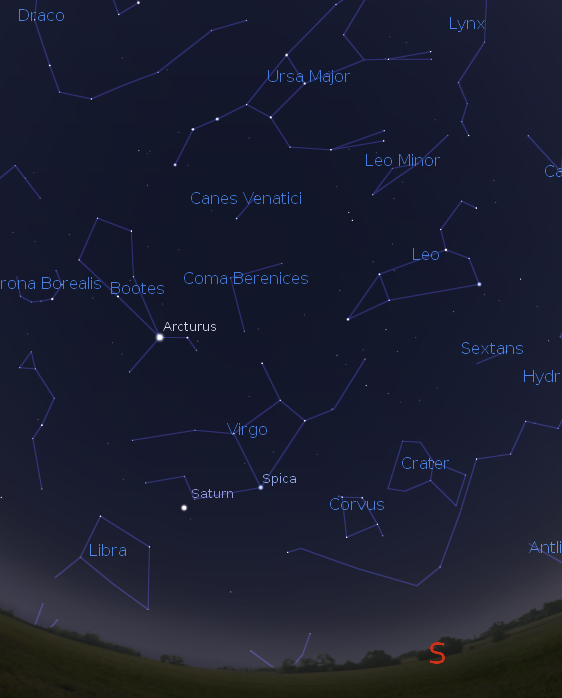
A more realistic view of the same part of the sky. Created using Stellarium.
03/04/2013 – Ephemeris – The Winter Circle
Ephemeris for Monday, March 4th. The sun will rise at 7:14. It’ll be up for 11 hours and 20 minutes, setting at 6:34. The moon, at last quarter today, will rise at 2:34 tomorrow morning.
The winter skies are blessed with more first magnitude stars than any other season. Six of these stars lie in a large circle centered on the seventh. This circle is up all evening now that we are in the heart of winter. Starting high overhead is Capella in Auriga the charioteer. Moving clockwise and downward, we come to Aldebaran in the face of Taurus the Bull and brighter nearby Jupiter. Then down to Orion’s knee we find Rigel. Down and left is the brightest star of all Sirius the Dog Star in Canis Major Orion’s large hunting dog, lowest of these stars in the south. Moving up and left there is Procyon in Canis Minor Orion’s other hunting dog, Then above is Pollux in Gemini the twins. All are centered on Betelgeuse in Orion.
Times are for the Traverse City/Interlochen area of Michigan. They may be different for your location.
Addendum
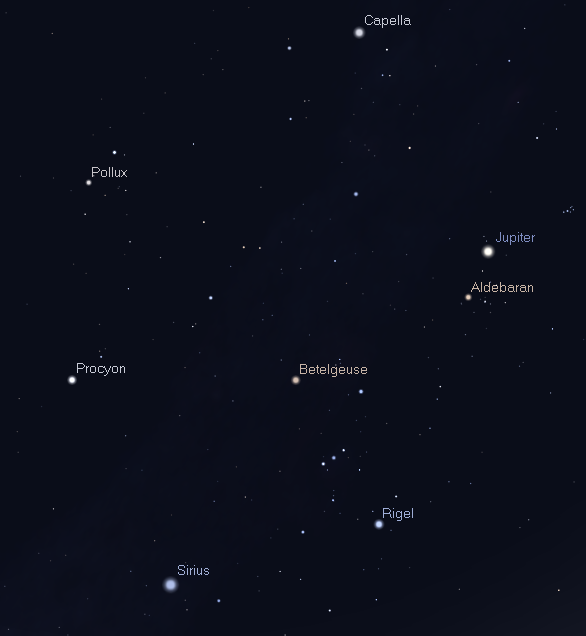
The Winter Circle and Jupiter for March. Created using Stellarium.
02/07/2013 – Ephemeris – The brother stars Castor and Pollux
Ephemeris for Thursday, February 7th. The sun will rise at 7:53. It’ll be up for 10 hours and 6 minutes, setting at 6:00. The moon, 3 days before new, will rise at 6:22 tomorrow morning.
At 9 p.m. the constellation of Gemini the twins will be seen high in the southeast. The namesake stars of the two lads are the two bright stars at the top of the constellation. Pollux the pugilist, or boxer, is the lower of the two, while Castor, the horseman, is the other star, or rather a six star system. In telescopes two close stars may be seen each is a spectroscopic binary, meaning the lines of two stars can be seen in the spectrum. A faint nearby spectroscopic binary also belong. Pollux, though a single star, does have at least one planet, one over twice the mass of Jupiter orbiting the star at a distance somewhat greater than Mars is from the sun. Pollux is 34 light years away while Castor is 50 light years away. Not too far away as stars go.
Times are for the Traverse City/Interlochen area of Michigan. They may be different for your location.
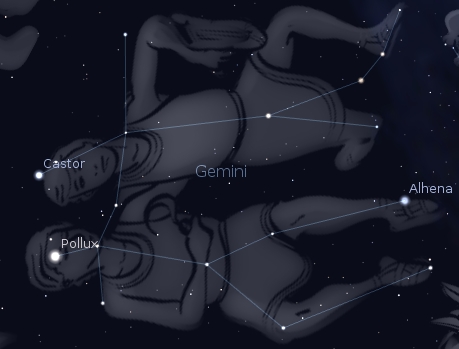
Gemini with Castor and Pollux. Created with Stellarium.
Addendum
02/05/2013 – Ephemeris – The bright stars Castor and Pollux of Gemini
Ephemeris for Tuesday, February 5th. The sun will rise at 7:56. It’ll be up for 10 hours and 1 minute, setting at 5:57. The moon, 2 days past last quarter, will rise at 4:42 tomorrow morning.
The constellation Gemini, the Twins is visible high in the southeast at 9 p.m. The namesake stars of the two lads, will be on the upper left edge of the constellation, diagonally aligned. Castor is to the upper right, while Pollux, a slightly brighter star is below left. Lines of stars from castor and Pollux to the lower right delineate the lads. In Greek mythology Castor and Pollux were twins, and half brothers, Castor was fathered by a mere mortal, while Pollux was fathered by Zeus in the famous Leda and the swan affair. The brothers, however were inseparable, and when Castor was killed during the quest for the Golden Fleece, Pollux pleaded with Zeus to let him die also. Zeus granted his wish, so both appear in the sky together forever.
Times are for the Traverse City/Interlochen area of Michigan. They may be different for your location.
Addendum
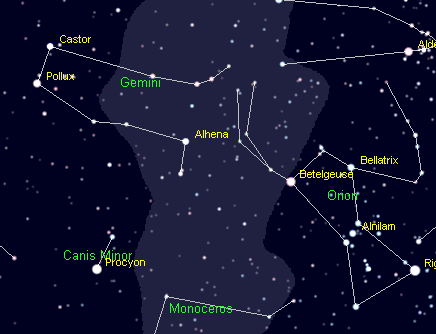
Gemini and Orion. Created using Cartes du Ciel
01/29/2013 – Ephemeris – Procyon, the Little Dog Star
Ephemeris for Tuesday, January 29th. The sun will rise at 8:04. It’ll be up for 9 hours and 43 minutes, setting at 5:47. The moon, 3 days past full, will rise at 8:52 this evening.
The constellation Orion has two hunting dogs. We’ve seen Canis Major the greater dog at Orion’s feet with Sirius in its heart. The lesser dog, Canis Minor iS level with Betelgeuse in Orion’s shoulder and off to the left. Just two stars mark it. Is it a dachshund or maybe a hot dog? It’s brighter star’s name is Procyon which means “Before the dog”, an odd title. It means that though east of Sirius, it rises before Sirius, due to its more northerly position in the sky. In many ways Procyon is nearly a twin of Sirius. It shines with the same white color, although a bit cooler, and has a white dwarf companion like Sirius. It’s a bit farther away than Sirius 8 light years. Procyon is at a distance of 11.46 light years. Procyon, Betelgeuse and Sirius make the winter triangle.
Times are for the Traverse City/Interlochen area of Michigan. They may be different for your location.
Addendum
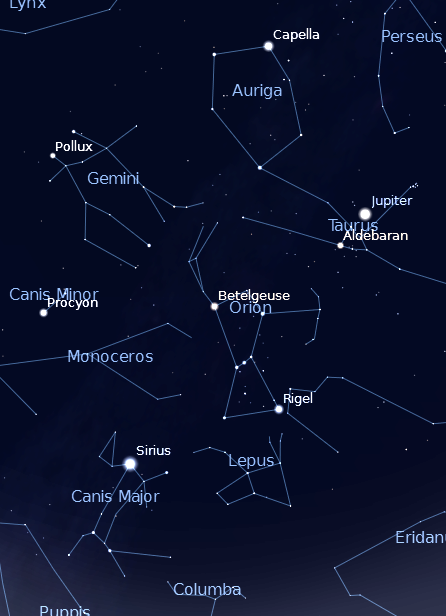
Winter Circle and Jupiter with Procyon to the far left. Created using Stellarium.
01/25/2013 – Ephemeris – The star names of Orion
Ephemeris for Friday, January 25th. The sun will rise at 8:08. It’ll be up for 9 hours and 33 minutes, setting at 5:42. The moon, 1 day before full, will set at 7:23 tomorrow morning.
The constellation of Orion the hunter is visible in the south at 9 p.m. The stars of Orion are interesting in themselves. Starting at the top left of the seven bright stars of Orion’s torso is Betelgeuse the bright red star, whose name means something like “Armpit of the Giant”. The star in Orion’s other shoulder is Bellatrix the “Amazon Star”. Below are the three stars of Orion’s belt, from left to right; Alnitak, Alnilam and Mintaka. Their names mean “Girdle”, “Belt of Pearls”, and “Belt” respectively. Down to Orion’s knees we look on the left to the star Saiph which means “Sword”, though it is some ways from the stars of Orion’s sword. Finally there’s the bright blue-white star Rigel whose name means “left Leg of the Giant”.
Times are for the Traverse City/Interlochen area of Michigan. They may be different for your location.
Addendum
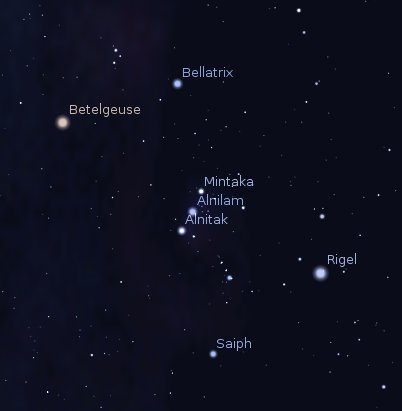
Orion with star names
01/24/2013 – Ephemeris – Sirius B, the Pup
Ephemeris for Thursday, January 24th. The sun will rise at 8:09. It’ll be up for 9 hours and 31 minutes, setting at 5:40. The moon, 2 days before full, will set at 6:48 tomorrow morning.
Sirius is the brightest night-time star and is located in the south at 9 p.m. below and a bit left of Orion the Hunter. We’ve visited Sirius Tuesday. But there is another star in the Sirius system that is practically invisible due to Sirius’ dazzling glare. Its name is Sirius B, nicknamed the Pup, alluding to Sirius’ Dog Star title. The tiny star was suspected as far back as 1834 due to Sirius’ wavy path against the more distant stars. Sirius and the Pup have 50 year orbits of each other. The Pup was first seen by famed 19th century telescope maker Alvan Clark in 1862 while testing a new telescope. The Pup was the first of a new class of stars to be discovered, white dwarfs. The Pup, with the mass of the sun, is only the size of the earth.
Times are for the Traverse City/Interlochen area of Michigan. They may be different for your location.
Addendum
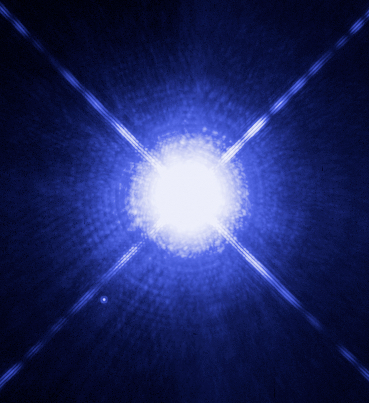
Sirius A and B (near the diffraction spike to the lower left), A Hubble Space Telescope photograph. Credit NASA, ESA.
The Hubble Space Telescope has two mirrors to produce its main image. The concave primary mirror, and a secondary mirror in front supported by 4 vanes called a spider. Light passing these vanes are bent or diffracted causing bright stars to have these 4 spikes. Most reflecting telescopes produce these diffraction spikes.
 Bob Moler's Ephemeris Blog