Archive
10/31/2012 – Epmeneris – The Ghoul Star
Ephemeris for Halloween, Wednesday, October 31st. The sun will rise at 8:19. It’ll be up for 10 hours and 12 minutes, setting at 6:32. The moon, 2 days past full, will rise at 7:37 this evening.
Not all the ghosts and goblins out tonight will be children. One will be out every night, because it’s a star. Its name is Algol, from the Arabic for Ghoul Star or Demon Star. The Chinese had a name for it that meant a mausoleum or more ominously ‘piled up corpses’. It’s the second brightest star in the constellation Perseus the hero, rising in the northeast this evening. The star is located where artists have drawn the severed head of Medusa, whom he had slain. Medusa was so ugly that she turned all who gazed upon her to stone. Algol is her still glittering eye. Astronomers finally found out what was wrong with Algol. It does a slow 6 hour wink every two days 21 hours, because it is two very close stars that eclipse each other in that period.
Times are for the Traverse City/Interlochen area of Michigan. They may be different for your location.
Addendum
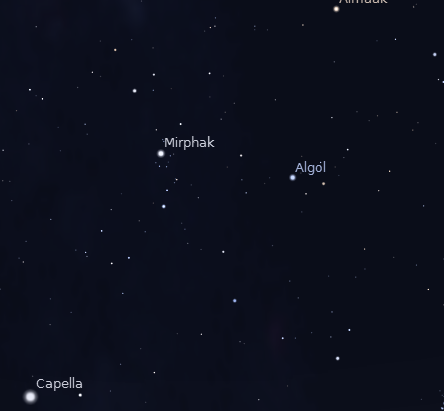
The constellation Perseus in the northeast at 9 p.m. on October 31, 2012. Created using Stellarium.
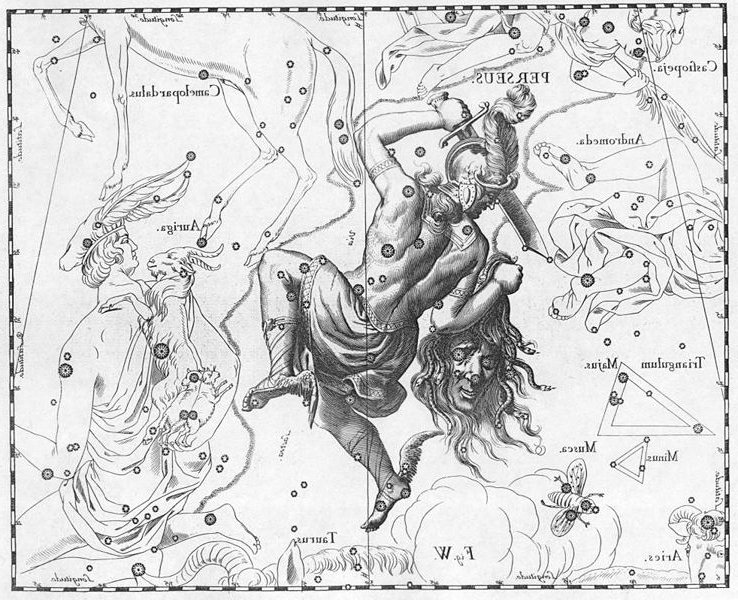
Perseus and the head of Medusa from the 1690 Uranographia by Johannes Hevelius. Image found with the article on Algol in Wikipedia.
Note that this is a mirror image. The star charts in the 17th century were based on celestial globes, which represented the constellations as seen from the outside of the celestial sphere instead of from the inside. I reversed the image to match Perseus as we see him.
10/15/2012 – Ephemeris – Autumn wonders for binoculars or small telescope: The Double Cluster
Ephemeris for Monday, October 15th. The sun will rise at 7:58. It’ll be up for 10 hours and 58 minutes, setting at 6:57. The moon is new today, and won’t be visible.
This week we’ll be looking at some of the wonders of the autumn sky that might better be seen in binoculars or a small telescope. Tonight we turn our attention to the Double Cluster, a fine pair of star clusters just below the W of the constellation of Cassiopeia the queen located in the northeast. Draw a vertical line down from the middle star of the W through the next star into the glow of the Milky Way. The Double Cluster appears to the unaided eye as a brighter glow of the Milky Way. This is confirmed with binoculars. But in a small telescope it becomes two piles of sparkling diamonds. The clusters are much younger than the sun so their brightest stars are blue-white to our eyes. The average distance of the two from earth is 7,200 light years and the are 1200 light years from each other.
Times are for the Traverse City/Interlochen area of Michigan. They may be different for your location.
Addendum
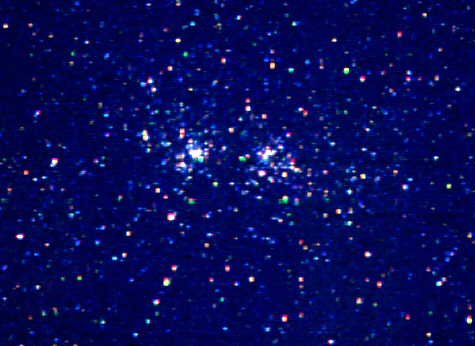
Double Cluster as it would be seen in a small telescope.
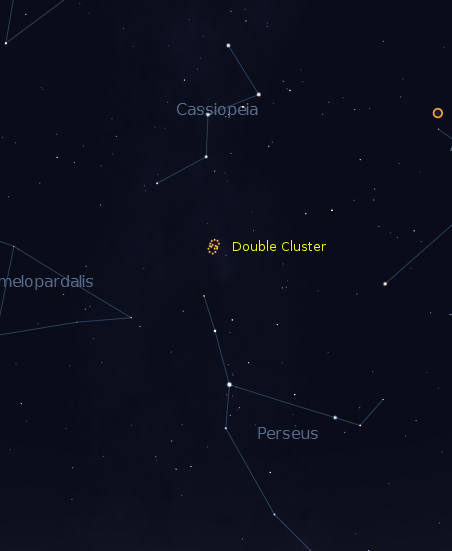
Chart for finding the Double cluster in October. Created using Stellarium.
10/04/2012 – Ephemeris – The lonely autumn star Fomalhaut
Ephemeris for Thursday, October 4th. The sun will rise at 7:44. It’ll be up for 11 hours and 32 minutes, setting at 7:16. The moon, 4 days before last quarter, will rise at 9:40 this evening.
There’s a bright star that appears for only seven and a half hours on autumn evenings. It’s appearance, low in the southeast at 10 p.m., is a clear indication of the autumn season. The star’s name is Fomalhaut, which means fish’s mouth. That’s fitting because it’s in the constellation of Piscis Austrinus, the southern fish. At our latitude it’s kind of the fish that got away, because Fomalhaut appears to be quite alone low in the sky. The dimness of the constellation’s other stars and location close to the horizon make the faint stars hard to spot. The earth’s thick atmosphere near the horizon reduces their brightness by a factor of two or more, so Fomalhaut, one of the brightest stars in the sky, keeps a lonely vigil in the south.
Times are for the Traverse City/Interlochen area of Michigan. They may be different for your location.
Addendum
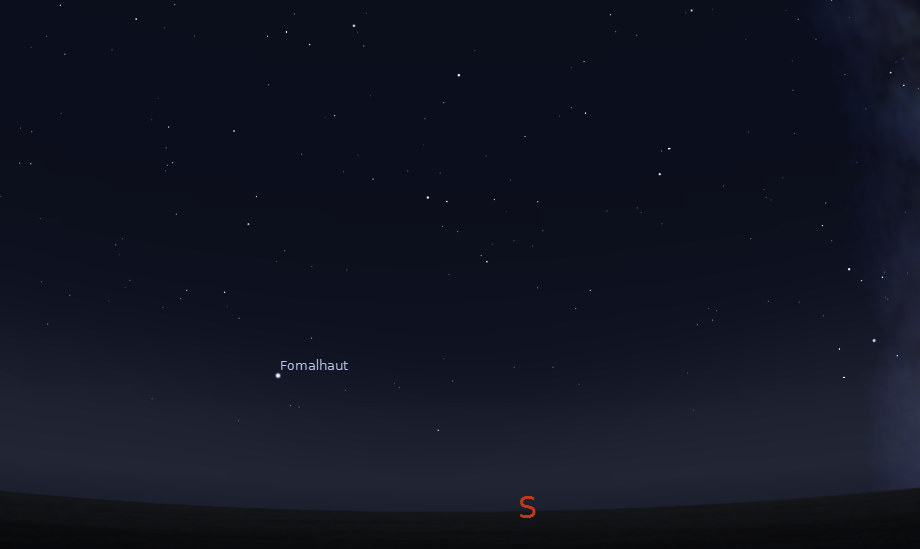
The bright star Fomalhaut all alone at 10 p.m. on October 4, 2012. Created using Stellarium.
Click image to enlarge.
08/28/2012 – Ephemeris – Altair, fatter in the middle
Ephemeris for Tuesday, August 28th. The sun will rise at 7:00. It’ll be up for 13 hours and 24 minutes, setting at 8:25. The moon, 3 days before full, will set at 4:54 tomorrow morning.
The southernmost star of the Summer Triangle is Altair, high in the south. The other two stars of the triangle are Vega nearly overhead, and Deneb high in the east. Altair is the closest of the three at a distance of 16.8 light years away. One light year is nearly 6 trillion miles. Altair is 10 times the brightness of the sun. If seen at Altair’s distance, the sun would only be as bright as one of the two stars that flank it. What is rather different about Altair is it’s rapid rotation. While its almost twice the sun’s diameter, it rotates once in only 9 hours, and has a decidedly squashed appearance when seen close up. There are techniques that can actually accomplish this. Our sun’s a slow poke, taking nearly a month to rotate once.
Times are for the Traverse City/Interlochen area of Michigan. They may be different for your location.
Addendum
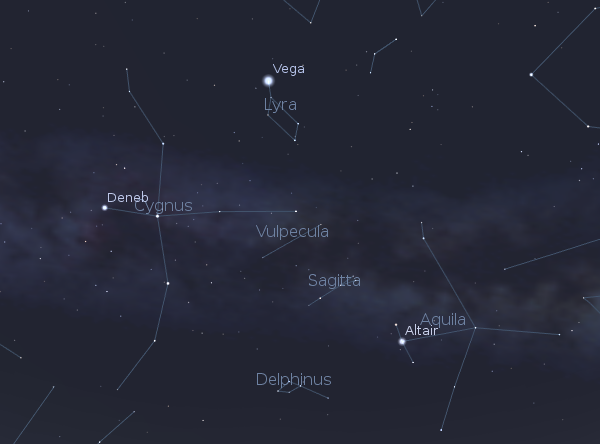
The constellations Lyra, Cygnus and Aquila. Created using Stellarium.
Check out Altair to the lower right.
07/30/2012 – Ephemeris – A closeup look at the bright star Deneb
Ephemeris for Monday, July 30th. The sun rises at 6:27. It’ll be up for 14 hours and 42 minutes, setting at 9:09. The moon, 2 days before full, will set at 4:47 tomorrow morning.
At 10:30 this evening the bright star Deneb in Cygnus the swan will be high in the east in the tail of Cygnus the swan. Deneb is the dimmest star of the summer triangle. Of the other stars of the triangle, Vega is nearly overhead, and Altair to the south. While Deneb’s apparent magnitude, or brightness as seen from earth, makes it the dimmest of the three bright stars, Deneb’s vast distance of possibly 1,500 to 2,600 light years makes it nearly 100 times the distance of Vega. If brought as close as Vega, Deneb would be several time brighter than Venus. For all this it is only 13-21 times the mass of the sun. It will have an extremely short life and it will explode, go supernova, in perhaps a few million years.
Times are for the Traverse City/Interlochen area of Michigan. They may be different for your location.
Addendum
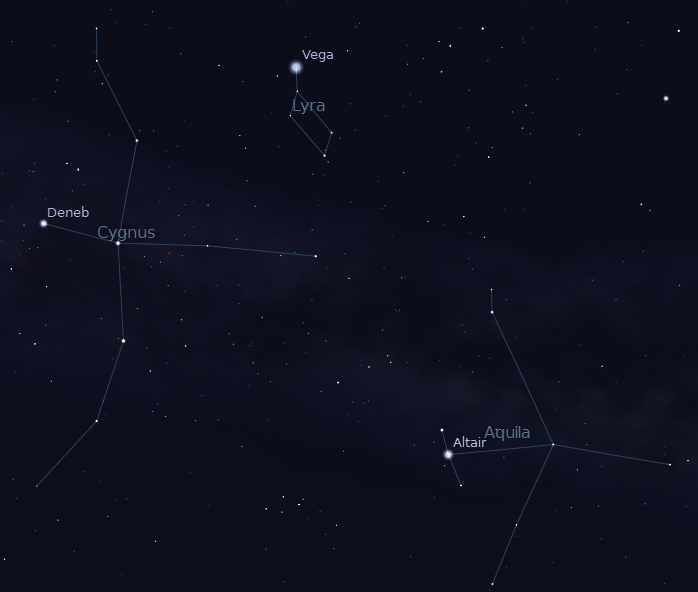
Summer Triangle. Created using Stellarium.
07/23/2012 – Ephemeris – The star Vega up close
Ephemeris for Monday, July 23rd. The sun rises at 6:19. It’ll be up for 14 hours and 57 minutes, setting at 9:17. The moon, 3 days before first quarter, will set at 11:14 this evening.
The star Vega, which is high in the east, near overhead or the zenith is a special star for astronomers. It’s part of the small constellation or Lyra the harp, which includes the parallelogram of stars near it. Vega is kind of a standard calibration star. It is the 5th brightest night time star with a brightness of 0.0 magnitude, although recent measurements place it at 0.03. Of the spectral types which denote the star’s color and surface temperature, Vega comes out to be pure white, with a surface temperature nearly twice the sun’s. It’s almost exactly 25 light years away, and so is one of the closer stars. It’s a tenth the sun’s age and 40 times the sun’s brightness. [It has perhaps a Jupiter sized planet, and a Kuiper belt of Pluto like objects.]
Times are for the Traverse City/Interlochen area of Michigan. They may be different for your location.
Addendum
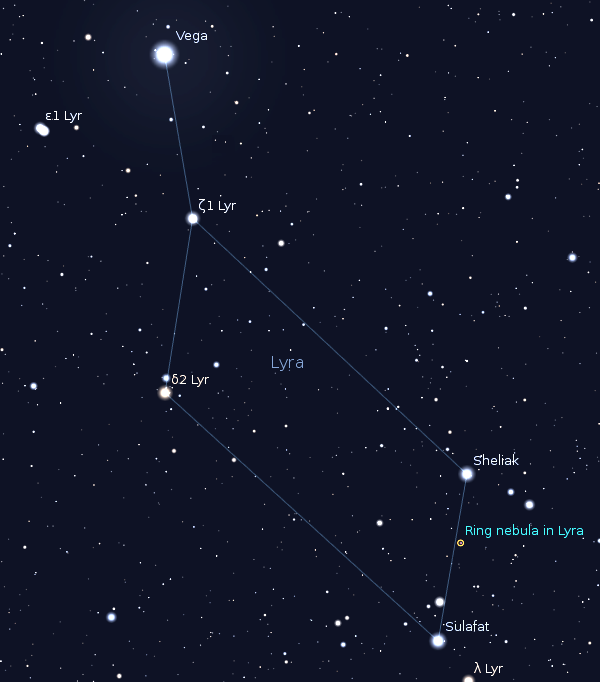
Lyra in Binoculars. Created using Stellarium.
07/24/2012 – Ephemeris – The star Antares up close
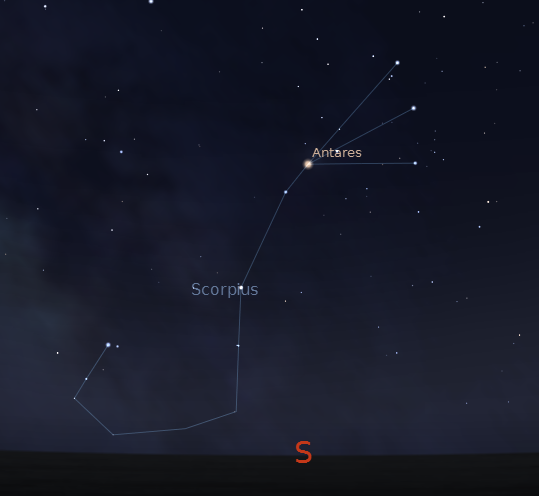
The constellation Scorpius with Antares. Created using Stellarium.
Ephemeris for Tuesday, July 24th. The sun rises at 6:20. It’ll be up for 14 hours and 55 minutes, setting at 9:16. The moon, 2 days before first quarter, will set at 11:44 this evening.
Antares is a most interesting star. It’s low in the south and red in color. Its the heart of the Scorpius the scorpion. Its name means Rival of Mars with which it shares its color. Antares is a huge star, a red giant star. Its mass is 12 times the mass of the sun, but it’s bloated out to a diameter somewhat larger than the orbit of Mars, over 300 million miles. This what happens to a star that has exhausted hydrogen in its core and is now fusing helium to produce energy and even more massive elements. Its surface temperature is close to the temperature of the filament of an incandescent light bulb, about 2/3rds the temperature of the sun. Antares also has a dim companion star.
Times are for the Traverse City/Interlochen area of Michigan. They may be different for your location.
07/12/2012 – Ephemeris – The constellation Lyra the harp
Thursday, July 12th. Today the sun will be up for 15 hours and 17 minutes, setting at 9:26. The moon, 2 days past last quarter, will rise at 1:50 tomorrow morning. Tomorrow the sun will rise at 6:10.
High in the east at 11 p.m. can be found a bright star called Vega just above a small, narrow, but very distinctive parallelogram of stars. They are the stars of the constellation Lyra the harp. Vega, the 5th brightest night time star, is one of the twenty one brightest stars, called first magnitude stars. The harp, according to Greek mythology, was invented by the god Hermes. The form of the harp in the sky, is as he had invented it: by stretching strings across a tortoise shell. Hermes gave it to his half-brother Apollo, who in turn gave it to the great musician Orpheus. In binoculars, near Vega, two stars appear together. They barely appear to the unaided eye as a single star, designated Epsilon Lyrae.
Times are for the Traverse City/Interlochen area of Michigan. They may be different for your location.
Addendum
Summer Triangle and the constellation Lyra at 07-12-12 at 11 p.m. Created using Stellarium.
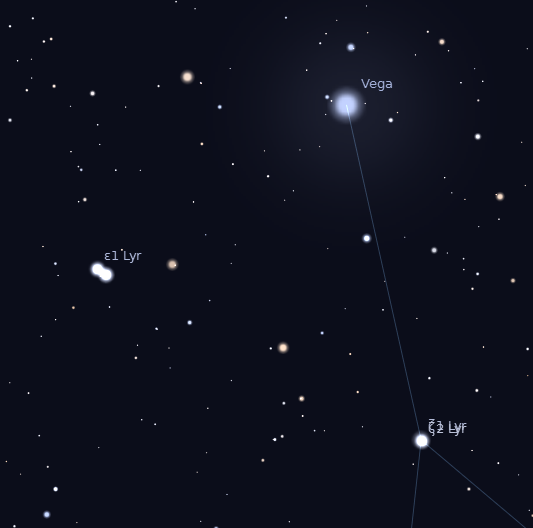
Closeup on Vega and Epsilon Lyrae. Created using Stellarium.
ε1 Lyrae is one of the stars of Epsilon Lyrae. The pair can be split better than this image with binoculars. Looking at the two with a good telescope and over 100 power can split each component into two more stars. We amateur astronomers call it the “Double-Double Star” Note too that Zeta (ζ) Lyrae is also a double star that can be split with a low power telescope.
07/05/2012 – Ephemeris – The Summer Triangle
Ephemeris for Thursday, July 5th. Today the sun will be up for 15 hours and 26 minutes, setting at 9:30. The moon, 2 days past full, will rise at 10:37 this evening. Tomorrow the sun will rise at 6:04.
Now that summer is here, the asterism or informal constellation called the Summer Triangle can be seen high in the east as it gets dark. Highest of the three bright stars is Vega in the constellation Lyra the harp, whose body is seen in a narrow parallelogram nearby. The second star of the triangle is Deneb lower and left of Vega, It appears dimmer than Vega because its is by far the most distant of the three. The third star of the Summer Triangle is seen farther below and right of Vega. It is Altair in Aquila the eagle, and the closest. Altair is 16.7 light years away, Vega is 25 light years while Deneb may be a whopping 1,550 light years away. [One light year is 6 about trillion miles. That’s 6 with 12 zeros after it.]
Times are for the Traverse City/Interlochen area of Michigan. They may be different for your location. Bracketed text was omitted from the broadcast due to time constraints.
Addendum
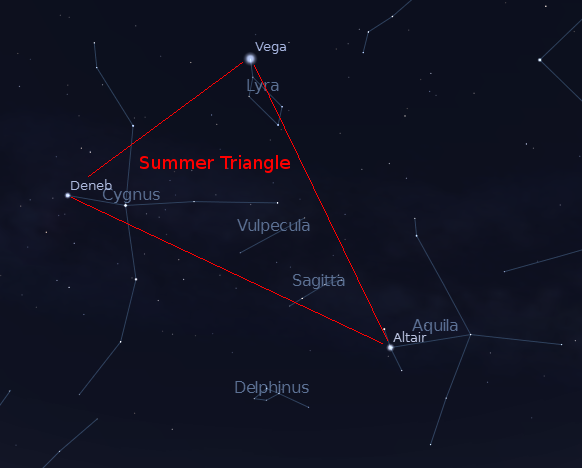
The Summer Triangle July 5, 2012 at 11 p.m. Created using Stellarium and The Gimp.
06/14/2012 – Ephemeris – Flag Day: Red, White and Blue Stars
Ephemeris for Flag Day, Thursday, June 14th. Today the sun will be up for 15 hours and 32 minutes, setting at 9:29. The moon, 3 days past last quarter, will rise at 3:16 tomorrow morning. Tomorrow the sun will rise at 5:56.
Since it’s Flag Day, lets look for some red white and blue stars. Red is easy, I talked about it Tuesday, It is Antares now low in the southeast in the evening in the heart of the constellation of Scorpius the scorpion. For the white star there is no purer white star than Vega, spectral type A0 (A zero), the astronomers definition of white. It is located midway up the sky in the east. It is the 5th brightest night time star, and is seen off a small parallelogram of stars that make up the body of Lyra the harp. For the blue star, the best is Spica, below Saturn this year and in the south in the evening. It is the bluest of the 21 brightest first magnitude stars. Color in stars is often subtle, so try to see these colors.
Times are for the Traverse City/Interlochen area of Michigan. They may be different for your location.
Addendum
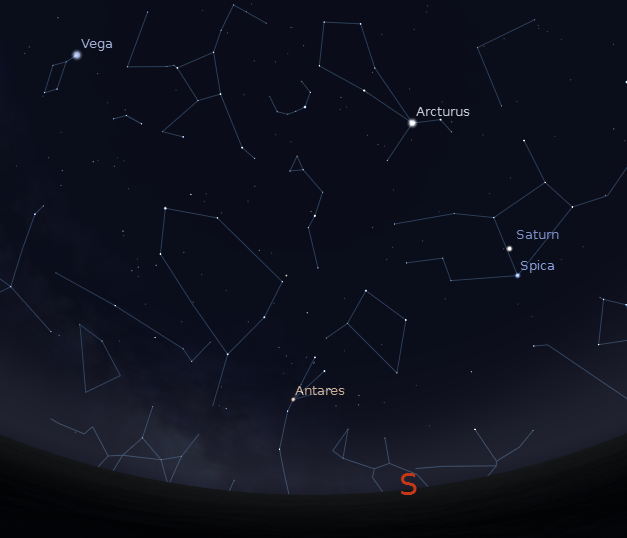
Red (Antares), White (Vega) and Blue (Spica) stars of spring. Created using Stellarium.
 Bob Moler's Ephemeris Blog