Archive
06/12/2012 – Ephemeris – The bright star Antares
Ephemeris for Tuesday, June 12th. Today the sun will be up for 15 hours and 31 minutes, setting at 9:28. The moon, 1 day past last quarter, will rise at 2:20 tomorrow morning. Tomorrow the sun will rise at 5:56.
A rival to Mars is now low in southeast at 10:30. It is the red star Antares, whose names literally means “Rival of Mars”. This is from the Greek who’s god of war was Ares. Mars is in the southwest now and a bit brighter than Antares. When Mars catches up with Antares around October 20th this year, they will be nearly the same brightness, and one would be hard put to tell them apart. Antares is in the heart of Scorpius the scorpion which lies close to our southern horizon later in the evening, and is best seen next month at an earlier time. Antares is also a star that appears strange as its twinkling is very pronounced being always close to the horizon for us sputtering all the colors of the rainbow.
Times are for the Traverse City/Interlochen area of Michigan. They may be different for your location.
Addendum
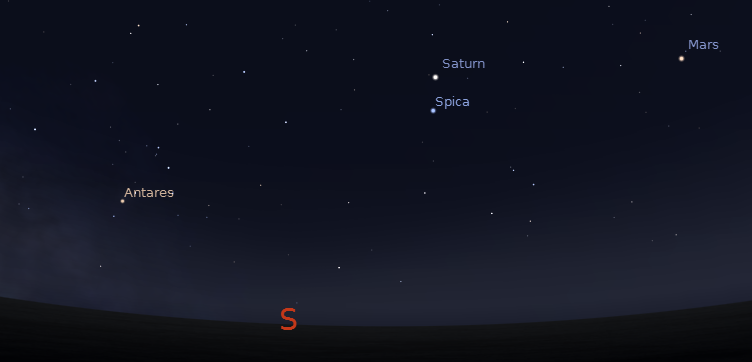
Antares and Mars at 11 p.m. on June 12, 2012. Created using Stellarium.
06/11/2012 – Ephemeris – The bright star Arcturus
Ephemeris for Monday, June 11th. Today the sun will be up for 15 hours and 30 minutes, setting at 9:27. The moon, at last quarter today, will rise at 1:55 tomorrow morning. Tomorrow the sun will rise at 5:56.
The bright star Arcturus appears high in the south at 10:30 in the evening. It’s at the base of a kite shaped constellation of Boötes the herdsman or bear chaser. Arcturus is remarkable for several reasons. It is only 10 percent more massive than the sun but is 110 times brighter and is orange in color. That’s because Arcturus has entered its red giant stage of life after depleting hydrogen in its core as its fuel source. Arcturus is much older than the sun to have evolved so far, being only a little more massive than the sun. Also Arcturus may be new to our galaxy, Its rapid motion of 76 miles per second with respect to the sun, along with 51 other stars known may have come from a small galaxy that collided with the Milky Way.
Times are for the Traverse City/Interlochen area of Michigan. They may be different for your location.
Addendum
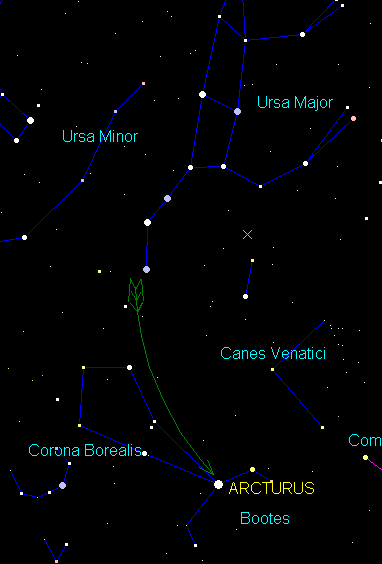
Arcturus, Boötes and the Big Dipper
05/11/2012 – Ephemeris – The bright star Spica
Ephemeris for Friday, May 11th. Today the sun will be up for 14 hours and 40 minutes, setting at 8:59. The moon, 1 day before last quarter, will rise at 2:09 tomorrow morning. Tomorrow the sun will rise at 6:17.
The bright blue star Spica can be found in the southeast as it gets dark now. It’s one of the fainter of the 21 first magnitude stars. It lies in the constellation of Virgo the virgin, and lies very close to the path of the sun, moon and planets in the sky. Saturn is just to the left of it this year. Spica is a binary star, whose brighter component is drawn into an ellipsoid by the tidal effect of the companion. They orbit each other in only 4 days. Spica is 260 light years away and over 3,000 times brighter than the sun. An Egyptian temple at Thebes was oriented to the setting point of Spica. The change in the setting point over time allowed the Greek astronomer Hipparchus to discover the precession of the equinoxes.
Times are for the Traverse City/Interlochen area of Michigan. They may be different for your location.
Addendum
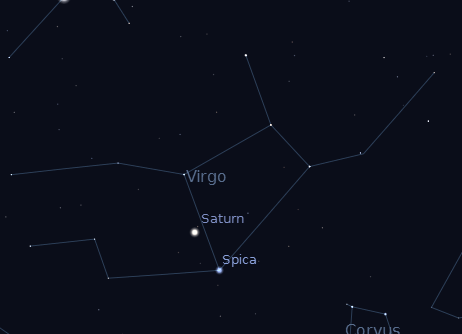
Saturn and Spica on May 11, 2012. Created using Stellarium.
02/09/2012 – Ephemeris – The star Betelgeuse
Ephemeris for Thursday, February 9th. The sun will rise at 7:51. It’ll be up for 10 hours and 10 minutes, setting at 6:02. The moon, 2 days past full, will rise at 8:38 this evening.
The bright red star at the upper left corner of the constellation Orion, high in the south at 9 p.n. Is Betelgeuse. The name is a contraction of an Arabic phrase that means “Armpit of the Central One”. Betelgeuse is a huge star with a diameter four times that of the earth’s orbit of the sun. It is throwing of gas and creating a nebula around itself. It’s distance from us isn’t accurately known, since it doesn’t have a companion star. It’s about 643 light years away, give or take 148 light years. Betelgeuse is about 18 times the mass of the sun and 140 thousand times brighter. It is in the latter stages of its short life,of 10 million year so far. Within another million years or so it will probably explode in a supernova. The good news is that it’s moving away from us.
* Times are for the Traverse City/Interlochen area of Michigan. They may be different for your location.
Addendum
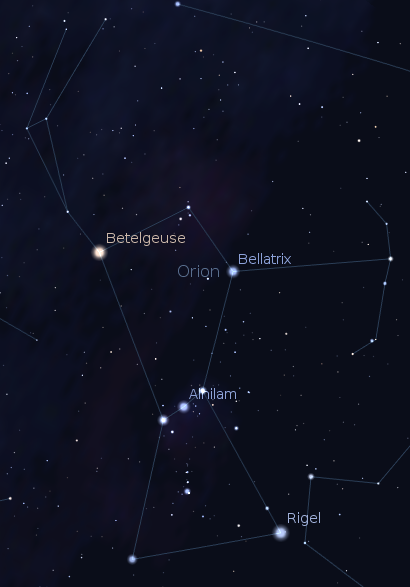
Orion upright and due south. Created using Stellarium.
Betegeuse in Orion
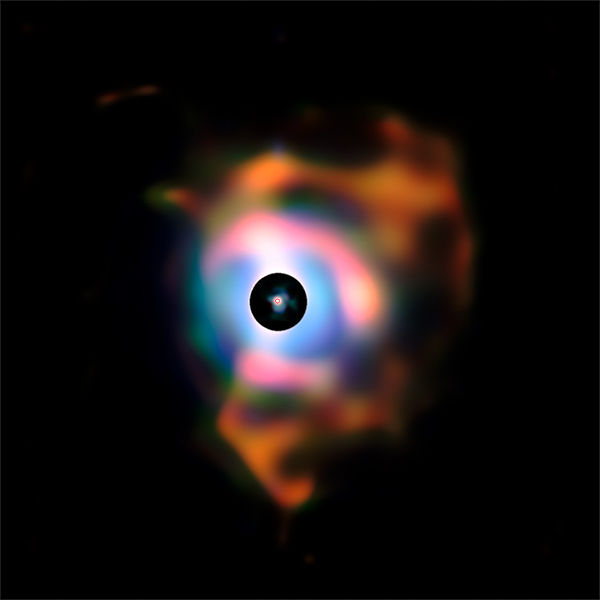
Betelgeuse and its nebula. From ESO's Very Large Telescope.
More information on the image above: http://www.eso.org/public/images/eso1121a/
01/30/2012 – Ephemeris – Getting Sirius about color
Ephemeris for Monday, January 30th. The sun will rise at 8:04. It’ll be up for 9 hours and 43 minutes, setting at 5:47. The moon, at first quarter today, will set at 1:51 tomorrow morning.
The bright star shining so bright low in the south southeast at 9 p.m. is Sirius the Dog Star. I talked about it Friday in the context of its constellation Canis Major, Orion’s larger hunting dog. Sirius itself is a remarkable star. It’s name means dazzling one and a look at it in binoculars or a telescope will prove it.. The twinkling effects are due to the earth’s atmosphere, but the bright arc light color is all his. Sirius is a perfect white star. Compare it with the brightest star now overhead Capella which has the same color as our sun. Star colors tell us the temperature of the star surfaces, which run from cool red to hot blue. On our Fahrenheit temperature scale, the sun’s surface is about 10,000 degrees, Sirius is nearly twice that.
* Times, as always are for the Traverse City/Interlochen area of Michigan.
Addendum
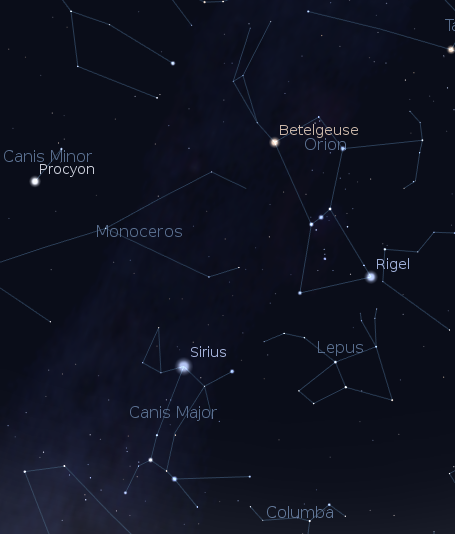
Orion and his Hunting Dogs. Created using Stellarium.
Sirius actually looks blue-white to me. Of course during the day our yellow sun looks white. I think it has to do with out night vision.
12/23/11 – Ephemeris – This year’s Christmas stars
Friday, December 23rd. The sun will rise at 8:17. It’ll be up for 8 hours and 48 minutes, setting at 5:06. The moon, 1 day before new, will rise at 8:04 tomorrow morning.
We have two bright planets and the brightest nighttime star out to be our Christmas stars this year. The planet Venus appears in the southwest in the evening and in seen higher and higher each evening, leading the sun in its slow climb as we move through winter into spring. Jupiter holds forth high in the south, the brightest star-like object once Venus sets. The brightest of all the night-time stars is Sirius, whose name means “Dazzling One” rising higher in the southeast, whiter than any planet with a tinge of blue, especially when seen in binoculars or a telescope.. It is accompanied by the rest of the bright stars of winter, including those of the great constellation Orion the hunter, whose three stars of his belt point down and to the left at Sirius.
* Times, as always are for the Traverse City/Interlochen area of Michigan.
12/20/11 – Ephemeris – Procyon, the “Little Dog Star”
Tuesday, December 20th. The sun will rise at 8:15. It’ll be up for 8 hours and 48 minutes, setting at 5:04. The moon, 3 days past last quarter, will rise at 4:45 tomorrow morning.
Visible low in the east at 9 p.m. appears the star Procyon to its lower left is Sirius the brightest night time star. Procyon is the bright star in the constellation Canis Minor, or lesser dog. I can find only one other star in Canis Minor. Perhaps it’s a hot dog. If Sirius, in Canis major is the Dog Star then Procyon should be the Little Dog Star. However Procyon is an interesting name. It means “Before the dog”, which is an allusion to the fact that Procyon, though east of Sirius actually rises before it. This is due to Procyon’s more northerly position. This effect doesn’t work south of the equator, however. Procyon is a star much like Sirius but farther away. [It’s 11.41 to Sirius’ 8.6 light years away. And like Sirius it even has a small white dwarf star in its system.]
* Times, as always are for the Traverse City/Interlochen area of Michigan. Text in brackets was omitted in the audio program due to time constraints.
Addendum
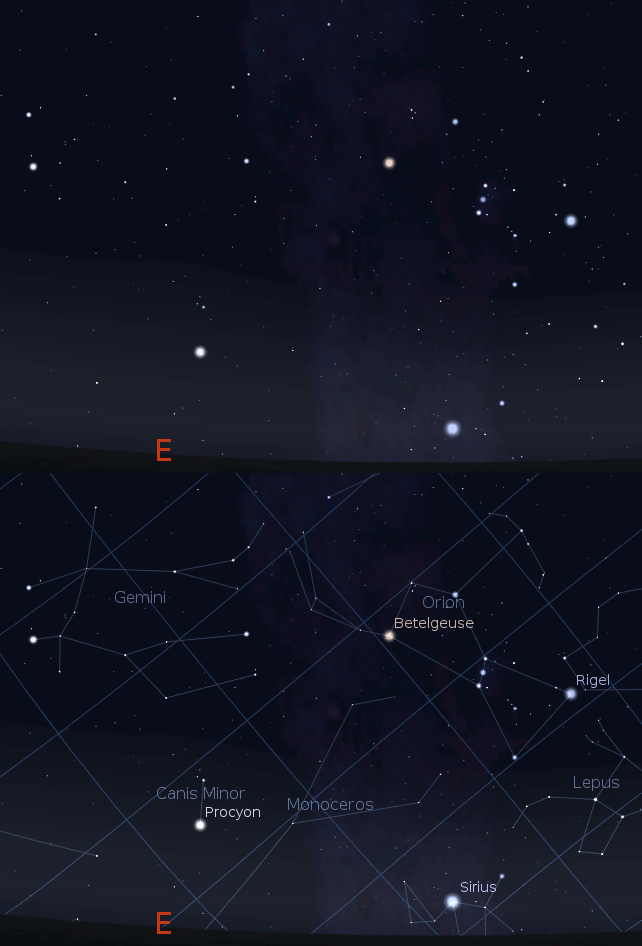
Procyon, Sirius and the stars of winter. Created using Stellarium
The grid lines are right ascension and declination, analogous to longitude and latitude on the earth. Looking eastward the right ascension lined run from the upper left to the lower right. Thus Procyon is definitely farther east than Sirius.
10/31/11 – Ephemeris – The spookiest star
Halloween, Monday, October 31st. The sun will rise at 8:18. It’ll be up for 10 hours and 14 minutes, setting at 6:33. The moon, 2 days before first quarter, will set at 11:04 this evening.
On the spookiest night of the year, lets look at the spookiest star of all. It’s Algol, from Ghoul Star or Demon Star. The Chinese had a name for it that meant ‘piled up corpses’. It’s the second brightest star in the constellation Perseus the hero, rising in the northeast this evening. The star is located where artists have drawn the severed head of Medusa, whom he had slain. Medusa was so ugly that she turned all who gazed upon her to stone. Algol is her still glittering eye. Astronomers finally found out what was wrong with Algol. It does a slow 6 hour wink every two days 21 hours, because it is two stars that eclipse each other. It will be winking this evening, dimmer than usual. My ephemeris blog has a finder chart. Just Google Bob Moler.
* Times are for the Traverse City/Interlochen area of Michigan. They may be different for your location.
10/27/11 – The Harbinger of Winter – Capella
Thursday, October 27th. The sun will rise at 8:13. It’ll be up for 10 hours and 25 minutes, setting at 6:39. The moon, 1 day past new, will set at 7:02 this evening.
A bright star called Capella has slowly been rising in the northeastern sky in the evenings for the past few months. At 9 p.m. now it is low in the north northeast far below the letter “W” shaped constellation of Cassiopeia. This winter Capella will be overhead the highest of winter’s seven brilliant first magnitude stars. Capella never quite sets for anyone north of Ludington. Due to its brightness, and being the closest first magnitude star to the pole Capella appears to move slowly as the earth rotates, and spends summer and autumn evenings close to the horizon. In the sky Capella represents a mamma goat held on the shoulders of a charioteer. There’s a thin triangle of three stars to Capella’s lower right. It’s a group of stars called the Kids. Her kids.
* Times are for the Traverse City/Interlochen area of Michigan. They may be different for your location.
Addendum
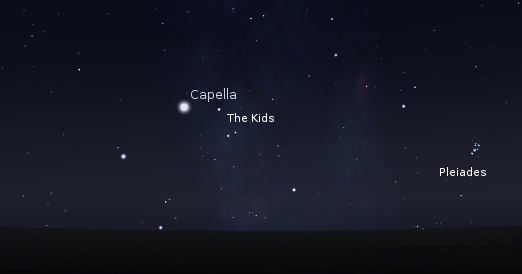
Capella and the Kids in the early evening. Created using Stellarium.
10/25/11 – Ephemeris – The lonely star Fomalhaut
Tuesday, October 25th. The sun will rise at 8:10. It’ll be up for 10 hours and 31 minutes, setting at 6:42. The moon, 1 day before new, will rise at 8:02 tomorrow morning
There’s a bright and lonely star that appears low in the south for only seven and a half hours a night on autumn evenings. It’s appearance is a sign as sure as the falling leaves that autumn is here At 9 p.m. tonight it’s low in the south southeast. The star’s name is Fomalhaut, which means fish’s mouth. This is appropriate because it’s in the constellation of Piscis Austrinus, the southern fish. At our latitude it’s the fish that got away, because Fomalhaut appears to be quite alone. The dimness of the constellation’s other stars and location close to the horizon make the fainter stars hard to spot. They would be overhead in Australia. The earth’s thick atmosphere near the horizon reduces the stars brightness by a factor of two or more, so Fomalhaut appears to keep a lonely vigil in the south.
* Times are for the Traverse City/Interlochen area of Michigan. They may be different for your location.
Addendum
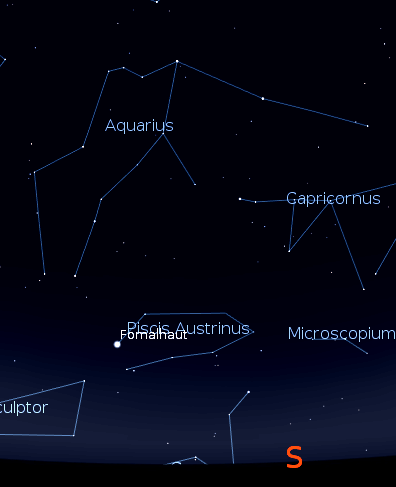
Aquarius and Fomalhaut as visualized by Stellarium
 Bob Moler's Ephemeris Blog