Archive
06/14/2019 – Ephemeris – I’m giving the talk Apollo and the Race to the Moon tonight at the Library in Thompsonville
Ephemeris for Flag Day, Friday, June 14th. Today the Sun will be up for 15 hours and 33 minutes, setting at 9:29, and it will rise tomorrow at 5:56. The Moon, 3 days before full, will set at 4:55 tomorrow morning.
Tonight the Grand Traverse Astronomical Society will host a star party… well a Moon party at the Betsie Valley District Library in Thompsonville, MI. It starts at 8:30 p.m. With what I like to call a twilight talk by yours truly, the title of which is Apollo and the Race to the Moon. I’ll explore the Apollo 11 mission and the events leading up to it both in the United States and the USSR. The bright Moon tonight will uncover all the Apollo landing areas, even though there too small to be seen from the Earth, though they will be shown in the presentation. Twilight talks at the library also involves a slide or planetarium-like presentation, so if it’s cloudy we’ll also explore the starry nights of summer inside. So come out clear or cloudy.
The times given are for the Traverse City/Interlochen area of Michigan. They may be different for your location.
Addendum
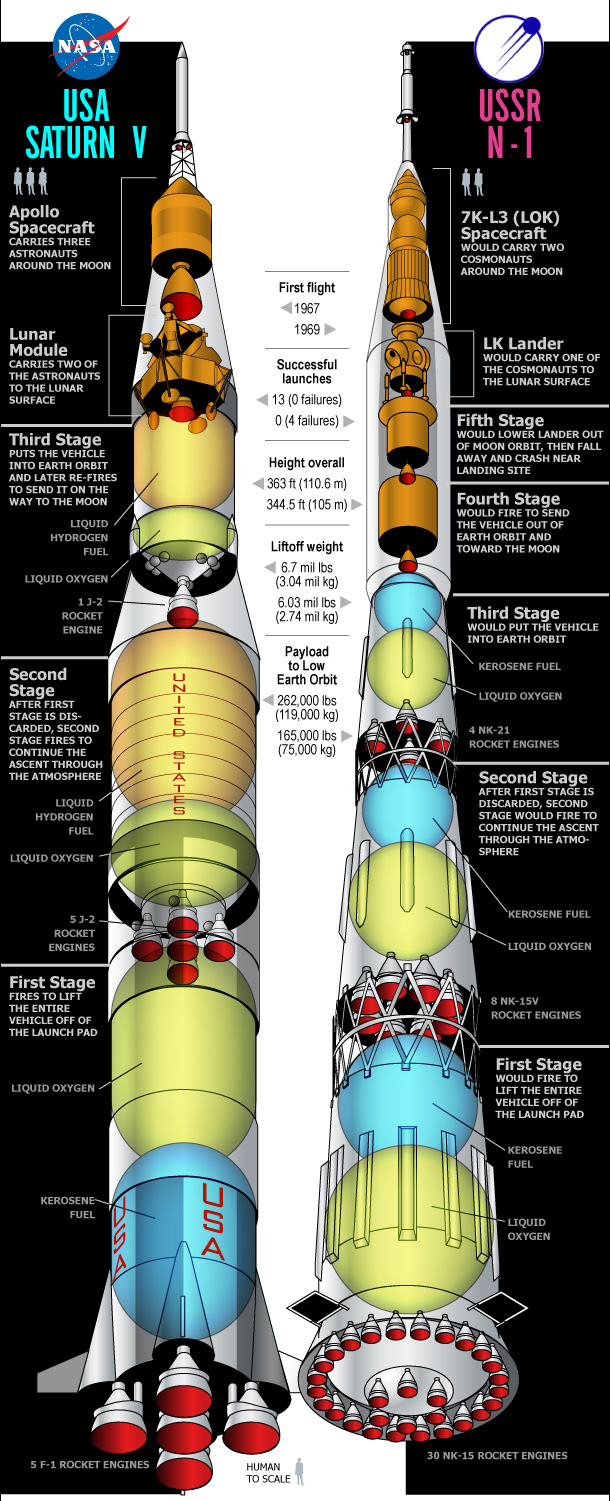
Comparison between The United States Saturn V and the Soviet N-1. Click on the Image to enlarge. Credit Karl Tate, Space.com.
06/06/2019 – Ephemeris – The 75th anniversary of D-Day, the astronomical connection
Ephemeris for Thursday, June 6th. Today the Sun will be up for 15 hours and 26 minutes, setting at 9:25, and it will rise tomorrow at 5:57. The Moon, 3 days past new, will set at 12:40 tomorrow morning.
Today is the 75th anniversary of the greatest battle of World War II was the invasion of Normandy on D-Day, a date governed by the position of the Moon. The full moon on June the 6th, 1944 gave light for the gliders and paratroopers to carry out their operations at midnight. Plus the high tides were near noon and midnight and the low tides near dawn. The idea was to hit the beach at low tide to enable the landing craft to operate without hitting the obstacles the Germans planted in the tidal zone. It was great for the landing craft, but the troops had a lot of open beach to cover to get to some sort of shelter. The best days for the invasion were the 5th, 6th and 7th of June. Bad weather on the 5th caused a one day postponement.
The times given are for the Traverse City/Interlochen area of Michigan. They may be different for your location.
05/09/2019 – Ephemeris – The USA: Step by step to the Moon
Ephemeris for Thursday, May 9th. Today the Sun will be up for 14 hours and 35 minutes, setting at 8:57, and it will rise tomorrow at 6:20. The Moon, 2 days before first quarter, will set at 1:54 tomorrow morning.
The Apollo 11 manned landing on the Moon 50 years ago was the culmination of a series of incremental steps. The Mercury program was in progress when President Kennedy announce the goal to land on the Moon. Following that was Gemini a two man capsule to test long duration flight, rendezvous and docking of two spacecraft, and EVA’s or spacewalks. There was the Ranger program attempted to photograph the Moon close up by sending probes to crash into the Moon. The Lunar Orbiter program to map the entire Moon, the Surveyor program to soft land on the Moon and test its surface. All this leading up to the three man Apollo program to test out the strategy and equipment and to land humans on the Moon.
The times given are for the Traverse City/Interlochen area of Michigan. They may be different for your location.
Addendum
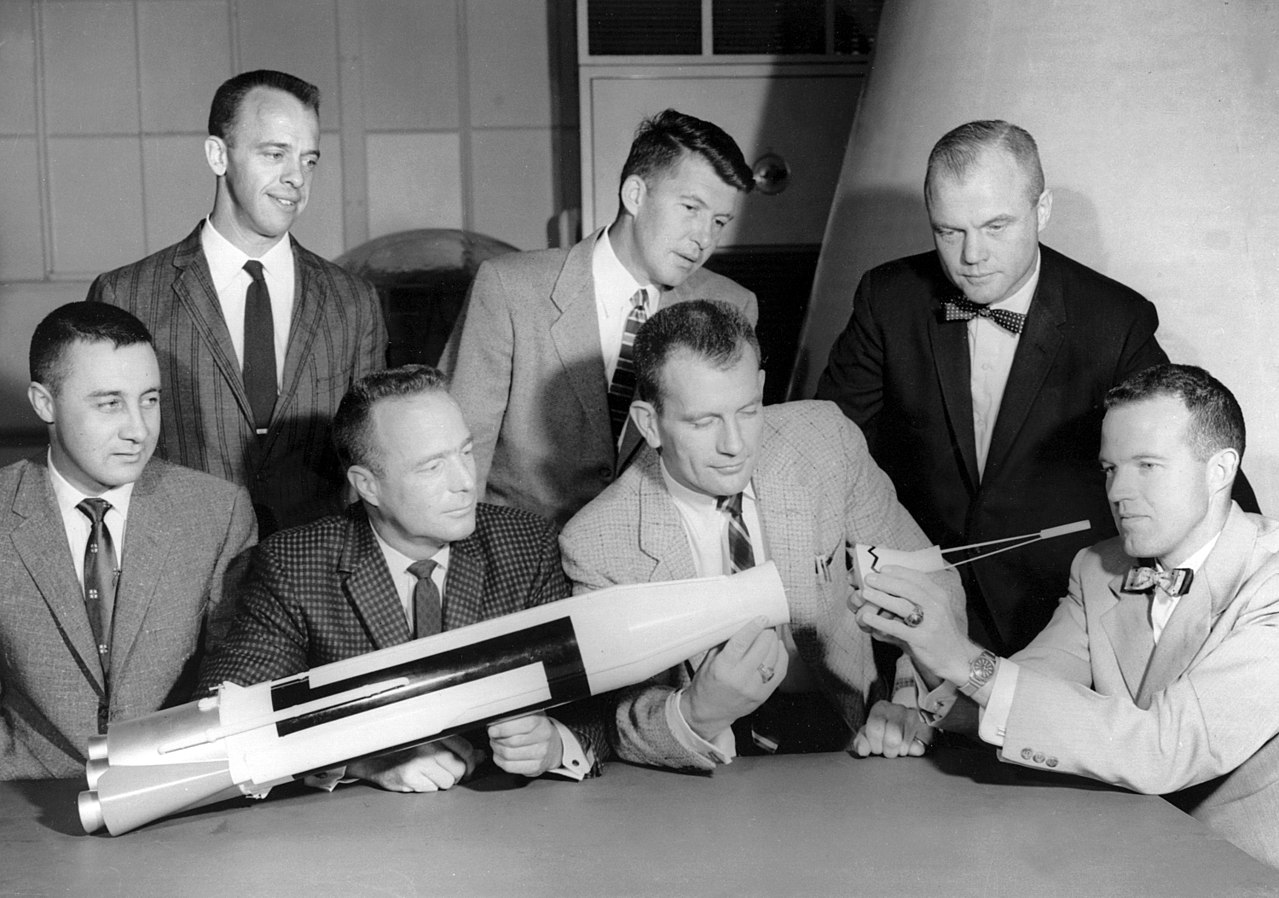
Project Mercury astronauts and a model of the Mercury-Atlas rocket and capsule. Left to right: Grissom, Shepard, Carpenter, Schirra, Slayton, Glenn and Cooper, in 1962. Click on the image to enlarge. Credit NASA.
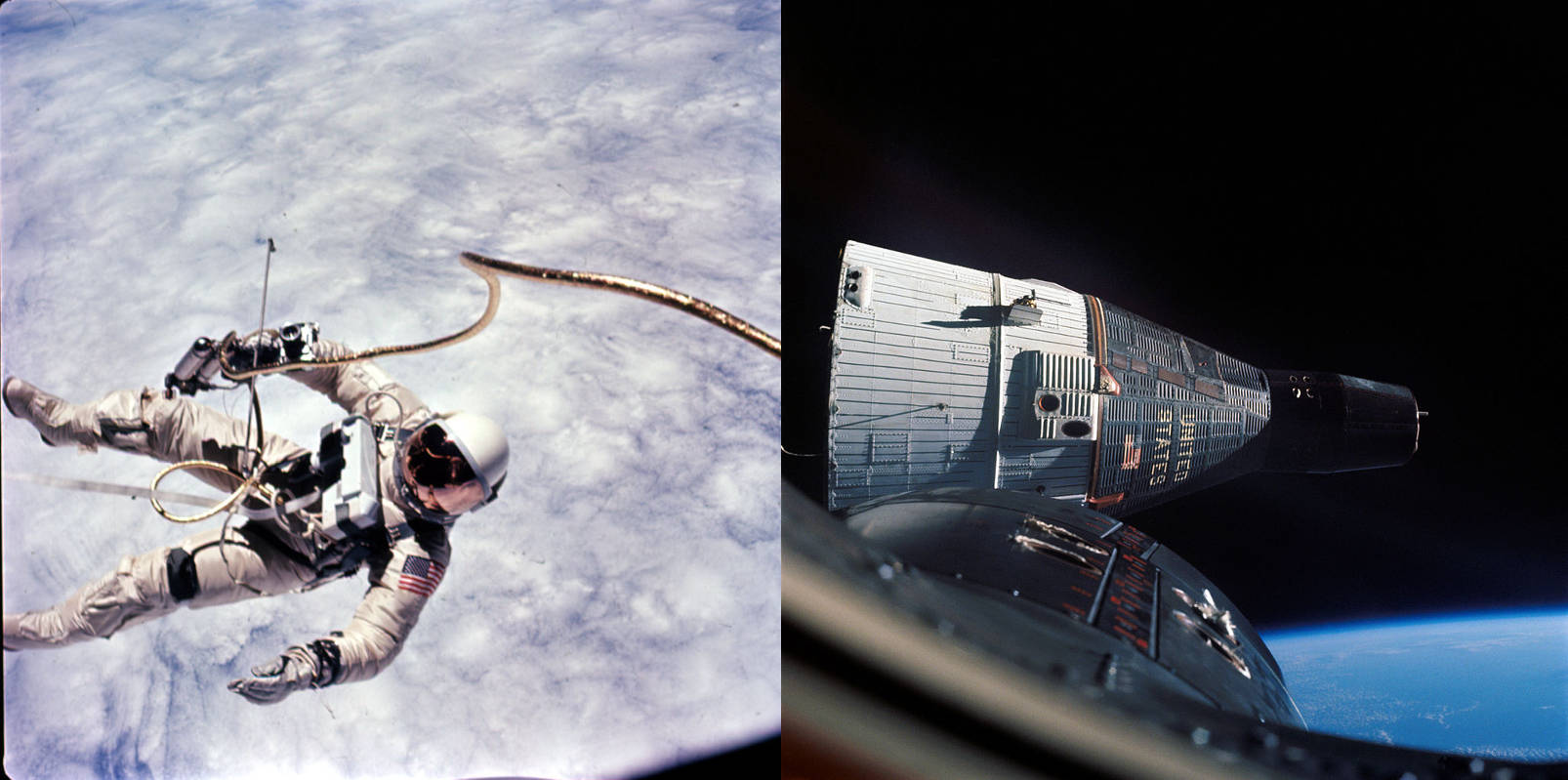
Project Gemini: Left Ed White during the US first space walk during Gemini 4 in June of 1965. Right The rendezvous of Gemini 6 & 7 in December of 1965. Click on the image to enlarge. Credit NASA.
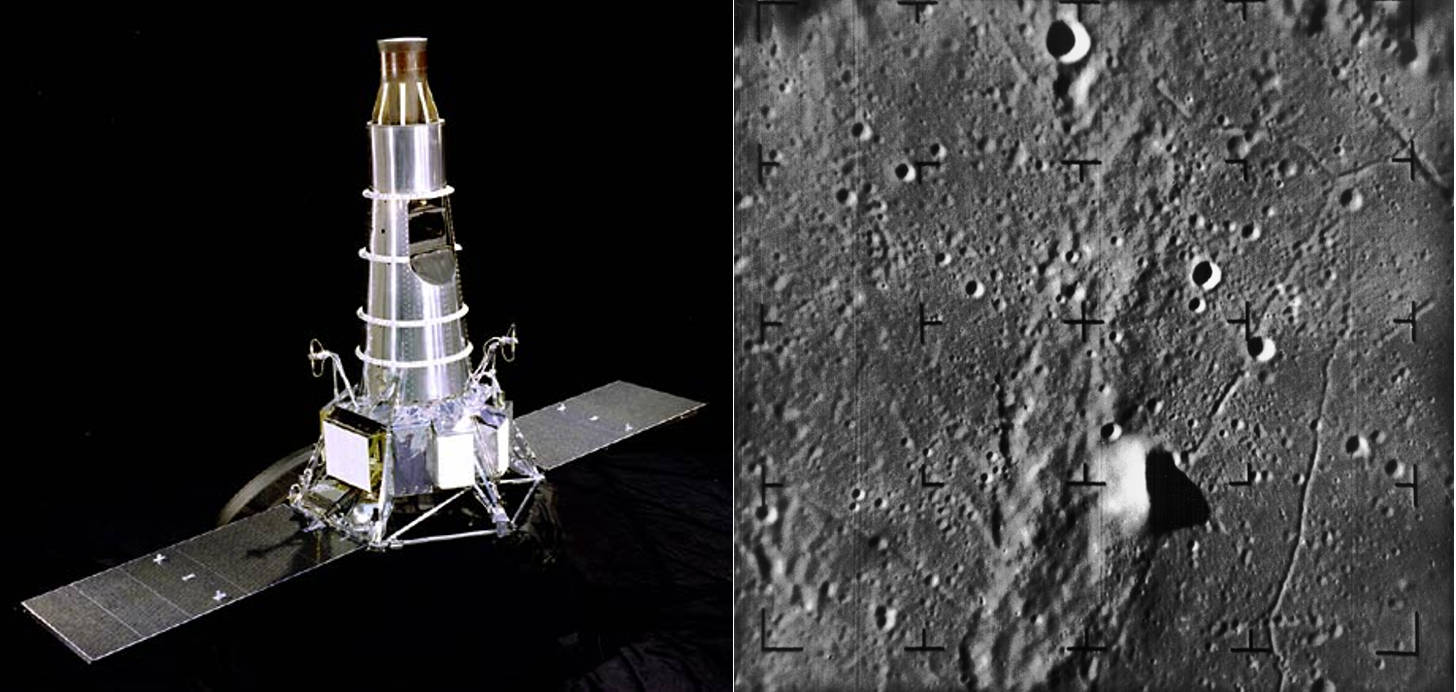
Left: The Ranger spacecraft. Right: The floor of the crater Alphonsus from Ranger 9. Only the last 3 spacecraft were successful. They transmitted images all the way down as they crashed into the Moon. Click on the image to enlarge. Credit NASA.
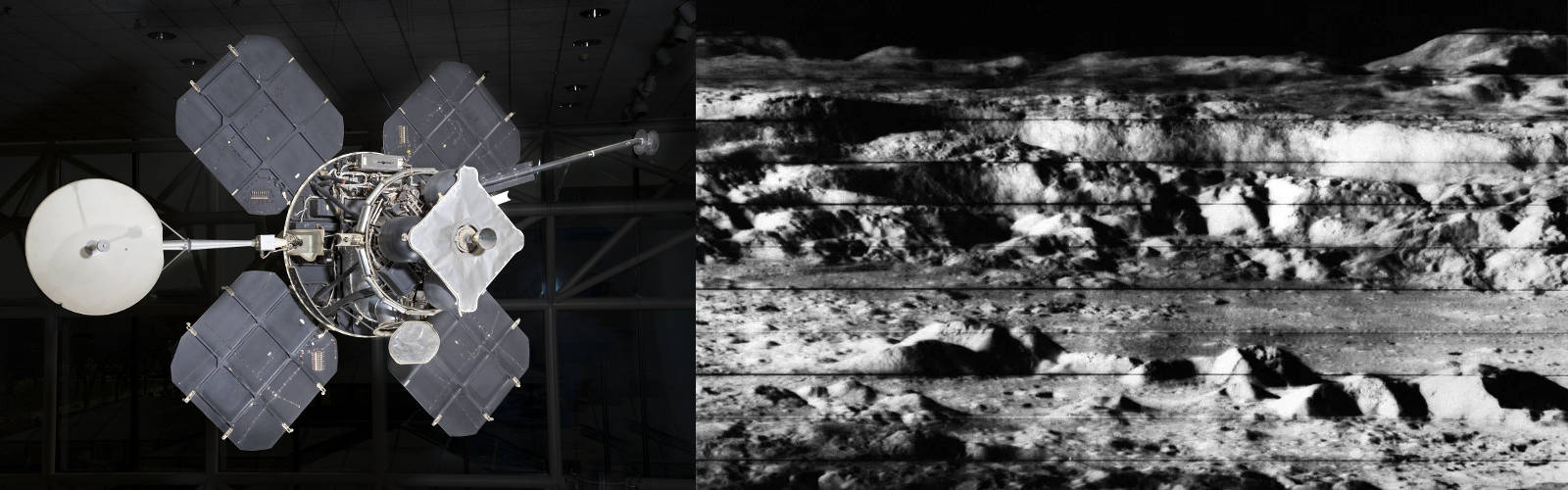
In the most unheralded of the lunar programs the 5 successful Lunar Orbiter satellites photographed 99% of the Moon. from 1966 to 1967. The Moon was photographed on film in strips, developed and the images scanned and transmitted back to Earth. Right: The oblique view of the crater Copernicus was dubbed at the time “The Picture of the Century”. Click on the image to enlarge. Credit NASA.
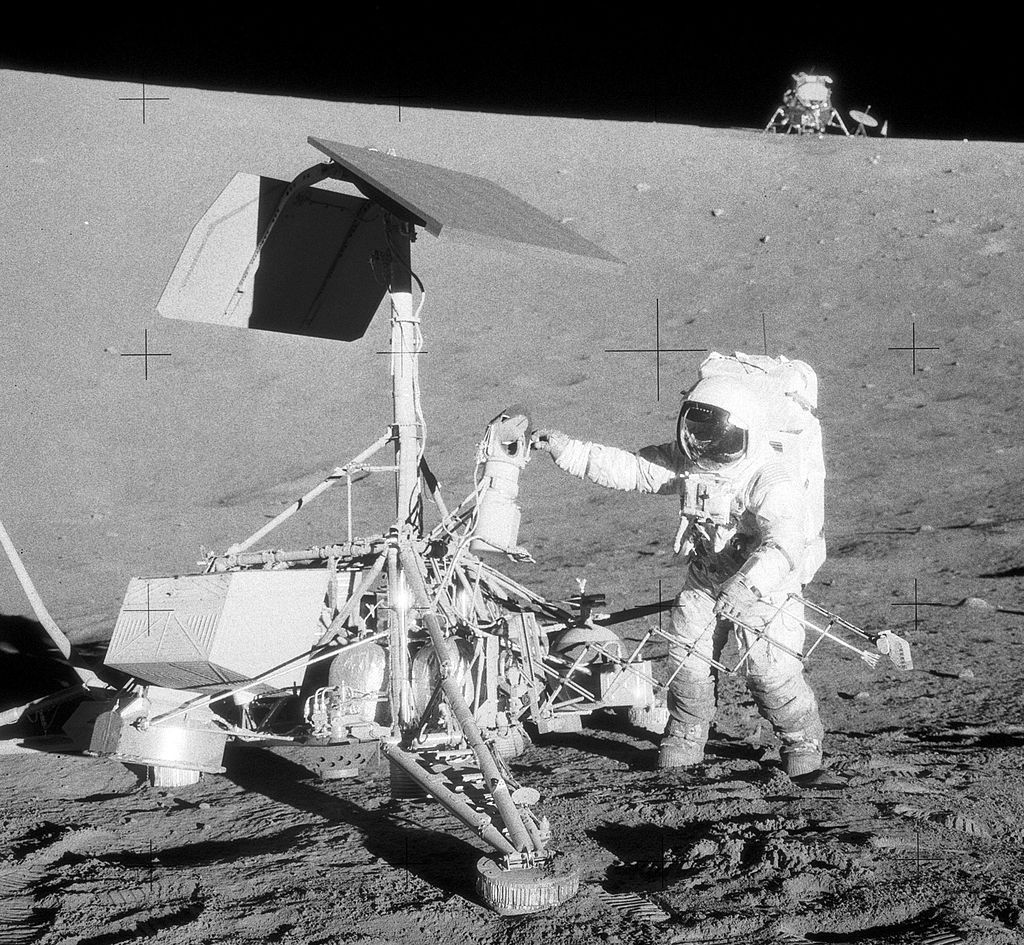
Surveyor 3, visited by astronaut Pete Conrad during the Apollo 12 mission. Click on the image to enlarge. Credit: NASA / Alan Bean.
04/15/2019 – Ephemeris – Why land at the Moon’s south pole?
Ephemeris for Tax Deadline Day Monday, April 15th. Today the Sun will be up for 13 hours and 28 minutes, setting at 8:27, and it will rise tomorrow at 6:57. The Moon, 3 days past first quarter, will set at 5:53 tomorrow morning.
The hottest piece of real estate on the Moon is the south pole. Unlike the Earth’s south pole and the rest of the Moon, except the north pole, there are mountain tops that are always in sunlight. The Moon has a very small axial tilt, only a degree an a half, compared to the Earth’s 23 and a half degrees which plunges the earth’s poles into a 6 month’s night. Another benefit of the small tilt is that the floors of craters at of near the poles never see sunlight, so are hundreds of degrees below zero and can be cold traps for water vapor from passing or colliding comets. Yes, thar’s water in them thar craters. It’s more valuable than gold, providing oxygen to breathe and hydrogen and oxygen for rocket fuel.
The times given are for the Traverse City/Interlochen area of Michigan. They may be different for your location.
Addendum
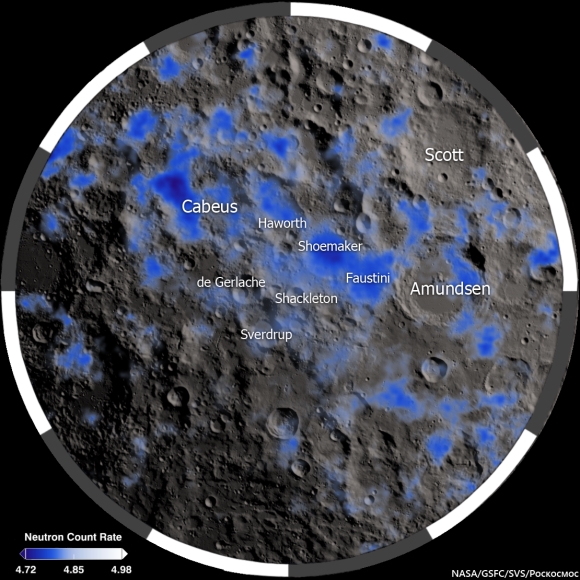
The south pole of the Moon where the presence of water ice is detected by the absorption of neutrons by the hydrogen atoms in the ice. Credit NASA/GSFC/SVS/Roscosmos.
04/11/2019 – Ephemeris – How far away is the Moon?
Ephemeris for Thursday, April 11th. Today the Sun will be up for 13 hours and 16 minutes, setting at 8:22, and it will rise tomorrow at 7:04. The Moon, 1 day before first quarter, will set at 3:02 tomorrow morning.
This year, the 50th anniversary of the Apollo 11 first human landing on the Moon, I’ll be talking about some basic facts about the Moon, the Apollo program. The first thing is to realize just how far the Moon is from the Earth. Most diagrams of the Earth and Moon cheat and make them closer than they are. The Greek astronomer Hipparchus in the second century BC got pretty close. The Moon is about 30 times the Earth’s diameter away. If the Earth were represented by a basketball and the Moon by a tennis ball to get their proportional distance correct they would have to be 23 and a half feet (7.16 meters) away from each other, give or take. On average 238,000 miles (383,000 km). It took the Apollo astronauts 3 days cover that distance to get to the Moon.
The times given are for the Traverse City/Interlochen area of Michigan. They may be different for your location.
Addendum

The Earth and Moon to scale. Click on the image to enlarge. Source Wikipedia.
03/19/2019 – Ephemeris – Spring and a super-moon happen tomorrow
Ephemeris for Tuesday, March 19th. Today the Sun will be up for 12 hours and 5 minutes, setting at 7:53, and it will rise tomorrow at 7:46. The Moon, 1 day before full, will set at 7:55 tomorrow morning.
Today and tomorrow are busy days, astronomically speaking, for the Earth, Sun and Moon. This afternoon at 3:47 the Moon will reach the perigee point in its orbit of the Earth, its closest point of 223,200 miles (359,400 km) center to center. With the full moon just 30 hours later this will make the Moon a super-moon, the third in a row. The Moon will be full enough to call tonight’s moon a super-moon too when it rises around 6:16 p.m. The next event will be the coming of spring, when the Sun appears to cross the celestial equator heading northward. For a point in the Pacific Ocean, on the equator the Sun will be directly overhead at 5:58 p.m. our time or 21 hours, 58 minutes Universal Time or Greenwich Mean Time.
The times given are for the Traverse City/Interlochen area of Michigan. They may be different for your location.
Addendum
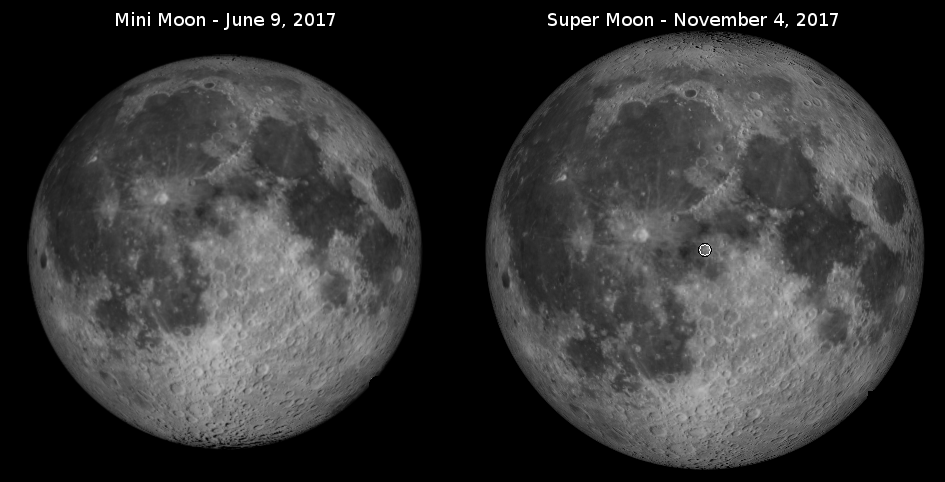
Mini Moon and Super Moon for 2017. Trouble is the Moon appears alone with nothing to compare it to when it is seen in the sky. Created using Cartes du Ciel (Sky Charts).
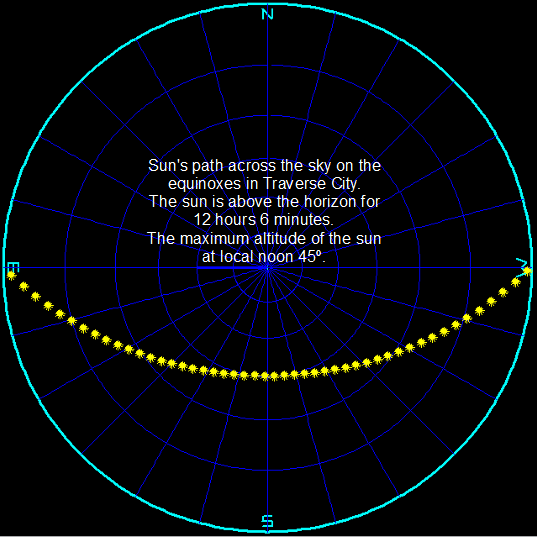
The Sun’s path through the sky on the equinox day from Traverse City, MI. Created using my LookingUp program. (This is from a couple of years ago. The actual length of daylight depends on when during the day the moment of the equinox occurs. I’ll have more on that Thursday.)
03/12/2019 – Ephemeris – Does the Moon rotate?
Ephemeris for Tuesday, March 12th. Today the Sun will be up for 11 hours and 43 minutes, setting at 7:44, and it will rise tomorrow at 7:59. The Moon, 2 days before first quarter, will set at 2:00 tomorrow morning.
Since we see only one face of the Moon throughout the month does that mean that the Moon doesn’t rotate? It doesn’t appear to rotate with respect to the Earth, but the Moon rotates through all the stars and constellations of the zodiac in a 27.32 days. That’s called a sidereal month. The lunar month we’re more familiar with is the synodic month, or lunation, that lasts 29.53 days which is the interval between new moons. It is the basis of the Jewish and Islamic calendars. The reason for the locking of the Moon’s rotation and revolution of the Earth, also called synchronous rotation, is the tidal pull of each on the other. The Earth has managed to slow the Moon’s rotation to match its revolution. The Moon is trying to do the same to the Earth with much less success, though every year or two a second is added to the time stream, UTC1 or Greenwich Mean Time, due to the slowing of the Earth’s rotation.
The times given are for the Traverse City/Interlochen area of Michigan. They may be different for your location.
Addendum
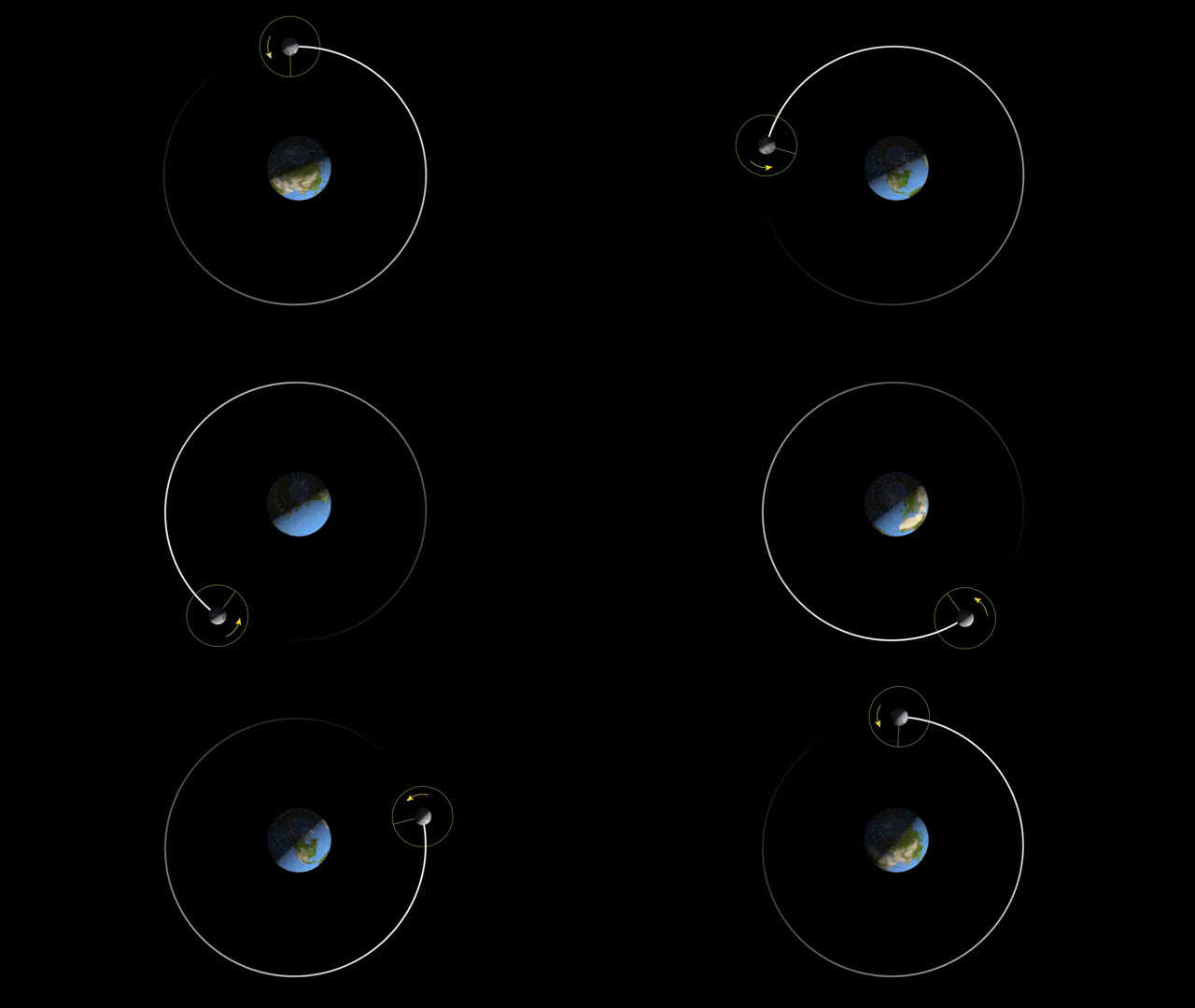
Animation of the Moon orbiting the Earth showing the Moon’s rotation. Credit: NASA’s Scientific Visualization Studio/Ernie Wright, modified and converted to GIF by Bob Moler.
NASA’s Scientific Visualization Studio web page where I got the original for the above video.
03/11/2019 – Ephemeris – The Moon: Dark side, far side, which is it?
Ephemeris for Monday, March 11th. Today the Sun will be up for 11 hours and 40 minutes, setting at 7:43, and it will rise tomorrow at 8:01. The Moon, 3 days before first quarter, will set at 12:54 tomorrow morning.
Tonight the Moon is at its crescent phase, meaning it is slightly closer to the Sun than the Earth is. Most of the Moon we see is in night. Some earth shine may be seen on its night side due to the big nearly full Earth shining on it. I get ticked sometimes when someone who knows better, especially in the media, mentions the dark side of the Moon when they should use the term far side, the part of the Moon that permanently faces away from the Earth. When the Chinese Chang’e 4 spacecraft landed on the far side of the Moon recently many headlines proclaimed that it landed on the dark side of the Moon. The Moon has a night side, as does the Earth, but that changes as the Moon rotates in the sunlight. And the Moon does rotate. It happens to be in sync with its revolution about the Earth.
The times given are for the Traverse City/Interlochen area of Michigan. They may be different for your location.
Addendum
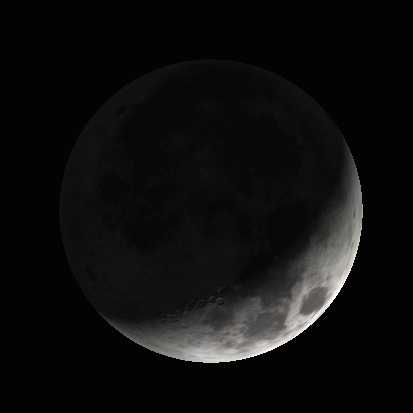
The crescent Moon tonight at 9 p.m. EDT, March 11, 2019. Created using Stellarium.
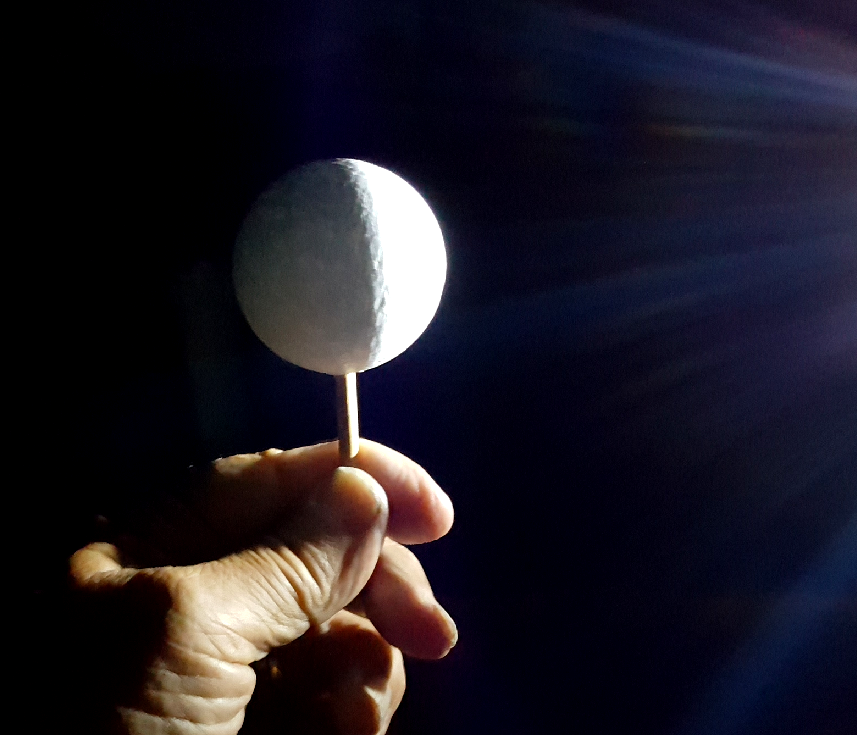
Demonstration of the Moon’s crescent phase with the Styrofoam moon ball we use for Project Astro held up to a light off frame to the right. The night side of the ball is illuminated a bit by the translucency of the ball, and the reflection off my hand. Note the roughness of the ball is visible only at the terminator.
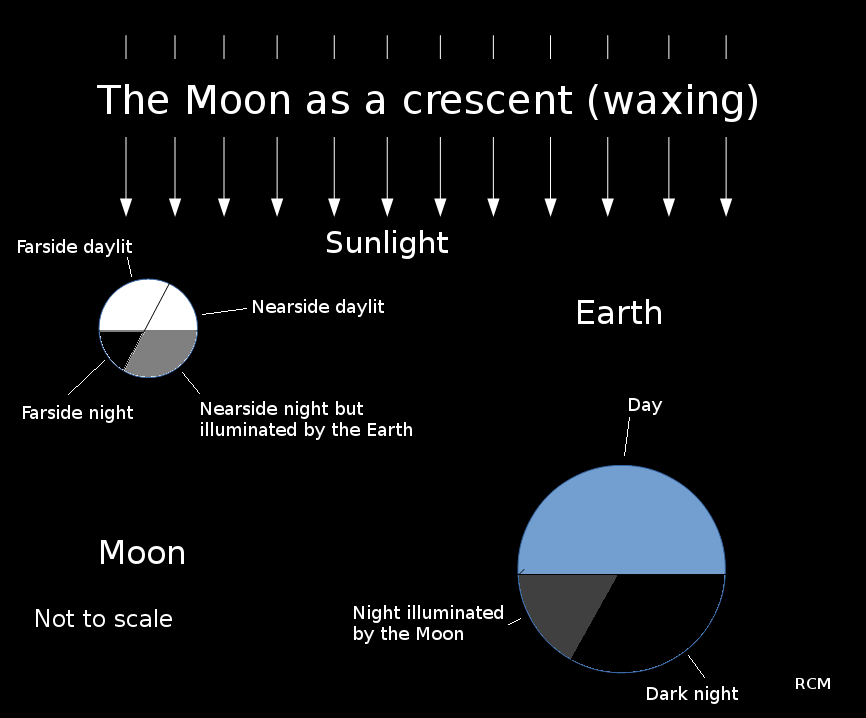
The Earth and Moon if seen as a crescent, near side, far side, sunlit side and earth shine. Credit: me.
02/18/2019 – Ephemeris – Super Moon, super math
Ephemeris for President’s Day, Monday, February 18th. Today the Sun will be up for 10 hours and 36 minutes, setting at 6:15, and it will rise tomorrow at 7:37. The Moon, 1 day before full, will set at 7:52 tomorrow morning.
Ready for some math this morning? This will be easy, because you will only have to think about it. Let’s say the Earth’s radius is 4,000 miles. That is pretty close to its actual value. OK, it is 3961 miles (6,378 km) at the equator. The Earth is nearly spherical. At 4 this morning the Moon passed perigee, its closest point to the Earth, making tomorrow’s full moon a super-moon. Let’s say it will be at today’s distance of 221,600 miles (356,800 km). That’s center to center. At moon rise or moon set the Moon is near that center to center distance, but if it moves overhead it’s 4,000 miles closer because we are on the Earth facing the Moon. Even though the Moon looks smaller than when it appears on the horizon. It’s an optical illusion that the Moon appears larger when it is rising. Super moon or not.
The times given are for the Traverse City/Interlochen area of Michigan. They may be different for your location.
Addendum
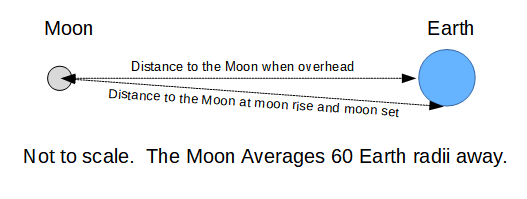
This illustrates the difference in the Moon’s distance at rising (or setting) versus when it is overhead. BTW today’s perigee puts the Moon at only 56 Earth radii from the Earth. The illustration is mine.
12/11/2018 – Ephemeris – The Chinese just launched a spacecraft to land on the far side of the Moon
Ephemeris for Tuesday, December 11th. The Sun will rise at 8:10. It’ll be up for 8 hours and 52 minutes, setting at 5:02. The Moon, half way from new to first quarter, will set at 9:06 this evening.
Last Friday the Chinese launched their Chang’e 4 spacecraft to land on the far side of the Moon in January. That side of the Moon has been mistakenly called the dark side. It actually gets more sunlight than the near, Earth facing, side. This will be an extraordinary feat. So how can they tell what’s happening on the other side? In preparation for this landing attempt the Chinese put a communications relay satellite in a halo orbit about the Earth-Moon L2 Lagrange point 38 thousand miles (61 thousand km) beyond the Moon. It is a kind of a gravitational point of equilibrium behind the Moon. One of five, and they are very useful. The satellite will lazily orbit that point, in view of the lander and the Earth for continuous communication between the Earth and the lander.
The times given are for the Traverse City/Interlochen area of Michigan. They may be different for your location.
Addendum
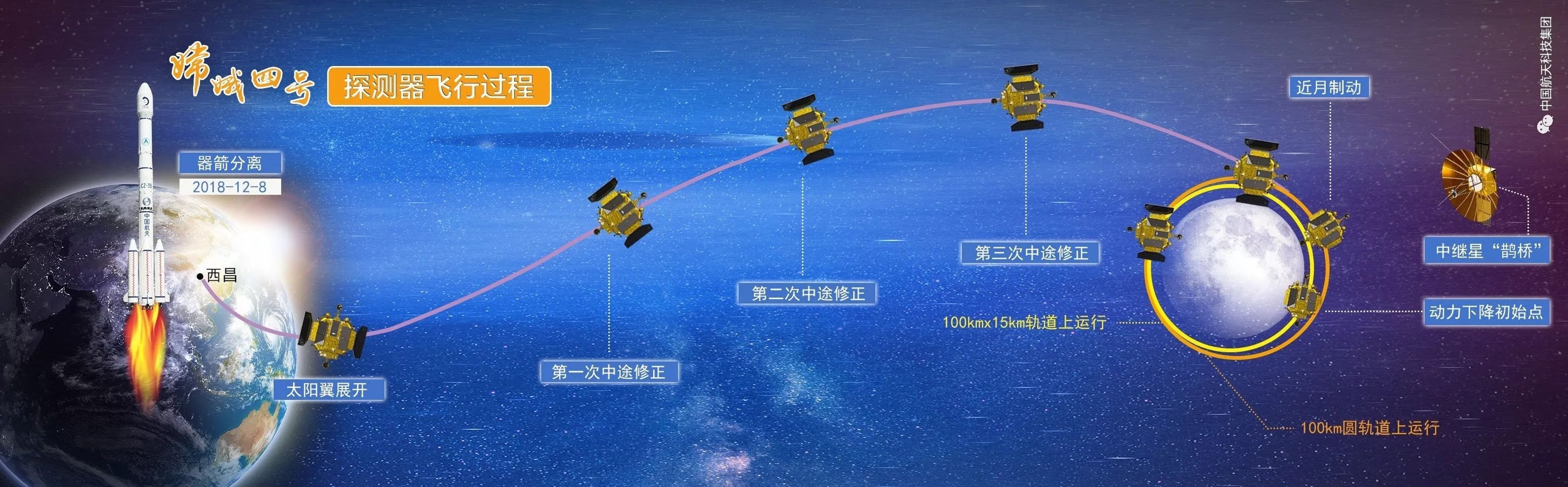
Chinese mission to land a lander and rover on the far side of the Moon. Click on the image to enlarge. It’s in Chinese except the numbers. Credit China Aerospace Science and Technology Corporation via Space.com.
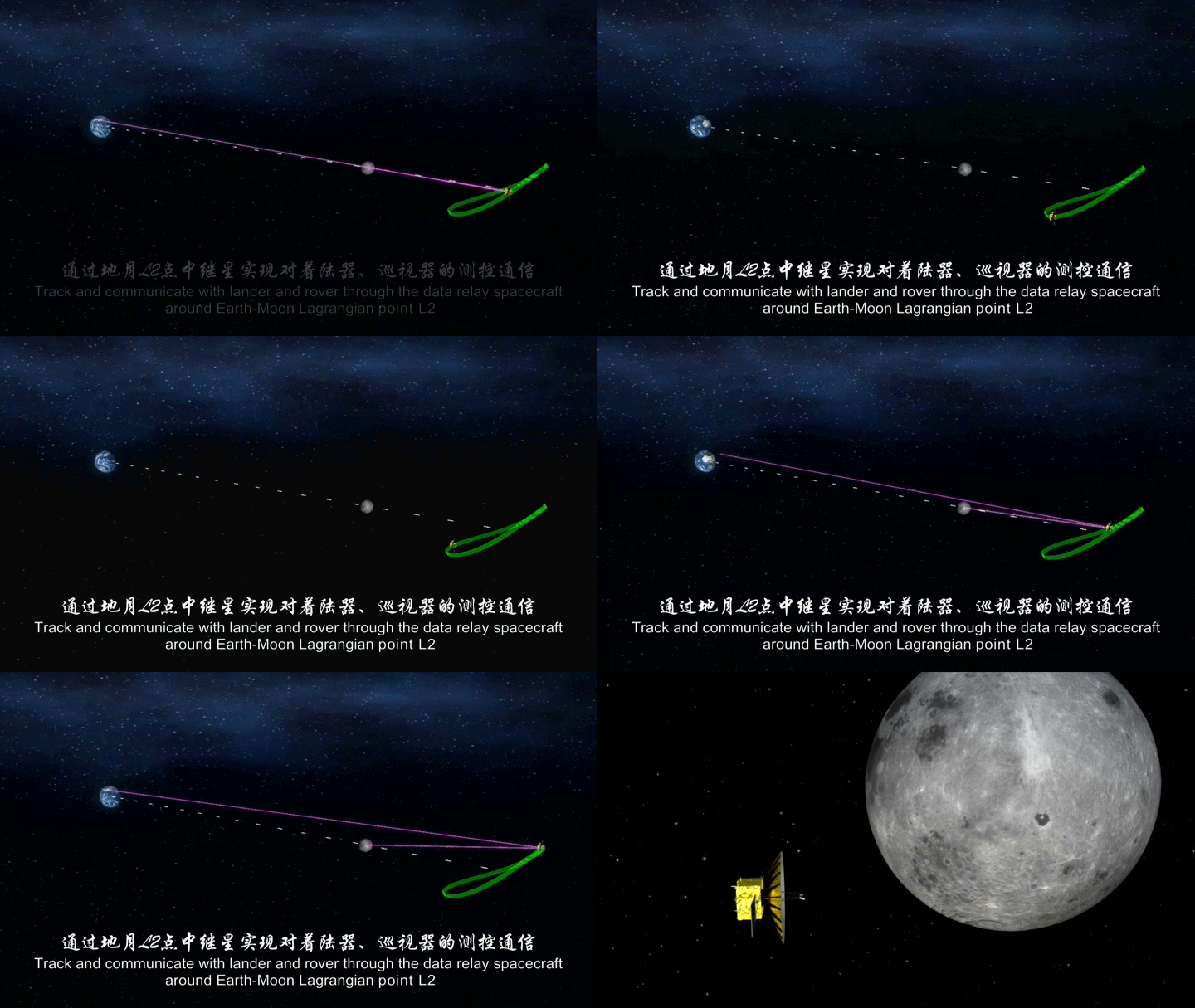
How Queuiao, the lunar communications satellite orbiting L2 performs its relay function. Click on image to enlarge. Credit CNSA via gbtimes.com.
Note: Next Monday’s program will be about Lagrangian points.
 Bob Moler's Ephemeris Blog