Archive
04/11/2019 – Ephemeris – How far away is the Moon?
Ephemeris for Thursday, April 11th. Today the Sun will be up for 13 hours and 16 minutes, setting at 8:22, and it will rise tomorrow at 7:04. The Moon, 1 day before first quarter, will set at 3:02 tomorrow morning.
This year, the 50th anniversary of the Apollo 11 first human landing on the Moon, I’ll be talking about some basic facts about the Moon, the Apollo program. The first thing is to realize just how far the Moon is from the Earth. Most diagrams of the Earth and Moon cheat and make them closer than they are. The Greek astronomer Hipparchus in the second century BC got pretty close. The Moon is about 30 times the Earth’s diameter away. If the Earth were represented by a basketball and the Moon by a tennis ball to get their proportional distance correct they would have to be 23 and a half feet (7.16 meters) away from each other, give or take. On average 238,000 miles (383,000 km). It took the Apollo astronauts 3 days cover that distance to get to the Moon.
The times given are for the Traverse City/Interlochen area of Michigan. They may be different for your location.
Addendum

The Earth and Moon to scale. Click on the image to enlarge. Source Wikipedia.
03/19/2019 – Ephemeris – Spring and a super-moon happen tomorrow
Ephemeris for Tuesday, March 19th. Today the Sun will be up for 12 hours and 5 minutes, setting at 7:53, and it will rise tomorrow at 7:46. The Moon, 1 day before full, will set at 7:55 tomorrow morning.
Today and tomorrow are busy days, astronomically speaking, for the Earth, Sun and Moon. This afternoon at 3:47 the Moon will reach the perigee point in its orbit of the Earth, its closest point of 223,200 miles (359,400 km) center to center. With the full moon just 30 hours later this will make the Moon a super-moon, the third in a row. The Moon will be full enough to call tonight’s moon a super-moon too when it rises around 6:16 p.m. The next event will be the coming of spring, when the Sun appears to cross the celestial equator heading northward. For a point in the Pacific Ocean, on the equator the Sun will be directly overhead at 5:58 p.m. our time or 21 hours, 58 minutes Universal Time or Greenwich Mean Time.
The times given are for the Traverse City/Interlochen area of Michigan. They may be different for your location.
Addendum
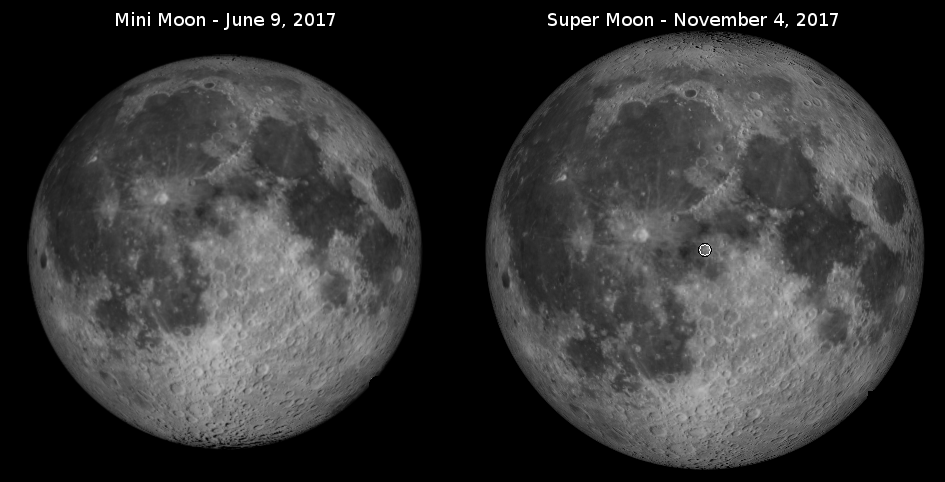
Mini Moon and Super Moon for 2017. Trouble is the Moon appears alone with nothing to compare it to when it is seen in the sky. Created using Cartes du Ciel (Sky Charts).
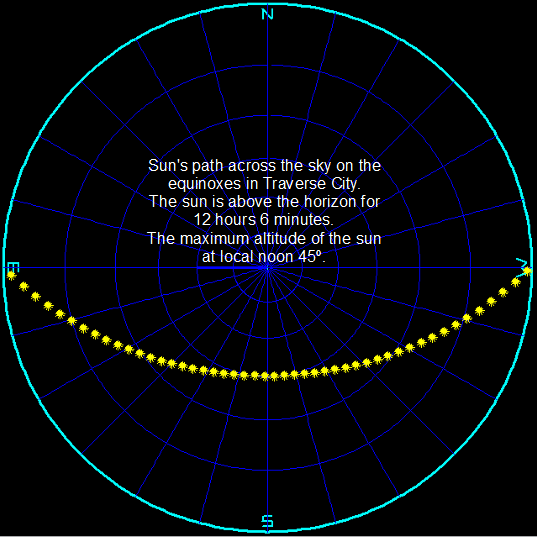
The Sun’s path through the sky on the equinox day from Traverse City, MI. Created using my LookingUp program. (This is from a couple of years ago. The actual length of daylight depends on when during the day the moment of the equinox occurs. I’ll have more on that Thursday.)
03/12/2019 – Ephemeris – Does the Moon rotate?
Ephemeris for Tuesday, March 12th. Today the Sun will be up for 11 hours and 43 minutes, setting at 7:44, and it will rise tomorrow at 7:59. The Moon, 2 days before first quarter, will set at 2:00 tomorrow morning.
Since we see only one face of the Moon throughout the month does that mean that the Moon doesn’t rotate? It doesn’t appear to rotate with respect to the Earth, but the Moon rotates through all the stars and constellations of the zodiac in a 27.32 days. That’s called a sidereal month. The lunar month we’re more familiar with is the synodic month, or lunation, that lasts 29.53 days which is the interval between new moons. It is the basis of the Jewish and Islamic calendars. The reason for the locking of the Moon’s rotation and revolution of the Earth, also called synchronous rotation, is the tidal pull of each on the other. The Earth has managed to slow the Moon’s rotation to match its revolution. The Moon is trying to do the same to the Earth with much less success, though every year or two a second is added to the time stream, UTC1 or Greenwich Mean Time, due to the slowing of the Earth’s rotation.
The times given are for the Traverse City/Interlochen area of Michigan. They may be different for your location.
Addendum
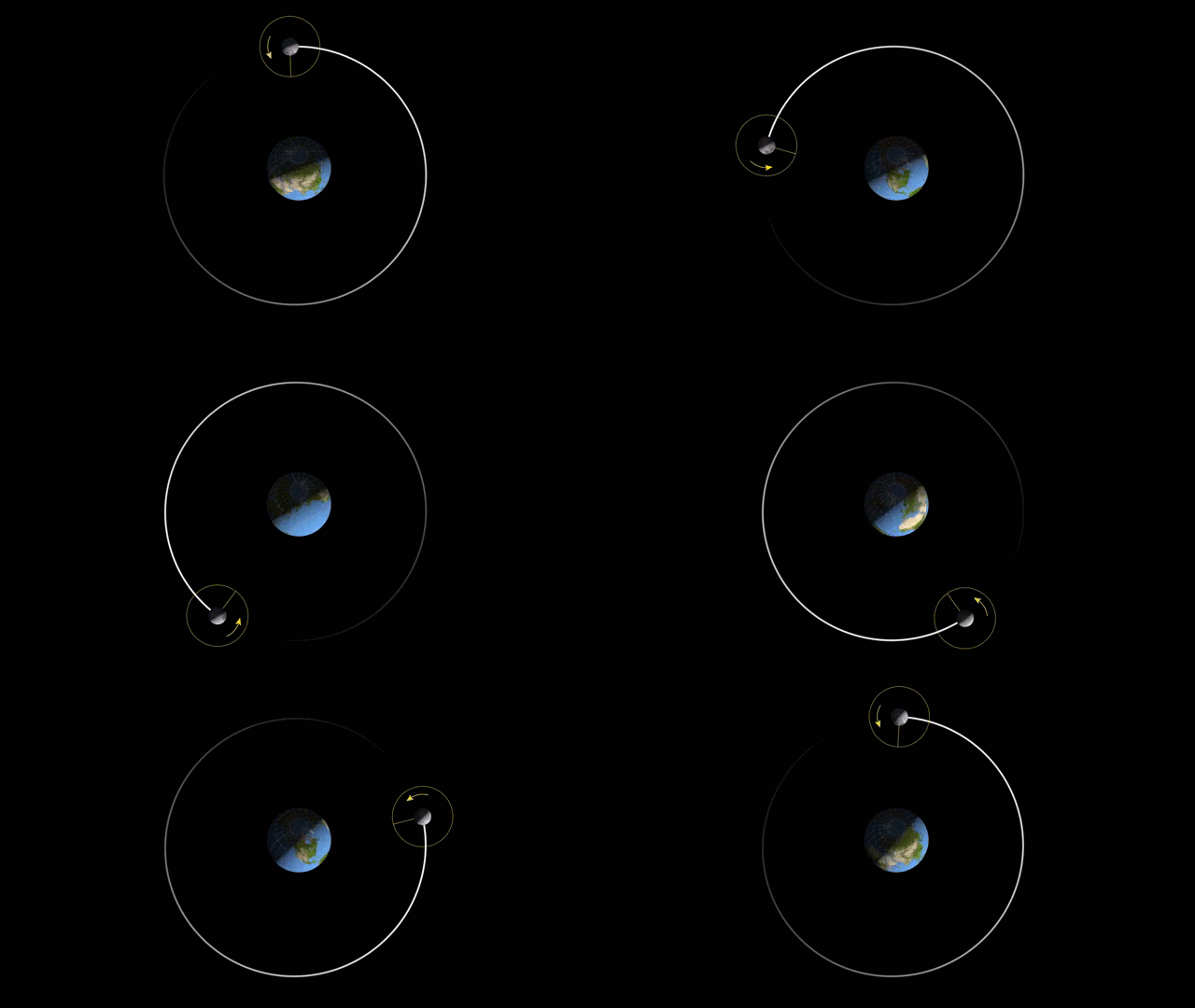
Animation of the Moon orbiting the Earth showing the Moon’s rotation. Credit: NASA’s Scientific Visualization Studio/Ernie Wright, modified and converted to GIF by Bob Moler.
NASA’s Scientific Visualization Studio web page where I got the original for the above video.
03/11/2019 – Ephemeris – The Moon: Dark side, far side, which is it?
Ephemeris for Monday, March 11th. Today the Sun will be up for 11 hours and 40 minutes, setting at 7:43, and it will rise tomorrow at 8:01. The Moon, 3 days before first quarter, will set at 12:54 tomorrow morning.
Tonight the Moon is at its crescent phase, meaning it is slightly closer to the Sun than the Earth is. Most of the Moon we see is in night. Some earth shine may be seen on its night side due to the big nearly full Earth shining on it. I get ticked sometimes when someone who knows better, especially in the media, mentions the dark side of the Moon when they should use the term far side, the part of the Moon that permanently faces away from the Earth. When the Chinese Chang’e 4 spacecraft landed on the far side of the Moon recently many headlines proclaimed that it landed on the dark side of the Moon. The Moon has a night side, as does the Earth, but that changes as the Moon rotates in the sunlight. And the Moon does rotate. It happens to be in sync with its revolution about the Earth.
The times given are for the Traverse City/Interlochen area of Michigan. They may be different for your location.
Addendum
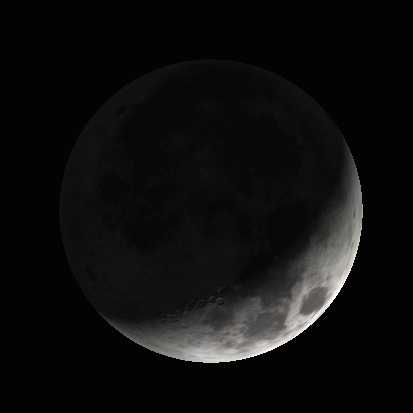
The crescent Moon tonight at 9 p.m. EDT, March 11, 2019. Created using Stellarium.
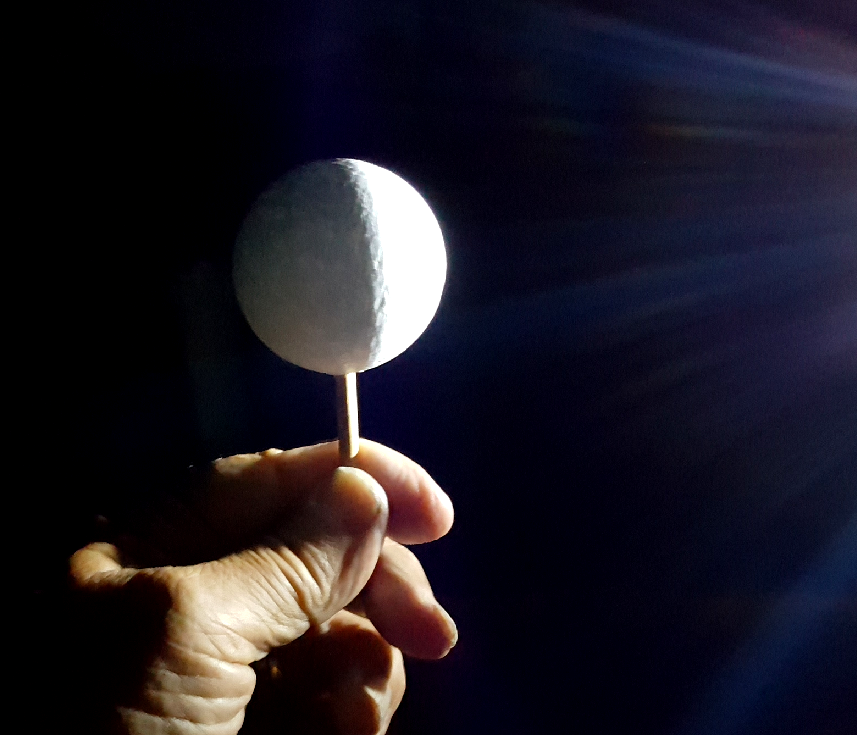
Demonstration of the Moon’s crescent phase with the Styrofoam moon ball we use for Project Astro held up to a light off frame to the right. The night side of the ball is illuminated a bit by the translucency of the ball, and the reflection off my hand. Note the roughness of the ball is visible only at the terminator.
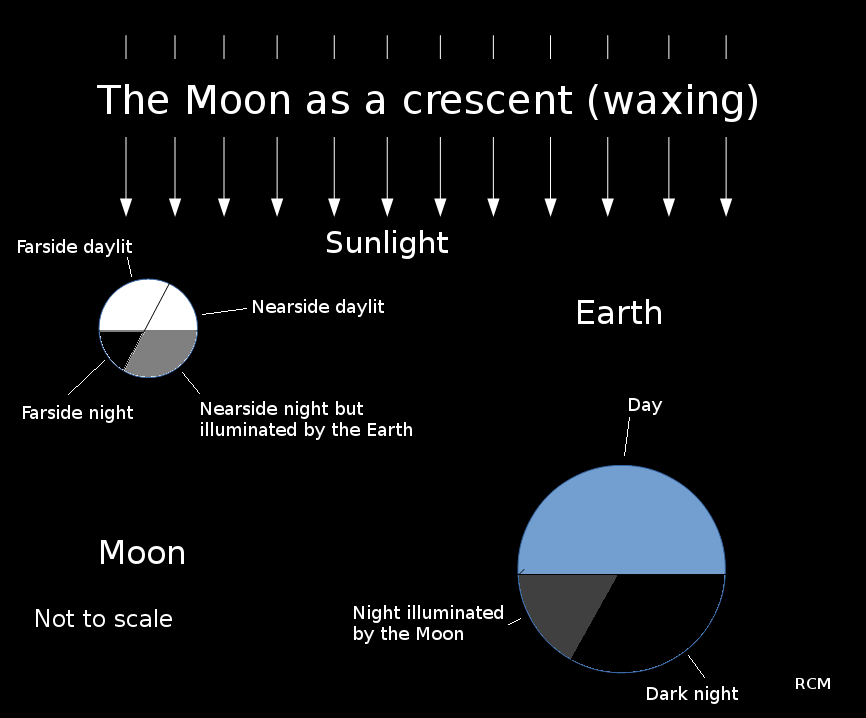
The Earth and Moon if seen as a crescent, near side, far side, sunlit side and earth shine. Credit: me.
02/18/2019 – Ephemeris – Super Moon, super math
Ephemeris for President’s Day, Monday, February 18th. Today the Sun will be up for 10 hours and 36 minutes, setting at 6:15, and it will rise tomorrow at 7:37. The Moon, 1 day before full, will set at 7:52 tomorrow morning.
Ready for some math this morning? This will be easy, because you will only have to think about it. Let’s say the Earth’s radius is 4,000 miles. That is pretty close to its actual value. OK, it is 3961 miles (6,378 km) at the equator. The Earth is nearly spherical. At 4 this morning the Moon passed perigee, its closest point to the Earth, making tomorrow’s full moon a super-moon. Let’s say it will be at today’s distance of 221,600 miles (356,800 km). That’s center to center. At moon rise or moon set the Moon is near that center to center distance, but if it moves overhead it’s 4,000 miles closer because we are on the Earth facing the Moon. Even though the Moon looks smaller than when it appears on the horizon. It’s an optical illusion that the Moon appears larger when it is rising. Super moon or not.
The times given are for the Traverse City/Interlochen area of Michigan. They may be different for your location.
Addendum
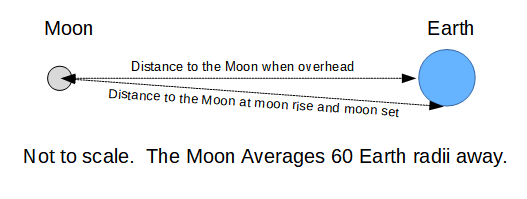
This illustrates the difference in the Moon’s distance at rising (or setting) versus when it is overhead. BTW today’s perigee puts the Moon at only 56 Earth radii from the Earth. The illustration is mine.
12/11/2018 – Ephemeris – The Chinese just launched a spacecraft to land on the far side of the Moon
Ephemeris for Tuesday, December 11th. The Sun will rise at 8:10. It’ll be up for 8 hours and 52 minutes, setting at 5:02. The Moon, half way from new to first quarter, will set at 9:06 this evening.
Last Friday the Chinese launched their Chang’e 4 spacecraft to land on the far side of the Moon in January. That side of the Moon has been mistakenly called the dark side. It actually gets more sunlight than the near, Earth facing, side. This will be an extraordinary feat. So how can they tell what’s happening on the other side? In preparation for this landing attempt the Chinese put a communications relay satellite in a halo orbit about the Earth-Moon L2 Lagrange point 38 thousand miles (61 thousand km) beyond the Moon. It is a kind of a gravitational point of equilibrium behind the Moon. One of five, and they are very useful. The satellite will lazily orbit that point, in view of the lander and the Earth for continuous communication between the Earth and the lander.
The times given are for the Traverse City/Interlochen area of Michigan. They may be different for your location.
Addendum
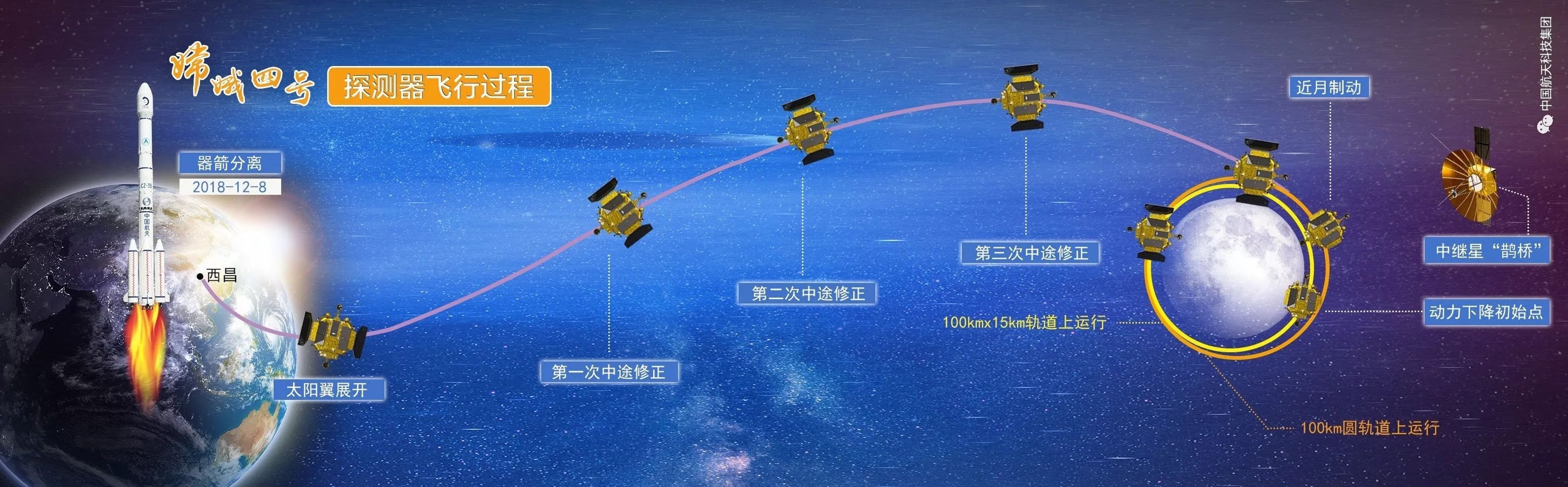
Chinese mission to land a lander and rover on the far side of the Moon. Click on the image to enlarge. It’s in Chinese except the numbers. Credit China Aerospace Science and Technology Corporation via Space.com.
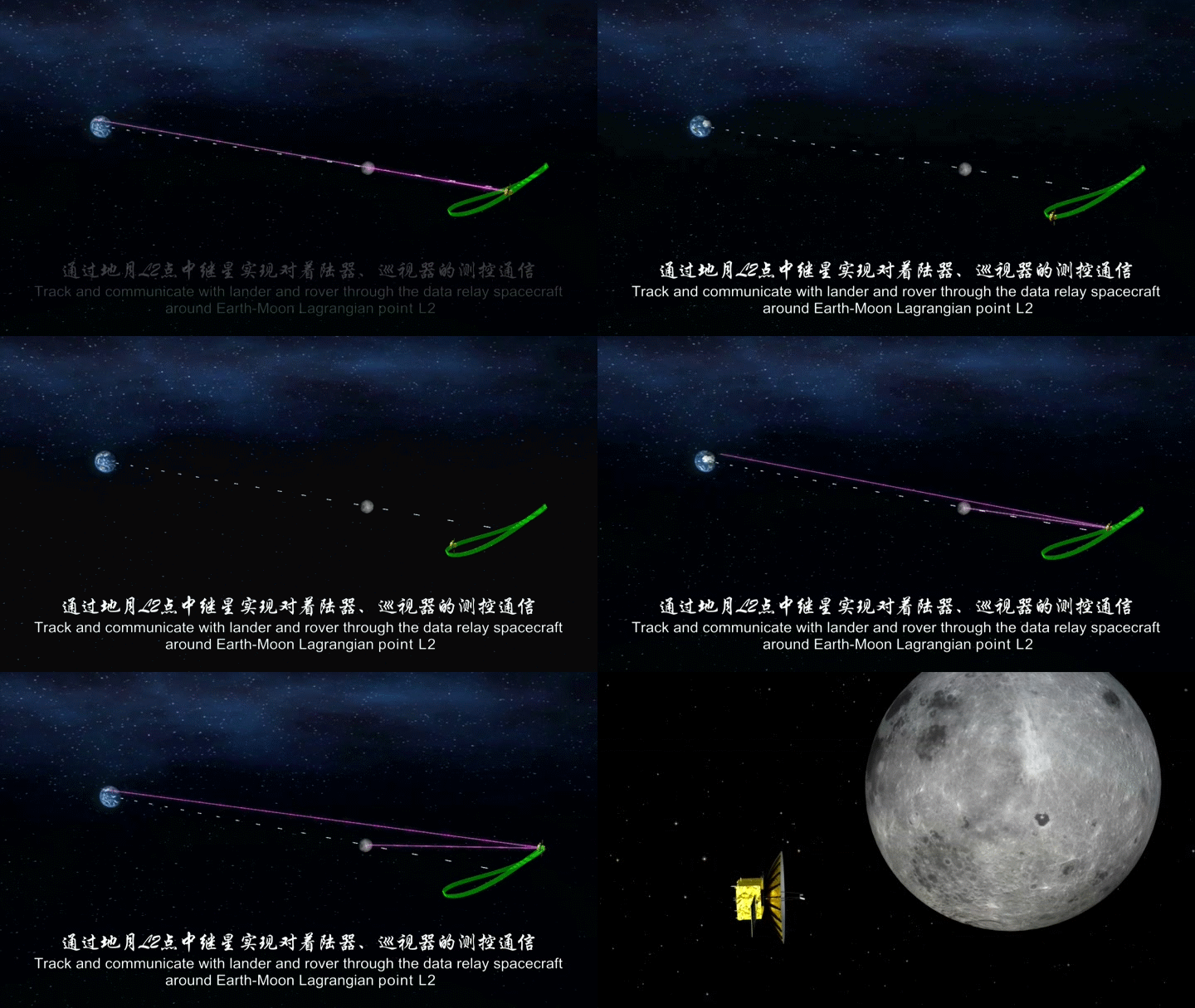
How Queuiao, the lunar communications satellite orbiting L2 performs its relay function. Click on image to enlarge. Credit CNSA via gbtimes.com.
Note: Next Monday’s program will be about Lagrangian points.
11/23/2018 – Ephemeris – The Moon and Aldebaran
Ephemeris for Friday, November 23rd. The Sun will rise at 7:50. It’ll be up for 9 hours and 17 minutes, setting at 5:07. The Moon, at full today, will rise at 5:55 this evening.
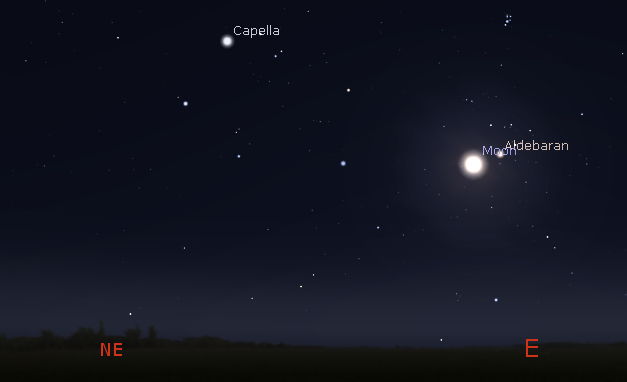
Tonight’s full Moon will be accompanied by the bright star Aldebaran, the angry red eye of the constellation Taurus the Bull. Earlier this year we had the last of nearly two years of the Moon every month passing in front of Aldebaran. The tilt of the Moon’s orbit with respect to the Earth’s own orbit of the Sun slides slowly westward with time, so The Moon won’t pass in front of Aldebaran for those of us on Earth again until 2033. This sliding of the Moon’s orbit is called regression of the nodes. A node is where the Moon’s orbital plane crosses the Earth’s. These are places eclipses of the Sun and Moon occur if lined up with the full or new moons. Why regression? The nodal points are moving westward, backward of most motions in the solar system.
The times given are for the Traverse City/Interlochen area of Michigan. They may be different for your location.
Addendum
10/12/2018 – Ephemeris – The Moon’s phases
Ephemeris for Friday, October 12th. The Sun will rise at 7:54. It’ll be up for 11 hours and 8 minutes, setting at 7:03. The Moon, halfway from new to first quarter, will set at 9:31 this evening.
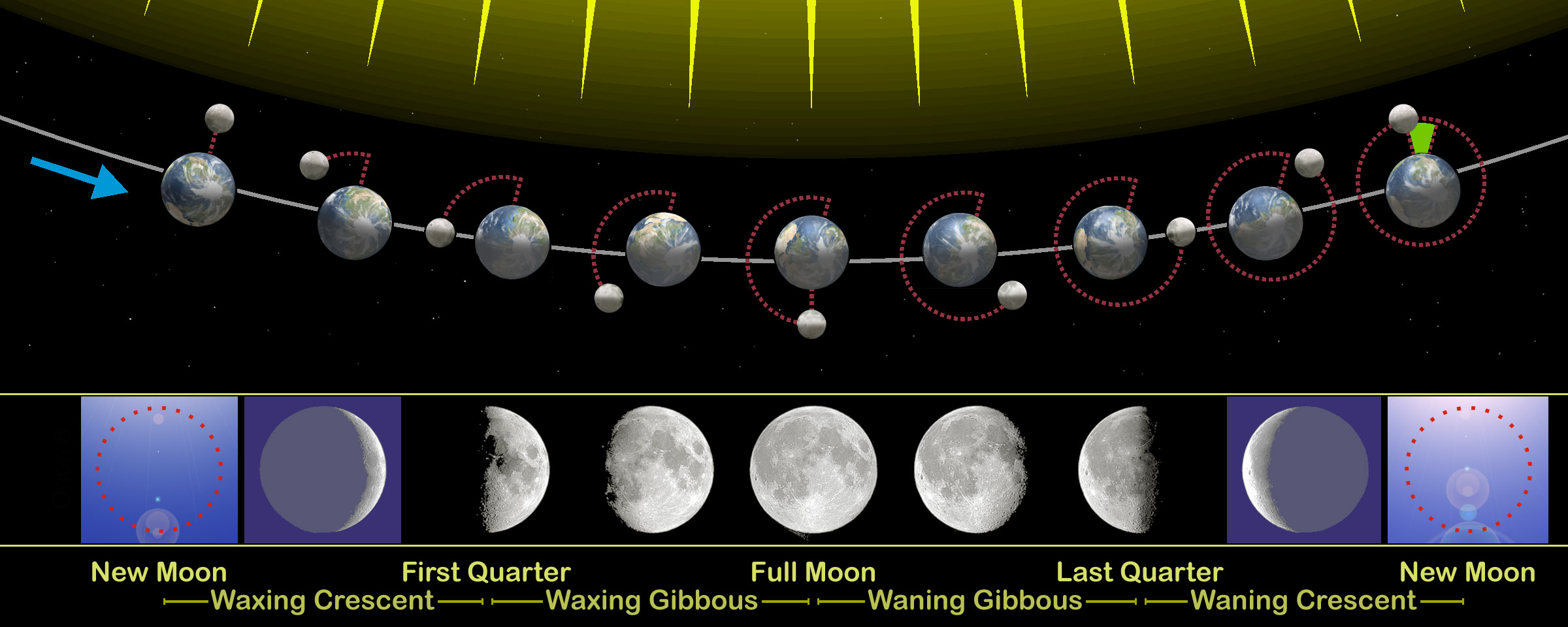
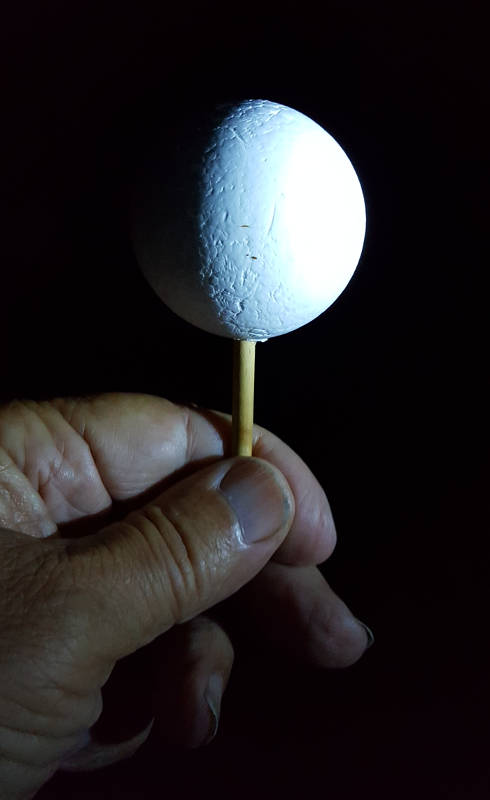
The Moon’s changing appearance over the month may seem to be mysterious at first glance. Maybe because one may think that the objects in the sky are somehow different from the familiar objects we see around us on the Earth. In ancient times, especially the Greeks thought that everything in the heavens halfway perfect and spotless. They explained the definite markings we see as the man-in-the-moon as a reflection of the Earth by a spotless Moon. The Moon’s phases are simply light and shadow on a ball in the sunlight. Sometimes, when the Moon appears in the daytime, take a small ball, like a golf ball and hold it up to the Moon, while the ball is also in sunlight, and the small ball will exhibit the same phase as the Moon.
The times given are for the Traverse City/Interlochen area of Michigan. They may be different for your location.
Addendum
09/25/2018 – Ephemeris – The harvest moon effect
Ephemeris for Tuesday, September 25th. The Sun will rise at 7:33. It’ll be up for 12 hours and 1 minute, setting at 7:34. The Moon, 1 day past full, will rise at 8:17 this evening.
The full, or nearly full moon, just rising, looks like a large orange pumpkin. The color, like the red of the sunset is caused by the scattering out of blue light by the atmosphere. It can happen at any full moon, not just the Harvest Moon, which was officially yesterday. What the Moon around the Harvest Moon does do is rise only a little later each evening. This helped the farmers in earlier times extend daylight to bring in the crops. On average the moon rises or sets 50 minutes later each night. However when the Moon is in the part of the sky where it is moving northward as well as eastward, then it rises only a little later each night. Tomorrow’s Moon will rise only 27 minutes later than it will this evening.
The times given are for the Traverse City/Interlochen area of Michigan. They may be different for your location.
Addendum
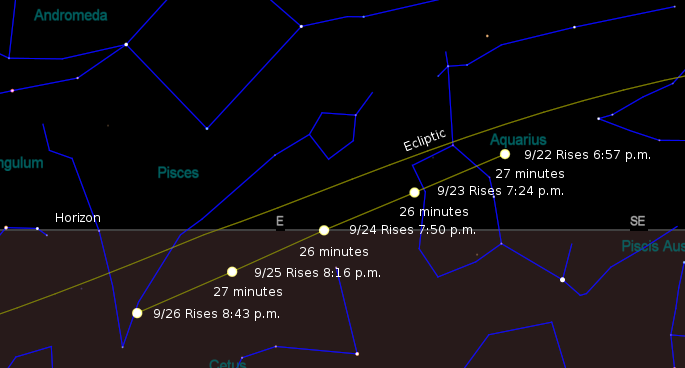
09/24/2018 – Ephemeris – The harvest moon and the Chinese Mid-Autumn Festival
Ephemeris for Monday, September 24th. The Sun will rise at 7:32. It’ll be up for 12 hours and 4 minutes, setting at 7:36. The Moon, at full today, will rise at 7:51 this evening.
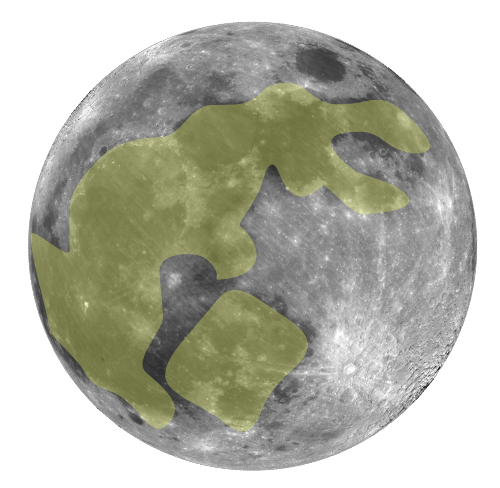
Tonight at 10:53 p.m. the Moon will be full. And since it’s only two days past the autumnal equinox, this makes it the Harvest Moon. This full moon also marks the Chinese Mid-Autumn Festival to honor the Moon and the story of Chang’e a mortal woman to took an elixir and flew off to the Moon and became a goddess. Another story revolves around the Jade Rabbit pounding Medicine. I talked about the figure of a rabbit seen on the face of the Moon last Monday. He is a companion to Chang’e, and has a mortar on the Moon with him. He pounds out the medicine that makes the inhabitants of the sky immortal. The Chinese lunar probes are named Chang’e. Chang’e 3 landed on the Moon in 2013 and sent out a lunar rover named Yutu , the Jade Rabbit.
The times given are for the Traverse City/Interlochen area of Michigan. They may be different for your location.
Addendum

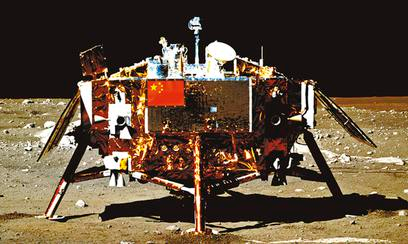
Chang’e 3 Lander on the Moon. Credit China National Space Administration 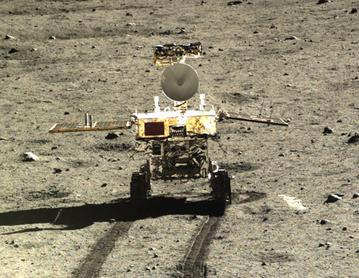
Yutu Rover on the Moon. Credit China National Space Administration.
 Bob Moler's Ephemeris Blog